What Is Forklift Training and How Does It Work in Australia
Forklift training in Australia is a regulated high-risk work licensing pathway that combines theory, supervised practical driving and a formal assessment, usually leading to an LF class High Risk Work Licence. In 2024, machinery operators and drivers accounted for 32% of all worker fatalities nationally, with a fatality rate of 6.7 deaths per 100,000 workers, more than five times the overall worker fatality rate (Safe Work Australia).
You might be standing in a warehouse on your first shift, looking at a forklift and wondering whether a quick induction is enough to let you drive it. Perhaps a supervisor has mentioned a “ticket”, or an employer has asked whether you hold an LF licence. The confusion is common because people often use “forklift training”, “forklift ticket” and “forklift licence” as though they mean exactly the same thing.
They don't. Training develops the knowledge and skills. Assessment checks whether you can apply them. The licence is issued through the relevant state or territory regulator, and workplace familiarisation prepares you for the particular truck, loads, traffic routes and hazards at your site.
Table of Contents
- What Forklift Training Really Means in Australia
- The Three Core Components of Forklift Training
- Australian Legal and Regulatory Framework
- How a Forklift Course Actually Runs From Start to Finish
- Why a Licence Alone Does Not Make You Workplace-Ready
- Safety Outcomes and Why Each Skill Matters
- Choosing the Right Forklift Licence Class
- Career Pathways, Earnings, and Next Steps
What Forklift Training Really Means in Australia
A new operator may begin with a simple assumption: learn the controls, drive around the yard and start moving pallets. That approach misses the legal purpose of forklift training. In Australia, operating a forklift is high-risk work, so a person operating a forklift truck must hold the relevant High Risk Work Licence, commonly the LF class.
The system is designed to produce an operator whose competence has been assessed, not someone who has merely attended an induction. Training covers practical decisions that affect safety, including load handling, stability, operating controls, pedestrian interaction, workplace hazards and pre-start checks. The operator must show that they can perform the task safely under the approved assessment process.
A licence is only the first layer
The national licence gives an operator an assessed foundation. It doesn't automatically mean the person is ready to drive every forklift, use every attachment or work safely in every warehouse. A reach truck in a narrow aisle, a counterbalanced forklift at a loading dock and a machine carrying an unusual load can present different operating problems.
That distinction matters to both workers and employers. The national framework establishes a baseline for competency, while state and territory regulators administer the licensing process where the application is made. Safe Work Australia provides national guidance, and a regulator such as SafeWork NSW manages local administration.
Practical rule: Treat the licence as permission to perform a high-risk task at the required competency standard, not as a substitute for learning the workplace.
Forklift training is relevant to new warehouse workers, experienced operators changing equipment, construction workers moving materials and employers checking whether a candidate is properly authorised. The broader context of vocational training in Australia is useful here because formal training is intended to connect demonstrated skills with real workplace requirements.
The pages ahead explain the three parts of training, the legal pathway, what happens during a course, why site familiarisation matters, how the skills reduce risk and how LF and LO licences relate to different work.
The Three Core Components of Forklift Training
A useful way to understand forklift training is to compare it with learning to drive a car. You wouldn't expect a learner to drive safely after only reading a manual, but you also wouldn't want them practising without understanding signs, braking distance or road hazards. Forklift training works in the same way, with the added risks of raised loads, limited visibility and workplace pedestrian movement.
Knowledge before movement
The first component is underpinning knowledge. Learners study the forklift's controls, operating limits, load capacity, load centres, stability, pre-start checks, hazards and traffic controls. They also need to understand how surfaces, ramps, racking, pedestrians and other vehicles affect the task.
Theory prevents a common error: assuming that a forklift behaves like a car. A forklift's steering response, rear-wheel steering, mast movement and load position all influence how it travels. An operator who understands those principles is better prepared to stop when a load blocks visibility or a route becomes unsafe.
Supervised practical operation
The second component is hands-on practice. Under the direction of an appropriately qualified trainer, learners practise controlled travel, steering, load engagement, lifting, lowering, reversing and parking. They learn to keep the machine stable and to position the forks and load deliberately rather than relying on speed or instinct.
Practical training should include the habits that continue after assessment, such as checking the machine before use, selecting a safe travel direction and communicating with people nearby. People exploring employment options can also browse certified forklift operator roles to see how assessed skills connect with warehouse and logistics work.
Formal assessment
The third component is a formal competency assessment. This is not just confirmation that a student attended. The learner must demonstrate the required knowledge and operating ability through the nationally approved process.
The Tlilic0003 License To Operate A Forklift Truck Safework Nsw Approved course is one example of practical, nationally recognised training with experienced trainers and hands-on learning across NSW.
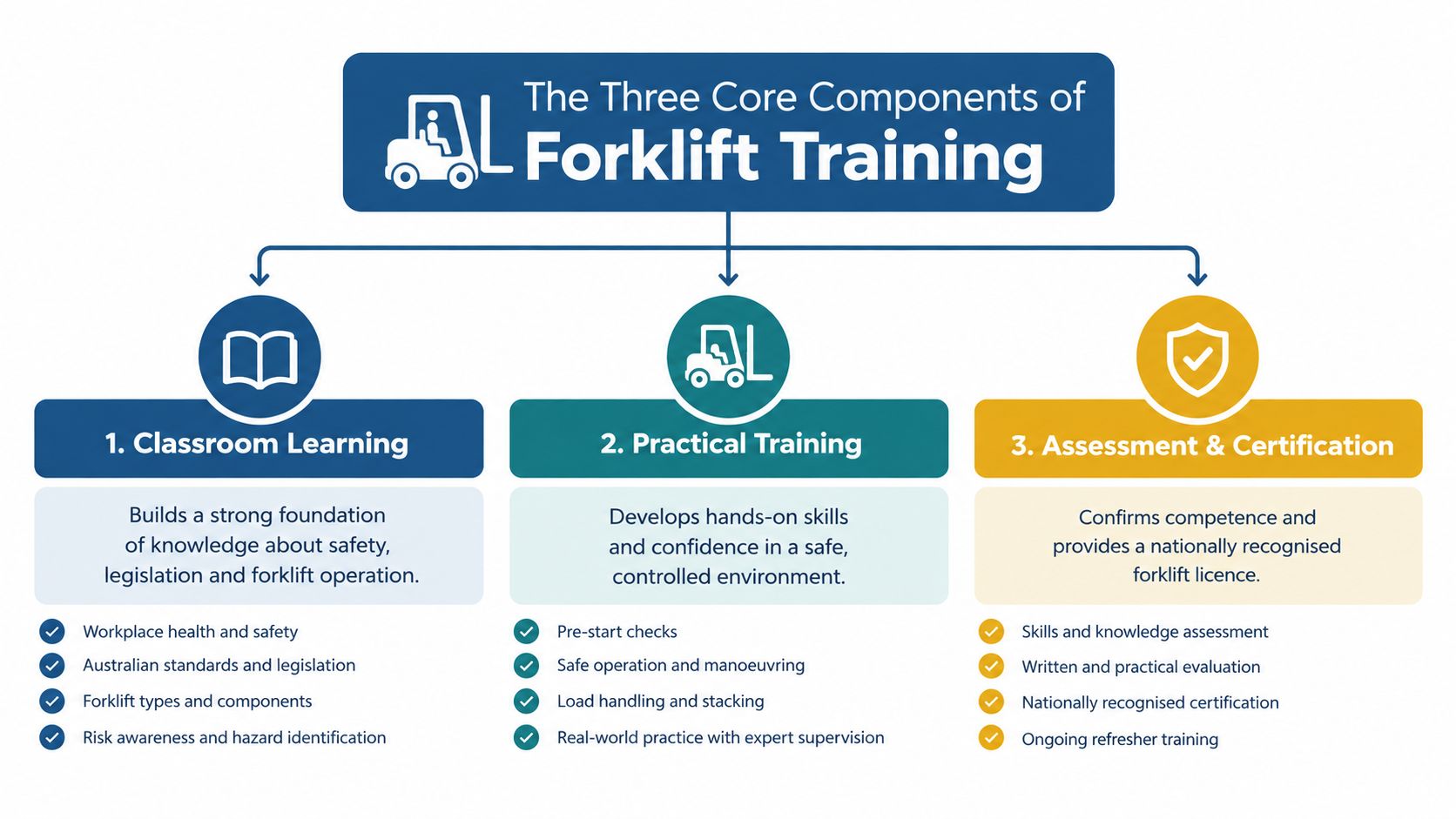
If any component is missing, the pathway is incomplete. Theory without practice leaves the learner untested at the controls. Practice without knowledge can create unsafe habits. Attendance without assessment doesn't establish the competence required for the licence.
Australian Legal and Regulatory Framework
A person can pass a forklift assessment and still need permission to operate a particular truck at a workplace. Australian requirements address both the nationally recognised licence and the employer's duties for the site, equipment and task.
LF and LO are not interchangeable
For standard forklift trucks, the usual licence class is LF. In NSW, LF covers counterbalanced, reach and side-loading forklifts. An LO licence covers order-picking forklifts, which have a different design and operating method.
The machine matters because its controls, movement and load-handling risks differ. A forklift combines powered travel with an elevating load carriage and fork arms or another attachment. That creates risks involving overturns, dropped loads, collisions and pedestrians. The national high-risk work licensing standard sets the basis for structured learning, practical experience and formal assessment.
An appropriately authorised Registered Training Organisation must deliver or supervise the training and assessment. A completed training unit does not, by itself, place a licence in the operator's hands. The learner completes the required assessment, then applies to the regulator responsible for the state or territory.
National standard, local administration
Safe Work Australia supports the national framework, while state and territory authorities handle applications. In NSW, SafeWork NSW manages the local process. For more on how high-risk work licences work in NSW, see our guide to high-risk work licences in NSW.
After a successful assessment, the applicant generally needs to apply to the regulator within 60 days, as outlined in Safe Work Australia's guidance on high-risk work licences. A High Risk Work Licence is generally valid across Australia for five years, subject to the applicable administrative requirements.
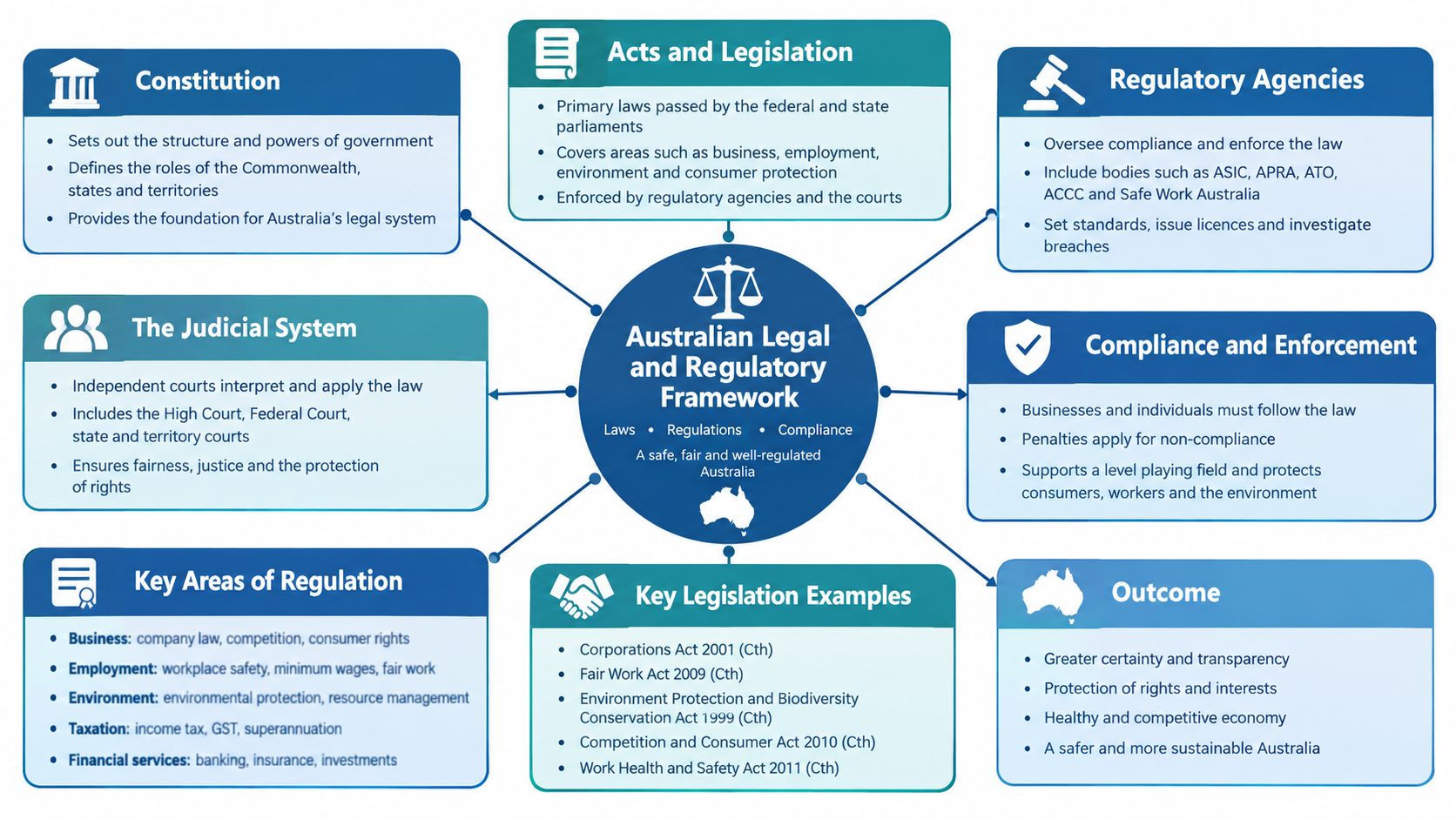
The licence confirms assessed national competence. It does not familiarise an operator with every truck, attachment, load or workplace. Before independent work begins, the employer must provide information, instruction, training and supervision for local conditions.
How a Forklift Course Actually Runs From Start to Finish
A legitimate course follows a sequence rather than putting a new learner straight onto a machine. The trainer builds understanding first, observes controlled practice and then assesses whether the learner can complete the required tasks safely.
Before the practical session
Enrolment normally involves confirming the learner's identity, course requirements and training arrangements. The learner may receive pre-course information covering forklift components, safety rules, load handling and the assessment process. A Unique Student Identifier is also relevant for vocational education records, and learners can use this guide to create and manage a Unique Student Identifier.
The class may include other trainees, an RTO trainer and, during workplace training, a licensed and experienced supervisor. A person undertaking forklift training can operate the machine only when enrolled with an RTO and directly supervised by someone who holds the appropriate licence and has suitable workplace experience.
From explanation to controlled operation
The trainer introduces the forklift, its controls, capacity information and pre-start process. Learners then practise basic movements before progressing to tasks such as approaching a load, engaging the forks, lifting, travelling, reversing, lowering and parking.
A trainee must remain under close supervision. Queensland guidance states that an unqualified trainee must remain within the supervisor's sight and hearing range, and workplace training must be documented in a written logbook recording practical training (WorkSafe Queensland).
Assessment and documentation
The final stage is the competency assessment. The assessor checks knowledge and observed performance against the required standard. Passing doesn't mean the physical licence card appears immediately in the learner's hand. The RTO provides a statement of attainment or equivalent documentation, and the successful applicant generally applies to the state or territory regulator within the required timeframe.
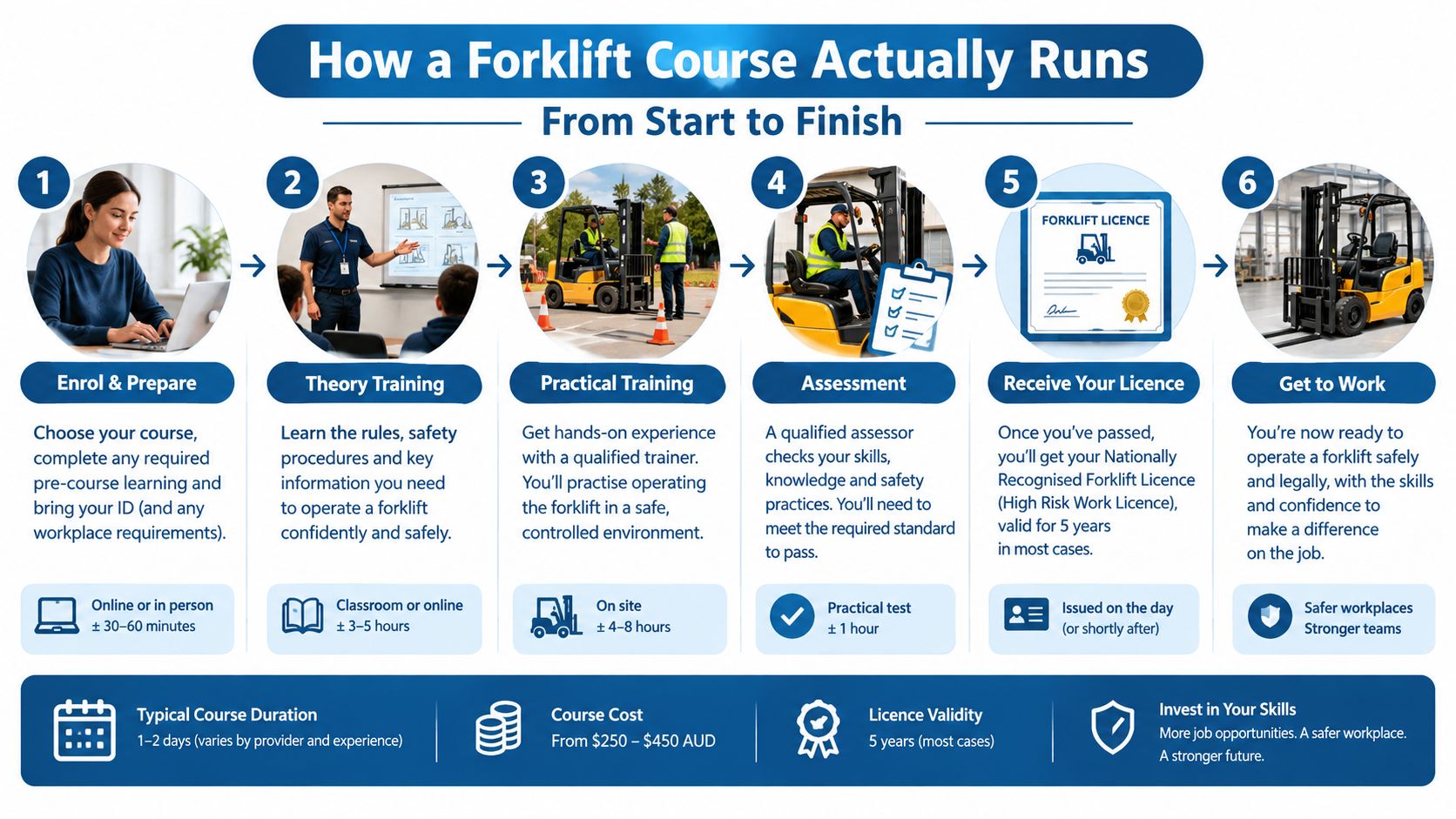
The practical lesson is simple: supervised driving is part of the pathway, not a replacement for it. A person who has practised on a forklift but hasn't completed the formal assessment and regulator application hasn't completed the licensing process.
Why a Licence Alone Does Not Make You Workplace-Ready
An LF licence proves that an operator has met the relevant high-risk-work competency standard. It doesn't prove that the operator understands every workplace where a forklift might be used.
A change in truck, attachment, load geometry or environment can alter stability, visibility, braking distance and the centre of gravity. A person who handled pallets on a level warehouse floor may need further instruction before carrying long materials on a ramp, working beside a loading dock or using an attachment that changes the machine's capacity.
What the employer must add
Safe Work Australia's forklift guidance says the person conducting a business or undertaking must ensure operators are trained for the specific industrial lift truck and attachments they use. The operator must also receive instruction about the hazards, risks and control measures relevant to that workplace (Safe Work Australia forklift information sheet).
That usually means an employer should:
- Verify the licence class: Confirm that the operator holds the class relevant to the machine.
- Explain the site: Cover traffic routes, dock edges, ramps, floor capacity, charging or refuelling areas and pedestrian exclusion zones.
- Familiarise the operator: Demonstrate the particular truck, controls, attachments, load types and manufacturer limits.
- Supervise the transition: Observe the operator until they can apply the local procedure consistently.
- Reassess after change: Review competence when equipment, attachments, work areas or operating conditions change.
A licence answers, “Have you demonstrated the national competency?” Site familiarisation answers, “Can you apply it safely here?”
What a new operator should expect
A responsible employer won't treat an LF licence as a reason to skip induction. You may be asked to walk the traffic route, identify blind corners, practise with the actual attachment or explain what you would do if a defect appeared during a pre-start check.
That isn't unnecessary repetition. It's the practical step that connects assessed competence with workplace authorisation. Guidance on workplace safety training can help employers and workers think about that wider responsibility rather than focusing only on the licence card.
Safety Outcomes and Why Each Skill Matters
Forklift training exists to control specific failure modes, not to create confident-looking drivers. Australian injury data shows why the focus extends beyond steering and acceleration. Between 2006–07 and 2013–14, approximately 617,755 hospitalised cases funded by workers' compensation were recorded, with fractures at 28%, soft-tissue injuries at 22% and open wounds at 16% (Australian Institute of Health and Welfare).
The same source records the wrist and hand as the most frequently injured body parts, representing 36% of cases, followed by the knee and lower leg at 14%. The data isn't forklift-specific, but it describes injury patterns that forklift controls are designed to reduce.
Turning principles into actions
Consider a loaded forklift approaching a turning ramp. If the load is high, poorly positioned or beyond the machine's capacity, the operator's decisions about speed, direction and load height become safety controls. Stability training gives the operator a reason to stop and reassess rather than treating the route as ordinary travel.
A pedestrian at a blind corner creates a different failure mode. Traffic management, horn use, visual checks, exclusion zones and communication reduce the chance that the operator and pedestrian enter the same space without warning.
Training also gives practical meaning to:
- Pre-start checks: Identify defects before the machine enters service.
- Load capacity: Keep the load within the truck's rated limits and account for load position.
- Stability principles: Understand how height, turning and uneven surfaces affect the machine.
- Pedestrian separation: Use routes and exclusion controls that keep people away from moving plant.
- Charging and refuelling: Follow the site's controls for energy sources and designated areas.
- Defect reporting: Remove unsafe equipment from use and tell the responsible person.
For readers responsible for equipment upkeep, this wider view of logistics equipment complements operator training. Safe operation depends on both human decisions and equipment that is inspected, maintained and managed properly.
Choosing the Right Forklift Licence Class
The right class depends on the machine you expect to operate, not only on the job title. An employer may advertise for a forklift operator but still use equipment that requires a particular class or additional familiarisation.
| Licence Class | Equipment Covered | Typical Settings |
|---|---|---|
| LF | Counterbalanced, reach and side-loading forklift trucks | Warehouses, distribution centres, construction and industrial workplaces |
| LO | Order-picking forklifts | Warehouses and storage environments where the operator works with an order-picking configuration |
The LF class is the common pathway for standard forklift trucks. It suits many pallet-handling tasks, including work involving counterbalanced and reach equipment. The LO class is separate because an order-picking forklift presents a different operating arrangement and task profile.
Attachments don't automatically turn one licence class into another, but they can change the machine's capacity, visibility and stability. The employer still needs to provide equipment-specific instruction and confirm that the operator can use the attachment safely.
Equipment outside the forklift classes
Telescopic handlers, elevating work platforms and other powered equipment may require different training units or licensing arrangements. A telescopic material handler is not just another name for a standard forklift, even though both may move materials.
If the intended job involves a telescopic machine, review the relevant telescopic materials handler training before enrolling in an LF course. Asking the employer which machine you'll operate is a practical way to avoid choosing training that doesn't match the work.
The safest decision process is straightforward:
- Identify the exact machine and attachment.
- Ask which licence class or unit the employer requires.
- Confirm whether the role includes order-picking, reach work, counterbalanced work or another machine type.
- Plan site familiarisation after the formal training.
Career Pathways, Earnings, and Next Steps
A forklift licence can support work in warehousing, logistics, manufacturing, construction, civil works and traffic-management support. It can also sit alongside other high-risk work or workplace qualifications, such as EWP, dogging or traffic control, when those skills match the employer's operations.
An LF or LO licence isn't a guarantee of a particular wage. Employers also consider experience, shift patterns, equipment type, reliability, site knowledge and the ability to work safely around people and production demands. The nationally recognised licence provides a foundation, while consistent site experience helps an operator take on more responsibility over time.
Career changers can use resources such as the Eztrackr 2026 career transition guide to organise applications, identify transferable skills and plan their next qualification.
Common questions from new operators
How long does the course take?
The duration depends on the provider, learner needs and training arrangement. Ask the RTO how the theory, practical training and assessment are scheduled rather than assuming that a short session equals a completed licence.
What documents are needed?
You generally need to meet the RTO's enrolment and identification requirements, complete the training and assessment, receive the relevant outcome documentation, then apply to the state or territory regulator.
How often should refresher training happen?
There isn't one universal interval that replaces judgement. Employers should provide further instruction or reassessment when unsafe operation occurs, an incident happens, equipment changes or the operator's competence needs checking. Refresher support can also be appropriate when a person has not operated for a significant period.
What happens after the licence is issued?
Give the licence details to the employer, complete the site's induction and learn the specific truck, attachment, load limits, traffic routes and emergency procedures. Don't start independent operation until the employer has authorised you for that workplace.
TP Training delivers practical, nationally recognised forklift training with hands-on learning and experienced trainers across NSW. If you're preparing for an LF pathway or building skills for warehouse, logistics, construction or civil work, visit TP Training to review the relevant course options and take the next step.

You may also like
Asbestos Removal Requirements in NSW: The Complete Guide
What to Do if You Find Asbestos on Site