
Workplace Safety Training: A 2026 Guide for Australia
Have you completed a workplace safety training course, yet still felt unsure when asked to perform the task alone on site? A certificate can show that you attended and passed an assessment, but it doesn't automatically prove that you can recognise a changing hazard, choose the right control, or work safely when time and production pressure build.
Effective training connects knowledge, supervised practice, competency verification and ongoing observation. It helps a new construction worker understand why a control matters, gives an experienced operator a chance to correct unsafe habits, and gives employers a practical way to confirm that workers can apply procedures in the workplace.
Table of Contents
- Why Workplace Safety Training Matters in Australia
- Understanding the Legal Obligations and Risks
- Common Course Types and Mandatory Requirements
- Moving Beyond Theory to Practical Competence
- Choosing Between Online and Face-to-Face Delivery
- How to Select the Right Training Provider
- Starting Your Safety Training Journey Today
Why Workplace Safety Training Matters in Australia
Your next project may begin with a site induction, a toolbox talk and a set of drawings. Before you pick up a hammer, enter a traffic zone or start a machine, you need to know what can hurt you, which controls are in place and what you must do when conditions change. That knowledge doesn't come from PPE alone. It comes from training that connects hazards to decisions.
Australian workers have consistently identified training courses as a primary source of workplace health and safety knowledge. Safe Work Australia found that 39% of workers identified training courses as their most common source of safety information, compared with 29% for media sources, in its nationwide 2014 survey of 2,350 business owners and senior managers, including 706 sole traders. Training courses had remained the most common way workers learned about safety since at least the mid-1990s, according to Safe Work Australia's survey of WHS information sources.
Training should change what you do
A useful course doesn't just name a hazard. It shows you how to respond. For example, a civil worker should be able to identify where plant, pedestrians and delivery vehicles might interact, then follow the site controls rather than relying on instinct. A worker handling silica-containing materials needs to understand dust-generating methods, controls, monitoring and health protection, not just where to find a respirator.
That makes training a career asset, not an administrative hurdle. Employers need people who can explain a safe method, ask sensible questions and stop when the work no longer matches the original plan. Practical guidance such as these workplace safety tips for Australian workers can reinforce that thinking between formal courses and daily tasks.
Practical rule: Learn the reason behind a control. You'll be more likely to apply it correctly when the worksite doesn't look exactly like the classroom example.
Understanding the Legal Obligations and Risks
Australian workplace safety duties exist because workers face consequences that extend well beyond an inspection or a completed form. A PCBU must manage risks so far as is reasonably practicable, while workers need the information, instruction, training and supervision required to work safely. The exact duties depend on the workplace, task, equipment and jurisdiction, so employers and workers should use current regulator guidance for the state or territory where the work occurs.
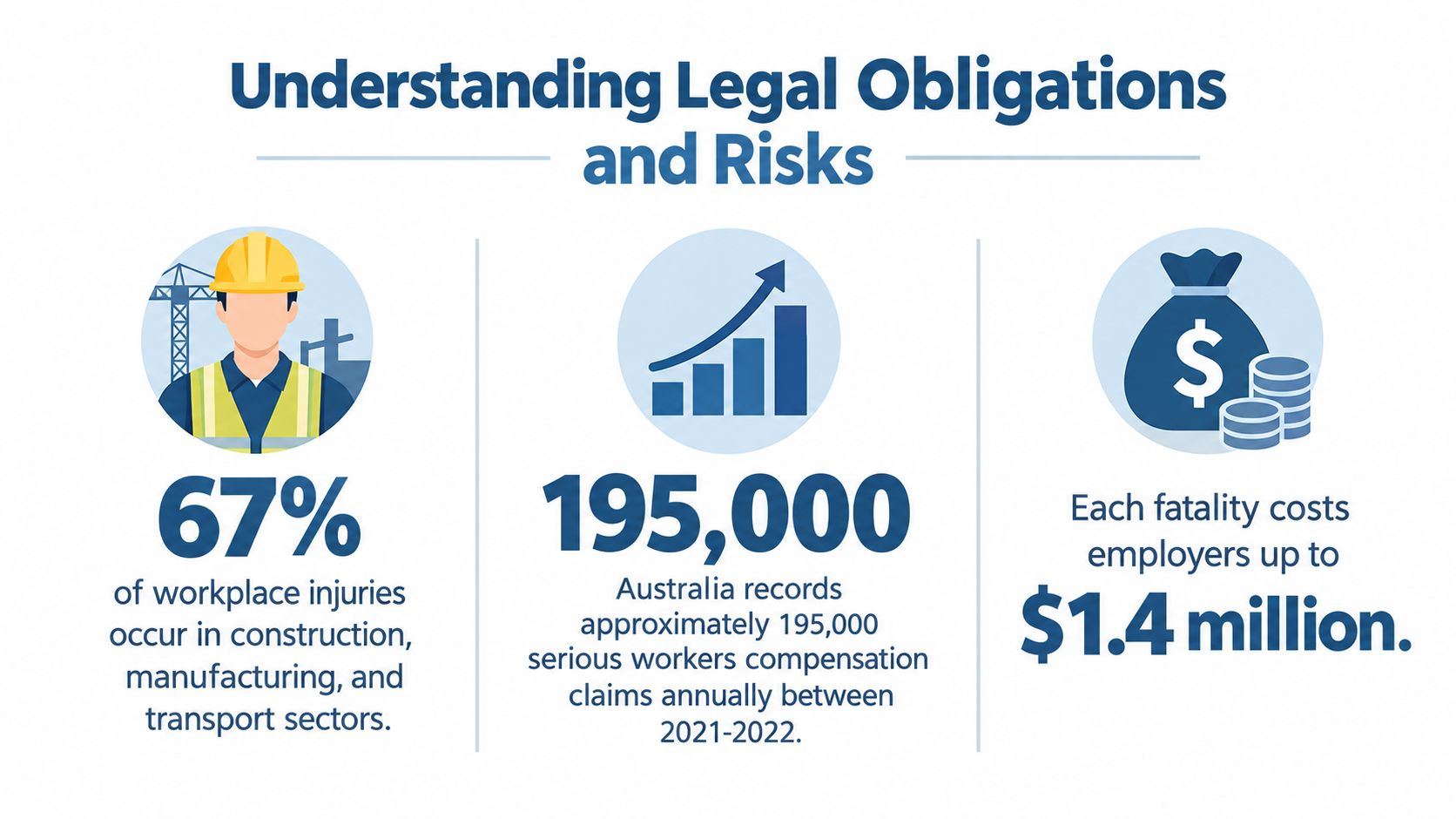
The national figures show why construction, transport and warehousing require disciplined systems. Safe Work Australia recorded 195 worker fatalities from traumatic injuries during work-related activity in 2022. The average fatality rate was 1.4 deaths per 100,000 workers over the 2018–2022 period. Construction accounted for 27 fatalities, or 14% of the national total, while transport, postal and warehousing accounted for 67 fatalities, or 34%, as reported in Key Work Health and Safety Statistics Australia 2023.
Risk continues beyond fatal incidents
In 2021–22, 497,300 of the 14.1 million Australians who had worked in the previous 12 months experienced a work-related injury or illness, representing 3.5% of the working population. Construction recorded 15,600 serious workers' compensation claims, with a serious-claims frequency rate of 9.8 claims per million hours worked, according to the same Safe Work Australia statistics.
The leading injury mechanisms included body stressing, falls, slips and trips, and being hit by moving objects. Vehicle incidents and moving-object incidents also continued to account for many fatalities. These are familiar hazards, but familiarity can make them easier to underestimate. A reversing vehicle, unstable load or poorly controlled edge can become dangerous before a worker has time to react.
Employers also need to understand state-specific workers' compensation and compliance requirements. For an initial comparison of obligations, you can find state-by-state compliance help from Benely, then confirm current requirements with the relevant regulator and insurer.
Good workplace safety training supports these duties by preparing people to recognise hazards, follow controls and report changes. It doesn't replace risk assessment, safe equipment, consultation or supervision. It gives workers the practical understanding needed to use those systems properly, while employer responsibilities in workplace safety remain active after the course ends.
Common Course Types and Mandatory Requirements
The right course depends on your role, the worksite and the hazards you control. A person entering a construction site needs a different pathway from someone operating a forklift, directing traffic or responding to a medical emergency. Start by identifying the task, then check the current state or territory requirement and the employer's site rules.
Begin with the foundation
The White Card is the usual starting point for people carrying out construction work in Australia. It introduces core construction safety concepts, including common hazards, worker and employer duties, consultation, incident response and the importance of following site controls. It isn't a substitute for a site-specific induction. Each project still has its own layout, interfaces, emergency arrangements and changing risks.
A worker in traffic management may need a Traffic Controller course, commonly associated with the Blue Card in NSW, while someone implementing traffic arrangements may need the relevant Traffic Management Implementer training, commonly associated with the Yellow Card. The job description matters. Directing vehicles and implementing a traffic plan aren't interchangeable tasks.
Add task-specific qualifications
Specialised training should match the equipment or environment:
- High-risk work licences: Dogging, rigging, crane operation, forklift operation and certain boom-type elevating work platforms require the relevant licence or authorisation. A worker must use the equipment only within the scope of their qualification and site permission.
- Plant and civil construction: Excavator, roller, loader, skid steer, backhoe and articulated haul truck courses develop operating skills for particular machines. The operator still needs site familiarisation, pre-start checks and supervision while adapting to local conditions.
- Hazard-focused courses: Confined spaces, asbestos awareness, working at heights and crystalline silica exposure prevention address hazards that need more than general induction knowledge.
- First aid and CPR: First aid training prepares designated workers to respond to injuries and illness, while CPR training focuses on a critical emergency skill. Employers should also consider access, response times, equipment and the workplace risk profile.
Food, alcohol and hospitality roles have their own requirements. A Food Safety Supervisor may need role-specific training, while RSA and RCG courses apply to particular licensed venues and duties. The useful overview of CPR, first aid, White Card and workplace safety certifications can help you compare common pathways before you enrol.
A qualification answers one question, whether you completed the required learning and assessment. Your employer must still confirm that you can perform the work safely in the actual workplace.
Moving Beyond Theory to Practical Competence
A completed course isn't the same as job readiness. It may confirm that you understood the learning material or demonstrated a skill in a controlled assessment, but a real site adds noise, weather, changing access, unfamiliar equipment and pressure to keep moving.
Historical Australian evidence illustrates why attendance alone isn't enough. In the ABS 2009–10 Work-related Injuries Survey, 640,700 employed people reported at least one work-related injury or illness, equivalent to 53 injuries per 1,000 employed people. Among those injured workers, 82% had received formal occupational health and safety training in their job before the injury, compared with 58% in 2005–06, according to the Australian Bureau of Statistics survey summary.
The missing link is verification
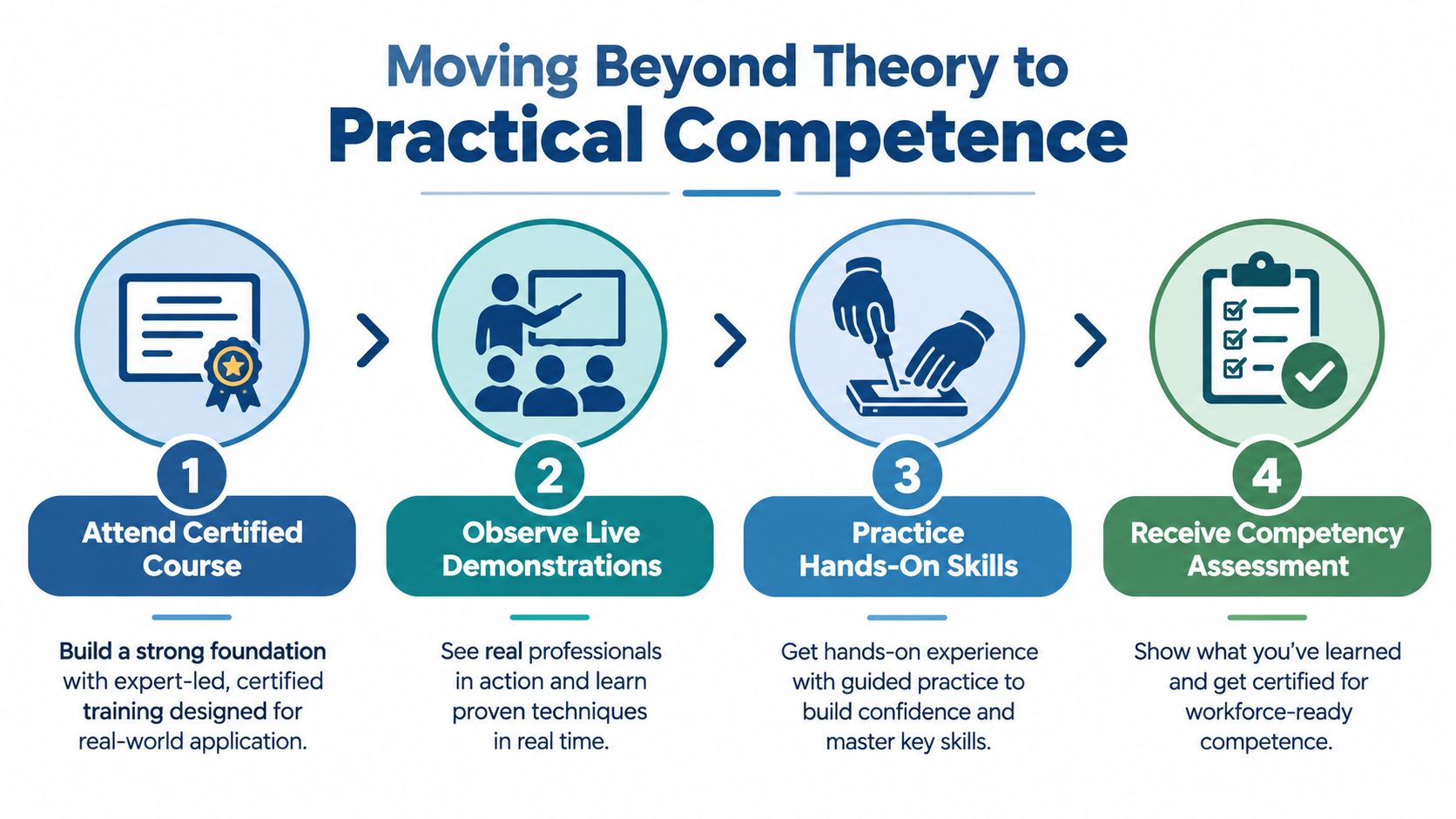
The figures are historical, and they don't prove that training caused an injury. They do show why a course record can't be treated as proof that every control is being applied reliably. Employers should connect learning to the task through a deliberate follow-up process:
- Explain the method. The worker describes the hazard, the control and the limits of the procedure.
- Demonstrate the task. A competent supervisor shows the correct method using the relevant equipment and conditions.
- Practise under observation. The worker performs the task while the supervisor watches decisions, sequencing and communication.
- Record the outcome. The supervisor documents competence, identifies gaps and sets a clear trigger for reassessment.
This applies to forklift movements, traffic setups, fall protection, manual handling, emergency response and plant operation. If the site changes, the equipment changes or an incident exposes a weakness, the employer may need targeted coaching or reassessment rather than telling the worker to repeat the original course.
A structured system can help employers manage completion records, expiries and evidence of follow-up. For example, Wistec training record solutions can support record management, but the record should reflect more than attendance. It should connect the worker, task, assessment and observed outcome.
A certificate starts the conversation. Supervision shows whether the conversation has become safe action.
Practical advice on on-site safety and workplace behaviour is most valuable when a supervisor turns it into observation, feedback and consistent site expectations.
Choosing Between Online and Face-to-Face Delivery
Online learning works well for knowledge that can be read, watched, discussed and checked digitally. It can introduce legal duties, hazard recognition, basic procedures and pre-course theory without requiring every worker to travel to a classroom for the same presentation.
Australian participation data shows that online delivery is substantial but not universal. 49% of Australians who undertook work-related training in 2024–25 completed their most recent training online or virtually, down from 55% in 2020–21, according to the Australian Bureau of Statistics work-related training release.
Match the method to the risk
| Learning need | Suitable delivery | What still needs checking |
|---|---|---|
| Hazard recognition and legal duties | Online or classroom theory | Whether the worker can apply the information to the site |
| Pre-start principles and safe work procedures | Blended learning | Whether the worker follows the sequence with the actual equipment |
| Forklift, EWP or civil plant operation | Supervised practical assessment | Controls, communication, manoeuvring and site-specific limits |
| Traffic control | Theory plus realistic practical scenarios | Placement, visibility, communication and changing traffic conditions |
| First aid and CPR | Theory may be online, practical assessment is essential | Physical technique, response sequence and feedback |
Online modules should prepare workers for the practical session, not replace it where competence depends on movement, judgement or equipment use. First aid, emergency response, traffic control and high-risk work need realistic practice and direct feedback.
A well-designed blended program uses digital learning to reduce repetition, then uses face-to-face time for demonstrations, troubleshooting and assessment. Before enrolling, ask how the provider verifies practical competence and how your employer will confirm readiness on the particular site. Guidance on working at heights training online is useful for understanding where digital theory can fit, but height-related equipment and procedures still require appropriate practical control.
How to Select the Right Training Provider
Choosing a provider isn't just about finding the nearest course date. You need a training environment that reflects the work you intend to do and an assessment process that gives you a fair chance to practise safely.
Check the course against the task
Read the course outline and confirm the qualification, licence or statement of attainment you need. Ask whether the course is nationally recognised where that matters, whether the assessment matches the equipment and whether the provider understands the requirements applying in your state or territory.
A useful provider should be able to answer practical questions clearly:
- Trainer capability: Can the trainer explain the task in plain language and relate it to construction, civil works, traffic management, warehousing or your chosen industry?
- Assessment conditions: Will you practise with suitable equipment, realistic work areas and the PPE required for the task?
- Class support: Can the trainer accommodate questions, language needs or reasonable learning support without rushing the assessment?
- Location and timing: Are the training centres accessible in Penrith, Burwood, Auburn, Parramatta, Sydney CBD or another location that suits your work and travel arrangements?
- Evidence and records: Will you receive clear results and know what further workplace supervision you need after completing the course?

Look past the certificate
Ask what happens when a learner struggles with a practical step. A responsible trainer should be able to explain how feedback is provided, how reassessment works and what evidence demonstrates competence. Be cautious of any process that treats fast completion as more important than safe performance.
TP Training is one option for workers and employers comparing workplace safety training in NSW. Its course categories include construction, civil construction, traffic control, first aid, hospitality and elevating work platforms, with training centres across Sydney and practical courses for roles such as forklift operation, dogging, EWP operation and civil plant.
The final check belongs to the employer. Even after a recognised course, the supervisor should confirm site induction, equipment familiarity, local procedures and the worker's ability to perform the task without unsafe shortcuts.
Starting Your Safety Training Journey Today
Workplace safety training works best as a continuing process. You learn the principles, practise the task, receive feedback and keep applying the controls as the workplace changes. That approach protects more than your own health. It helps your workmates, supervisors and future employers rely on your judgement.
Start by listing the work you want to perform, then identify the qualification, hazard training and practical assessment it requires. Ask the provider what you'll practise, ask the employer how competence will be verified on site, and keep your records organised so refresher or reassessment needs don't arrive as a surprise.
The most valuable qualification is one you can use responsibly. A worker who understands the hazard, follows the control, communicates a problem and accepts supervision builds a safer workplace and a more durable career.
TP Training offers practical, nationally recognised courses across construction, civil construction, traffic control, first aid, hospitality and workplace safety at training centres throughout NSW. Review the available options and visit TP Training to discuss the course and hands-on assessment that match your role.

You may also like
First Aid Certificate for Childcare in NSW: Complete Guide
5 Vocational Training Courses for Career Skills