
First Aid Certificate for Childcare in NSW: Complete Guide
A nationally recognised Childcare First Aid qualification is mandatory under Australia's National Quality Framework, is generally current for 3 years, and must be paired with CPR training completed within the previous 1 year for full regulatory compliance. The first-aid certificate and CPR update follow separate renewal cycles, so one training date rarely tells the whole story.
You may be checking your credentials before starting a childcare job, preparing for an interview, or trying to understand why your service has asked for more than a standard workplace first-aid card. The confusion is understandable. Childcare first aid involves the qualification itself, anaphylaxis and asthma training, current CPR, approved course content, staffing coverage, and practical emergency systems.
For a new educator, the safest approach is to treat your certificate as part of a wider safety process. Your service must be able to place a suitably trained person where children are being cared for, keep that coverage current, and support it with accessible equipment and clear procedures.
Table of Contents
- Why Every Childcare Worker Needs This Certificate
- National Quality Framework Requirements Explained
- What the Childcare First Aid Course Covers
- Certificate Validity and Renewal Cycles
- Generic First Aid Versus Childcare-Suitable Qualification
- How to Obtain Your Childcare First Aid Certificate in NSW
- Your Childcare First Aid Compliance Checklist
Why Every Childcare Worker Needs This Certificate
During an outing, a child develops signs of a serious allergic reaction. The educator closest to the child recognises the emergency, follows the service procedure, helps access the child's emergency medication, and directs another staff member to contact emergency services. Quick action depends on more than confidence. It depends on current, child-appropriate training and a team that knows who is qualified and immediately available.
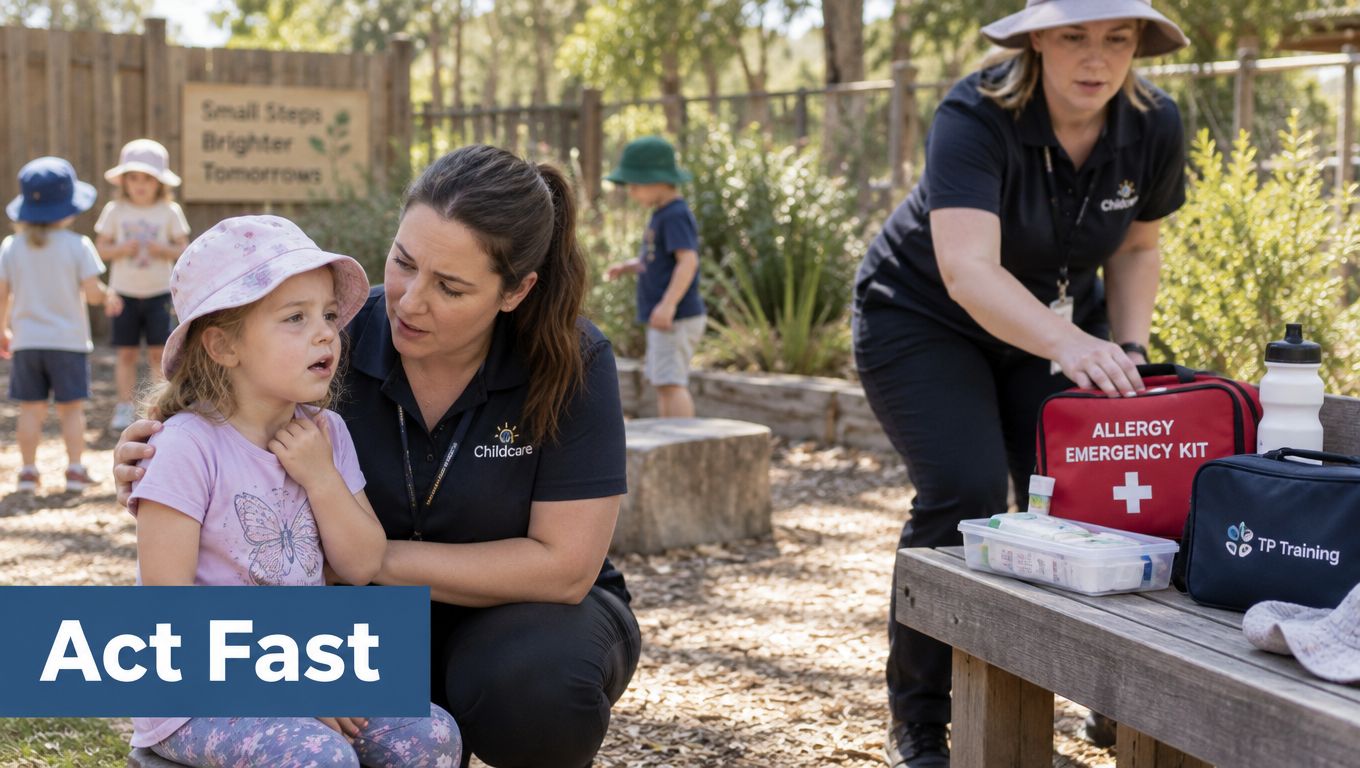
Australia's childcare first-aid requirement sits within the National Quality Framework, rather than existing as an optional professional-development choice. The framework connects qualifications with supervision, emergency readiness, injury prevention, medication procedures, and incident review. A certificate matters because children may not be able to explain what has happened or protect themselves while an emergency develops.
Practical rule: Treat first aid as a live workplace capability, not a document kept in a personnel file.
A current qualification also supports your responsibilities as part of a larger team. Employers must organise rosters so an approved person is present and immediately available wherever care is taking place. You can read more about the wider duties of childcare operators in employer responsibilities in childcare.
Your employment checks matter too. A Childcare background check can help you understand another part of the screening process, but it doesn't replace first-aid training or prove that you meet the qualification requirements.
National Quality Framework Requirements Explained
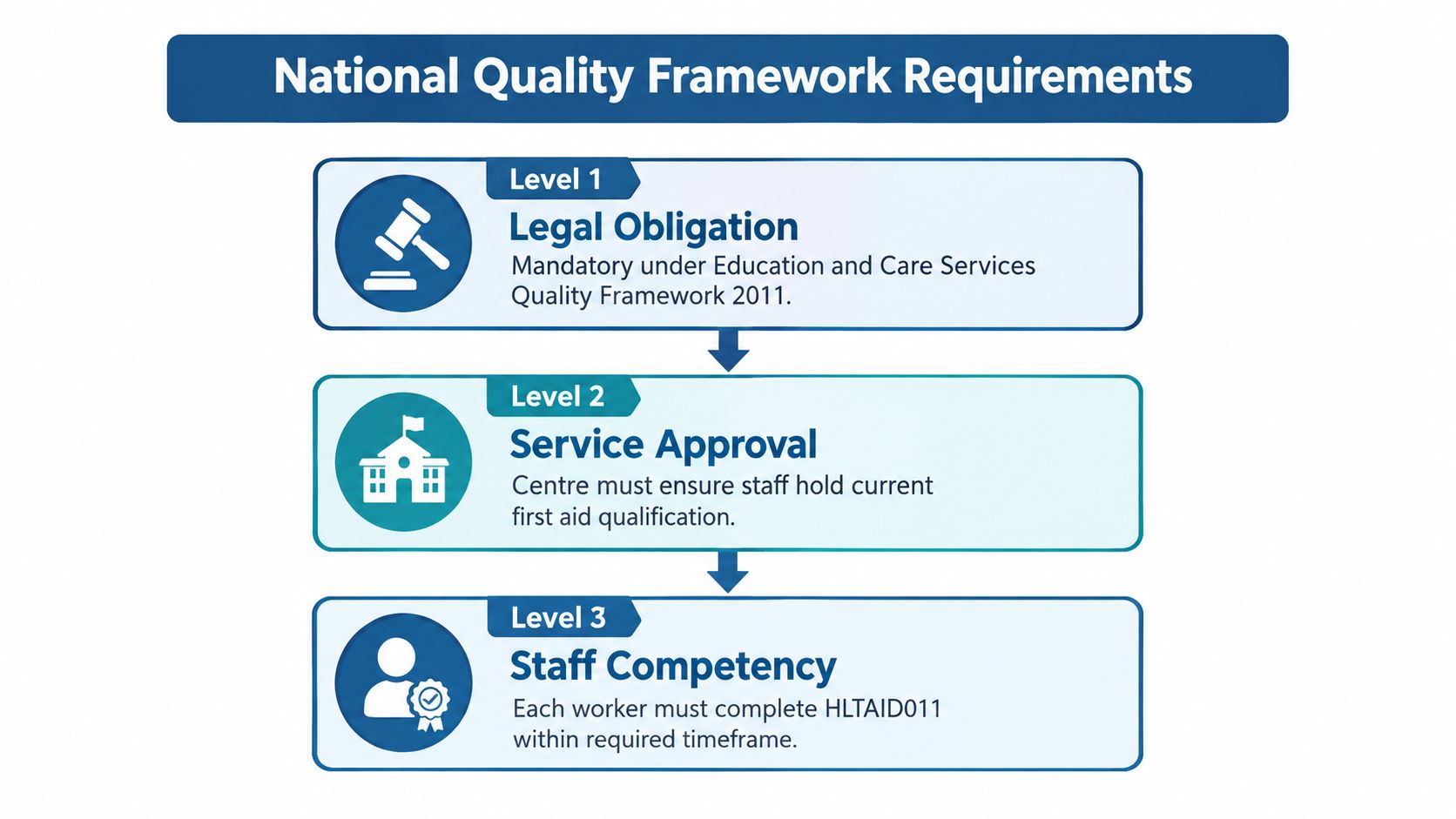
The legal foundation is the Education and Care Services National Law Act 2010 and the Education and Care Services National Regulations 2011, which establish the National Quality Framework. The Australian Government's Child Care Provider Handbook explains the staffing expectations that apply to approved services.
For a centre-based service, at least 1 staff member or nominated supervisor must hold a current approved first-aid qualification and be on duty and immediately available whenever children are being educated and cared for. The same on-site availability principle applies to approved anaphylaxis-management training and emergency-asthma-management training.
Centre-based coverage
The obligation follows the children, not just the building. If children are transported, attend an excursion, use an outdoor area, or receive care away from the main premises, the service must plan for approved first-aid coverage there as well.
That means a roster can look compliant in the classroom but fail operationally if the qualified person leaves with another group. Supervisors need to check who is on duty, where each group is located, and whether the trained person can respond without delay.
Family day care coverage
Family day care has a stricter individual requirement. Every family day-care educator and educator assistant must hold the approved first-aid qualification and complete the two related medical-emergency training components. The service can't rely on a qualified colleague elsewhere in the network to cover an educator who lacks the required credentials.
The rules also extend beyond certificates. NSW material requires a suitable, fully stocked first-aid kit in a position where children can't access it but staff can reach it quickly. Older NSW centre-based rules also illustrate the importance of practising emergency procedures with enrolled children at regular intervals, while family day care rules require a prominently displayed CPR flow chart in the care area.
For a practical overview of recognised training in Australia, see this guide to first aid certification requirements. A Childcare First Aid Course is one training option described by TP Training as practical, nationally recognised, and delivered with hands-on learning across NSW.
What the Childcare First Aid Course Covers
A childcare-suitable qualification must address emergencies involving children, not just general workplace incidents. ACECQA's first-aid qualification guidance requires the course to appear on the approved list and cover a defined range of capabilities.
First aid and CPR response
Training addresses emergency life support and CPR, along with responses to convulsions, poisoning, respiratory difficulties, severe bleeding, injuries, and basic wound care. The practical difference is important. A child may deteriorate quickly, and an educator needs to recognise the situation, protect the child, provide appropriate first aid, and follow the service's escalation process.
CPR practice also helps you work through the sequence under pressure. You learn how to assess the situation, seek help, and provide care appropriate to the circumstances rather than relying on memory from an old general course.
Anaphylaxis management
Anaphylaxis training focuses on recognising a severe allergic reaction and administering an adrenaline auto-injector according to the approved procedure. It also supports safe communication, emergency escalation, and incident documentation.
A generic course may mention allergies without giving the childcare-specific emphasis required for service staffing. Check whether the evidence you receive clearly identifies the anaphylaxis-management component.
Emergency asthma management
Emergency asthma management is a separate capability area. It deals with recognising respiratory distress, following the child's emergency plan where applicable, providing assistance, and obtaining urgent medical help.
The three areas should be recorded clearly: approved first aid, anaphylaxis management, and emergency asthma management. A course that only provides a broad workplace certificate doesn't automatically prove that all three requirements have been met. The practical relationship between the last two components is also covered in asthma and anaphylaxis training guidance.
Certificate Validity and Renewal Cycles
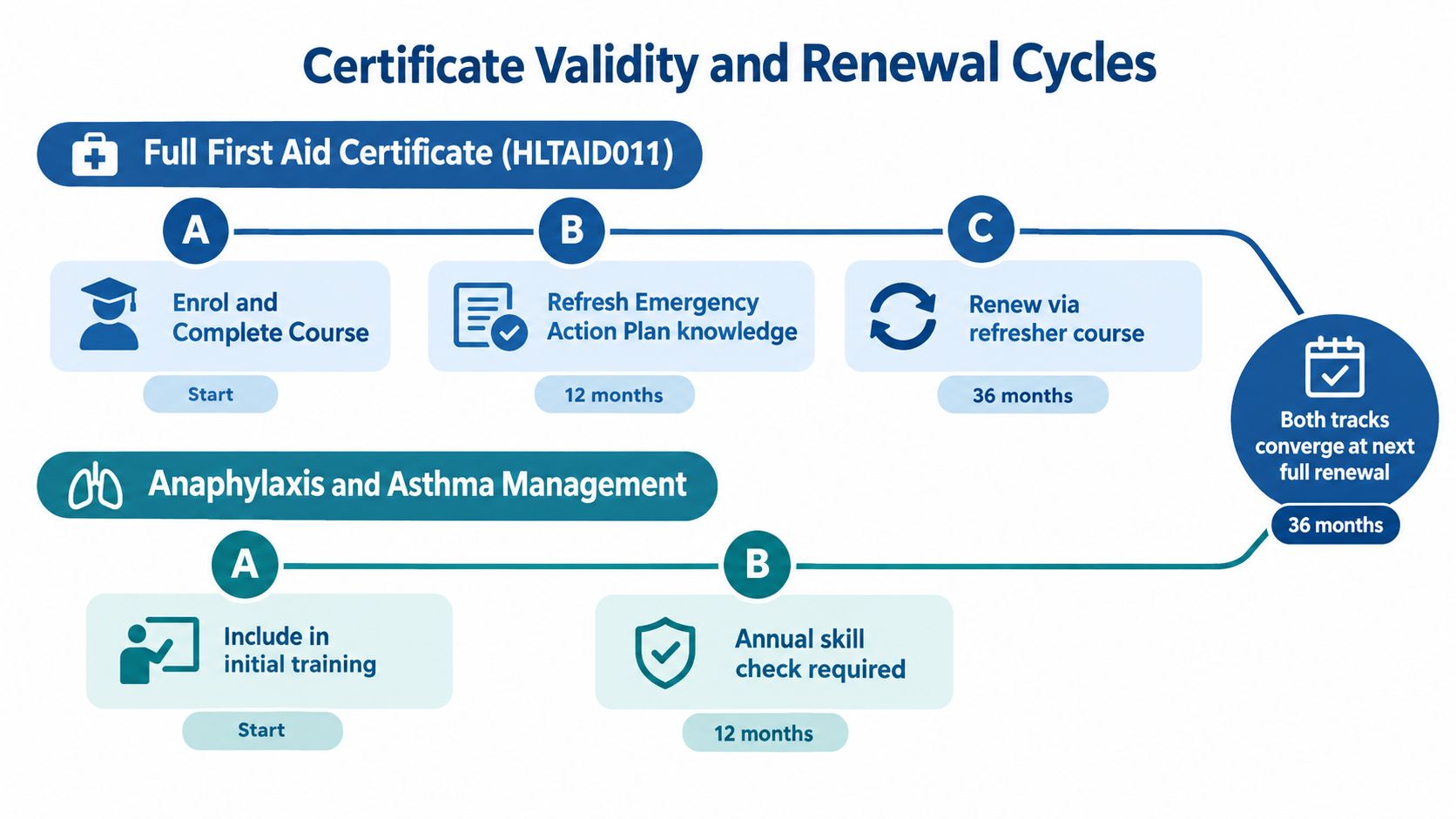
The most common mistake is keeping one expiry date and assuming it covers everything. ACECQA's qualification requirements describe a two-level cycle: the broader approved first-aid qualification is generally treated as current for 3 years, while CPR must have been completed within the previous 1 year.
That creates a practical situation many workers miss. Imagine your first-aid certificate was issued 2 years ago. The wider certificate may still sit within its usual three-year period, but your CPR training could be out of date if you haven't completed the required annual refresher.
Track both dates separately
ACECQA identifies the industry standard as renewing first aid, anaphylaxis-management, and emergency-asthma-management training every three years, with annual CPR refreshers. One staff member may hold one or more required qualifications, but the service still has to ensure approved people are on duty and immediately available whenever children are being cared for.
A simple register should show:
- First-aid date: Record the completion date and the point at which the broader qualification needs renewal.
- CPR date: Record the most recent CPR completion separately, rather than copying the first-aid date.
- Medical-emergency components: Confirm the evidence for anaphylaxis and emergency asthma management.
- Roster impact: Alert the nominated supervisor before a renewal gap affects coverage.
A current first-aid certificate with an outdated CPR record is not the same as fully current childcare coverage.
Schedule CPR refreshers before the annual deadline, not after a roster has already been published. For more detail on the timing, see how long a first-aid certificate lasts.
Generic First Aid Versus Childcare-Suitable Qualification
A standard workplace first-aid course and a childcare-approved qualification can look similar on paper, but they aren't automatically interchangeable. The deciding question is whether the course is appropriate to children and listed by ACECQA, with evidence that the required medical-emergency components are included.
| Check | Generic workplace course | Childcare-suitable qualification |
|---|---|---|
| Main purpose | Broad workplace emergencies | Emergencies relevant to children in care |
| Approval | May not appear on the ACECQA list | Must meet ACECQA approval requirements |
| Paediatric hazards | May receive limited attention | Must address childhood-relevant risks |
| Additional capabilities | May not include both medical-emergency components | Must account for anaphylaxis and emergency asthma management |
| Evidence | Certificate alone may be insufficient | Course name, code, and components should be verified |
The approved scope includes CPR and emergency life support, convulsions, poisoning, respiratory difficulties, severe bleeding, injury, basic wound care, adrenaline auto-injector administration, and incident reporting and review. Those topics reflect the situations educators may face in an early-childhood environment.
Verify before enrolling
Start with the ACECQA approved qualifications list. Compare the exact course name and code, then ask the training provider what evidence will appear on the certificate or statement of attainment.
Don't assume that a course described as “paediatric” automatically satisfies every service obligation. You must also confirm the anaphylaxis-management and emergency-asthma-management components. A nationally recognised Provide First Aid Course is described by TP Training as practical, nationally recognised training with experienced trainers and hands-on learning across NSW, but you should still verify that the specific course meets your childcare service's requirements.
How to Obtain Your Childcare First Aid Certificate in NSW
Start by identifying the qualification your employer or intended service accepts. Check the ACECQA list, confirm the first-aid, anaphylaxis, and emergency-asthma requirements, and ask how CPR currency will be recorded.
Follow a clear enrolment process
- Confirm the course scope. Ask the provider to identify the approved course name and code, the child-specific content, and the related medical-emergency components.
- Choose a practical format. Childcare first aid involves physical skills, including CPR and emergency response practice. Make sure you understand which activities are completed during training and what assessment evidence you'll receive.
- Prepare your details. Have the identification and enrolment information requested by the provider, along with any information your employer needs for its training register.
- Book around your roster. Allow time for hands-on participation and assessment rather than treating the course as a document-only exercise.
- Collect your evidence. After successful completion, obtain the certificate or other completion record and check that your name, course details, and relevant components are accurate.
- Give the record to your service. Ask the nominated supervisor or training coordinator to add the qualification and CPR date to the staff register.
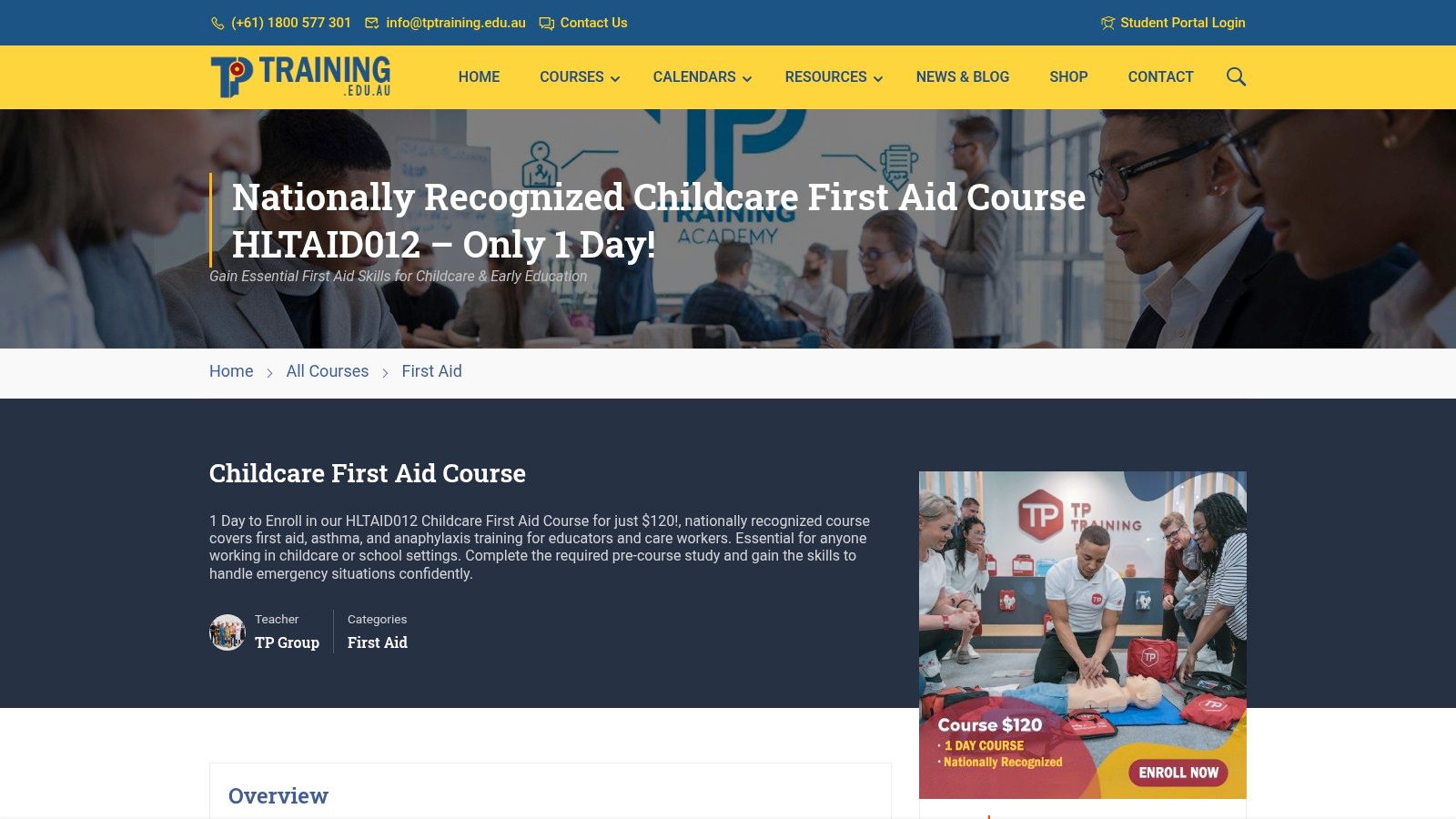
TP Training delivers practical, nationally recognised Childcare First Aid training with experienced trainers and hands-on learning across NSW. Its listed NSW training-centre locations include Penrith, Burwood, Auburn, Parramatta, and Sydney CBD, giving workers a way to consider training location alongside their work commitments.
Check the workplace system after training
Your certificate is only one part of readiness. NSW rules require a suitable, fully stocked first-aid kit that children can't access but staff can reach quickly. Family day care settings also require at least one person with a current approved first-aid qualification at the carer's home whenever children are being cared for, with a CPR flow chart displayed prominently in the care area.
Use this guide to find CPR and first-aid training near you, then ask your service how it records certificates, manages annual CPR dates, and plans coverage during excursions or transport.
Your Childcare First Aid Compliance Checklist
Use this checklist before your first shift and whenever your credentials change:
- Verify approval: Match the course name and code with the ACECQA approved list.
- Check the scope: Confirm approved first aid, anaphylaxis management, and emergency asthma management are covered.
- Track the cycles: Record the broader 3-year first-aid period and the separate 1-year CPR requirement.
- Submit evidence: Give your service accurate certificates and completion records.
- Review coverage: Confirm an approved person is on duty and immediately available wherever children are being cared for.
- Check readiness: Know the location of the first-aid kit, emergency procedures, and CPR flow chart where applicable.
Safe childcare environments also depend on suitable physical resources, so it can help to understand what makes furniture commercial grade when reviewing a care space.
TP Training provides practical, nationally recognised Childcare First Aid training with hands-on learning across NSW. Visit TP Training to review the course information, check suitable NSW training locations, and take the next step towards keeping your childcare first-aid credentials current.

You may also like
Workplace Safety Training: A 2026 Guide for Australia
5 Vocational Training Courses for Career Skills