FAA Part 61 vs 141: A Practical Pilot Training Guide
You've narrowed your flight-school search to two labels, FAA Part 61 and Part 141, but the labels haven't made the decision any easier. One school talks about flexibility, another promotes an approved syllabus, and both promise to help you reach the same licence. You're left wondering whether you're choosing a different licence, a different standard, or just a different way to organise lessons.
The practical answer is that the choice is mainly about how training is delivered, how much structure you want, and whether that structure matches your flying goal and available time. There's also an important jurisdictional point for Australian readers. CASA uses Part 61 for the licensing framework and Part 141 for approved non-integrated flight training, so Australian students shouldn't assume that FAA terminology transfers directly to the Australian system.
Why the Part 61 vs Part 141 Question Matters
A prospective pilot often encounters the decision at the front desk of a flight school. You may know that you want to fly, perhaps for recreation, a career change, or an eventual airline pathway, but the school's regulatory labels can sound like two competing qualifications.
They aren't two different pilot licences. In the Australian framework, CASA defines Part 61 as the framework for flight crew licences, ratings, and endorsements, while Part 141 covers specified non-integrated flight training. CASA's explanation of Australia's vocational training system is useful context for understanding a broader principle, training approval and the qualification outcome are related, but they aren't interchangeable.
Start with the outcome, not the label
Think of the decision in this order:
- What do you want to fly for? A weekend hobby requires a different training rhythm from a commercial career plan.
- How regularly can you train? A flexible schedule may suit someone working full time, while a structured course may suit a student available most weekdays.
- How do you learn best? Some students progress through a formal syllabus and checkpoints. Others need an instructor to adapt each lesson to their strengths and weak areas.
- What records and approvals does the operator hold? The school's certificate and authorised scope matter more than the label in its advertising.
CASA's model separates the legal authority to train from the licensing standard applied to the pilot. Part 141 is the training approval. Part 61 is the licensing framework. CASA also states that training for the grant of a Part 61 licence, rating, or endorsement must be conducted by a holder of a Part 141 or Part 142 certificate. That means the parts work together rather than compete.
Practical rule: Ask a school, “Which approval authorises this exact course, and which Part 61 outcome does it lead to?” That question is more useful than asking which part is better.
The choice affects scheduling, lesson continuity, instructor oversight, progress records, and the way the operator prepares you for assessment. It can also affect whether a school's course suits a weekend hobbyist, a career changer, or a student pursuing a longer professional pathway.
What Part 61 Actually Covers
Part 61 describes the pilot licensing standard. It's concerned with what the candidate must achieve to receive a licence, rating, or endorsement, rather than with the branding or teaching style of a particular school.
In Australia, CASA identifies Part 61 as the regulatory framework for granting flight crew licences, ratings, and endorsements. The framework applies to outcomes such as a recreational pilot licence, private pilot licence, commercial pilot licence, aircraft ratings, and operational ratings within the relevant scope. It also sets the requirements that sit behind the outcome, including aeronautical knowledge, competency, medical eligibility, flight experience, and assessment.
Part 61 describes the pilot
A useful way to read Part 61 is to ask, “What must I demonstrate?”
The answer may include:
- Knowledge: You need to understand the applicable aeronautical subjects and operating rules.
- Experience: You must complete the experience required for the licence or rating.
- Competency: You must perform the required tasks to the applicable standard.
- Medical fitness: You need the appropriate medical pathway for the operation and licence.
- Assessment: You must complete the required examinations, flight tests, or other checks.
Those requirements follow the pilot, even if the student changes instructors or training organisations. The school may organise the lessons, but the licence standard remains the regulator's standard.
CASA's Part 61 guide for the aeroplane category makes the relationship clear for Australian pilots. Training for a Part 61 licence, rating, or endorsement must be delivered by a Part 141 or Part 142 certificate holder. For pilots flying VH-registered aircraft, the guide also says an Australian licence or certificate of validation is required.
Why the distinction prevents confusion
A student sometimes says, “I'm doing Part 61 training,” as if Part 61 were the school's operating approval. In practice, that phrase usually means the student is training towards a Part 61 licence or rating. The organisation delivering that training still needs the relevant Part 141 or Part 142 authority.
That distinction also explains why a training provider must be checked against the exact course it offers. A Part 141 certificate doesn't automatically mean the operator can conduct every kind of training. CASA's regulation defines authorised Part 141 training as the subset listed in the operator's certificate.
The principle is similar to other regulated training decisions. Someone comparing a flight pathway with a Provide First Aid Course also needs to distinguish the qualification outcome from the organisation's authority to deliver the course. The regulator's requirements determine what the learner must achieve, while the provider's approval determines how the training can be delivered.
What Part 141 Actually Covers
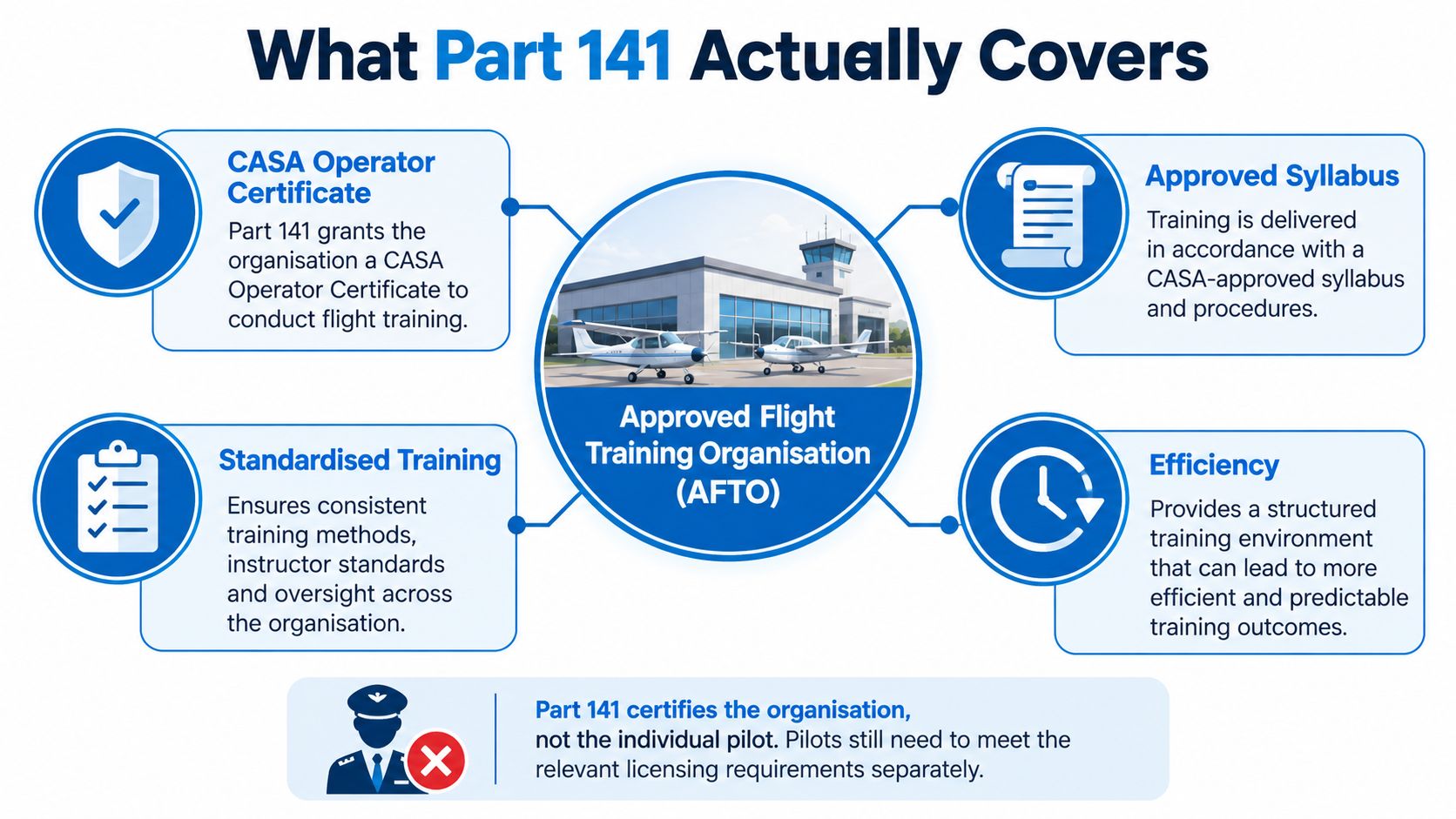
Part 141 is the operator approval for specified flight training. It isn't a synonym for “flight school”, and it isn't a personal licence held by the student. It's a CASA certificate held by an organisation, with authorised activities and limits recorded in its documentation.
CASA says Part 141 covers non-integrated training for a recreational pilot licence, private pilot licence, commercial pilot licence, single-pilot aircraft ratings, certain operational ratings, and specified type ratings. The legislative definition also includes certain endorsements and flight reviews conducted in an aircraft or flight simulation training device.
The certificate defines the scope
A Part 141 operator's authority is task-specific. CASA's regulation 141.015 describes a Part 141 operator as the holder of a Part 141 certificate and states that authorised training is only the training listed in that certificate.
That means a student shouldn't stop at, “Are you Part 141?” The better questions are:
- Which courses are listed on your certificate?
- Is my exact licence or rating included?
- Which aircraft and simulation devices are authorised?
- Who supervises the training and checks student progress?
- How are records maintained and supplied when required?
The operator's syllabus, instructors, aircraft, facilities, training devices, and recordkeeping arrangements must all fit the approval. In plain language, Part 141 governs the organisation's method of delivering approved training, while Part 61 governs the licensing outcome applied to the pilot.
Structure can be valuable, but it isn't automatically better
A structured programme can give students a defined sequence, common lesson objectives, formal progress reviews, and clearer handovers between instructors. That can help a full-time student maintain momentum and identify weak areas before a final assessment.
It can also create friction for a student whose availability changes constantly. A weekend pilot may prefer to book lessons around work, family, weather, and aircraft availability. A fixed course structure can still work, but only if the student can attend consistently and keep up with the operator's sequence.
The critical point is that Part 141 approval doesn't remove the need for individual competence. A certificate authorises the operator to conduct specific training. It doesn't guarantee that every student will complete training at the same pace or that the student will be ready for assessment after a particular number of lessons.
How CFII Can Help
CFII is a Southern California flight training organisation built around a structured career pathway from initial flight training through instructor-level qualifications. For a reader comparing flexible and structured approaches, its relevance is the way it combines one-on-one instruction, coordinated assessment preparation, digital study resources, and a defined training sequence.
The organisation's FAA Part 61 vs 141 guide can help students who want a US-specific explanation of the two FAA pathways. It should still be read alongside the rules that apply in the country where you intend to train and use your licence.
What the structured model is designed to solve
A career-focused student commonly struggles with scattered lesson planning, inconsistent instructor handovers, delayed checkrides, and uncertainty about what to study next. CFII's approach addresses those problems through:
- Individual instruction: Flight and ground training are coordinated around the student's progress.
- A defined career sequence: The programme is designed to move from foundational training into commercial and instructor qualifications.
- Digital learning support: Lessons, quizzes, stage checks, written-test preparation, and a digital logbook sit within a training portal.
- Assessment coordination: The school handles preparation and coordinates checkride scheduling with examiners.
- Modern training resources: The stated approach uses glass-cockpit aircraft, certified simulators, and structured study materials.

That model is most useful for a student who can commit to regular training and wants the school to manage more of the administration. It's less obviously suitable for someone who can only fly irregularly or who wants to change the order and pace of lessons frequently.
The important editorial caution is to separate programme features from regulatory outcomes. A school can offer intensive scheduling, a digital portal, or career support under its own operating model. Those features don't, by themselves, prove that a student has met the applicable licensing standard. Always confirm the operator approval, the exact course scope, the assessment pathway, and what is included in the training agreement.
Training Hours, Syllabus and Oversight Compared
The most useful comparison is not “easy versus hard”. It's flexible delivery versus approved structure. The exact requirements depend on the regulator and licence, so an Australian student must use CASA requirements rather than importing assumptions from US flight-school marketing.
| Element | Part 61 | Part 141 |
|---|---|---|
| Regulatory role | Establishes the licence, rating, and endorsement standards | Authorises an organisation to conduct specified approved training |
| Student outcome | The pilot must meet the applicable Part 61 requirements | The pilot still works towards the applicable Part 61 outcome |
| Syllabus | Training can be tailored by the authorised operator within the regulatory framework | Training follows the approved scope and syllabus applicable to the operator |
| Schedule | Usually more adaptable to work, family, weather, and changing availability | Usually more organised around defined lessons, stages, and progress checks |
| Oversight | Focuses on whether the candidate meets the licensing standard | Adds operator-level controls for the approved training activity |
| Records | The student and operator must retain the records required for the training and licence | The operator must maintain records that support its approved training activity |
| Best fit | Students needing flexibility or a highly individual pace | Students who want a formal course structure and regular milestones |
| Final result | The candidate earns the relevant licence or rating after meeting the standard | The candidate earns the relevant licence or rating after meeting the standard |
The weekend hobbyist
A hobbyist who flies around work and family commitments may value the ability to book training when life permits. If one lesson reveals that circuits, navigation, or radio work needs more attention, an adaptable instructor can spend additional time there before moving on.
That student should still maintain a consistent logbook and ask the operator how gaps between lessons affect retention. Flexibility is useful only when the student can return often enough to build on previous learning.
The accelerated career student
A full-time career student may gain more from a formal course sequence. Clear stages can help the student understand what must be completed before progressing, while scheduled reviews can expose weaknesses earlier.
The trade-off is commitment. A structured programme requires the student to protect training time, complete ground study, attend progress events, and communicate early when illness, work, finances, or personal circumstances interrupt the plan.
The integrated aspirant
An integrated aspirant needs to look beyond the label and inspect the complete pathway. Ask whether the course covers the intended licence outcomes, how theory is delivered, what records are issued, and how the training connects with later employer or regulator requirements.
For Australian students, CASA's Part 141 legislative material confirms that the category applies to defined training activities rather than every service a flight school might advertise. A student should therefore match the programme's authorised scope to the intended next step.
The checkride is only the visible end of training. The better pathway is the one that helps you arrive prepared, current, and properly documented.
Which Pathway Fits Which Student Profile
A simple profile test can make the decision less abstract. Start by writing down your intended flying outcome, your weekly availability, and how much control you want over lesson sequencing. Then compare your answers with the training environment.
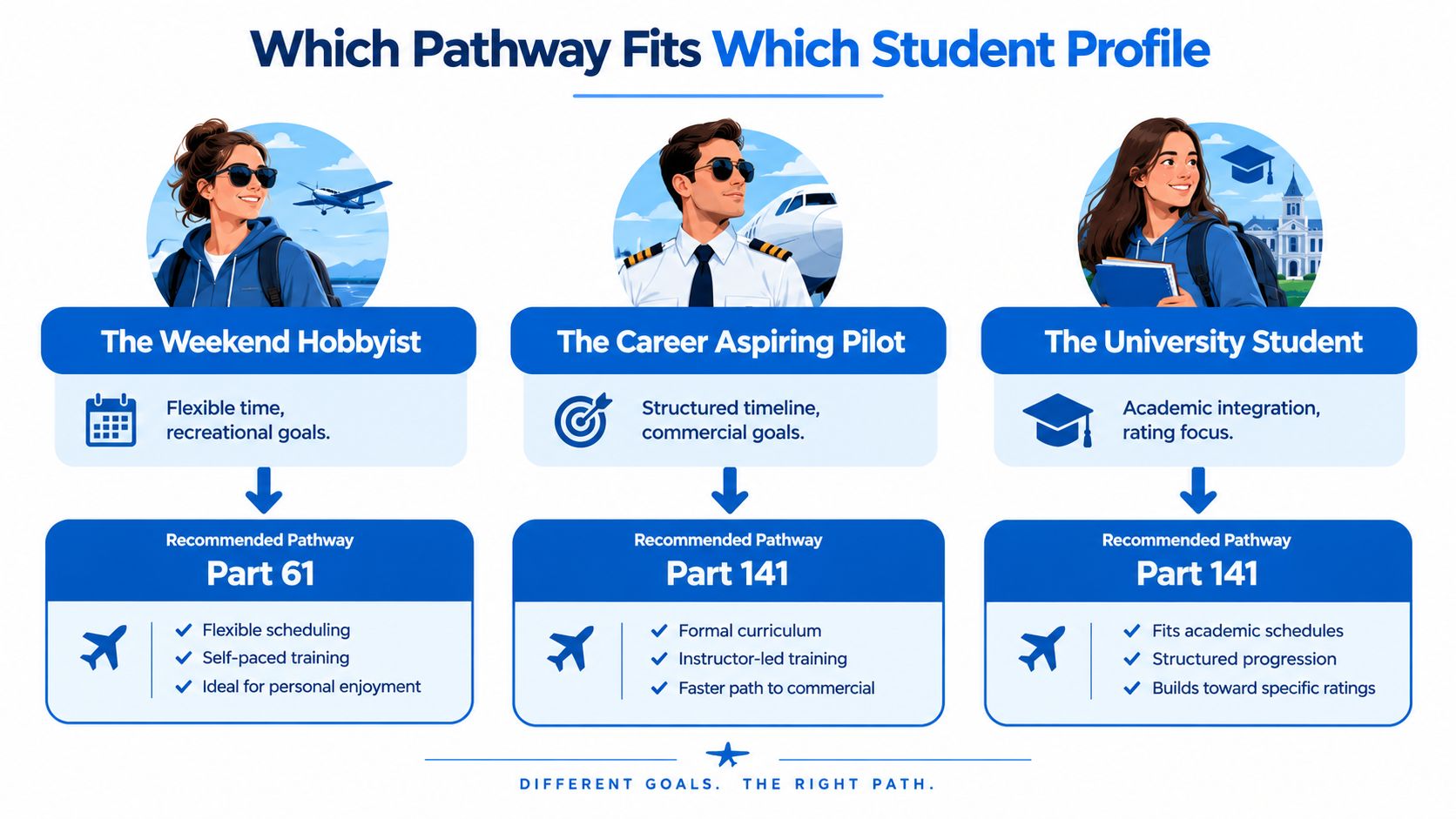
The weekend hobbyist
You work during the week, have family commitments, and want to fly for personal enjoyment. Your schedule changes, and you may not be able to attend a fixed weekday programme.
A flexible pathway will often fit better because you can organise lessons around your availability and ask the instructor to adjust the pace. That doesn't mean casual training is consequence-free. You'll still need organised study, regular practice, and reliable recordkeeping.
The career changer
You're leaving another industry and want a clear route into professional flying. You may be able to train frequently, but you're also managing finances, medical requirements, study, and family responsibilities.
This profile sits in the overlap zone. A structured Part 141 environment may provide useful momentum, but only if the timetable is realistic. If your availability is irregular, a flexible operator with strong progress tracking may be a better fit than a rigid course that you repeatedly pause.
The decision is similar to choosing a new vocational direction. A resource on career change planning can help you consider transferable skills, financial commitments, and the pace of a new qualification before you commit to a training schedule.
The airline-oriented student
You want a professional pathway and expect to move through several qualifications and instructor or employment stages. You'll likely benefit from a school that can explain the full sequence, maintain accurate records, and provide clear progress milestones.
Ask whether the operator's approval covers the specific training you need. CASA's updated licensing guidance reinforces that Part 141 training is limited to the activities authorised for that operator, so the school's certificate matters more than the word “academy” in its name.
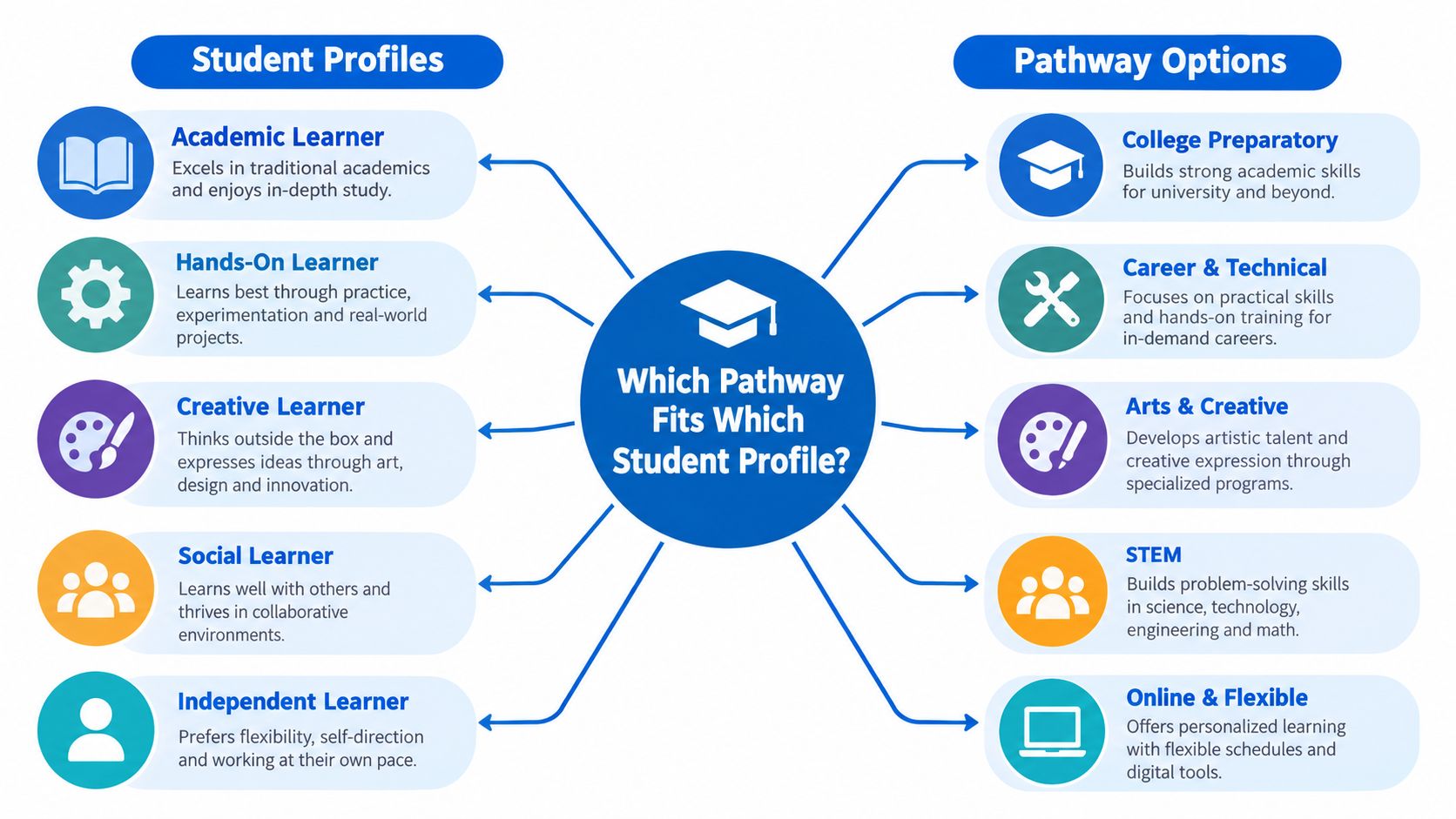
The university student and the international student
A student combining aviation with another course may need flexibility during exams and semester breaks. An international student may also need to confirm how the intended licence will be recognised or converted later. Those questions can change the best pathway, even when the school's training environment looks attractive.
Use this decision rule:
- Recreation with irregular availability: Start by investigating a flexible route.
- Full-time career training: Compare structured Part 141 courses carefully.
- Mixed study and flying: Prioritise a timetable that can survive academic commitments.
- International or conversion plans: Confirm recognition with the destination regulator before enrolling.
- Add-on ratings: Check that the operator is authorised for the exact rating, aircraft, or device involved.
How to Choose the Right Pathway for Your Goals
Choose the pathway in three filters. Don't start with the school's aircraft photos or a promise of accelerated progress. Start with the outcome you want, then test whether the training model fits your life.
Filter one is the flying goal
For recreational flying, a flexible training arrangement may be more practical. For commercial ambitions, a structured operator can be useful if it offers the authorised courses, instructor supervision, theory support, and records you need.
The phrase “career programme” isn't enough. Ask for the exact licence sequence, the training approval that covers it, the assessment arrangements, and the point at which you'll need to move to another operator.
Filter two is your real availability
Look at your calendar rather than your intentions. Can you train consistently, complete study outside lessons, and recover quickly when weather cancels a flight? Or will work and family regularly interrupt the plan?
A flexible pathway may suit a student with limited or changing availability. A structured pathway may suit someone who can protect regular training blocks and wants formal milestones. Neither option compensates for long gaps, poor preparation, or an unrealistic timetable.
Filter three is the complete budget
Compare more than the aircraft hourly rate. Include instructor time, ground training, examinations, assessment fees, equipment, travel, accommodation, rescheduling, and the possibility that extra training will be needed before a flight test.
For a Part 141 operator, ask how the approved course is priced and which services are included. For a flexible arrangement, ask how the operator estimates the likely progression without presenting an unsupported guarantee.

Before signing, ask these questions:
- Approval: Which regulator authorises the course?
- Scope: Is the exact licence or rating listed within the operator's approval?
- Progress: How are stage checks, reviews, and weak areas handled?
- Records: Who maintains the training records and logbook evidence?
- Interruptions: What happens if weather, illness, work, or finances pause training?
- Exit plan: Can you transfer records to another operator if your circumstances change?
Students comparing aviation with other safety-focused study may also find it useful to understand how CPR, first aid, and workplace safety certifications are separated by course scope and training requirements. The same habit applies here, identify the exact approval and outcome rather than relying on a broad label.
Next Steps After You Pick a Pathway
Once you've chosen a likely route, turn the decision into checks you can complete before committing money and time.
First, verify the operator's current approval and confirm that it covers the exact training you want. Ask for the relevant syllabus, training stages, assessment process, and recordkeeping arrangements. If the provider can't explain which certificate or approval authorises the course, pause before enrolling.
Next, book a discovery flight or skills assessment. Use it to evaluate the instructor's communication, the aircraft's condition, the briefing process, and the way the school answers questions. You're assessing the training environment, not just trying the aircraft.
A sensible first-month checklist
- Confirm medical eligibility: Find out which medical pathway applies before building a career plan around flying.
- Read the agreement: Check withdrawal, refund, weather, aircraft unserviceability, transfer, and rescheduling clauses.
- Build the accurate budget: Include aircraft hire, instructor fees, ground study, examinations, equipment, travel, and additional training.
- Set recordkeeping expectations: Start your pilot logbook properly and ask how the operator stores supporting records.
- Agree on milestones: Identify the reviews or stages that will show whether your pace and training plan remain realistic.
- Schedule a progress conversation: Arrange a review with the chief flight instructor after meaningful early progress, rather than waiting until problems become expensive.
A student identifier and organised records matter across regulated education. Guidance on creating and managing a unique student identifier can also reinforce the importance of keeping personal training information accurate and accessible.
If your objective is an airline pathway, speak with a careers adviser before enrolling. Integrated programmes can have separate intake windows, selection criteria, medical expectations, and progression requirements. Confirm those details in writing, then choose the pathway that matches your actual schedule and goal.
Don't choose between Part 61 and Part 141 because one sounds more professional. Speak with an authorised training operator, show them your target licence and weekly availability, and ask for the exact approval, syllabus, cost structure, recordkeeping process, and progression milestones that apply to you. That conversation will give you a more reliable starting point than any generic promise about the “best” pathway.

You may also like

5 Vocational Training Courses for Career Skills
Asthma and Anaphylaxis Training in NSW