

Vocational Training Australia: Your Complete Guide to VET
You've probably landed here with one of two questions in mind. You're either trying to choose a first course and the options all sound similar, or you're already working and need a faster way to move into a better job. Vocational training in Australia sits right in the middle of that decision, and the trick is understanding which pathway fits your situation, not just which course name sounds useful.
The system can feel crowded at first, with acronyms, licences, certificates, and training providers all competing for attention. Once you separate the structure from the marketing, though, it becomes much easier to read. VET, or Vocational Education and Training, is a national pathway built around practical, competency-based learning that leads to recognised qualifications and job-ready skills, not just classroom theory. Study Australia's VET pathway overview describes it as a formal post-school route, and the national system sits inside a much larger workforce pipeline, with over 5.1 million students enrolled in VET in 2024 and 3,805 registered training organisations delivering training across the country as reported by the Productivity Commission.
That scale matters because it tells you this isn't a niche fallback. It's a mainstream way Australians move into work, switch fields, and build job-specific skills. If you're trying to work out whether a short course, a certificate, an apprenticeship, or a diploma is the right next step, the clearest path is to start with the system itself, then narrow it down to your own goals.
Table of Contents
- What Vocational Training Really Means in Australia
- Understanding AQF Qualification Levels from Certificate I to Diploma
- Popular Industries and Courses That Drive VET Enrolment
- How VET Funding and Government Subsidies Work
- Choosing the Right RTO Without the Guesswork
- Who Gets Left Behind in VET and How to Bridge the Gap
- Pathways From VET to Employment and Further Study
- Practical Steps to Enrol and Start Your VET Journey
What Vocational Training Really Means in Australia
A school leaver can look at university offers, traineeships, TAFE brochures, and private course ads and still feel unsure about which path leads to real work. A career changer faces the same maze, only with more pressure to choose well and keep moving. VET gives that choice a clearer shape because it is built around job tasks, workplace standards, and pathways that match specific kinds of learners.
VET is practical by design
Australian VET is competency-based and industry-linked according to a comparative overview of the system. The focus is on whether you can do the required tasks to industry standard, not whether you can write a long academic essay about them. For many learners, that is the point. They want training that shows how the job works, confirms they can do it, and gets them ready for paid work.
VET also sits inside a regulated national framework. Training is delivered by Registered Training Organisations, or RTOs, which are registered by ASQA, and the qualifications they issue are nationally recognised through the NSW education fact sheet on VET. That recognition matters because it gives a learner a credential that can travel across employers and states, instead of a local course with limited reach.
The simplest way to read VET is to ask one question. What job does this training prepare me for, and how directly does it get me there?
VET is also broad enough to cover both short skill-building and longer qualification pathways. It includes people studying full qualifications, short courses, and stand-alone subjects, which is why it can suit someone starting from zero as well as someone adding a specific job skill. A learner who only needs a single safety credential can take a targeted course, while another person may use the same system to work toward a full occupation.
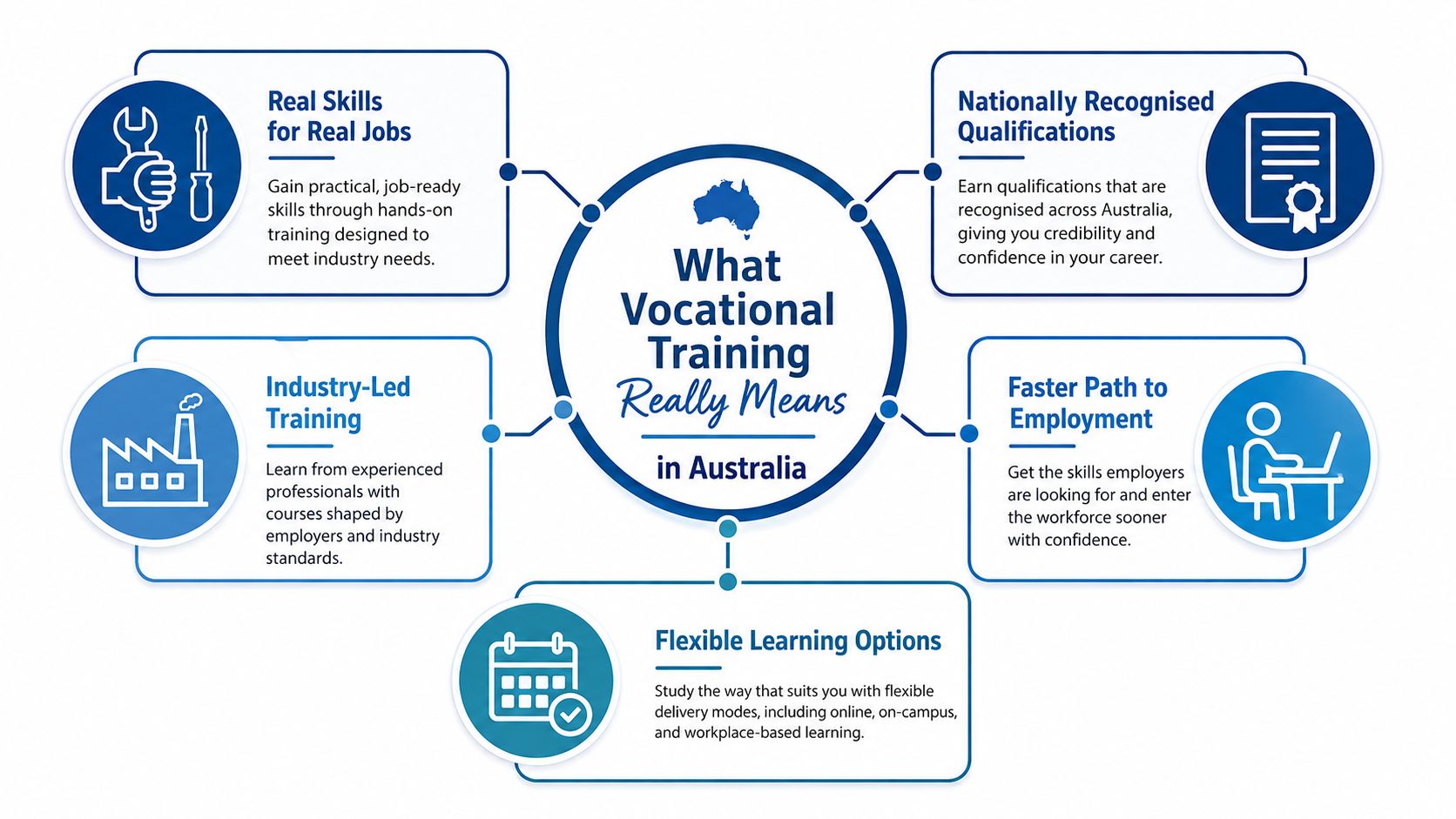
If you are choosing between study that stays general and study that points toward a job outcome, VET exists for the second path. That does not make it smaller or simpler. It makes it clearer about where the learner is headed.
Some entry points sit right at the start of that journey. For example, the CPR, first aid, White Card and workplace safety certifications guide shows how short, work-focused training can help people understand the first steps into job-ready learning, while an option like the Ace Aviation Aerospace Academy drone course can suit someone aiming for a more specialised vocational pathway in aviation-related work.
Understanding AQF Qualification Levels from Certificate I to Diploma
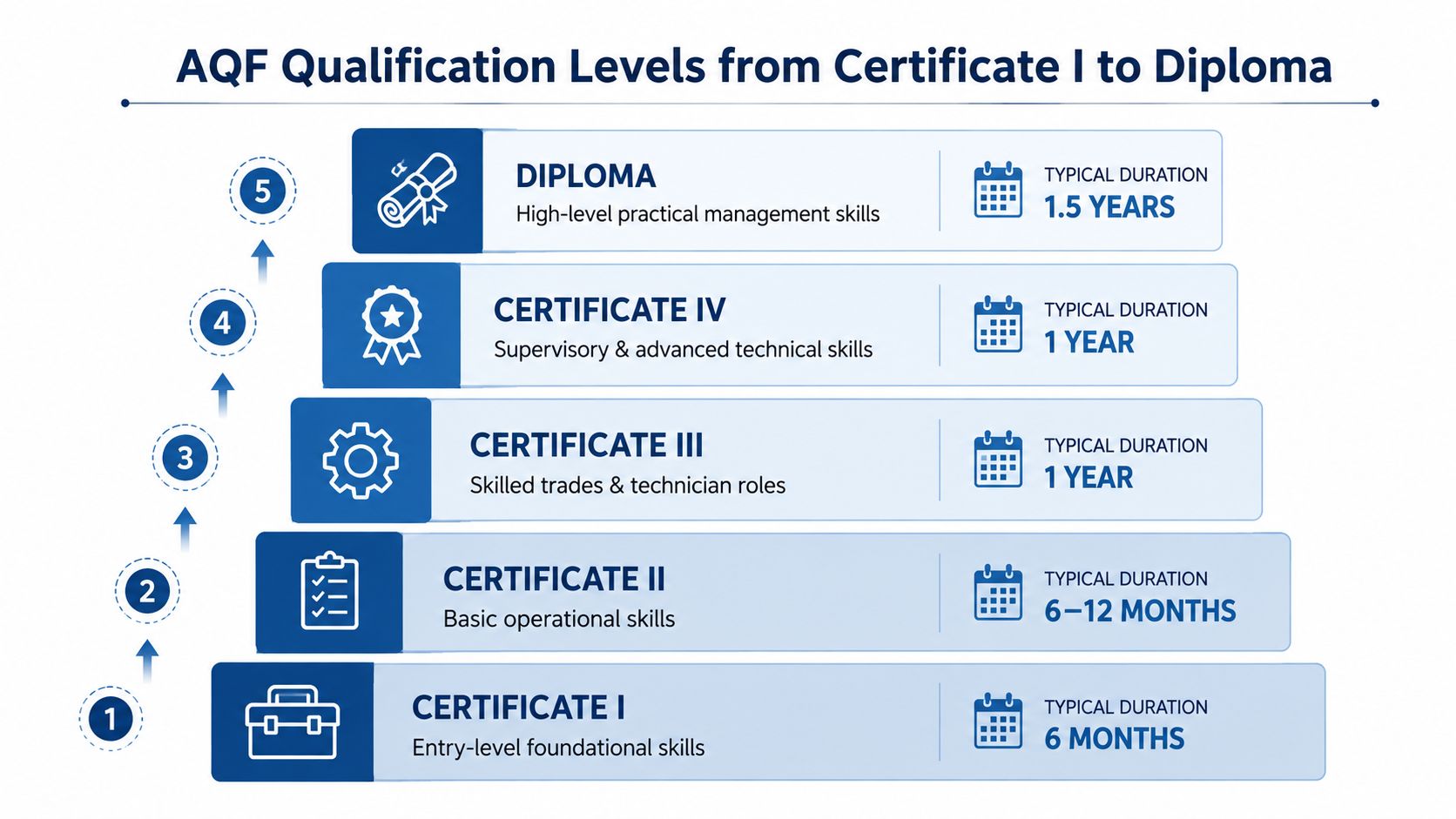
A lot of newcomers hear “Certificate III” or “Diploma” and assume the numbers are just branding. They're not. The Australian Qualifications Framework, or AQF, works like a ladder, and each rung tells you how much responsibility, independence, and complexity the training is preparing you for.
The ladder model makes the levels easier to read
Think of Certificate I as the entry rung. It's where learners start building foundational skills and confidence with simple tasks. Certificate II adds basic operational capability, which is useful when a job needs routine skills but not full trade depth. By the time you reach Certificate III, the work usually shifts into skilled trade or technician territory, where someone is expected to handle tasks with less supervision.
Certificate IV is often where supervision, coordination, or advanced technical responsibility starts to appear. In safety, business, or leadership-oriented roles, it can be the point where a worker moves from “do the task” to “manage the task properly and help others do it too.” A qualification like a Certificate IV in Work Health and Safety fits that shape, because the role asks for deeper judgement, not just basic execution.
A Diploma sits higher again and usually signals more complex practical management skills. In civil construction, a Diploma can support a move towards a supervisor or coordination role, especially when someone already has site experience and wants to formalise the next step. If you want a real-world example of how these levels connect to industry, the trade licensing guide is useful because it shows how training, licensing, and workplace requirements often sit together rather than separately.
A good way to choose is simple, start with the job you want, then work backwards to the level of independence that job requires.
The practical advantage of AQF is portability. A qualification earned in one city is nationally recognised, so a learner who trains in Sydney isn't locked out of jobs elsewhere in Australia. That makes the level choice especially important, because you're not just choosing a course, you're choosing the kind of responsibility you want to hold.
If you're comparing a narrow entry course with a broader qualification, it helps to see how the level changes the outcome. A learner looking at aviation, for example, might find the Ace Aviation Aerospace Academy drone course a helpful reference point for how a Certificate III can sit inside a more specialised career path.
You may also come across practical NSW courses like the Prepare Work Zone Traffic Management Plan Course Pwz Red Card, which shows how a nationally recognised training product can target a very specific on-site role without turning into a broad academic program.
Popular Industries and Courses That Drive VET Enrolment
A learner often starts with a job title in mind, then finds the course that matches the doorway into that job. That is why VET enrolment does not cluster around one kind of student or one style of study. It spans broad entry pathways, short compliance courses, and more specialised training that prepares someone for a specific workplace task.
Short courses matter because many jobs need immediate proof
Construction is the clearest example. A person who wants site entry usually needs a White Card, and that training exists because compliance comes before employment. Traffic control, work zone planning, first aid, and hospitality follow the same pattern. Employers often want proof of competence before they will roster someone for a shift, so the course itself becomes part of the hiring filter.
That is one reason short training stays central in VET. The system is not only for full qualifications. It also includes the stand-alone subjects and job-specific learning that help people step into work quickly, as reflected in the national enrolment mix as reflected in the national enrolment mix. In practical terms, that is why learners keep returning for traffic control, CPR, first aid, and barista skills.
Hospitality shows the same logic. A learner might need an RSA before serving alcohol, or a coffee skill course before working in a café. The barista training page is a clear example of how a short course can support a very specific job target rather than a broad career change.
Industry demand shapes course choice
The best course is the one that matches the actual entry requirement for the role you want. If the role requires a licence, start with the licence pathway. If it requires site induction, begin there. If it calls for more advanced coordination or management, a certificate or diploma may be the better fit.
- Construction entry: White Card, asbestos awareness, silica awareness, and other site safety training support access to worksites.
- Traffic and civil work: traffic controller training, work zone planning, and related competency training support road and site operations.
- Hospitality and service: RSA, RCG, food safety, and barista training support customer-facing work.
- High-risk roles: forklift, EWPs, dogging, rigging, and other equipment-based courses support jobs where practical skill and safety are closely linked.
The key is to match the learner to the gatekeeper, then choose the course that gets them through that gate first.
How VET Funding and Government Subsidies Work
A learner often checks the price before anything else. That makes sense, because the right course still has to fit the budget, and in VET the funding path can change the amount you pay.
Government funding is tied to labour market outcomes
Public spending on VET is significant. In 2024, Australia's government real recurrent expenditure on VET was $8.9 billion, up 5.4% from $8.4 billion in 2023, according to VOCED records. That level of spending is not arbitrary. It shows that public money is directed toward training that supports employability, responds to skill needs, and helps people enter the workforce.
Learner intent lines up with that focus. In 2023, the main reason qualification completers took part in VET was employment-related, accounting for 74.3% of government-funded VET completers and 73.1% of total VET completers, as noted in the same VOCED records. Many people enter training because they want a job outcome, not just a certificate on paper.
Subsidies and fee structures vary by pathway
In NSW, learners often come across Smart and Skilled, the state's main subsidised training pathway. Some courses are government-funded, some are fee-for-service, and some sit between those two depending on the learner's circumstances and the training product. Eligibility can depend on residency, age, prior study, and the qualification you want to enrol in.
A helpful way to sort funding is to ask who carries the cost, and what the entry conditions are.
| Funding Type | Who Pays | Eligibility Check | Typical Use Case |
|---|---|---|---|
| Government-funded | Government shares or covers the cost | Residency, age, prior study, course type | Priority skills and entry pathways |
| Fee-for-service | Student or employer pays the full fee | Provider enrolment requirements | Fast access, private training, or niche courses |
| Employer-supported | Employer pays part or all | Workplace agreement | Staff upskilling or compliance |
Before you pay anything, ask two questions, is the course subsidised for my situation, and what proof do I need to show it?
Funding can make training easier to access, but it does not remove the need to check the rules. A course may sound affordable until the eligibility test is applied, and then the cost shifts back to you. If you want a practical example of how a learner might compare short, job-focused training pathways, the top traffic controller training centres in Sydney comparison shows how course choice and provider choice often need to be considered together.
Choosing the Right RTO Without the Guesswork
With 3,805 registered training organisations in the system in 2024, the hardest part is often not finding an RTO, but working out which one fits your goal Productivity Commission data. Once you start comparing providers, the useful shift is away from brochure language and toward the details that affect whether you can finish, get assessed properly, and use the qualification the way you intended.
A first-time learner can get pulled in by course titles alone. That is a bit like choosing a tool by its label instead of the job it has to do.
Registration matters, but it's only the starting point
An RTO is not just any training company. It is an organisation registered to deliver nationally recognised training, and that registration sits under the quality framework managed by ASQA. Registration means the provider is authorised to issue recognised qualifications and must meet compliance expectations, but it does not guarantee the same teaching style, learner support, or course fit.
The better question is whether the provider matches the way you learn and the outcome you want. Some learners need in-person teaching because they are new to the area or not confident online. Others need a blended format because they are already working and need study to fit around shifts. Some want a provider near a train line or with parking, while others care more about trainer experience and whether the course can be finished quickly enough for a job deadline.
For readers comparing practical options, the top traffic controller training centres in Sydney comparison is a useful example of how provider choice and course choice need to be weighed together.
Compare providers on what affects your outcome
A good shortlist should focus on the parts of training that change the result, not just the marketing copy.
- Delivery mode: face-to-face, online, or blended.
- Location practicality: travel time, parking, and whether the site is easy to reach.
- Trainer background: whether trainers have current industry experience.
- Assessment support: how the provider handles competency checks and reassessment.
- Post-course help: whether they explain certification, licensing next steps, or renewals clearly.
- Transparency: clear fees, no hidden extras, and no exaggerated claims about completion.
If a provider promises instant qualification, no assessment, or “too easy” entry, pause and verify everything.
ASQA's 2025 Standards FAQs say providers must review a prospective student's skills and competencies, including language, literacy, numeracy, and digital literacy, before enrolment for every training product ASQA guidance. That matters because a good RTO should be matching the course to the learner, not taking money and hoping the fit works out later.
For learners comparing NSW options, TP Training is one example of an RTO with multiple Sydney locations, practical delivery, and safety and construction-oriented training. The choice still needs to be based on your goal, not the provider's marketing.
Who Gets Left Behind in VET and How to Bridge the Gap
A learner can want a practical qualification and still hit barriers before the first class begins. Some people are comfortable with hands-on work but less confident using portals, forms, or online assessments. Others are juggling care responsibilities, dealing with disability-related support needs, or trying to study while housing is unstable. Those barriers are not personal failures, they usually point to a course design that expects too much from the learner too early.
Access problems are often hidden until enrolment
NCVER research has shown that young people with disabilities are underrepresented in VET, with odds of undertaking VET at only 60% of those without a disability NCVER report. The same research also found underrepresentation among young people from single-parent families and families affected by parental unemployment. That matters because it shows participation is not just about whether a course exists. A learner also needs to be able to reach it, enter it, and keep going once study starts.
The same NCVER reporting also points to a wide learner mix, including First Nations learners, people with disability, regional and remote learners, and people with limited literacy, numeracy, digital access, or stable housing. That range should shape how providers explain enrolment and support, because a single process does not fit every starting point.
Better support beats more hype
Pre-enrolment checking helps when it is done with care. A provider that checks language, literacy, numeracy, and digital skills early can point a learner toward a course they are more likely to complete. Without that check, the learner can be left carrying the strain later, after fees are paid and the course is already under way.
Support usually makes the difference between starting and finishing.
- Foundation skills help: literacy, numeracy, and digital support can close gaps before the main course starts.
- Flexible delivery: evening, weekend, blended, or staged training can help learners with work or care commitments.
- Clear enrolment advice: simple explanations beat jargon when a learner is making a first decision.
- Workplace adjustments: support needs should be discussed before the first assessment, not after a failure.
The strongest point here is simple. More course advertising will not fix completion problems if the learner cannot access the training in the first place. Clear pathway advice and well-designed support do as much for success as the course itself.
Pathways From VET to Employment and Further Study
Many people think of VET as the end of the road because it's shorter and more work-focused than university. That view misses how often VET is the start of a career. The whole point is movement, into work, into higher qualifications, or into a different kind of study later on.
Work first is often the fastest outcome
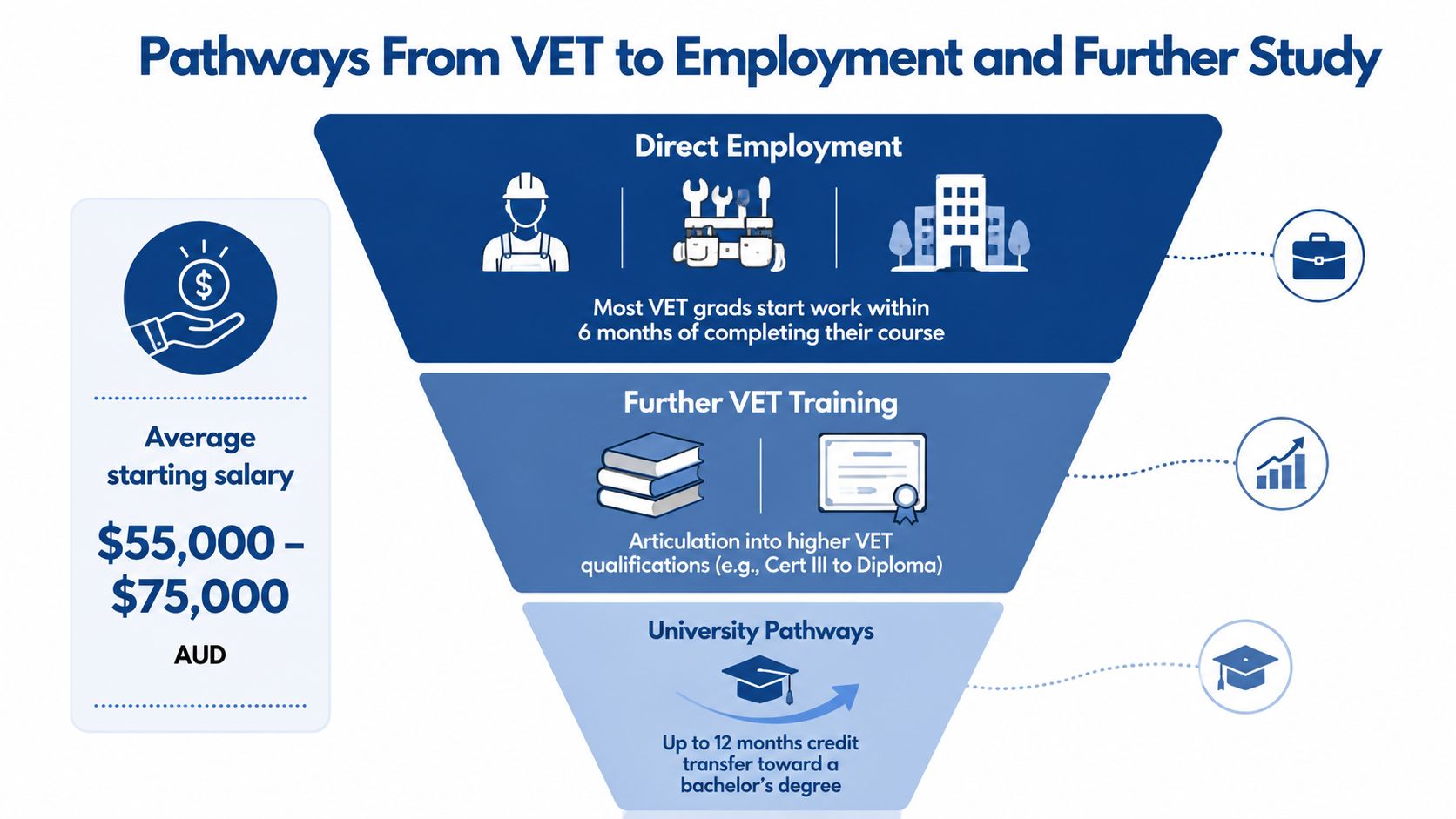
A White Card, traffic control ticket, or first aid qualification can open the door to immediate work because those credentials are often tied to site access or job compliance. In construction and traffic management, employers want people who can start safely and legally, which is why these courses matter so much at entry level. The same logic applies to hospitality and warehouse work, where practical qualifications can help a candidate get on a roster faster.
VET can also stack upward
A lot of learners move from a lower qualification into a higher one once they're working. That's where the AQF ladder becomes useful again. A Certificate III can lead into a Certificate IV, and a Diploma can support more advanced practical coordination or management work. This is one reason employers like VET, it can produce workers who grow into more responsibility without leaving the industry.
Apprenticeships and traineeships are part of the same ecosystem. They combine paid work with structured training, which helps learners build experience while they study. The model suits people who learn best by doing, and it lets employers train someone inside the realities of the job rather than only in a classroom.
You'll also see some VET pathways linked to university entry. That can mean credit toward a degree in certain cases, although the amount depends on the institution and the course match. The key thing to understand is that VET isn't a dead end. It's a practical route that can connect directly to work, then continue upward if the learner wants more study later.
Practical Steps to Enrol and Start Your VET Journey
A clear pathway makes enrolment feel far less daunting. The trick is to treat it like a checklist rather than a leap, because the confusion usually starts when people focus on payment before they have matched the course to the job outcome, confirmed the provider, and gathered the right details.
Start with the course, then check the fit
Begin with the occupation or work task you want to move toward. From there, check whether the course is a qualification, a licence-related program, or a short compliance unit, because each one serves a different purpose. A good enrolment decision is less about picking a course name and more about matching the training route to the role you want.
Next, verify that the RTO is registered and ask what they need before you submit an application. Common requirements include photo ID, your USI, and residency evidence if you are applying for subsidised training. You may also be asked to complete a pre-enrolment skills or capability check, since providers are required to assess relevant skills before enrolment under current standards ASQA FAQs. That step can feel detailed, but it helps stop the wrong learner from being placed in the wrong course.
If you have not set up your student identifier yet, use the USI setup guide before you apply. Missing that number can slow the whole process, a bit like arriving at a station with the right ticket but no platform information.
Make your first day easier
Before class starts, confirm the start time, location, any PPE requirements, and whether you need to finish online work first. For trade, safety, and traffic courses, it helps to arrive ready to participate rather than expecting a passive lecture. Competency-based assessment usually asks you to show what you can do, not just what you can recall.
A practical way to reduce first-day stress is to prepare your documents, your travel plan, and any required gear the day before. That small bit of organisation often makes the first session easier, especially if the training includes hands-on tasks or site-based learning. If you are choosing between providers, location can matter as much as course content, which is why TP Training's locations in Penrith, Burwood, Auburn, Parramatta, and Sydney CBD may be useful if commuting is part of your decision.

After you finish the course, keep your certificate with your records and use it in job applications. Also check whether the qualification needs renewal, refresher training, or an upgrade later on. That matters in occupations where the certificate is only the starting point and further training keeps your skills current.
If you want practical, nationally recognised training in construction, traffic control, first aid, hospitality, or workplace safety, TP Training offers a straightforward way to match the right course to the right job pathway. Visit TP Training to compare options, check locations, and take the next step when you are ready.

You may also like

Owner Builder Online Course: Your Complete NSW Guide

High Risk Work Solutions in Australia: A Practical Guide