

White Card Practice Test: Sample Questions and Answers
You've lined up a construction job, or you're hoping to apply for one, and someone has asked whether you've got your White Card. You open a practice quiz, recognise a few safety terms and wonder whether choosing the right answers will be enough.
A White Card practice test is useful when it helps you explain what you'd do on site. Memorising an answer about a missing guardrail won't protect anyone if you keep working beside it. Use these questions to practise safe decisions, not just chase a score.
Table of Contents
- Sample White Card Practice Questions and Answers
- Costly Knowledge Gaps Before You Enter a Site
- Reading Scenario Questions Like an Assessor
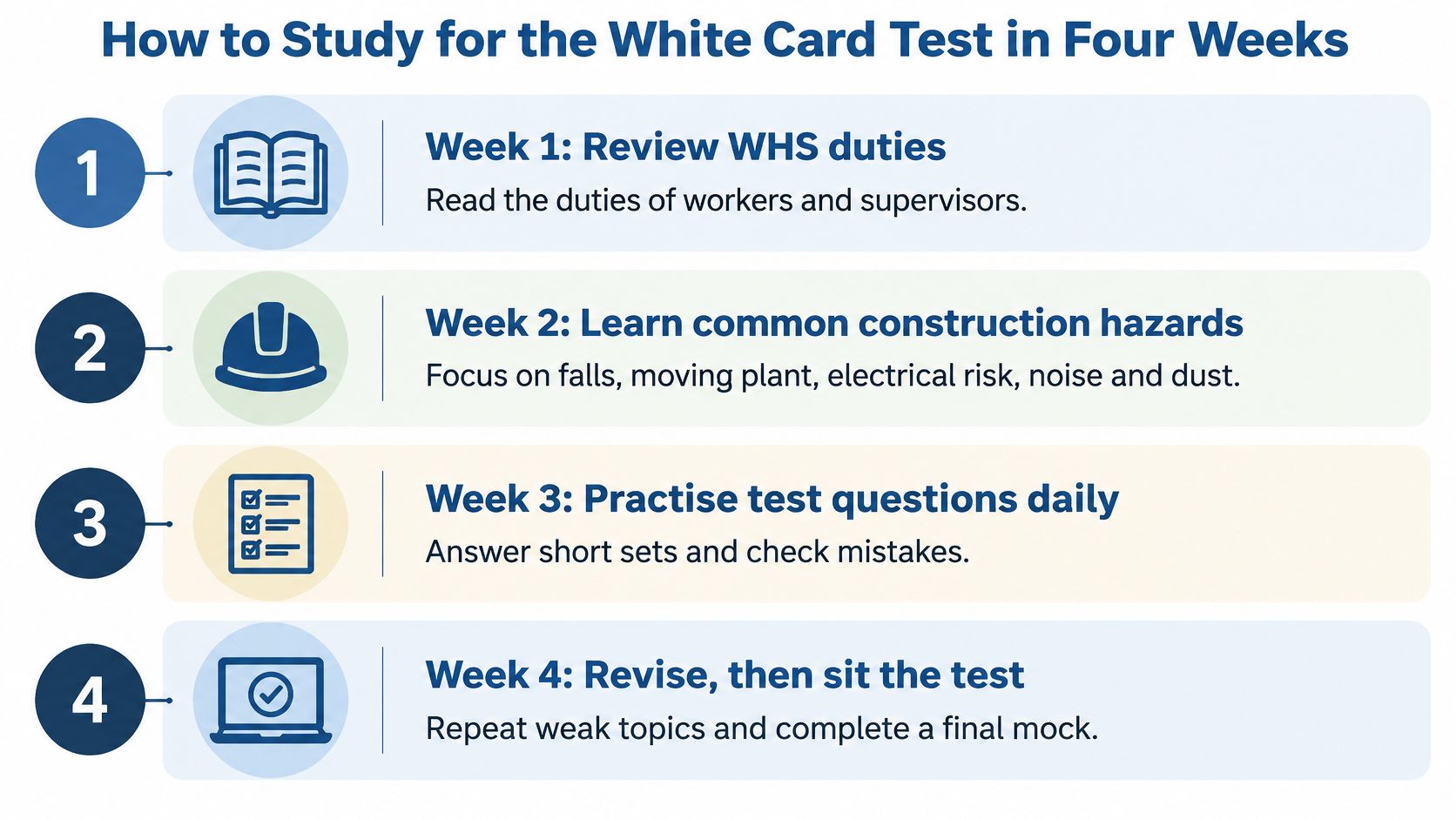
- How to Study for the White Card Test in Four Weeks
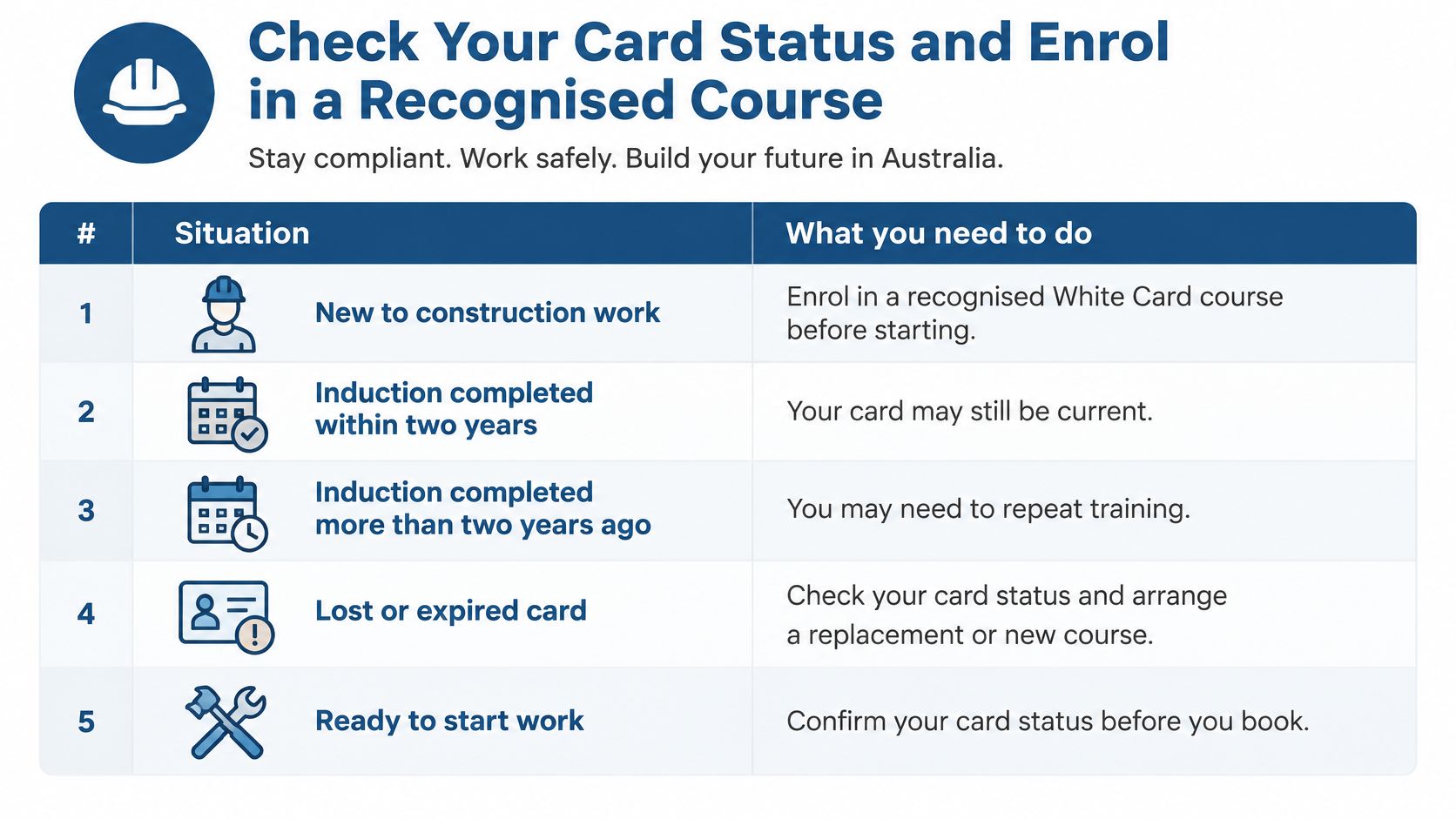
- Check Your Card Status and Enrol in a Recognised Course
Sample White Card Practice Questions and Answers
| Sample question | Correct answer | Why it holds |
|---|---|---|
| Before starting work on a new site, what must you complete? | Site-specific induction and a read of the applicable SWMS | The White Card covers general induction; each site adds its own procedures and relevant task information. |
| A scaffold guardrail is missing and work is going ahead. What do you do? | Stop the affected work, move somewhere safe and report it to the supervisor | Hazards must be reported and immediate danger controlled, not worked around. |
| Which is higher in the hierarchy of controls: PPE or isolating the hazard? | Isolating the hazard | Separating people from danger provides stronger protection than relying on personal protective equipment alone. |
| You completed induction in 2021, did no construction work since, and now want to start. What applies? | Complete general construction induction again | The extended period without construction work means the induction is no longer current. |
| Does a White Card authorise you to operate an excavator? | No | Plant operation requires its own demonstrated competency and any applicable licence. |
| What must you do if an inspector asks for evidence? | Show your White Card | The holder must produce the card to the person conducting a business or undertaking, or an inspector, when requested. |
| How long is a statement of attainment valid while the card is pending? | 60 days | It provides temporary evidence while the card is issued; most cards arrive within 30 days. |
The administrative periods in the final row are specified by SafeWork NSW's White Card guidance, which distinguishes temporary evidence from the card itself.
Understand the reason before memorising the answer
For the induction question, think about what you still don't know when you arrive: vehicle routes, assembly areas and the work happening nearby. A Safe Work Method Statement (SWMS) addresses relevant high-risk construction work, not every possible activity on every site.
For the scaffold question, reporting the defect doesn't make it safe to continue using the scaffold. For the controls question, separating people from the hazard is stronger than asking them to compensate with clothing or equipment.
For the returning-worker question, the important detail is the absence from construction, not whether the old card looks undamaged. For the excavator question, general safety knowledge isn't proof that you can operate a particular machine.
For the inspector question, knowing you completed training isn't the same as producing evidence. For the pending-card question, temporary documentation needs to remain within its permitted period.
Use our guide to on-site safety to connect these answers with everyday workplace decisions. Cover the answer column, say your response aloud, then check whether your explanation matches the reason.
These are revision questions only. They don't replace general construction induction training or the observed assessment conducted by a Registered Training Organisation.
Costly Knowledge Gaps Before You Enter a Site
An old card isn't automatically a current card. Under Safe Work Australia's construction-site guidance, someone who completed induction more than two years earlier and hasn't carried out construction work during the intervening two years must undertake induction again before being allowed to perform construction work.
Say you left construction for another industry and now want to return. Finding your card in a drawer doesn't resolve the currency question. The card records completed induction, but it doesn't, by itself, demonstrate current induction after that extended absence.
Our explanation of White Card validity in NSW can help you distinguish a training-currency issue from a missing physical card.

Recognise the unsafe shortcut
PPE isn't the starting point for every hazard. Say workers are exposed to cutting dust. Choosing a mask immediately skips the question of whether the dusty process can be avoided, changed, enclosed or controlled at the tool. PPE can form part of the solution without being the strongest available control.
Almost finished doesn't mean safe enough. If a damaged electrical lead appears near the end of a task, the remaining workload doesn't justify using it. Stop using the affected equipment, prevent others from using it where safe, and report the defect through the site procedure.
A White Card isn't permission to perform every task. An employer asking you to help with plant, asbestos work or another specialised activity must still establish the relevant competency, training and licensing requirements. Don't interpret general induction as authorisation to take over unfamiliar equipment.
Separate induction from task readiness
- General induction establishes foundational construction safety knowledge.
- Site-specific induction explains the particular workplace, its procedures and its hazards.
- Task-specific instruction prepares you for the activity and equipment you'll use.
A useful practice answer identifies which preparation is missing instead of treating all training as interchangeable.
Practical rule: If an answer lets work continue without resolving the hazard or checking the required competency, examine it closely.
Be cautious about advertised success percentages, too. Australian guidance doesn't publish a nationally standardised White Card pass rate, so a provider's numerical promise needs audited regulator or RTO evidence, not just a confident headline.
Reading Scenario Questions Like an Assessor
The assessment checks whether you can apply safety knowledge in context: identify a hazard, select a suitable control, follow procedures and respond appropriately when something goes wrong. It isn't just a test of whether you recognise WHS abbreviations.
The current unit is CPCWHS1001, Prepare to Work Safely in the Construction Industry, as identified by the Australian Skills Quality Authority. Older guidance may refer to CPCCWHS1001, so don't confuse an older unit reference with confirmation that a particular course is currently approved.
The SafeWork NSW Construction Work Code of Practice covers duty-holder responsibilities, consultation and reporting, risk management, construction hazards and safety documentation. Those subjects belong together: identifying a hazard is incomplete if you can't explain who needs to know or how exposure will be controlled.
Use a consistent reasoning method
- Identify the hazard and the people exposed. Name the actual source of harm. A moving truck, an unsupported excavation edge and pedestrians nearby are more useful descriptions than stating the site is dangerous.
- Decide whether the affected work must stop. Don't select a long-term improvement while leaving someone exposed to immediate danger.
- Work down the hierarchy of controls. Consider elimination, substitution, isolation, engineering controls, administrative controls and then PPE. Explain why your chosen control fits the situation.
- Choose the reporting route. Follow the site procedure, which may involve the supervisor, the person conducting a business or undertaking (PCBU), or a health and safety representative.
- Reject answers that leave the danger unresolved. Be suspicious of options that rely only on being careful, wearing hi-vis or telling someone later.
Read the whole question twice before looking at the options. Notice absolute words such as always and only, but don't assume they automatically make an answer wrong. Check the action against the circumstances.
Work through a reversing-truck scenario
A truck is reversing near an open trench, pedestrians are nearby and no spotter is controlling the movement. Wearing hi-vis doesn't resolve the interaction between the vehicle, people and excavation.
The stronger response is to stop the reversing movement through the agreed safe communication procedure, keep people clear and notify the supervisor. Before movement resumes, the responsible people need to establish suitable controls, such as a properly managed exclusion zone and a trained spotter where required by the traffic arrangements.
Don't walk behind the vehicle to improvise directions. Your answer should explain both what needs to change and how you'll avoid creating another exposure.
For educators considering how to review a learner's explanation and demonstration, video-based assessment strategies from MEDIAL offer broader assessment-design context. They aren't authority for NSW delivery approval or a substitute for an RTO's assessment requirements.
Our guide to construction induction training explains the training context behind these decisions.
A high quiz score can hide unsafe habits. Talk through each scenario until you can explain the safe action without relying on the answer options.
How to Study for the White Card Test in Four Weeks
- Review duties and a familiar hazard. Start each study session by recalling what workers, supervisors and PCBUs need to do. Connect those duties with falls, vehicle movement, manual handling or another construction hazard.
- Apply controls and consultation. Use a short scenario to choose a control and identify who needs to be involved. Don't stop at naming the hazard.
- Explain your decision aloud. Say why you chose that control, why a weaker answer isn't enough and what must happen before work proceeds.
- Get your reasoning checked. Ask a trainer to review your explanation. When arranged through your RTO, practise the demonstration or role-play under assessor observation.
The distinction between practising and being assessed matters. Safe Work Australia's RTO guidance requires direct observation of performance, physically or through real-time audio-visual interaction, and sets out trainer interaction and assessment requirements. It doesn't mean an unattended online quiz can issue a recognised White Card.
Keep a repeatable weekly routine
The session lengths below are suggested revision time, not official course durations or assessment limits. Adjust your self-study around the topics you find difficult rather than rushing through material you can't yet explain.
| Week | Focus | Practice task | Session length |
|---|---|---|---|
| Week 1 | WHS duties and roles | Summarise who has duties under WHS law and list the induction topics | 3 × 30 minutes, suggested |
| Week 2 | Common hazards and controls | List five possible controls each for falls and vehicle movement, then check suitability | 3 × 30 minutes, suggested |
| Week 3 | Hierarchy of controls and consultation | Explain each selected control aloud for three short scenarios | 3 × 30 minutes, suggested |
| Week 4 | Mock scenarios and recency | Complete a timed practice set, then review every wrong answer | 2 × 60 minutes, suggested |
Keep an error notebook with the question, your original reasoning and the safer reasoning. Writing down only the correct letter won't help when the next scenario describes the same hazard differently.
For instance, if you chose gloves for an exposed moving machine part, record why preventing access to the moving part matters more than changing hand protection. Ask your trainer to check any control you're unsure about rather than practising an incorrect explanation repeatedly.
Retrieve answers before checking them
Close your notes before answering. For background on this study approach, Million Whys explains how the testing effect improves recall; use it as study-method reading, not as evidence that a practice score proves workplace competence.
Our workplace safety training guide can also help you connect revision with broader workplace learning. Keep sessions regular, revisit weak topics and remember that self-study supports, but doesn't replace, recognised RTO training and assessment.
Check Your Card Status and Enrol in a Recognised Course
| Your situation | What applies | Next step |
|---|---|---|
| New to construction work | Complete general construction induction through an RTO | Enrol in a recognised course and prepare the required identification |
| Induction completed within two years and construction work since | Your card remains current, provided it hasn't otherwise been cancelled or suspended | Carry the card and show it when asked |
| Induction over two years ago with no construction work since | Induction must be completed again | Re-enrol before undertaking construction work |
| Valid interstate card, not cancelled or suspended | NSW recognises eligible interstate cards, subject to industry-recency requirements | Confirm recognition with SafeWork NSW before work starts |
| Statement of attainment while the card is pending | Temporary evidence can be used during the permitted issue period | Keep the statement and track its validity limit |
The SafeWork NSW recognition fact sheet explains interstate recognition, including the condition that the holder hasn't been out of the industry for more than two years. Moving to NSW alone doesn't mean you automatically need to repeat valid induction.
Resolve the paperwork before your start date
If your physical card is missing, establish whether you need a replacement rather than assuming your training has lapsed. If your induction is no longer current, arrange retraining before accepting a construction-work start date.
Don't rely on a downloadable certificate from an unauthorised website. A polished learning portal doesn't establish that the provider can deliver recognised induction or arrange the relevant card application.
Employers comparing training systems may find UI Lib's guide to choosing between self-hosted and cloud LMS useful for administration decisions. That software choice is separate from checking an RTO's authorisation and a worker's actual evidence.
Our guide to how to get a White Card explains the application pathway. We provide practical, nationally recognised White Card Training Course training with experienced trainers and hands-on learning across NSW; the course takes 7 hours and costs $95.
Prepare your documents
Before booking, check the current course details and establish which documents apply to your situation.
- Identification: Prepare the required 100 points of identification for the RTO.
- Existing evidence: Bring your current card or statement of attainment if you have one.
- Interstate documentation: Keep the issuing-jurisdiction details and evidence needed to confirm recognition.
If you've never completed induction or your training has lapsed, book recognised training. If you've lost a current card, resolve replacement first so you don't pay for unnecessary retraining.
TP Training offers practical White Card safety training to help you develop the knowledge and site-safety reasoning these practice questions introduce. Visit TP Training to check current course details and book recognised training before you start construction work.

You may also like

Asbestos Removal Geelong: Who Can Do It and When

CPR Certificate Online Australia: What Counts in 2026