
White Card Ballarat: Face-to-Face Course Steps for 2026
A Victorian White Card must come from face-to-face construction induction training in CPCWHS1001, with a minimum of six hours at an approved registered training organisation. Online-only courses are not accepted.
Plenty of ads still promise a card after a short login and a quiz. That offer looks convenient, and it fails the Victorian rule. Around Ballarat, three separate gates decide whether you can start: the approved course, the card issued from that course, and the site induction that still follows. Passing one does not open the next. A PDF that looks official, or a plastic card from the wrong pathway, will stop you at the gate just as firmly as having nothing at all.
If you're sorting White Card Ballarat listings this week, throw out any course that never puts you in a room with a trainer.
Table of Contents
- Which White Card Courses Count in Ballarat
- Eligibility, Photo ID and Cards From Other States
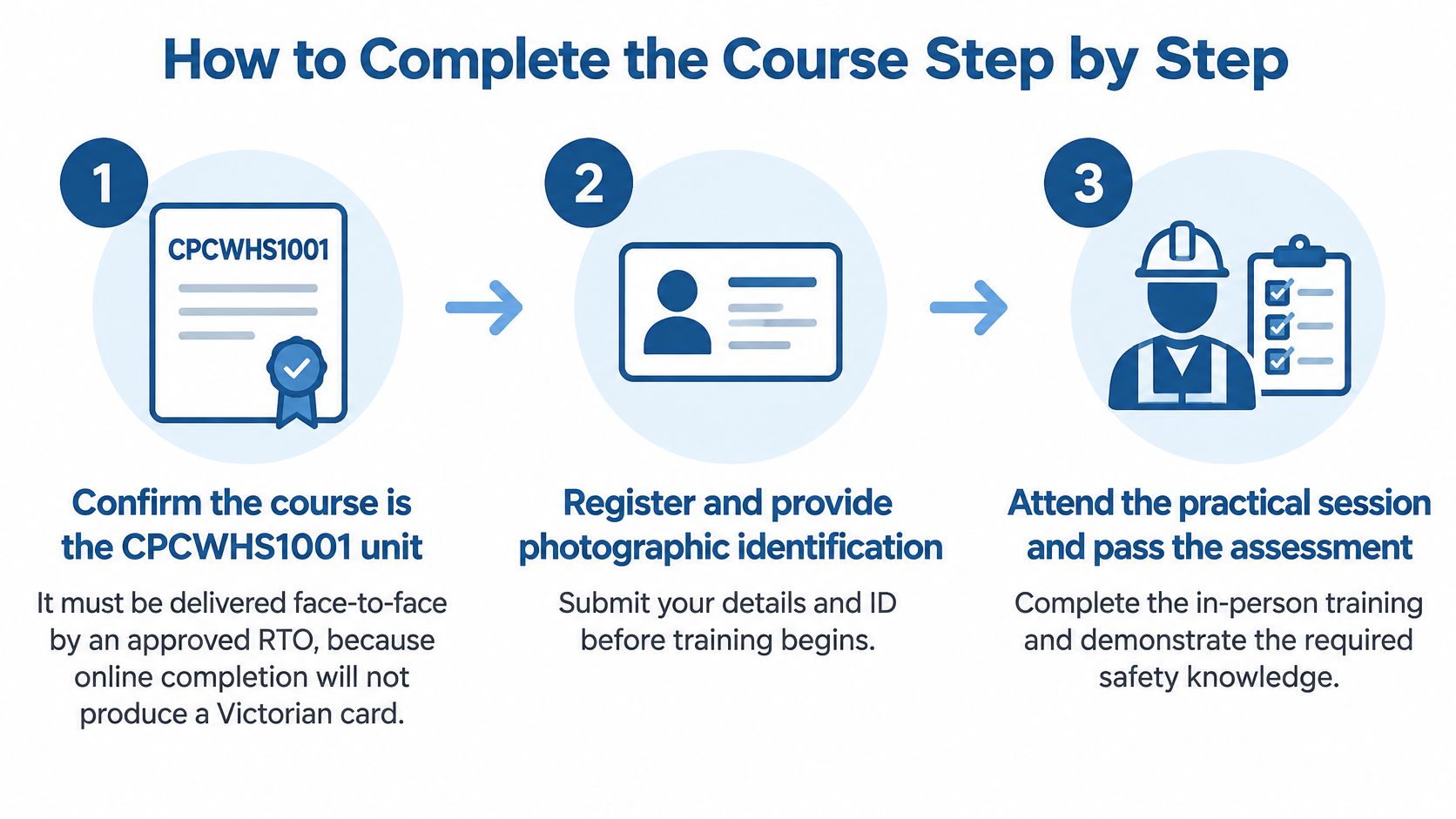
- How to Complete the Course Step by Step
- Hazard, Risk and PPE Skills the Course Tests
- What Happens After You Pass
- Check the Provider and Book Your Course
Which White Card Courses Count in Ballarat
The costly assumption is that any listing with "White Card" in the title will get you onto a Ballarat site. It won't. In Ballarat and across Victoria, the card has to come from face-to-face construction induction training delivered by an approved registered training organisation. Online delivery is not accepted, even when the advert calls the product a White Card course.
The unit to look for in a course outline is CPCWHS1001, Prepare to Work Safely in the Construction Industry. The earlier code, CPCCWHS1001, is still recognised where it applies, so an outline that names that older version is not automatically invalid. What fails is the delivery method and the provider, not a familiar older code on its own.
A certificate can look identical to a valid one and still be useless here. If the provider is not an approved RTO, or the whole course was completed online, that certificate does not satisfy Victoria's construction-induction pathway. Employers who check properly will not treat it as permission to send you to site.
| Option | Accepted in Victoria | Minimum duration | ID required | Notes |
|---|---|---|---|---|
| Face-to-face course at an approved RTO | Yes | 6 hours minimum | Photo ID at registration and on the training day | The only route WorkSafe Victoria accepts |
| Online-only White Card course | No | Not applicable | Not applicable | Not accepted, even when advertised as a White Card course |
| Course from an unapproved provider | No | Not guaranteed | Not guaranteed | The certificate does not satisfy the Victorian pathway |
Read the middle column before the price. A cheaper online option and a dearer unapproved classroom can fail you in the same way.
Practical rule: If the listing is online-only, or it never names an approved RTO, keep looking.
The same trap shows up in claims that a White Card can be finished online. Treat those pages as a reason to check the provider, not as a shortcut.
Eligibility, Photo ID and Cards From Other States
Anyone performing construction work needs a valid construction induction card. An employer must not let someone carry out that work without one. WorkSafe Victoria's guidance on construction is clear on both points. The card covers general induction topics, including workplace health and safety legislation, common site hazards and risk controls. It does not replace any other licence you might need for plant, traffic control or high-risk work.
Photo ID that matches the enrolment
You'll need valid photographic identification at registration, and the same ID again on the training day. The name on the ID has to match the name on the enrolment. Evidence issued under a different name causes trouble when an employer checks you, because the card, the certificate and the ID no longer tell one story.
A card from another state
A common question is whether a White Card from NSW, or from another state, works around Ballarat. The card is recognised across all Australian states and territories, so a card lawfully obtained elsewhere can be recognised in Victoria, including for construction work in this region. Recognition should be confirmed, not assumed.
- Keep proof: Hold the existing card, plus any statement that shows how it was issued.
- Ask the employer first: Confirm they will accept it before you accept the job.
- Ask WorkSafe Victoria if the employer is unsure: Don't guess from a forum post.
- Don't book a second course yet: Enrol again only after recognition is refused or unclear.
What a NSW White Card covers is worth reading if that is the card you already hold, then take the employer's answer as the deciding step.
That check matters in a big local industry. City of Ballarat employment data for 2022/23 recorded 6,150 people employed in construction, 9.9% of all industry employment in the municipality, up 1.9% from 6,035 people in 2021/22, when the sector accounted for 10.1%. A card that is recognised, and documented in the right name, is a common entry requirement in that workforce.
How to Complete the Course Step by Step
On the day, bring the photo identification you enrolled with and the confirmation that shows the unit and the provider. Arrive early enough to sign in and settle, because the trainer starts with a roll check and a short explanation of how the session runs. A trainer leads the day and pauses for questions, so bring the parts of the process that confuse you. The room works like a site induction compressed into a classroom: you will speak, move, handle equipment and work through scenarios with the group.
The seven steps
- Confirm the booking names CPCWHS1001 and an approved RTO before you pay. The usual slip is an advert that never names either. The WorkSafe Victoria construction induction page explains the approval requirement.
- Register in the exact name on your photo identification. A nickname, a shortened surname or a missing middle name is the slip that shows up later on the card.
- Plan the trip before the morning. Arrange a lift or a bus the day before, and leave enough margin to sign in without rushing. Late arrival can put your completion at risk.
- Bring the same photo identification on the training day. It is checked again when you sign in. A photo on your phone does not replace the document you enrolled with.
- Work through the practical and oral activities. The trainer assesses you by watching you do them and speak through them, and the five competency areas are set out next.
- Pass, then collect the evidence of completion before you leave. Ask for both a digital copy and a printed copy. A provider who says the paperwork will "turn up later" with no date is a reason to follow up that day.
- Receive the Victorian construction induction card after successful completion. You are finished when the card and the evidence of completion are both in hand, and the name on each matches the photo identification.
Before a Ballarat employer assigns you to construction work, the business should verify the provider's RTO status, confirm the unit code, retain the evidence of completion, and check that you hold the WorkSafe-issued card. A certificate from an unapproved provider or an online-only course does not meet that checkpoint, even if it was sold as a White Card course.
Ask the provider which class times suit a school or work roster, and block the full day plus travel.
You'll also need a Unique Student Identifier before the enrolment can be finalised. The steps to create and manage your USI take a few minutes if you do them before you arrive, not in the car park.
Hazard, Risk and PPE Skills the Course Tests
The assessor is looking for five practical competencies: spotting hazards, explaining controls, responding to an emergency, fitting PPE and recalling the WHS basics. Trade skills sit outside the unit.
| Competency area | What the assessor asks you to do | Where candidates lose marks |
|---|---|---|
| Hazard identification | Name common construction hazards in a scene and report them aloud | Seeing the hazard but pointing instead of speaking |
| Risk controls | Explain a basic control for each hazard you named | Giving a control that depends on someone else noticing the problem |
| Emergency procedures | Describe who you would alert, how you would call for help and where first aid is | Freezing or saying you would "find someone" |
| PPE selection | Pick eye protection, hearing protection and a hard hat, then fit them | A loose hat, goggles on the forehead or earmuffs that do not seal |
| Workplace health and safety basics | Recall the core WHS duties covered in the unit | Treating the questions as legal trivia instead of site practice |
Your result is recorded against those five areas. The card is issued later, once the provider processes the completion.
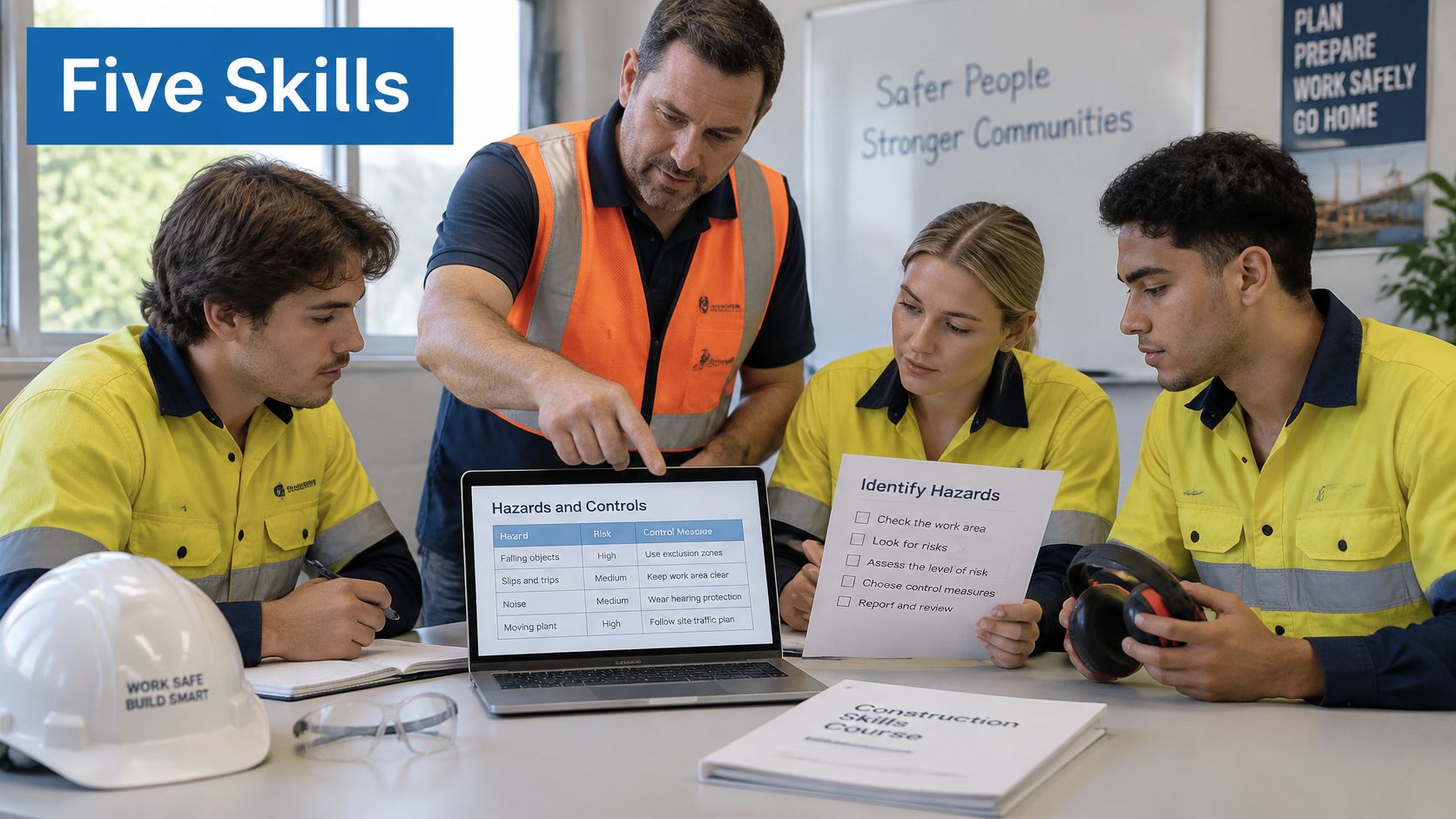
What a Ballarat site example looks like
Say you're walking a new subdivision on the edge of Ballarat. An unguarded trench edge, or a cable lying across the walkway, is a hazard you should spot and report aloud. Oral reporting is part of the assessment, so pointing without speaking is not enough. You name the hazard, say where it is, and tell the person responsible.
Risk control follows in the same answer. Barricade the trench edge, move the cable off the walkway, or stop work until a supervisor responds. A control that exists only in your head does not protect the next person who walks through.
Emergency procedure at this level means you can say who you would alert, how you would call emergency services and where the first-aid point is. In the subdivision example, that might be the site shed, with the supervisor called on the radio before anyone touches the cable or leans over the trench. You are not expected to run a rescue. You are expected to avoid freezing or wandering off to find someone.
PPE in the unit names three items: eye protection, hearing protection and a hard hat. A loose hat, goggles sitting on your forehead, or earmuffs that do not seal give little protection. The trainer will ask you to select the item and fit it, not just name it.
Trade skills, plant operation and high-risk work licences sit outside this unit. If the job needs a forklift licence, a crane ticket or a traffic control card, that is a separate qualification. The general induction tests your ability to notice and report, which carries over to a live Ballarat site before the project induction begins.
Short practice questions help these skills stick. Techniques for making useful practice quizzes are a practical way to turn "name three hazards" into prompts you can answer out loud before assessment day. For a wider look at induction-style safety topics, see workplace safety training options.
What Happens After You Pass
Your first morning on site starts with a second induction. The supervisor walks you through this project's layout, its current hazards, its traffic plan and its muster point, and you sign in. A general course cannot describe an excavation dug last week or a traffic route that changed on Monday, so the induction gets repeated site by site for as long as you work in construction.
That gap is where most Ballarat booking pages lose the reader. The card gets sold as a finish line, and people arrive expecting the gate to open on its own. The national training standard for CPCWHS1001 treats the site-specific induction as a separate step, delivered by the employer before construction work begins.
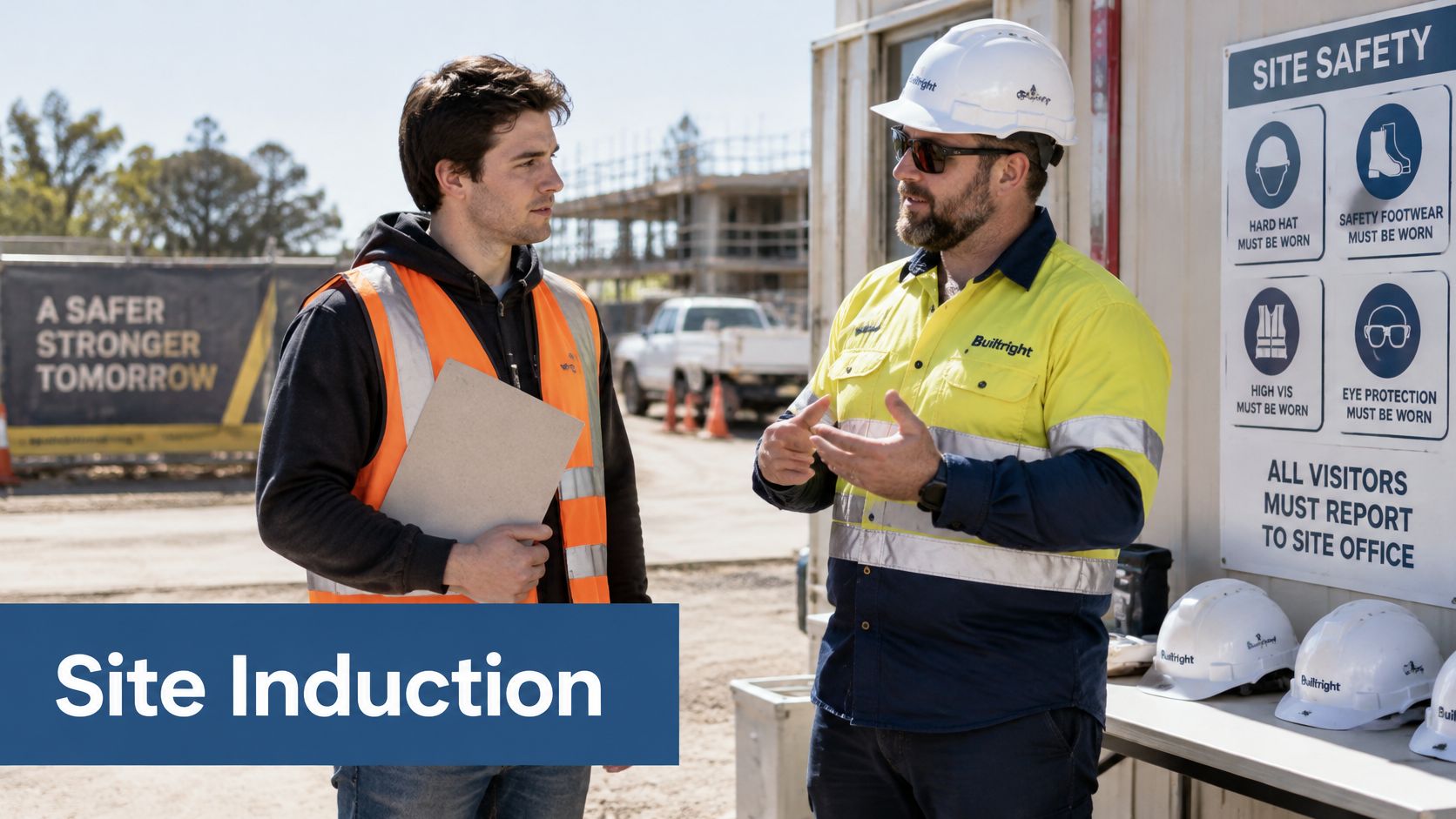
A first morning on a Ballarat site
Bring photo identification and your evidence of completion, wear practical clothing and enclosed footwear, and expect the first hour to be induction rather than a task. Some supervisors hand you a short check: name the hazards you can see, point out the amenities, confirm how you would raise a problem. Answer in your own words. "I'd tell someone" is thinner than "I'd barricade it and radio the leading hand".
Confirm the employer's requirements before you travel. Some ask for the plastic card, some accept the evidence of completion while the card is still being issued, and some want both plus a second form of ID. A digital copy on your phone alongside the paper one saves a trip home.
The card certifies general induction. Trade competence, high-risk work licences and plant experience sit outside it. If someone points at a machine and says your White Card covers it, say plainly that it does not.
What you do with the crew matters more than the certificate in your wallet. Report a hazard the same day, in plain words, naming the location and the person responsible, instead of waiting for a supervisor to notice. Construction induction training covers the general rules once. The site conversation is what repeats every shift.
Check the Provider and Book Your Course
A provider that isn't on the national register can't issue you a card, and no amount of glossy advertising fixes that once you've paid. Spend two minutes on this before you spend anything else.
- Search the register by code. Take the RTO number shown on the provider's website and search the national register for that number. Check that the registered name matches the name on your invoice. A trading name in a social media ad does not tell you who holds the registration.
- Find the unit code on the outline. The page you book from should name CPCWHS1001 or CPCCWHS1001 in the course description itself, not in an email that arrives after payment. If the code isn't there, ask for it before you enter card details.
- Request the assessment outline in writing. A registered provider can tell you the format, what you'll physically do on the day and which ID to bring. A reply that describes footage you can rewatch at home has answered a different question.
Write the RTO number and the unit code into your own notes at enrolment. Employers and site supervisors sometimes ask for both, and "I think it was a safety course" gets you nowhere at the gate.
Five minutes before you pay
- Register entry: Screenshot the listing with the RTO number and registered name visible, so you can produce it later if an employer asks who trained you.
- Written outline: Keep the email or page that states the unit code, the face-to-face format and how you'll be assessed on the day.
- Name on the ID: Enrol under the exact spelling printed on your photo ID. A mismatch at the door usually means losing the day, not just a delay.
- Day plus travel: Block the full session and the travel either side of it. A late arrival can void your place in a course that runs to a set minimum length.
White Card Training Course delivery from TP Training runs as a seven-hour Construction Induction session with the unit code and price published on the course page before you book. If your work is in Victoria, apply the same three checks to whichever provider you choose: register entry, unit code on the outline, assessment method in writing. The course is the start of safe site behaviour, and the site induction that follows on your first morning is where you apply it.

You may also like
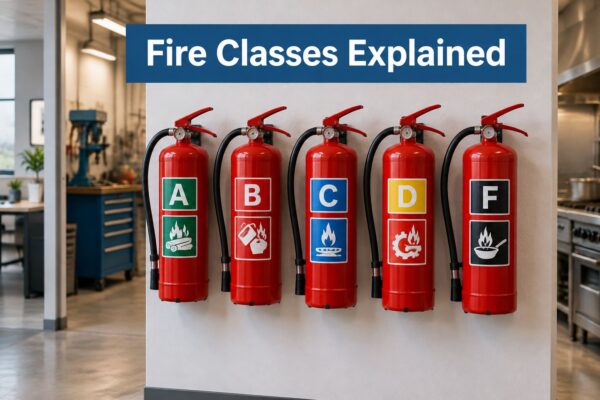
Different Classes of Fire Extinguishers: A Workplace Guide

Childcare First Aid Training: What Services Need in 2026