

Construction White Card Online: Is It Valid in NSW?
You can complete a construction White Card online in NSW only when a registered training organisation delivers live, observed training and assessment, with at least six hours of training. A self-paced video course with an unsupervised quiz doesn't qualify.
If a website lets you book and pay online, does that mean you can complete the actual qualification online too? Not necessarily. Online booking, online learning, a Statement of Training and the state-issued White Card are different things, and confusing them can leave you without acceptable evidence when an employer asks you to start.
The practical approach is to check who delivers the training, how the assessor observes you and what evidence you'll receive afterwards. Returning workers also need to check their construction work history, not just whether they still have a card in their wallet.
Table of Contents
- Which Online White Card Formats Meet NSW Rules
- What the Course Covers and Why It Matters
- Enrol and Finish Online Training Without Delays
- Keeping Your White Card Valid and Recognised
- Interstate Cards, Site Inductions and High-Risk Work
- What to Do If You Miss a Deadline or Lose Evidence
- Check Course Compliance Before You Pay
Which Online White Card Formats Meet NSW Rules
The common assumption is that an online course is valid because its website advertises a White Card. In NSW, the delivery method matters more than the wording on the booking page. Live online training can meet the requirements; an unattended collection of videos and questions cannot.
A trainer needs to communicate with you, verify your participation and observe your assessment. A downloadable certificate doesn't establish that those things happened.
Online White Card formats and whether they meet NSW rules
| Delivery format | Accepted for a White Card? | What to check before booking |
|---|---|---|
| Self-paced online course with unsupervised quiz | No | Videos and quizzes alone do not show competency |
| Live online class with real-time audio-visual trainer | Yes, if run by an approved RTO | Trainer must observe and interact with you throughout |
| Blended online theory plus in-person practical | Yes, if the practical is observed and the full delivery meets NSW requirements | Confirm where and when the practical assessment happens |
| Fully face-to-face classroom course | Yes, through an approved RTO | The same training minimum and assessment rules apply |
| Online booking platform with statement issued later | Not enough on its own | Confirm the RTO itself delivers and assesses the training |
For blended delivery, an observed practical isn't a workaround for unsuitable theory delivery. Ask whether the complete course, including its online component, meets NSW requirements.

What live and observed actually means
Safe Work Australia's White Card training guidance specifies direct observation, physically or through real-time audio-visual media, a minimum of six hours of training excluding administration and identity verification, completion within two weeks, and no more than 10 learners in a learning session, although a regulator may impose a lower limit.
Where connected real-time delivery is approved, the guidance also requires live trainer interaction and individual or face-to-face training and assessment interaction. Being logged into a meeting while your camera is off isn't equivalent to demonstrating competence.
Your setup therefore matters. Use a device with a working camera and microphone, position it so the assessor can see your practical demonstrations, and choose somewhere you can speak without interruption.
A quick provider test
Before paying, get clear answers to these questions:
- Live trainer: Will a trainer teach and interact with me in real time?
- Identity checks: What identification must I provide before training starts?
- Observed assessment: How will the assessor watch my practical tasks and confirm they're my own work?
Practical rule: A booking confirmation proves you reserved a place. It doesn't prove you completed construction induction training.
If the provider's answers focus only on instant access, downloadable certificates or unlimited quiz attempts, keep asking about the actual assessment.
What the Course Covers and Why It Matters
Think of a White Card like a learner's permit. It establishes basic safety knowledge, but it doesn't qualify you to operate every vehicle or machine you encounter.
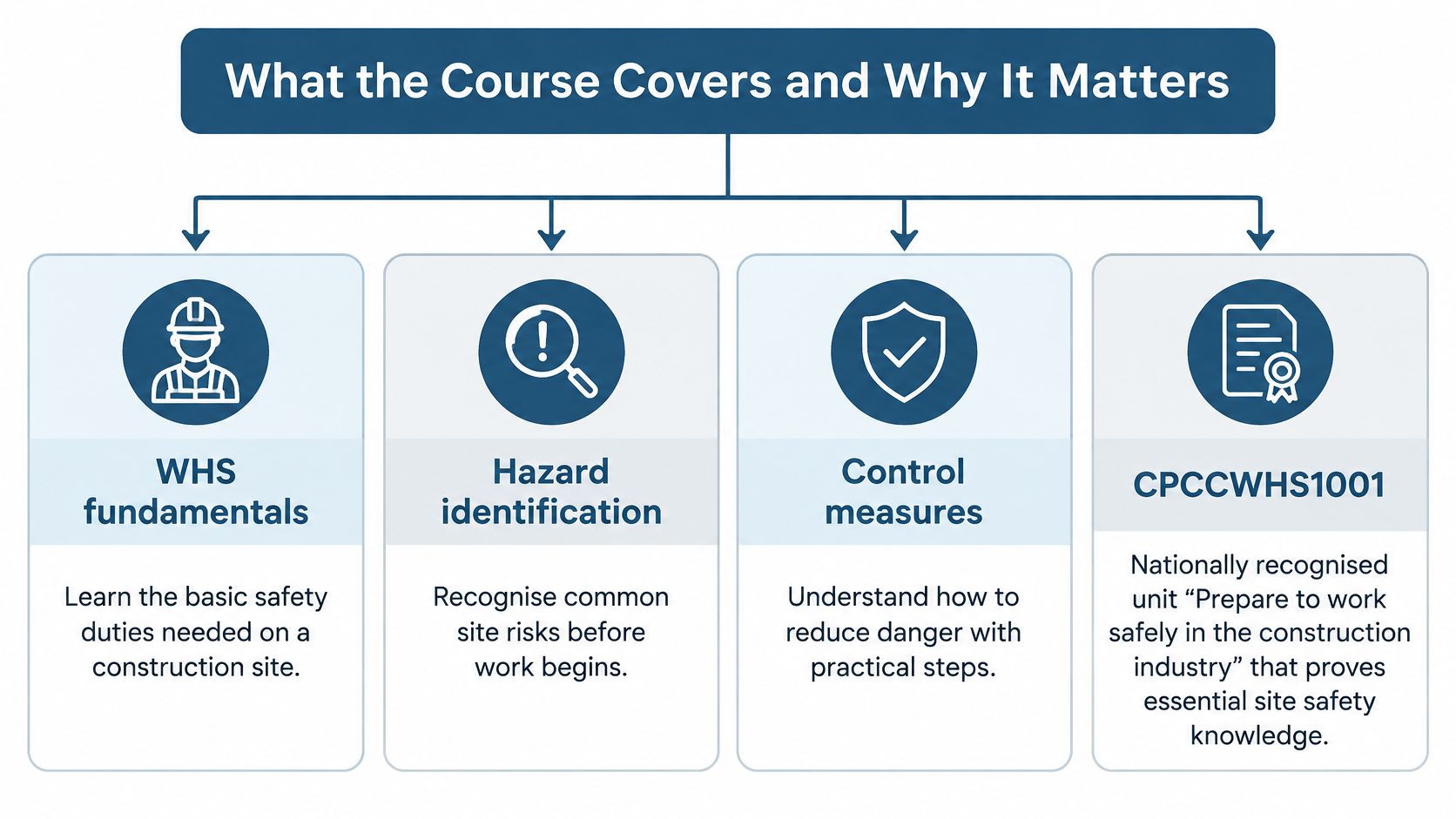
The nationally recognised unit identified in construction induction guidance is CPCCWHS1001, Prepare to work safely in the construction industry. Its purpose is to establish essential safety understanding before construction work begins, rather than teach a complete trade.
Follow a walk around a house slab
You arrive beside a house slab while a delivery vehicle reverses towards stacked materials. A worker is carrying reinforcement, an electrical lead crosses an access route and someone is preparing to work near an unprotected edge.
The course teaches you to recognise moving plant, manual-handling risks, electrical hazards, falling objects and falls from height. You learn to connect each hazard with a sensible control rather than just name the danger.
For the delivery vehicle, separating pedestrians from its operating area is more useful than relying on a high-visibility vest alone. For materials handling, a mechanical aid or a different delivery position may remove the need for a difficult lift.
Move from spotting hazards to acting safely
The hierarchy of control starts with eliminating the hazard, then considers substitution, isolation and engineering controls before administrative controls and personal protective equipment. PPE matters, but a hard hat doesn't stop an unsecured load from falling.
The course also introduces the responsibilities of workers and those managing construction work. Workers need to follow reasonable safety instructions, use equipment correctly and report hazards; the principal contractor coordinates site arrangements rather than leaving each trade to invent its own system.
Consultation means speaking up when a task changes or a control doesn't work. Emergency preparation includes understanding alarms, reporting incidents, finding assembly points and avoiding actions that expose another person to danger.
Our guide to workplace safety training provides useful context for connecting induction knowledge with everyday work practices.
Try a short exercise before class:
- Choose a setting: Use a house slab, excavation or civil works job.
- List five hazards: Include people, equipment and the surrounding environment.
- Match each hazard to a control: Prefer removing or separating the danger over relying only on PPE.
The aim isn't to memorise a site rulebook. It's to learn how to notice a problem, communicate it and take an appropriate next step.
Enrol and Finish Online Training Without Delays
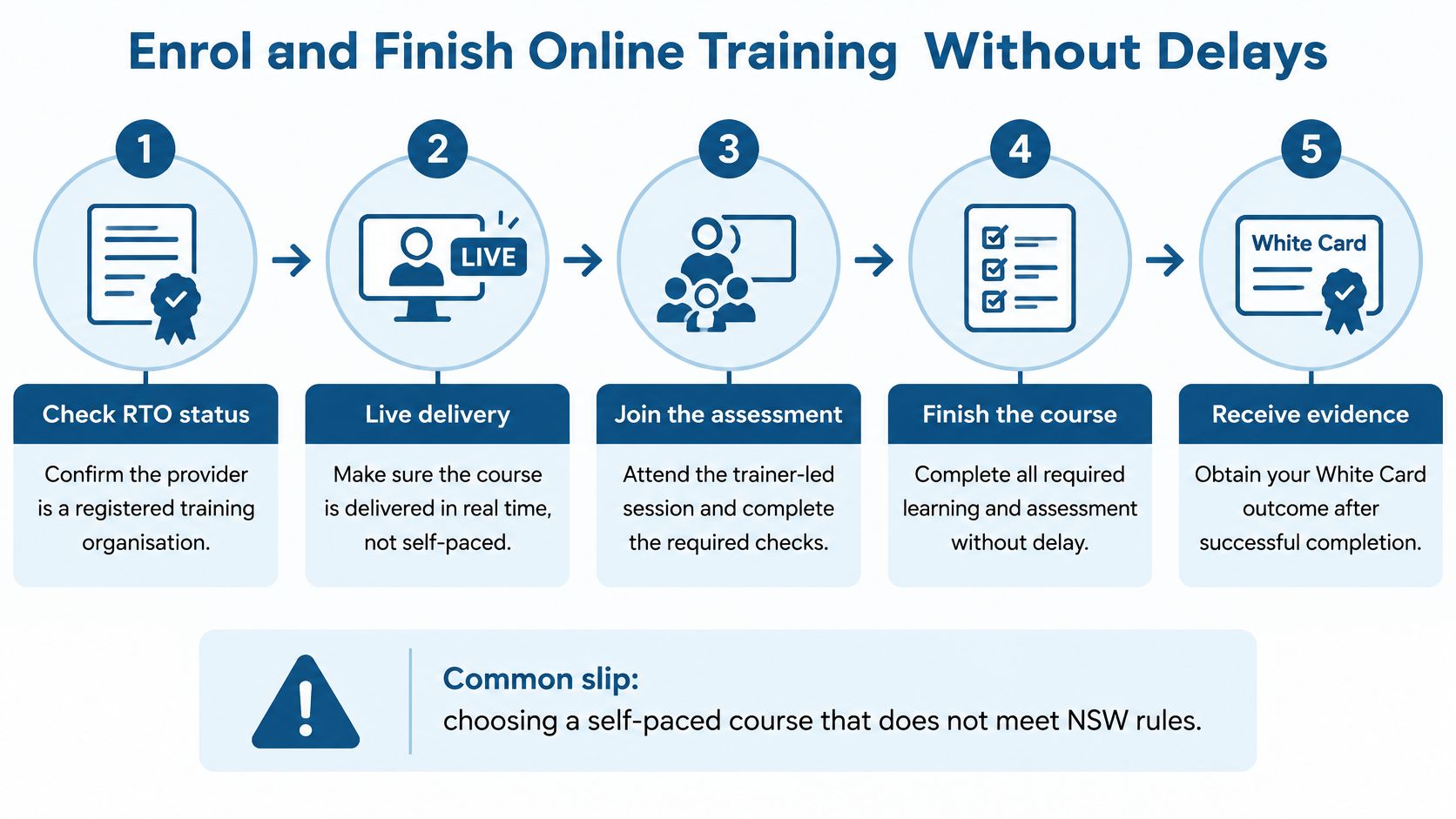
Treat enrolment as a sequence of checks, not a payment followed by an automatic card. Each stage establishes something different: your identity, participation, competence or entitlement to receive the final credential.
Safe Work Australia's construction-site guidance explains that workers need construction induction evidence before starting construction work and must be able to show it to the person conducting a business or undertaking and inspectors.
Prepare before the live session
Confirm the training organisation. Identify the RTO delivering and assessing the course, not just the company collecting the booking. Check that its proposed format meets NSW requirements. The common slip is assuming a polished booking website is the training provider.
Book a session you can attend properly. Check the class arrangements and test your internet, camera and microphone the day before. Use a quiet room, charge your device and log in early. A noisy phone connection makes it harder to hear instructions and demonstrate understanding.
Prepare your identification. Follow the RTO's accepted-document instructions and make sure your booking name matches your ID. Have the documents ready for verification before training starts. If you need help preparing your student details, use our guide to creating and managing your Unique Student Identifier.
Participate throughout the training. Keep your camera positioned correctly, respond to the trainer and ask questions when a safety concept isn't clear. Don't assume silent attendance is enough. A switched-off camera can prevent the trainer from verifying participation.
Finish the assessment and organise your evidence
Complete the observed assessment within the required completion window. Read each question carefully and let the assessor finish instructions before starting a demonstration. Ask for unclear wording to be repeated rather than guessing. Leaving assessment until the deadline creates avoidable problems if your connection fails.
Receive the correct completion evidence. After successful completion, the RTO issues the NSW Statement of Training and submits the card application to SafeWork NSW. Save a readable PDF and check your name and other details immediately. Don't confuse this document with a booking receipt or attendance email.
Keep temporary evidence accessible while the card is processed. Under the NSW White Card application process, the Statement of Training can be used for up to 60 days, and the physical card generally arrives within 30 days. Store the statement somewhere you can retrieve without searching through old emails.
Record your finish date and follow-up dates. Add reminders for the expected card delivery and the end of your statement's permitted use. Check your postal address and photograph the physical card when it arrives for your records. A photograph is useful for retrieving details, but don't assume every workplace will accept it instead of the required credential.
A finished enrolment means you have usable evidence, a clear application status and a recorded follow-up date. Avoid the rushed-start scenario: joining from a noisy phone, missing live interaction and discovering later that the assessor couldn't verify essential parts of your participation.
Keeping Your White Card Valid and Recognised
An old White Card isn't automatically usable just because the plastic looks intact. For returning workers, recent construction experience is the critical check.
Service NSW's White Card replacement guidance states that a White Card becomes void when the holder hasn't done construction work for two consecutive years or more, and retraining is required. That makes “White Cards don't expire” an incomplete answer.
White Card status by situation
| Situation | Card status | What to do |
|---|---|---|
| Card held and construction work within the last two years | Valid while the issuing state recognises it | Carry the card and complete the site induction |
| No construction work for two consecutive years or more | Void; retraining required | Enrol in a new White Card course |
| Course finished, physical card not yet received | Statement usable during its permitted temporary period | Show the statement and ID, and monitor delivery |
| Card cancelled, suspended or expired | Not recognised | Follow the regulator's reinstatement, replacement or retraining directions |
| Card lost or damaged, otherwise current | Loss alone doesn't establish that the underlying credential is invalid | Request a replacement from the issuing state |
Check duties, not just job titles
Construction work history should describe what you did. A job title such as warehouse assistant, maintenance worker or project administrator doesn't establish whether your duties involved construction work.
Keep employer letters, payslips, contracts or tax records that help establish dates and duties. These are practical supporting records, not a guaranteed regulator-approved evidence checklist. An employer letter describing the project, work performed and employment period is more informative than a payslip with no description of your role.
If your work was mixed or occasional, ask the regulator how the rule applies before relying on an old card. Don't assume that visiting a construction office or holding a construction-related job title establishes ongoing construction work.
A card can look current while the holder's work history makes it unusable.
Career changers and migrants should check this before applying for site roles. Replacing a missing card won't resolve an industry-absence problem, and a new employer can't remove the need for retraining.
Our explanation of construction induction training can help you distinguish general induction from other workplace training.
If your absence is shorter than the threshold and the issuing jurisdiction still recognises your card, retain it and organise acceptable evidence. If the absence rule applies, complete fresh training before taking up construction work.
Interstate Cards, Site Inductions and High-Risk Work
A valid White Card settles your general induction requirement, not every question about starting a job. Your employer still needs to check where the card is recognised, what the site requires and which tasks you're competent to perform.
Interstate recognition and site access
White Cards are recognised across Australia, but the physical card and a state's digital display aren't necessarily interchangeable everywhere. The NSW digital White Card is optional and may not be recognised outside NSW, so carry the physical card when working interstate.
An interstate card brought into NSW must remain valid in its issuing jurisdiction and must not have been cancelled, suspended or expired. Recent construction work history still matters. Before travelling, check the receiving employer's evidence requirements rather than arriving with only an app screenshot.
A separate site-specific induction is also required whenever you start at a new construction site. The contractor needs to explain local arrangements such as delivery routes, exclusion zones, amenities, emergency assembly points and reporting contacts.
General induction teaches you to recognise an emergency arrangement. Site induction tells you where this site's assembly point actually is.
Ask for that induction before beginning work, even if you've worked for the same contractor elsewhere.
Your card doesn't authorise every task
Crane operation, forklift work and elevating work platform operation require separate consideration of licensing and competency requirements. The exact requirement follows the equipment and task, not the fact that you already hold a White Card.
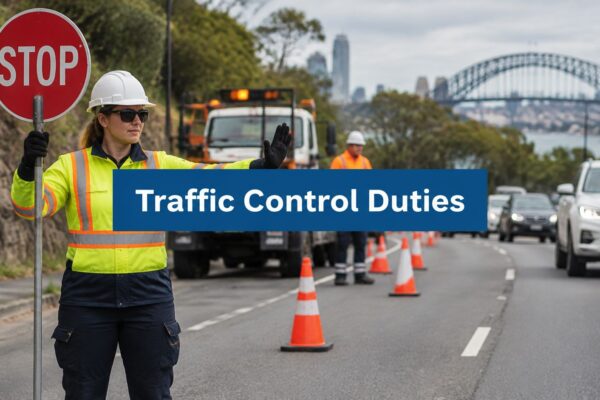
Traffic control on roads also needs its own training. Our guide to high-risk work training explains why general induction and task-specific preparation serve different purposes.
Before starting, check:
- Evidence ready: Carry your accepted induction evidence.
- Local induction completed: Know the site's routes, emergency arrangements and reporting process.
- Tasks confirmed: Ask your supervisor which activities you're authorised and competent to perform.
If someone asks you to operate unfamiliar plant, stop and clarify your authorisation before touching the controls.
What to Do If You Miss a Deadline or Lose Evidence
A missed assessment, delayed card and lost credential need different solutions. Start by identifying which document or stage is affected rather than paying for another course automatically.
When training or delivery is delayed
If you can't finish assessment within the course completion window, contact the RTO before it closes. Ask what remains outstanding and whether its policy allows reassessment, another session or re-enrolment. Don't assume an extension is automatic.
If the physical card hasn't arrived by the expected delivery time, check the application status with the RTO. Confirm your postal address, keep your Statement of Training and ID accessible, and contact SafeWork NSW if the delay remains unresolved.
Temporary evidence doesn't become permanently valid because delivery is late. Check your statement's permitted-use dates before accepting another shift.
When the evidence itself is missing
For a lost or damaged but otherwise current card, request a replacement from the issuing jurisdiction. Our guide to finding your White Card number can help you organise the details needed for that enquiry.
A cancelled or suspended card requires the regulator's directions, not an ordinary replacement order. Establish what must happen before the credential can be recognised again.
Keep unrelated credentials separate too. If a civil role also involves drones, you can find answers about drone pilot training from Ace Aviation Aerospace Academy, but aviation training doesn't replace construction induction evidence.
Use this recovery sequence:
- Record the dates: Note training completion, application submission and the temporary-evidence deadline.
- Contact the right organisation: Start with the RTO for training or application questions, and the issuing regulator for card-status issues.
- Confirm usable evidence: Don't begin construction work until you hold the physical card or a valid Statement of Training accepted for the work.
Check Course Compliance Before You Pay
Choose a course by checking the delivery and evidence process first, then comparing price. A cheap booking isn't good value if it doesn't provide the training and assessment you need.
Pre-booking checks for an online White Card
| Check | What to confirm |
|---|---|
| RTO status | Provider is a registered training organisation approved to deliver the training |
| Delivery | Live or compliant blended delivery with an observed practical, not unattended self-paced training |
| Duration | Required training time excludes administration and identity checks |
| Assessment | Directly observed by an assessor |
| Statement | Correct evidence issued by the RTO after successful completion |
| Price | Clear total with no hidden fees; government fees stated separately |
Compare the timetable with the actual training
A course's advertised duration doesn't prove compliance by itself. Check how the provider separates teaching, breaks, identity verification and assessment, and whether you can attend every required component.
TP Training's White Card Training Course provides practical, nationally recognised training with experienced trainers and hands-on learning across NSW. Our White Card Safety Training Course takes 7 hours and costs $95.
That advertised duration exceeds the minimum training length, but learners should still confirm the current delivery format and calendar before booking. Don't assume a course is available remotely because its booking system is online.
Government-regulated credentials such as White Card may require additional application fees paid directly to the relevant authority. Include any applicable authority charge in your budget rather than assuming the training price covers every possible cost.
Keep convenience separate from compliance
Digital tools can help you organise learning and work, but they don't replace assessment or authorisation. For broader reading about workplace technology, Truespeak's construction AI guide offers a separate resource; use technology to support your work, not to generate answers for a competency assessment.
Before paying, write down:
- Course date and format: Know whether you're attending a classroom or an approved live session.
- Identification: List the accepted documents you'll present.
- Completion deadline: Record when your assessment must be finished.
- Evidence process: Know what you'll receive and who submits the card application.
If any of those details is unclear, resolve it before booking. You should be able to explain your pathway from enrolment to usable evidence without relying on the word “online” to fill the gaps.
TP Training offers practical construction induction training with experienced trainers across NSW. Visit TP Training to check the current White Card course format and calendar, then prepare your identification and record your training date before booking.

You may also like
Traffic Control Responsibilities in NSW Explained

Most Dangerous Jobs in Australia: 10 High-Risk Roles
