High Risk Work Solutions in Australia: A Practical Guide
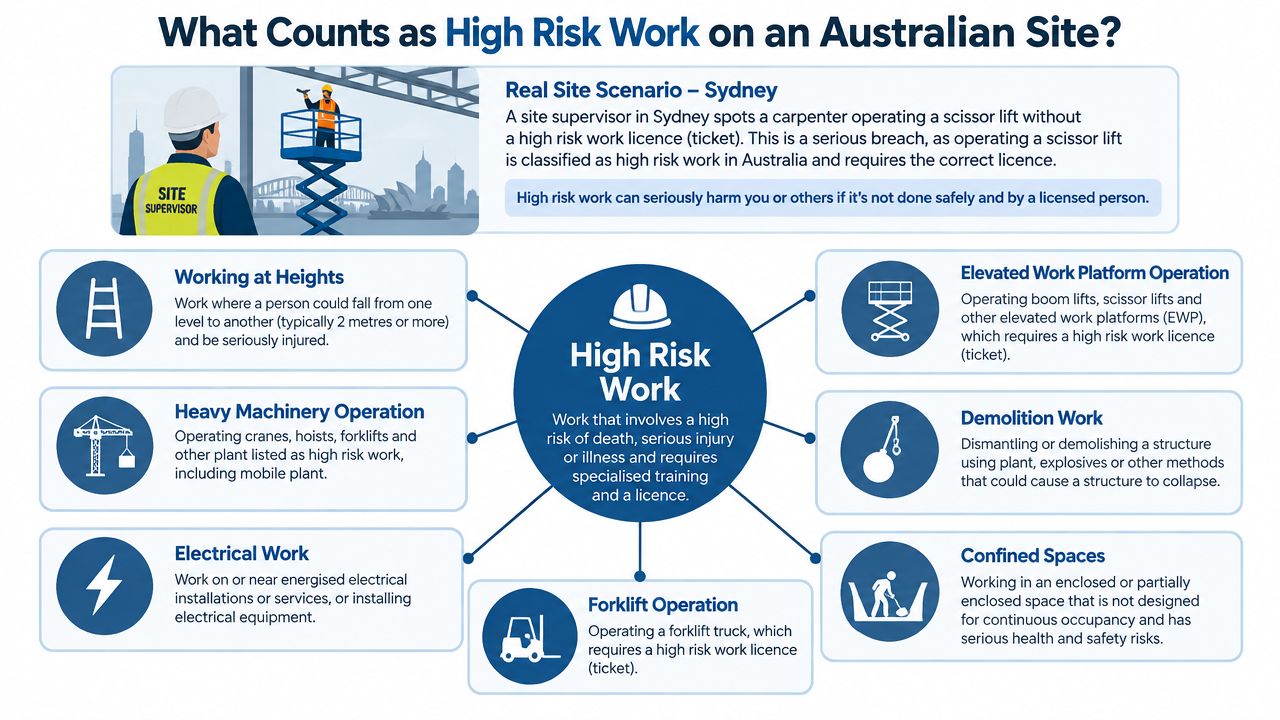
You're halfway through a busy morning on a Sydney construction site when you notice a carpenter working from a raised platform. The machine looks familiar, the job appears routine, and the worker has completed the site induction. Then you check the licence details and realise the ticket doesn't match the plant, or there isn't a high risk work licence at all.
That moment is where a practical safety system starts. High risk work solutions aren't just about booking a course or checking a plastic card. They connect the actual task, the hazard, the licence class, the Safe Work Method Statement (SWMS), supervision, and the worker's demonstrated ability to perform the job safely.
Table of Contents
- What Counts as High Risk Work on an Australian Site
- Licence Classes and the National High Risk Work Framework
- Core Training Pathways for High Risk Work Solutions
- Matching the Right Licence Class to the Task
- Control Measures That Sit Alongside Licensing
- The Regional NSW Challenge Most Guides Miss
- Building a Compliant High Risk Work System Step by Step
What Counts as High Risk Work on an Australian Site
A construction site can contain ordinary tasks and high risk construction work at the same time. Carrying materials across a slab might be general construction work. Operating a crane to lift those materials over people, working beside live services, or using a platform where a fall could cause fatal harm changes the control requirements.
Safe Work Australia identifies high risk construction work through the hazard and the way people are exposed, not just through a worker's job title. The relevant triggers include falls from more than 2 metres, trenches deeper than 1.5 metres, energised electrical installations, confined spaces, asbestos disturbance, pressurised gas lines, flammable atmospheres, roads and rail corridors, powered mobile plant, and water-related drowning hazards. These categories are set out in the national guidance on managing construction risks.
Start with the hazard, not the trade
The same worker can perform a low-risk task in one area and a regulated task in another. A carpenter assembling frames at ground level isn't automatically performing high risk work. That carpenter may need a different level of competency when operating a boom-type elevating work platform, moving suspended loads, or working near energised services.
This is why supervisors should ask three questions before work starts:
- What can cause a fatal or life-changing injury?
- Which equipment, environment, or work method creates that exposure?
- Does the task require a specific licence, SWMS, isolation, exclusion zone, or competent supervision?
The model WHS framework covers prescribed high risk work such as scaffolding, dogging, rigging, crane and hoist operation, forklift operation, and certain pressure equipment work. High risk work licensing is separate from a general construction induction card and separate from a site-specific induction.
Practical rule: A licence shows that a worker has been assessed for a defined class of work. It doesn't prove that every site condition has been controlled.
The same principle applies outside construction. Before pruning or removing trees near structures, roads, powerlines, or public areas, a supervisor may also need a specialist assessment of the hazard environment. Guidance on why you need a tree risk assessment can help explain why the condition and location of the work matter as much as the job description.
For a plain-language overview of how hazards, controls, and responsibilities connect on a building project, see risk management in construction. The working mental model is simple: identify the hazard profile first, then confirm the licence and documented controls.
Licence Classes and the National High Risk Work Framework
The national high risk work system uses defined licence classes so a worker's competency matches the plant or activity. A worker must generally be 18 or older and hold the correct current licence before performing regulated high risk work. Safe Work Australia explains the licensing framework and national recognition of high risk work licences through its guidance on high risk work licences.
A SafeWork NSW high risk work licence is issued after training and assessment through an RTO and an authorised assessor. The card is evidence of competency in a particular class, not a general authorisation to operate anything that looks similar.
Seven high risk work licence classes at a glance
| Licence Class | Work Covered | Unit of Competency |
|---|---|---|
| Scaffolding | Basic, intermediate, or advanced scaffolding work, depending on the class | Relevant scaffolding unit |
| Dogging | Selecting slings, inspecting lifting gear, attaching loads, and directing crane operations | Relevant dogging unit |
| Rigging | Structural steel, plant, equipment, and load movement tasks covered by the relevant rigging class | Relevant rigging unit |
| Crane and hoist operation | Operation of defined crane and hoist types, including slewing mobile cranes | Relevant crane or hoist unit |
| Forklift | Operation of forklift trucks | Forklift licence unit |
| Pressure equipment | Operation of prescribed boilers and pressure equipment | Relevant pressure equipment unit |
| Boom-type EWP | Operation of a boom-type elevating work platform with a boom length of 11 metres or more | TLILIC0005 |
The detailed class boundaries matter. A dogger's competency isn't automatically the same as a rigger's, and a forklift licence doesn't authorise crane operation. Employers should compare the work method, plant configuration, and licence class before allocating the job.
Each high risk work licence is generally valid for 5 years across Australia, subject to the state or territory issuing arrangements. Safe Work Australia's licensing information states that workers must hold a current licence for the high risk work they perform. Renewal tracking therefore belongs in the business's operational calendar, alongside competency records and medical or site requirements where relevant.
Workers can enter through an RTO training pathway and assessment, while experienced operators may be eligible for an assessor-led pathway where the applicable rules allow it. Either way, competency must be demonstrated against the relevant nationally endorsed unit. Practical observation matters because a written answer alone cannot show whether a worker can inspect equipment, communicate clearly, set up safely, and complete the task under realistic conditions.
For a closer NSW-focused explanation of the card, class boundaries, and renewal responsibilities, read this guide to a high risk work licence in NSW. TP Training provides practical, nationally recognised Courses training with experienced trainers and hands-on learning across NSW.
Core Training Pathways for High Risk Work Solutions
A strong training pathway starts before enrolment. The employer or worker needs to identify the intended task, confirm the equipment, check the relevant licence class, and establish whether the learner has the language, literacy, numeracy, and practical foundation skills needed for the unit.
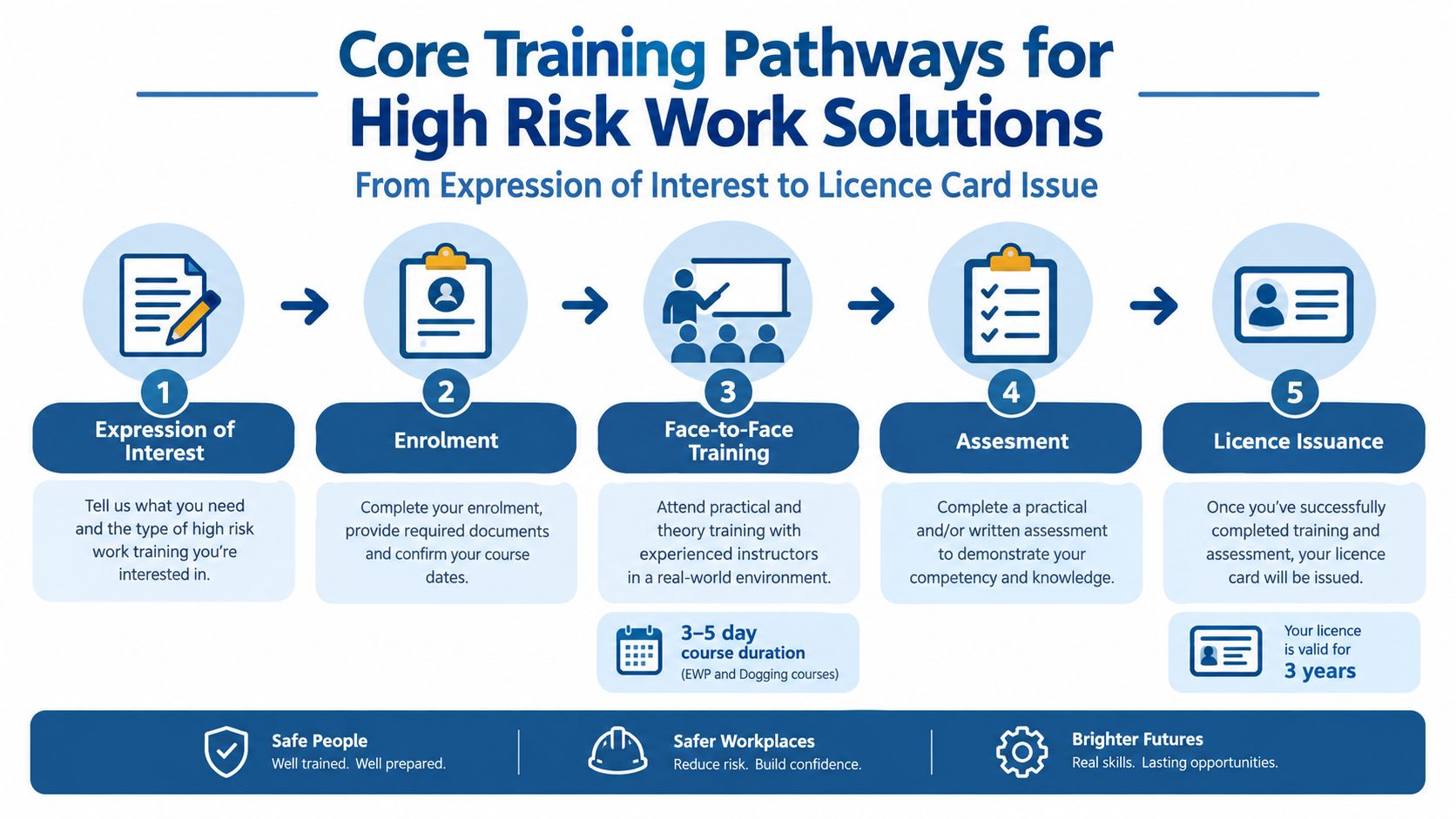
The process usually follows a clear sequence:
- Expression of interest: Define the job the person needs to perform, including the plant type and operating environment.
- Enrolment: Select an RTO or authorised assessment pathway that matches the required unit and licensing process.
- Face-to-face training: Build knowledge through instruction, demonstrations, equipment inspection, communication practice, and supervised operation.
- Assessment: Complete the required knowledge and practical assessment against the unit requirements.
- Licence card issue: Submit the required application and supporting evidence through the relevant state process once competency has been confirmed.
Course length isn't the same as job readiness
EWP, dogging, and basic rigging programs are often organised as 3 to 5 day courses, but duration alone doesn't establish competence. A learner may complete the scheduled training and still need more workplace coaching before a supervisor is comfortable assigning complex lifts, restricted access work, or operations around other trades.
Advanced rigging can also involve logbook requirements. The logbook records workplace experience and supports a structured progression, rather than treating a classroom block as the entire learning journey.
Language and literacy can create a practical barrier for experienced workers. Licence training includes safety terminology, load information, operating limits, inspection steps, signals, and assessment questions. An experienced operator who struggles to interpret written instructions may need foundation skills support before the formal assessment, not a shortcut around it.
Employers can improve access by planning group bookings, using regional RTO delivery, and checking whether funding programs apply. Depending on eligibility and location, options may include Construction Skills Queensland, NSW Smart and Skilled, and employer-supported training arrangements. Funding rules change, so the business should confirm current requirements with the relevant program or RTO rather than relying on an old assumption.
For a broader look at how vocational education connects training, assessment, and employment readiness, see vocational training in Australia. The practical test is whether the worker can transfer the assessed skill to the machine, load, surface, weather, traffic, and team communication demands of the site.
Matching the Right Licence Class to the Task
Licence errors often happen because equipment names sound interchangeable. A supervisor sees a platform, crane, or telehandler and assumes the ticket follows the general equipment family. The correct approach is more precise. Check the machine configuration, the operating function, the load, and the task being performed.
| Task / Equipment | Required Licence Class | Common Error |
|---|---|---|
| Directing a crane lift and selecting or attaching lifting gear | Dogging | Assuming a general plant ticket covers load-slinging and direction |
| Performing structural or mechanical rigging work | Relevant rigging class | Treating dogging competency as full rigging competency |
| Operating a slewing mobile crane | C6 or the applicable crane class | Using a telehandler or forklift ticket as a crane licence |
| Operating a boom-type EWP with a boom length of 11 metres or more | Boom-type EWP high risk work licence | Confusing a yellow-card EWP course with the high risk work licence |
| Operating a scissor lift on a flat slab where the boom threshold isn't met | The applicable site competency and equipment training | Assuming every EWP automatically requires the same high risk work class |
| Operating a telehandler with a work platform or personnel box where the boom exceeds 11 metres | Boom-type EWP high risk work licence | Checking the base machine only and ignoring the attachment |
A dogger working with a franna crane may select and attach the load and direct the lift. If the task expands into rigging structural members or equipment, the employer must check whether a rigging class is required. Likewise, a telehandler's ordinary material-handling function isn't automatically the same as slewing crane operation. The equipment's design and the way it's being used determine the relevant pathway.
Safe Work Australia's national guidance on elevating work platforms includes a narrow training exception. A person operating a boom-type EWP with a boom length of 11 metres or more may do so while undertaking nationally recognised training with an RTO, provided they're supervised by a person holding the relevant licence. Specific exceptions can also apply to manufacturing, testing, installation, commissioning, maintenance, servicing, repair, alteration, disposal, unloaded workplace movement, and loading or unloading for transport. Those exceptions shouldn't be treated as a general operating permission.
Workers comparing regulated licences with other industry credentials can use tools such as explore aviation certificates to see how different certification systems classify work. For mobile crane operations, the practical equipment and task distinction is also covered in how to operate a mobile crane.
Control Measures That Sit Alongside Licensing
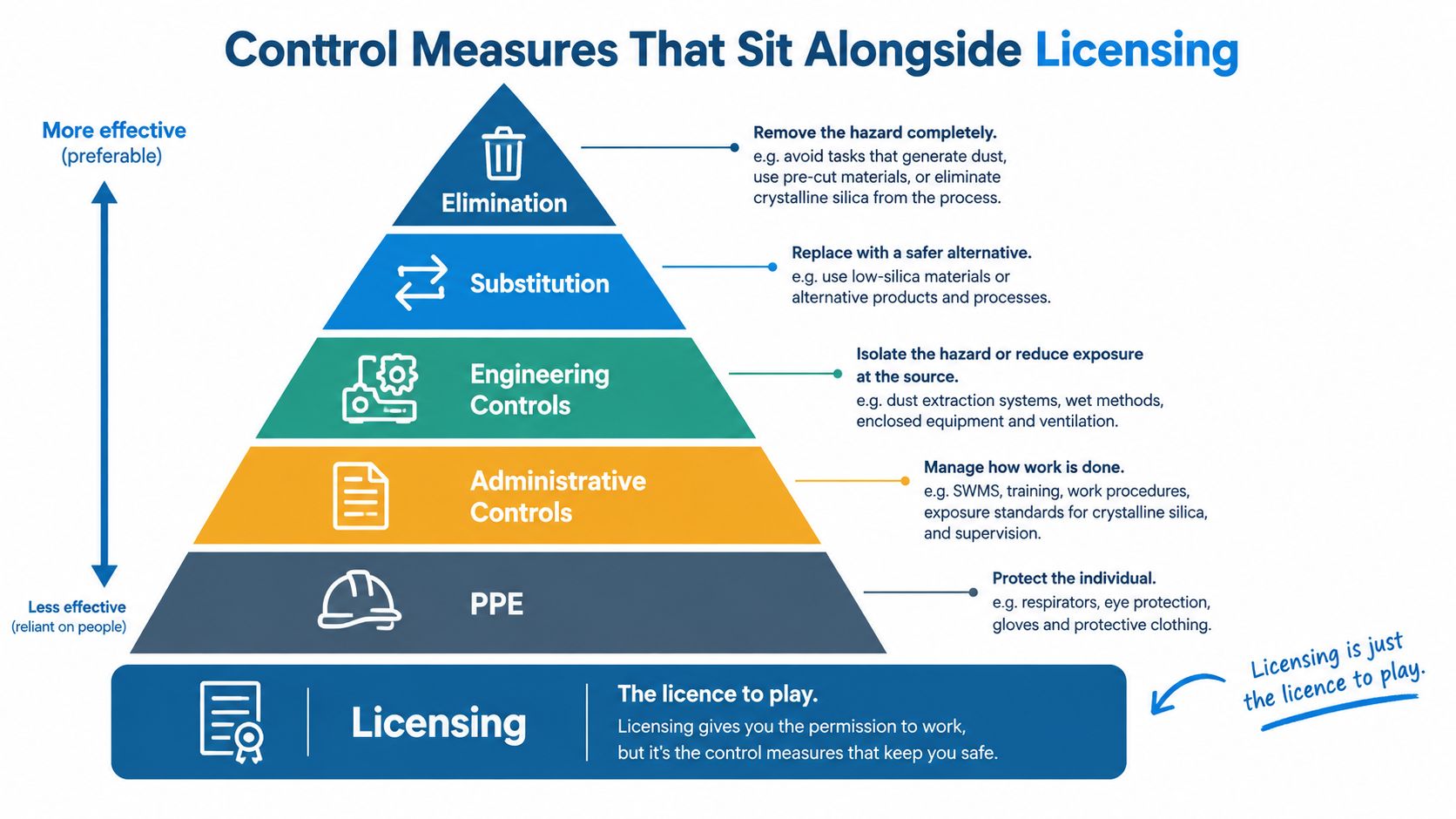
The licence is the licence to play, not the complete safety system. A competent operator can still be exposed to an uncontrolled lift, unstable ground, overhead services, moving traffic, silica dust, poor visibility, or another worker entering the exclusion zone.
For high risk construction work, the SWMS should describe the specific task and the controls used to manage its credible fatality mechanisms. It should be available to the people doing the work, reviewed when conditions change, and reflected in the pre-start conversation. A generic document copied from another project won't necessarily control the hazards on the slab, road corridor, trench, or work area in front of the crew.
Apply the hierarchy to the real exposure
For a crane set-up, start by asking whether the lift can be redesigned or removed. If it must proceed, use engineering controls such as suitable ground support, verified lifting equipment, physical barriers, and plant positioning. Administrative controls, including lift plans, communication systems, exclusion zones, and supervision, support the engineered controls. PPE remains necessary, but it should not carry the entire burden.
Silica exposure provides a clear example of why licensing doesn't solve every hazard. Safe Work Australia sets the eight-hour time-weighted average exposure standard for respirable crystalline silica at 0.05 mg/m³ and says workers must not be exposed above that level over a standard five-day work week. Where exposure is uncertain, the PCBU must consider air monitoring and keep exposure as low as reasonably practicable. Controls can include local exhaust ventilation, water suppression, dust-collection attachments, shift rotations, and respiratory protection, generally at least a P2 efficiency half-face respirator. These requirements are explained in the guidance on the workplace exposure standard for respirable crystalline silica.
For EWP work near powerlines, the control plan should address service identification, isolation where possible, approach limits, spotters, plant positioning, and communication. Hot work brings a different permit and fire-control problem, which is why supervisors should also understand hot work permit requirements. The licence confirms the operator's base competency. The control system makes the specific job manageable.
The Regional NSW Challenge Most Guides Miss
Many compliance plans assume that an RTO, assessor, and suitable machine are close by. That assumption breaks down across regional NSW, where a worker may need to travel for dogging, rigging, crane, or EWP training and a small contractor may lose a key operator from the site while the course is running.
Powering Skills Organisation's 2025 workforce paper identifies the need for more high risk work and plant operations training, alongside flexible, mobile, and on-site delivery in regional areas. It also highlights shortages of trainers with recent industry experience. The Productivity Commission has separately noted that Australian training data is patchy, which makes it harder to measure employer investment and identify where capability gaps are most serious. The workforce paper is available through Powering Skills Organisation.
Plan access before the vacancy appears
A regional employer can reduce disruption by building training into the workforce plan rather than waiting until a licensed operator resigns or a project starts. Useful approaches include:
- Block bookings: Group workers who need the same class and coordinate delivery around project stages.
- Mobile delivery: Ask whether an RTO or assessor can deliver training or assessment at a suitable regional workplace.
- Equipment planning: Confirm that the exact machine or configuration needed for assessment will be available.
- Renewal tracking: Record licence expiry dates well ahead of the five-year validity period so a critical role doesn't become vacant unexpectedly.
- Task redesign: Where appropriate, consider whether a non-slewing plant option changes the licensing requirement, while still checking the actual task and controls.
Regional access is not just a convenience issue. If employers can't reach suitable training, they may place pressure on experienced workers to perform tasks outside their class or postpone competency development until the job is already underway. A resilient high risk work solution gives supervisors a second trained person for critical tasks and maintains a realistic pipeline of future operators.
Building a Compliant High Risk Work System Step by Step
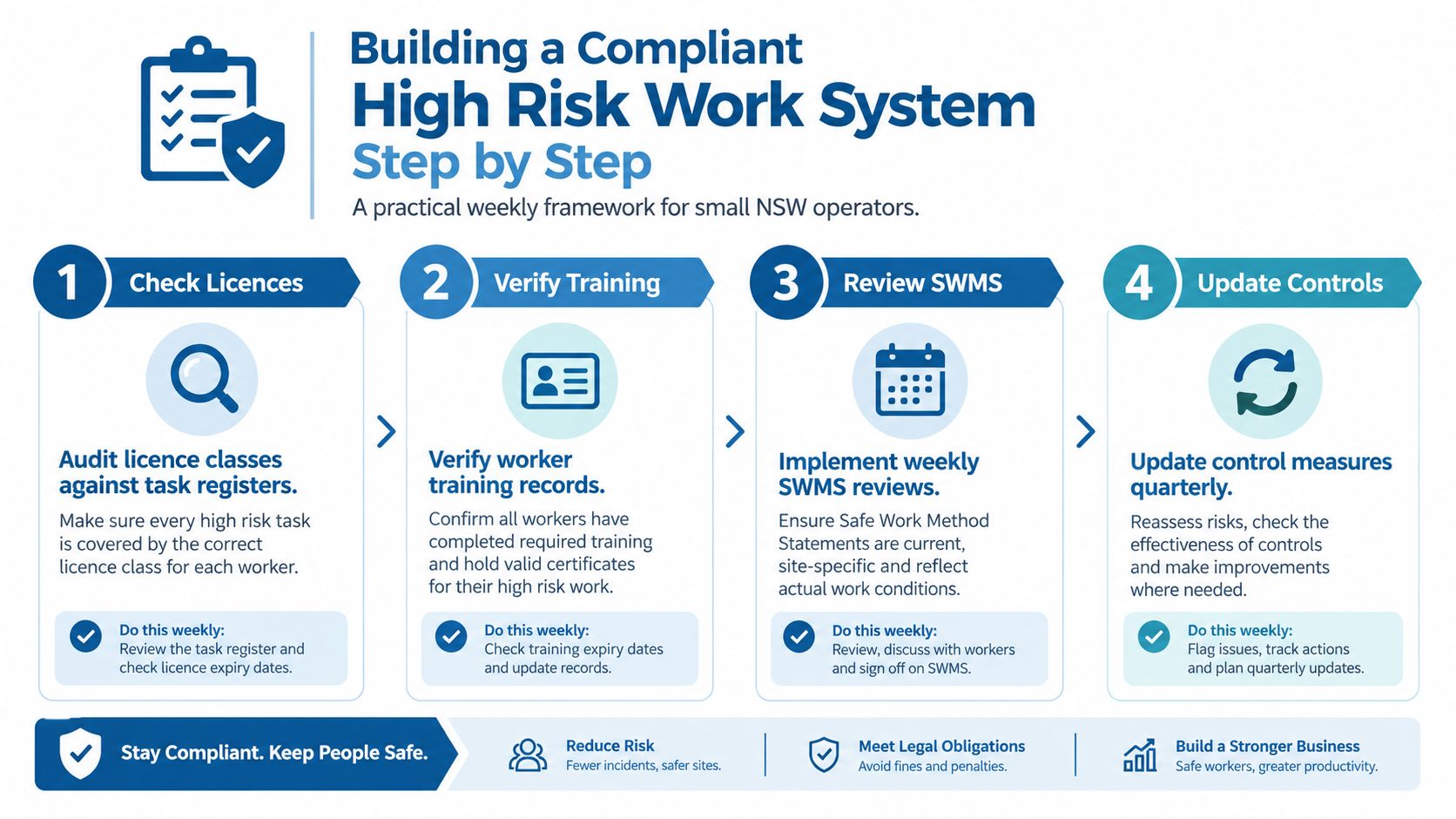
A small NSW operator doesn't need a complicated system to improve control. The business needs one reliable register that connects tasks, equipment, workers, licences, training gaps, SWMS documents, and review dates.
Use a weekly operating rhythm
Start with the task register. List the high risk activities your crews perform, then record the equipment and licence class associated with each one. Check each worker's current high risk work licence status through the relevant NSW process, identify gaps, and schedule training or assessment through an RTO.
At the weekly supervisor meeting, review upcoming work and ask whether the existing SWMS still matches the site. On each daily pre-start, confirm the operator, plant condition, exclusion zones, ground or surface conditions, nearby services, weather, communication method, and emergency response. Assign a nominated supervisor to maintain competency records and follow up on expiry dates.
Manual handling still belongs in this system. A worker who avoids plant exposure may face repeated lifting and carrying, so employers can use practical resources on ergonomics and safe lifting training when reviewing task design and worker capability.
Crib room checklist
- Task register: Does every high risk task have a matching licence class?
- Licence status: Is each operator's licence current and relevant to the plant?
- Equipment: Does the machine configuration match the licence and assessment evidence?
- SWMS: Has the document been reviewed for the current site conditions?
- Pre-start: Have plant checks, exclusion zones, services, communication, and emergency arrangements been confirmed?
- Supervision: Has a competent person been nominated to verify the work?
- Renewals: Are upcoming licence expiries recorded and acted on early?
- Training gaps: Is every unlicensed or under-skilled worker linked to a realistic training plan?
Common questions from supervisors
Does a dogging licence cover basic rigging?
No. Dogging and rigging are separate competency areas. If the task moves beyond load selection, slinging, and directing into rigging work, check the relevant rigging class before assigning it.
Are a boom-type EWP and a scissor lift the same licence class?
No. A boom-type EWP with a boom length of 11 metres or more falls within the high risk work licensing framework. A scissor lift may require equipment-specific training and site controls without being the same licence class. Always check the machine configuration and intended use.
Does changing employers cancel a high risk work licence?
The licence belongs to the worker and is generally nationally recognised for its validity period, but the new employer must still verify the current card, confirm the class matches the task, and provide site-specific instruction and supervision. A licence doesn't transfer knowledge of the new workplace, plant condition, or local hazards.
What should a supervisor do when the ticket and task don't match?
Stop the task, keep people clear of the hazard, confirm the correct class, and arrange competent supervision or a properly licensed operator. Don't rely on a verbal assurance that the worker has “done it before”.
TP Training delivers practical, nationally recognised high risk work and safety training with experienced trainers and hands-on learning across NSW. If your team needs a clearer pathway for EWP, dogging, rigging, crane, or related workplace safety competency, visit TP Training to discuss the training option that matches your site tasks.

You may also like
Basic Fatigue Management Course Guide for NSW Workers
Silica & Asbestos Courses Cost Guide for NSW Workers