Risk Management in Construction: Australian Guide 2026
Construction remains one of Australia's most demanding industries for injury prevention, with 29,100 serious workers' compensation claims recorded in 2021 to 22, the highest total of any industry and 12% of all serious claims nationwide (Safe Work Australia data cited in the SmartMarket report). That same source also notes construction employed 1.3 million people in 2022 to 23, so the risk sits across a very large workforce, not a small niche. Add the fact that 200 workers died from work-related traumatic injuries in 2023 nationwide, and risk management in construction stops looking like paperwork and starts looking like the daily discipline that keeps people alive.
On a real NSW site, that discipline can't sit with one manager or one safety file. It has to follow the work package, the subcontractor, the plant, the design change, and the weather. The practical question is always the same. Who owns each risk, how does it move across subcontracting tiers, and what gets done before a hazard turns into an incident, a delay, or a shutdown?
Table of Contents
- Why Risk Management in Construction Matters More Than Ever
- Legal Duties and the WHS Framework for Construction Sites
- Common Construction Risks Across Australian Worksites
- How to Conduct a Construction Risk Assessment Step by Step
- Applying the Hierarchy of Controls on Construction Sites
- Monitoring Risks and Adapting to Changing Site Conditions
- Training Pathways for Construction Risk Management Roles
Why Risk Management in Construction Matters More Than Ever
Construction risk management in Australia starts with a blunt fact. The industry recorded the highest number of serious workers' compensation claims of any industry in 2021 to 22, and the burden sits on a workforce of 1.3 million people (Safe Work Australia data cited in the SmartMarket report). That combination tells you why prevention can't be treated as an admin task. A single weak control, a rushed induction, or a missed sequence can affect a lot of people very quickly.
The biggest mistake on site is thinking risk management is only about avoiding fines. It's broader than that, because construction risk spreads across safety, cost, time, quality, and compliance at once. A bad access plan can create a fall risk, a plant interaction risk, and a delay claim before lunch.
Practical rule: if a hazard can injure one worker, it can usually disrupt the whole workface too.
That's why supervisors should treat safety planning as part of production planning, not as a separate conversation. The same applies to subcontractors. If a concreter, a demolition crew, and an electrician all work inside one tight sequence, the risk register has to reflect who's on site, what's changing, and which trade controls the next interface.
The fatality data makes the stakes even clearer. Nationally, 200 workers died from work-related traumatic injuries in 2023 (same source). That's why good construction risk management is really a fatal-risk reduction system with commercial benefits attached, not the other way around.
What this guide focuses on
The most useful parts of risk management are the ones that work under pressure, on a noisy site, with multiple subcontractors and a changing scope. That means knowing the legal duties, recognising the common hazards, building a risk register that tracks ownership, and applying controls in the right order. It also means understanding how training, induction, and site access evidence fit into the control system, especially on fragmented NSW projects.
Legal Duties and the WHS Framework for Construction Sites
The legal framework matters because it sets the minimum standard for who must do what. In the model WHS system, the duty sits with the person conducting a business or undertaking, often shortened to PCBU, and that duty covers providing and maintaining a work environment that's without risks to health and safety so far as is reasonably practicable. Workers also have duties. They must take reasonable care, follow instructions, and cooperate with the site's safety procedures.
A useful way to think about it is simple. The PCBU sets the system, supervisors enforce the system, and workers keep the system honest by following it and speaking up when it breaks. If one of those pieces is missing, the site ends up with a paper process instead of a real control process.
For induction, Australia is even more concrete. A worker must complete construction induction training before carrying out construction work, and the White Card is the evidence that this has been done. That makes the card more than a bit of plastic. It becomes a hard access requirement and a record that the worker has been introduced to the hazards and controls expected on a construction site (White Card overview).
How the framework works on a real site
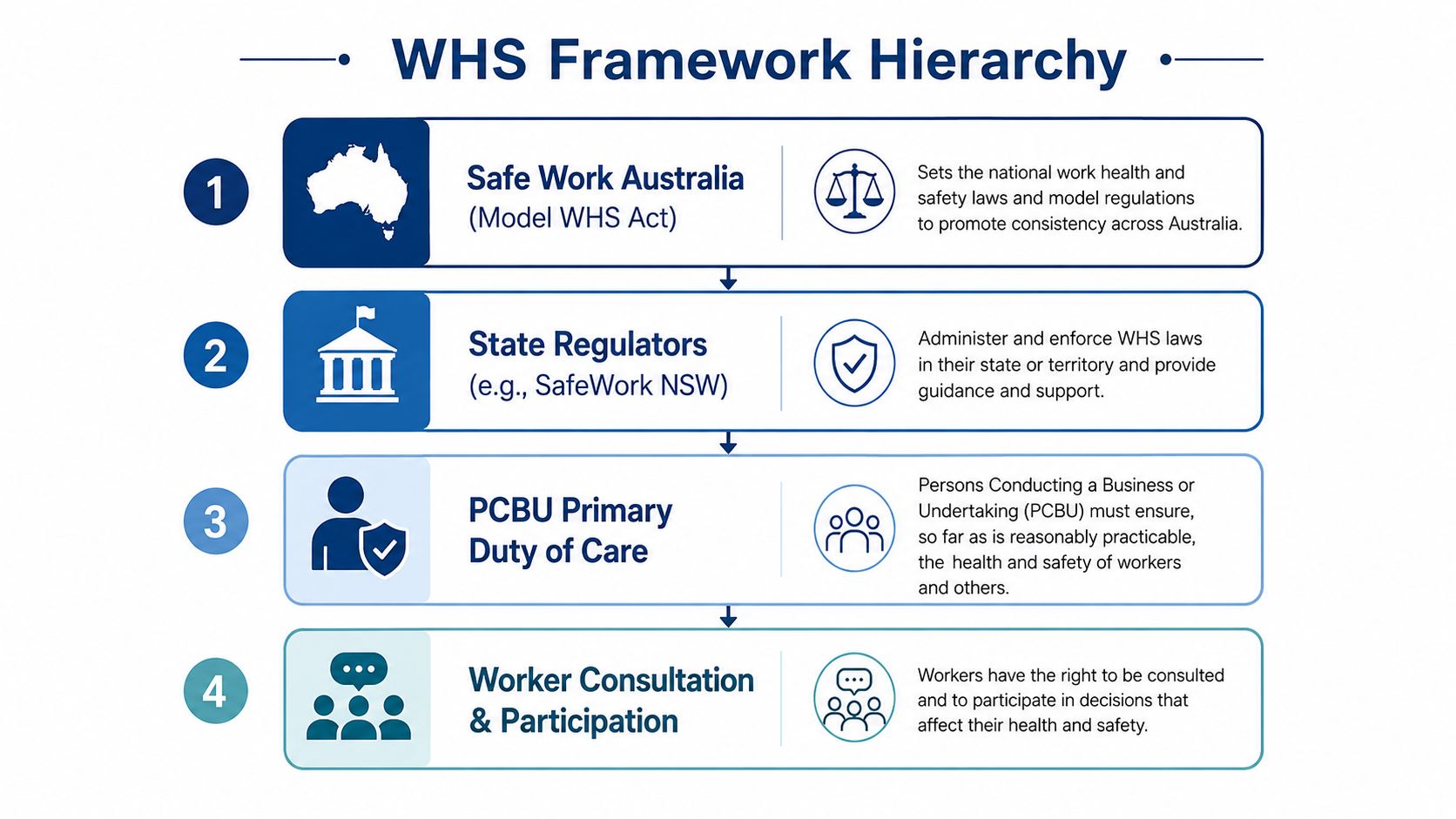
At the top level sits Safe Work Australia, which develops the model framework. Below that are the state regulators, such as SafeWork NSW, which enforce the rules on the ground. Then comes the PCBU primary duty of care, which is where most day-to-day decisions about access, supervision, plant, and work methods should land.
A simple hierarchy diagram helps people remember the order of control. It also helps when a supervisor is trying to sort out why a subcontractor has arrived without induction evidence or why a task has been started before the controls are in place.
For workers who want structured entry training, TP Training's White Card Training Course is one example of nationally recognised construction induction training delivered with practical, hands-on learning across NSW. The course matters because site access and risk evidence start there, not at the first toolbox talk.
If you want a useful comparison from another safety-heavy field, the Fleetalyse guide to fleet law shows the same basic idea. Duties only work when someone can point to the responsible party, the evidence, and the control in place.
A site with clear duties is easier to manage than a site where everyone “sort of” owns the risk.
Why this matters to supervisors and workers
People get confused when legal duty sounds abstract, but it gets easier when you translate it into site language. If a trade is arriving through a gate, the PCBU must make sure that access, induction, supervision, and task controls are in place. If a worker sees a missing barricade, they don't need to quote legislation. They need to stop, escalate, and get the control fixed.
That's the core value of the WHS framework. It turns responsibility into a chain that can be checked, not a vague promise that safety is “everyone's job”.
Common Construction Risks Across Australian Worksites
Construction risks don't arrive one at a time. They show up in clusters, and one weak control can trigger several problems at once. A cut-off saw kicking up dust isn't just a health issue. It can also affect visibility, housekeeping, nearby trades, and the likelihood of a complaint or stop-work direction.
Physical hazards that move fast
Falls from height, mobile plant interactions, and electrical exposure remain the kinds of hazards everyone notices because they can hurt someone immediately. On a framing job, a worker on an unprotected edge can get distracted by a delivery truck reversing into the laydown area. On a civil site, a spotter steps out of view for a second and the excavator bucket becomes the danger point.
Those are physical risks, but they also become coordination risks. If the delivery arrives early, the lift plan changes. If the access scaffold isn't ready, a worker improvises. That's how a small sequencing problem turns into a serious event.
Health risks that build quietly
Respirable crystalline silica is the clearest example because it's so common in cutting, grinding, drilling, and demolition tasks on Australian projects. Safe Work Australia sets the workplace exposure standard at 0.05 mg/m³ as an 8-hour time-weighted average. That number matters because it gives supervisors a measurable line, not a guess.
A concrete cutter in western Sydney can make that risk real in minutes if the task is dry, the extraction is poor, and nobody checks the control performance. The same job done with on-tool extraction, wet suppression, air monitoring, and proper respiratory protection is a very different risk picture.
Environmental and project risks that people underestimate
Australian sites also deal with heat, storms, flooding, and bushfire-prone conditions. Those aren't background issues. They affect lift plans, access roads, drainage, concrete pours, and the ability of subcontractors to keep turning up on time. When weather moves in, a site supervisor may need to re-sequence work, close an area, or hold the whole crew back.
The stronger lesson is that construction risk is multi-domain. Safety, commercial, technical, and environmental risks can cascade. A storm can delay material delivery, which can push a crew into overtime, which can increase fatigue, which can raise the chance of a mistake.
| Risk category | Site example | What usually goes wrong |
|---|---|---|
| Physical | A worker climbs a ladder to finish a quick fix | The task gets treated as routine, so access control gets skipped |
| Health | Saw cutting concrete near other trades | Dust controls are assumed, not verified |
| Environmental | Sudden heavy rain on an earthworks site | Access, drainage, and plant movement all change at once |
| Operational | A late subcontractor delivery | The sequence shifts and crews improvise |
That's why good supervisors don't just ask whether a hazard exists. They ask what else that hazard can affect before the shift ends.
How to Conduct a Construction Risk Assessment Step by Step
A useful risk assessment doesn't start with forms. It starts with the work breakdown structure, because risk follows the work package. If you break a job into concept, procurement, mobilisation, construction, and closeout, you can see where the exposure changes and who should own it.
Start with the highest-value risks early
The best time to deal with risk is early, when changes are cheap to make. Once a design is locked, a procurement lead time is fixed, or a crew is already on site, every change costs more. That's why the first pass should screen the big risks during concept and design, then sharpen the detail as the job moves forward.
A good register entry should name the hazard, the probability, the consequence, the response owner, and the review cycle. It should also link to practical inputs like cost forecasts, work packages, procurement dates, and inspection evidence. That way the register isn't just a list, it's a control system.
Site truth: a risk with no owner usually becomes a risk with no action.
Rank first, then model only what matters
Most risks can be handled qualitatively with probability and impact. That's enough for day-to-day decisions on many sites. Use a risk matrix to sort the work: low-priority items stay under watch, medium-priority items need active mitigation, and high-priority items need immediate attention or escalation.
The table below is a simple construction risk matrix example.
| Likelihood | Consequence | Risk Rating | Required Action |
|---|---|---|---|
| Rare | Minor | Low | Monitor |
| Possible | Moderate | Medium | Assign controls and review |
| Likely | Major | High | Escalate and set immediate mitigation |
| Almost certain | Severe | Extreme | Stop, isolate, and reassess |
For the small set of risks where the uncertainty really changes the budget or programme, quantitative methods such as scenario analysis or Monte Carlo modelling make sense. A good maintenance-style comparison for this kind of prioritisation is the Forge Reliability maintenance strategy, because it reinforces the same basic principle, don't give equal attention to every issue when the consequences aren't equal.
Build the register around accountability
A register that doesn't show the owner is unfinished. On a fragmented subcontracting chain, that matters even more. The earthworks subcontractor may own excavation risk, the civil subcontractor may own edge protection, and the principal contractor may own interface control. If those lines aren't written down, handovers get blurry and problems get duplicated or missed.
TP Training's traffic management designer red card course in NSW is one example of how structured training supports that ownership mindset, because traffic planning, site access, and work zone controls all depend on clear responsibility.
When the risk register is tied to the work packages and the lifecycle stage, supervisors can see what changed, who must respond, and when the next review is due.
Applying the Hierarchy of Controls on Construction Sites
The hierarchy of controls works because it asks a simple question. What removes the danger most effectively, and what only reduces the harm after the danger is already there? On a construction site, that difference is huge.
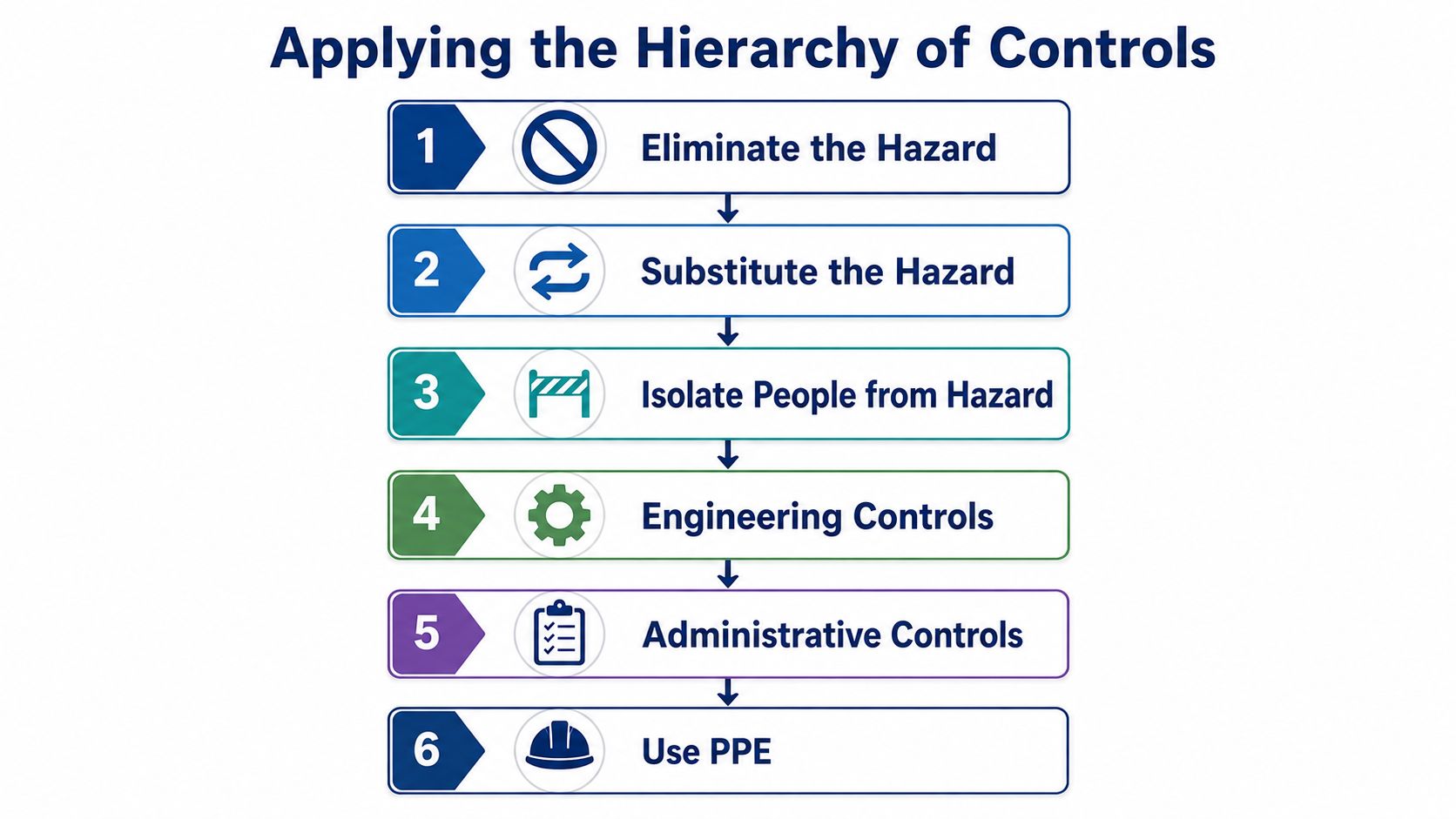
Start at the top, not at PPE
Elimination is the cleanest option. If a task can be redesigned so the worker doesn't enter the hazard zone, that's better than asking the worker to manage exposure with a mask or harness. Substitution comes next, for example using a lower-dust method instead of a high-dust one.
A fit-out crew might isolate a dangerous area, but that's still not as strong as eliminating the need to work there in the first place. Engineering controls then do the heavy lifting. On-tool extraction, guarding, barriers, and wet suppression reduce exposure at the source.
PPE sits at the bottom for a reason. It's necessary, but it's the last line of defence, not the main plan.
Match the control to the task
A demolition job and a handover clean-up don't need the same control mix. During demolition, the first goal is usually to remove people from the hazard, isolate the work area, and use engineered dust and debris controls. During fit-out, the focus may shift to administrative controls, permits, sequencing, and worker separation.
That's why silica control is so important on Australian construction sites. Safe Work Australia's respirable crystalline silica standard is 0.05 mg/m³, and the practical response is hierarchical. Use lower-dust methods where you can, then on-tool extraction or wet suppression, then verify performance with air monitoring, and only then rely on respiratory protective equipment as a back-up layer.
For workers learning the technical side of isolation and confined environments, the confined space training resource is relevant because it reinforces the same principle, the job changes once the hazard is enclosed and access is controlled.
Verify the control, don't assume it works
Engineered controls need checking. A vacuum hose that isn't connected properly, a wet suppression line that's blocked, or a barrier that's been moved to help a forklift through can undo the whole plan. Supervisors should look for evidence, not just promises.
If the control can't be seen working, it isn't a control yet.
That's the practical test on site. The hierarchy only works when the strongest available measure is selected first and then verified in the field.
Monitoring Risks and Adapting to Changing Site Conditions
Risk ownership often gets fuzzy on complex projects because subcontractors move in and out, and each tier assumes someone else is watching the same issue. Recent research on construction risk management barriers points to ineffective risk communication, the absence of a unified risk framework, and weak integration with other project processes as major management barriers, along with limited expertise and experience in the team (Strathprints research). That's exactly why supervisors need a live ownership map, not just a register sitting in a folder.
Make ownership visible across subcontracting tiers
On a fragmented NSW site, the most practical question is who escalates what. A subcontractor foreman should know which hazards they own, what they can fix directly, and what must go to the principal contractor. The principal contractor should know what needs a site-wide decision, especially when one trade's control affects another trade's workface.
That's not bureaucracy. It prevents the classic failure where a hazard gets reported three times and fixed zero times. If the chain of responsibility is clear, the site can move faster because people don't waste time guessing who's in charge.
Treat weather as a live operational risk
Australian construction doesn't run in stable conditions. Heat, storms, flooding, and bushfire-prone environments can all shift the risk profile during a shift, not just before the project starts. A risk register that was accurate last week may be wrong by midday if weather changes the access, visibility, or plant movement conditions.
The right response is to update the register in real time and make the stop-work threshold obvious to the crew. If a trench, a crane lift, or an outdoor pour no longer meets the control standard, the supervisor needs to stop and re-plan. That decision protects people, but it also protects productivity because it avoids a bigger failure later.
Recent research on sustainable risk management shows the field is moving beyond a narrow cost-schedule-safety view toward resilience and sustainability considerations (Almashhour et al.). That shift makes sense on Australian sites, where a weather-triggered stoppage can cascade through labour, plant, and supply.
Keep the register alive during the job
The core habit to build is simple. Review the register at the same rhythm as site conditions, then ask whether any control has become weaker, outdated, or unowned. If the answer is yes, the site has to respond before the issue grows teeth.
Risk management only works when it stays active. Once it becomes a file at project start, the site has already moved on.
Training Pathways for Construction Risk Management Roles
Training only helps when it matches the job people are doing. For construction work, the starting point is always the White Card, because induction evidence is the access gate and the first proof that the worker understands site hazards and procedures. From there, the pathway branches by role.
Match the course to the task
A traffic controller needs a different control skill set from an excavator operator. Someone planning a work zone has to understand how traffic, plant, workers, and public interfaces change the risk picture. Someone operating machinery needs to understand exclusion zones, visibility, and ground conditions. A worker taking on high-risk tasks needs the right licence and practical instruction before stepping into the role.
TP Training offers course options across construction, civil construction, traffic control, elevated work platforms, and high-risk work. Its nationally recognised, hands-on training model fits the logic of risk management because it teaches people how to work safely in the conditions they'll meet on site. The guide to construction safety officer roles is a useful companion read if someone wants to understand how site safety responsibilities are often organised in practice.
Use training as part of risk ownership
A worker who knows the task boundaries is easier to manage and more likely to escalate early. That's why training isn't just about compliance. It helps define who can own a risk, who can control it, and who needs supervision.
For example, a supervisor who understands trade licensing requirements can better match tasks to competence and verify that a worker is operating within their scope. TP Training's guide to trade licensing in Australia is one practical reference for that broader pathway mindset.
Keep the path practical
The safest sites don't treat training as a one-off milestone. They use it to build a team that can recognise hazards, respect site controls, and respond when conditions change. That's especially valuable on subcontracted jobs, where people may not have worked together before and can't rely on informal habits.
If you're building a safer, more reliable construction career, choose training that links directly to site risk, not just to a certificate on the wall. Visit TP Training to check the courses that support construction induction, traffic control, civil operations, and high-risk work, and use that training to back up the way you manage risk on site.

You may also like
High Risk Work Solutions in Australia: A Practical Guide
Basic Fatigue Management Course Guide for NSW Workers