Hot Work Permit Requirements in NSW: A Practical Guide
You're on site, the crew's already set up, and someone's about to strike an arc in a corner that wasn't planned for hot work. That's the moment the permit conversation matters. Not because paperwork looks tidy, but because hot work permit requirements are the line between a controlled task and a fire risk that spreads before anyone notices.
In NSW, the practical question isn't whether welding, grinding, cutting, brazing or torch work can happen. It's whether the area, the people and the equipment have been checked, documented and authorised before ignition starts. The permit is the proof that someone competent has looked at the job, the location and the fire controls, then signed off on the task under the right conditions.
That's where generic advice falls short. NSW sites don't need overseas boilerplate, they need a permit they can use on Monday morning, in a warehouse, on a civil job, or at a maintenance shutdown. The details below focus on what gets checked, who signs, how fire watch timing works, and where NSW Transport's narrower rule for routine versus ad-hoc work changes the answer.
Table of Contents
- Why Hot Work Permit Requirements Matter on NSW Sites
- The Legal and Regulatory Framework Behind the Permit
- Mandatory Elements Every Permit Must Capture
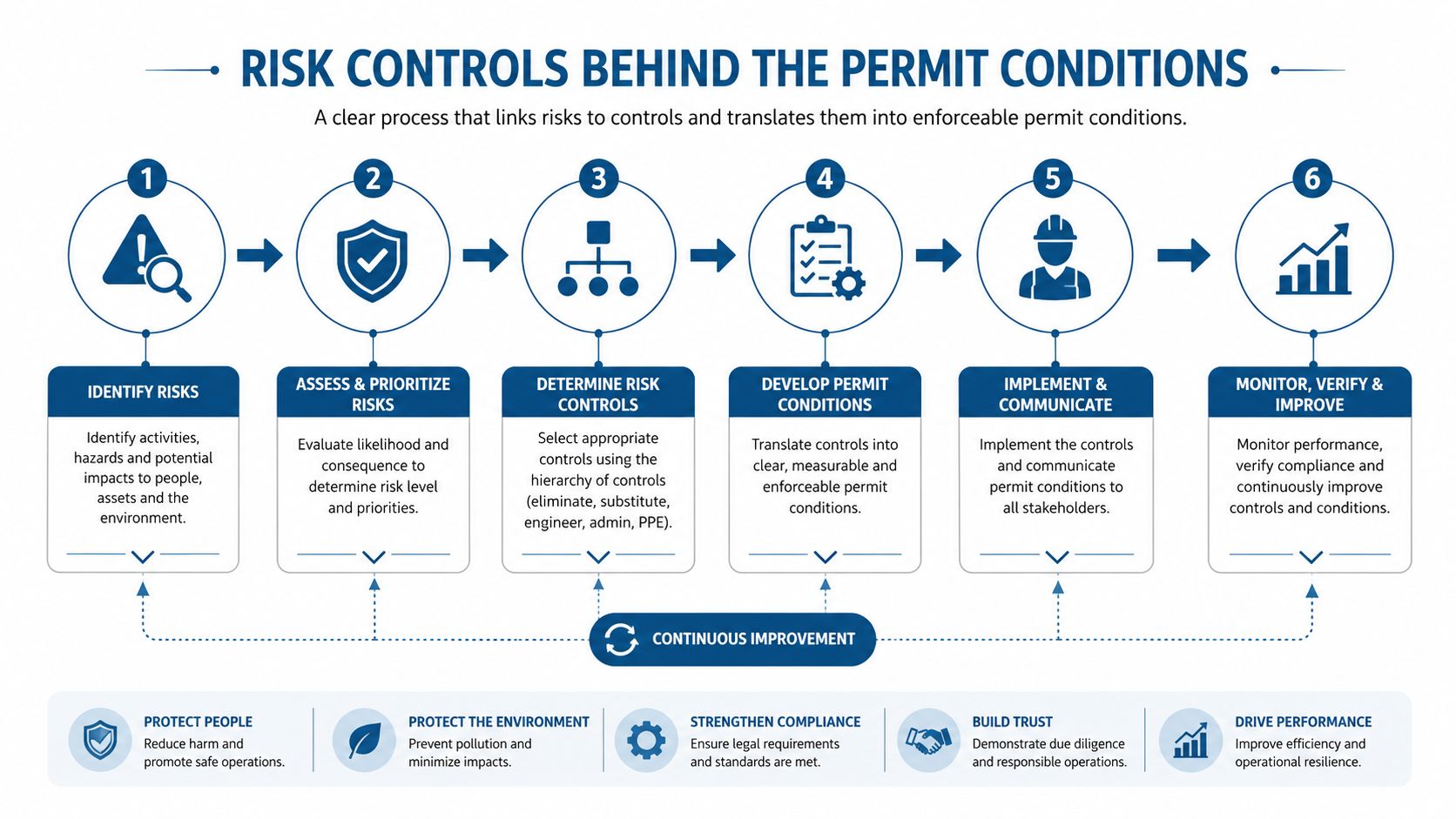
- Risk Controls Behind the Permit Conditions
- Who Issues, Signs and Closes Out the Permit
- Training and Competency That Support the Permit
- Common Non-Compliance Issues and Audit Red Flags
- Your Pre-Ignition Permit Checklist for Tomorrow Morning
Why Hot Work Permit Requirements Matter on NSW Sites
A Sydney maintenance crew rolls up to a plant room, and the welder is ready before the supervisor has even looked behind the pipework. That's the exact moment a good site stops the job and asks for the permit. The form isn't filler, it's the documented control that shows the area was inspected, the hazards were reviewed and the task was authorised before sparks were allowed anywhere near combustibles.
The permit is the control, not the admin
Under AS 1674, hot work is treated as a formal fire-risk activity with documented controls, and permits are typically required outside approved fire-safe areas. The practical purpose is simple, it forces the site to verify that the work area is clear of combustible materials, firefighting equipment is ready, and an authorised person has checked the setup before ignition starts. That is why Australian regulators and training providers use the standard as the baseline for site procedure, not just as a reference note.
Practical rule: if a job needs sparks, flame or grinding outside a designated safe area, someone must slow the work down long enough to check it properly.
That's also why permit talk matters for NSW crews who work across construction, warehousing and maintenance. The issue isn't the tool alone, it's the surrounding environment, the timing and the supervision. A permit creates a shared record that says the site understood the risk and controlled it before the task began, which is exactly how risk management in construction should work in practice.
NSW reality is tighter than generic hot work advice
Most workers already know that welding and grinding throw sparks. What gets missed is how often the surrounding area changes between the job being planned and the job being started. That's why permit systems are built around pre-work review and post-job monitoring, because the main danger is often not the task itself, but the combustible materials, dust, vapours or poor housekeeping around it.
On NSW sites, that means the permit is part of daily control, not an occasional form. It gives the supervisor something tangible to check, the operator something clear to follow, and the fire watch something to monitor after the arc is off. If the permit can't prove those things, it hasn't done its job.
The Legal and Regulatory Framework Behind the Permit
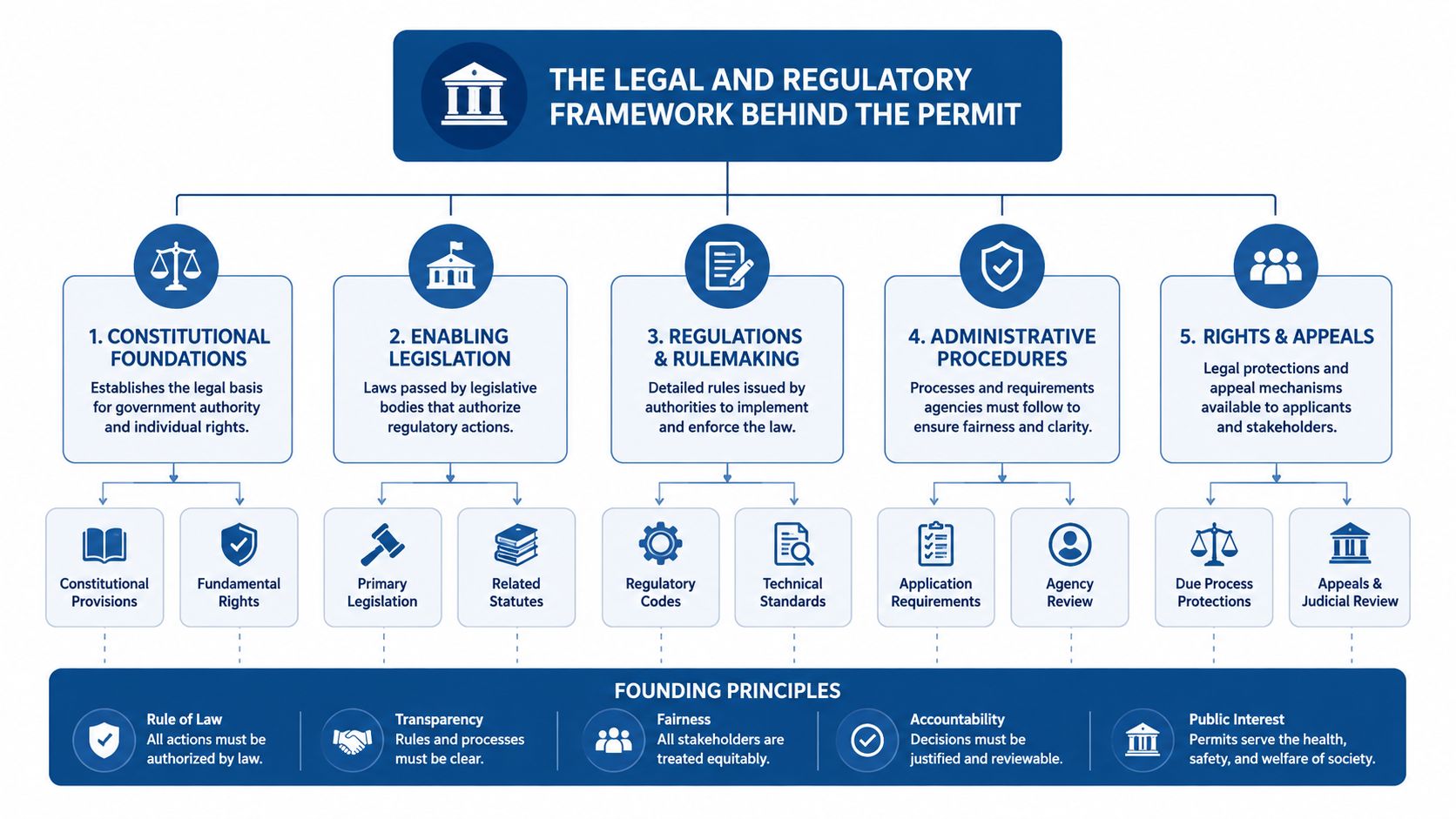
The legal stack behind hot work is straightforward once you strip away the jargon. NSW workplaces work from WHS duties first, then apply the technical detail from AS 1674, and then convert both into site procedure. The permit is the paper, or digital record, that shows those duties were met for that specific job.
Law, standard and site procedure work together
The WHS framework puts the duty on the PCBU and workers to manage ignition risks. AS 1674 gives the technical baseline for welding, cutting, grinding and related spark-producing work. Site procedures, principal contractor systems and internal permit-to-work processes then turn that baseline into daily checks, sign-off steps and post-job monitoring.
That's why the permit matters so much. It is the operational record that says the hazard assessment happened, the controls were verified and the task was authorised under the applicable risk controls. Without that record, the site may have done some of the right things, but it can't easily prove it.
A permit only works when it reflects the job that's actually happening, not the job that was planned yesterday.
NSW Transport adds a useful point of nuance that many generic guides miss. Its guidance says permits are required for confined spaces, underground networks, areas with flammable atmospheres, open flame in enclosed spaces and infrequent ad-hoc work, while regular planned welding isn't expected to need one. That distinction matters on Sydney sites because crews often assume every hot work task is automatically permit-triggered, when the operational rule is more specific.
For readers who want a broader compliance context, negligence per se in PA and NJ is a useful reminder that legal systems often treat breached safety duties as evidence of fault. The NSW position is different, but the practical lesson is the same, if the site can't show its controls, it is exposed.
Why the permit sits inside broader permit-to-work discipline
Hot work doesn't stand alone. In industrial settings it sits alongside other permit-based tasks, and the permit-to-work discipline is reinforced by WHS risk-management duties and standards such as AS/NZS 2865 where confined space conditions overlap. The point is not to add paperwork for its own sake, it's to make sure the right person checks the right risks before someone starts work that can spread fire beyond the task zone.
For a refresher on linked site-induction pathways, what is a White Card sits in the same practical space, because the people signing and supervising these jobs need to understand the site rules before they touch the permit.
Mandatory Elements Every Permit Must Capture
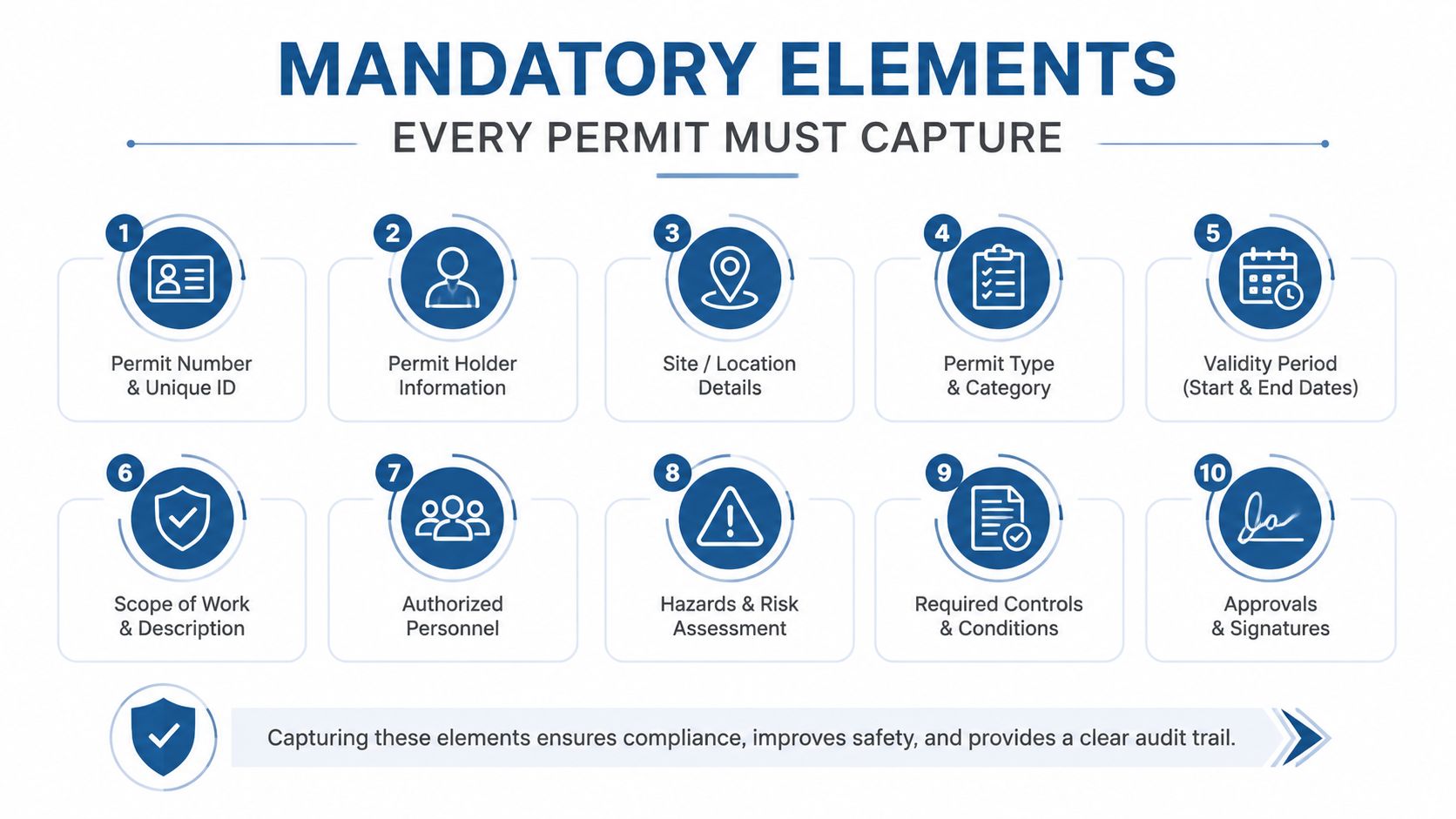
A good hot work permit reads like a live job brief, not a ceremonial form. If the person signing it can't point to each field and explain why it matters, the permit is too weak for the site conditions. NSW Transport's permit approach and AS 1674 both push the same idea, the record has to describe the job, the location, the controls and the person responsible.
The fields that need to be clear before signing
A supervisor should expect the permit to capture date, time and duration, exact location, description of the task, equipment being used, named operator, permit issuer, gas or atmospheric test results where relevant, exclusion zone, fire watch arrangement, extinguishers on site, combustibles isolated, access and egress, and post-job monitoring. Those aren't decorative fields, they are the line items that prove the work has been thought through before the first spark.
Naming one operator instead of “the crew” matters because accountability gets blurry fast when several people are on the tools. A single named operator and a single permit issuer make it much easier to stop the job, verify the controls and file the record later. That's also why permits are usually valid for the day or the specific task only, then reissued if the job changes or runs into another shift.
The NSW Transport permit model goes further by requiring a competent worker to generate a local permit number and check for flammable gases or dusts, combustible materials, access and egress, ventilation and firefighting equipment before authorising the task. That turns the form into a real safety check, not a sign-off routine.
Good permits describe the job as it exists on the ground, not as someone hoped it would look when the planner typed it up.
Why the wording has to be job-specific
Generic boxes like “area clear” or “standard precautions” don't tell a supervisor anything. You need enough detail to know where the work is, what's nearby, what could ignite and who's watching it after completion. That's where task-specific permits reduce confusion on busy sites, especially when forklifts, delivery traffic and other trades are moving through the same area.
For crews that also work around plant and warehouse traffic, the permit often sits beside other competency tools. Tlilic0003 License To Operate A Forklift Truck Safework Nsw Approved is one example of the kind of practical, nationally recognised training that supports safer site coordination when machinery and hot work share the same workspace.
Here's a concise view supervisors can use when checking a form.
| Mandatory field | Why it matters | What good looks like |
|---|---|---|
| Date and duration | Limits the authority to the actual job window | A clear start and finish for that shift or task |
| Exact location | Stops confusion on large or multi-bay sites | Specific bay, room, level or zone |
| Task description | Shows what sparks, flame or heat will be created | Named process, not a vague label |
| Named operator | Creates accountability | One person, not a group title |
| Permit issuer | Shows who authorised the work | Competent supervisor or nominated person |
| Atmospheric testing | Confirms conditions before ignition | Recorded result where required |
| Exclusion zone | Defines the protected area | Clearly marked and kept clear |
| Fire watch | Ensures monitoring during and after work | Dedicated person with no other task |
| Extinguishers | Gives immediate response capability | Right type, accessible and ready |
| Post-job monitoring | Covers delayed ignition risk | Logged checks after the work ends |
For a deeper look at related entry control tasks, confined space training sits close to hot work practice because many of the same atmospheric and isolation checks apply when the workspace is constrained.
Risk Controls Behind the Permit Conditions
The permit only makes sense if the controls behind it match the physics of the job. Sparks don't politely stay in the cut line, and molten metal travels farther than people expect, especially in cluttered or enclosed spaces. That's why the permit conditions tighten as combustibles, vapours, dust or poor ventilation appear in the work area.
Exclusion zones and atmospheric checks do the heavy lifting
A practical benchmark used in permit systems is an exclusion zone of about 10 to 11 metres around the hot work area for combustibles, with tighter controls when flammable vapours or dust may be present. If ventilation, gas testing or process isolation can't reduce the risk enough, the permit has to reflect that and either add controls or stop the job. The form is really a written summary of how far the ignition hazard can travel.
The same logic applies to gas testing and ventilation. If a permit covers an area where vapours or dust could accumulate, the sign-off has to show those conditions were checked before ignition started. That's why the permit asks for environmental controls rather than only PPE, because PPE won't stop a spark from finding a solvent pocket, cable void or dust layer.
For crews who work around grinders, cut-off tools and other portable equipment, Value Tools Co safety guide is a practical reminder that tool handling and worksite housekeeping need to line up with the hot work setup, not sit apart from it.
Fire watch timing is where many sites get caught
The post-work watch is where complacency shows up. Munich Re's loss-prevention guidance calls for a continuous 30 minute watch after work stops, then periodic inspection for at least another 30 minutes, and extension to 2 hours or more where combustible loading or combustible construction is significant. That's a very different standard from “someone had a quick look later.”
The reason is simple, smouldering ignition can begin after visible sparks stop. A cable tray, timber packing, insulation void or dust layer may not flare immediately, which means the compliance gap often appears after the torch is down and the crew is packing up. If the permit doesn't force a logged post-work watch, it's leaving the site exposed.
Extinguishers need to be ready, not just present
The permit should also show that extinguishers are appropriate to the fire class, immediately accessible and in date. A fire watch needs to know how to raise the alarm, and the site needs a clear communication path if the first response doesn't hold. These checks sound basic because they are basic, but basic failures are common when the form gets rushed.
For crews who are learning adjacent safety topics, Courses that include short safety training and practical workplace tickets can help build the habits that support this kind of site discipline.
Who Issues, Signs and Closes Out the Permit
On a civil maintenance job in western Sydney, the process should be obvious to everyone on the ground. The operator wants to start, the fire watch is already assigned, and the supervisor is walking the area before anyone lights up. That sequence matters because the permit lives or dies on the checks that happen before and after the actual work.
The roles need to stay separate
The operator is the person doing the welding, grinding, cutting or torch work. The fire watch is a dedicated person with no other task during the hot work. The permit issuer is usually a supervisor, foreman or nominated WHS person who can verify the controls and authorise the work. The area authority or principal contractor representative can veto the job, or extend it if conditions change.
The NSW Transport rule is useful here because it says a competent worker must generate a local permit number and verify gases, dusts, combustibles, access and egress, ventilation and firefighting equipment before authorising work. That means the person signing the permit isn't just filling out paperwork, they're carrying the main duty to make sure the conditions are right.
A permit should then be easy to trace after the job finishes. It needs to be filed, retained and available during an audit, because permit records are part of the evidence trail for the site. If the document disappears as soon as the sparks stop, the site loses the record of what was checked and who approved it.
The close-out step is not optional
The close-out should confirm the work is finished, the fire watch period is complete, the area has been inspected again and the permit is signed off or filed. That close-out is where rushed crews often drop the ball, especially when another job is waiting or a vehicle is blocking access. A permit that never gets closed properly tells the auditor that the site runs on habit, not control.
Practical rule: if the permit can't be produced later, it didn't really exist as a control.
That's why good sites treat sign-off as a sequence, pre-job inspection, gas test if needed, permit raised, work performed, fire watch logged, permit closed and filed. It's repetitive on purpose. Repetition is what makes the process reliable when the site is busy.
Training and Competency That Support the Permit
A permit only works when the people using it can understand it. That's why the competent person requirement matters so much. Anyone issuing, supervising or acting as fire watch on hot work needs demonstrated competency, usually built through a mix of nationally recognised training and on-site experience.
Adjacent tickets shape better permit judgement
For people coming into NSW construction and industrial work, the base layer often starts with a White Card, because site induction teaches the language of hazard control and authority lines. For tasks near plant or at height, EWP and other high risk work licences may come into play depending on the job. In many workplaces, the same person who supervises hot work also needs to understand how those other controls interact with the permit.
The overlap with other hazards matters too. Hot work commonly appears in environments where asbestos risk or crystalline silica exposure controls are relevant, especially during demolition, cutting or refurbishment. That's why short courses such as Asbestos Awareness and Crystalline Silica Exposure Prevention often sit alongside permit training in NSW workplaces.
If you want a wider view of the pathway, CPR, First Aid, White Card and workplace safety certifications are part of the same practical ladder, because competent permit sign-off depends on workers who can respond properly when something goes wrong.
Training supports sign-off, it doesn't replace it
The important distinction is that training does not replace the permit. It underpins it. A trained worker still has to check the area, read the permit and confirm the controls before work starts. A supervisor who can't confidently complete the form or explain the fire watch timing isn't the right person to sign it yet.
TP Training's practical safety and licence pathways, including Tlilic0003 License To Operate A Forklift Truck Safework Nsw Approved, are part of the broader competency mix that helps sites keep high-risk work disciplined. The point is not the ticket itself, it's the judgement that comes with repeated, practical training.
Common Non-Compliance Issues and Audit Red Flags
Most NSW audit findings on hot work aren't about the absence of a permit. They're about a permit that looks complete at a glance but falls apart when you read the details. That usually happens when the crew uses a generic template, the supervisor is rushed, or the site has fallen into a habit of copying yesterday's form.
The recurring mistakes are predictable
The most common red flags are familiar to anyone who has walked a busy site office. The combustibles cleared box is left blank. The fire watch is also doing another task. The permit runs for a whole week instead of one shift. Extinguisher inspection dates are missing. Gas test records are absent where flammable atmospheres were possible. A signature appears, but the worker doesn't have the relevant licence or competency for the task.
Here's the pattern behind those failures. Time pressure pushes people to reuse old wording. Generic templates make it easy to tick boxes without thinking. Poor handover between shifts leaves the permit in limbo. Once that happens, the form starts describing the paperwork process rather than the actual control of the fire risk.
| Audit finding | Why it happens | Quick fix |
|---|---|---|
| Blank combustibles box | Crew assumes housekeeping was done yesterday | Recheck the area before every issue |
| Fire watch doing other tasks | Site treats the watch as extra labour | Name one dedicated person only |
| Permit valid for a week | Supervisors try to save time | Reissue daily or for the specific task |
| Missing extinguisher dates | Equipment checks aren't linked to the permit | Attach current inspection evidence |
| No gas test record | People assume the area is fine | Record atmospheric testing before ignition |
| Wrong signature | Competency wasn't verified | Match the signer to the role and licence |
A simple fix works better than a clever one, a one-page example of a good permit pinned on the site wall. Crews copy what they can see, so give them the standard version, not a blurry memory of one from last month.
Your Pre-Ignition Permit Checklist for Tomorrow Morning
Tomorrow morning, use the permit as a real pre-start checkpoint, not an approval stamp. First, confirm the task isn't exempt under the NSW Transport rule for routine planned welding versus confined spaces, flammable atmospheres, enclosed open flame work or infrequent ad-hoc hot work. Then identify the authorised person who will sign off, because if the signer isn't clear, the control isn't clear either.
Next, walk the area and look for combustibles within about 10 to 11 metres. If the job needs gas or atmospheric testing, get it done before ignition, and don't start until ventilation and isolation are verified. Set up the extinguishers, assign a named fire watch with no other duty, and make sure that person knows how to raise the alarm.
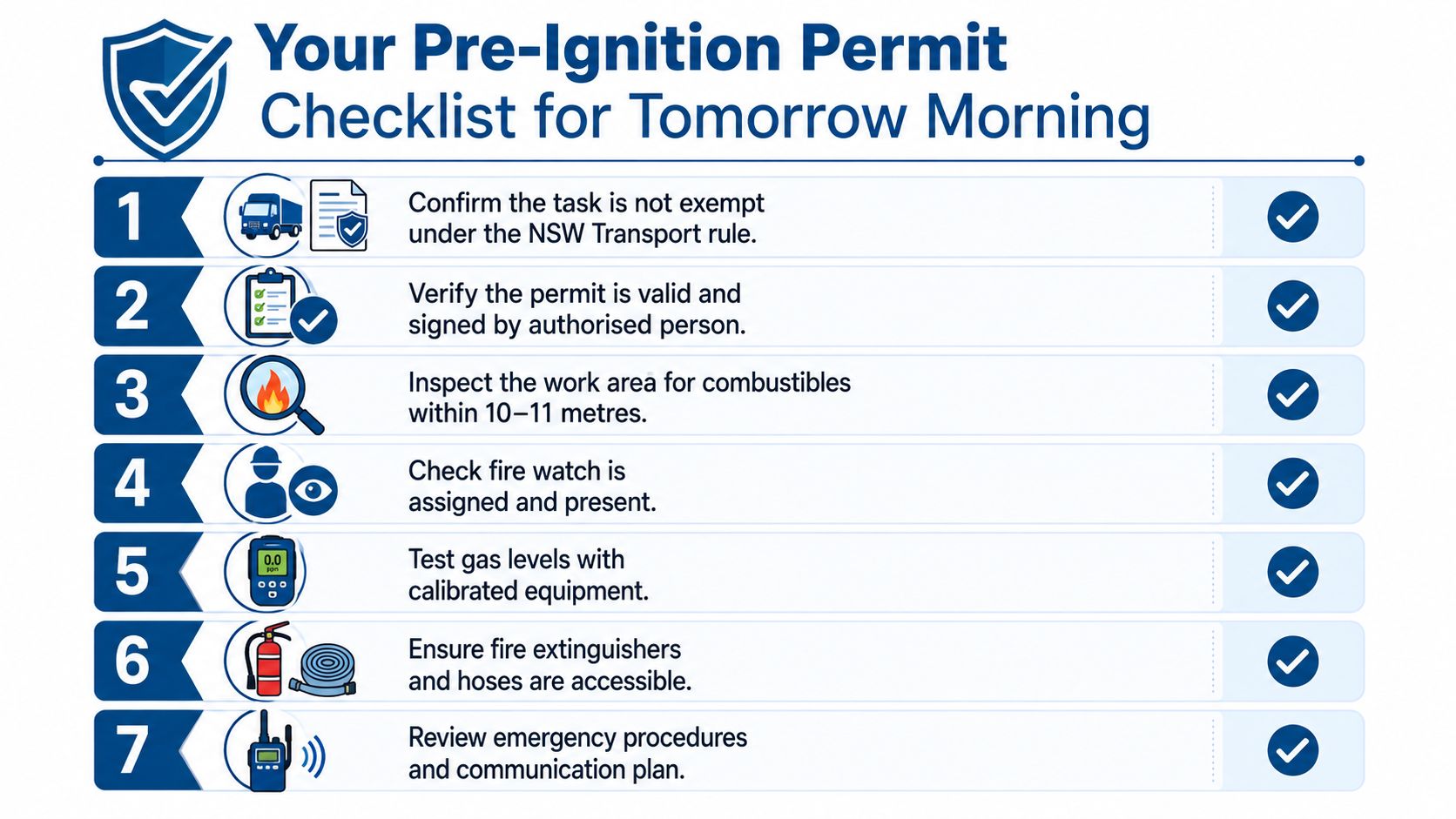
Use the permit to capture the date, location, duration, operator and post-job monitoring period, then brief the operator before work starts. Keep the permit on file once the job closes out so it can be produced during an audit or investigation. That habit is what separates a routine hot work job from a controlled one.
TP Training supports that habit with practical courses and licences that build the competency behind the sign-off. If your team needs stronger site judgement, better permit discipline and the right adjacent tickets, visit TP Training and line up the training that fits your crew's work.

You may also like
High Risk Work Solutions in Australia: A Practical Guide
Basic Fatigue Management Course Guide for NSW Workers