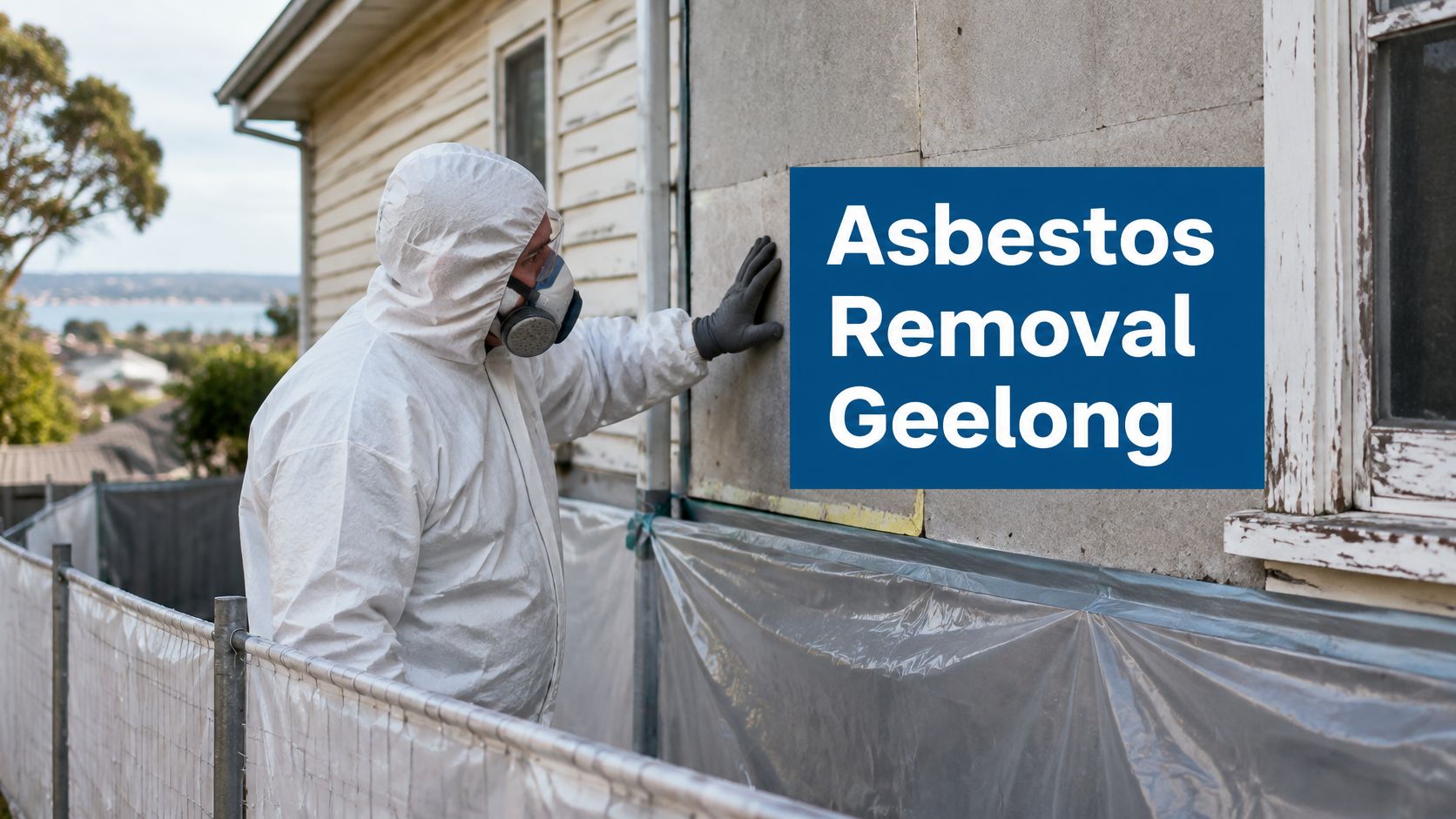
Asbestos Removal Geelong: Who Can Do It and When
You've opened up the laundry wall and found grey cement sheeting behind the lining. The renovation suddenly has another question attached to it: can you remove the material yourself, or does the job need a licensed asbestos removalist?
For homeowners arranging asbestos removal in Geelong, the answer starts with identification, not a demolition tool. The material, its condition, the total area and the removal time determine the legal route. Disposal matters just as much, because a small job isn't finished when the sheets leave the wall.
Table of Contents
- Who Can Remove Asbestos in Geelong and When
- How to Check If a Job Qualifies for Self-Removal
- Why Asbestos Needs Care and When to Leave It
- How Licensed Removal Runs From Notice to Clearance
- What to Do If Asbestos Turns Up Mid-Job
- Where Geelong Asbestos Waste Goes and How to Pack It
- Book a Licensed Removalist After Checking These Points
Who Can Remove Asbestos in Geelong and When
A renovation can stall when grey cement sheeting appears behind a laundry wall in a home built before 1990. WorkSafe Victoria warns that asbestos may remain in buildings constructed before that year, where renovation, maintenance or demolition can disturb it.
The sheet's appearance alone cannot confirm its contents. Eaves, sheds, fences and wall linings may all need to be considered when defining the work.
Match the material to the removal route
Victoria's rules distinguish between limited unlicensed work, licensed removal and work involving friable material. The requirements are covered in WorkSafe's limited-removal guidance, high-risk work notification guidance and licensed asbestos clean-up guidance.
Asbestos removal routes in Victoria by case
| Situation | Who may remove it | Notice to WorkSafe Victoria | Key condition |
|---|---|---|---|
| Non-friable asbestos, 10 m² or less, 1 hour or less in any 7 days | Homeowner, unlicensed | None for unlicensed work | Both the area and time limits must be met |
| Non-friable asbestos, 10 m² or less, licensed job | Class B licence holder | At least 24 hours before work starts | Separate notice for each job and location |
| Non-friable asbestos, more than 10 m² | Class B licence holder | At least 5 days before work starts | Asbestos control plan required before work begins |
| Friable asbestos, any amount | Class A licence holder | At least 5 days before work starts | Enclosures and a nominated supervisor on site |
| Visibly contaminated soil | Class A licence holder | Friable material requires at least 5 days' notice; confirm the soil classification before scheduling | Air monitoring may apply where other people could be exposed |
A Class A licence holder can also remove non-friable asbestos. Class B covers the licensed route for bonded material.
Use the table in order: identify the material, check the area and time conditions, then confirm the notice period before setting a start date. Limited unlicensed removal is permitted only when its conditions are met. A licensed removalist is the safer choice for any amount.
Bathroom approvals and asbestos licensing are separate matters. If the laundry work extends into a bathroom, you can find permit guidance for bathroom renovations while arranging the asbestos assessment independently.
For any job outside the limited unlicensed category, the appropriate licence route applies. A borderline job needs measured totals, not an estimate based on the most visible sheet.
How to Check If a Job Qualifies for Self-Removal
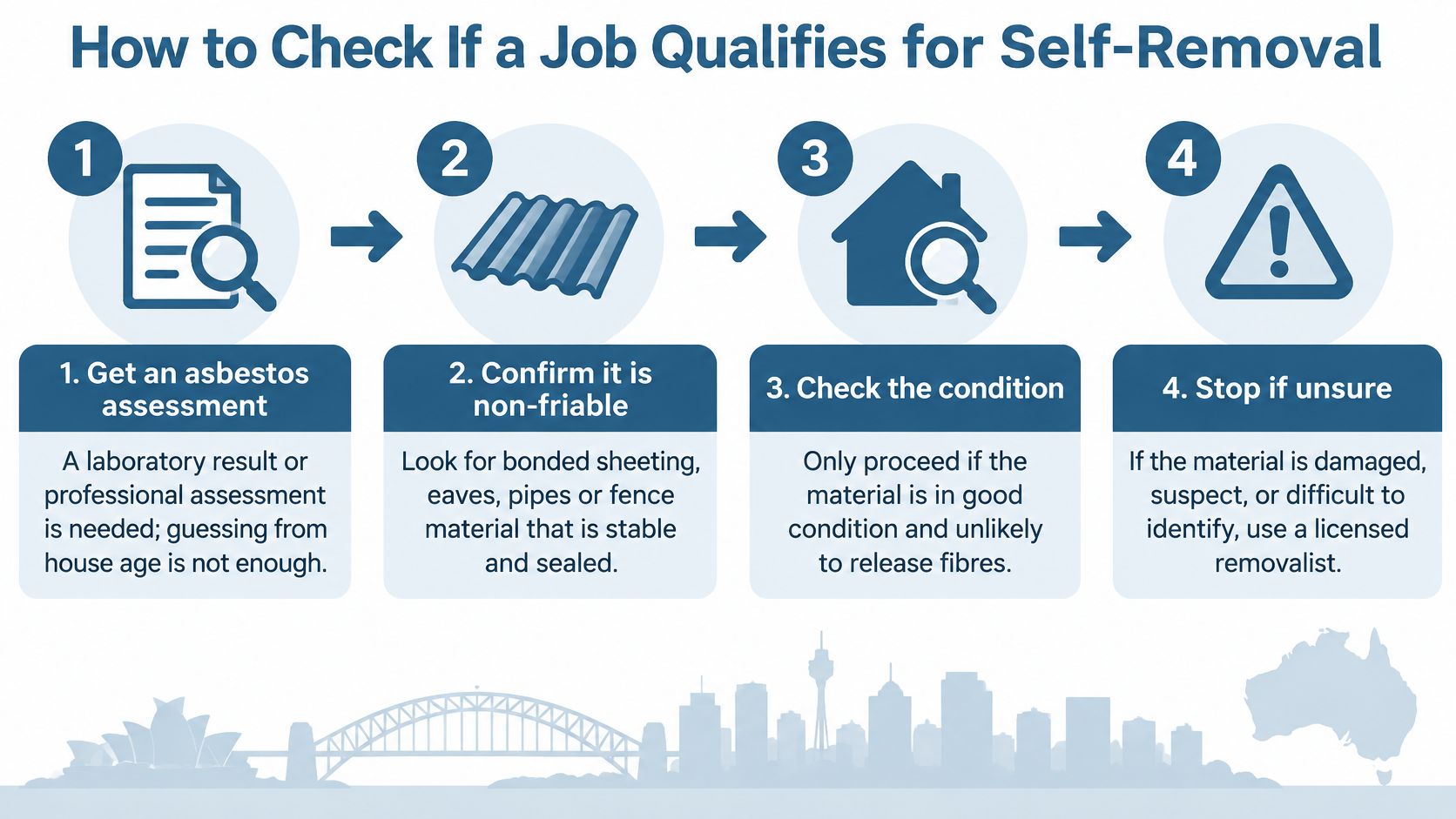
A small-looking repair can exceed the unlicensed-removal limits once you count every sheet that must come out and all the time spent removing it. WorkSafe Victoria's asbestos guidance allows limited unlicensed removal only when the material is non-friable, the total area is no more than 10 m², and removal takes no more than one hour in any seven-day period. Both limits must be met.
Start by identifying the material and defining the work. Protective clothing won't make an unidentified or oversized job eligible for self-removal.
Check the whole job before disturbing anything
Get an assessment or laboratory result. Have the material identified before treating it as ordinary building waste. House age, paint colour and the appearance of a broken edge can't confirm whether asbestos is present. Don't break off a sample yourself.
Confirm that it's non-friable. Bonded cement sheeting, eaves, pipes and fence panels may be non-friable while their fibres remain firmly bound. Don't squeeze, scrape or crumble suspected asbestos to test it.
Measure everything you'll disturb. Record each relevant sheet, backing board and section of eave in the work zone. Measuring only the damaged panel can miss adjoining material that also needs to be removed.
Keep a removal-time log. Record the actual time spent removing material. Add up removal time across the rolling seven-day period, and count each session once.
Compare both totals with the permitted limits. If the area exceeds 10 m² or removal takes more than one hour in the rolling seven-day period, the job does not meet the limited unlicensed-removal conditions. Several small sheets can push the total over the area limit.
Verify the licence before booking. Check that the licence class matches the assessed material and confirm which business will do the work. A general builder's registration or training certificate is not an asbestos-removal licence.
Plan isolation and dust prevention. Keep other people out of the work area and plan how the material can be removed without cutting, sanding or uncontrolled breakage. Power tools, brooms, brushes and high-pressure water can spread dust rather than control it.
Record decisions, not just dimensions
Keep the assessment, undisturbed photographs, area calculations and proposed scope together. These records help you describe the job accurately when requesting quotes and make it easier to spot material missing from the proposed scope.
An asbestos register in NSW records material locations and condition. It offers an example of why a written record is clearer than relying on memory.
A job that may qualify for limited unlicensed removal must be small enough, non-friable and clearly identified, with a method that avoids generating dust. If any of those points is uncertain, ask a licensed removalist to assess the work before it starts.
Why Asbestos Needs Care and When to Leave It
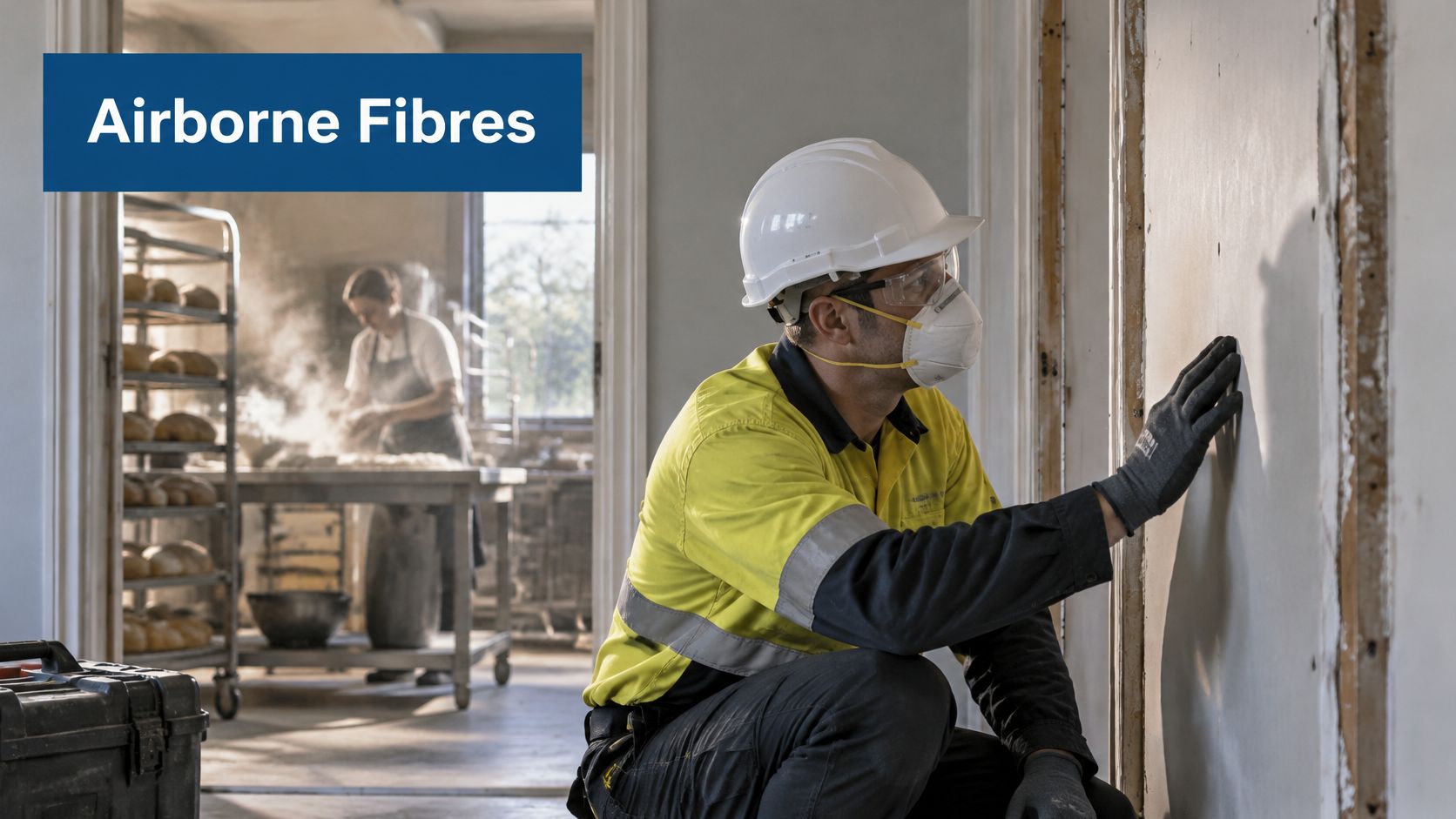
Fine flour dust in a bakery can hang in the air, settle on surfaces and travel on clothing. Released asbestos fibres can spread in comparable ways, but you can't rely on seeing them, and exposure can cause diseases such as mesothelioma that take decades to develop.
Friable asbestos can crumble under hand pressure. Bonded fibro cement holds fibres within a solid material, but cutting, drilling, sanding or breaking it can release them. Australia's 2003 national ban didn't remove asbestos already installed in homes and workplaces.
Decide according to disturbance risk
Victoria's safe-removal guidance warns that improper removal can release more fibres than leaving asbestos undisturbed. Assess the material's type, condition, location and proposed disturbance before choosing removal, professional encapsulation or management in place.
- Untouched shed lining: Intact bonded sheeting may be suitable to remain, with its location recorded and condition monitored.
- A bathroom wall scheduled for demolition: Affected asbestos must be identified and removed before demolition disturbs it.
Once contractors are engaged, the home becomes a workplace and occupational health and safety duties apply. Our asbestos awareness training guide explains the role of recognising hazards, which is different from being authorised to remove them.
How Licensed Removal Runs From Notice to Clearance
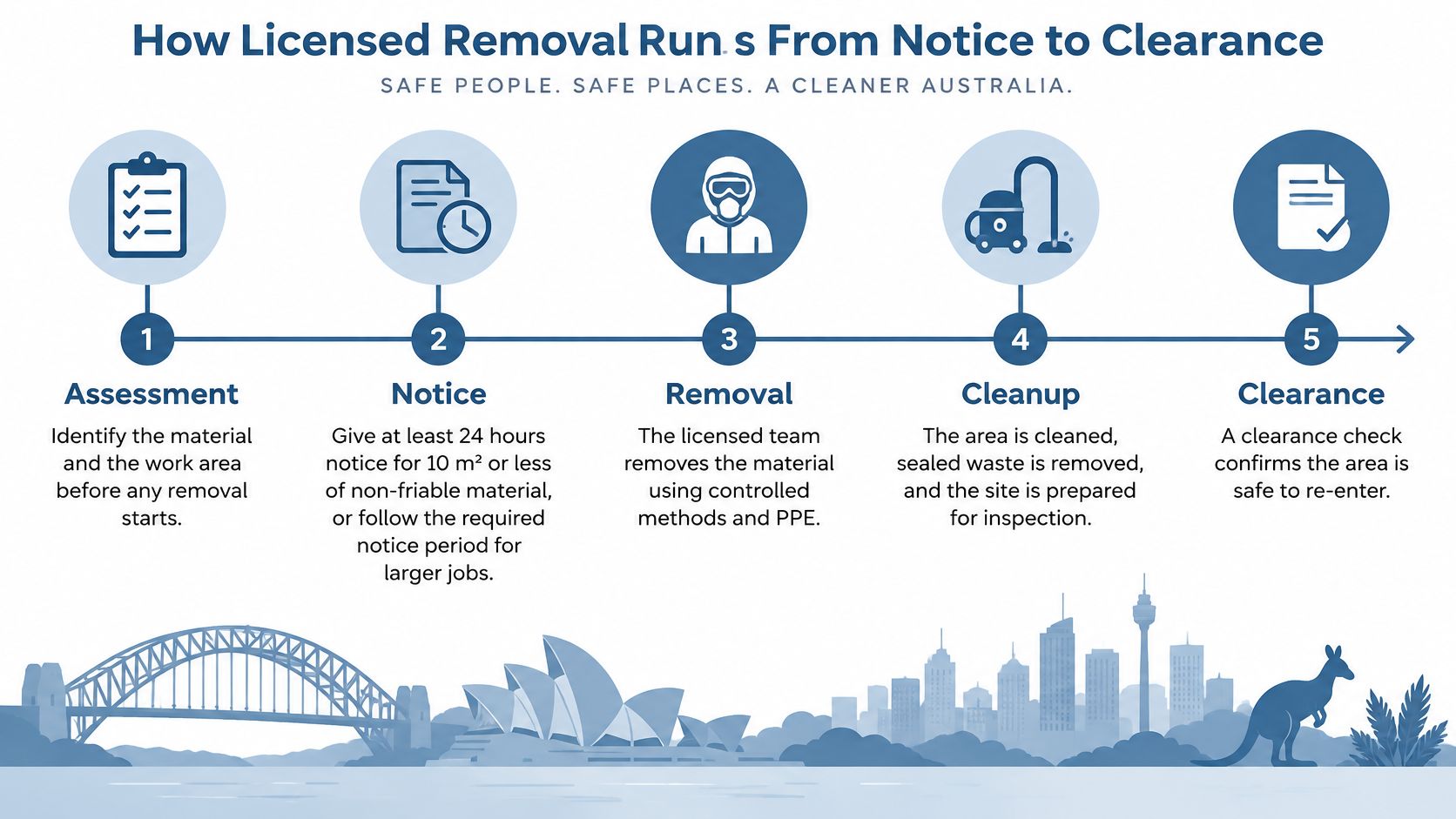
A licensed job runs through three handovers: assessment, notification and clearance. The assessment sets the scope; notification gives the regulator advance notice where required; clearance documents whether the area is ready for reoccupation. A quote that leaves out identification, disposal or clearance may not cover the full job.
Before the removal team arrives
Assessment comes first. The scope should identify the material, its condition, the affected area and access constraints. Tell the removalist whether other trades, household members or neighbours could be affected.
Notification must meet the required lead time. Licensed non-friable work in the smaller-area category requires at least one day's notice, according to WorkSafe Victoria's notification requirements. Larger non-friable jobs and friable work require a longer notification period. WorkSafe permits notification within 24 hours after work starts when removal is required because of an unexpected situation, as set out in its asbestos notification guidance. That exception applies to unexpected work, not a renovation schedule running late.
The asbestos control plan must be ready before work begins. It should set out the removal method, supervision, training, relevant monitoring and clearance arrangements, with required documents available on site. Friable work follows the Class A route, with controls that include an enclosure and a nominated supervisor on site.
During removal and at handover
The team establishes an exclusion zone and uses wet or other controlled methods suited to the material. Household members should stay out, including when retrieving tools, checking progress or taking photographs.
WorkSafe's power-tool safety guidance explains that personal atmospheric monitoring checks whether worker exposure limits are exceeded. Relevant outdoor monitoring must confirm airborne asbestos fibre levels do not exceed 0.01 fibres per millilitre before work resumes or normal use returns.
Run personal and area monitoring together because they answer different questions. Personal monitoring assesses a worker's exposure; para-occupational monitoring helps assess possible exposure among people near the work area.
A clean-looking room is not proof of clearance. The handover needs the inspection and documentation required for the removal work.
After removal, the team cleans the work area and sends sealed waste through the agreed disposal route. Clearance checks whether the area is suitable for reoccupation, rather than only confirming that the main sheets have been removed.
For domestic premises where the homeowner engaged the licence holder, the licence holder must obtain the clearance certificate. Before authorising follow-on trades, establish who will conduct the inspection, when it will happen and how you will receive the certificate.
Keep the assessment, quote, waste documentation and clearance certificate together. They show whether identification, removal, disposal and clearance were included and completed. An invoice that says only “asbestos removed” does not provide the same record.
What to Do If Asbestos Turns Up Mid-Job
You pull back a bathroom lining and uncover an unexpected sheet or dusty backing material. Stop work immediately, even if the plumber is booked and the room is already unusable.
Make the area safe without disturbing it
- Leave the material alone. Don't pull away another section to see how far it extends.
- Keep people and pets out. Stop using nearby tools and, where safe without entering the affected zone, switch off fans that could spread dust.
- Don't attempt ordinary cleaning. Avoid sweeping, household vacuuming or pressure washing.
- Arrange identification. Get a professional assessment or laboratory result before deciding what happens next.
- Review the scope. Record material already disturbed, the affected area and removal time so the removalist can assess the correct route.
- Let the removalist address notification. An unexpected situation may qualify for the notification exception, but discovering asbestos doesn't authorise continued DIY work.
- Maintain isolation. Leave the area closed off until a professional confirms the control and clean-up plan.
WorkSafe's waste guidance treats contaminated wet wipes, rags and coveralls as asbestos waste, not ordinary rubbish.
For broader sequencing when planning your period home renovation, Western Bathroom Renovations provides useful renovation context. Our guide to what to do if you find asbestos on site also explains the immediate response.
An unexpected discovery can change the entire removal category. Reassess the complete job before any further disturbance.
Where Geelong Asbestos Waste Goes and How to Pack It
A DIY removal can look cheaper until the waste is ready to leave the property. If the landfill will not accept the load, or the asbestos is packed incorrectly, disposal can become the point where the plan fails.
The City of Greater Geelong's asbestos disposal guidance says Drysdale Landfill accepts small domestic quantities, up to a six-by-four trailer, by appointment. Check acceptance before arranging transport.
Confirm acceptance before loading
EPA Victoria lists Drysdale as authorised to receive domestic asbestos. Call the facility before transport to confirm it can accept your specific material and load when you plan to arrive.
Describe whether the load contains intact sheets, smaller wrapped material or waste from a professional removal. A booking for general rubbish does not confirm asbestos acceptance. Do not travel with an unconfirmed load.
Accepted domestic asbestos must stay sealed during lifting, loading, transport and unloading. Protect wrapped parcels from sharp edges and movement in the vehicle, and do not break sheets to make them easier to carry.
The disposal test: If you have not arranged an accepted destination and safe handling, you do not yet have a workable removal plan.
Know which records apply
Under Victoria's applicable Waste Tracker requirements, household asbestos transported in the owner's vehicle is exempt from Waste Tracker. The exemption does not remove the need for safe packaging, accepted disposal or compliance with the facility's conditions.
Commercial removalists have documentation obligations for reportable priority waste. Confirm that the transporter has the required permission, uses Waste Tracker where applicable and provides the resulting record.
Ask for evidence of lawful disposal in the job handover. A wrapped load being taken away does not prove it reached an authorised facility.
If the load exceeds Drysdale's domestic allowance, cannot be packed for safe handling or is not accepted on the proposed day, stop and arrange disposal through a licensed removalist who can organise an appropriate destination.
Drysdale Landfill drop-off rules for domestic asbestos
All requirements below are from the City of Greater Geelong's asbestos disposal guidance.
| Requirement | Drysdale rule |
|---|---|
| Quantity | Small domestic quantities, no larger than a six-by-four trailer |
| Booking | By appointment |
| Packaging | Double-wrapped in 200-micron heavy-duty builders' plastic, sealed airtight with duct tape |
| Parcel size | Parcels small enough for one operator to handle safely |
| Labelling | Labelled “Asbestos – Do Not Open” |
| Drop-off hours | 9 am to 3 pm, seven days a week |
| Acceptance | Authorised for domestic asbestos; call before transport to confirm acceptance |
Book a Licensed Removalist After Checking These Points
Don't disturb suspected asbestos while you're still deciding who will remove it. Confirm the material, establish the scope and verify the removalist's Victorian licence directly with WorkSafe before engaging the business.
The cheapest quote may exclude the very tasks that make removal complete. Compare the written scope, not just the total on the last page.
Get the full job in writing
- Correct licence: The licence must match the assessed material, including Class A authorisation for friable work.
- Itemised scope: Identification, containment, decontamination, notification, disposal and clearance should be addressed explicitly.
- Control plan and notice: Confirm that the removalist will prepare the plan and lodge the required notification.
- Waste transport: Name the transporter and require the applicable Waste Tracker record and disposal evidence.
- Clearance handover: Confirm the inspection arrangements and certificate before anyone reoccupies the affected area.
WorkSafe Victoria's licence fee schedule lists 2026–27 fees of $1,307.30 for Class A and $1,113.90 for Class B. These are fees paid by removalists for their licences, not prices for removing asbestos from your home.
A quote excluding disposal or clearance isn't directly comparable with an inclusive quote. Ask the contractor to resolve those omissions before you accept it, rather than discovering additional charges when the room is already stripped.
Separate safety preparation from renovation choices
Workers and supervisors need to recognise suspected asbestos before routine tasks disturb it. We offer an online Asbestos Awareness course and deliver face-to-face training across Australia, including Victoria; our silica and asbestos course cost guide provides further training context. Awareness training doesn't replace removal licensing.
Once assessment and any necessary removal are resolved, you can finalise finishes and explore heated bathroom floor options through Melbourne Tiling Services P/L. Keep those design decisions separate from permission to disturb existing backing boards or floor materials.
Your practical step today is to document the suspected material and proposed work, then obtain an assessment and a complete licensed-removal quote where needed. A finished job includes controlled removal, lawful disposal and the required clearance evidence, not merely an empty wall.
TP Training offers online Asbestos Awareness training and delivers face-to-face training across Australia, including Victoria, to support better hazard recognition around renovation and construction work. Visit TP Training to explore training that helps you recognise suspected asbestos and understand when to stop work and involve a licensed professional.

You may also like

CPR Certificate Online Australia: What Counts in 2026

White Card Ballarat: Face-to-Face Course Steps for 2026