
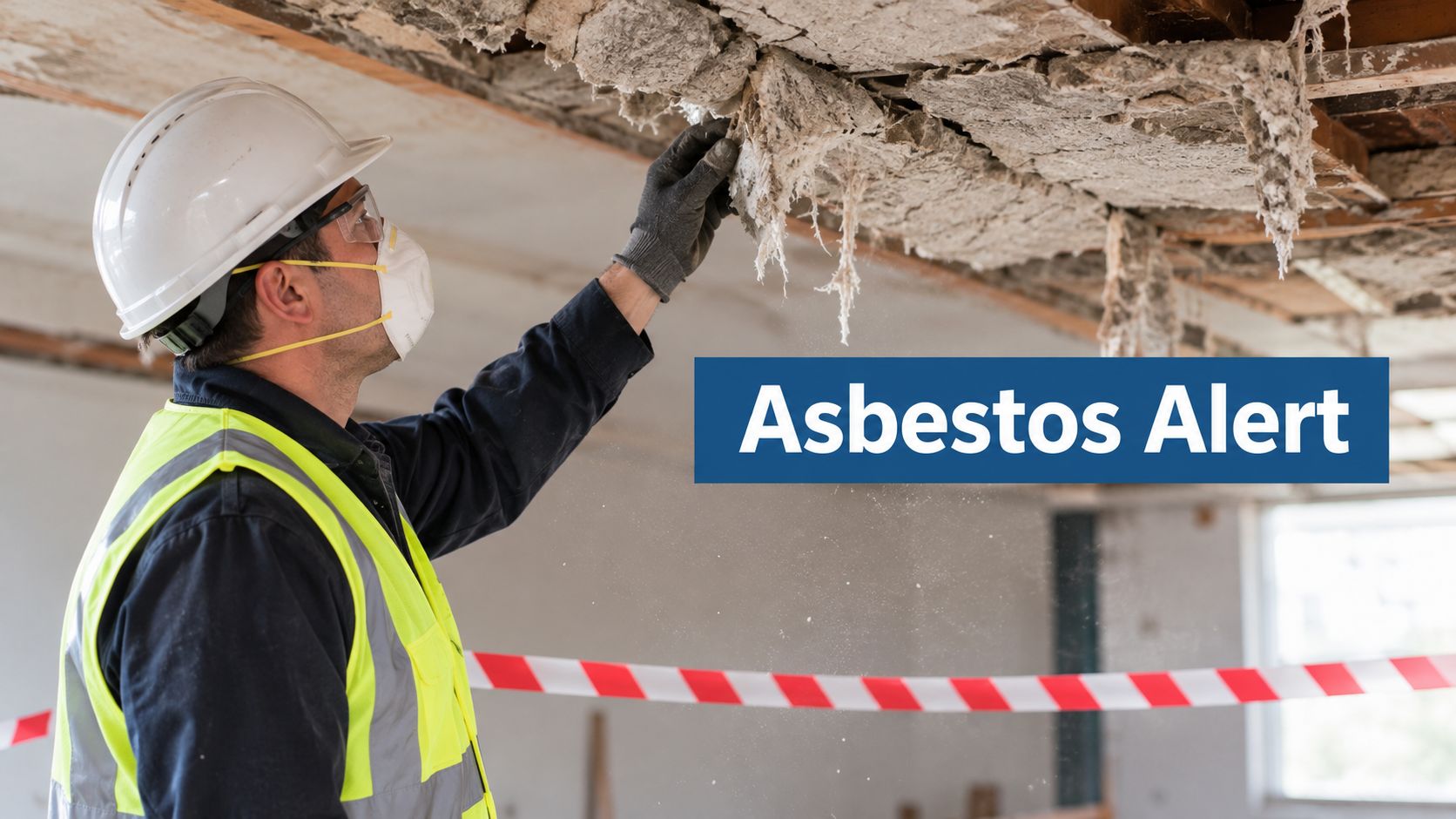
What to Do if You Find Asbestos on Site
You're on a live site, the job is moving, and someone has just found cracked sheeting, brittle debris, or old insulation where it shouldn't be. Don't keep working and hope it's harmless. Treat it as asbestos until it's checked properly, because once you disturb it, you've made the problem worse for everyone on site.
Australia banned the manufacture, import, supply and use of asbestos from 31 December 2003, but legacy asbestos still remains in millions of homes, public buildings and commercial premises (Asbestos Facts and Figures Guidance). That's why the right response is not guesswork. It's a disciplined, site-controlled reaction that stops fibre release, keeps people out, and gets the right licensed people involved fast.
If you need a practical waste chain once material is confirmed and packaged, Gegan's waste management services is a useful reference point for understanding how disposal support fits into the broader control process.
Table of Contents
- The Moment You Spot Suspect Material on Site
- Isolate the Area and Stop Fibre Migration
- Notify the Right People and Record the Discovery
- Get Competent Identification Before Anyone Touches It
- Engage Licensed Removalists and Meet Regulator Notice Rules
- Real-World Scenarios Workers Actually Face
The Moment You Spot Suspect Material on Site
You find cracked sheeting, fibrous debris, lagging, or old insulation during a live task. Stop the task immediately. Keep people clear and leave the material exactly where it is. Do not sweep, cut, drill, break, move, or sample it with bare hands.
Practical rule: treat any uncertain material as asbestos until a competent person confirms otherwise.
Tell the site supervisor or person in control without delay. NSW guidance for unexpected asbestos finds directs workers to cease work, leave the area, prevent unauthorised access, report the discovery, and consider whether decontamination is required (unexpected asbestos finds procedure). The crew's job is immediate control. The supervisor's job is to start the regulated response.
The material must then be assessed by a competent asbestos professional. That person determines whether sampling is safe, arranges laboratory identification where required, and advises whether the asbestos register or site records need updating. Workers should not collect samples themselves or decide that an old product is harmless by appearance.
Disturbance can release fibres into the air and carry contamination on clothing, footwear, tools, or vehicles. Keep suspected items out of the waste stream until they are identified and managed correctly. Workplace safety training can help crews understand their responsibilities before an unexpected discovery occurs.
For formal asbestos awareness preparation, an asbestos awareness training course gives workers a structured starting point. Removal, regulator notifications, packaging, transport, and disposal belong to appropriately licensed and authorised people. Once material is confirmed, Gegan's waste management services can provide a reference for the disposal stage.
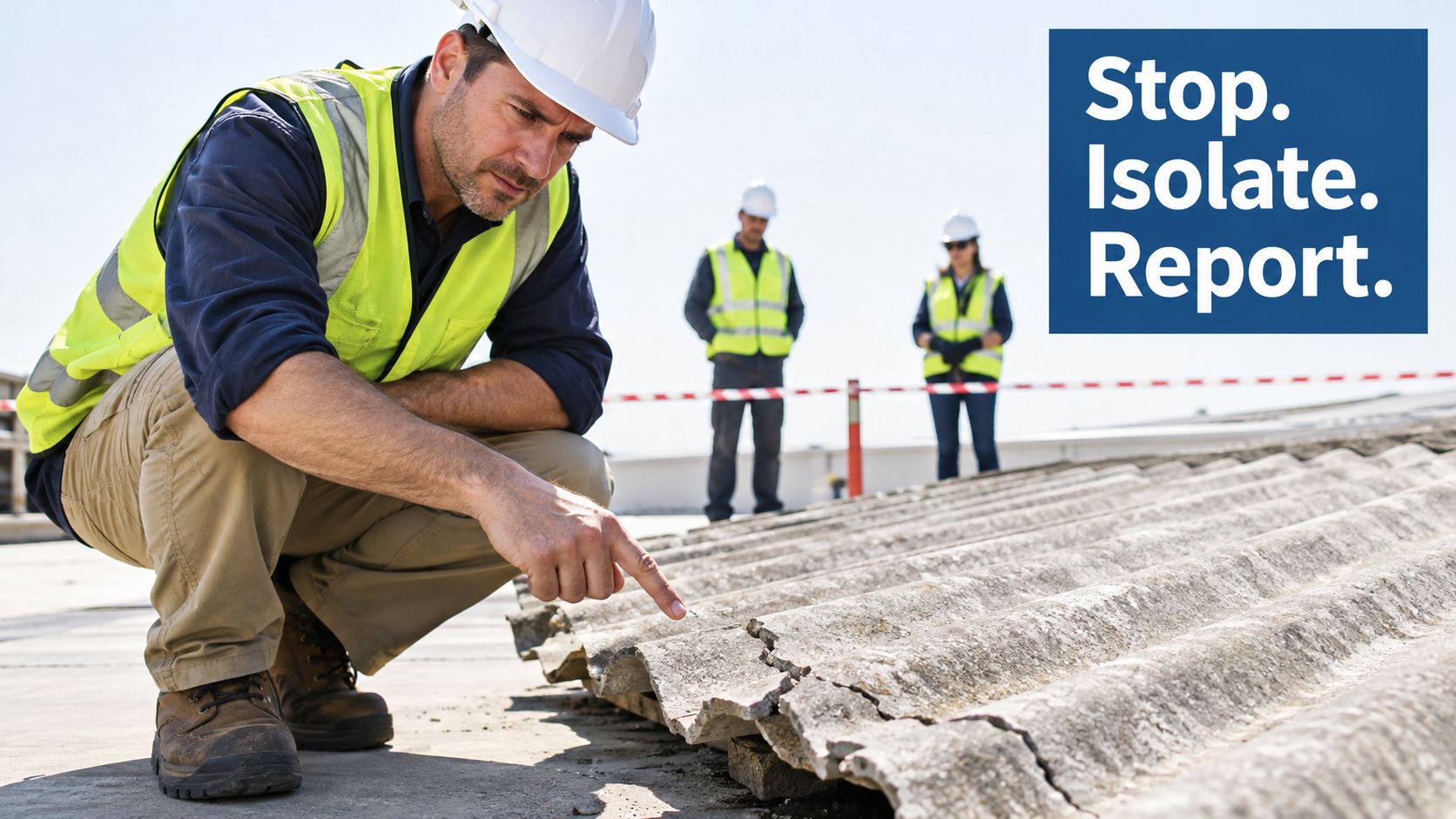
Isolate the Area and Stop Fibre Migration
A damaged sheet, lagging, or board can turn a contained find into a wider contamination event if people keep walking through the area. Set the physical controls before anyone resumes nearby work. Close doors, gates, and other access points. Stop work that could disturb the material, and isolate HVAC or mechanical ventilation if it could move contaminated air.
Use barriers, tape, or solid site controls to create a clear exclusion zone. Place warning signs at every approach, not just beside the material. Keep workers, visitors, and other trades out unless they are authorised and equipped for the task. The boundary must cover the material, likely debris, and the route used to approach it. Do not rely on a verbal warning or a barrier that people can step around.
Do not sweep, cut, drill, scrape, blow with compressed air, or use unsuitable vacuum equipment. Do not pick up fragments or move tools through the area. Leave the material where it is until competent people decide how it will be assessed and managed. The unexpected find procedure supports a controlled response to an unexpected discovery.
What clean isolation looks like
- Set the boundary first. Prevent casual entry before arranging further work.
- Mark every access point. Make the warning visible from each direction.
- Control movement. Keep vehicles, tools, clothing, and footwear from crossing between the suspect area and clean areas.
- Limit air movement. Shut openings and stop systems that could carry dust, where this can be done safely.
- Plan decontamination. If material has been disturbed or contamination may have spread, competent personnel must determine what decontamination controls are required before anyone leaves.
Contamination on boots, sleeves, tools, or vehicles creates a second work area to control. Keep potentially affected items in the restricted area and prevent workers from carrying them elsewhere. Follow on-site safety guidance alongside the site's controls, then leave sampling, removal, cleaning, and waste handling to the authorised people responsible for those tasks.
Notify the Right People and Record the Discovery
Don't let the discovery become a hallway rumour. Tell the supervisor, the site manager, or the person conducting a business or undertaking immediately, then log the event through the site's incident process. If you're on a school, government, or managed project, the local asbestos management plan and asbestos register need to be checked and updated without delay.
Write down the details while they're still clear. Record the exact location, what the material looked like, whether it was damaged or disturbed, who was nearby, and whether anyone may have carried contamination out of the area. That record matters because it shows what happened, what was controlled, and who may need follow-up.
Asbestos incidents and near misses must be reported as soon as reasonably practicable within 24 hours through the relevant reporting channels (School Infrastructure NSW asbestos management plan). Don't sit on it waiting for a convenient moment. If there's doubt about what you've found, NSW council guidance says to contact SafeWork NSW on 13 10 50.
If the site record is weak, the next crew inherits the risk.
A good paper trail protects workers and management. It also stops the same spot being treated casually later, which is how repeat finds happen. If your team needs a stronger understanding of register handling, the internal guide on asbestos register NSW is the right follow-up.
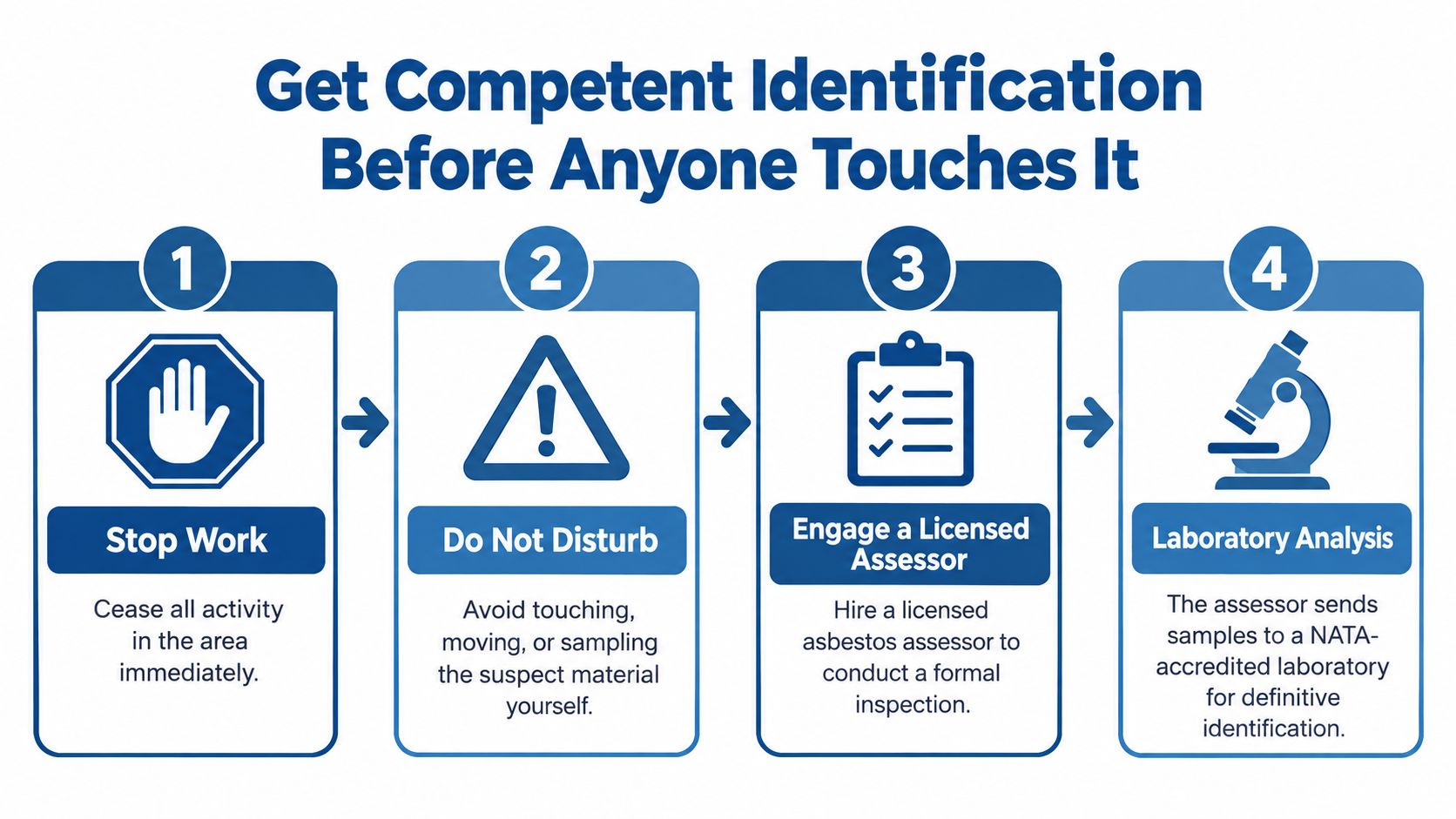
Get Competent Identification Before Anyone Touches It
Visual inspection is not proof. A clean-looking sheet, pipe wrap, or fragment can still be asbestos, and the wrong person taking a quick sample can spread contamination before the result even comes back. Safe Work Australia says that, where uncertainty exists, a PCBU must assume asbestos is present or arrange competent-person sampling (Safe Work Australia asbestos guidance).
That means the sample, if one is needed, comes from a competent person under controlled conditions and goes to a NATA-accredited laboratory or a regulator-approved laboratory. Workers shouldn't collect their own samples just to get an answer faster. That's not speed, that's exposure.
What competent identification actually means
A proper assessment usually follows a tight order:
- Stop the task. Nothing else happens until the area is stable.
- Protect the discovery. The material stays where it is unless safe handling is arranged.
- Use a competent person. They identify representative samples and assess the condition.
- Wait for lab confirmation or lawful presumption. The site proceeds on evidence, not guesswork.
If the material can't be sampled safely, treat it as asbestos. That's the hard truth, and it's the safer one. The PCBU's duty is to control the site, not to satisfy curiosity.
If you're trying to recognise likely materials before a job starts, a plain-language resource on identify asbestos in your home can help people understand why old building materials are treated cautiously. On a worksite, though, home-style curiosity is the wrong attitude. The job is to verify without creating a release.
The internal page on asbestos awareness training fits neatly here because awareness only matters if people know when to stop and hand the matter over to a competent assessor.
Engage Licensed Removalists and Meet Regulator Notice Rules
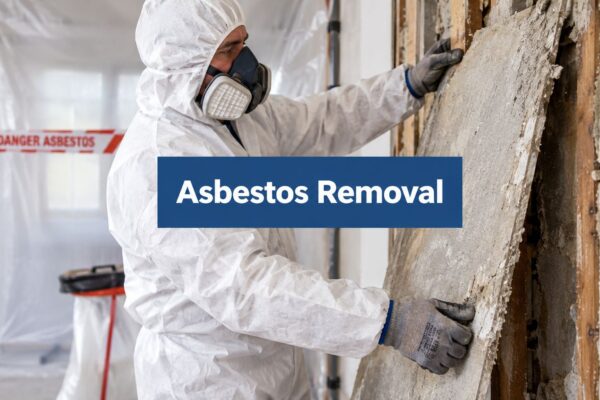
Once asbestos is confirmed or must be presumed, removal isn't a side task for whoever's available. It has to be planned and carried out by the appropriately licensed asbestos removalist under controlled conditions. The work area should be segregated, access controlled, and the job sequenced so people aren't working around the removal zone.
In NSW, licensed asbestos removal work normally requires written notice to the regulator at least 5 days before the work begins, and failure to give that notice carries maximum penalties of 43 penalty units for an individual and 217 penalty units for a body corporate (NSW legislation). That notice window is not an excuse to keep disturbing the site. The area stays isolated until the work is legally set up.

The controlled removal chain
Removalists should use wet methods and controlled waste handling, not dry disturbance. Anything leaving the area needs to be decontaminated, sealed, labelled, and taken to an EPA-licensed disposal facility. Legacy guidance also specifies heavy-duty polythene waste bags with a minimum thickness of 200 micrometres and maximum dimensions of 1,200 mm by 900 mm (Safe Work Australia exposure and compliance study).
There's a narrow emergency pathway when asbestos has to be removed immediately because of a sudden and unexpected event or an unexpected essential-service breakdown. In that case, the licensed removalist must notify the regulator immediately by telephone and provide written notice within 24 hours. After the removal, a documented visual inspection should confirm the area is clean before reopening. Don't rely on an informal “looks good” from someone who was never responsible for the risk.
Real-World Scenarios Workers Actually Face
The neat checklist breaks down when the site is messy. You might find broken fragments already tracked onto clean floors, dust disturbed by earlier work, or suspect material buried in soil during trenching. In those situations, the response doesn't change much, but the control chain gets stricter, not looser.
The person with management or control of the workplace must treat suspected asbestos in soil as asbestos until competent assessment shows otherwise, and work must cease immediately where soil is suspected to contain asbestos (Safe Work Australia model code). That applies on demolition, civil, landscaping, and excavation jobs just as much as on building work. If the ground is suspect, stop driving through it, stop grading it, and stop moving it around.
Quick reference
| Stage | Immediate Action | Who to Notify | Key Rule |
|---|---|---|---|
| Discovery | Stop work and isolate the area | Supervisor, site manager, PCBU | Don't disturb the material |
| Identification | Arrange competent assessment | Licensed assessor or competent person | Treat uncertainty as asbestos |
| Removal | Engage licensed removalist | Regulator, site controller | Follow notice and control rules |
| Disposal | Seal, label, transport, document | Disposal facility, site records | Keep chain of custody intact |
A rejected load at a landfill creates a different kind of headache. If asbestos is suspected or found in waste, onward transport should stop until the receiving facility and regulator requirements are confirmed. Illegal dumping must be left alone and reported through the proper channels, not shifted from one site to another to “solve” the problem. NSW guidance also points to broader contamination reporting where people could be exposed or contamination could migrate.
For crews who want a broader hazard-prevention view that includes dust and legacy materials, the internal course note on crystalline silica exposure prevention and asbestos awareness is relevant, especially on mixed civil and demolition jobs where dusty work and asbestos risk can overlap.
If you're dealing with asbestos risk on a live site, get the team trained before the next find happens. TP Training offers practical asbestos awareness and related workplace safety courses that help crews recognise suspect material, stop work correctly, and follow the right response chain. Visit TP Training and put proper site control in place before the next discovery shuts your job down.

You may also like
Asbestos Removal Requirements in NSW: The Complete Guide
What Is Forklift Training and How Does It Work in Australia