
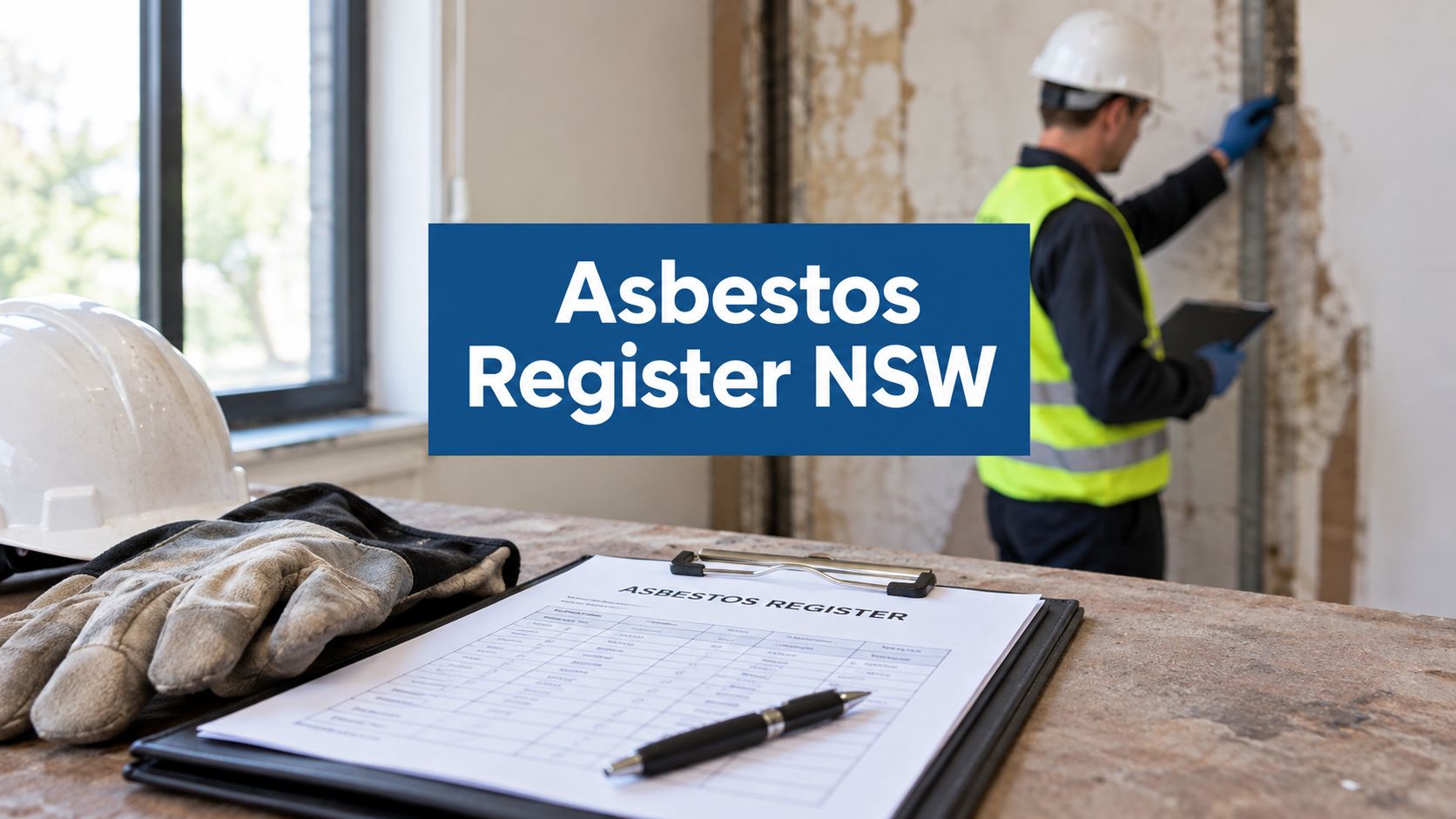
Asbestos Register NSW: How to Create and Maintain One
You're standing on a NSW job, the client wants work started today, and the superintendent asks for the asbestos register before anyone drills, cuts, or opens up a wall. If that register is vague, out of date, or missing presumed ACM, you're already behind. That's the reality of asbestos register NSW compliance, it's not a filing exercise, it's the document that decides whether the work can start safely.
Table of Contents
- What an Asbestos Register Means in NSW
- What Every NSW Register Entry Must Include
- Running the Inspection and Survey
- Completing Entries, Storage and Access
- Pitfalls That Get NSW Sites Caught Out
- Reviews, Enforcement and Penalty Exposure
- Building Competence and Your Compliance Checklist
What an Asbestos Register Means in NSW
A commercial property in Penrith built before 1990 is a good example of where people get caught. The owner treats the register as a folder in the office, the site manager assumes the contractor will “spot it on the day”, and the PCBU carries the risk when hidden material gets disturbed. In NSW, the register is a live control document. It belongs with the person who has management or control of the workplace, not just the employer or whoever first found the asbestos.

The law expects a register where asbestos has been identified, or where a workplace was built before 31 December 2003 and asbestos may still be present SafeWork NSW guidance. That is why a brand-new-looking office can still need one, while an older light-industrial site usually deserves close checking. On NSW sites, the costly mistake is usually the assumption.
Practical rule: if a worker might open, cut, sand, drill, or remove something before checking the register, the register is already too weak.
The duty sits with the person who manages or controls the workplace. They must prepare, keep and maintain the register, and the information has to stay current NSW WHS Regulation. In practice, that means the register has to follow the building, tenancy changes, refurbishments, and removal jobs. A one-off survey report buried in an email folder does not do that.
Site leaders also need the right mindset. A register exists so the next trade can tell, before work starts, whether they are dealing with fibre-cement, old backing board, lagging, vinyl products, or something else that needs control. If you want a broader safety refresher for crews and supervisors, this on-site safety resource is a useful starting point.
What Every NSW Register Entry Must Include
A useful register entry tells a worker exactly what they need to know before they touch the material. The four essentials are simple, but sites still get them wrong: location, material type, condition, and date identified. If one of those is missing, the entry becomes a note, not a control.
Write the location like a person will use it tomorrow
“West wing” or “Level 2 toilet area” is too loose for most jobs. A good entry says where the material is and how a worker can find it without guessing, for example, “north wall of electrical room, behind switchboard, lower panel”. That level of detail matters because the first person on site might be an electrician, a plumber, or a maintenance contractor carrying tools, not a person with time to decode a floor plan.
Material type needs the same discipline. NSW sites often deal with fibre-cement cladding, vinyl tiles, old switchboard backing, and lagging on older services. A register that just says “asbestos” hides the practical difference between a bonded sheet on a wall and insulation around a pipe. Those are not the same task, the same access method, or the same control response.
Record the material the way a contractor would recognise it. If the entry doesn't help a worker decide what not to disturb, it's too vague.
Condition is just as important. A sound, sealed item still needs recording, but a cracked, damaged, or weathered material deserves clearer attention because the next person on site needs to know whether the surface is stable or already compromised. The identification date shows when the information entered the register, which matters when a site has been altered since the original survey.
The gap people miss most often is presumed ACM. The register should not list only what a lab has confirmed. If the material is reasonably likely to contain asbestos based on age, construction type, or prior reports, it belongs in the register as presumed ACM until it's assessed properly. For a practical refresher on inspection habits, this workplace inspection checklist is a useful companion for supervisors and managers.
Running the Inspection and Survey
A competent register starts well before anyone opens a ceiling or cuts a sample. The first pass is a desk review, because the building history usually gives you the strongest clues. Look at construction age, original plans, renovation records, old asbestos reports, maintenance logs, and any prior removal certificates. If the property has a patchy paper trail, treat that as a warning sign, not a reason to assume the place is clear.
Start with records, then walk the site
The physical inspection should focus on accessible areas, where the likely ACM can be seen without destructive work. That means roof spaces that can be safely reached, service rooms, plant areas, switchboard enclosures, wall linings, floor coverings, and the sorts of hidden surfaces maintenance crews routinely touch. The person doing the survey needs to distinguish between what is confirmed, what is presumed, and what can't yet be accessed.
Sampling is only useful when it answers a question that matters for control. If the material is clearly suspicious and sampling is appropriate, the sample needs to be handled by a competent person and the result linked back to the exact location in the register. If sampling isn't possible, presumption is better than delay, but it has to be justified in writing. “Not sampled” is not a reason to leave the item out.
A strong external report should tell you three things, location, material identification, and what should happen next. If you're comparing report formats, a practical inspection report template can help you see how good evidence is usually structured, even though the job-specific asbestos details still need to come from the site itself.
For teams that want a single training pathway covering both hazardous dust and asbestos awareness, TP Training also provides the 10830Nat 11084Nat Crystalline Silica Exposure Prevention Asbestos Awareness Combo Courses, which can suit crews moving between construction and maintenance environments.
The key point is sequence. Review the records first, inspect the accessible areas next, decide where presumption is justified, and only then finalise the register. That order keeps the register tied to evidence, not guesswork. For workers who need a quick online reminder of exposure controls before a survey or pre-start, this online crystalline silica exposure prevention and asbestos awareness course resource is a useful reference point.
Completing Entries, Storage and Access
A register that sits in a folder nobody can find is a compliance problem. Once the survey is finished, the register has to be readable at speed, kept where people can get to it before work starts, and controlled so the current version is the one being used. Hard copy is acceptable if it is managed properly. Digital is fine if workers can open it on site when they need it. Many workplaces end up using both.
Location matters. If contractors have to ask around for the register, the system is failing them. Put it where the people starting the job will look first, and make sure the site controller, HSR, and incoming contractor know exactly where that is. When the workplace changes hands, the register must move with it.
If the register is not available before pre-start planning, the chance to prevent disturbance has already been lost.
Access is wider than some managers assume. Under the WHS requirements, workers, health and safety representatives, contractors, and other relevant persons must be able to see the register before service, maintenance, refurbishment, or demolition where exposure could occur. The register is not an internal note for office filing. It is a working document for the people who are about to cut, drill, strip, or open up the building.
Keep it current as soon as conditions change. If asbestos is identified, removed, enclosed, damaged, or otherwise changes condition, update the register straight away. If a contractor opens a wall and finds material that was not noted before, that information belongs in the register promptly, not after someone gets around to it at the end of the month.
| When an NSW Asbestos Register Must Be Updated | What to Record or Update | Who to Notify |
|---|---|---|
| New asbestos or ACM identified | Exact location, material type, condition, identification date | Workers, contractors, HSRs, site management |
| Asbestos removed | Item removed, date, area affected, any remaining ACM | Incoming controller, workers likely to enter area |
| Asbestos enclosed or sealed | Control measure used, date, revised condition note | Workers and contractors before work starts |
| Material damaged or condition changes | New condition assessment and any immediate controls | Site management, HSRs, relevant trades |
| Workplace handed over | Latest register version and supporting records | New person with management or control |
Training matters here because people often confuse a register with a clearance or a one-off report. TP Training's 11084Nat Asbestos Awareness Training Course can help workers understand why the register needs to be checked before they step onto site.
Pitfalls That Get NSW Sites Caught Out
Inspectors don't usually find a dramatic failure first. They find small, ordinary mistakes that make the register unreliable. The most common one is omitting presumed ACM because nobody sampled it. That creates a false sense of safety, especially on older sites where fibre-cement sheets, vinyl flooring, pipe lagging, or textured finishes were installed long before current controls.
The weak entry is the one that sounds tidy but helps no one
Room names alone are another classic problem. “Bathroom,” “Plant room,” or “Level 1 corridor” doesn't help a contractor find the exact surface or panel they need to avoid. Add the specific wall, ceiling, backing board, pipe section, or enclosure point, and the register becomes useful. Without that detail, the worker still has to guess.
Skipping photographs also hurts. A photo isn't a legal substitute for a proper description, but it can prevent confusion when the same room has similar-looking materials on multiple surfaces. The register should help a worker recognise the material, not just remind an office administrator that a report exists somewhere.
Common failure: treating a “no asbestos identified” note as if it were a clearance certificate. That is not the same thing, and it doesn't protect a site from future disturbance.
The other trap is time. A register that hasn't been visually reviewed in years may still look complete on paper, but the building might have changed. Partitions move, plant is replaced, tenants refurbish, and maintenance crews alter materials in ways that never make it back into the original file. SafeWork NSW expects the register to be kept up to date and reviewed at least every five years, with earlier review triggered by disturbance, removal, sealing, enclosure, or an HSR request SafeWork NSW Code of Practice.
There's also a confusion between a private home and a workplace. A private residence doesn't usually need a workplace asbestos register just because asbestos might be there, but once workers enter a pre-2004 commercial property, the workplace duty applies. That distinction matters on mixed-use sites, strata properties, and owner-managed buildings where people assume “no register required” means “no asbestos risk”.
Reviews, Enforcement and Penalty Exposure
A register that has not been reviewed is one of the first things that goes wrong on a live site. The sensible standard is straightforward. Check the listed material against what is on site, update the entry if conditions have changed, and keep that review cycle current. If the building has been quiet, that does not stop the duty. If work is active, the trigger can come much sooner.
The missed triggers are usually routine jobs. A health and safety representative asks for a review, asbestos is removed, disturbed, sealed, or enclosed, or someone changes the fabric of the building during maintenance or fit-out. A repaint over damaged lining, a new service penetration through older material, or a plant replacement can leave an entry stale very quickly.
What inspectors ask for on the day
Inspectors usually ask for the register itself, the latest review record, the supporting survey or inspection notes, and proof that workers could access it before the job started. They compare the paperwork with the site. That is where weak registers show up. If the entry says a panel is intact but the panel has since been cut, the site has both a documentation problem and a physical one.
Penalty exposure is real. The NSW rules set a maximum penalty of 40 penalty units for an individual and 210 penalty units for a body corporate for failing to prepare, keep, and maintain the register NSW WHS Regulation. The legal position also includes a separate maximum of 43 penalty units for an individual and 217 penalty units for a body corporate for some register and maintenance failures NSW legislation. In practice, exposure turns on who controls the workplace, how obvious the gap is, and what the inspector finds on the day.
If you want a practical reminder of what site managers and PCBUs are expected to handle, this responsibilities of employers resource is a useful reference.
Building Competence and Your Compliance Checklist
A good register depends on people who know what they're looking at. The person compiling it needs enough asbestos knowledge to recognise likely ACM, understand when presumption is appropriate, and record the result in a way the next trade can use. The workers reading it need enough awareness to stop and check before they disturb anything. That's where asbestos awareness training earns its place.
If a supervisor wants to lift the standard quickly, start with the people who touch the register and the people who rely on it. Training should cover how to read entries, how to respond to presumed ACM, and when to escalate a finding instead of pressing on with the job. TP Training's Asbestos Awareness Training is one option for building that baseline understanding in a practical way.
A short checklist for the next site walk-through
- Review date: check when the register was last visually reviewed and whether anything on site has changed since then.
- Location accuracy: confirm the entry points to the exact surface, panel, or service area.
- Condition rating: make sure the current condition matches what's there.
- Photographs: verify that images support the written description where needed.
- Presumed ACM entries: look for older materials that should be listed even if they weren't sampled.
- Access controls: confirm workers and contractors can get the register before pre-start.
- Handover notes: check that changes are documented when control of the workplace changes.
If you need a training format that can be adapted to site procedures, induction content, and role-specific risks, this article on how bespoke eLearning gets built gives a useful sense of how customised workplace learning is structured.
A compliant NSW site isn't the one with the fanciest folder. It's the one where the register matches the building, the likely ACM is recorded even when it hasn't been sampled, the review cycle is real, and the crew can get the document before work starts. That's the difference between paperwork and control.
If you want your team to get this right before the next pre-start, book practical asbestos awareness training with TP Training and give supervisors a clearer way to recognise, record, and act on ACM. Visit TP Training to see the current course options and choose the training that fits your site.

You may also like
Asbestos Removal Requirements in NSW: The Complete Guide

What to Do if You Find Asbestos on Site