
On Site Safety Guide for Construction and Civil Works
You arrive before the morning traffic has settled. An excavator is already warming up, a delivery vehicle is edging towards the gate, and several workers are walking between storage areas and the active work zone. Everyone may be wearing high-vis clothing, but safe movement still depends on who has been inducted, where vehicles can travel, who controls the exclusion zone, and whether the plan matches the work starting.
That's the practical meaning of on site safety. It isn't a poster, a signature on a form, or a quick reminder to wear a hard hat. It's a working system that protects employees, contractors, visitors and members of the public through site design, competent supervision, clear communication and controls that match real exposure.
Table of Contents
- Introduction to On Site Safety on Australian Worksites
- What On Site Safety Really Means Beyond the Checklist
- Site Induction and Training Requirements for Legal Access
- Hazard Identification and Risk Controls That Actually Work
- PPE and Plant Safety Essentials on Construction Sites
- Incident Reporting Contractor Management and Real Site Examples
- Building Your Daily On Site Safety Routine
Introduction to On Site Safety on Australian Worksites
Australian construction and civil sites combine people, plant, vehicles, changing ground conditions and time pressure. A new worker might be focused on learning the task while an experienced operator is concentrating on a load, an excavation or a reversing movement. Without coordination, ordinary activities can overlap in dangerous ways.
The injury profile shows why a practical approach matters. Safe Work Australia data cited by Queensland regulators recorded a serious claim incidence rate of 16.9 claims per 1,000 construction workers, compared with 10.5 per 1,000 across all industries. The same dataset recorded more than 16,000 construction claims and 24 construction fatalities in the referenced year. Machinery operators and drivers had the highest fatality rate by occupation, followed by labourers. These figures are reported by Workplace Health and Safety Queensland.
That pattern points to a useful shift in thinking. A site can't rely only on controls for rare catastrophic events while overlooking repeated contact with mobile plant, site traffic, excavation edges or poorly coordinated work fronts.
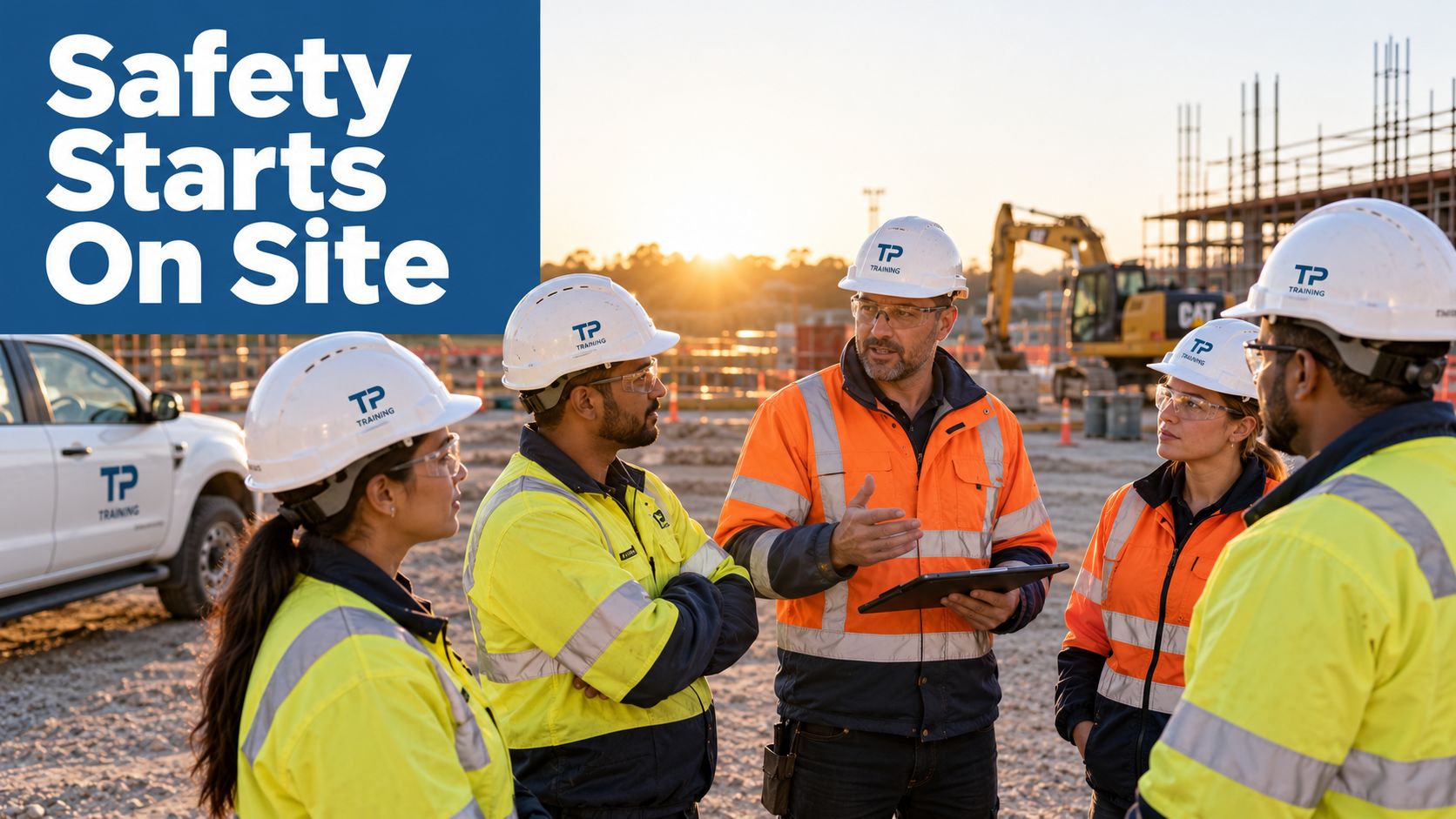
Safety is part of the work
A good pre-start meeting helps the crew understand what has changed since the previous shift. A supervisor can point out a relocated haul route, a new delivery area or a temporary exclusion zone, then ask workers to explain how they'll move through the area safely. That conversation is more useful than repeating a generic warning.
Workers also benefit from understanding the reason behind each control. When people know why a pedestrian route has been separated from an excavator, they're more likely to respect the route when the schedule becomes busy.
Use the workplace safety tips from TP Training as a practical prompt for everyday preparation, communication and hazard awareness. By the end of this guide, you should be able to recognise the main exposure points, question weak controls, participate in risk assessments and follow a repeatable routine before, during and after a shift.
What On Site Safety Really Means Beyond the Checklist
A hazard is something with the potential to cause harm. Risk depends on how people interact with that hazard, how often they're exposed, and how severe the outcome could be. An uncovered excavation beside a pedestrian path is a hazard. The risk rises when workers, visitors or members of the public can approach the edge without a barrier, clear route or supervision.
Think of a site as a shared road system. A vehicle may be mechanically sound, and every driver may have a licence, but the system still becomes unsafe if pedestrians and vehicles use the same narrow space without clear priority. On site safety manages the interaction, not just the condition of one item.
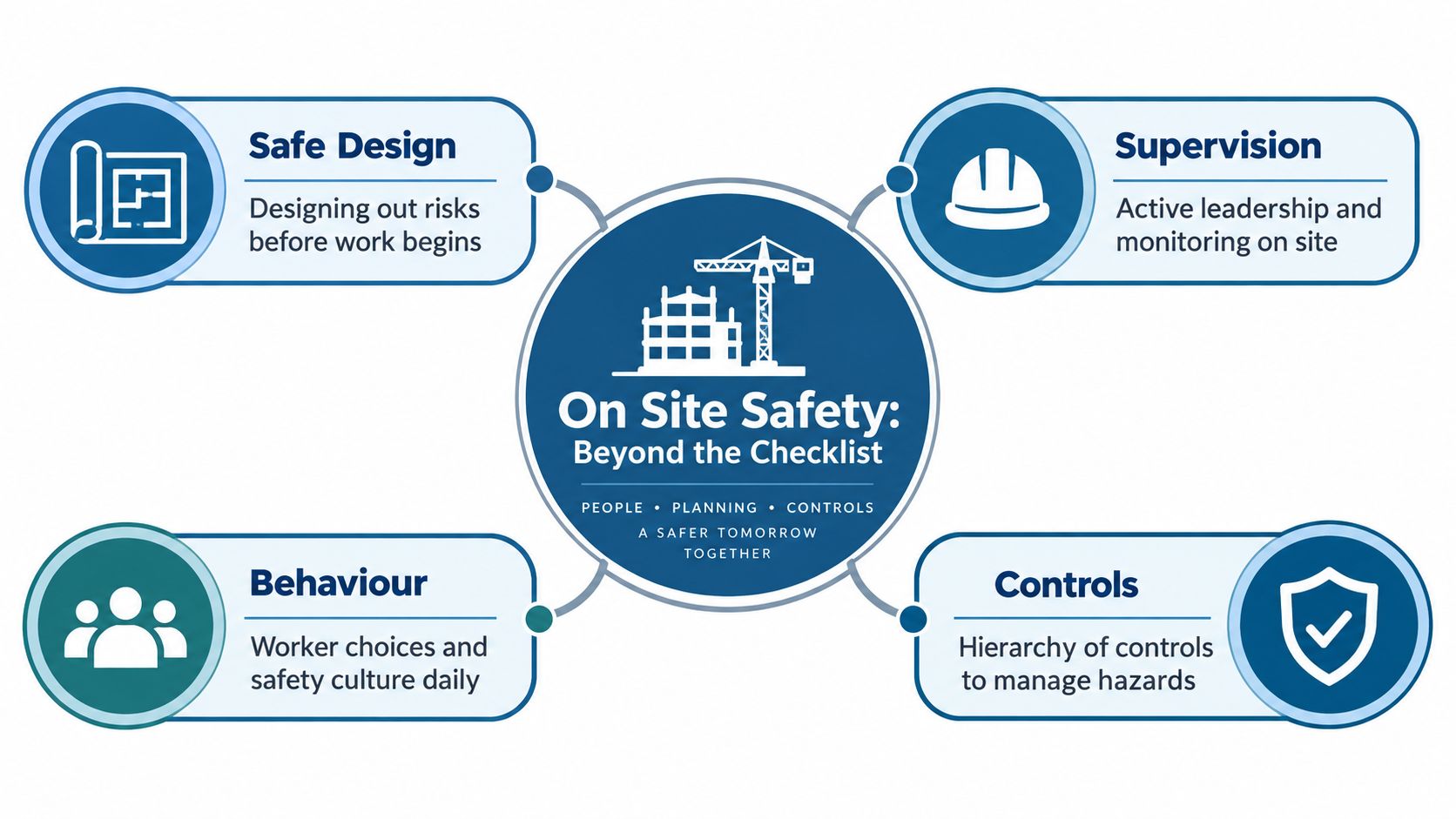
Four parts of a working system
Safe design starts before the first task. A project team can plan vehicle routes, locate delivery points away from pedestrian access, provide stable work platforms and design temporary works around the actual sequence of construction.
Supervision means checking that the plan works in the field. A supervisor notices when a barrier has moved, a subcontractor has entered the wrong zone or a task has changed from the method described in the SWMS.
Behaviour includes the decisions people make under normal pressure. Workers stop at a crossing, make eye contact with an operator, use the designated walkway and speak up when conditions no longer match the plan.
Controls are the physical and procedural measures that reduce exposure. They include guarding, barriers, exclusion zones, isolation, traffic plans, permits and emergency arrangements. PPE remains important, but it should support stronger controls rather than replace them.
Practical rule: If a control depends entirely on someone remembering to be careful, ask whether the site can add a physical separation, interlock, barrier or planned sequence.
The PCBU has duties to provide a safe work environment and manage risks, while workers must follow reasonable instructions, use equipment correctly and report hazards. Contractors bring their own experience and responsibilities, but the principal contractor still needs a coordinated system for shared risks. A safe site makes those responsibilities visible instead of assuming that every crew will interpret the work the same way.
Site Induction and Training Requirements for Legal Access
A worker arrives at the gate ready to start, but the induction record is missing. The hard hat cannot solve that problem. Construction access begins with the required training and verification. Before carrying out construction work, workers must hold a valid construction induction training card, commonly called a White Card. Comcare's construction induction information explains that it is usually issued after completing CPCWHS1001 Prepare to work safely in the construction industry through a state or territory licensing body.
The White Card gives workers general construction safety knowledge. It does not authorise every task on every project. A site-specific induction, task instruction, high-risk work licence, plant verification or other approval may still be required before work begins. For workers checking the process before enrolment, this guide explains how to get a White Card.
Treat the gate process as a safety control
A practical first-day process is:
- Prepare your documents. Bring the required identification and your construction induction card details. If the card was replaced, transferred or issued in another jurisdiction, confirm what the employer or licensing body requires before arriving.
- Complete verification. The site representative should check your identity, training status and role. This keeps unverified workers out of active work areas.
- Attend the site induction. Learn the emergency arrangements, first aid locations, amenities, reporting process and local site hazards.
- Confirm task authorisation. Check whether you may operate the equipment, enter the work zone or perform the assigned high-risk activity.
The White Card Training Course from TP Training provides nationally recognised training with experienced trainers and hands-on learning across NSW. General induction is the starting point. Employer verification and the site briefing still determine whether a person can begin work there.
Training must match the task
A toolbox talk can explain changed conditions for the day. It cannot replace competency for operating civil plant or performing high-risk work. Traffic control, work platforms at height, lifting operations, silica-related tasks and excavation each require instruction suited to the hazard, equipment and work method.
Before starting, ask:
- Am I trained and authorised? Do not operate unfamiliar plant because the crew is short-staffed.
- Does the site know my capability? Tell the supervisor about relevant licences, cards and experience.
- Has the work changed? If the route, plant, ground or crew has changed, request a fresh briefing.
Refresher training may be needed after a long period away from a task, a change of equipment or an incident that exposes a knowledge gap. Competence is shown through safe performance, not by holding a document.
Hazard Identification and Risk Controls That Actually Work
Hazard identification works best when it follows the job from preparation to completion. Start with the work area, identify who and what can be affected, then examine each movement, energy source and change in condition. A pre-start check should cover more than equipment defects. It should also ask where people will stand, how vehicles will move, what can fall, what can collapse and what happens if the planned sequence changes.
The hierarchy of controls gives the team an order of preference. Elimination removes the hazard. Substitution replaces it with something less hazardous. Engineering controls isolate people from the hazard. Administrative controls organise the work. PPE protects the individual when exposure remains.
Apply the hierarchy to real tasks
For mobile plant, elimination might mean changing the work sequence so pedestrians don't need to enter the operating area. Engineering controls include physical barriers, separate haul routes, controlled gates, reversing cameras and proximity systems. A sign or radio call can help, but it won't provide the same separation as a designed exclusion zone.
For silica-generating work, the team should consider whether the task can be changed, whether wet methods or on-tool extraction can reduce airborne dust, and whether the work area can be isolated. Australia's workplace exposure standard for respirable crystalline silica is 0.05 mg/m³ as an eight-hour time-weighted average, as set out in the silica facts and figures. The control plan must therefore address how dust is generated, captured, contained and monitored.
For excavation, controls may include locating services before digging, designing battering or shoring, restricting access and checking conditions after weather or nearby loading changes. For work at height, use a safer work position or a suitable platform before relying on fall protection equipment.
| Hazard Example | Preferred Control Level | Practical Site Action |
|---|---|---|
| Pedestrians near an excavator | Elimination or engineering | Change the sequence or install a physical exclusion zone with controlled access |
| Reversing trucks in a shared area | Engineering | Separate vehicle and pedestrian routes, define reversing areas and use a traffic management plan |
| Silica dust from cutting | Engineering | Use wet cutting or effective extraction, isolate the task and select suitable respiratory protection |
| Excavation beside a work path | Engineering | Locate services, provide designed support or battering, and prevent unauthorised entry |
| Short-duration work at height | Substitution or engineering | Use a safer platform or access method instead of improvising from materials |
| Lone work near changing hazards | Administrative and technological support | Establish check-ins, escalation arrangements and reliable communication; guidance on how to improve lone worker safety with 3rd-i may help teams assess monitoring options |
A SWMS should be something the crew can challenge and improve. If the document says “keep clear” but doesn't show where the safe position is, the control isn't finished. Workers should be able to point to the barrier, route, isolation point or permit that makes the instruction practical.
For silica-specific learning, the crystalline silica exposure prevention guidance from TP Training provides a useful training reference. The key test on site is simple: can the crew explain the hazard, identify the strongest available control and verify that it remains effective while the task continues?
PPE and Plant Safety Essentials on Construction Sites
A hard hat may reduce injury from some falling or moving objects, yet it cannot stop a reversing vehicle entering a pedestrian zone. High-visibility clothing can help an operator see a worker, but it cannot create a safe distance from an excavator. PPE is the last visible layer of protection. Site layout, plant controls and coordination must do the heavier work.
Australian PCBUs must provide PPE to workers unless another PCBU has already supplied it. The equipment must be reasonably comfortable and suitable for both the worker and the task. The PCBU must also provide information, training and instructions, check effectiveness periodically, and display PPE signage, as described in Safe Work Australia's PPE guidance.
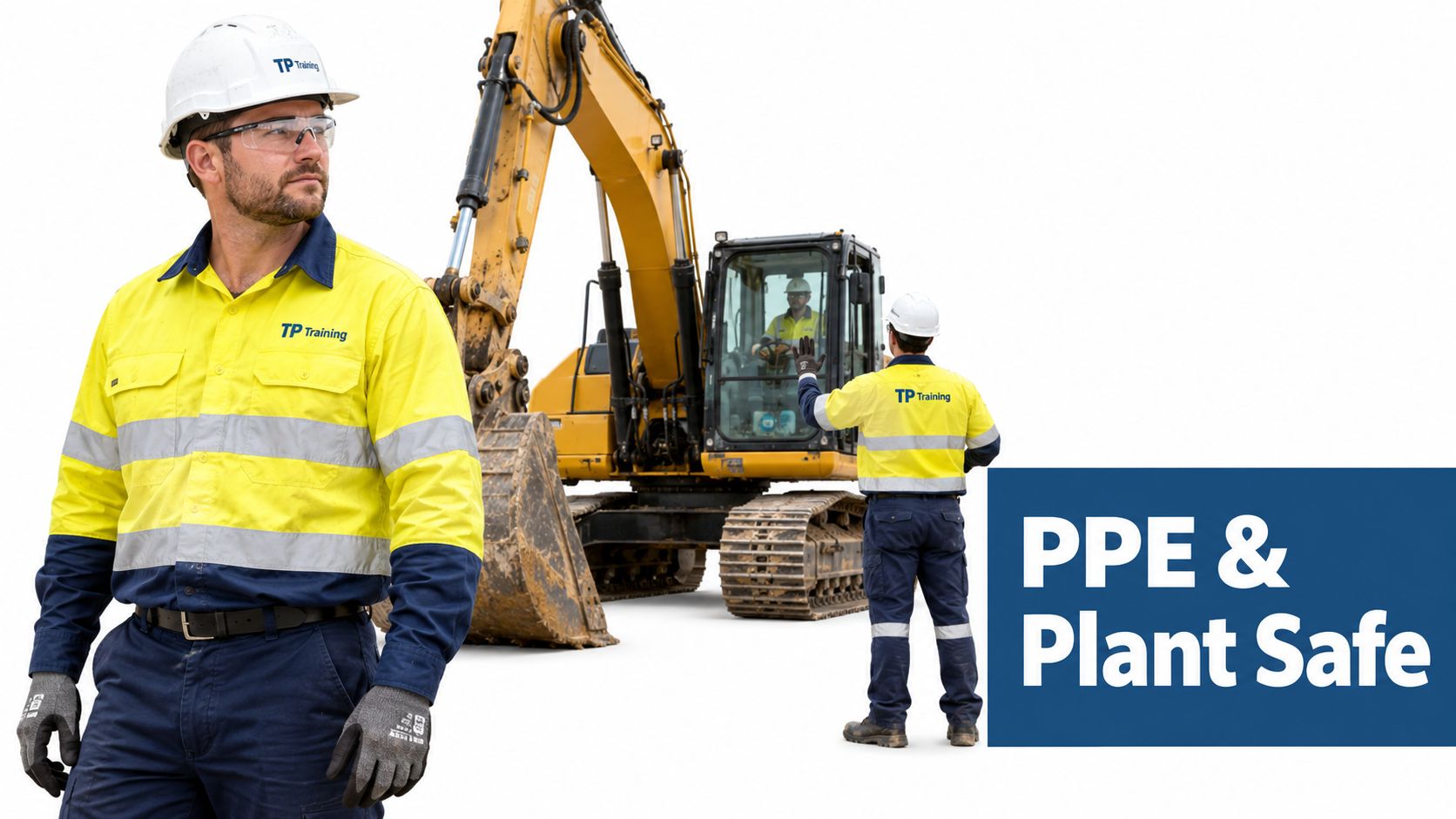
Correct PPE is task-specific
A worker cutting concrete may need eye protection, hearing protection, protective clothing and respiratory protection, depending on the risk assessment and control system. A traffic controller needs clothing that supports visibility, but also a traffic environment with safe routes and clear instructions. Gloves must suit the material and task. The wrong pair can reduce grip or create an entanglement risk.
Respiratory protective equipment for silica must fit the wearer properly and be maintained. Australian silica safety guidance explains the practical test: having a mask available is not enough if it does not fit or function as required.
Before work starts, check each item's condition, fit, compatibility and storage. Replace damaged equipment, report discomfort that affects use, and ask for instruction if you do not know how to test or maintain RPE.
Plant separation does the heavier work
Plant safety starts with the site map. A traffic management plan should set out vehicle routes, pedestrian paths, crossing points, delivery arrangements, speed controls and exclusion zones. Operators need clear sightlines. Pedestrians need routes that do not rely on guessing what a machine will do next.
Consider a worker taking the shortest path behind an excavator. The operator may assume the worker will stay clear, while the worker may assume they have been seen. A safer arrangement separates the pedestrian route, barricades the operating zone, controls access and confirms communication before movement begins.
A spotter can support a difficult movement, but cannot replace physical separation and a planned system. Before work platform operations begin, supervisors and workers should review equipment, ground conditions, access, overhead hazards and emergency arrangements using this work platform risk assessment resource. The aim is simple: make the safe position and the next movement clear before people and plant share the same space.
Incident Reporting Contractor Management and Real Site Examples
A near miss is useful information before it becomes an injury. Suppose a delivery truck crosses a pedestrian route at a roadworks site, but nobody is struck. The supervisor should stop and control the immediate area, check that everyone is safe, notify the relevant site contact, record what happened and preserve useful details such as location, time, vehicle movement, visibility and the condition of barriers.
The report isn't about assigning blame first. It helps the team identify why the interaction was possible and whether the traffic plan, induction, supervision or physical layout needs to change.
A practical reporting workflow
- Make the area safe. Stop the task if an immediate danger remains and arrange first aid or emergency support when needed.
- Notify the right people. Follow the site procedure for supervisors, project managers, principal contractors and regulators where required.
- Record facts. Note what was observed, who was involved, the equipment or area affected, the conditions and the control that failed or was missing.
- Review the system. Ask what allowed the event to occur, then assign corrective actions with an owner and a verification date.
- Share the learning. Explain the changed control at the next briefing without exposing personal information unnecessarily.
Official Federal Safety Commissioner reporting shows why consistent measurement matters. Accredited companies recorded a TRIFR of 6.49 in 2024, down from 6.72 in 2023 and 8.77 in 2019, while the FFR was 0.64 in 2024, down from 1.41 in 2023, according to the 2024 Federal Safety Commissioner Annual Data Report. The same report recorded seven fatal incidents on Scheme-accredited building sites in 2023, showing that improved frequency measures don't remove the need to verify high-consequence controls.
Coordinating contractors
Contractor management starts before arrival. Confirm capability, licences, plant condition, insurance and the contractor's understanding of site rules. On arrival, complete induction and explain shared hazards, interfaces and authority to stop work.
For high-risk work, use a clear permit or authorisation process where appropriate. The principal contractor and subcontractor should agree who controls the area, who provides the exclusion zone, who communicates with other crews and who verifies the work before release.
A warehouse beside civil works creates a common interface problem. A delivery driver may know the warehouse route but not the excavation boundary, while the civil crew may not expect a forklift to enter the work zone. A joint briefing, controlled access point and named contact can prevent assumptions from becoming incidents.
Building Your Daily On Site Safety Routine
A reliable routine turns safety from intention into verification. When you arrive, confirm that you're inducted, authorised for the task and aware of the day's changes. Check the access route, emergency arrangements and the location of other crews before collecting equipment.
Before starting work, compare the actual job with the SWMS or risk assessment. Look for changed plant, altered ground, new deliveries, weather effects, damaged barriers, overhead services and people entering the work area. If the conditions don't match the plan, stop and ask for the control to be reviewed.
A routine you can repeat
- Arrive prepared: Carry the required card, identification and task information, then attend the briefing.
- Inspect the work area: Confirm routes, exclusion zones, access points, ground conditions and nearby activities.
- Check equipment: Complete the pre-start inspection and report defects before use.
- Control interaction: Keep pedestrians and mobile plant separated, and confirm communication before movement.
- Monitor the job: Pause when the sequence changes, controls fail or another crew enters the interface.
- Close the shift properly: Report hazards, near misses, defects and unfinished controls so the next crew doesn't inherit an unknown risk.
A workplace inspection checklist from TP Training can support a structured review, but a checklist only helps when someone verifies each item in the field. The most valuable question isn't “Has the form been completed?” It's “Can I see the control working?”
The Federal Safety Commissioner data shows that accredited companies can reduce injury frequency, while continuing fatalities demonstrate why critical risks need more than paperwork. Consistent habits build trust between workers, supervisors and employers. They also help job seekers and experienced operators show that they can work reliably within a professional safety system.
TP Training delivers practical, nationally recognised training for construction induction, civil construction, traffic control, high-risk work and workplace safety across NSW. Visit TP Training to explore courses that can help you enter the industry, strengthen your current skills and work more confidently on Australian sites.

You may also like
EWP Ticket Over 11 Metres: Complete NSW Guide

How Long Does CPR Certificate Last in Australia