EWP Ticket Over 11 Metres: Complete NSW Guide
You've arrived on a NSW worksite ready to operate a large boom lift. The induction is complete, your PPE is on, and the supervisor asks for your high-risk work licence before you approach the controls. You've passed an EWP course, so you expect the paperwork to be straightforward. Then you discover that course completion and licence issuance are separate steps.
That distinction matters whenever the boom-type elevating work platform can reach the 11-metre threshold. The machine's maximum design geometry, not the height you plan to work at that day, determines whether you need the WP class high-risk work licence. The rules apply across construction, civil works, maintenance, access work, and other industries that use this type of plant.
Table of Contents
- Why the 11 Metre Threshold Changes Everything
- How the 11 Metre Boom Length is Actually Measured
- Inside the TLILIC0005 Training and Assessment
- Yellow Card vs High Risk Work Licence
- From Course Completion to State Licence Issuance
- Career Pathways and Industry Demand in NSW
- Next Steps to Get Qualified with TP Training
Why the 11 Metre Threshold Changes Everything
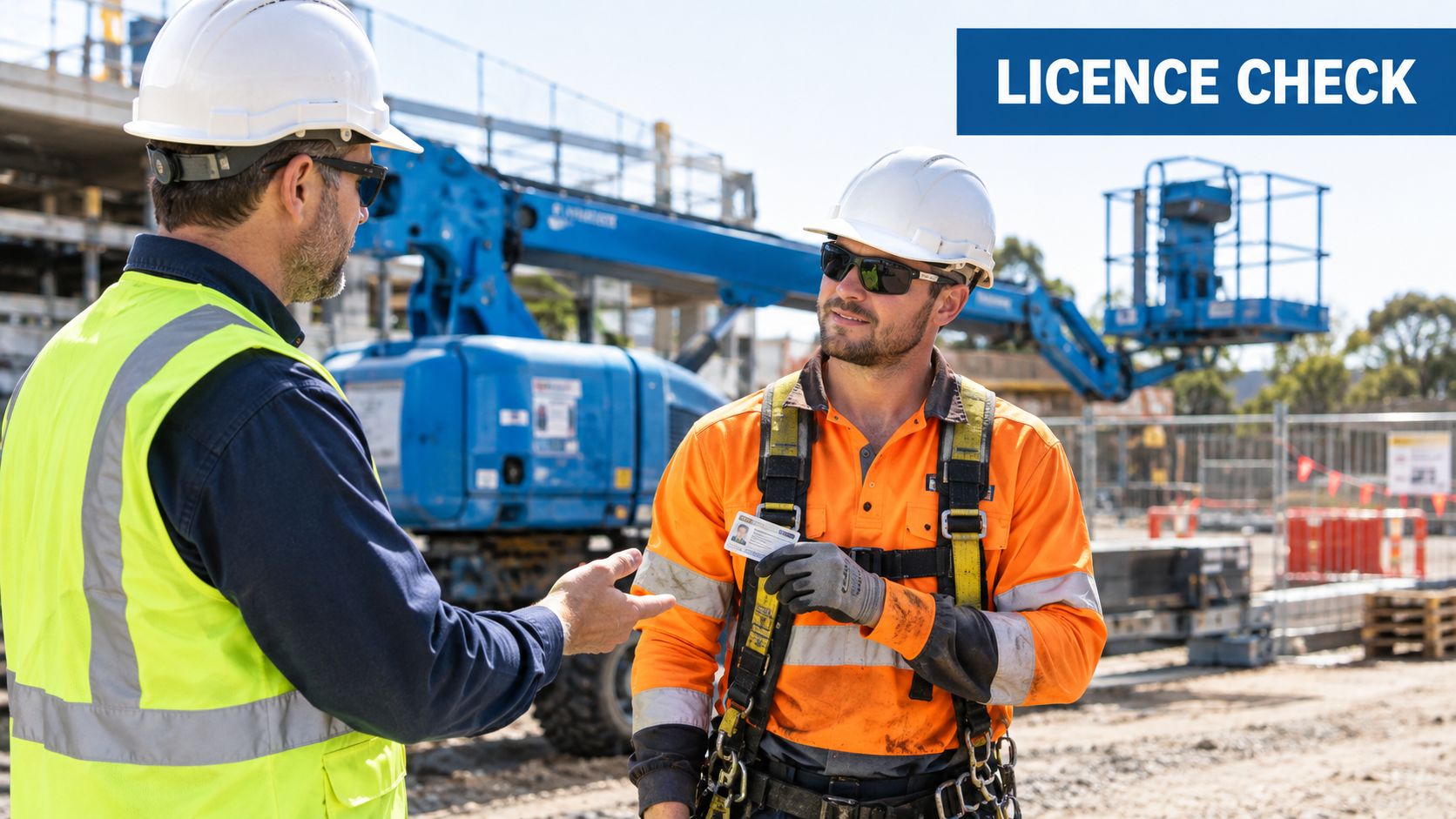
A supervisor checking your licence isn't creating an extra site rule. For a boom-type EWP with a boom length of 11 metres or more, the operator must hold the appropriate WP high-risk work licence. SafeWork NSW describes the relevant equipment as telescoping, hinged, articulated, or combined devices used to lift people, equipment, and materials on a work platform. Its guidance confirms that the licence requirement applies to the machine category, not only to the task being performed. SafeWork NSW's EWP code of practice sets out this requirement.
A smaller EWP may still require documented operator training, site authorisation, and equipment-specific familiarisation. However, crossing the threshold moves the machine into the high-risk work licensing system. Safe Work Australia's crane guidance includes self-propelled, trailer-mounted, and vehicle-mounted boom-type EWPs in the WP class when the boom extends over 11 metres. The mounting style doesn't remove the licensing obligation. The national crane guide explains how these machine types sit within the same licence category.
Practical rule: Treat the machine's maximum capable reach as the compliance starting point, even if the job only needs a lower working position.
That's why an employer may stop a worker who has completed general EWP training but hasn't completed the state application process. A certificate or assessor outcome can show that training and assessment have occurred, but the regulator-issued HRW licence is the document that authorises licensed operation.
The EWP licence requirements explained by TP Training can help applicants understand the difference between training evidence and the licence they need to carry into site work. Before you book, identify the machine, check its boom specifications, and ask the relevant state regulator or training provider what documentation must follow the assessment.
How the 11 Metre Boom Length is Actually Measured
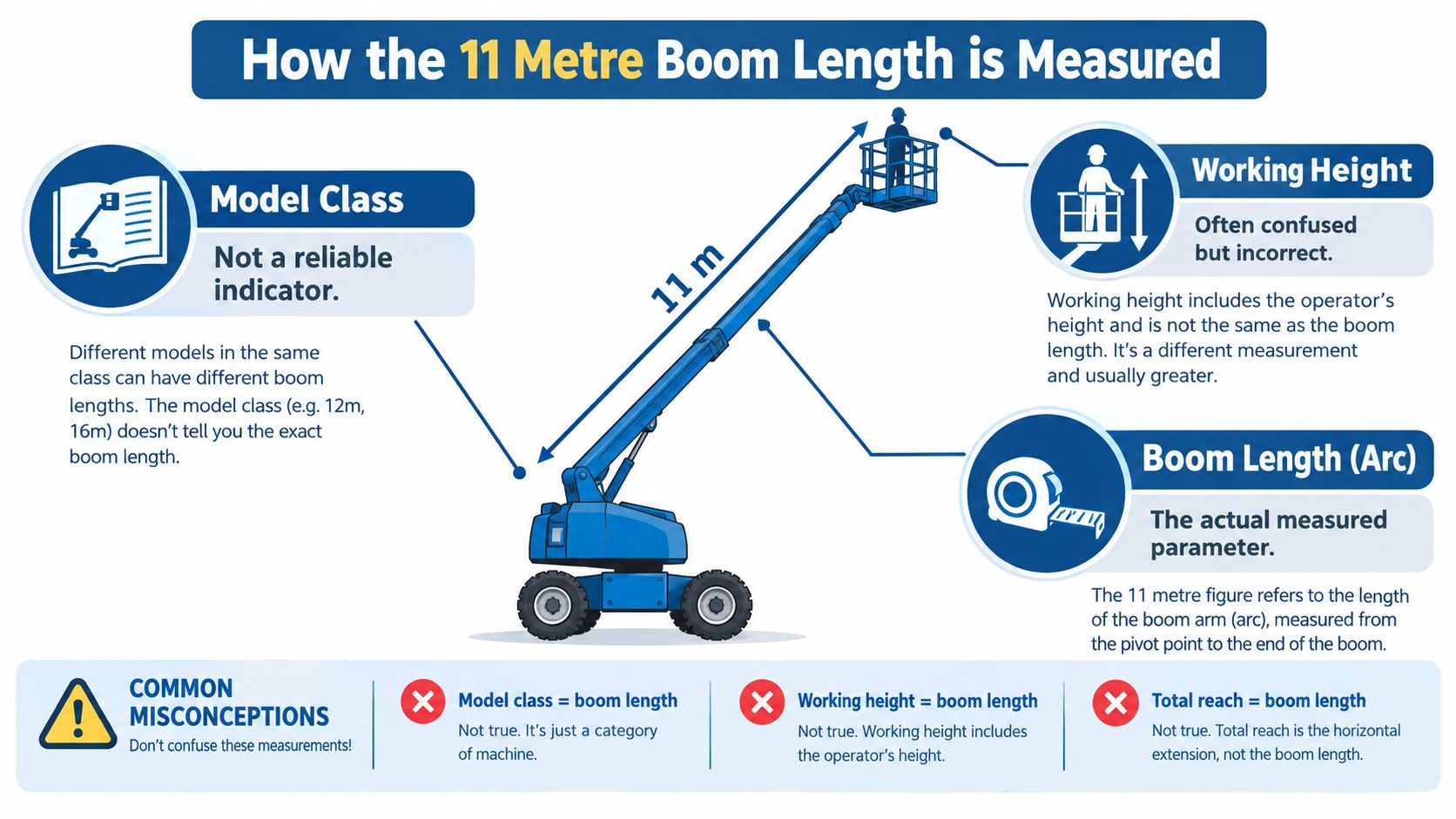
Many operators use the wrong reference point. They look at the machine's advertised model name, the platform height printed in a brochure, or the height needed for a particular task. None of those shortcuts replaces the technical measurement used to decide whether the WP threshold applies.
Safe Work Australia defines the measurement in two ways. The first is the vertical distance from the surface supporting the EWP to the platform floor when the platform is at maximum height. The second is the horizontal nominal reach from the boom's centre of rotation to the outer edge of the platform at maximum extension. The greater value determines whether the machine meets the threshold. Safe Work Australia's guide for managing EWP risks provides the relevant measurement rule.
Why planned working height isn't the deciding factor
Suppose a boom lift is capable of meeting the threshold but your task only requires partial extension. The machine doesn't become a non-licensable unit for that shift. Its maximum capable geometry still determines its classification.
The same principle applies if a machine has been modified in a way that appears to reduce its reach. Safe Work Australia states that the relevant length is measured from the original design, and later modifications that reduce apparent reach don't remove the licensing requirement. That protects the site from relying on a temporary configuration to reclassify plant.
What employers should check before allocation
A competent pre-task check should confirm:
- Machine specifications: Verify the original design geometry and equipment documentation.
- Measurement basis: Consider both the vertical height and horizontal nominal reach, then use the greater value.
- Operator coverage: Confirm that the assigned operator holds the WP class HRWL where the threshold applies.
- Site records: Record licence checks and induction information before the operator begins work.
- Task controls: Include ground conditions, overhead hazards, exclusion zones, weather, rescue arrangements, and manufacturer instructions in the risk assessment.
If you're still deciding which machine suits a particular access task, a technical resource on how to choose the right boom lift may help you compare equipment characteristics. The final licensing decision should still be based on the machine's original design and the applicable Australian rules.
For related equipment considerations, TP Training's EWP equipment guidance can provide another starting point when reviewing plant requirements. Don't rely on a sales label alone. Ask for the manufacturer's specifications and make the licence decision before the machine is dispatched to site.
Inside the TLILIC0005 Training and Assessment
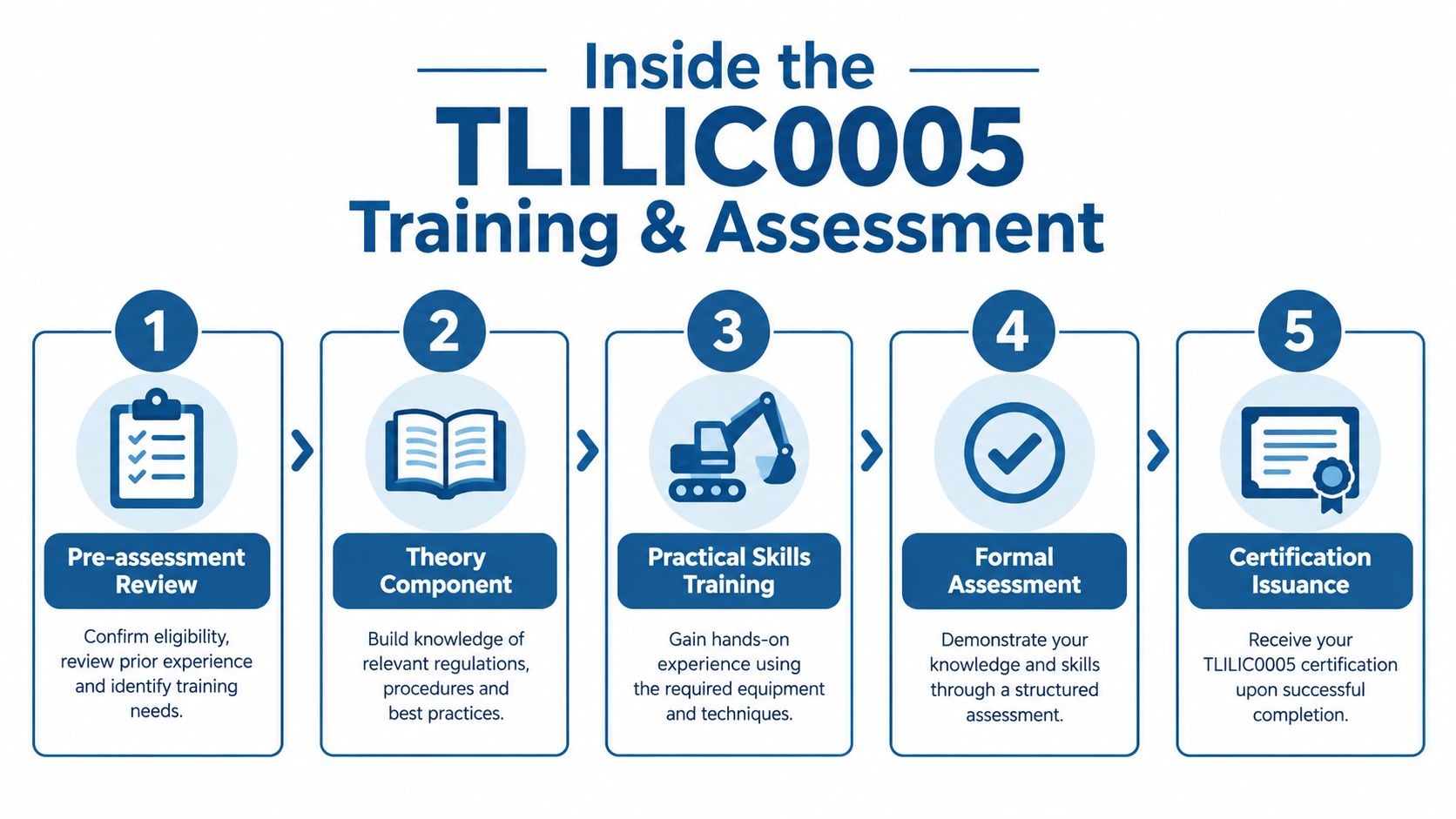
The national competency standard for this work is TLILIC0005 Licence to operate a boom-type elevating work platform, covering boom-type EWPs with a boom length of 11 metres or more. The Australian training record shows that TLILIC0005 was first released on 13 September 2018 and remains current, confirming its role as the formal national competency standard for this category. The unit record on training.gov.au is the appropriate reference for the current unit information.
What you'll be expected to understand
Training combines knowledge work with practical operation. You'll need to understand the machine's controls, limitations, safety systems, operating instructions, and the hazards created by the work environment.
Typical learning and assessment activities include:
- Pre-start inspection: Identify defects, check controls and safety devices, and report faults before operation.
- Load and capacity decisions: Interpret the equipment's rated information and work within its limits.
- Safety information: Read manufacturer instructions, warning labels, data plates, and site controls.
- Positioning and manoeuvring: Set up and operate the EWP while managing clearances, ground conditions, and people near the work zone.
- Emergency response: Demonstrate the correct response to an emergency, including emergency lowering procedures where required by the equipment and assessment.
The assessor isn't only watching whether you can move the platform. They're checking whether you can plan the operation, recognise changing hazards, use the controls deliberately, and stop when conditions fall outside the safe operating envelope.
Preparation before you attend
Training providers will generally need your identity details and a Unique Student Identifier for nationally recognised training. Confirm the provider's enrolment requirements before attending, and bring the identification requested for the course and licensing process.
Practical confidence also improves when students arrive ready to ask questions. If you don't understand a load chart, emergency control, exclusion zone, or pre-start response, raise it before assessment rather than guessing beside the machine.
TP Training provides practical, nationally recognised Tlilic0005 Elevate Work Platform Licence To Operate Boom Length 11M Or More Ewp training with experienced trainers and hands-on learning across NSW. Operators who work around building façades or maintenance access may also find background on high-rise window cleaning solutions useful for understanding how access equipment supports specialised work.
For location and preparation information, review EWP training in Sydney before selecting a course. The most useful preparation is simple: understand the machine, read the instructions, bring the required identification, and be ready to demonstrate safe decisions rather than just memorised answers.
Yellow Card vs High Risk Work Licence
The Yellow Card and the WP high-risk work licence aren't interchangeable. They may both relate to elevating work platforms, but they serve different compliance purposes.
A Yellow Card is industry training evidence for specified EWP operation where a high-risk work licence isn't required. The WP licence is a state-issued high-risk work licence for operating a boom-type EWP that meets the over-11-metre threshold.
EWP ticket comparison
| Feature | Under 11m (Yellow Card) | Over 11m (WP HRWL) |
|---|---|---|
| Regulatory status | Industry training evidence for relevant equipment | State-issued high-risk work licence |
| Boom threshold | Boom-type equipment below the licensing threshold | Boom-type EWP with a boom length of 11 metres or more |
| Typical equipment considerations | Relevant smaller boom equipment, scissor lifts, and other EWP types subject to training requirements | Self-propelled, trailer-mounted, and vehicle-mounted boom-type EWPs within the WP class |
| Assessment pathway | Training and documented evidence of competency | National unit assessment followed by a regulator application |
| Site expectation | Equipment-specific training, familiarisation, and authorisation | Current WP licence, plus site induction and machine familiarisation |
A scissor lift can require operator training even though it isn't assessed under the same boom-length rule. A trailer-mounted boom can also require the WP class licence if its original design meets the threshold. The practical question is always: what machine will you operate, and what is its regulated configuration?
A Yellow Card doesn't substitute for a WP licence, and a WP licence doesn't automatically prove familiarisation with every EWP model on a site.
Don't book based on the word “EWP” alone. Give the provider the machine type and specifications, then confirm whether you need the under-threshold training pathway, the WP class, or both for the work you expect to perform. TP Training's NSW high-risk work licence overview offers related context for applicants comparing licensing pathways.
Traffic work creates a separate training question. TP Training provides practical, nationally recognised Prepare Work Zone Traffic Management Plan Course Pwz Red Card training with experienced trainers and hands-on learning across NSW. That credential doesn't replace EWP training or the WP licence, but it may be relevant to a role involving work-zone planning.
From Course Completion to State Licence Issuance
Passing the TLILIC0005 assessment is an important result, but it isn't the same as receiving the physical high-risk work licence. The assessor confirms your competency against the unit. The state or territory regulator processes the application and issues the licence.
The administrative sequence
- Complete the nationally recognised assessment. Keep the assessor's report and any statement or documentation supplied by the RTO.
- Apply to the relevant regulator. In NSW, that means following SafeWork NSW's application process. Other jurisdictions have their own forms, evidence requirements, and submission methods.
- Provide identity and assessment evidence. The regulator checks the information before issuing the HRW licence.
- Wait for the licence outcome. Don't assume that course completion alone authorises unsupervised commercial operation.
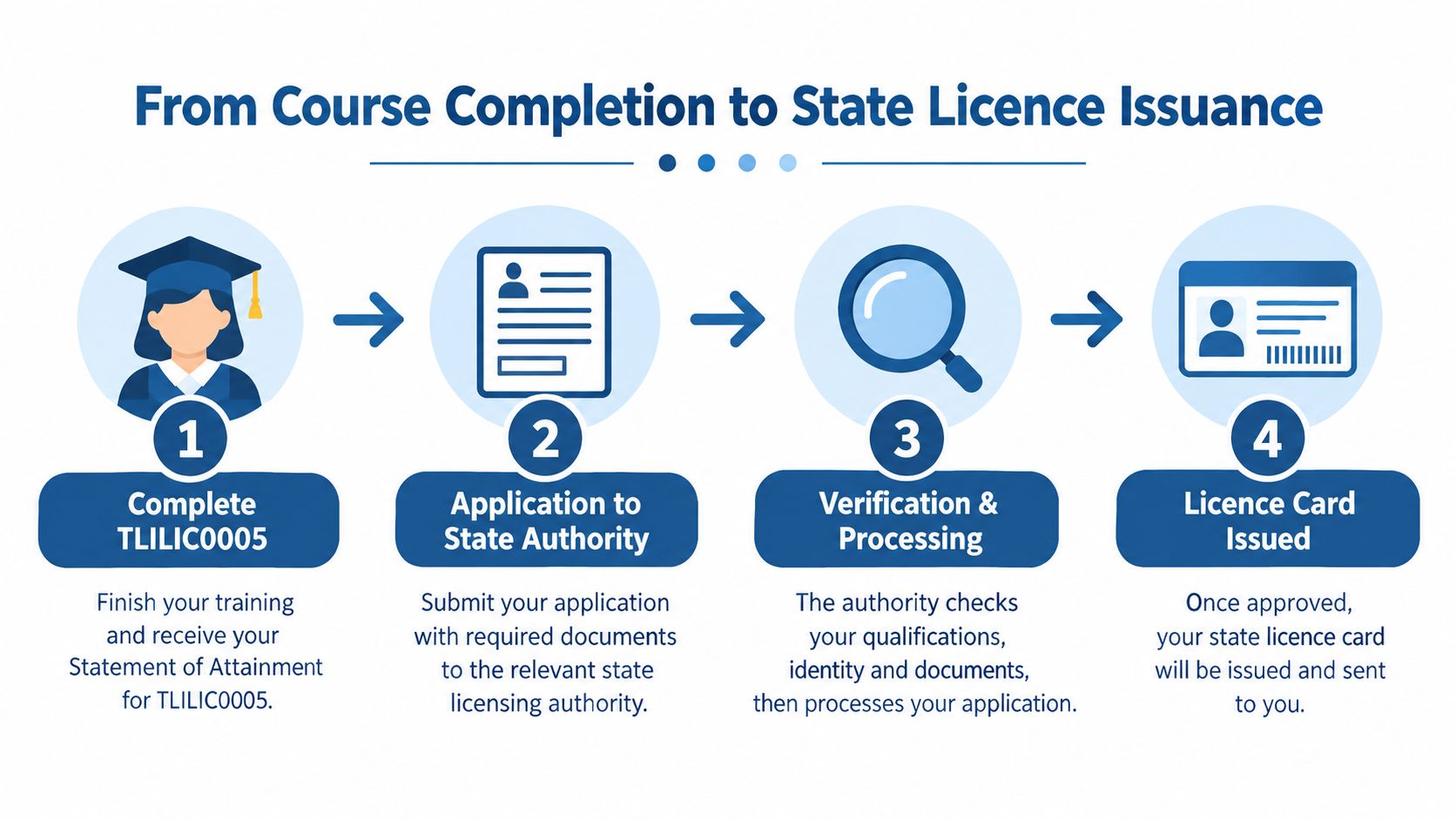
A nationally recognised course outcome supports the application, but the licence remains regulator-issued. Processes differ between jurisdictions. For example, Northern Territory guidance requires applicants to submit the assessor report, photo identification, a passport photo, and payment within 60 days to receive the HRW licence. That example shows why you should read the instructions issued by the regulator where you apply rather than assuming one state's process applies everywhere.
A Unique Student Identifier may also be part of your training administration. If you need to create or manage yours, TP Training's USI guide provides practical guidance.
Training supervision is a limited exemption
Safe Work Australia states that a person operating a boom-type EWP at or above the threshold isn't required to hold the licence while undertaking nationally recognised training with an RTO, provided the person is supervised by someone who holds the relevant licence. That exemption doesn't mean a trainee can be rostered as an ordinary unsupervised operator.
The licensed supervisor must be present and actively manage the training situation. The employer should verify the supervisor's licence, follow the RTO's training arrangements, control access to the machine, and keep the trainee within the scope of supervised learning.
HRW licences are generally valid for five years, and renewal is part of ongoing compliance. Check the licence expiry and regulator requirements early so a current credential is available when the next project begins.
Career Pathways and Industry Demand in NSW
A WP licence can change the type of work you're eligible to pursue. Instead of being limited to general labouring tasks, you may be considered for work where access at height is central to the job, subject to the employer's other requirements and your machine experience.
Construction crews use boom-type EWPs for façade work, steel installation, services installation, maintenance, and material positioning. Civil contractors may use them around infrastructure projects, work zones, structures, and industrial sites. Maintenance teams can require high-level access for building services, lighting, mechanical equipment, inspection, and repair.
Where the licence fits
The licence is useful when a principal contractor or PCBU needs evidence that the operator is legally authorised for the relevant plant. Site management may check the licence during induction, before allocation, or during compliance inspections. WorkSafe Queensland inspector guidance treats the licence as a mandatory compliance check item for operators of boom-type EWPs at or above the threshold.
The national framework has a clear history. Queensland guidance identifies 1 September 2010 as the date when high-risk work for this equipment was classed that way, while TLILIC0005 was first released on 13 September 2018 and remains current in the national training record. These dates mark the development of a formal, nationally standardised pathway rather than an informal site preference.
Employers don't just need someone who can reach the work area. They need an operator who can prove legal authorisation, understand the machine, and work within the site's control system.
A licence won't replace experience. You'll still need equipment familiarisation, reliable hazard awareness, communication skills, and the ability to work around pedestrians, vehicles, structures, overhead services, and changing ground conditions. Employers may also require a White Card, other site inductions, a driver licence, or role-specific training.
Career progression often comes from combining the WP licence with practical exposure. Keep records of the machine types you've operated, learn from experienced supervisors, and treat every new model as equipment requiring familiarisation rather than assuming the controls will be identical.
Next Steps to Get Qualified with TP Training
Start with the machine, not the course title. Confirm whether its original boom geometry meets the 11-metre threshold, identify whether the work requires the WP class, and ask the employer or equipment supplier for the relevant specifications.
Then prepare for the training and application stages:
- Confirm the pathway: Decide whether you need TLILIC0005, under-threshold EWP training, or additional equipment familiarisation.
- Organise identification: Check the RTO's enrolment requirements and arrange your USI before training.
- Understand the assessment: Expect theory and practical activities involving pre-start checks, capacity information, safe movement, hazard controls, and emergency procedures.
- Plan the licence application: Keep the assessor's report and follow the state regulator's instructions after successful assessment.
- Choose a suitable location: TP Training delivers practical courses across NSW, including Penrith, Burwood, Auburn, Parramatta, and Sydney CBD.
The most common mistake is treating a passed course as the finished legal process. Your safer plan is to separate the stages clearly: machine classification, TLILIC0005 assessment, regulator application, and licence verification.
TP Training's practical, nationally recognised EWP training uses experienced trainers and hands-on learning across NSW. Check the course information, prepare your documents, and contact the training centre if you need help confirming which pathway matches the boom lift you'll operate.
TP Training offers practical, nationally recognised training for the TLILIC0005 boom-type EWP pathway across NSW, with hands-on learning at centres including Penrith, Burwood, Auburn, Parramatta, and Sydney CBD. Visit TP Training to review the course information, prepare for the state licence application, and take the next step towards operating over-11-metre boom lifts safely and legally.

You may also like
How Long Does CPR Certificate Last in Australia

Barista Course NSW: A Practical Guide to Getting Started