Elevated Work Platform for Sale: A Buyer’s Guide
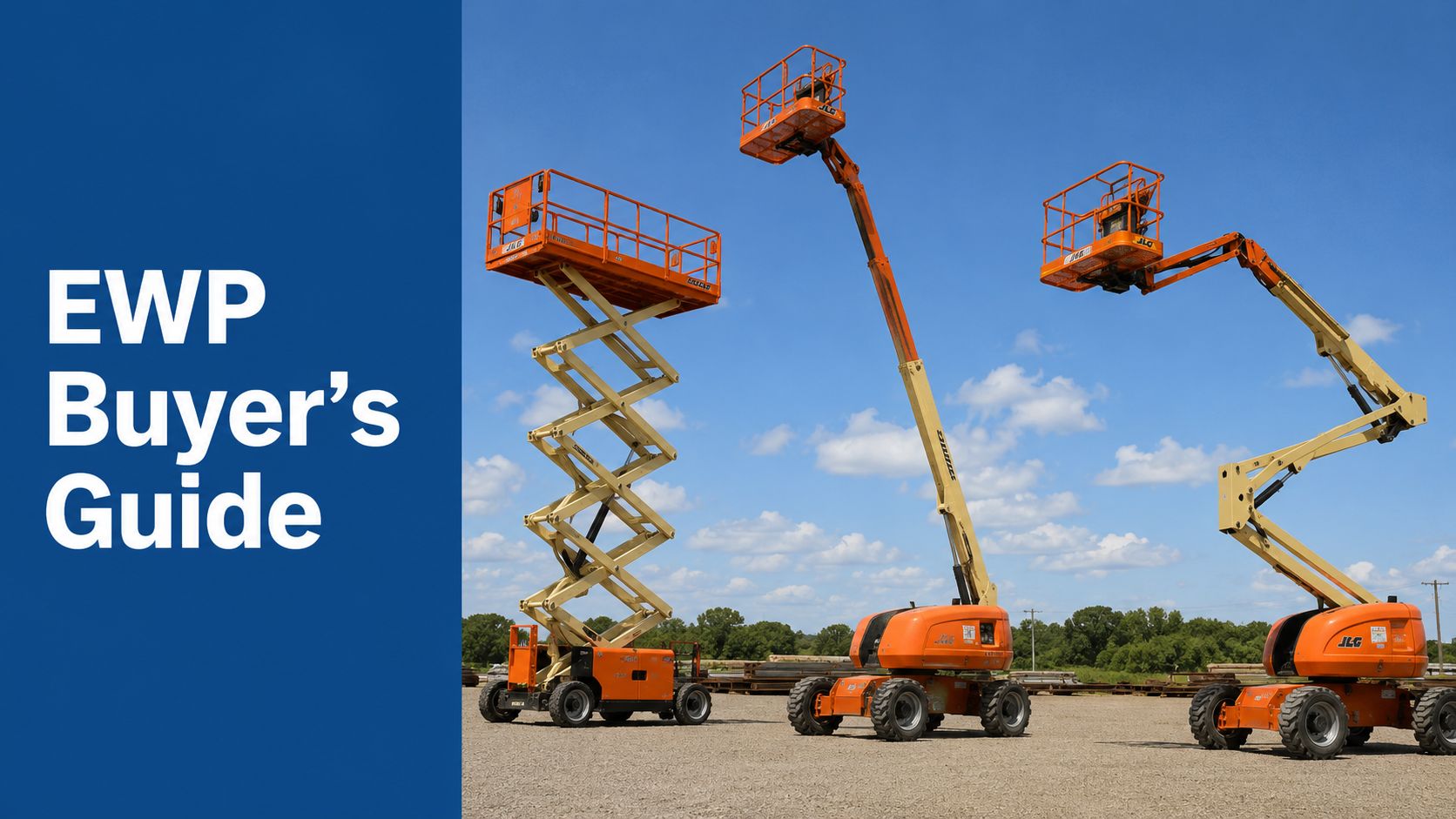
You're standing in a depot yard with three machines in front of you: a scissor lift, a straight boom and an articulated knuckle boom. Each carries a different price tag, and the tallest machine looks like the safest choice because it appears to cover every job. That's how NSW businesses end up paying twice, first for the wrong equipment and then for the transport, training, downtime and compliance work needed to make it usable.
Buying an elevated work platform for sale starts with the job, not the advertisement. Confirm the required working height, the actual reach, the ground or floor conditions, the available access route and the operator qualification before comparing brands or prices. Australian guidance defines EWPs as mobile plant designed to lift or lower people and equipment through telescopic, hinged or articulated mechanisms, so the category covers far more than one familiar type of machine. Safe Work Australia's model code also makes clear that EWP work needs planned risk controls and, where applicable, safe work method statements.
The comparison below gives you the starting point. The licensing decision depends on the machine's original boom geometry, not just the label on the seller's listing.
| EWP type | Best practical application | Main site requirement | Licensing focus |
|---|---|---|---|
| Electric scissor lift | Warehouses, fit-outs and level indoor floors | Suitable slab, doorway and aisle access | Check whether the machine has a boom-type configuration |
| Rough-terrain scissor lift | Outdoor construction and uneven ground | Ground capability, tyre condition and loading limits | Confirm the machine classification |
| Straight boom lift | High work requiring vertical and horizontal reach | Clear travel path and stable outdoor surface | Boom length of 11 metres or more requires the relevant HRW licence |
| Articulated boom lift | Work around obstructions and over structures | Space for slew, reach and stabilisation | Boom length and machine design determine the ticket |
| Trailer or truck-mounted platform | Mobile service, utilities and roadside work | Vehicle access, setup area and electrical controls | Mounting method doesn't automatically remove EWP licensing duties |
Table of Contents
- What an Elevated Work Platform Buyer Actually Needs to Figure Out
- Boom, Scissor and Articulated EWPs Compared by Use Case
- New vs Used Work Platforms for Sale
- Australian Licensing Rules That Decide Which EWP You Can Legally Run
- Site Readiness Checks Before You Commit to a Purchase
- Cost Breakdown of Buying and Operating an EWP in Australia
- Which Elevated Work Platform Matches Your Job Site
- Buyer Questions Competitors Forget to Answer
What an Elevated Work Platform Buyer Actually Needs to Figure Out
Start with three questions, and answer them in writing.
What point must the worker reach? Working height alone isn't enough. A scissor lift may reach the required height but leave the worker directly below the task. A boom lift may reach across a void or over a roof edge, but it can introduce different ground, fall and exclusion-zone requirements.
Where will the machine operate? An electric scissor designed for a smooth warehouse slab isn't an outdoor construction machine. Gravel, mud, slopes, overhead services, narrow doorways and fragile flooring all affect the purchase. Safe work guidance recommends checking ground and support capability, static wheel loads, floor loading, tyre pressure and stabiliser operation before using an EWP. SafeWork SA's EWP audit material shows why this matters commercially. Its 2019 campaign recorded 336 site visits, 261 compliance audits, 234 EWP audits and 27 systems-only audits, followed by 87 statutory notices, including 66 Improvement Notices and 21 Prohibition Notices.
Who'll operate it? A worker with a Yellow Card style competency for a lower boom category isn't automatically qualified for a boom-type EWP that reaches the high-risk work licensing threshold. The machine may be sitting idle while the buyer organises the correct training, licence application and site authorisation.
Practical rule: If the seller can't give you the original machine specifications, service records, manuals and inspection evidence, you haven't found a bargain. You've found an investigation.
Before you compare prices, record the machine's boom length, platform height, horizontal outreach, platform capacity, overall width, weight, power source, tyre type and stabiliser requirements. Then compare those details with one real jobsite, including the surface, access route and overhead hazards.
The Australian EWP audit overview is useful for seeing how documentation and control failures affect actual workplaces, particularly construction, plant hire, manufacturing and mining. Treat compliance as part of the machine's commercial value. A platform that can't be deployed legally or safely isn't an asset, regardless of its purchase price.
Boom, Scissor and Articulated EWPs Compared by Use Case
The wrong machine category is usually more expensive than a higher purchase price. Match the movement pattern to the work first.
A scissor lift moves vertically and gives workers a broad platform with room for tools and materials. That makes it sensible for warehouse racking, lighting, fit-out and overhead services on a level slab where the work sits above the machine. Electric models suit indoor work where noise, emissions and floor marking matter. Rough-terrain scissors are built for outdoor conditions, but they need suitable ground support and more careful site planning.
A straight boom lift, also called a telescopic boom, extends up and out. It's the stronger choice when the work point sits away from the base, such as signage, structural steel, façade work or tree maintenance. The trade-off is a narrower platform and greater dependence on accurate reach planning. Don't buy on maximum height alone. Check the working envelope, rated load at reach and the clearance needed to position the machine.
An articulated boom adds a knuckle joint. That joint lets the operator move over obstacles, around corners and into areas a straight boom can't approach directly. It's often the more useful machine for maintenance, utilities, industrial services and cluttered construction sites, but the additional movement demands disciplined controls around slew zones, overhead hazards and fall protection.
| EWP type | Typical working height | Best-fit use case | Terrain | Reach style |
|---|---|---|---|---|
| Electric scissor | Lower to medium access work | Warehouse racking and indoor fit-out | Smooth, level slabs | Vertical only |
| Rough-terrain scissor | Medium access work | Outdoor construction and services | Uneven or prepared outdoor ground | Vertical only |
| Straight boom | Medium to high access work | Steel, signage and façade tasks | Outdoor sites with suitable support | Up and out |
| Articulated boom | Medium to high access work | Maintenance and obstructed work areas | Indoor or outdoor, subject to model limits | Up, out and over |
| Tracked spider | Site-specific access work | Restricted or sensitive ground locations | Depends on track and stabiliser design | Articulated or telescopic |
The table uses qualitative height descriptions deliberately. A seller's advertised working height doesn't replace the manufacturer's technical data or a site assessment. The licence question is separate and decisive. In Australia, a boom-type EWP with a boom length of 11 metres or more falls within the high-risk work licensing framework, as explained in Safe Work Australia's EWP overview.
For workers operating a boom under that threshold, Riihan301E Elevate Work Platform Course Operate Boom Under 11M Yellow Card Ewp training is one practical nationally recognised pathway delivered with hands-on learning across NSW. It doesn't turn a lower-threshold course into a high-risk work licence, so keep the machine classification and training outcome aligned.
New vs Used Work Platforms for Sale
Price alone is a poor basis for choosing between new and used equipment. A new machine gives you a known build configuration, current documentation, manufacturer warranty coverage and a clear starting point for maintenance. You still need pre-start checks, inspections, trained operators and site controls, but there is less uncertainty about the machine's operating history.
Used equipment can be the better commercial choice when its records are complete. Hire-fleet machines are often serviced routinely, and documented usage makes their condition easier to assess. The key divide is between known used equipment and cheap equipment with missing evidence. If the seller cannot show what the machine has done or how it was maintained, treat the lower price as a risk allowance, not a saving.
What to inspect on a used machine
Before making an offer, request the operator manual, serial plate details, service records, inspection documents and repair history. Arrange an inspection with a technician familiar with hydraulic and access equipment, especially if the machine will be used regularly or falls within a higher licensing category.
Check the following:
- Hydraulic systems: Look for leaks, damaged hoses, slow movement and inconsistent pressure.
- Structure: Inspect welds, boom sections, pins, scissor arms, guardrails and platform mounts for repairs, cracks or deformation.
- Controls: Test ground and platform controls, emergency stops, alarms and emergency lowering functions.
- Identity: Match the serial plate with the manuals and service records. Any mismatch needs an explanation before purchase.
- Wear patterns: Compare hour-meter readings with tyre wear, control wear, platform damage and service intervals.
- Safety equipment: Confirm that anchorage points, gates, guardrails and interlocks are present and suitable for the machine.
Fresh paint does not prove a defect, though paint over a repaired chassis warrants close questioning. Missing manuals or unexplained inspection gaps should reduce your offer because they increase the work required before the platform enters service.
A used EWP is good value only when you can verify its work history, maintenance and immediate repair needs.
A blended fleet can suit NSW businesses. Buy a new primary platform for frequent or critical work, then use a documented used unit for less demanding sites. Apply the same inspection, recordkeeping and operator-authorisation standards to both machines. unerquicklich
Australian Licensing Rules That Decide Which EWP You Can Legally Run
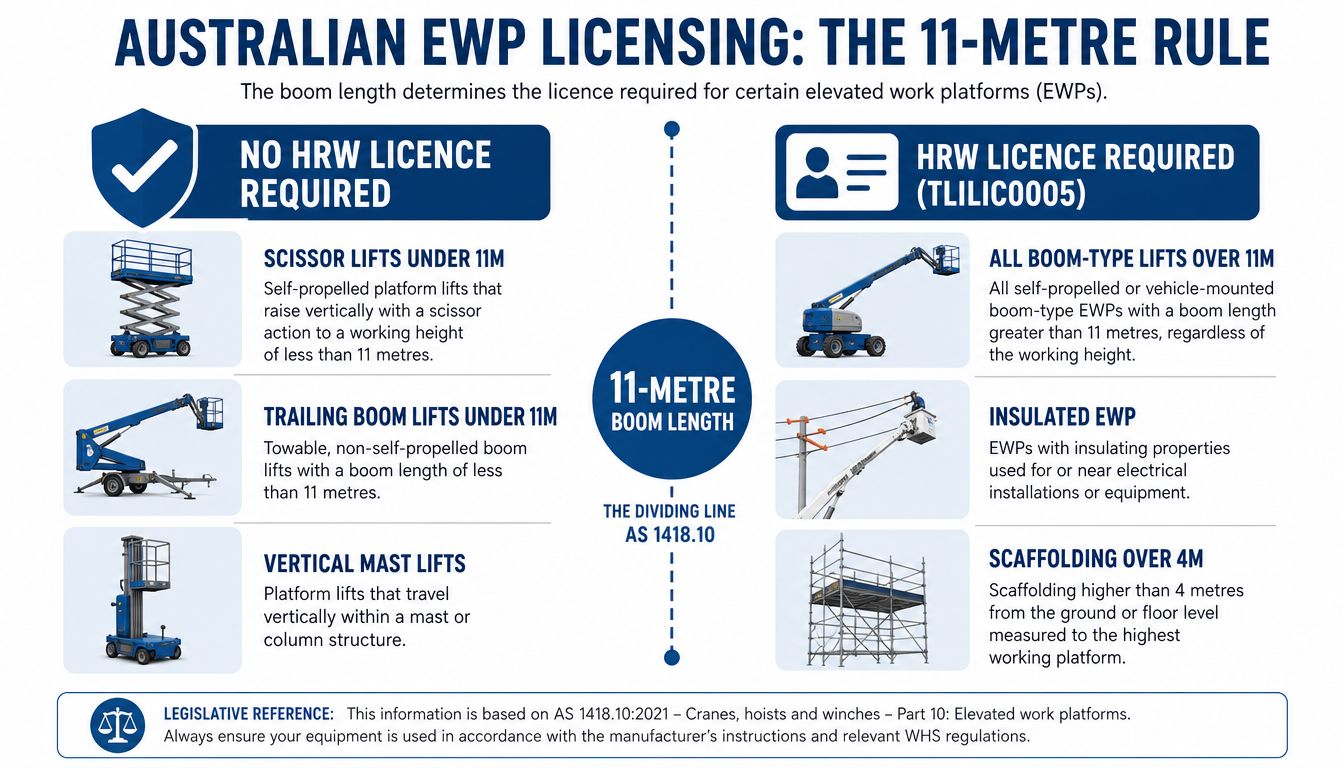
For a buyer in NSW, the first licensing question is 11 metres of boom length. For a boom-type EWP, measure the greater of the vertical platform height or the horizontal reach from the boom's rotation point to the platform edge. The machine's original design controls the requirement. A later modification does not remove the licence obligation if the original boom design was 11 metres or more, as set out in the Safe Work Australia model code.
The nationally endorsed training unit for this high-risk work licence class is TLILIC0005, current from 13 September 2018 and superseding TLILIC2005. In NSW, SafeWork NSW issues the high-risk work licence after the required training and assessment. The licence is state-issued, while the competency framework is nationally recognised.
Use the threshold before comparing reach, drive type or platform capacity. Confirm that the equipment is a boom-type EWP, then verify its original boom length. Labels such as “cherry picker”, “truck-mounted”, “self-propelled” and “telehandler” do not decide the licence category.
What the licence decision means for the buyer
An EWP requiring TLILIC0005 must be operated by someone holding the appropriate high-risk work licence before work starts. Include training, assessment, licence administration and operator availability in the purchase plan. A machine below the threshold may meet the job brief with less licensing administration. A larger platform can provide greater reach, but it also brings a formal operator requirement.
Use this NSW high-risk work licence guidance to check the broader application pathway. Confirm current application fees, processing requirements and any issuance lead time directly with SafeWork NSW before setting a delivery date, because those details can change.
Site Readiness Checks Before You Commit to a Purchase
A machine can pass inspection and still fail your site survey. In NSW, ground conditions, access, overhead hazards and recovery arrangements should decide the purchase before specifications do.
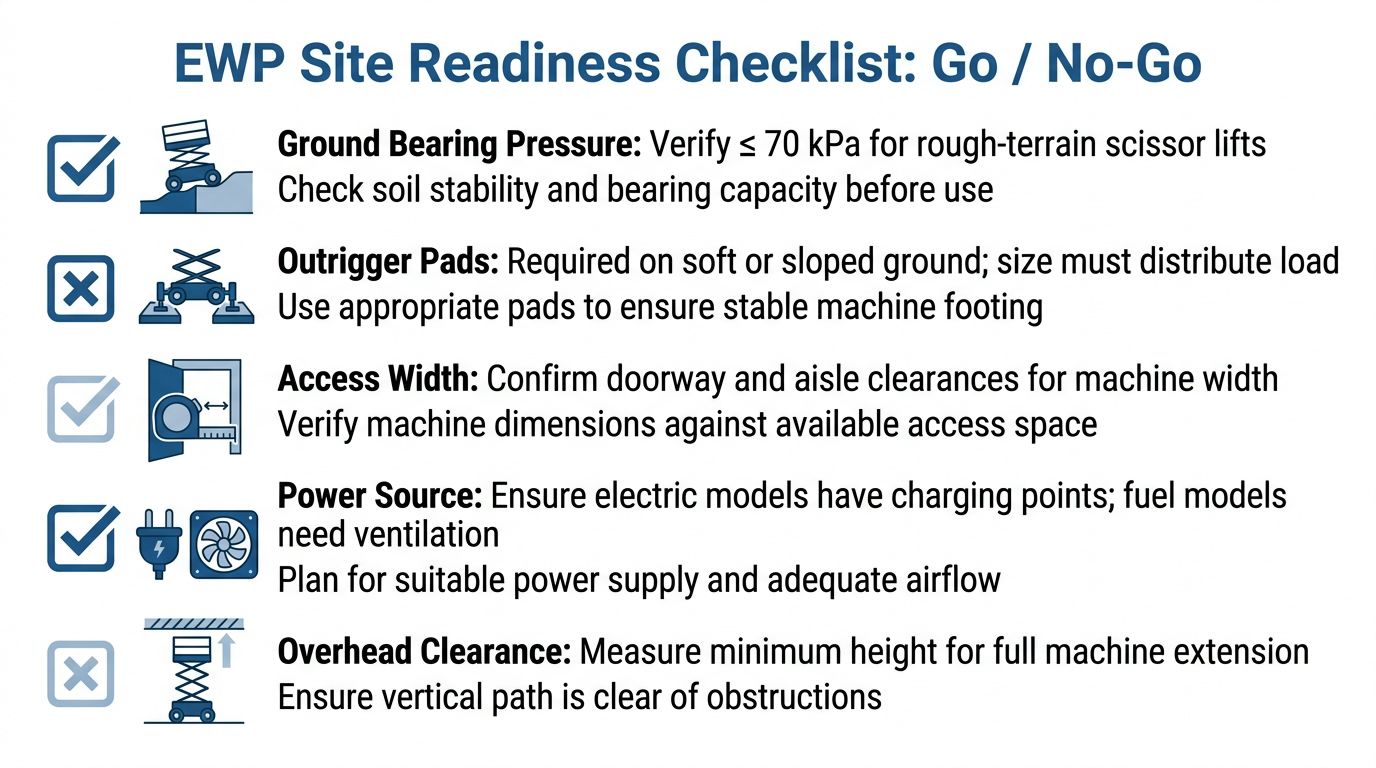
Start with the ground. Compare the manufacturer's static wheel loads with the slab's permitted loading and the capacity of soil, compacted fill or temporary surfaces. Rough-terrain equipment may need a competent person or engineer to confirm that the ground will support the machine throughout its operating envelope. Surface appearance is not evidence of adequate support.
Outriggers create another common failure point. Confirm the setup area, pad dimensions, allowable slope and clearance from edges, trenches and openings. Some pneumatic-tyred EWPs can only be raised with stabilisers activated, subject to the machine instructions. Read the manual before assuming the tyres provide sufficient support.
Use a written site survey
Give your safety adviser a clear go or no-go checklist before signing the purchase order:
- Ground and floor: What support and loading limits have been confirmed?
- Access: Can the machine pass every doorway, gate, aisle and turning point?
- Power: Is charging available for electric equipment, and is ventilation suitable for combustion engines?
- Overhead services: Have electrical hazards, structures and roof obstructions been identified?
- Fall protection: Does the platform have the required restraint or fall-arrest arrangement?
- Traffic interaction: Can pedestrians, vehicles and other plant remain separated from the EWP?
- Recovery: How will the platform be lowered or the machine recovered after a power, control or mechanical failure?
Fall protection is required for boom work where a person could fall. Operators must remain inside the guardrails and must not climb or overreach. Use this EWP risk assessment guidance to convert those hazards into documented controls, assigned responsibilities and site instructions.
Truck-mounted and trailer-mounted platforms need a separate access and setup check. Their road mobility does not remove EWP duties. A roadside setup can combine traffic, overhead electrical and stabiliser risks, so confirm the work zone, exclusion area and recovery plan before delivery.
A purchase should be conditional on a written site survey. If the machine cannot enter, stabilise, operate or be recovered safely, choose another category rather than trying to make the site fit the equipment.
Cost Breakdown of Buying and Operating an EWP in Australia
The purchase price is only the first line on the spreadsheet. A sound comparison includes the machine's compliance status, service support, transport requirements, storage footprint and operator capability.
Don't insert invented price ranges into your budget. Australian EWP pricing changes sharply with brand, capacity, age, hours, attachments, delivery condition and dealer support. Instead, request itemised quotes for the exact configuration and separate these costs:
- Machine acquisition: Include delivery, commissioning, attachments and any required modifications.
- Training: Allow for the appropriate operator course, including TLILIC0005 where the machine falls within the high-risk work class.
- Verification: Include site-specific competency checks, supervisor verification of competency and induction requirements.
- Maintenance: Price scheduled servicing, hydraulic inspections, batteries, tyres, hoses and specialist repairs.
- Inspection: Confirm the required inspection programme and evidence supplied at handover.
- Insurance: Check plant, public liability, theft and transport coverage with your broker.
- Logistics: Include delivery between depots, loading equipment, permits where relevant and recovery arrangements.
- Storage: Allow for a secure, weather-suitable area with charging or fuel arrangements.
- Downtime: Estimate the operational effect of parts delays and unavailable technicians.
A seller who only discusses the sticker price is giving you an incomplete commercial picture. Ask for a five-year ownership forecast using the machine's expected hours, travel between sites, charging or fuel requirements and maintenance plan.
| Cost line item | 10 m electric scissor (AUD) | 16 m articulated boom (AUD) |
|---|---|---|
| Purchase price | Obtain a configuration-specific quote | Obtain a configuration-specific quote |
| Delivery and commissioning | Quote separately | Quote separately |
| Operator training | Appropriate EWP competency pathway | TLILIC0005 pathway if the original boom length is 11 m or more |
| Verification and induction | Site and employer requirements | Site and employer requirements |
| Scheduled servicing | Batteries, controls, tyres and hydraulics | Engine or powertrain, hydraulics, boom and tyres |
| Inspection and records | Confirm with supplier and safety adviser | Confirm with supplier and safety adviser |
| Insurance and registration | Confirm with broker and regulator | Confirm with broker and regulator |
| Transport and depot space | Usually lower logistical demand | Usually higher logistical demand |
| Five-year total | Calculate from supplier and operating quotes | Calculate from supplier and operating quotes |
The table is intentionally a planning framework, not a fabricated market estimate. Use actual written quotes. A cheaper scissor lift can become the more expensive option if it can't reach over the structure, while a capable boom can be wasteful if it spends most of its life indoors on a slab.
Which Elevated Work Platform Matches Your Job Site
Three NSW buying situations make the decision clearer.
For steel erection and outdoor construction, I'd favour a straight boom or articulated boom with suitable rough-terrain capability when the work sits beyond the slab edge or above obstructions. A scissor lift may provide a generous platform, but it can't replace horizontal outreach. Confirm ground support, tyre specification, travel route and the machine's rated envelope before purchase. If the boom geometry reaches the licensing threshold, the operator needs TLILIC0005, not a lower-level competency alone.
For a warehouse or fit-out contractor, an electric scissor is usually the sensible first machine for level indoor work. Choose the smallest platform that carries the team's tools and reaches the job safely, then verify doorway widths, aisle turning space, floor loading, charging arrangements and ceiling clearance. Smaller machines often avoid the high-risk boom licence threshold, but the employer still needs trained, authorised operators and documented controls.
For a hire-fleet buyer, versatility matters more than a narrow single-site specification. An articulated boom in the medium access range can serve maintenance, construction, services and obstructed work, provided the fleet team can manage transport, inspections, operator documentation and the licensing implications. A fleet machine that serves several job types can earn its space, but only when the business can support its compliance and maintenance burden.
| Site scenario | Recommended EWP | Typical platform height | Licence note |
|---|---|---|---|
| Outdoor steel erection | Straight or articulated boom | Medium to high | Check original boom length against the 11 m threshold |
| Indoor warehouse fit-out | Electric scissor | Lower to medium | Confirm machine classification and operator competency |
| Mixed hire fleet | Articulated boom | Medium access range | TLILIC0005 may be required for the machine's boom design |
| Narrow maintenance area | Compact articulated or vertical access machine | Site dependent | Don't infer licensing from the marketing name |
Training belongs in the procurement meeting. Employers comparing boom equipment should review the TLILIC0005 EWP training pathway alongside the machine specification, not after delivery. For broader maintenance planning, a resource on browse mobile plant support can help buyers think beyond the platform itself and consider the wider mobile plant support environment.
Buyer Questions Competitors Forget to Answer
Does a telehandler become an EWP when a personnel platform is fitted? Treat the raised personnel platform as a raised work activity, not as ordinary forklift work. Safe Work Australia's guidance applies the relevant licensing requirement to telehandlers where the boom length is greater than 11 metres, so a standard forklift high-risk work licence shouldn't be treated as a substitute. The national EWP guide links the requirement to boom length rather than the marketing label.
Are EWP tickets national? The training unit is nationally recognised, but the high-risk work licence is issued by the relevant state regulator. In NSW, employers should verify the operator's current SafeWork NSW licence and match it to the machine class before authorising work.
What must transfer with a used boom lift? Demand the operator manual, service history, inspection evidence, logbook and identification records. Confirm the machine's major inspection status with a competent inspector and your safety adviser, particularly where the equipment has an older operating history. Don't accept vague references to overseas systems or “LOLER-equivalent” paperwork as a replacement for Australian requirements.
What happens after delivery? Set up pre-start checklists, defect reporting, logbook control, emergency procedures, operator authorisation and scheduled inspections before the machine enters production. Also check whether the particular plant item requires registration with SafeWork NSW.
Which machine will hold value? Australian dealer support, parts access, technician familiarity, accurate records and a common fleet configuration usually matter more than a flashy specification. The cheapest unit often loses its advantage when transport, re-inspection, missing manuals, training and repairs are added.
For NSW operators who need a practical pathway, EWP training in Sydney is one place to review relevant training options before finalising the purchase. Compare the course outcome with the machine's actual boom design, and don't let a seller's casual classification make the decision for you.
TP Training provides practical, nationally recognised EWP courses with hands-on learning across NSW, including pathways for boom operation under 11 metres and the TLILIC0005 high-risk work licence class. Visit TP Training before your machine arrives, confirm the operator training that matches your chosen platform, and build compliance into the purchase from day one.

You may also like
CPR Training Face Shields: A Practical Australian Guide
Civil Construction Plant Operations Courses Explained