First Aid Training in the Workplace: A Complete Guide
You've inherited the training register, found the first aid certificates and checked that there's a kit in the office. Then a supervisor asks who covers the civil crew when its usual first aider is away. That's the moment first aid training in the workplace stops being a spreadsheet task and becomes a practical question: can someone help wherever your people are working?
Table of Contents
- What Workplace First Aid Really Looks Like
- The Legal Framework Behind Workplace First Aid
- Calculating First Aider Numbers and Equipment From Risk
- The HLTAID Course Family and Who Should Take Each One
- Refresher Cycles, Renewal Dates and Keeping Skills Current
- Building a Workplace First Aid Programme Step by Step
- Choosing a Training Provider You Can Trust
- Why This Matters Beyond the Compliance Tick
What Workplace First Aid Really Looks Like
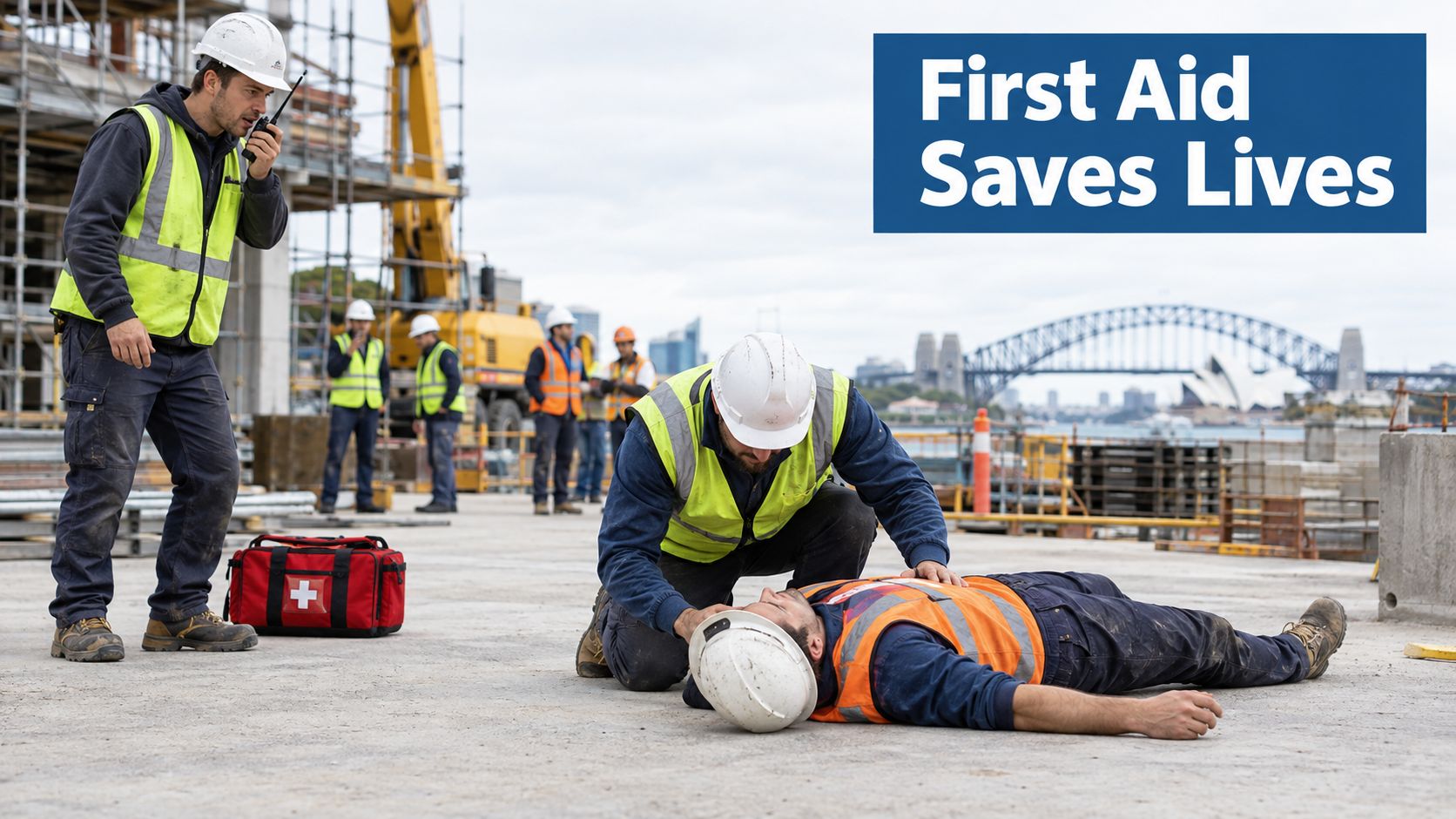
Consider a hypothetical Sydney construction site during the morning warm-up. A worker collapses, a colleague calls for help, and someone heads towards the site office to find the first aider. The kit is there, but the nominated responder has already left to collect materials.
Nothing in that scenario requires an unusual chain of events. The problem is that the employer has checked the equipment and training records without checking whether the response will work.
Readiness means people can act
A useful way to assess readiness is to follow the incident from the worker's position. Can their colleagues summon help, reach appropriate equipment and direct emergency services to the correct entrance? Does someone know what to do while professional help is being arranged?
Build your arrangements around these connected elements:
- Trained people: Responders need suitable skills and must be available where work happens.
- Appropriate equipment and facilities: Supplies need to suit the hazards and be accessible to the people using them.
- Rehearsed procedures: Workers need to understand how to raise the alarm, request assistance and support the response.
A wall poster can remind someone of a procedure. It can't establish whether the site gate is locked or whether the nominated responder is working elsewhere.
Practical rule: Test the arrangement from the incident location, not from the training register.
Match advice to its purpose
First aid information also needs a clear boundary. Someone responsible for animal care might find Evo Dyne Products' resource on first aid for pet nail clipping relevant to that specific task. It isn't a substitute for human workplace first aid training or guidance on managing an injured colleague.
For HR, the useful starting question isn't whether staff have attended a course. Ask whether the right people, equipment and instructions will come together when someone needs help.
The Legal Framework Behind Workplace First Aid
PCBU means person conducting a business or undertaking. In everyday workplace discussions, that will often mean the business or organisation responsible for arranging the work, rather than the HR manager personally.
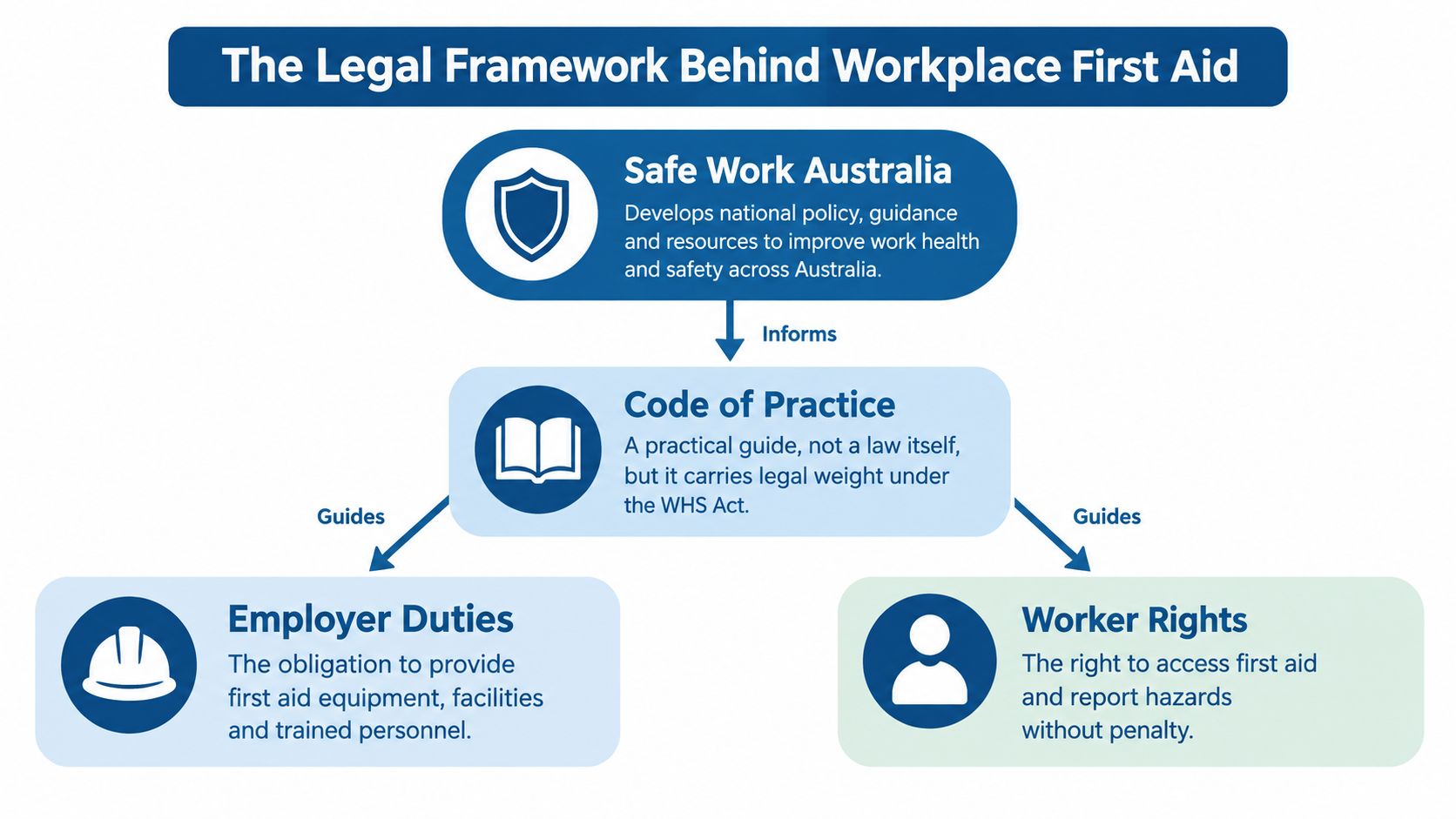
Under the model WHS framework, the PCBU must provide access to first aid equipment, facilities and trained first aiders. Safe Work Australia's First Aid in the Workplace Code of Practice explains that these arrangements must remain accessible whenever work occurs, including night shifts and overtime.
Understand the different documents
Think of the WHS legislation as establishing duties and the Code of Practice as practical guidance for meeting them. A code isn't itself the WHS Act, but it shouldn't be treated as an optional brochure either.
Safe Work Australia provides the model guidance used in this discussion. Before making a legal compliance decision, confirm the requirements and status of the relevant code with your state or territory regulator rather than assuming every jurisdiction uses identical arrangements.
The important operational distinction is between owning resources and providing access. A stocked cabinet inside a locked administration building won't help a crew that works after the administration team leaves.
Translate the duty into a working arrangement
For a new HR manager, the duty becomes easier to understand when it's expressed as questions:
- People: Can workers reach someone trained to administer first aid?
- Equipment: Can they retrieve suitable supplies without avoidable obstacles?
- Facilities: Is there an appropriate place to provide assistance?
- Availability: Do those arrangements still work outside normal office hours?
The organisation's broader responsibilities as an employer provide the context for assigning ownership. HR might manage bookings and records, while supervisors manage access, rosters and local procedures.
Don't let that division create a gap. Someone needs authority to resolve a missing responder, an inaccessible kit or a changed work location before the next shift begins.
Adequate means suitable for the work as performed. A tender document listing trained personnel is useful evidence, but it doesn't establish whether those people are available when and where workers need them.
Calculating First Aider Numbers and Equipment From Risk
Start with the hazards and work locations, then calculate coverage. Starting with a company-wide headcount can hide the very gaps you're trying to identify.
The Safe Work Australia guidance on first aider coverage recommends one first aider per 50 workers in low-risk workplaces, one per 25 in high-risk workplaces and one per 10 in remote high-risk workplaces. These are planning benchmarks, not permission to ignore distance, availability or the nature of the work.
First aider benchmarks by workplace risk profile
The benchmarks below come from that guidance. The equipment and facility columns are illustrative planning considerations, not universal minimum specifications.
| Risk Profile | First Aider Benchmark | Typical Equipment | Typical Facility |
|---|---|---|---|
| Low-risk office | Low-risk benchmark above | Accessible general first aid kit and clearly identified supplies | Suitable accessible area for assistance |
| High-risk construction workplace | High-risk benchmark above | Kits positioned near work areas, with additions selected for identified hazards | Protected treatment area, with a dedicated room considered where appropriate |
| Remote high-risk civil works | Remote high-risk benchmark above | Mobile kits, hazard-specific resources and suitable communication equipment | Planned treatment location and arrangements for emergency access |
Compare the same employer's different workplaces
In the office, workers may occupy a compact floor with straightforward access to the kit and nominated responder. The main planning questions concern availability during breaks, meetings and absences.
At the employer's construction site, workers may be separated by levels, fencing or active work areas. Applying the benchmark across the whole project doesn't prove that a responder can reach each crew promptly. Our guidance on first aid training for construction workers is a useful starting point for discussing those site-specific needs.
For the regional civil crew, consider communication coverage, changing locations and access for emergency vehicles. A kit stored in the supervisor's vehicle may become unavailable when that vehicle leaves the work front.
Count the people who can actually respond at each location, not just the certificates held across the business.
Record the reasoning behind your decisions. Note the hazards, how workers are distributed, who provides backup and what happens during overtime or off-site work.
Equipment decisions should follow the same logic. Don't buy specialised supplies to make a kit look comprehensive. Identify the hazard, establish what equipment is appropriate and ensure the intended users have suitable training.
The HLTAID Course Family and Who Should Take Each One
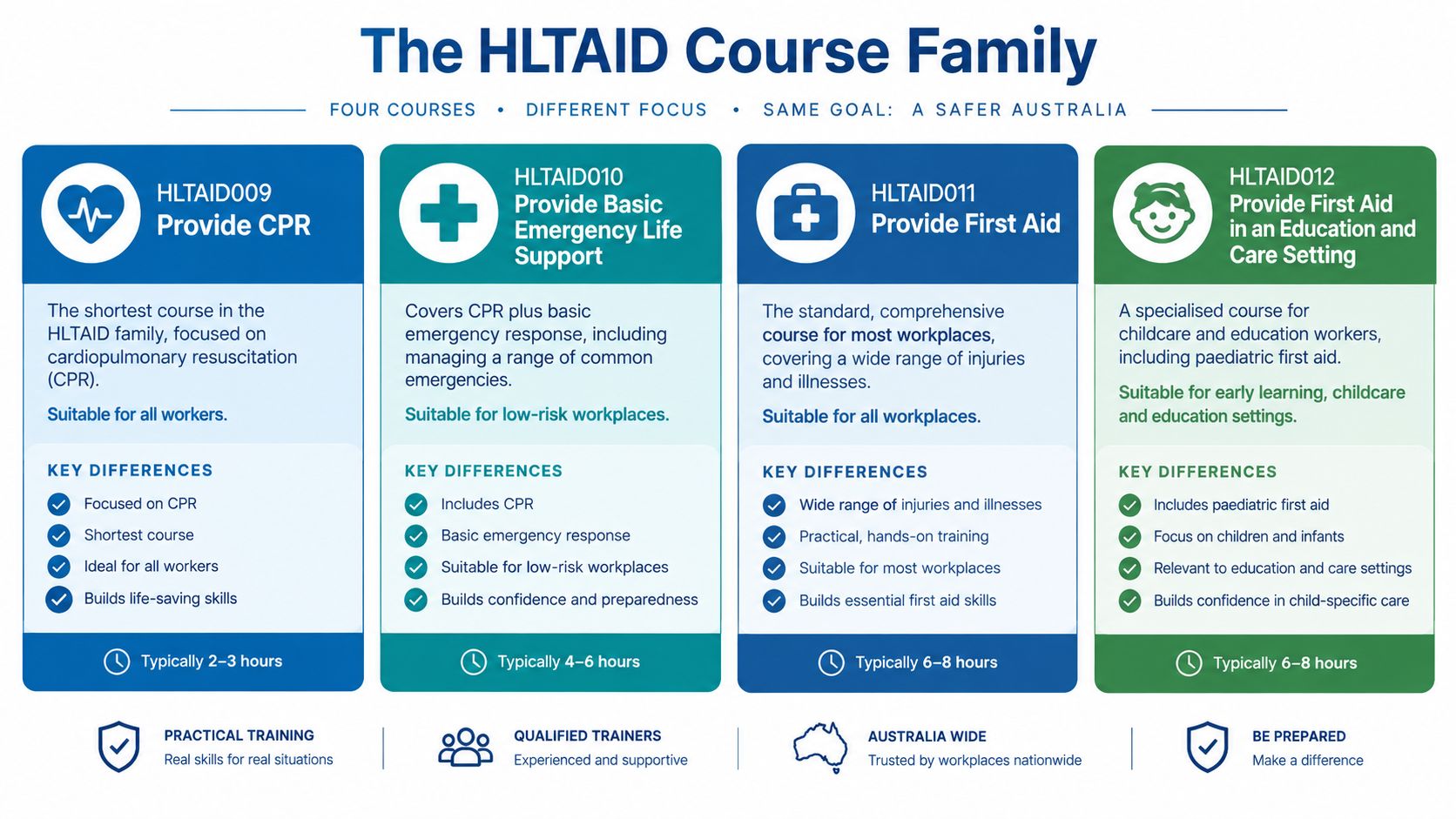
HLTAID unit codes describe different training outcomes, not ranks. A higher-looking number doesn't automatically mean a better choice for every employee.
Begin with the person's role. Are they learning CPR, supporting a basic emergency response, becoming a designated workplace first aider or working in an education and care setting?
| Unit | Typical Learner | Depth of Content | Common Workplace Use |
|---|---|---|---|
| HLTAID009 Provide Cardiopulmonary Resuscitation | Workers needing CPR capability | Focused CPR skills | CPR training and refresher needs |
| HLTAID010 Provide Basic Emergency Life Support | Workers needing basic emergency response skills | CPR and basic emergency life support | Roles requiring that defined scope |
| HLTAID011 Provide First Aid | Designated workplace first aiders | Broader response to injuries and illnesses | General workplace first aid arrangements |
| HLTAID012 Provide First Aid in an Education and Care Setting | Education and care workers | Setting-specific first aid, including child-focused emergencies | Education and childcare environments |
Choose for the responsibility, not the course label
A construction worker might undertake CPR training as part of their skills development. However, CPR alone shouldn't automatically be treated as sufficient preparation for a designated site first aider whose responsibilities include responding to a wider range of incidents.
For that broader role, examine what HLTAID011 first aid training covers against the workplace risk assessment. Ask the provider to explain the training outcome rather than relying on a booking page labelled “first aid”.
Education and care work requires a different conversation. HLTAID012 addresses that setting, including asthma and anaphylaxis involving children. Confirm the role-specific requirement with the employer before enrolling.
- Check the code: Match the booking to the unit required for the role.
- Describe the setting: Tell the provider whether learners work in an office, on construction sites or with children.
- Confirm the outcome: Ask which units will appear on the statement of attainment.
One available option is TP Training's Provide First Aid Course, which provides practical, nationally recognised training with experienced trainers and hands-on learning across NSW. Compare any course against the same role-based criteria before committing staff time.
Refresher Cycles, Renewal Dates and Keeping Skills Current
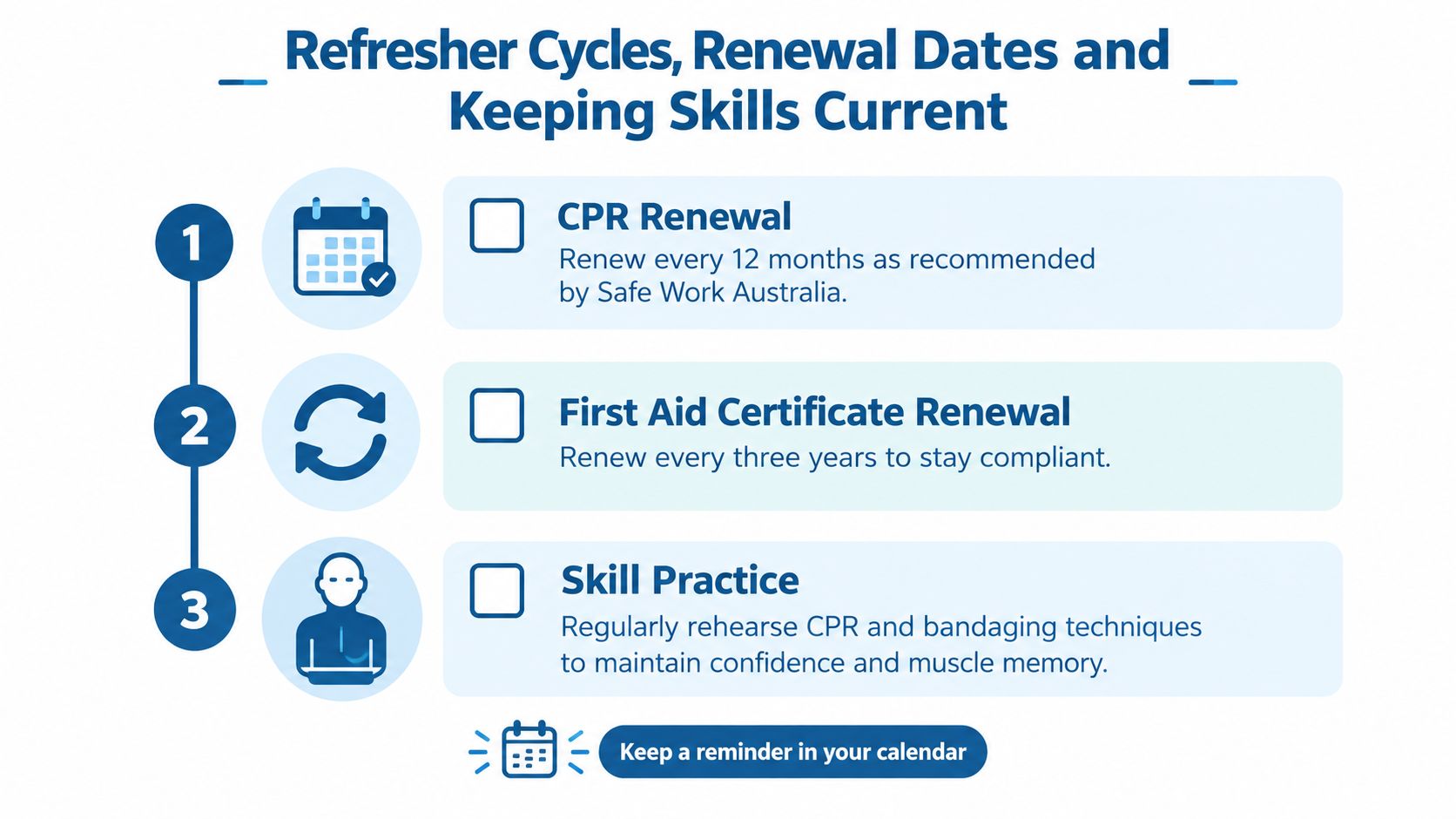
A training register needs more than a single “expiry date” column. CPR refreshers, broader qualification renewal and local practice serve different purposes.
Safe Work Australia's first aid guidance recommends annual CPR refresher training, renewal of first aid qualifications every three years, and a nationally recognised statement of attainment issued by a registered training organisation. These are distinct recommendations, so don't assume the broader qualification's renewal date also tells you when CPR practice is due.
Separate course maintenance from workplace practice
Formal refresher training gives first aiders an opportunity to revisit skills and confirm competence. Workplace practice answers a different question: can this team use its procedures in this particular environment?
For example, a qualified responder might know the required first aid response but be unfamiliar with the site's radio channels. A short local exercise can reveal that communication gap without pretending to replace accredited training.
Our explanation of how often CPR should be refreshed can help HR staff distinguish course scheduling from wider programme maintenance. Keep both visible rather than using a single “current” status for everything.
Build a reliable training rhythm
Use separate register fields for the relevant unit, completion date, planned refresher, broader renewal and work location. Record the nominated backup as well, so a booking or absence doesn't unexpectedly remove coverage.
- At onboarding: Explain how to summon help, identify responders and locate equipment before the worker begins unfamiliar tasks.
- Before training falls due: Arrange bookings and confirm cover while participants attend.
- During local practice: Rehearse communication, access and handover using the actual workplace arrangements.
- After operational changes: Check whether new tasks, locations or rosters require different preparation.
Don't describe every certificate as becoming legally invalid on a universal anniversary. Distinguish the Code's recommended maintenance intervals from any additional requirements applying to the role, contract or workplace.
The practical objective is continuity. A carefully maintained calendar should help supervisors arrange cover early, not merely alert HR after a preferred booking date has passed.
Building a Workplace First Aid Programme Step by Step
Build the programme around decisions someone can own and verify. A folder of certificates is a record of training, but a working programme also explains how the business turns that training into accessible assistance.
Establish the operating plan
Write down the work and hazards. Walk the workplace with supervisors and workers. Include mobile tasks, isolated areas, changing work fronts and activities outside normal hours.
Map responder availability. Put nominated first aiders against actual locations and rosters. Record backup arrangements, then ask supervisors to check whether the plan matches daily operations.
Create the training schedule. Use the maintenance approach outlined above to coordinate bookings, induction and local exercises. Make someone responsible for resolving clashes before staff leave the workplace to attend training.
Define the response procedure. Describe how workers raise the alarm, contact emergency services and guide responders to the incident. Keep the instructions usable under pressure rather than writing them as a lengthy policy statement.
The most valuable test is often a straightforward walk-through. Ask a worker to explain how they would request help from their usual work area, then follow the route the responder and emergency services would need to take.
Make maintenance someone's job
Assign responsibility for checking kits, replacing used supplies and keeping signs legible. Include a way for workers to report missing equipment without needing to identify the “correct” manager first.
Your records should allow a supervisor to establish:
- Who is available: Current designated responders and their work locations.
- What has changed: Staffing, equipment, access or hazard changes affecting the arrangements.
- What needs attention: Training bookings, missing supplies and unresolved exercise findings.
- Who will act: A named owner for each outstanding issue.
Useful test: If the programme owner went on leave, another supervisor should still be able to find and use the arrangements.
Invite workers to review the procedure after exercises and incidents. They may identify practical obstacles that aren't visible from an office, such as a noisy radio channel or a kit location blocked by deliveries.
Close the loop on those observations. Record the change, tell affected workers and check that the revised arrangement works.
Choosing a Training Provider You Can Trust
A provider should be able to explain what learners will practise, what they'll be assessed on and what documentation they'll receive. If the conversation focuses only on finishing quickly, ask more questions before booking.
Treat provider selection as a suitability decision rather than a search for the cheapest certificate. The course needs to prepare your workers for their assigned responsibilities.
Ask for evidence before booking
| Decision Area | What to Ask |
|---|---|
| RTO status | Who is the registered training organisation responsible for issuing the statement of attainment? |
| Unit codes | Which exact HLTAID units are included in the booking and assessment? |
| Trainer experience | What relevant first aid and workplace experience do trainers bring? |
| Practical learning | What will learners physically practise, and how will competence be assessed? |
| Delivery arrangements | Are face-to-face, blended or workplace group arrangements available for this booking? |
| Total cost | What is included, and are there additional assessment or rescheduling costs? |
Don't assume every delivery mode is available because a provider offers several courses. Ask about the particular course, venue and booking you need.
Accessibility matters too. For a NSW workforce, compare travel from the actual workplace with centres in Penrith, Burwood, Auburn, Parramatta and Sydney CBD. Check the specific course location before arranging transport or releasing staff from a shift.
Match the offer to your learners
For general workplace responders, start with the broader first aid option discussed earlier. For education and care roles, the Childcare First Aid Course offers practical, nationally recognised training with experienced trainers and hands-on learning across NSW.
Give prospective providers a clear description of your workers' responsibilities and setting. Ask about practical participation requirements, preparation and support before enrolment, particularly where a learner may need adjustments.
A useful provider conversation should leave you knowing what you're buying and why it suits the role. It shouldn't leave you guessing whether the course title matches the qualification your workplace needs.
Why This Matters Beyond the Compliance Tick
Safe Work Australia's work health and safety statistics report that 497,300 people experienced a work-related injury or illness in 2021–22, while 195 workers died from traumatic work-related injuries in 2022. Those figures describe different measures, but both put workplace preparedness in a human context.
First aid arrangements don't replace hazard controls. Employers still need to prevent injuries and manage risks, while preparing for the possibility that someone will need immediate assistance.
Make the next action specific
A trained colleague gives the workplace someone prepared to act while professional help is arranged. Clear procedures also give other workers useful responsibilities rather than leaving everyone to improvise.
- If coverage is uncertain: Review the roster with the relevant supervisor.
- If training is due: Arrange the booking and the person's replacement cover.
- If workers are unfamiliar with procedures: Walk through how they would summon assistance.
- If the role involves specific medical emergencies: Review relevant preparation, including asthma and anaphylaxis training.
Return to that question about the civil crew's absent first aider. A good programme gives you a usable answer, a named backup, accessible resources and workers who understand the response, rather than a certificate belonging to someone who isn't there.
TP Training offers practical, nationally recognised first aid and childcare first aid training with experienced trainers and hands-on learning across NSW. Visit TP Training with your workplace risk assessment and required unit codes to discuss suitable training for your responders.

You may also like
CPR Course Penrith: Book Your Training Today

Safety & Health Policy: A Guide for Australian Employers