First Aid Training for Construction Workers NSW
Construction recorded 17,600 serious workers' compensation claims in 2023–24, representing 12.0% of all serious claims, while its serious claims frequency rate reached 9.3 per million hours worked, compared with 6.8 across all industries. Safe Work Australia also recorded 37 construction worker fatalities in 2024, equal to 20% of all traumatic work deaths. These figures make first aid training for construction workers a practical safety control, not a box to tick during mobilisation. Safe Work Australia's latest WHS statistics show why every NSW site needs trained people who can act before emergency services arrive.
On a busy site, the person nearest an injured worker may be a concreter, dogman, supervisor or subcontractor from a crew that arrived that morning. The response system has to work through noise, dust, changing access points, plant movement and incomplete information. A certificate matters, but a current, known and practised responder matters more.
Table of Contents
- The Reality of Worksite Injuries and Emergency Response
- Understanding WHS Compliance and First Aid Ratios
- Choosing the Right Nationally Recognised Training Units
- Applying Scenario-Based Skills on Active Construction Sites
- Managing Skill Decay and Subcontractor Workforce Turnover
- Course Formats Timings and TP Training Locations
- Building a Safer Worksite Through Proactive First Aid Investment
The Reality of Worksite Injuries and Emergency Response
Construction combines hazards that can produce sudden, serious injuries. A worker can fall from scaffolding, suffer a deep laceration from a power tool, become trapped by materials, or receive an electrical injury while other trades continue working nearby. First aid training helps the crew manage the immediate priorities, protect the scene, contact emergency services and provide appropriate care while help is on its way.
The risk is not limited to large commercial projects. Residential builds, civil works, roadworks and fit-outs all present different emergency response problems. A civil crew may work away from established facilities, while a high-rise project may require responders to work their way through several levels before reaching an injured person. The site plan needs to account for those conditions rather than assume that a first aid kit and a phone are enough.
What a capable response looks like
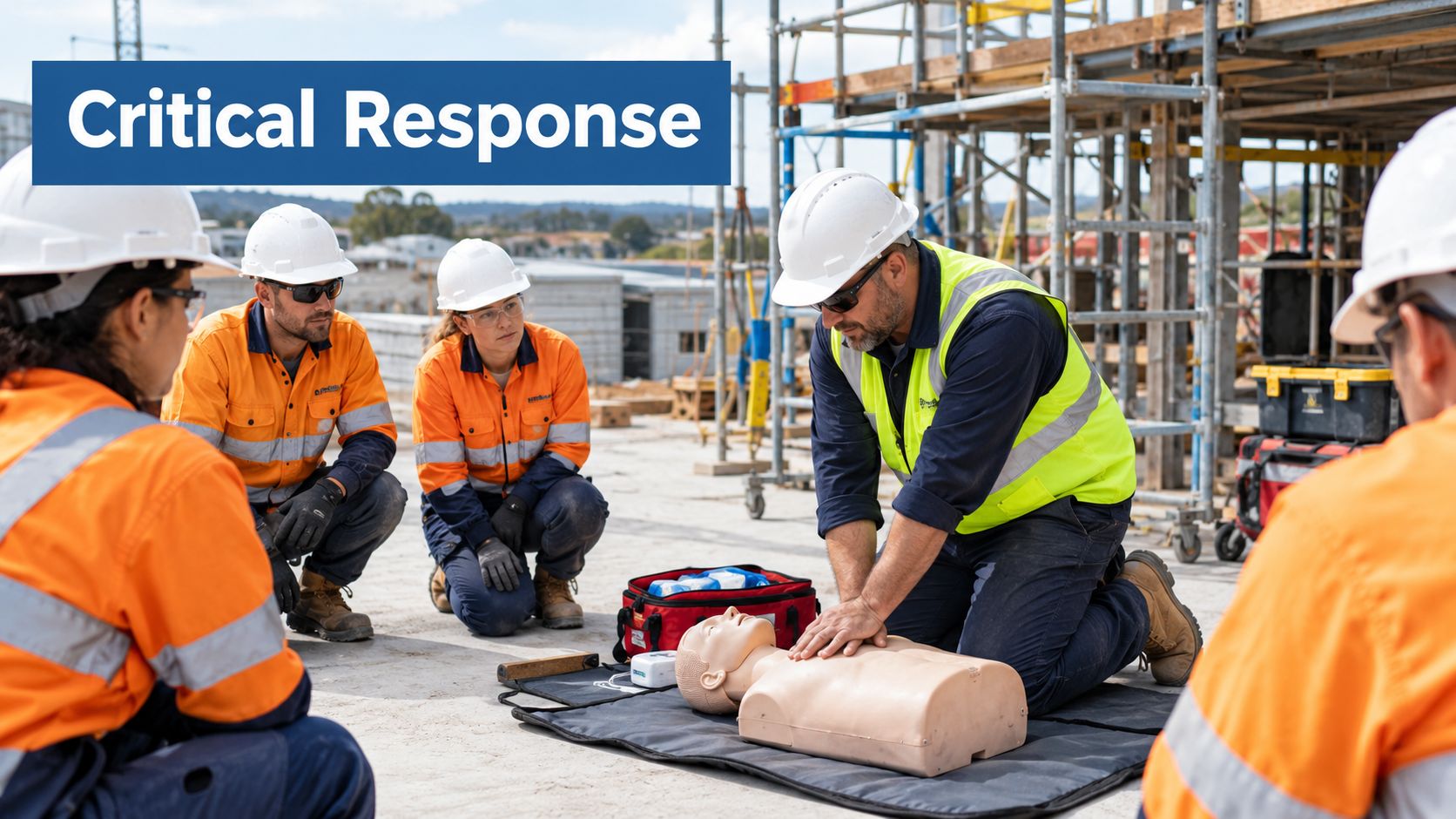
A trained worker doesn't rush into a dangerous area. They check for ongoing hazards, direct someone to isolate plant or electricity where appropriate, ask another person to call emergency services, and give clear information about the site entrance and access route. They also understand that moving an injured person without a sound reason can create additional harm.
The response must be rehearsed in the same language the crew uses at work. Site-specific emergency contacts, first aid officer names and access instructions should be easy to find. The risk management guidance for construction is useful alongside a practical health and safety for builders guide because first aid works best as part of a wider hazard and emergency management system.
Practical rule: A first aid certificate has limited value if the crew doesn't know who holds it, where the kit is, how to call for help or which gate emergency services should use.
Understanding WHS Compliance and First Aid Ratios
A PCBU, or Person Conducting a Business or Undertaking, must provide first aid equipment, facilities and trained people suited to the workplace hazards and operating conditions. Construction is a high-risk workplace, so headcount is only one part of the assessment. Worker density, site remoteness, shift patterns, emergency vehicle access, and the likely type and severity of injury all shape the required arrangement.
Safe Work Australia's construction first aid guidance advises one trained first aider for every 25 workers. For a remote, high-risk workplace, the guidance increases coverage to one for every 10 workers. A construction workplace with 100 or more workers should have a first aid room, and first aiders should hold a nationally recognised statement of attainment and refresh their training regularly.
| Site Classification | Worker Count | Minimum First Aiders | Facility Requirement |
|---|---|---|---|
| High-risk construction workplace | Every 25 workers | One trained first aider for every 25 workers | Facilities and equipment matched to assessed risk |
| Remote, high-risk construction workplace | Every 10 workers | One trained first aider for every 10 workers | Additional planning for longer emergency response access |
| Construction workplace | 100 or more workers | Coverage must continue across the worksite and operating periods | First aid room |
These ratios provide a planning baseline. A large or dispersed site needs coverage that remains available when a responder is absent, working on another level, rostered off or attached to a subcontractor crew that has demobilised. On a busy NSW project, the roster can change between shifts, and a short-term contract can remove trained coverage with little notice. The responsibilities of employers in workplace safety include keeping those arrangements effective as the workplace changes.
What should be checked before work starts
- Coverage: Confirm trained first aiders are present for every active shift and work area. Check the roster again when subcontractors arrive or leave.
- Access: Keep kits, facilities, communication devices and emergency routes available to all crews, including workers on separate levels or remote sections.
- Information: Display first aid officer names, response procedures and emergency contact numbers as part of workplace-specific induction and training.
- Review: Reassess the arrangement when crew numbers, hazards, work locations or working hours change.
The NSW construction work code of practice places these duties on the PCBU. That includes providing suitable equipment, access to facilities and enough trained workers, or reliable access to trained people. International contractor information, including this overview of OSHA contractor safety requirements, can offer comparison, while NSW sites must organise their systems around Australian WHS duties. The Provide First Aid Course is one nationally recognised training option, with practical instruction and hands-on learning across NSW.
Choosing the Right Nationally Recognised Training Units
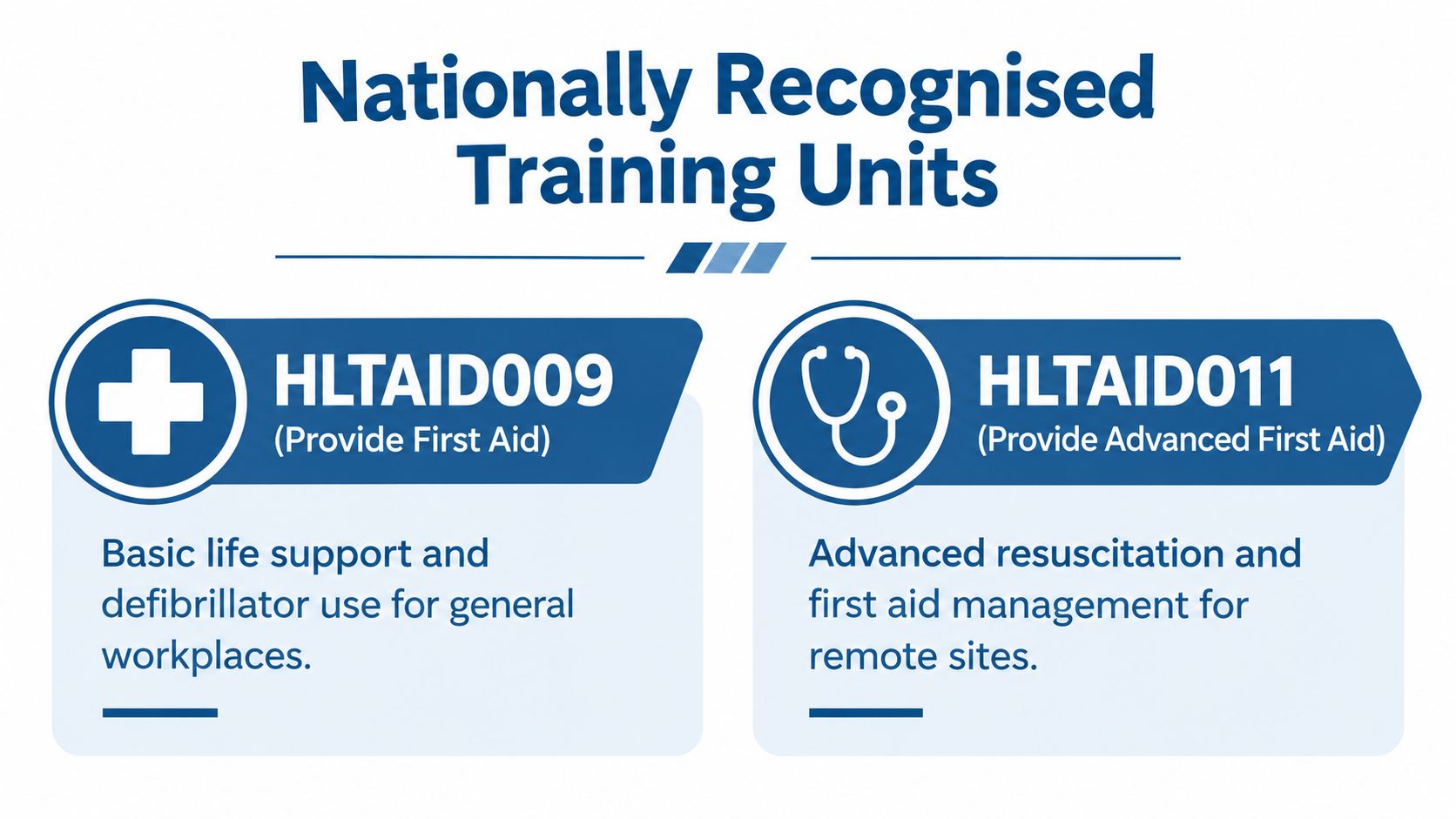
The right unit depends on the role, the risk assessment and the coverage the site needs. HLTAID009, Provide Cardiopulmonary Resuscitation, focuses on CPR and resuscitation skills. It suits a workplace that needs specific CPR capability, but it doesn't replace first aid training where workers may face serious bleeding, burns, fractures, environmental exposure or other construction injuries.
HLTAID011, Provide First Aid, covers a broader first aid response. For active construction crews, that wider scope is generally more useful because a worksite emergency is unlikely to arrive neatly labelled as a CPR-only incident. A worker may need to assess the scene, manage bleeding, support an injured person, monitor changes and communicate with emergency services while the site team controls surrounding hazards.
Compare the training decision with the worksite
| Training focus | What it prepares a worker to do | Where the limitation appears |
|---|---|---|
| HLTAID009 CPR | Provide CPR and use an AED within the training scope | It may not provide the broader injury management expected from a construction first aider |
| HLTAID011 First Aid | Manage a wider range of first aid situations and coordinate an initial response | It still needs to be supported by site procedures, equipment and practical drills |
| Additional site-specific practice | Apply skills to hazards such as severe bleeding, crush injuries and suspected spinal trauma | Practice cannot replace the nationally recognised unit or the site's risk assessment |
Employers should also distinguish between a worker's personal qualification and the site's emergency capability. A current unit doesn't tell a supervisor whether the worker can reach the northern excavation, whether another trained person covers night work, or whether the crew knows how to summon help. The CPR, first aid and White Card safety overview provides useful context when mapping first aid against other construction credentials.
Training should reflect the actual environment. A remote civil crew may need more emphasis on communication and delayed access. A building crew may need to practise navigating stairs, hoists and restricted work areas. Workers who also need plant or rigging qualifications may complete a Cpccldg3001 Perform Dogging Licence Course And Training In Sydney through a separate training pathway. That licence doesn't replace first aid training, and first aid training doesn't authorise dogging work.
Applying Scenario-Based Skills on Active Construction Sites
A classroom demonstration can look straightforward. An active site is different. The radio is busy, machinery is operating, workers are asking questions and the injured person may be in a location that responders can't reach safely without help.
Consider a worker who suffers a severe laceration from a power tool. A capable response starts with scene control, not immediately kneeling beside the wound. One person stops the activity and keeps others clear, another brings the first aid kit, and a third contacts emergency services with the site address and access instructions. The trained responder provides care within their training, monitors the worker and updates the arriving team.
Practice the decisions, not just the technique
A fall near scaffolding creates a different problem. The crew must consider unstable materials, the possibility of further falls and whether moving the person is safe. Training should make workers practise who gives instructions, who manages bystanders and how the supervisor keeps other trades away from the area.
A trench or excavation incident adds another layer. Workers may feel pressure to enter quickly, but an unstable excavation can injure a second person. Scenario-based training reinforces the need to control the hazard, call for specialist assistance and provide care from a safe position where possible.
- Noise: Practise repeating key information and confirming instructions when plant is operating.
- Access: Use the actual site entrance, evacuation route and assembly arrangements during drills.
- Equipment: Train with the type of first aid kit, gloves, dressings and communication devices workers will find on site.
- Team roles: Rotate the caller, scene controller, first aider and supervisor so one absence doesn't stop the response.
The on-site safety resource supports the broader principle that safety arrangements must work where the job happens. A good trainer doesn't turn an exercise into theatre. They introduce realistic distractions, require clear communication and then debrief the decisions that helped or delayed the response.
The objective isn't to make construction workers act like paramedics. It's to help them recognise danger, take appropriate first aid action, avoid making the situation worse and keep emergency communication moving until professional help arrives.
Managing Skill Decay and Subcontractor Workforce Turnover
A single training day doesn't create permanent readiness. Construction teams change constantly. A subcontractor finishes a package, a new labourer joins for a short contract, a first aider transfers to another project, or a worker's qualification approaches expiry while they're working a different shift.
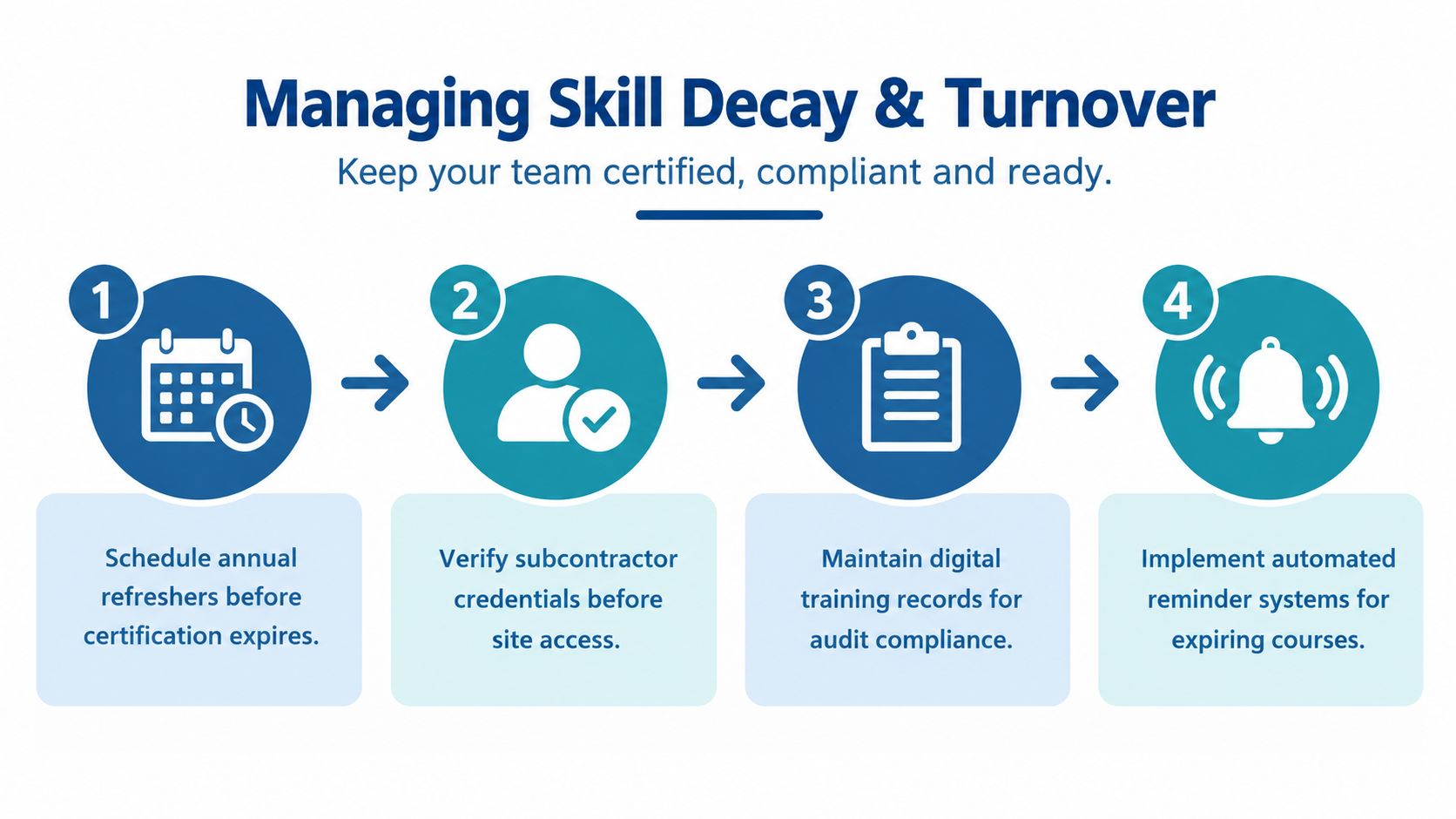
Australian guidance advises annual CPR refreshers and renewal of first aid qualifications every three years. Safe Work Australia's first aid code of practice also emphasises reviewing arrangements as circumstances change. The operational challenge is keeping that advice connected to rosters, inductions and site access rather than leaving it in a training spreadsheet nobody checks.
Build a system that survives workforce movement
A site manager should maintain one current register covering employees, subcontractors and regular visitors who have agreed first aid responsibilities. Record the qualification, issue date, expiry date, work group and the shifts or areas covered. Digital records can make this easier, but the register must still be checked against the people physically signing in.
- Before access: Verify credentials during mobilisation and again when a subcontractor changes crew.
- At induction: Explain where the first aid equipment is, who the officers are and how to raise an emergency.
- During toolbox talks: Rehearse CPR awareness, bleeding response, emergency calls and site access arrangements without pretending a short talk replaces formal training.
- Before expiry: Schedule training early enough to avoid a gap in coverage.
Short-term workers need the same practical orientation as permanent staff. A worker can hold a current certificate and still not know the location of the first aid room or the emergency gate. Supervisors should ask new crews to repeat the site response route and identify the person responsible for coordinating help.
The CPR refresher guidance can help employers plan recurring training. The strongest system treats first aid readiness as a live operational control, reviewed whenever the workforce, work area, shift pattern or risk profile changes.
Course Formats Timings and TP Training Locations
Course logistics matter because supervisors can't maintain coverage if training is difficult to fit around mobilisation, pours, shutdowns and changing subcontractor schedules. The choice should start with the required unit and the practical assessment, then move to delivery format.
Face-to-face training gives workers direct time with an instructor, equipment and other participants. That matters for CPR technique, AED familiarisation, bandaging, communication and the physical decisions involved in an emergency. Blended learning can reduce classroom theory time by allowing some learning before the practical session, but it still needs an appropriate hands-on assessment for skills that workers must perform physically.
Match delivery to the crew
For an individual worker, a scheduled training centre can be easier than arranging a private session. For an employer onboarding several people, a coordinated group session may reduce travel and make it easier to train the same crew in a shared response approach. The right option depends on shift patterns, project location, worker language needs, existing qualifications and the time available before site access.
Don't choose a course solely because it appears quick. Confirm the unit, assessment requirements, currency rules and acceptance criteria in the project safety plan. A course that doesn't match the PCBU's risk assessment or the principal contractor's requirements can leave a worker trained but still unable to satisfy mobilisation requirements.
TP Training delivers nationally recognised, hands-on safety and vocational training across NSW, including first aid training and construction-related courses. Its training centre locations include Penrith, Burwood, Auburn, Parramatta and Sydney CBD, giving workers and employers several locations to consider when planning attendance.
A practical booking checklist
- Confirm the unit: Check whether the site needs CPR-specific capability or full first aid coverage.
- Check the format: Make sure any blended option includes the required practical component.
- Coordinate the roster: Avoid training only the day-shift responders when the site operates outside those hours.
- Update records: Save evidence of completion in the site register before the worker is assigned first aid duties.
- Brief the crew: Treat course completion as the start of site-specific familiarisation, not the end.
Building a Safer Worksite Through Proactive First Aid Investment
First aid readiness is strongest when it combines correct coverage, practical skill and reliable administration. The ratio alone won't protect a worker if the designated responder is absent. A current qualification alone won't help if the crew can't locate the kit. A well-stocked facility won't compensate for a workforce that has never practised its emergency roles.
Start the audit with the worksite itself. Confirm whether the current workforce, locations, shifts and hazards still match the first aid arrangement. Safe Work Australia's construction guidance treats the workplace as high risk and provides the planning benchmarks of one trained first aider for every 25 workers, or one for every 10 workers at a remote, high-risk workplace, with a first aid room expected at a construction workplace with 100 or more workers. The official construction first aid information should remain the primary reference for this review.
Audit the system, not just the certificates
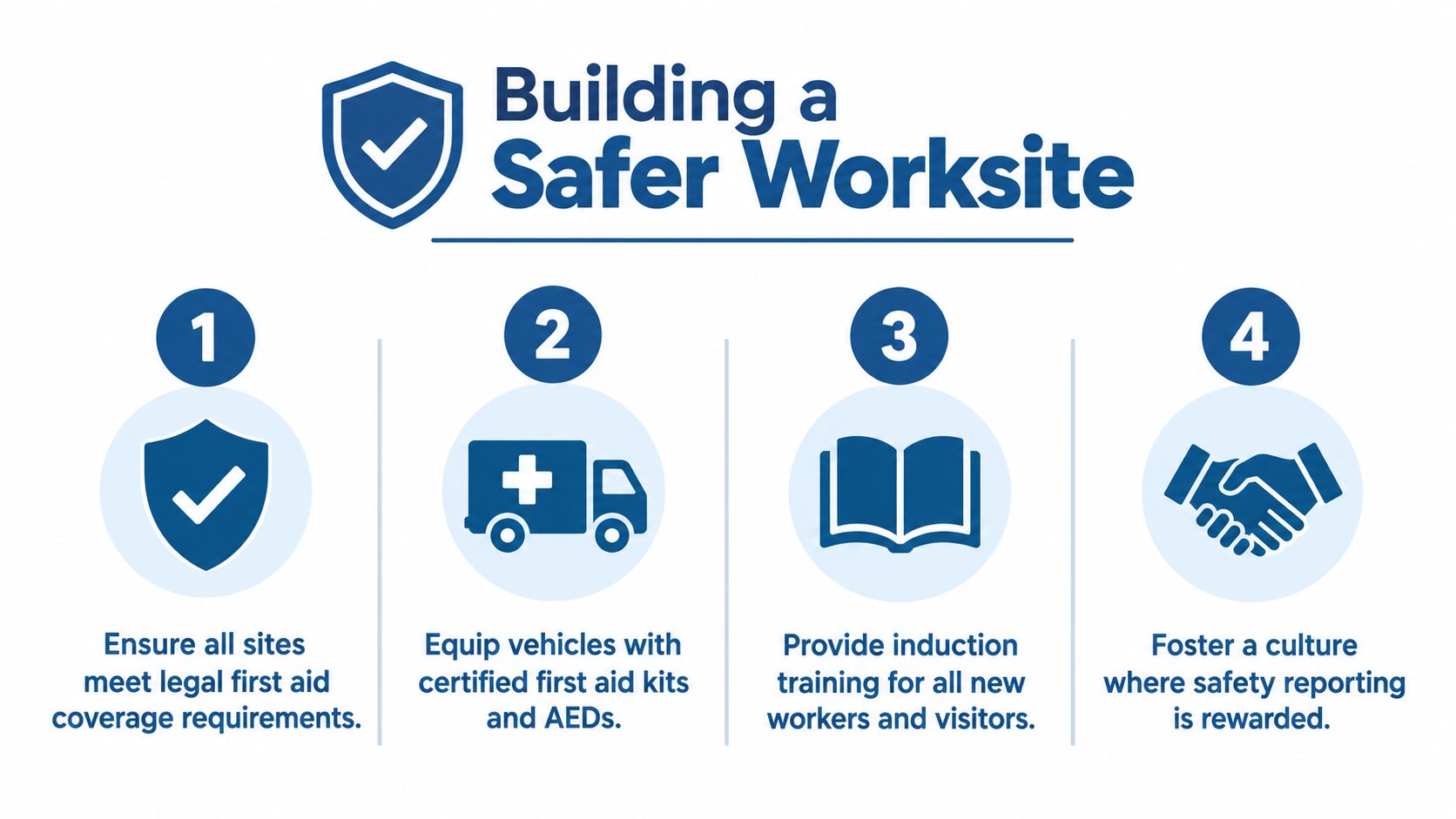
- Coverage: List trained responders by shift, work area and crew, then identify gaps caused by leave or demobilisation.
- Equipment: Check that first aid kits and facilities are accessible, clearly identified and suited to the hazards assessed for the site.
- Communication: Display procedures, officer names, emergency contacts and access directions where workers will see them.
- Practice: Use scenario drills to test scene control, calling for help, bystander management and access for emergency services.
- Records: Track credentials for employees and subcontractors, with reminders before refreshers and renewals are due.
Digital risk workflows can help teams keep reviews, actions and records visible. A resource such as this risk assessment automation guide may be useful when connecting first aid planning with broader site risk processes, provided the system supports the practical decisions supervisors make on site.
The best investment is not the certificate sitting in a personnel file. It's a trained person who can be found quickly, a crew that knows what to do, equipment that can be reached and a supervisor who reviews the arrangement when the site changes. That approach protects workers and gives the PCBU a clearer, more defensible safety system.
TP Training provides practical, nationally recognised first aid training with experienced trainers and hands-on learning across NSW, alongside construction and workplace safety courses. Visit TP Training to review the available training options and organise the right first aid pathway for your role or changing construction crew.

You may also like

Asthma and Anaphylaxis Training in NSW
Traffic Management Signs: A Complete Work Zone Reference