
Responsibilities of Employers: A Complete NSW Safety Guide
Under NSW law, employers acting as PCBUs must eliminate or minimise risks so far as is reasonably practicable, covering physical and psychological health, training, supervision and consultation; in 2024, 188 workers died from traumatic workplace injuries, with a fatality rate of 1.3 deaths per 100,000 workers. Serious harm remains a practical business responsibility, with 146,700 serious workers' compensation claims lodged in 2023–24.
A Sydney employer can discover the gap at an ordinary moment. A subcontractor arrives at a Penrith construction site, a new forklift enters an Auburn warehouse, or a team in the CBD moves into a different office layout. The paperwork may look organised, yet nobody can clearly explain who controls the hazard, who consulted the affected workers, or what happens if the risk involves stress, harassment or isolated work.
Table of Contents
- The Reality of Employer Duties in NSW Workplaces
- Understanding Your Primary Duty of Care as a PCBU
- How to Manage Workplace Risks Effectively
- Training First Aid PPE and Essential Safety Equipment
- Consultation Cooperation and Coordination Duties
- Record Keeping and Compliance Documentation
- Building a Proactive Safety Culture Beyond Compliance
The Reality of Employer Duties in NSW Workplaces
A construction manager in Penrith might have current induction records, a site safety plan and the right signs at the gate. Then a subcontractor changes the sequence of work without telling the principal contractor. A delivery route crosses a pedestrian path, workers raise concerns about fatigue, and the supervisor discovers that the risk assessment describes an earlier version of the job.
That scenario isn't unusual because employer responsibilities aren't confined to policies. They appear in decisions about equipment, rosters, access, supervision, communication and contractor coordination. In a warehouse in Auburn, a safe system might depend on separating people from moving vehicles. In an office in the Sydney CBD, it might depend on managing workload, inappropriate behaviour, emergency arrangements and the practical needs of workers who aren't always present in person.
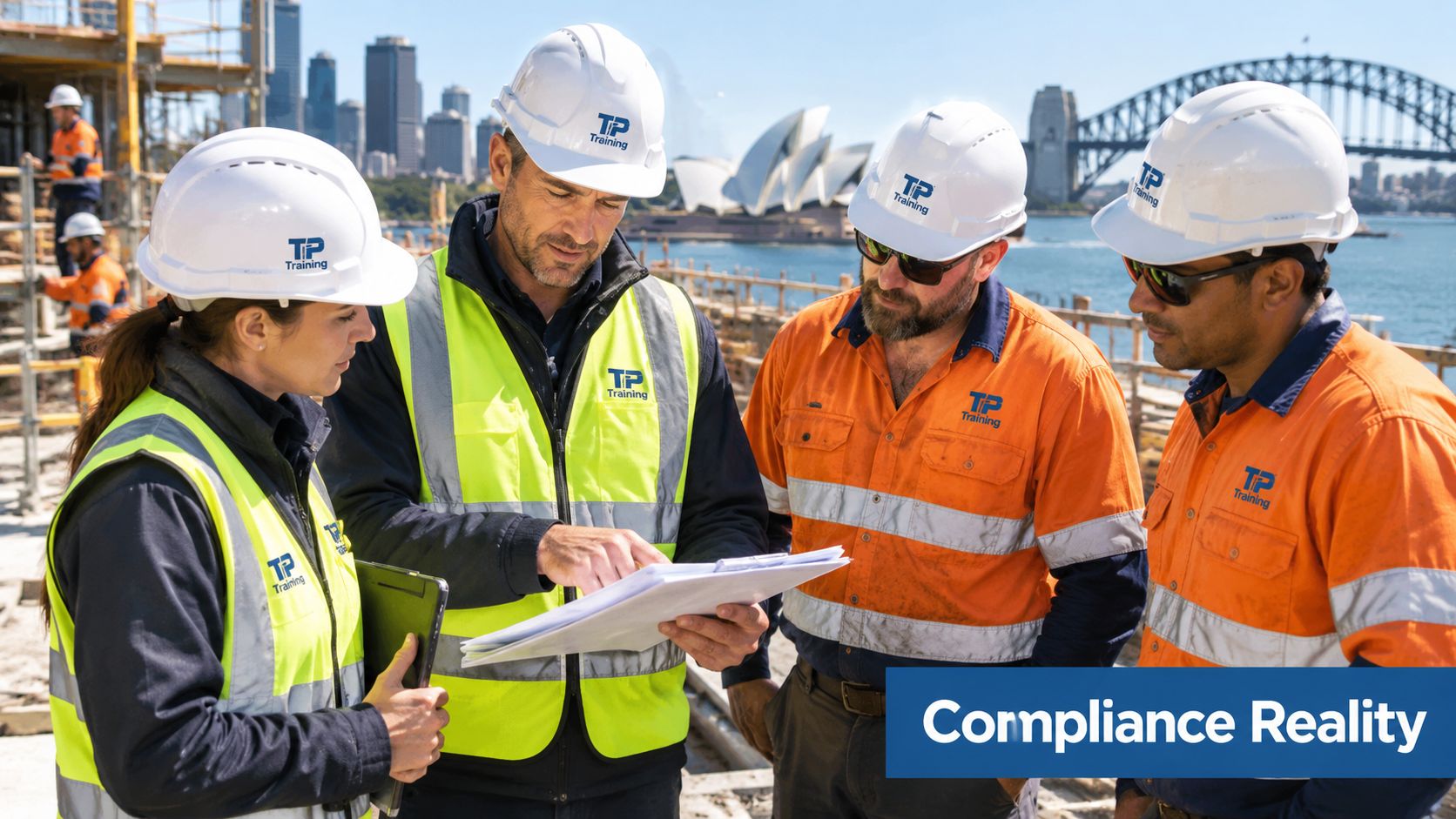
Compliance must reach the worksite
A policy helps only when workers understand it and supervisors apply it. The employer needs a repeatable way to identify hazards, select controls, provide suitable instruction and check whether the control still works after the job changes.
Safe Work Australia's national data records 146,700 serious workers' compensation claims in 2023–24, while around 140,000 workers are compensated for serious work-related injury or illness each year. Those figures make the responsibilities of employers tangible. Safety systems are intended to reduce exposure to harm, not merely create a file for an inspection. Safe Work Australia's annual report provides the national context.
A useful external perspective is gestire sicurezza sul lavoro con Spark, particularly for employers comparing ways to organise safety activities and maintain visibility of actions.
The practical test is straightforward: can a worker explain the safe method, can a supervisor see whether it is being followed, and can management prove that concerns lead to action? If the answer is no, the business has a safety system on paper rather than a safety system at work.
Understanding Your Primary Duty of Care as a PCBU
A PCBU, or Person Conducting a Business or Undertaking, carries the primary duty to ensure, so far as is reasonably practicable, the health and safety of workers and other people affected by the work. The duty applies to more than direct employees. It can reach contractors, labour hire workers, visitors, customers and members of the public who may be exposed to the business's activities.
In practical terms, the duty requires an employer to remove risks where possible. Where removal isn't possible, the employer must minimise the remaining risk using a considered hierarchy of controls rather than relying on a toolbox talk or a reminder to “take care”. The duty covers safe premises, plant, structures, substances, systems of work, facilities, information, training, instruction, supervision and monitoring. It also covers both physical and psychological health. Business.gov.au's WHS guidance sets out these core obligations.
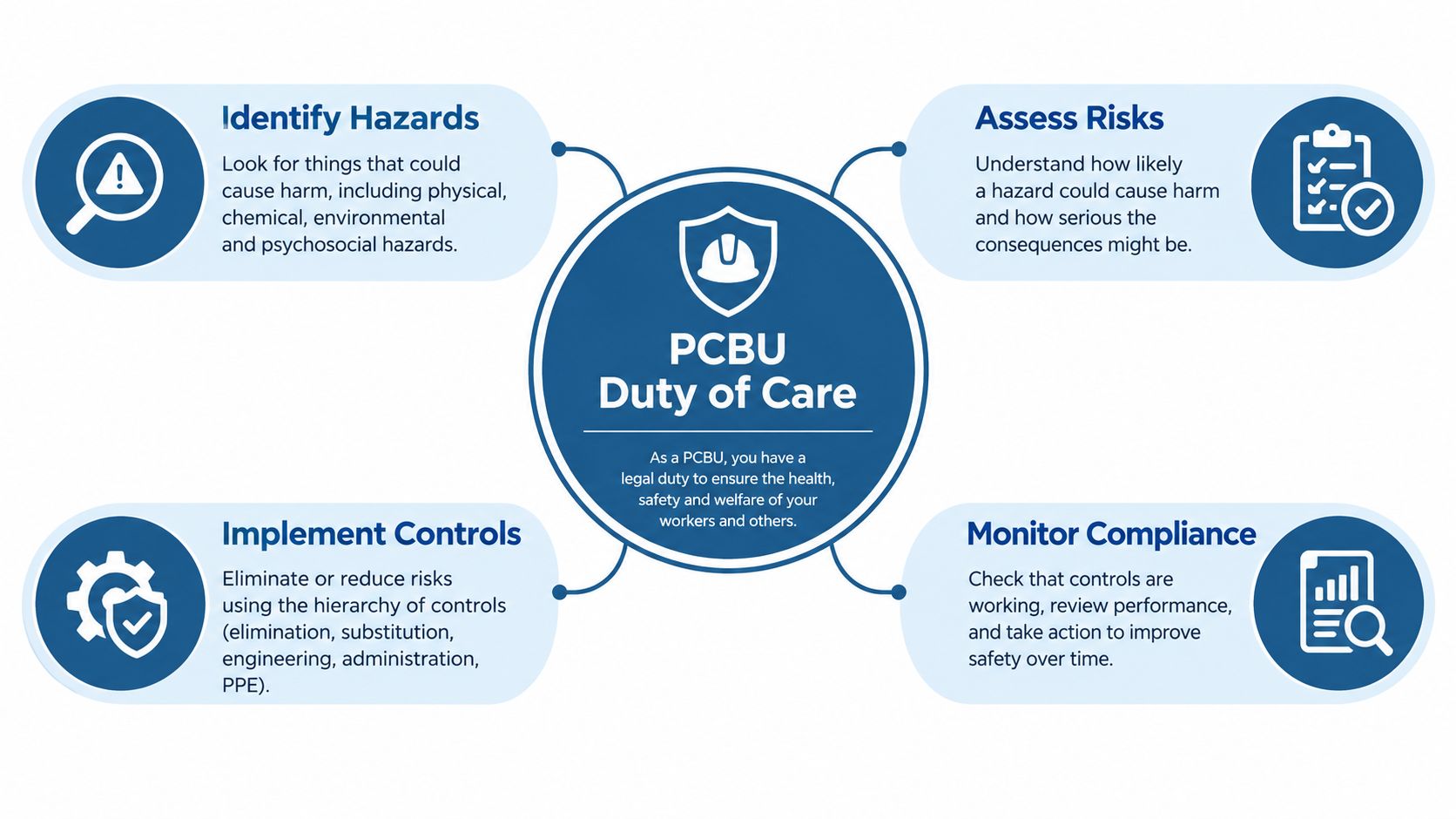
The PCBU decision sequence
A sound process follows four connected questions:
- What can cause harm? Identify hazards through inspections, worker consultation, incident information, task observation and contractor discussions.
- What could happen? Assess the way people may be exposed, including frequency, duration, equipment interaction and work organisation.
- What will control the risk? Prefer elimination and higher-order controls before administrative measures and PPE.
- Is the control working? Monitor conditions, speak with workers, review changes and correct failures promptly.
The national model WHS system strengthened duties such as consultation, hazard control and officer due diligence when harmonised laws began aligning jurisdictions in 2011. Safe Work Australia records that work-related injury or illness affected 3.5% of workers in 2021–22, compared with 6.4% in 2005–06, a long-term change associated with employer-controlled safety systems and broader prevention efforts. These figures appear in Safe Work Australia's WHS law and regulation material.
The duty doesn't require an employer to guarantee that no incident will ever occur. It requires a defensible, active process that reflects what the business knows, what workers report and what controls are reasonably available. A practical GM GROUP Services guide to duty of care obligations can help employers compare the legal concept with everyday management decisions.
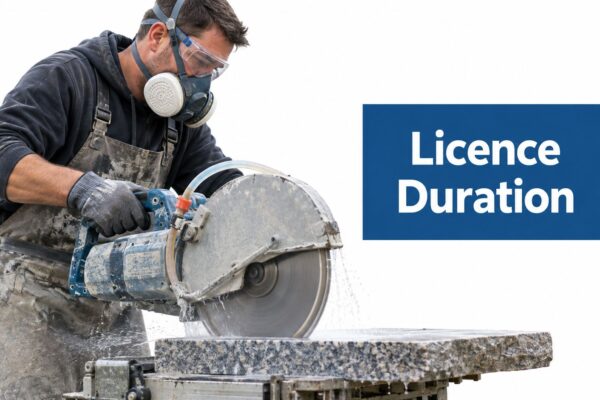
For specialised work, the control must match the task. Silica exposure, for example, needs more than general induction, so employers should use task-specific controls and review the guidance on crystalline silica exposure prevention. Where lifting and load movement are part of the work, Cpccldg3001 Perform Dogging Licence Course And Training In Sydney provides practical, nationally recognised training with experienced trainers and hands-on learning across NSW.
How to Manage Workplace Risks Effectively
Risk management works best as a living work process, not a document completed at the start of a project. Start by walking through the task with the people who perform it. Ask what changes during busy periods, what shortcuts appear under pressure, which controls fail in wet or noisy conditions, and where contractors interact with employees.
Use the hierarchy in the right order
Consider a construction excavation. Elimination might mean changing the design so workers don't enter a hazardous area. Substitution could involve selecting a less hazardous material or process. Engineering controls may include physical barriers, guarding, isolation or mechanical handling. Administrative controls, such as procedures, scheduling and supervision, support those measures. PPE remains important, but it sits lower in the hierarchy because it depends heavily on correct selection and consistent use.
A hospitality venue may apply the same logic to a slipping hazard. Removing the source of the spill is stronger than placing a sign beside it. Improving drainage, changing the layout or selecting a safer surface may control the risk more reliably than reminding staff to walk carefully.
Use this working sequence:
- Identify hazards: Include routine work, maintenance, deliveries, cleaning, emergencies and changes to equipment or staffing.
- Assess exposure: Consider who may be affected, how they interact with the hazard and what happens if the control fails.
- Select controls: Choose the highest reasonably practicable control, then add administrative measures and PPE where residual risk remains.
- Consult before changes: Ask affected workers whether the proposed control is workable and whether it creates a new hazard.
- Review after implementation: Check the control in real conditions, not only during a scheduled inspection.
- Document decisions: Record the hazard, chosen control, responsible person, review trigger and outstanding action.
Practical rule: If the control depends entirely on a worker remembering a warning, look for a stronger control first.
Risk management also needs a trigger list. Review controls after an incident, near miss, complaint, equipment change, process change, contractor change or indication that workers are experiencing psychological strain. The construction risk management guidance provides a useful task-based reference for employers working in that environment.
Training First Aid PPE and Essential Safety Equipment
Training is a control only when it matches the work and the worker can apply it. An employer should identify the task, define the required competence, provide instruction in a form workers understand, supervise the first applications and check whether the person remains capable after the work changes.
A generic online module won't replace practical instruction for high-risk work. A worker operating plant may need task-specific instruction, supervised practice and clear limits on what they can do. A new employee who speaks limited English may need information, training and supervision in an appropriate language or format. Records should show what was covered and whether the worker was assessed as ready for the task.
Build an equipment and response checklist
First aid arrangements should reflect the workplace, the work performed, access to assistance, worker numbers and the type of foreseeable injury or illness. Employers need suitable first aid equipment, trained people where appropriate, clear emergency communication and a process for checking supplies. A kit that has expired or cannot be reached quickly isn't an effective control.
PPE selection should follow the hazard assessment. Eye protection, hearing protection, respiratory protection, gloves, high-visibility clothing, protective footwear and fall protection all have different purposes. Employers should check fit, compatibility, maintenance, storage and replacement. PPE shouldn't be used to conceal a failure to isolate a machine or remove an exposure.
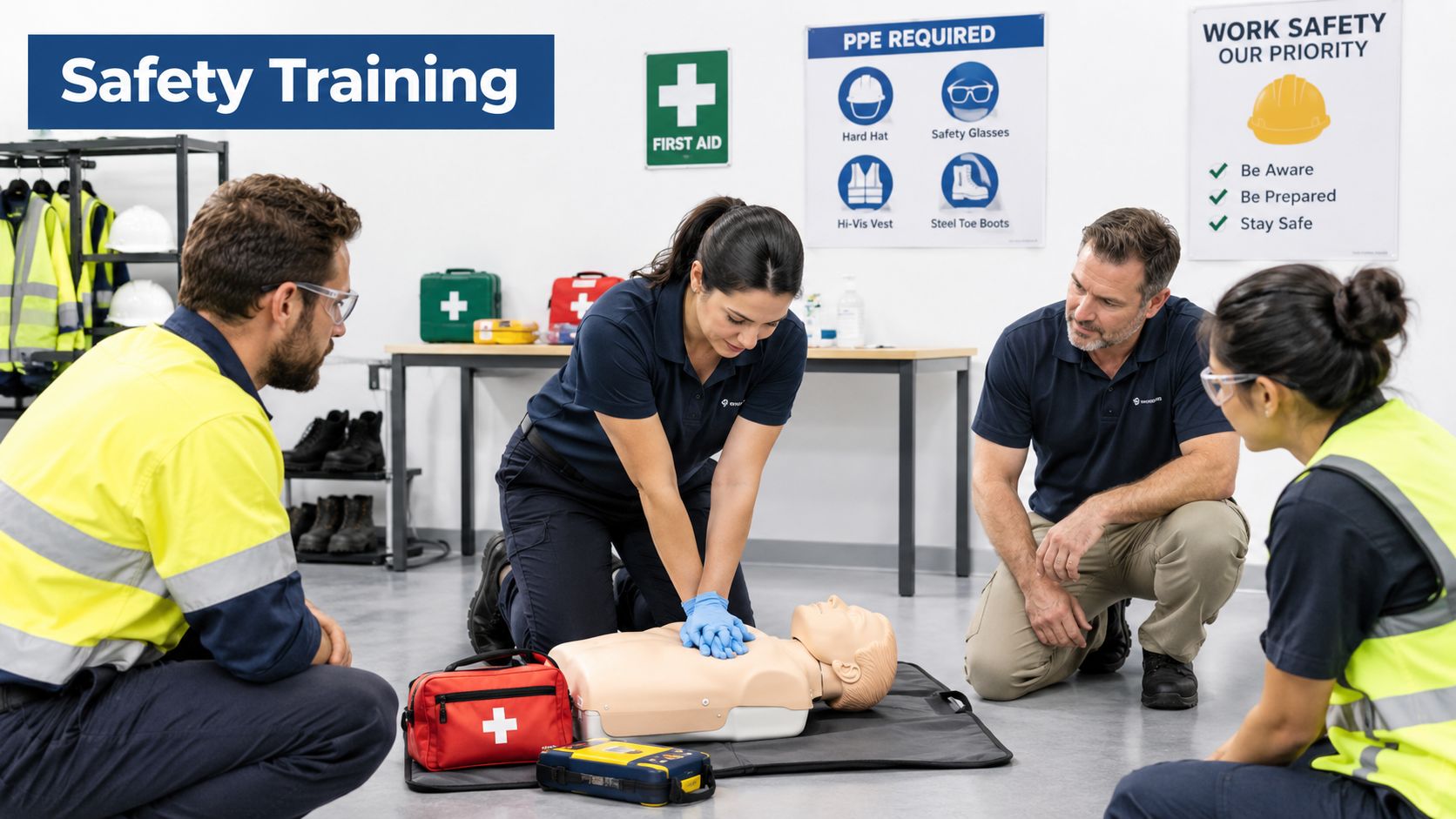
Make competence visible
A strong training system links each task to a person, evidence and review point. Keep induction separate from task competence, and don't treat attendance as proof that a worker can perform the job safely. Supervisors should observe work, correct unsafe practice and escalate gaps rather than allowing production pressure to set the standard.
For employers reviewing emergency readiness, first aid and CPR training information can support planning around practical instruction and workplace response. The right course depends on the workplace risk profile and the role assigned to each worker.
Consultation Cooperation and Coordination Duties
Shared worksites create shared duties, not transferred duties. If a contractor introduces a risk at a Sydney construction site, the principal employer cannot just say the contractor caused it. Each duty holder retains responsibility for the part of the work they influence or control, and the businesses must consult, cooperate and coordinate their activities.
Before work starts, establish who controls the site, access, plant, isolation points, emergency response, traffic movement, permits and day-to-day supervision. Put those arrangements into clear contracts and site procedures, then confirm them during pre-start meetings. Contract wording can allocate tasks, but it can't remove a PCBU's legal duty to manage risks it can control.
Ask better contractor questions
A useful contractor review asks:
- Who identified the hazard? The answer should be based on the actual task, not a generic company statement.
- Who controls the interface? Define what happens where employees, labour hire workers and subcontractors meet.
- Who receives complaints? Workers need a clear route for reporting physical and psychological concerns.
- Who checks the control? Name the supervisor or manager responsible for verification.
- What changes require consultation? Equipment, procedures, schedules and risk controls should not change without notice.
NSW guidance requires employers to manage hazards, consult workers and maintain safe equipment and systems. Consultation is especially important before changing equipment, procedures or controls, as outlined by SafeWork NSW's employer responsibilities guidance.
Psychosocial hazards need the same discipline. Excessive demands, poor role clarity, aggression, bullying, harassment, gender-based violence and isolated work should be identified, assessed and controlled. A contractor or labour hire agency may contribute to the risk, but the host business still needs to coordinate the work and respond to warning signs. Practical on-site safety guidance can help translate shared responsibilities into site routines.
Record Keeping and Compliance Documentation
Good records support two different needs. A small business may need a simple, accessible system that a manager can maintain without creating duplicated paperwork. A larger operation may need defined ownership, version control, approval workflows and a central register that links training, inspections, incidents, consultations and corrective actions.
Neither approach works if records are incomplete or impossible to retrieve. Fair Work requires employers to make and keep accurate, complete employee records that are readily accessible to inspectors, legible, in English and retained for 7 years. The records must not be altered except to correct an error, and they cover matters including pay, hours, leave, termination, superannuation contributions, individual flexibility arrangements and guarantees of annual earnings. The Fair Work record-keeping and pay slips guidance sets out these requirements.
Compare the two common approaches
| Approach | What works | Where it fails |
|---|---|---|
| Small-business register | One controlled folder or system with named owners, review dates and consistent file names | Documents sit in personal inboxes, records aren't updated, and nobody can locate the current version |
| Larger compliance system | Central registers, permission controls, audit trails and scheduled reviews | Teams collect excessive data without linking it to decisions or closing corrective actions |
Keep safety records that explain the decision, not just the event. A consultation note should identify who was consulted, what concern was raised and what changed. A training record should identify the task and evidence of competence. An inspection should show the defect, action owner and completion status.
Workers' compensation needs separate attention. Employers should understand their relevant insurance arrangements and know how to support an injured employee. Safe Work Australia doesn't administer workers' compensation schemes or manage claims, so employers need to follow the requirements of the applicable jurisdictional scheme. A broader HR compliance checklist from LeaveWizard can help identify record categories that sit alongside WHS documentation.
For training administration, employers should also control identity and course records properly. The steps for creating and managing a Unique Student Identifier provide a practical reference for handling that information.
Building a Proactive Safety Culture Beyond Compliance
A proactive safety culture isn't created by adding another policy to the intranet. It grows when managers respond to reports, supervisors model the safe method, workers can challenge a decision without retaliation and contractors receive the same operational expectations as employees.
The responsibilities of employers now extend beyond traditional physical hazards. Employers must protect psychological health, identify and control psychosocial hazards, and address gender-based violence by eliminating or minimising related risks as far as possible. That includes consultation with workers and an appropriate response to complaints. Remote and isolated work also needs active planning, including communication, emergency response, supervision and a way to identify when a worker may be at risk.
Turn principles into routines
Start with a short action plan:
- Review the risk profile: Include physical hazards, workload, behaviour, work design, remote arrangements and contractor interfaces.
- Ask workers directly: Use toolbox talks, private reporting routes and consultation before changes are implemented.
- Train supervisors: They need to recognise psychological as well as physical warning signs and know how to escalate concerns.
- Communicate accessibly: Provide information, training, instruction and supervision in languages and formats workers understand.
- Measure actions, not paperwork: Track whether controls were implemented, complaints were handled and review dates were met.
- Recheck after change: A new client, contractor, roster, technology or work location can alter the risk profile.
Workers judge safety culture by what happens after they speak up.
The strongest employers don't wait for an incident to reveal a weak control. They use worker feedback, contractor coordination, inspections, training observations and complaint handling to find problems early. That approach supports compliance, but it also protects continuity, trust and the people who make the business operate.
TP Training provides practical, nationally recognised training across construction, civil construction, traffic control, first aid and workplace safety, with experienced trainers and hands-on learning across NSW. Visit TP Training to review training options that can help your workplace strengthen competence, emergency readiness and day-to-day safety practices.

You may also like

First Aid Training Cost: A Complete Guide for Sydney Workers
How Long Licence Crystalline Silica Prevention Last