

White Card Validity NSW: A Practical Guide for 2026
A NSW white card has no printed expiry date and stays valid only while you've carried out construction work within the previous two years. A break of two or more consecutive years voids the card and means retraining, not renewing the card.
That distinction matters on a Monday morning. Your boots are on, your hard hat is in the ute, and a site supervisor asks to see your white card. You find a laminated card from an earlier job. It looks perfectly usable, but the date you need to check isn't printed on the plastic. It's the date you last carried out construction work.
The practical rule is straightforward. If you've remained active in construction, the card can continue to be valid even without a printed expiry date. If you've been away for two years or more, you'll need to complete the required training again before returning to site. Personal details, lost cards and interstate cards create separate administrative questions, so it helps to deal with each one carefully.
Table of Contents
- Starting a NSW Job and Wondering If Your Card Still Counts
- How NSW White Card Validity Actually Works
- The Main Triggers That Change Your Card Status
- Replacing a Lost Damaged or Outdated White Card
- Retraining Versus Replacing Which Path Do You Need
- Real Scenarios NSW Workers Face
- Next Steps and Where to Book in NSW
Starting a NSW Job and Wondering If Your Card Still Counts
A white card is formally called a General Construction Induction Card. Before you enter a NSW construction site, the business responsible for the site needs to be satisfied that you hold a current card. The physical card alone may not answer that question because most cards don't show an expiry date.
Start with your work history, not the card's appearance. Ask yourself when you last performed construction work. A recent change of employer doesn't automatically affect your card, and moving between construction roles doesn't create a new validity period. The important issue is whether you've had a continuous break from construction work lasting two years or more.
If you've continued working in construction, your card may still be valid even if it was issued years ago. If you stopped construction work and the break reached the two-year threshold, the card is treated as no longer valid for the purpose of returning to site. Completing a replacement form won't fix that problem because replacement is an administrative process for an existing valid card.
Practical rule: Don't use the absence of a printed expiry date as proof that your white card is current. Use your construction work history to make the first check.
There's also a simple admin step that can save time before your first shift. Check that the name and other identifying details connected with your card match your current records. If you need to locate the card number for an employer or training provider, learn how to find your white card number before you arrive at the site office.
If your answer is uncertain, tell the supervisor or training provider before the job starts. A short verification conversation is better than arriving at the gate with a card that looks fine but no longer meets the current validity rule.
How NSW White Card Validity Actually Works
The NSW white card system can feel unusual because the card doesn't operate like a licence with a routine renewal date. It's the General Construction Induction Card, and its continued validity is connected to the holder's participation in construction work.
SafeWork NSW is the regulator responsible for the state's work health and safety framework. Service NSW provides the government channel used for transactions such as replacing a card. The official Service NSW white card information explains the key point for workers, the card has no printed expiry date, but it becomes void when the holder hasn't carried out construction work for two consecutive years or more.
Think of it as a work-linked status rather than a routine renewal cycle. A driver's licence normally tells you when its fixed validity period ends. A white card instead remains useful while you stay active in the industry, subject to the applicable regulatory conditions. A long break changes the position even though the original card still looks unchanged.
What the card does and doesn't prove
The plastic card proves that you completed the relevant general construction induction process. It doesn't independently show the date of your last construction shift. That's why employers, principal contractors and site supervisors may ask questions or request confirmation before allowing access.
There's no need to replace a card just because it has no expiry date printed on it. Replacement is for a valid card that has been lost, damaged or needs administrative updating. Retraining is the relevant path after the two-year break.
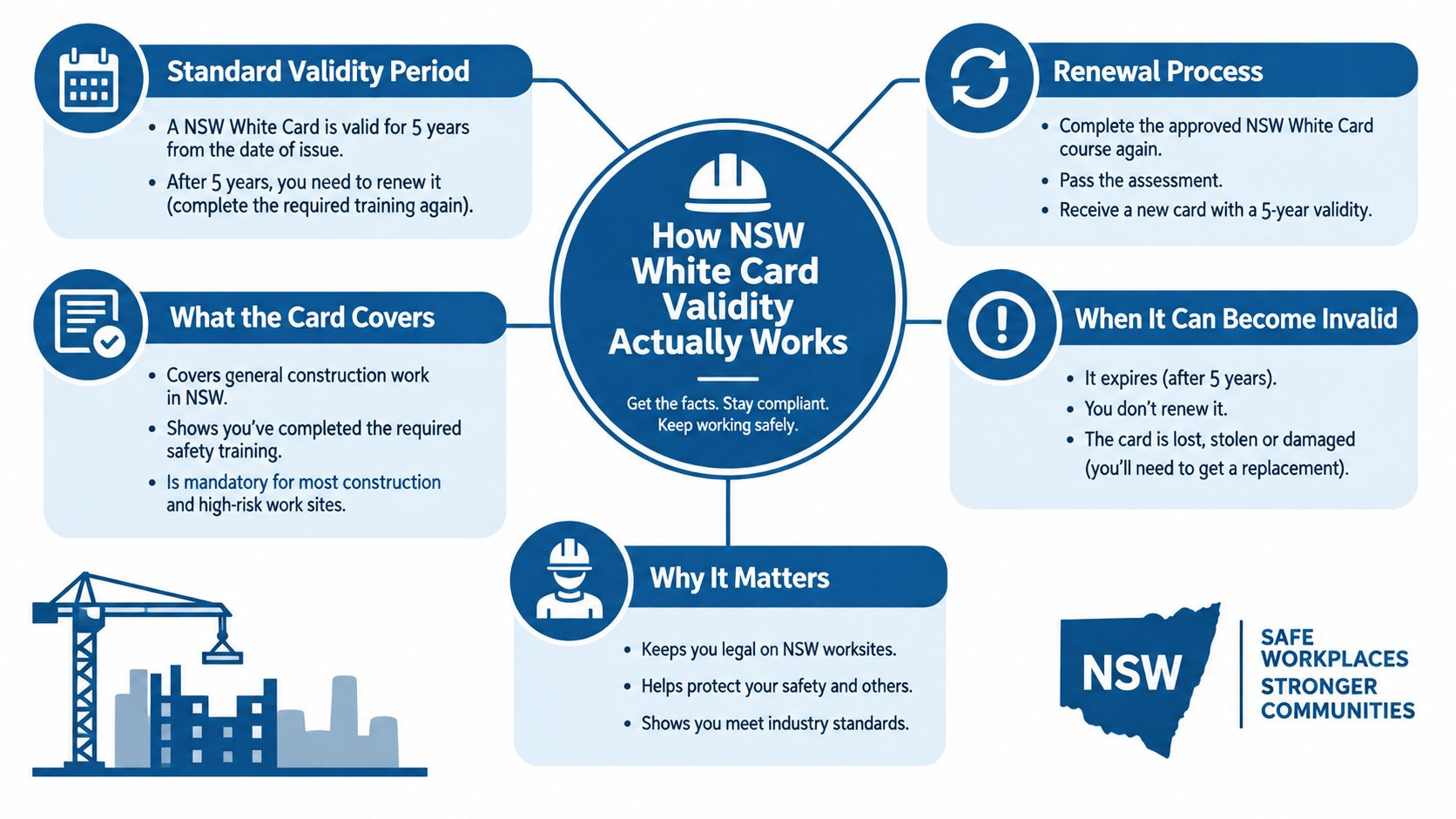
The infographic below contains a visual overview, but the current NSW rule is the one to follow. A white card isn't governed by a fixed five-year renewal period.
If you're returning to construction or entering the industry for the first time, White Card Training Course training is one option. TP Training describes its course as practical, nationally recognised training delivered by experienced trainers with hands-on learning across NSW. You can also review its information about free online white card training while checking that any course you choose follows the applicable NSW requirements.
The Main Triggers That Change Your Card Status
Use this checklist before accepting a construction shift in NSW. It separates a genuine validity problem from an administrative issue that can be solved without repeating the training.
Check the work gap first
A continuous break of two years or more from construction work is the main trigger that makes the card void. If that applies to you, plan to retrain through an approved training provider rather than applying for a replacement.
Check where the card was issued
NSW recognises an interstate General Construction Induction Card while it remains valid in the state or territory that issued it. The card must not have been cancelled, suspended or expired, and the holder must not have been out of the industry for more than two years. The SafeWork NSW interstate card fact sheet sets out this recognition position.
That means a worker moving to NSW from Queensland, Victoria or another Australian jurisdiction may not need a new card. First confirm that the issuing jurisdiction still regards the card as valid and that your construction work history hasn't crossed the two-year threshold.
Check your personal details
A name or other identifying detail may need to be updated on the card. That's a replacement matter, not automatically a reason to repeat induction training. Keep the card details aligned with your identity records so an employer can match the card to you.
Check whether the card is missing
A lost, stolen or damaged card creates a proof problem. It doesn't necessarily mean the underlying training has disappeared, but you'll need to follow the official replacement pathway and provide the required information. Don't treat a replacement application as a substitute for retraining if the card had already become void through inactivity.
| Trigger | Card Status | Action Needed |
|---|---|---|
| Two years or more away from construction | Void under the NSW validity rule | Complete the required training again |
| Interstate card remains valid in its issuing jurisdiction | Recognised in NSW, subject to the two-year industry rule | Confirm its status before starting work |
| Personal details have changed | Existing record may remain valid, but details need updating | Apply for a replacement |
| Card is lost, stolen or damaged | Validity and proof are separate questions | Report the issue and follow the replacement process |
For broader workplace safety preparation, you can also review white card, CPR, first aid and workplace safety certifications. Keep the central decision in view: inactivity points to retraining, while a valid card with an admin or physical problem points to replacement.
Replacing a Lost Damaged or Outdated White Card
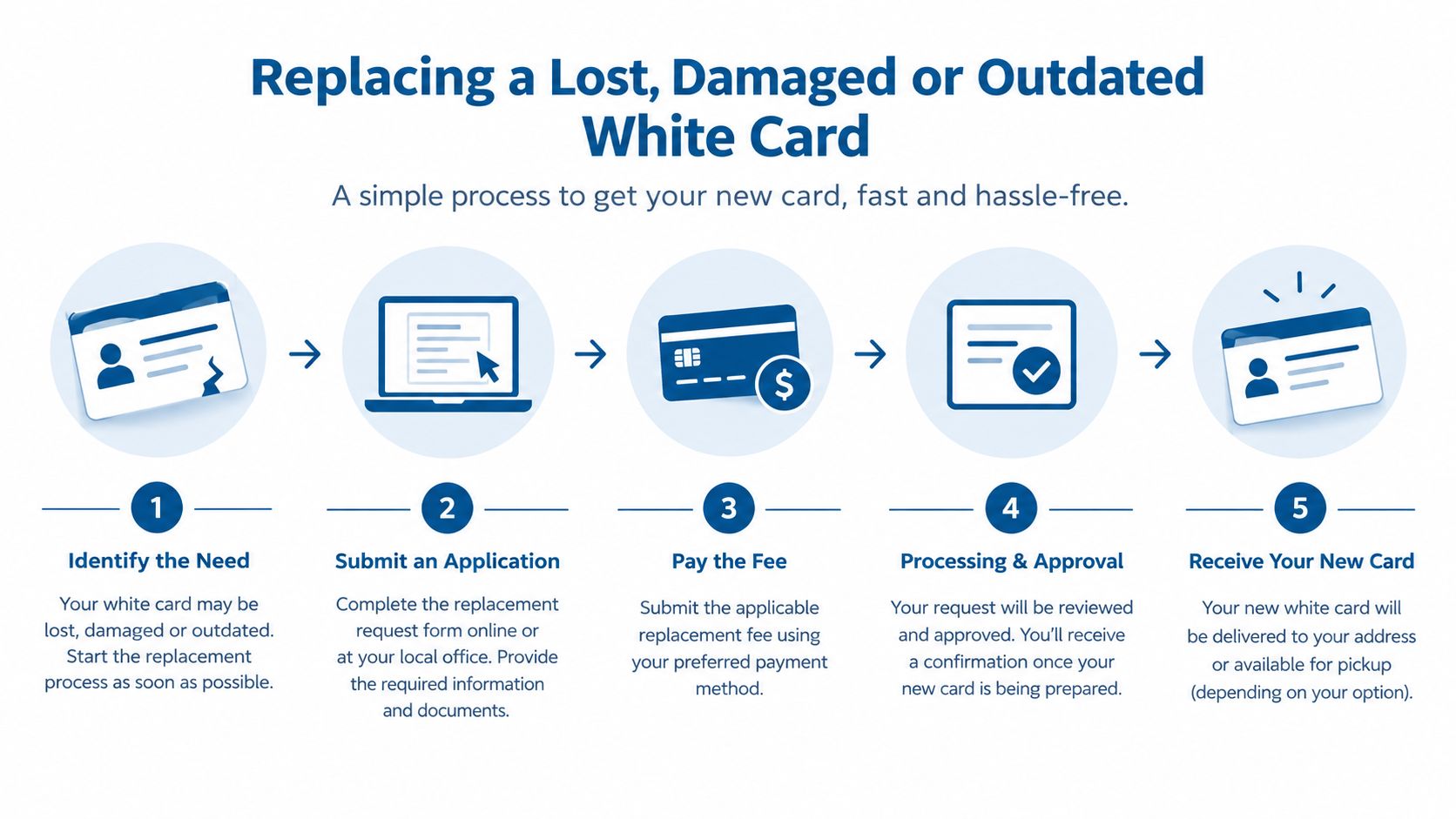
Replacement only makes sense when the underlying white card is still valid. It's designed to give you a new physical card or updated record, not to restore a card that became void after a prolonged break from construction.
For the current NSW process, start with the replacement pathway provided by SafeWork NSW or Service NSW. A registered training organisation may assist with the Replacement General Construction Induction card form. You'll need to establish your identity and provide the details needed to locate your training record, so have acceptable photo identification and your existing card information available if you still have it.
Understand the fees and documents
The current SafeWork NSW fee schedule lists a replacement white card at $41, while an online replacement costs $36. Check the official SafeWork NSW white card guidance before lodging an application because administrative details and fees may change.
A replacement statement is valid for 60 days, and Service NSW says most cards are issued in less than 30 days. Those timeframes relate to the replacement paperwork and evidence you use while waiting. They don't create a printed expiry date for the underlying white card.
If your details change and you receive a new card, NSW requires the old card to be returned within 7 days. Keep copies or records of the application until the replacement arrives, particularly if you're preparing for a new employer or project.
A digital government record can help with administration, but it doesn't change the underlying validity rule. If you've been away from construction for two years or more, pause the replacement application and confirm whether retraining is required instead.
You may also need a Unique Student Identifier for training or enrolment administration. TP Training provides general guidance on creating and managing a Unique Student Identifier, but use the current instructions from the relevant government system if your details have changed.
Retraining Versus Replacing Which Path Do You Need
The simplest way to choose is to ask whether your problem is about validity or proof. A two-year break affects validity. A missing card, damage or changed details usually affects how you prove or update an existing record.
| Factor | Retraining | Replacement |
|---|---|---|
| Main reason | The card has become void after the relevant break from construction | A valid card is lost, damaged or needs updated details |
| Cost | Set by the training provider and course requirements | NSW replacement fees apply |
| Time | Requires completing the training and assessment process | Requires an administrative application and record check |
| Delivery | Training is completed through an approved provider | The replacement process is handled through the relevant NSW channel |
| Outcome | A new construction induction training outcome | A replacement or updated card connected to the existing record |
Use this decision guide
- You've stayed active in construction: Check your records and card details. If the card is physically missing or damaged, investigate replacement.
- You've been away for two years or more: Don't apply for replacement as a shortcut. Arrange the required training again.
- You hold an interstate card: Confirm that it remains valid where it was issued and that your industry break hasn't exceeded the NSW threshold.
- Your name or other details have changed: Follow the replacement route and keep evidence of the updated application.
Workers with older construction induction records should also ask the regulator or training provider whether their document is accepted for the work they plan to do. The label on an old card isn't enough if the record, issuing jurisdiction or current requirements are unclear.
The white card course information can help you compare the training route with the administrative replacement route. Don't book retraining solely because your card has no printed expiry date, and don't book replacement when your work history shows that the card is no longer valid.
Real Scenarios NSW Workers Face
A former construction worker returns after four years away while caring for children. The old card is still in a drawer and has no printed expiry date. The correct question isn't whether the plastic looks readable. The four-year break is beyond the NSW threshold, so the worker needs to retrain before returning to construction work.
A Queensland labourer accepts a job in Sydney and brings a General Construction Induction Card issued in Queensland. NSW can recognise that interstate card if it remains valid in Queensland, hasn't been cancelled, suspended or expired, and the worker hasn't been out of construction for more than two years. The labourer should confirm those conditions before the first shift rather than assume every interstate document is automatically accepted.
Changes that call for administration
A tradesperson changes their surname after marriage. Her construction work has continued, so the issue isn't a break in industry activity. She should arrange a replacement so the card details match her current identity, then follow the requirement to return the old card after receiving the new one.
A new apprentice arrives with an interstate visitor card that isn't recognised for the NSW role. The apprentice should find out why it isn't accepted. If the document is cancelled, suspended or expired in its issuing jurisdiction, or if the holder has been away from construction beyond the permitted period, it won't bridge into NSW under the recognition conditions.
These examples show why “does my white card expire?” is often the wrong first question. The useful questions are: When did I last work in construction? Where was the card issued? Do my current details match the record? Is the card available and readable?
A site supervisor may still ask for confirmation even when a worker believes the card is current. Bring the relevant card details and be ready to explain your work history. That makes the conversation practical instead of leaving the decision to the appearance of an old piece of plastic.
Next Steps and Where to Book in NSW
Turn the rule into a quick pre-start check. Write down your last construction shift date, compare your current personal details with the card, and identify whether the card was issued in NSW or another state or territory.
Then choose the right route:
- A recent construction work history: Keep evidence of your card details and confirm what the employer wants before your first shift.
- A break of two years or more: Book the required general construction induction training again. A replacement card won't remove the retraining requirement.
- An interstate card: Confirm that it remains valid in its issuing jurisdiction and meets the NSW recognition conditions.
- A changed, lost or damaged card: Use the replacement process while the underlying card is still valid.
For a NSW general construction induction course, ask the provider what identity documents, Unique Student Identifier details and clothing or PPE you need to bring. Comfortable clothing and suitable site footwear are sensible preparation for any practical component, but follow the provider's specific instructions rather than relying on a generic checklist.
TP Training delivers practical, nationally recognised training with experienced trainers and hands-on learning across NSW. Check the current course information, locations and enrolment requirements directly before booking, because course arrangements can change.
If you're unsure whether your card is current, don't wait until the site gate to find out. Confirm your last construction work date, check your card details and speak with the regulator, employer or training provider so you can arrive ready for work.
TP Training offers practical, nationally recognised White Card training with experienced trainers and hands-on learning across NSW. If your construction work history shows a break of two years or more, visit TP Training to review the current course information and take the correct next step before returning to site.

You may also like

CPR Course Parramatta: What to Expect and How to Book
Operate Truck or Trailer Mounted EWPs Safely