MSMWHS217 Gas Test Atmospheres: A Practical Guide
You're at the edge of a service pit at ten past six in the morning, detector in one hand and permit in the other, and the screen is a clean green. Nothing is beeping. Climbing down feels like the obvious next move, which is exactly when gas testing goes wrong.
A green display isn't a decision. It's a number from an instrument that had to be the right one, calibrated, sampled in the right place, and compared against the right limit before anyone touched a ladder. MSMWHS217 Gas test atmospheres is the unit that teaches the whole chain, from the moment you pick up the detector to the moment you tell the crew whether to start.
The unit seems straightforward on paper. On site, every part of it turns into a decision about whether someone gets to work.
Table of Contents
- What the MSMWHS217 Unit Covers at a Glance
- Learning Outcomes and Core Competencies Explained
- Assessment Requirements You Must Evidence
- How to Gas Test an Atmosphere Step by Step
- Reading Gas Test Results and Choosing the Next Action
- Where Gas Testing Applies on Australian Worksites
- Confirm Your Training Pathway Before You Enrol
What the MSMWHS217 Unit Covers at a Glance
MSMWHS217 Gas test atmospheres is the nationally recognised unit for determining whether a workplace atmosphere is safe for the work about to happen. It replaced MSAPMOHS217A Gas test atmospheres and is equivalent to it, so the older code still appears on training records and job ads without meaning anything different.
The unit isn't a gas awareness talk. It covers three stages of real work: preparing for testing, conducting atmospheric tests with electronic test apparatus, and interpreting results to decide whether controls or further action are needed.
| Element | What the unit requires |
|---|---|
| Unit code | MSMWHS217 Gas test atmospheres |
| Former equivalent | MSAPMOHS217A Gas test atmospheres |
| Core work stages | Prepare for testing, test with electronic apparatus, interpret results |
| Hazards tested | Oxygen, airborne flammable contaminants, harmful contaminants such as hydrogen sulfide and carbon monoxide |
| Settings covered | Confined and enclosed spaces, hot work, tanks, silos, pits, pipes, shafts, ducts, transport vehicles and ships |
| Permit use | Testing for permit issue and ongoing monitoring while work proceeds under a permit |
| Authoritative source | training.gov.au unit listing, not course descriptions |
The official training.gov.au listing defines the scope, application and performance criteria. Commercial course pages describe a day out. They don't set the benchmark.
Scope check: if a course description never mentions interpreting readings and taking action on them, it isn't describing this unit, whatever the title says.
Because the unit sits inside the national framework, it travels with you between employers. A tester who learned on a Sydney civil site can move onto a mine site or a warehouse with a different permit system and still be assessed against the same competency.
The three stages look simple in summary. Each one carries its own expectations, and the gap between a confident tester and a competent one lives in the details.
Learning Outcomes and Core Competencies Explained
Think of a gas tester the way you'd think of a lifesaver reading the water before a patrol. The skill isn't holding the equipment. It's knowing where to look, when to look again, and what the water is likely to do next.
MSMWHS217 is built around that judgement. Producing a reading is the easy part. Deciding what it means for the job, and what has to happen before anyone proceeds, is where the competency sits.
What the exposure limits actually mean
Three terms come up constantly and get muddled constantly.
- Time-weighted average (TWA): the average exposure over a full work shift. A short spike can sit inside a compliant TWA and still be a problem.
- Short-term exposure limit (STEL): the maximum average exposure allowed over a short period, usually 15 minutes.
- Peak limitation: a concentration that must never be exceeded at any moment, even briefly.
Before work starts, check the current Safe Work Australia exposure standard for each gas on the site. A reading of 12 ppm means nothing until it's compared with the limit that applies to that gas, which is why "the meter says 12" is not a report.
What a competent tester actually does
The competencies read like a description of a careful shift.
- Identifies the atmosphere first. The process, stored materials, likely decomposition products and the permit all point to which contaminants are plausible in that space.
- Matches sensors to those contaminants. The detector should carry the channels the hazard calls for, not just the channels that came in the case.
- Calibrates and checks the instrument before it's used, not after a reading looks odd.
- Defines a sampling pattern. Where to sample, at which heights, and how many points before a result counts as representative of the space.
- Takes and interprets readings, comparing each one against the relevant limit and the permit conditions.
- Records and reports the location, time, instrument identification, calibration status, readings and actions taken.
A standard four-gas instrument is a sensible default and a poor assumption. It covers oxygen, flammability, carbon monoxide and hydrogen sulfide. A site storing solvents may need a different sensor or a photoionisation detector. A sealed pit or a fermentation vessel may call for carbon dioxide measurement. If the sensor isn't fitted, the instrument can't warn you, and a green screen is just a green screen.
If you're new to site safety more generally, workplace safety training covers the framework that sits around this unit, including hazard identification and the permit systems that gas testing feeds into.
None of this is memorised theory. Competence means running that sequence on a real site with the materials present there, and being able to explain why each choice was made.
Assessment Requirements You Must Evidence
The MSMWHS217 assessment requirements ask for evidence of a complete job, not one clean detector reading. A candidate has to show they can recognise the conditions that call for atmospheric testing, then select, prepare and use gas-testing equipment.
The evidence areas read like a shift on site.
- Applying the testing regime. Following the site procedure rather than an improvised routine, because the procedure exists to make results comparable between people and days.
- Selecting and using personal protective equipment. A tester standing at a hatch still needs the right gloves, eye protection and footwear for what's coming out of it.
- Identifying hazards and applying control measures. Isolation, ventilation, barricades and exclusion zones are part of the job, not someone else's.
- Cleaning and maintaining equipment. Hoses, filters and sensors degrade. An instrument that isn't maintained stops being a safety tool.
- Taking readings. Sampling in a way that reflects the space, at the heights and points the procedure specifies.
- Interpreting, recording and reporting data. Turning numbers into a written record a supervisor, auditor or next crew can act on.
- Solving routine problems using known procedures. A failed bump test, a flat battery or a blocked probe has a defined response, and following it is the skill.
- Communicating safety conditions clearly to supervisors, standby persons and entry crews, in plain language, so nobody starts work on a misunderstanding.
Hazard control is where gas testing meets the rest of site safety, and the underlying principles are the ones set out in risk management in construction. The assessment requirements make clear that completion isn't proven by a detector reading alone, because equipment care, hazard control, documentation, decision-making and communication are all assessed.
Keep a personal log while you train: each practical task, each pre-use check, each time you explained a result to someone. Evidence is far easier to present when it was written down as it happened. Assessors look for consistent safe practice across tasks, not one perfect demonstration on the day.
How to Gas Test an Atmosphere Step by Step
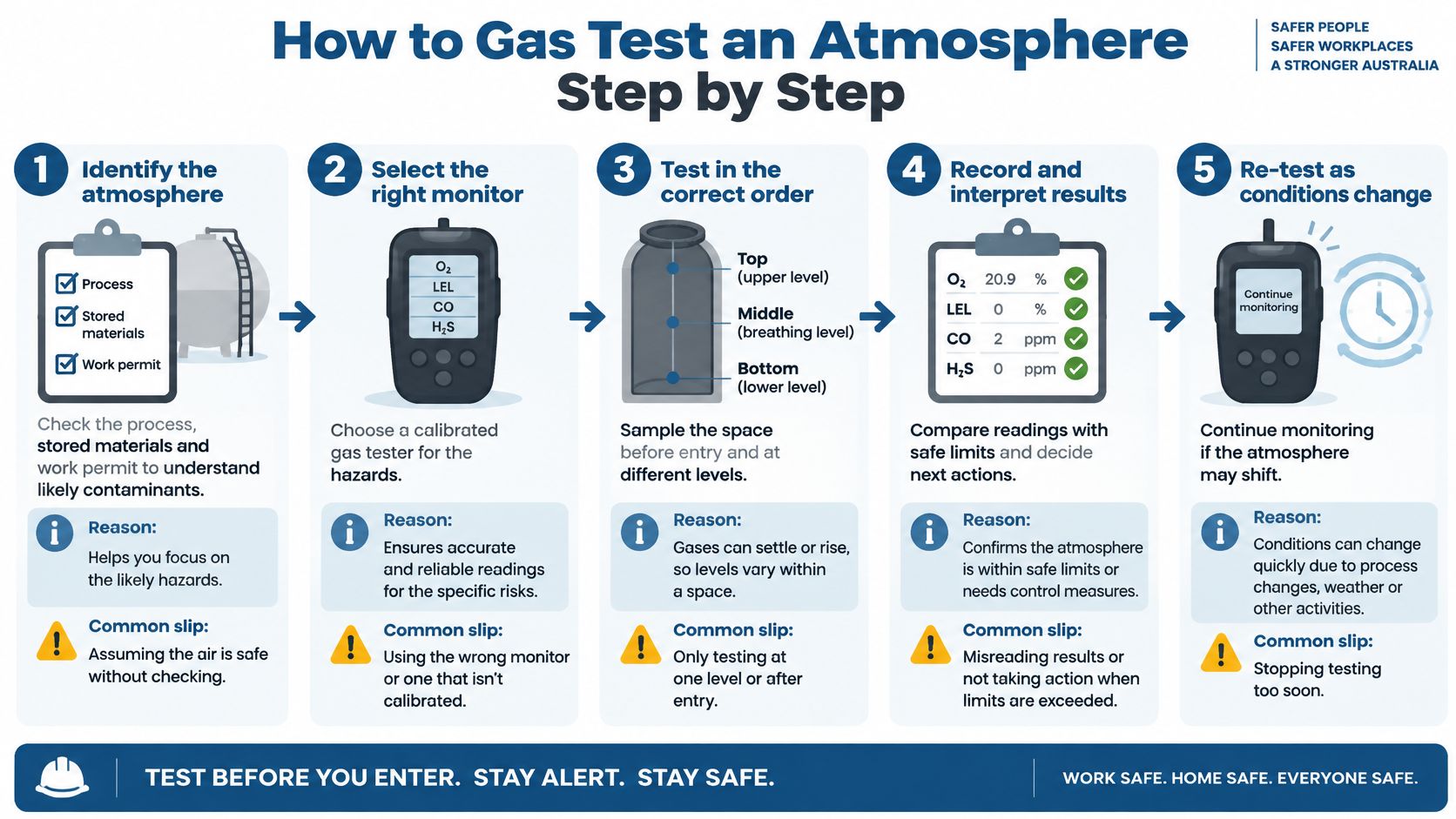
A detector can show a normal reading at the hatch while a pocket deeper inside remains hazardous. The sequence matters because each sample needs to represent the place where work will happen, and each result must lead to a safe work decision.
Identify the atmosphere and likely contaminants. Review the work process, stored materials and permit before choosing an instrument. A sewer pit, welded tank and cargo hold can each present different hazards. A detector only measures the gases its sensors are designed to detect.
Select a detector with sensors suited to those hazards. Choosing the nearest instrument is no substitute for matching the sensors to the potential contaminants.
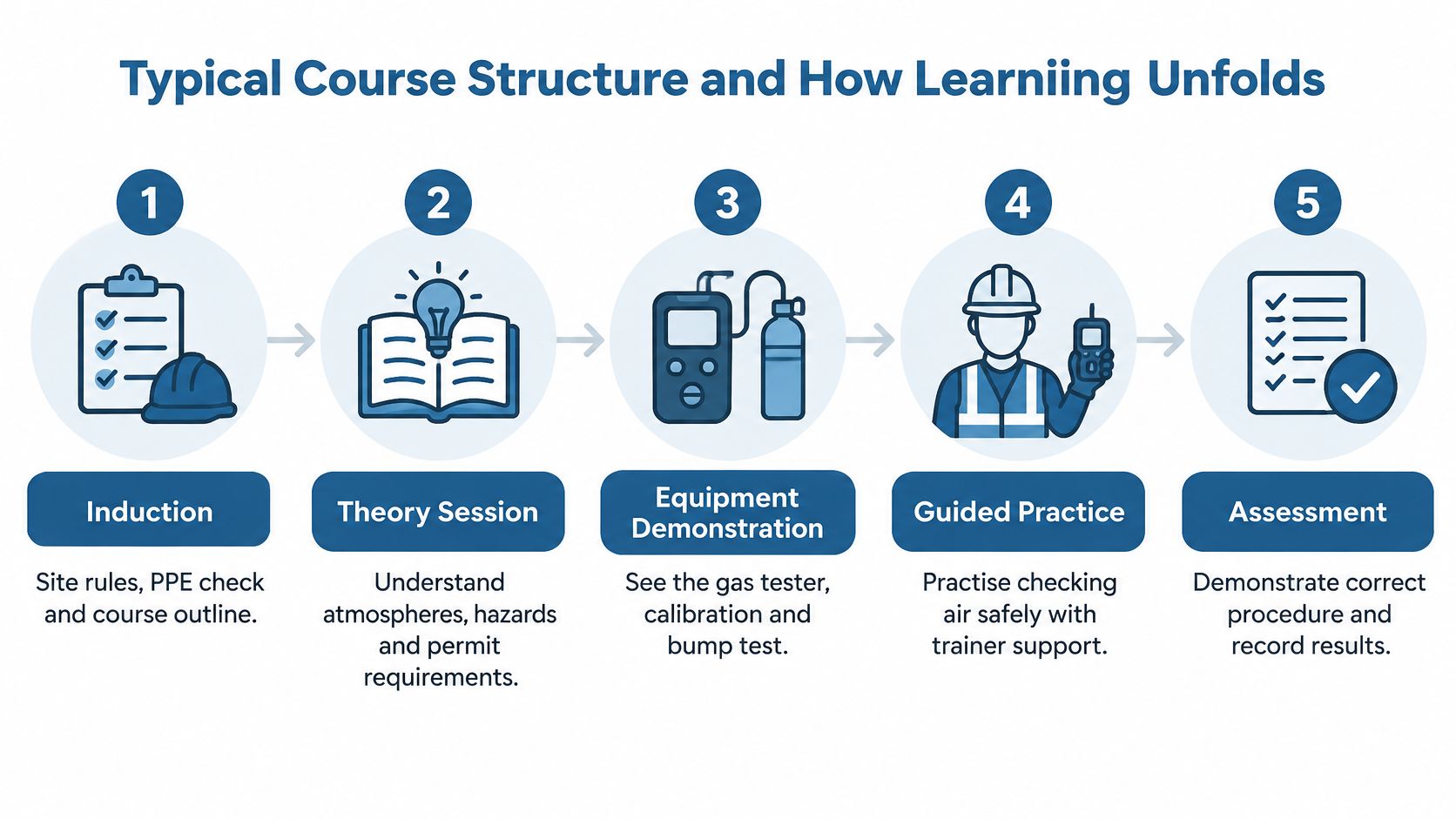
Check the instrument before use. Confirm its identity and sensor list, inspect the hose and filters for damage or blockages, and check calibration status and expiry. A blocked filter can prevent a representative sample from reaching the sensors.
Complete the bump test as instructed by the manufacturer. Apply test gas and check that each channel responds within tolerance. If the instrument fails, quarantine it and use another one. Do not rely on readings from a detector that has failed its bump test.
Sample from outside before entry. Use a probe or portable detector through the access point, then check the top, middle and bottom and sample across the space. Gases can collect in pockets or at different heights. Australian guidance on safe working in confined spaces describes initial testing from outside, followed by sampling at different elevations and across the space.
Test in the correct order. Check oxygen first, then flammable contaminants, then harmful contaminants such as hydrogen sulfide and carbon monoxide. Oxygen must sit within the narrow safe band set by Australian confined-space guidance, close to normal air. Treat a reading outside that band as a stop condition and follow the site procedure.
The order helps separate different hazards. Low oxygen can impair judgement and consciousness, while oxygen enrichment increases fire risk. Flammable vapours can ignite even when oxygen appears normal, and toxic gases can be harmful below explosive levels.
Record the results and the action taken. Note the location, time, instrument identification, calibration status, readings and response. These details let the permit holder and the next tester understand what was measured and where.
Repeat the test when conditions may have changed. Ventilation failure, welding, cleaning chemicals, disturbed product or biological decomposition can alter the atmosphere. For welding work, hot work permit requirements explain how gas testing relates to the permit.
An unexplained, unstable or alarm-level reading stops the sequence. Isolate the area, withdraw and escalate until the cause is understood. Do not average a concerning result or move the probe just to obtain a better-looking number.
Reading Gas Test Results and Choosing the Next Action
A green screen is the most common false comfort in gas testing. It tells you only that the instrument didn't register anything at the levels it was set to detect, at the point the sample entered the hose, at the moment you looked at it.
Australian confined-space guidance treats three categories as essential: oxygen concentration, airborne flammable contaminants, and potentially harmful contaminants such as hydrogen sulfide and carbon monoxide. It also defines a flammable atmosphere as one where flammable gas, vapour or mist is likely to exceed 5% of its lower explosive limit (LEL), a threshold that demands action long before a gas reaches its full explosive range. Flammable liquids stored or used nearby are a common source of that vapour, and the dangerous goods class 3 flammable liquids material explains how those products are classified and handled.
| Reading or condition | What it signals | Required response |
|---|---|---|
| Oxygen below 19.5% | Oxygen deficiency that can impair judgement and consciousness | Do not enter, isolate, reassess ventilation and retest |
| Oxygen between 19.5% and 23.5% | Generally safe range, compared with normal air near 21% | Acceptable for entry only if other controls remain in place |
| Oxygen above 23.5% | Enrichment that increases fire intensity | Stop, control ignition sources and escalate under site procedure |
| Flammable contaminant at or above 5% of LEL | Likely to exceed the model-code threshold and create an ignition risk | Stop hot work, ventilate and reassess before any ignition source |
| Hydrogen sulfide or carbon monoxide detected | Toxic exposure risk that can be dangerous below the explosive range | Withdraw, escalate and retest from outside; compare with the workplace exposure standard |
| Unstable, unexplained or alarm-level reading | Failed entry condition | Isolate the space, withdraw and escalate; never average it away |
Three things regularly produce a pass that means nothing: the wrong sensor configuration, a sample taken from the wrong location, and an alarm threshold set higher or lower than the site's own criteria. Portable testing also covers only the space in front of you. Where a job involves temporary gas supply, cylinders or a reticulated line, gas leak detection for temporary setups belongs in the same control conversation, because a leak at the supply end can change the atmosphere faster than a test cycle.
The last thing to keep straight is who does what. The gas tester takes and reports readings. The standby person stays outside and watches the entrant. The entry supervisor makes the entry decision. The rescue team responds to an emergency. On a small site one person may hold two of those roles, but they don't collapse into each other, and a tester who makes the entry call has taken on someone else's accountability without formally assuming that role.
Where Gas Testing Applies on Australian Worksites
A civil crew is working beside a stormwater pit on a new estate. The pit has been closed for a week, the weather is warm, and the first sample comes from the surface with the probe lowered through the grate.
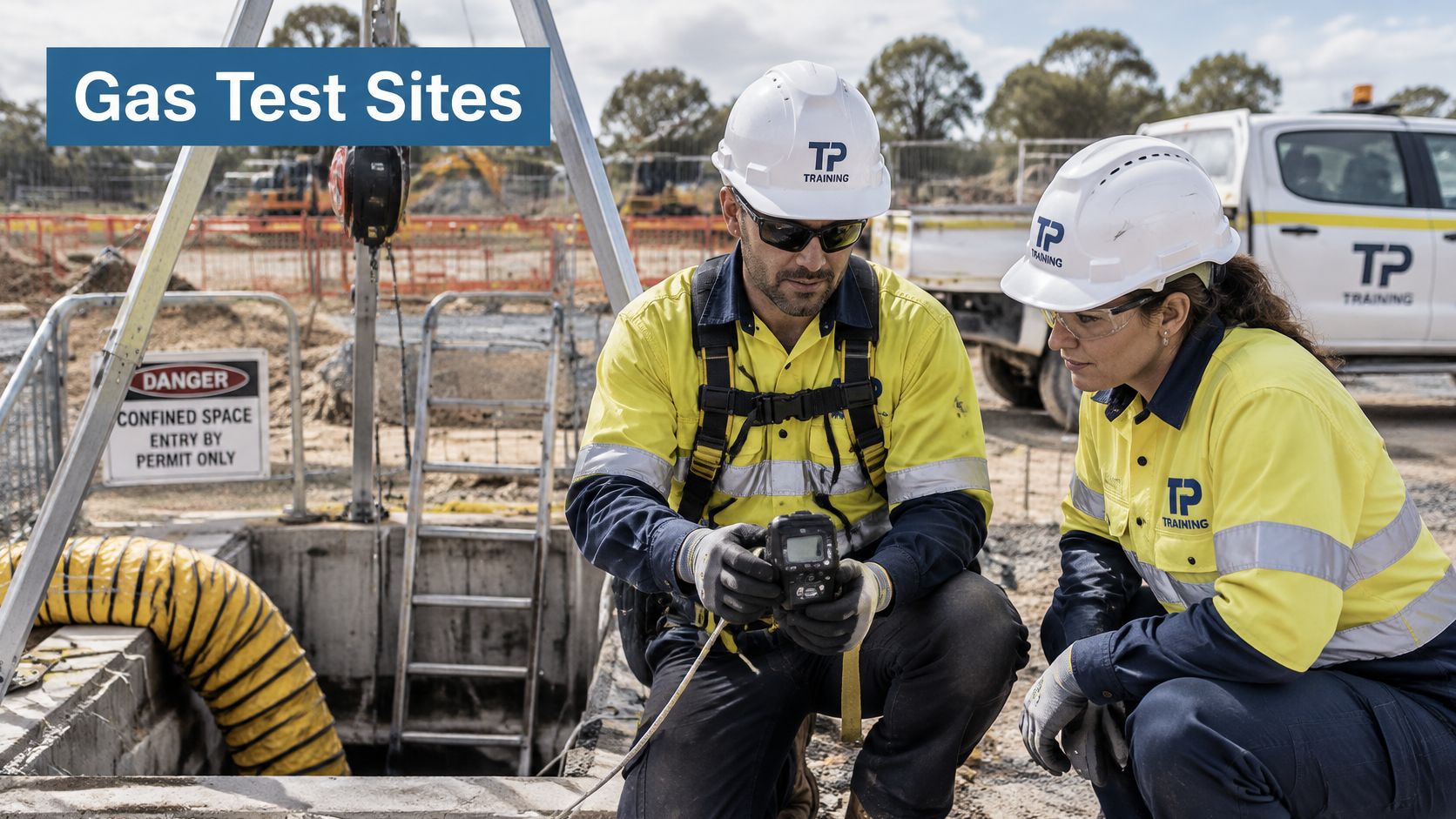
That one scene touches a handful of the settings the unit covers. MSMWHS217 applies across construction, civil construction, industrial plants, utilities and confined-space work, where atmospheres can change quickly and without warning.
The scenarios repeat in familiar shapes. A sewer or stormwater pit where biological decomposition releases hydrogen sulfide. A tank or silo where welding or cleaning shifts oxygen and flammable levels. A transport vehicle or ship hold where stored cargo off-gasses during transit. An open area where the detector is carried by hand or lowered on a line. The unit also covers testing for permit issue and ongoing monitoring while work continues under a permit, which is where a lot of testers first meet it.
The two assumptions that cause trouble: owning a detector counts as atmospheric control, and one reading covers the whole job. Neither holds up on site.
A reading is closer to a weather snapshot than a forecast. A snapshot describes the air at that point and that moment. It says nothing about the pocket behind the baffle, the sediment that gets disturbed when the pump starts, or the vapour that appears when welding begins.
That's why monitoring continues while the work runs, and why the same competency follows workers across industries. The instruments differ, the permits differ, the contaminants differ. The decisions don't. If you're building the entry side of the skill as well, confined space training covers how testing, entry, standby and rescue fit together as one system.
Confirm Your Training Pathway Before You Enrol
Three checks will save you from paying for the wrong course.
Confirm the scope. Look up MSMWHS217 on training.gov.au and ask your employer which unit, or units, the job requires. A general confined-space course may not include gas test atmospheres at all, and a gas testing course may not include entry.
Compare content, not titles. Ask for an outline that shows how much time is dedicated to practical sampling, which detector types are used, whether bump testing and calibration are demonstrated, and whether delivery is face to face, blended, or online. Length varies significantly between providers. Our confined space training ranges from 4-hour refreshers to 2-day sessions, illustrating how differently the same subject can be presented.
Check the assessment. Ask how practical tasks are assessed and how evidence is recorded. Confirm the evidence areas are covered, including the testing regime, PPE, hazard control, equipment care, reporting and communication. Then ask the trainer which pathway fits your role, whether you're a new entrant, due for a refresher, or a supervisor who signs off entries.
One action today: write down the unit your employer requires, check it against the official listing, then request the outline that matches the evidence you'll have to produce. Course titles are marketing. The outline is the course.
TP Training delivers nationally recognised safety and vocational training across NSW, including the atmospheric testing and confined space skills this unit depends on. Our trainers work through the equipment checks, sampling patterns and stop-work decisions on realistic scenarios, so a reading becomes a work decision rather than a green light. Visit TP Training to see upcoming course dates and training locations.

You may also like
CBD First Aid Courses in Sydney: Costs and Booking
What Is Friable Asbestos? Risks, Examples and Rules