
White Card Course Guide: Costs, Locations and Online Options
You're staring at a job start date, the supervisor wants you on site, and someone's just told you that your White Card isn't optional. That's the moment the search begins, and it's also where bad advice starts piling up. The wrong provider, the wrong state rule, or the wrong delivery mode can cost you a day on site, or stop you at the gate.
A white card course is not just another safety class. It's the compliance credential construction employers expect before you step into a live site, and the rules change enough from state to state that generic advice usually misses the details that matter. If you're looking for a straight answer on costs, online options, portability, and booking, read this carefully and book from a provider that understands the rules.
Table of Contents
- Why Every Construction Worker Needs a White Card
- Understanding the CPCCWHS1001 Unit and What It Covers
- White Card Course Costs and What Affects the Price
- Online Versus Face-to-Face Delivery Across Australian States
- Interstate Portability and Validity Rules You Must Know
- Booking Your White Card Course with TP Training
- Key Takeaways and Common Questions Answered
Why Every Construction Worker Needs a White Card
The most common mistake is thinking a white card is only for tradies with years in the industry. It isn't. If you're an employee, contractor, labour-hire worker, or anyone carrying out construction work, you need the card before you start. Safe Work Australia says white cards are recognised Australia-wide, and workers must show them to the PCBU on site and to inspectors on request, which is why site access gets stopped fast when the card isn't there. See the practical explanation in TP Training's white card overview and the national rule on Safe Work Australia's construction site guidance.

A site supervisor doesn't care that you “meant to book it later”. They care that everyone entering the job has completed the mandatory general construction induction training and can prove it on the day. That's the function of the card, it's a legal gate, not a nice-to-have certificate.
Practical rule: if the work involves construction activity, assume the white card is required until the site operator tells you otherwise in writing.
Who gets caught out most
Labour-hire workers get caught because they're moved quickly. Career changers get caught because they assume a past safety ticket still counts. Job seekers get caught because they book the wrong course format for the state they'll work in. If you're unsure, don't guess. Book the right induction first, then keep your paperwork ready for the job start date.
The white card is also why principal contractors ask for proof at the gate. It gives them a standard compliance check across different crews, different subcontractors, and different states. That consistency is the whole point.
Understanding the CPCCWHS1001 Unit and What It Covers
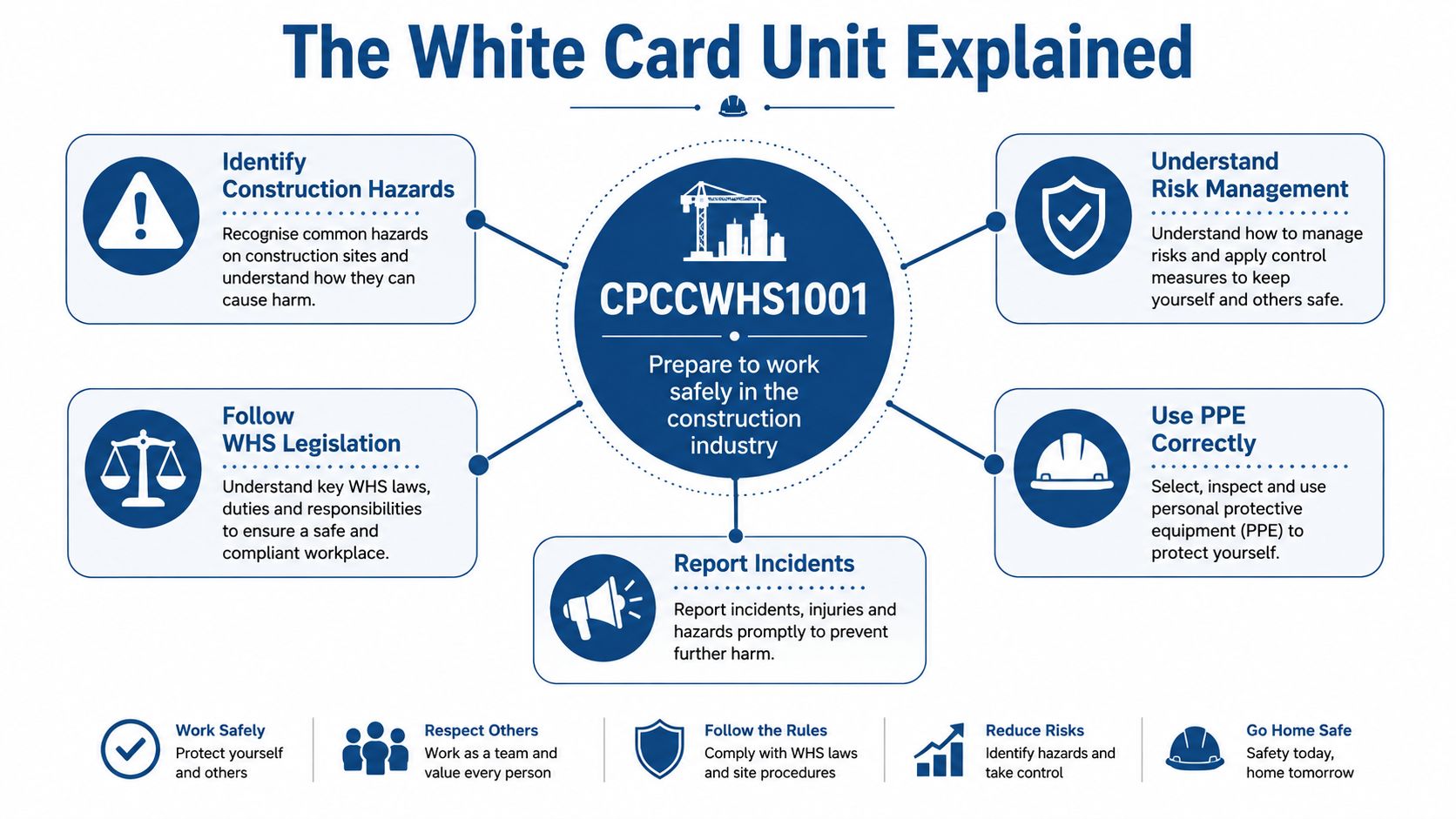
A course advertised as a “white card course” should identify the nationally accredited unit CPCCWHS1001 Prepare to work safely in the construction industry. Check that unit code before booking. In NSW, the training must be delivered through a Registered Training Organisation, so an online advertisement alone does not prove compliance. Confirm the requirements through SafeWork NSW's white card guidance, then compare the enrolment process with TP Training's how-to-get-a-white-card guide.
The training benchmark is six hours. It covers workplace health and safety law, common construction hazards, and risk controls. Those topics prepare a new worker to recognise dangers such as moving plant, uneven ground, exposed edges, and weak site controls before starting work.
The unit is not just a short quiz.
What the training usually tests
Expect knowledge questions about safety duties, hazards, and control measures, along with a practical demonstration. You need to show that you can apply basic controls, not just repeat definitions. If you cannot identify a risk or use the required control correctly, you are not ready to enter a construction site.
A Statement of Attainment confirms completion of the unit. It is separate from the physical white card, which serves as the site credential. NSW may also issue a statement of training while the card is being processed. That interim document is valid for 60 days, so check its issue date and ask the employer whether it will accept it before your first shift.
State rules can change the practical value of your paperwork. An interim statement accepted in NSW may not provide the same access in another state, and online delivery is not accepted everywhere. Confirm the destination state's requirements before paying, especially if you are travelling for work or taking a short-term labour-hire role.
Finish the course before your first shift. Do not rely on an unconfirmed interim document at the gate.
For a provider comparison, the White Card Training Course lists practical, nationally recognised training with experienced trainers and hands-on learning across NSW. Check the delivery method, assessment process, and documents issued before booking. Those details determine whether the course leaves you ready to work, rather than just holding an online completion record.
White Card Course Costs and What Affects the Price
The lowest advertised fee can create the highest delay. Before booking, check exactly what the price covers, when you receive proof of completion, and whether the document will be accepted where you are starting work. Course costs change with delivery mode, location, class size, PPE inclusion, processing speed, and whether you are completing the unit for the first time or paying for replacement administration.
The ACT provides a useful public benchmark. For the 1 July 2025 to 30 June 2026 period, its application fee is $46.00 and its replacement card fee is $43.00. The ACT also states that its card does not expire unless cancelled and remains valid indefinitely. Training must still be completed through a registered training organisation. Use the ACT white card guidance from ASQA to separate government charges from the provider's course fee.
What usually moves the price
City and regional courses can have different prices because venues, timetables, trainer travel, and parking costs vary. Face-to-face sessions may include more practical support and equipment setup. Online or blended delivery may cost less or suit shift workers, but only where the state permits that format and the provider follows the approved RTO pathway.
| Cost Factor | Impact on Price | What to Check |
|---|---|---|
| Delivery mode | Face-to-face, blended, and online formats may be priced differently | Whether the state accepts the format and the provider is approved |
| Location | City and regional prices can vary | Venue access, travel time, and parking |
| PPE provided | Supplied PPE may increase the fee | Whether hard hats, vests, and other items are included |
| Certificate timing | Faster processing may affect the total cost | When you need acceptable proof for site entry |
| Course type | A new enrolment differs from replacement administration | Whether you need the full unit or only replacement paperwork |
Ask for the full cost before paying. Confirm card charges, replacement fees, materials, assessment arrangements, and the document issued while any card is processed. State rules can make an apparently cheaper option unusable for a short-term job, particularly where an interim statement or online record is not accepted.
Free and low-cost pathways may be available through government-funded programs, employer sponsorship, or referrals. Check eligibility before assuming the advertised fee is your final cost.
For workers arranging several safety tickets, TP Training's CPR and first aid guidance offers a practical reference for grouping compliance training around work schedules.
Online Versus Face-to-Face Delivery Across Australian States
A worker can complete a course online, receive paperwork, and still be refused at the gate. “Can I do a white card course online?” has no Australia-wide answer. Victoria and the Northern Territory reject online-only or non-approved delivery, while Tasmania requires the course to be completed in Tasmania. Each state depends on approved RTO delivery, even though the nationally accredited unit is CPCCWHS1001. Check the jurisdiction where you will work, not just the course description. WorkSafe Victoria's white card page sets out Victoria's position.
Face-to-face training is my recommendation for first-timers. A trainer can check PPE, explain site hazards in plain language, and correct mistakes before assessment. Online or blended delivery can suit experienced workers managing shifts, but flexibility is useful only when the state accepts the format and the provider is approved. For workers comparing digital training formats, TP Training's guide to working-at-heights training online provides useful context on approved delivery modes.
The decision that actually matters
For NSW, QLD, or WA, check two things before booking: whether the delivery mode complies with that state's rules and whether the RTO is recognised there. Do not choose an internet listing because its price or booking process looks simple. An unsuitable card may fail at site entry, leaving you to repeat the training and absorb another fee.
Best practice: choose the course for the state where you will work, not the state featured most prominently on the provider's website.
Workers who cross state lines need recognition that will hold up in practice. Ask the provider what document is issued after assessment, whether an interim statement is accepted, and how the record is verified while a card is processed. Confirm those details before paying. State requirements can make a seemingly cheap online option unusable for a short-term job, so check first, then book the delivery format that the relevant jurisdiction accepts.
Interstate Portability and Validity Rules You Must Know
A white card may be recognised Australia-wide, but that does not make every state rule interchangeable. People get caught out by the details. WorkSafe WA says a white card becomes invalid if the holder leaves construction for two consecutive years or longer, and ACT guidance says workers who completed training more than 2 years ago must have worked in construction in the preceding 2 years. NSW also has its own recognition rule, it accepts WA-issued cards only if they're dated after 1 July 2009. The WA database guidance is in WorkSafe WA's induction card page, and the ACT student support details are in ASQA's white card page.
Why this matters in real life
Seasonal workers and labour-hire staff move in and out of construction more often than office-based workers. FIFO workers also cross state lines regularly, especially between QLD, WA, and NSW. If they leave construction for too long, or rely on old paperwork without checking the current rule, site access can be stopped even when they held a white card before.
The practical answer is straightforward. Keep your record current, keep your contact details updated, and do not assume an old card still works after a long break. If you are returning to construction after time away, check the state rule before you accept the job start.
Replacement cards create another trap. WA tracks construction induction cards in an online licence search database, which helps employers verify details quickly. That check matters because site managers want a clean, current record at the gate.
If you have been out of construction for years, do not rely on memory. Verify the rule before you start packing for site.
The biggest mistake is treating the white card as a lifetime free pass without conditions. It is portable, yes, but the rules around industry continuity and interstate recognition still matter. Miss that, and you can lose a shift before you have even put your boots on.
Booking Your White Card Course with TP Training
Book in the state where the job starts. For Sydney and nearby projects, TP Training offers white card training at Penrith, Burwood, Auburn, Parramatta, and Sydney CBD. The Sydney CBD white card course details explain the central-city option, which can save unnecessary travel and make attendance easier around work commitments. Use the online booking system to secure a seat before your start date is fixed.
TP Training provides practical, nationally recognised training through experienced trainers across NSW. It also assists students seeking online options connected with QLD, WA, and NSW, including low-cost and free course availability through eligible programs. Delivery rules differ by state, so confirm the current location, format, dates, and eligibility before paying. An online option that suits one state may not satisfy the requirements of another.
How to book without wasting time
- Choose the correct location: Select the nearest NSW centre if your job is in Sydney or the surrounding areas.
- Match training to the job state: For QLD or WA work, confirm that the delivery pathway and resulting documentation will be accepted there.
- Prepare your ID: Bring valid identification and any documents listed in your booking confirmation.
- Check the course instructions: Confirm PPE requirements, arrival time, assessment arrangements, and how completion documents are issued.
- Keep every record: Store your statement of attainment and any interim document until your card is available and its details are verified.
A course booking is only part of compliance. Check whether you will receive an interim statement, how long it can support site access, and whether the state recognises training completed elsewhere. These details can affect your first shift, particularly if you are travelling between states or moving from online study to a site-based role.
TP Training has operated since 2011 and provides NSW training with support in English, Mandarin, Korean, and Vietnamese. Clear instructions matter during assessment, especially when you need to understand identification, participation, and site-safety requirements without guesswork. Book before the roster creates pressure, verify the state rule, and arrive ready for training.
Key Takeaways and Common Questions Answered
A white card course is mandatory for construction work, and the wrong provider or wrong state format can leave you stranded at the gate. Bring your ID, arrive ready to learn, and keep your paperwork. If you fail the assessment, you'll need to complete the requirements again through the provider's process. If you're waiting on the physical card, NSW uses a 60-day statement of training as the interim document, and employers may accept it when it's current. Keep your statement of attainment too, because Queensland says it may be needed to replace the card later.
What should you bring? Follow the provider's instructions, but expect to need ID and be ready for practical assessment. You don't book a white card course to admire the paperwork, you book it to get cleared for site. If you're moving between states or returning after time away, check the validity and recognition rule before you assume your old card still works.
Book the course that matches the state you'll work in, not the one with the flashiest ad. That's how you avoid delays, extra costs, and site-day surprises.
TP Training gives you a practical path into construction induction training, with NSW locations, booking support, and course options that suit workers chasing site-ready compliance. If you need a white card course that lines up with real state rules, visit TP Training and book the option that fits where you'll be working.

You may also like

Asthma and Anaphylaxis Training in NSW
First Aid Training for Construction Workers NSW