

How to Get a White Card in NSW (2026 Guide)
White Card training in NSW is a one-day course, usually about 6 to 8 hours, and it's built around the construction induction unit CPCCWHS1001. You complete it with a registered RTO, then the RTO lodges your completion with SafeWork NSW and your card is processed after that.
A lot of people only realise they need it when a supervisor asks for it before they can step on site. By Friday afternoon, they're scrambling for ID, a USI, and a booking, because Monday morning labour hire starts don't wait for paperwork. That's exactly why the fastest path isn't just finding any course, it's understanding the bits that delay real people in NSW.
Table of Contents
- Why the White Card Matters Before You Step on Site
- Eligibility, USI, and the ID Checklist You Need Before Enrolling
- Face-to-Face vs Online White Card Training in NSW
- From Enrolment to Card in Hand Step by Step
- White Card Course Costs and What Affects the Price
- Portability, Replacement Cards, and Crossing State Borders
- Common Pitfalls and Quick Answers for NSW Learners
Why the White Card Matters Before You Step on Site
By the time a new labourer gets the Monday call-up, the White Card is usually the one thing standing between them and site entry. Site supervisors don't ask for it because they enjoy paperwork, they ask because construction induction is part of how workers are cleared to start safely on NSW worksites, and the White Card sits behind that requirement as the recognised proof of training. The practical reality is simple, no card means no access, even if the person is keen, reliable, and already has steel caps on.

The White Card is based on the nationally recognised construction induction unit CPCWHS1001, Prepare to work safely in the construction industry, completed through a registered training organisation, or RTO, as SafeWork NSW explains in its White Card guidance. That matters because the qualification is the same recognised foundation, even though the card-issuing process can vary by state and territory.
A good supervisor sees the card as more than admin. It tells them the worker has been through the basic safety language of the industry, including how to recognise site hazards, follow instructions, and avoid showing up unprepared on day one. For a first-day labourer, that often means the difference between being handed a broom and being sent home.
If you're also organising your kit for long shifts, browse construction worker insoles can be useful alongside the White Card because comfort matters once the paperwork is done and the work starts.
Practical rule: if the White Card isn't already sorted, the rest of the onboarding conversation is mostly wasted time.
Eligibility, USI, and the ID Checklist You Need Before Enrolling
The first mistake people make is thinking they can book, turn up, and sort everything out on the day. In practice, the biggest delay is usually admin, not the training itself, because NSW providers commonly check identity carefully before enrolment and often apply a 100-point identity check with a valid photo ID that shows your date of birth. That means a learner who is otherwise ready can still get knocked back or delayed if the name, date of birth, or document set doesn't line up.
A Unique Student Identifier, or USI, also needs to be in order before you enrol with an RTO. If you've changed your name, moved from overseas, or your documents don't match the details already attached to your records, fix that before class day. The smoothest enrolments I've seen are the ones where the learner brings exactly what the provider asked for, no guesswork and no “I'll email it later”.
| Document | Purpose | Notes |
|---|---|---|
| Valid photo ID | Confirms identity | Needs date of birth, and NSW providers commonly check it before enrolment |
| USI | Links your training record | Create or confirm it before booking |
| Name change evidence | Matches your current records | Useful if your ID and student records differ |
| Extra supporting ID | Helps meet provider checks | Often used where a 100-point check applies |
If you want a clean process, keep your USI work done first. The practical guide to that is creating and managing your USI, because the enrolment form is where a lot of delays start, not finish.
Bring the documents the provider actually asked for, not the ones you hope will be enough. That's the difference between a quick booking and an enrolment that stalls.
Face-to-Face vs Online White Card Training in NSW
The delivery mode matters more than most marketing pages admit. In NSW, the safest choice is the format your regulator and site gatekeeper will accept without drama, because a cheap online course that isn't compliant can leave you with a certificate that looks useful but doesn't get you onto a real job. That's the trap, people buy speed, but they need validity.
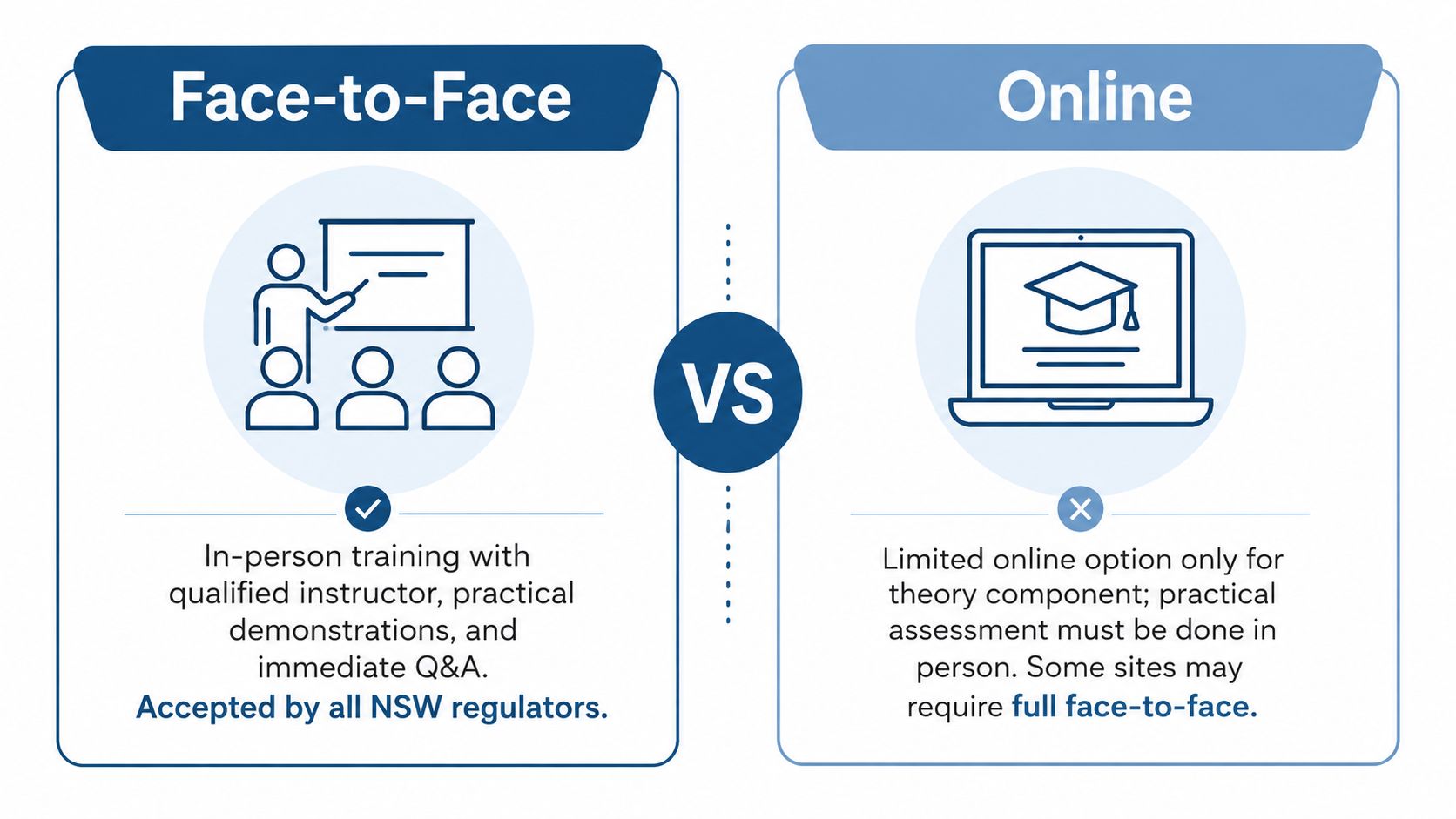
Face-to-face training is still the clearest option for most learners because it combines the class, practical demonstrations, and immediate correction if you miss a point. That matters when the session includes knowledge checks and the trainer needs to see that you can apply the safety rules, not just click through slides. Many NSW learners prefer it because it removes uncertainty about whether the delivery mode will be accepted.
Online training is where confusion creeps in. Some providers still describe online or blended options, but the current rule environment is state-specific and compliance-sensitive, so you need to check whether the provider is allowed to issue a valid White Card for NSW. The core question isn't whether a laptop session is convenient, it's whether the final outcome will be recognised on a NSW site tomorrow.
TP Training's White Card Training Course is presented as practical, nationally recognised training with experienced trainers and hands-on learning across NSW, which is the sort of delivery model that makes sense when the goal is site acceptance rather than box ticking. For a Sydney-based learner comparing options, the course note on White Card course delivery in Sydney CBD is useful because location and format often decide whether someone books or postpones.
From Enrolment to Card in Hand Step by Step
The process usually starts with a booking, but the day that matters most is the training day itself. Once you've enrolled with an RTO approved for your state, you turn up with your ID, your USI, and the details the provider asked for. From there, the course is usually a one-day program of roughly 4 to 8 hours, with a NSW guide commonly placing it around 6 to 8 hours, and the content is built around safety induction rather than long-form theory.
During the class, learners generally go through the practical safety material, then complete assessment tasks that check understanding and basic application. The format is not glamorous, but it is direct. If someone can't follow the trainer's instructions, struggle with the language of the class, or arrive without the right ID, that's where the day gets messy.
Once you've passed, the RTO sends the completion through to SafeWork NSW, and a statement of training is issued while the card is processed. In NSW, that statement is valid for 60 days, which is the main working window if you need to show an employer you've completed the training before the physical card arrives. The bottleneck is usually the handoff and paperwork accuracy, not the course itself.
If you need a practical entry point, TP Training runs White Card classes at Penrith, Burwood, Auburn, Parramatta, and Sydney CBD, which helps when you're trying to line up a class close to where you live or where the job is. For learners who need help in more than one language, the note on multilingual support for White Card training is worth checking before enrolment if English isn't your first language.
The shortest route is usually the cleanest one, book early, bring the right documents, pass the class, then let the RTO handle the regulator handoff.
White Card Course Costs and What Affects the Price
White Card pricing isn't set by a single government fee, because the RTO sets its own training fee. That's why one quote can look cheaper at first glance and still end up more expensive once you add re-issue charges, extra ID checks, or a second trip because the provider's process wasn't clear. The comparison is what's included, how far you have to travel, and how fast the provider can process your completion.
Most learners should check whether the quote covers the training session, assessment, statement of training, and card lodgement, rather than focusing only on the headline number. If the provider is vague about identity requirements, delivery mode, or whether they handle the regulator submission for you, that usually means extra friction later. Cheap can be fine, but only when it's compliant and complete.
A practical way to compare quotes is to ask three questions. Is the training accepted in NSW? Is the enrolment process clear on ID and USI? And how much hassle will I face if my details don't match? Those are the details that decide whether the booking runs smoothly or becomes a back-and-forth email thread.
TP Training's NSW White Card offering is positioned as a practical course with hands-on learning, so it fits the kind of comparison many need, which is not “what's the lowest number” but “which provider will get me through without unnecessary delays”. That's the lens I'd use every time.
Portability, Replacement Cards, and Crossing State Borders
A lot of learners assume the White Card works exactly the same way everywhere once they've got it. The card is nationally recognised, but the administration around it isn't identical in every jurisdiction, and that's where people get caught when they move for work. NSW, ACT, NT, and SA all keep the same basic idea, complete the nationally recognised induction unit through an RTO, then apply through the relevant regulator or government service, but the handoff and paperwork can differ.
The practical issue is not the qualification itself, it's the admin around it. If you already have a White Card and you move interstate, your existing card is generally recognised, but you may still need to follow the new jurisdiction's rules for records, replacement, or notification. If your name changes, your employer still needs your details to match what's on your training and card records, otherwise site admin can turn into a delay.
For business owners comparing site administration and staff onboarding, choose your business structure Australia is a useful reminder that paperwork consistency matters across the whole operation, not just the training side. The same applies to workers who shift between Sydney and Canberra, because portability is useful only when the details are current.
For a quick reference on what to do if you've lost the number or need to verify it, the guide on finding your White Card number is worth keeping handy. It's the kind of thing that sounds minor until a supervisor asks for it at induction.
Common Pitfalls and Quick Answers for NSW Learners
The questions that keep coming up are usually the ones people ask after they've already booked. The White Card itself doesn't behave like a short-lived ticket you keep renewing every season, but you still need to keep your records straight, because if the details don't match your USI or identity documents, the site admin problem lands on you, not the trainer.
One common worry is whether the statement of training means you can start work straight away. In NSW, that document matters because it shows you've completed the training while the card is being processed, but employers still expect the paperwork to be correct and current. Another is whether the card transfers interstate, and the practical answer is that recognition is national, but the administration can still change when you cross a border.
If you're also dealing with other site training, the guide on asbestos awareness training is a good reminder that construction onboarding often involves more than one safety credential. That's normal on real sites, and it's why getting the White Card right early saves time later.
The safest habit is simple, keep your ID aligned, keep your USI active, and keep a copy of your completion details somewhere you can find them fast. That's what stops a first day from turning into a rescheduling conversation.
If you're ready to get your White Card sorted, book with TP Training and choose a NSW location that suits your commute. Their White Card classes are built for practical enrolment, clear ID checks, and straightforward processing, which is exactly what you want when you need to be on site without delay.

You may also like

Barista Course NSW: A Practical Guide to Getting Started