
Blue Card Training in NSW: How to Get Yours in 2026
Say you arrive at a road-widening site ready for your first traffic-control shift. At the gate, the supervisor checks your paperwork and turns you away: you've brought a course attendance certificate, but you can't show the authorisation needed for the job.
That's the distinction to understand before booking blue card training. Getting through a course, being assessed as competent, holding the right card class and being ready for deployment aren't interchangeable.
Table of Contents
- Blue Card Requirements at a Glance
- How to Get Your Blue Card Step by Step
- What the Assessment Covers and the Application Deadline
- What a Blue Card Does and Does Not Authorise
- Keeping Your Blue Card Current with Refresher Training
- Book Your Blue Card Course at a TP Training Centre
Blue Card Requirements at a Glance
In NSW, the blue card commonly means the SafeWork NSW Traffic Control Work Training (TCWT) card for the Traffic Controller (TCR) class. It's a work authorisation, not merely evidence that you attended a safety course.
The Service NSW traffic-control card guide states that applicants must be at least 17 years old, complete approved training and assessment before applying, and hold the relevant card for traffic-control work on or adjacent to a public road, including stop/slow bat and boom-gate duties.
Blue card eligibility requirements in NSW
| Requirement | Standard | Evidence to keep |
|---|---|---|
| Minimum age | At least 17 years old | Proof of age |
| Training | Approved course from a SafeWork NSW-approved RTO | Statement of completion or certificate |
| Assessment | Knowledge and practical assessment, both mandatory | Competent result from the provider |
| Card class | TCR (Traffic Controller) for the blue card | Class printed on the card |
| Application | Apply after a competent result, within 60 days | Training certificate date |
| Medical fitness | Confirm applicable requirements with SafeWork NSW before enrolling | Confirm with SafeWork NSW |
| Photo ID | Confirm applicable requirements with SafeWork NSW before enrolling | Confirm with SafeWork NSW |
Keep the documents separately identified. An attendance record, a Statement of Completion, a competency result and a card serve different purposes. Don't assume a site supervisor will accept whichever document happens to be saved on your phone.
Medical fitness and photo identification requirements need confirmation with SafeWork NSW before enrolment. Also ask what identification the training provider needs for its enrolment and assessment processes.
Check eligibility before comparing fees
Run a quick self-check:
- Age: Have you reached the minimum application age?
- Work location: Will you work on or next to a public road?
- Actual duty: Will you direct road users rather than perform unrelated labouring work?
- Provider approval: Does the RTO hold SafeWork NSW approval for this training?
Then compare the traffic controller course price against what the booking includes. A cheaper classroom booking isn't better value if you haven't allowed for the assessment arrangements or application process.
How to Get Your Blue Card Step by Step
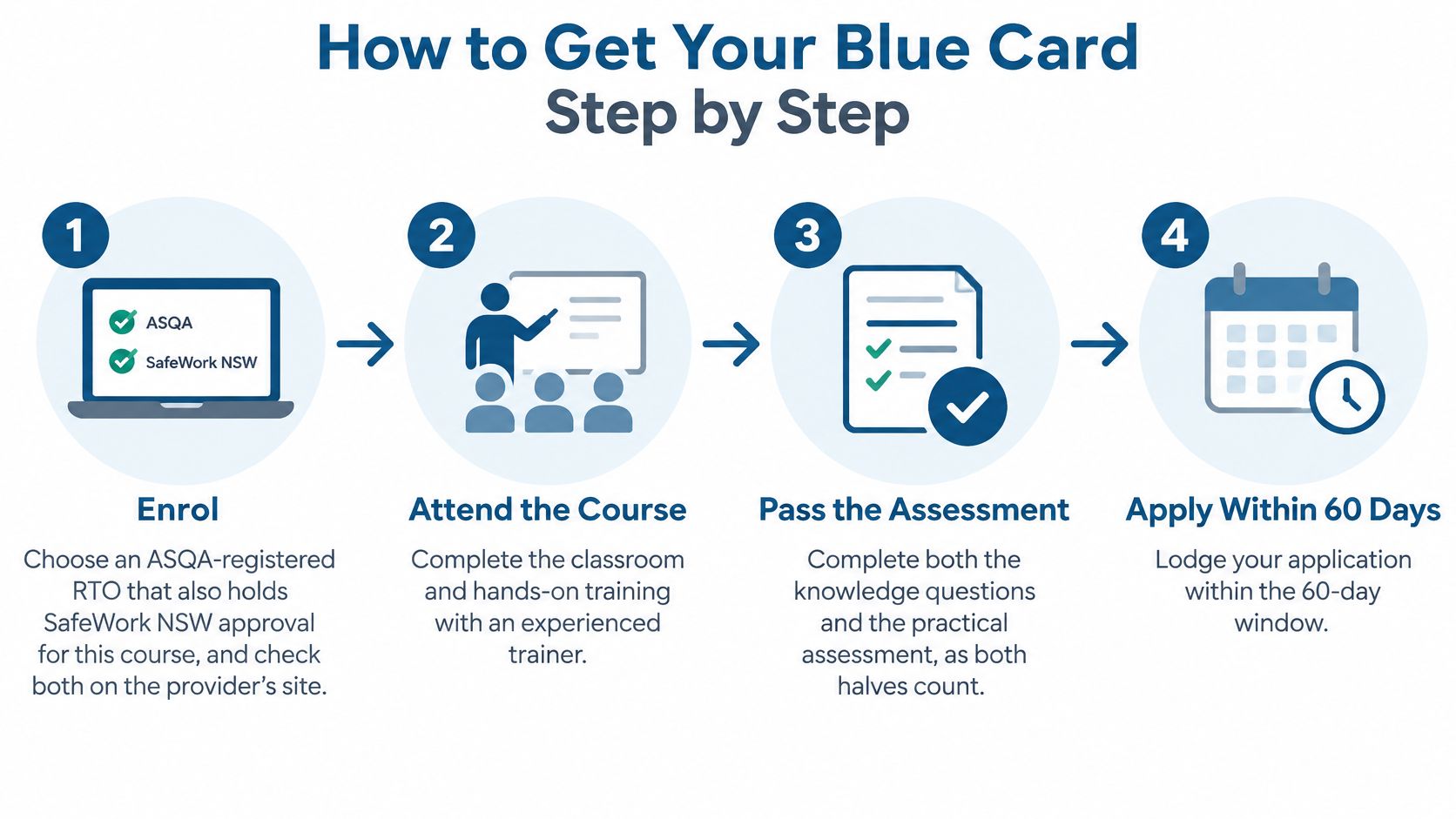
A sound training pathway connects enrolment, learning, assessment and the card application. The SafeWork NSW TCWT card guidance describes the relevant training and assessment pathway, including RIIWHS201E, RIICOM201E, RIIWHS205E and RIIWHS206.
Choose the right enrolment
Enrol with an appropriately approved RTO.
Check that the organisation is ASQA-registered and also holds SafeWork NSW approval for the course. Registration as an RTO alone doesn't establish approval to deliver this particular regulated training.Check both before paying, not after receiving the booking confirmation. TP Training is accredited by SafeWork NSW.
Complete the classroom and hands-on learning.
The training covers safe work and WHS procedures, workplace communication, stop/slow bat operation, and portable traffic-control devices and temporary signs. Treat those subjects as connected skills rather than separate boxes to tick.For example, knowing the correct bat signal isn't enough if you can't communicate clearly with the controller at the other end of the work zone. Equally, recognising a sign doesn't give you permission to implement an entire traffic-control layout.
Complete the assessment and application
Demonstrate knowledge and practical performance.
Expect to explain your decisions and show that you can carry out the work in simulated or workplace-style scenarios. Practise clear signals, deliberate movements and concise radio communication rather than memorising answers without understanding them.The sticking point is often preparation for the practical component. Ask about assessment arrangements when enrolling, including what happens if you need further practice or another assessment opportunity. Recognition of prior learning can address training components, but it doesn't remove the full assessment.
Apply after successful assessment.
Keep your result and application documents together, check that your personal details agree across them, and lodge within the applicable application window. Don't book training and then leave the remaining arrangements unresolved around an unpredictable work roster.
Booking check: Ask when each assessment component happens and what document you receive at each stage.
If you're changing careers, the practical guide to becoming a traffic controller can help you organise the broader employment steps alongside training.
The course must match the work you'll really perform. For the blue-card pathway, that means preparing to direct traffic under an approved work-zone traffic-management plan, not qualifying for every task a traffic-management crew undertakes.
What the Assessment Covers and the Application Deadline
Finishing the course day gives you an attendance record. The card depends on what you can demonstrate under assessment, because a blue card authorises one defined task: directing traffic under an approved work-zone traffic-management plan. The assessor's job is to confirm you can carry out that task safely, inside its limits.
A trainer needs evidence that you understand the instructions and can act on them safely. Confident delivery of memorised answers won't compensate for unclear signals or unsafe positioning during the practical component.
What you need to demonstrate
| Assessment component | What it checks | Useful preparation |
|---|---|---|
| Knowledge questions | Safe work, WHS procedures, communication and understanding instructions | Explain why a control is needed, and where the blue-card task's authority ends |
| Practical stop/slow bat work | Positioning, visible signals and controlled movement of vehicles and pedestrians | Treat the scenario as work under a plan: state which plan covers you and stay within it |
| Communication tasks | Clear messages, acknowledgement and coordination | Confirm each instruction back to the site coordinator before acting on it |
| Changed-site scenarios | Recognition of conditions that no longer match the planned arrangements | Name the mismatch and explain how you would escalate it, since redesigning the layout sits outside the blue-card task |
For example, a delivery vehicle might obstruct your view of approaching traffic. The competent response is to recognise that you can no longer perform the task safely from the assigned position and follow the site's escalation procedure. Improvising a new layout without telling anyone isn't a substitute.
The knowledge and practical components both count. Neither is an administrative formality.
Protect the application window
SafeWork NSW's training and assessment guidance states that an application must generally be made within 60 days of completing training, or within 60 days of the relevant training certificate's issue when that certificate is used for the application.
That window shapes how you book. Leave enough lead time to finish the assessment, resolve paperwork problems and still lodge. An assessment booking does not pause or extend the deadline.
Employers have a stake in this too. A worker holding a certificate that has passed its application window cannot be deployed on a stop/slow task, because the card is the authorisation a site checks at the gate.
- Keep one document folder: Save the certificate, assessment result and application records together.
- Check the relevant date: Confirm which document, and which date, your application runs from.
- Act on delays early: Contact the provider and SafeWork NSW promptly if assessment or paperwork stalls.
A calendar reminder helps, but complete paperwork is what counts. Check names, dates and supporting documents before lodging rather than rushing an incomplete application in at the deadline.
What a Blue Card Does and Does Not Authorise
A blue card authorises one function: controlling traffic under an approved work-zone plan. Treating it as approval for every traffic task on a roster is where deployments go wrong.
NSW treats the blue card as a task-bound safety authorisation. Transport for NSW's traffic-control training guidance distinguishes Traffic Controller (TCR), Implement Traffic Control Plans (IMP) and Prepare Work Zone Traffic Management Plans (PWZ), each with a separate scope.
Traffic control classes and their authority
| Class | Authorises | Does not cover |
|---|---|---|
| Blue card (TCR) | Directing traffic with a stop/slow bat under an approved plan | Setting up devices, implementing or designing plans |
| Yellow card (IMP) | Implementing traffic control plans | Designing or inspecting plans |
| Red card (PWZ) | Preparing and inspecting work zone traffic management plans | Separate TCR or IMP duties without that training |
The TCR function involves directing road users with a prescribed traffic-control device, usually a stop/slow bat, in accordance with an approved work-zone traffic-management plan. That is a defined responsibility with boundaries.
The colours are separate classes, each tied to its own training and scope. Check the actual classes and training held by the worker.
Match the instruction to the authority
A blue-card holder can follow the approved arrangements for directing traffic. Establishing the layout, implementing someone else's plan, or designing and inspecting a plan sit outside that authority.
If your intended job includes installing traffic-control devices, check the yellow card requirements before accepting those duties. The employer's job title might say traffic controller while the daily task list includes implementation work.
If the task involves writing, changing or formally checking the plan, keep it off the blue-card task list.
A controller can report a hazard. Identifying a blocked sightline and notifying the supervisor sits within the role. Independently redesigning the arrangement does not.
Before rostering or accepting a shift, compare the card class with the task list and confirm the separate two-year currency requirement is met. Checking after the crew reaches site creates an avoidable choice between delaying work and assigning someone duties they aren't authorised to perform.
Keeping Your Blue Card Current with Refresher Training
Possessing a card doesn't prove permanent competence. A worker who hasn't performed traffic control for a long period needs more than a familiar-looking card in their wallet.
The Transport for NSW currency guidance requires relevant SafeWork NSW training within the preceding two years, or performance of that type of traffic-control work within the preceding two years. That makes recent training or relevant practice a separate deployment check.
Blue card currency and what to do
| Situation | Currency status | What to do |
|---|---|---|
| Trained within the last two years, still doing traffic control | Current | Keep the training record and run a pre-shift check |
| Trained over two years ago, worked traffic control within two years | Current through recent practice | Keep a log of work dates as evidence |
| No training and no traffic control work for two years | May not meet the currency condition | Retrain through a provider before directing traffic |
| Student with a statement of completion, final assessment not yet passed | Supervised work only under transitional conditions | Finish the final assessment before working unsupervised |
Recent practice needs to match the type of work. General construction labouring doesn't establish that someone has recently performed the Traffic Controller function.
A Statement of Completion also needs careful handling. It isn't permission to place an unassessed student on an unsupervised traffic-control position; any supervised work must comply with the applicable transitional conditions.
Build a usable currency record
Keep a simple record that a supervisor can check without chasing messages across different phones:
- Authority: Record the card class and retain accessible card evidence.
- Recency: Record relevant training or work dates with supporting documents.
- Reverification: Record the card's expiry or reverification date and confirm the exact validity period with SafeWork NSW.
- Pre-shift check: Confirm that the assigned task matches the worker's authority and that accepted evidence is available.
Deployment test: Check both what the worker is authorised to do and whether they can demonstrate current competence.
Initial training suits someone entering without the relevant card. A returning card holder should ask about the traffic control refresher course pathway rather than automatically repeating an initial booking.
Refresher content and length differ between providers, so request the outline before committing. Contractors and PCBUs must verify class and recency before deployment; neither a roster entry nor a worker's verbal assurance replaces that check.
Book Your Blue Card Course at a TP Training Centre
You're ready to book when you know the job requires the TCR function and you've checked which training pathway fits your circumstances. Choose a booking that leaves room for assessment and paperwork, not just the earliest classroom date.
TP Training provides the Traffic Controller Course Blue Card, with nationally recognised training, experienced trainers and practical, hands-on learning across NSW. Our RIISS00054 Traffic Controller Skill Set takes 1 day and costs $282; confirm the fee at booking.

Choose the centre around your routine
Our NSW centres include Penrith, Burwood, Auburn, Parramatta and Sydney CBD. Start with the centre closest to home or your worksite, then compare the available booking dates.
A convenient location matters when you're fitting training around early starts, public transport or an employer's roster. Allow enough travel time to arrive ready for the session rather than relying on a tight connection.
We list booking calendars for TC Blue Card training. Check the relevant calendar rather than assuming every centre runs the same course on the same dates.
Make the booking with the right questions
- Check the blue-card calendar. Select the relevant course and centre, then compare the date with your work commitments.
- Confirm eligibility and documents. Check that you meet the minimum age requirement, prepare proof of age and confirm any photo ID we ask you to bring.
- Clarify the practical arrangements. Ask whether the practical session is held on the same day and what remains to be completed afterwards.
- Set an application reminder. Note your intended application date and check the relevant certificate details when issued.
The skill set's scheduled duration isn't a promise that every card-related step will be finished that day. Confirm the assessment and application arrangements before telling an employer you're ready for unsupervised deployment.
If you're comparing vocational training options, use our traffic controller course and TAFE guide to frame the questions you ask about course scope and assessment.
Finally, disclose any earlier card and any extended break from traffic-control work before booking. If you're returning after falling outside the currency condition, request a refresher pathway assessment rather than assuming the initial course is the right starting point.
TP Training offers practical blue card training for workers preparing to direct traffic under an approved work-zone plan. Visit TP Training to check the course calendar and discuss whether initial or refresher training matches your current authorisation and work history.

You may also like

White Card NSW: How to Get Certified and Keep It Valid
Yellow Card NSW: Requirements, Units and How to Enrol