Traffic Controller Course Price Explained for 2026
A traffic controller course can look inexpensive at first glance, then turn into a much larger outlay once licensing fees, checks, and state rules are added. In New South Wales, the Blue Card course itself sits between $180 and $400, but the total entry budget rises to about $400 to $600 once the mandatory SafeWork NSW card fee and prerequisite checks are included, based on 2025 pricing compiled across Australian RTOs in this traffic control training cost breakdown.
That gap between the advertised course fee and the amount you need to have ready is where many people mis-budget. It also explains why simple price lists don't tell the full story. A cheaper booking can still cost more overall if it excludes mandatory fees, while a higher quote can represent better value if it bundles compliance costs properly.
Table of Contents
- Introduction to Traffic Controller Course Price
- Price Ranges for Blue Yellow Combo and Red Courses
- What Each Price Includes in a Traffic Controller Course
- Key Factors Influencing Traffic Controller Course Price
- Location Variations in Course Pricing
- How to Book Payment Options and Discounts
- Conclusion and Next Steps
- Frequently Asked Questions
Introduction to Traffic Controller Course Price
The most useful way to think about traffic controller course price is as a compliance budget, not just a training fee. The certificate is only one part of the spend. Your licence card, screening checks, and any extra qualifications you need for broader site access all affect what you'll pay before you can start working.
That's why early planning matters. If you're moving into the industry for the first time, it helps to understand the training pathway before comparing providers. TP Training's guide on how to become a traffic controller is useful for mapping the sequence from enrolment to job readiness.
Practical rule: Don't compare course ads by headline fee alone. Compare the total amount needed to become eligible to work.
A transparent quote should make three things obvious. First, what qualification you're getting. Second, which mandatory external fees are separate. Third, which checks or documents you'll need to organise yourself.
Price Ranges for Blue Yellow Combo and Red Courses
Course ads often compress very different cost structures into one headline number. That is why the gap between the advertised fee and the amount you need to spend can be wider than expected, especially once state card charges, checks, and bundled units are factored in.
In NSW, earlier pricing analysis cited in this article places the Traffic Controller Course (Blue Card) in a broad entry range of $180 to $400, before the $28 SafeWork NSW card fee and other setup costs. After those extras are added, the working budget rises to roughly $400 to $600 for many first-time entrants. The pattern matters more than the exact ad price. A provider at the low end can still end up costing more if external fees sit outside the quote.
Bundled training changes the maths. The same earlier analysis found that a Blue and Yellow pathway can reduce the per-course cost compared with separate enrolments, even though the upfront payment is higher. For readers comparing bundled options, TP Training's guide to the traffic control combo course Blue Yellow Card gives a useful NSW reference point for how the package is framed.
A practical benchmark is to compare three figures, not one: the advertised tuition fee, the external charges required by your state, and the full amount needed before you are work-ready.
TP Training's Traffic Controller Course Blue Card is listed as a NSW course with practical training and experienced trainers. That kind of detail helps when two providers appear close on price. Similar course names do not always mean similar delivery time, trainer access, or assessment support.
Course Price Comparison
| Course Type | Typical Price Range (AUD) | Regional Fees | Total Cost Estimate |
|---|---|---|---|
| Blue Card in NSW | $180 to $400 | $28 SafeWork NSW card fee | Approximately $400 to $600 including prerequisite checks |
| Yellow Card in NSW | Price varies by provider | State requirements and setup costs vary | Ask for an itemised quote before booking |
| Blue and Yellow combo in NSW | Bundled price varies by provider | External charges may still apply separately | Often higher upfront, but may lower the per-course cost |
| Red Card | Price varies by provider | Administrative or card-related charges may be separate | Depends on inclusions and state rules |
The less obvious cost driver is state administration, not classroom time alone. Blue, Yellow, and Red course pricing can look similar across providers until one quote excludes card fees, identity checks, or related compliance steps. That is where real savings are found. Not by chasing the cheapest ad, but by identifying which provider shows the full cost clearly enough for a like-for-like comparison.
What Each Price Includes in a Traffic Controller Course
A proper comparison starts with inclusions. Two course fees can look similar while covering very different things. One may include all learner materials and administrative processing. Another may leave you organising documents, assessments, or safety items separately.
What a bundled fee usually covers
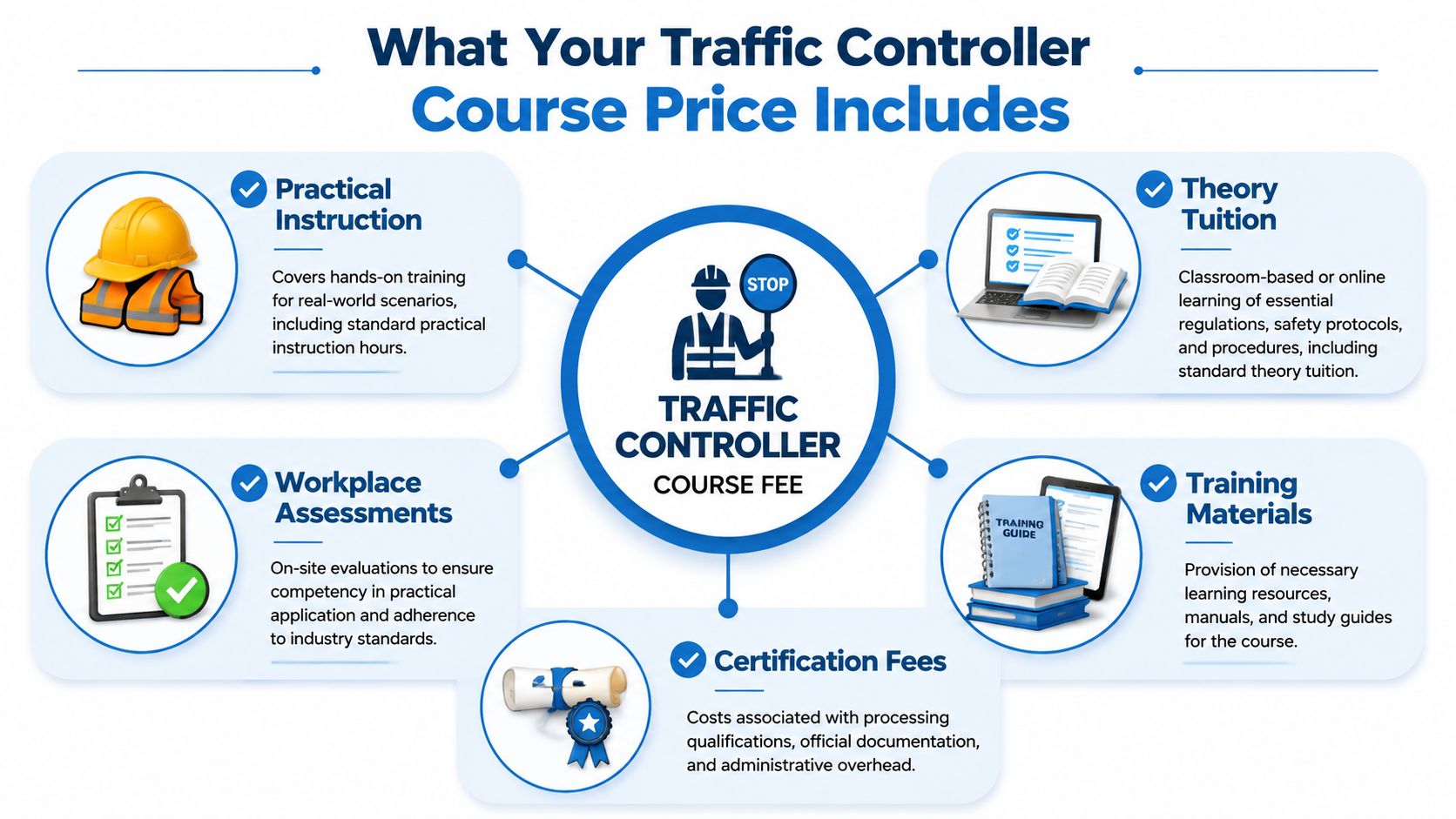
Most traffic control quotes draw from the same broad cost components:
- Practical instruction involves supervised, hands-on learning in realistic traffic control scenarios.
- Theory tuition covers the rules, procedures, and safety obligations behind on-site decisions.
- Workplace assessments test whether the learner can apply the training to the required standard.
- Training materials can include manuals, printed resources, or digital content.
- Certification fees may cover processing, administration, and issue of the relevant documentation.
The challenge is that not every provider presents those items the same way. Some wrap them into one course fee. Others separate administrative steps or card-related charges. That's why it helps to ask for an itemised breakdown before booking.
If you're evaluating whether a traffic ticket can support a broader work plan, TP Training's article on quick low-cost Blue Card training in Sydney gives useful context on how learners often view traffic control as part of a larger qualification pathway.
A good cross-check is to compare against other practical licensing courses. For example, TP Training's Tlilic0003 License To Operate A Forklift Truck Safework Nsw Approved is also described as practical, nationally recognised training with experienced trainers and hands-on learning across NSW. That kind of delivery model helps illustrate why inclusions matter as much as the sticker price.
Why GST status matters
Traffic control courses delivered by Registered Training Organisations are GST exempt under section 38-85 of the GSTR 2003/1 ruling, which means the advertised course price is the final amount payable without an additional 10% tax, as set out in this RTO fees and charges schedule referencing the GST exemption.
That sounds technical, but it has a practical budgeting effect. If a provider is an accredited RTO, the course fee shouldn't suddenly increase at checkout because of GST.
Ask one direct question before paying: “Is this the final RTO training price, and are there any separate mandatory fees outside the quoted amount?”
Key Factors Influencing Traffic Controller Course Price
One course isn't expensive or cheap in isolation. Price shifts because providers package the training differently, teach in different locations, and respond to different local operating conditions.
Why one quote sits above another
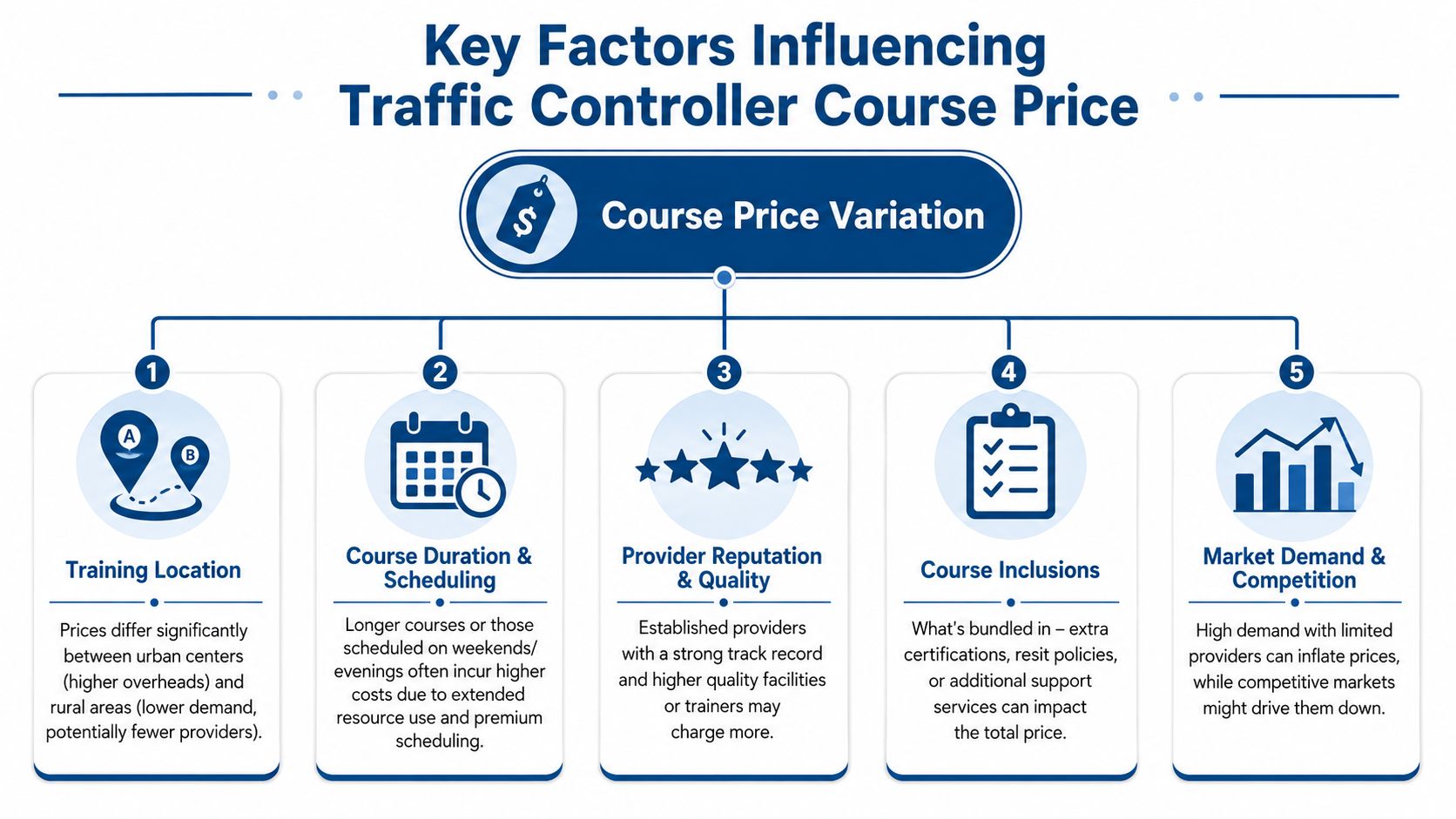
Several factors usually explain the spread between one quote and another:
- Training location can push prices up in metro areas where venue and staffing costs are higher, while some regional markets have fewer delivery options.
- Course duration and scheduling affect how providers allocate trainers, facilities, and placements. Weekend or non-standard timetables may be priced differently.
- Provider reputation and training quality influence what's bundled into the course experience, especially where practical support is stronger.
- Course inclusions matter more than many learners expect. A quote that includes resources, support, and administrative handling can be better value than a bare course fee.
- Demand and competition shape local pricing. In areas with many providers, quotes may be easier to compare. In tighter markets, learners often have fewer choices.
These factors make traffic control pricing similar to other project-based training decisions. If you work in civil construction or site coordination, the logic is close to the way planning costs move with scope, scheduling, and resource constraints. A concise explanation appears in TruTec's article on project planner definition, which helps frame why a low initial quote doesn't always reflect the actual delivery cost.
How to compare offers properly
Use a short screening method before you commit:
- Check the qualification scope. Make sure the course matches the work you want to do.
- Ask what's excluded. Card issue fees, checks, and resits can alter the overall cost.
- Confirm the delivery format. Practical support and assessment arrangements affect value.
- Review local provider comparisons. TP Training's article on the top traffic controller training centres in Sydney is a useful model for comparing more than just price.
Cheap training can become expensive if it creates delays, repeat admin, or extra compliance steps after the booking.
Location Variations in Course Pricing
State rules don't just change the paperwork. They change the cost structure. That's why national averages can be misleading if you're booking in NSW, moving to Queensland, or comparing a Victorian bundled course.
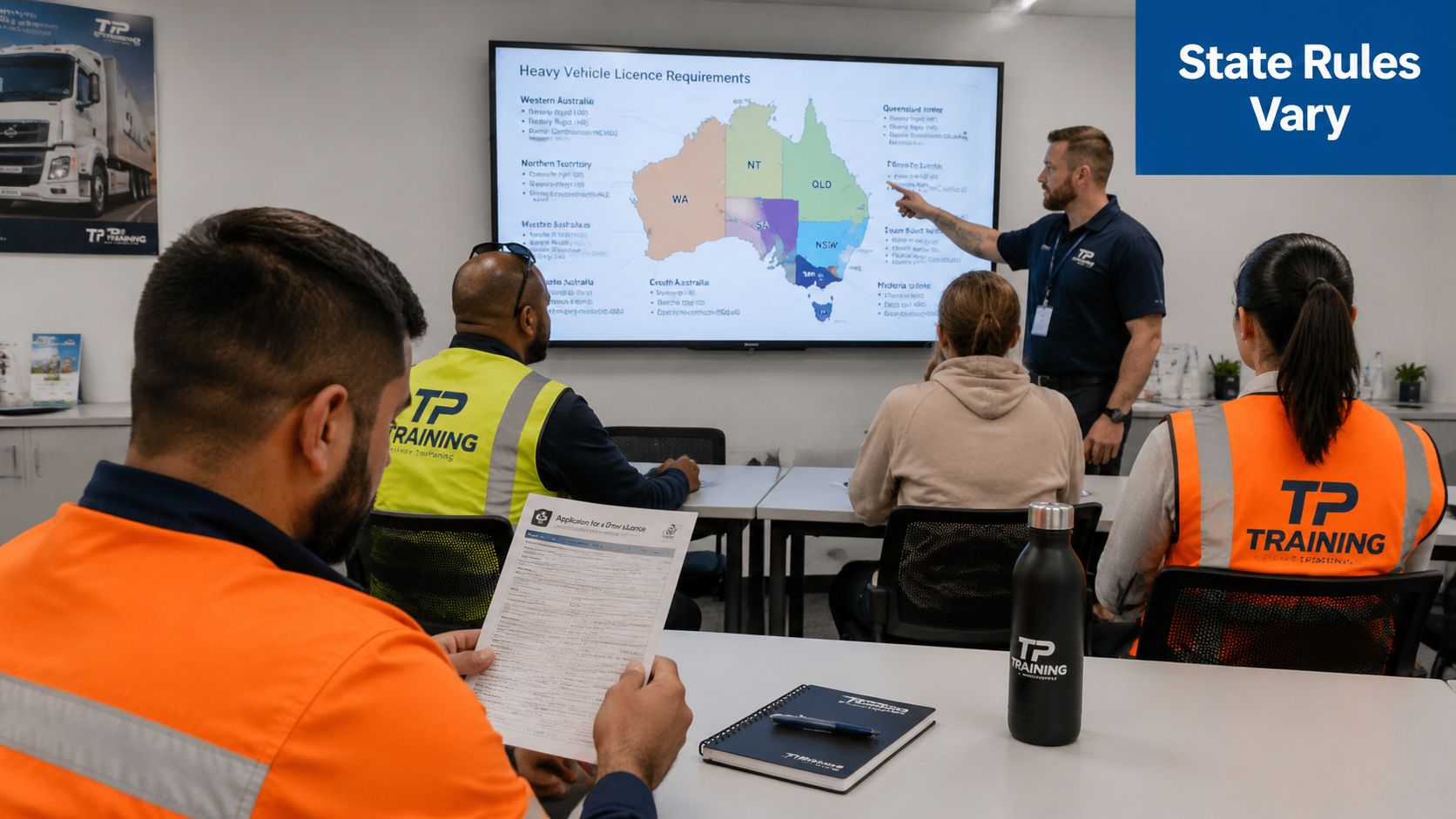
NSW and Queensland use different cost logic
NSW pricing is shaped heavily by entry-stage fees and checks. Queensland uses a different model because eligibility and renewal mechanics play a larger role over time.
Queensland applicants must hold an open or provisional driver licence from the last five years and renew accreditation every three years by completing approved refresher training and submitting Form F4115 declaring offence history and medical fitness, according to the Queensland traffic controller accreditation scheme.
That's a meaningful cost driver. In NSW, learners often focus on what it takes to get started. In Queensland, you also need to think about whether you meet the licence-history requirement and how recurring refresher obligations affect long-term budgeting.
Victoria shows how bundled fees change comparisons
Victoria highlights another issue. A quoted course fee can look higher because it includes a compulsory external charge that other listings leave out.
The combined TC1 and TMI1 skill set course in Melbourne is priced at $1,000.00, and that price includes the $125.00 Austroads Lodgement fee required for certification registration. The listing also states that the fee covers student resources, learning materials, 21 hours of face-to-face delivery and 20 hours of live placement, as shown on the Melbourne TC1 and TMI1 course page.
The lesson is broader than Victoria. A higher quote may be more complete. A lower one may postpone the cost into later admin steps.
How to Book Payment Options and Discounts
Booking a traffic control course is straightforward when you treat it like a compliance purchase rather than an impulse enrolment. The process works best when you confirm the qualification first, then the timing, then the payment arrangement.
A practical booking checklist
Start with the provider's booking page or course enquiry channel and work through these steps:
- Choose the exact course you need. Don't assume Blue, Yellow, Combo, and Red training are interchangeable.
- Check the training location and date. Travel time can affect the practical value of the booking.
- Review prerequisites before paying. Missing documents can delay commencement.
- Ask for the full payable amount in writing. This is the fastest way to spot unlisted add-ons.
- Confirm how your place is secured. Some providers allocate seats only after payment clears.
For people focused on keeping costs down, TP Training's article on affordable traffic control and traffic management training is a useful starting point for thinking about cost versus inclusion.
What to ask before you pay
Because provider policies differ, the best way to avoid surprises is to ask direct operational questions rather than broad ones.
- About deposits ask whether a partial payment holds the seat or whether full payment is required.
- On payment methods confirm which options are accepted at the time of booking, because providers may vary.
- Regarding discounts ask whether there are current offers for group bookings, employers, or job seekers.
- For rescheduling find out whether date changes trigger extra admin costs.
- On cancellations check whether fees are refundable, transferable, or credited.
This part matters because many “discounts” aren't really discounts. Sometimes the better saving comes from choosing a bundled course, avoiding repeat travel, or booking a provider whose quote already includes the administrative steps you'd otherwise pay for later.
The smartest booking decision usually comes from asking fewer marketing questions and more compliance questions.
If you're enrolling through an employer or as part of a work-readiness plan, ask them to compare quotes based on total eligibility cost, not just the training line item.
Conclusion and Next Steps
The story behind traffic controller course price is that the advertised fee is only one layer of the decision. In NSW, the course cost, card fee, and checks combine into a larger entry budget. In Queensland, licence history and periodic renewal shape the economics differently. In Victoria, bundled administration can make a higher quote more transparent and easier to budget.
That's why the most reliable strategy is simple. Ask for a fully inclusive breakdown, confirm what's mandatory in your state, and choose the course that matches the work you want to do.
If you're comparing options in NSW, TP Training operates across Penrith, Burwood, Auburn, Parramatta, and Sydney CBD, which makes location part of the budgeting decision too. Shorter travel and clearer scheduling can reduce friction even when headline prices look similar across providers.
Keep the regulatory requirements handy, save course pages that clearly list inclusions, and speak to a training team before booking if anything in the fee structure looks vague. Clear pricing is more than a convenience. It's the fastest way to start training without expensive surprises.
Frequently Asked Questions
Is the SafeWork NSW card fee included in every course?
Not always. In NSW, the $28 SafeWork NSW card fee is a distinct mandatory cost component in the pricing evidence cited earlier, so you should always ask whether it's already included in the quote or payable separately.
Can I pay by instalments or direct debit?
That depends on the provider. Because policies vary, ask before enrolment whether the seat can be held with a deposit, whether instalments are available, and when the full balance must be paid.
Will weekend classes cost more than weekdays?
They can, but not every provider prices scheduling the same way. The safer approach is to compare the full quoted amount and ask whether timetable choice changes the fee.
Are PPE replacement costs extra?
They may be. Some providers include core training materials and basic requirements, while replacements or upgraded gear can sit outside the original quote. Ask for an inclusions list rather than assuming PPE is covered.
Is GST added to the listed course fee?
For traffic control training delivered by an accredited RTO, the earlier GST ruling means the advertised training price should be the final amount without an extra tax amount added. If you're unsure, confirm the provider's RTO status and ask whether the displayed figure is final.
Is a bundled course better value than separate bookings?
Often, yes, if you already know you'll need both qualifications. The NSW pricing evidence cited earlier shows that Blue and Yellow bundling can reduce individual costs compared with booking separately, but the right choice depends on your job goal and timing.
If you want a clearer path into traffic control training in NSW, TP Training is one option to review for practical, nationally recognised courses across multiple Sydney-area locations. Before you book anywhere, ask for a full fee breakdown, confirm state-specific requirements, and make sure the quoted price matches the qualification path you need.

You may also like
Yellow Card NSW: Requirements, Units and How to Enrol

Construction Induction Training in NSW Explained