
Yellow Card NSW: Requirements, Units and How to Enrol
You've found a roadworks job, and the employer has asked whether you hold a Yellow Card. You search for training and find Blue Cards, Red Cards, implementation courses and even machinery tickets using the same colour. Before you book anything, you need to know which qualification matches the work you'll do.
For traffic management, Yellow Card NSW searches should lead you towards Implement Traffic Control Plans, usually shortened to IMP. The important question isn't whether you can get the card. It's whether you understand the decisions an implementer must make when an approved drawing meets a busy, changing worksite.
Table of Contents
- What a Yellow Card Lets You Do on NSW Worksites
- Choosing Between Blue, Yellow and Red Cards
- Prerequisites You Need Before Enrolling
- What the Course Covers and How You Are Assessed
- Legal Duties and Compliance on NSW Sites
- Enrolling with TP Training in Sydney and NSW
What a Yellow Card Lets You Do on NSW Worksites
A supervisor asks someone to help set up a lane closure. Another worker assumes that person can also take over the stop/slow bat during a break. That's the mix-up to avoid: implementing the traffic arrangement and directly controlling traffic are different functions.
In NSW, the qualification historically called Apply Traffic Control Plans, or the Yellow Card, corresponds to the current Implement Traffic Control Plans function. It covers implementing a work-zone traffic-management plan in the immediate vicinity of a workplace. Someone else prepares the approved plan; the implementer translates it into physical site controls.
Those controls can include signs, barriers, traffic guidance arrangements and related safety measures. The job requires more than unloading equipment and putting it roughly where the drawing suggests.
Implementation means following the approved arrangement
Consider a hypothetical footpath repair beside a suburban road. The approved arrangement identifies how pedestrians will pass the work area, where warning signs belong and how workers will be separated from road users.
The implementer needs to understand how those elements fit together. A sign that's present but hidden behind a parked vehicle doesn't provide useful warning. A barrier arrangement that leaves pedestrians walking towards moving plant needs attention.
Practical rule: Your task is to make the approved arrangement work as intended, not invent a replacement arrangement because it looks easier to install.
The Yellow Card doesn't authorise you to:
- Direct traffic with a stop/slow bat or boom gate. That requires the relevant traffic-controller training and authorisation.
- Modify an existing traffic-control plan independently. Spotting a problem doesn't give you authority to redesign the solution.
- Assume planning or inspection authority. Those responsibilities must match the person's separate qualifications and assigned duties.
Why older paperwork can be confusing
Legacy NSW documents may refer to a Red Card for selecting and making minor modifications to standard plans. They may also mention an Orange Card, associated with plan design and inspection. Don't treat those historical colour labels as a reliable description of someone's current authority.
Ask what work function the person is qualified and authorised to perform. That's more useful than asking which coloured card they remember receiving.
There's another naming trap: work platform training also uses Yellow Card terminology. If your employer means machinery operation, check the separate elevated work platform training information rather than booking a traffic-management course.
The simplest description is this: a traffic-management Yellow Card holder implements an approved plan, within the limits of their qualification and site responsibilities.
Choosing Between Blue, Yellow and Red Cards
On a Sydney roadworks site, one worker may direct approaching vehicles while another sets out signs and devices. A third may need to prepare a revised arrangement when the work sequence changes. Those jobs call for different functions, so start with the job description; the course colour comes second.
The current NSW Traffic Control Work Training Card system separates traffic controller, implement traffic-control plans and prepare a work-zone traffic-management plan functions. A current card is mandatory for traffic-control work on or adjacent to a public road, subject to the accepted supervised student pathway.
Traffic Control Card Functions in NSW
| Card or Function | What the Holder Does | Typical Site Duty |
|---|---|---|
| Blue Card terminology, Traffic Controller | Directs traffic under the work-zone traffic-management plan | Operates stop/slow traffic control at the assigned position |
| Yellow Card terminology, Implement Traffic Control Plans | Implements the approved arrangement near the workplace | Sets out signs and devices for an approved lane closure |
| Prepare a Work Zone Traffic Management Plan, commonly marketed as Red Card training | Prepares, varies or inspects the plan within the relevant authority | Prepares a revised arrangement when the work sequence changes, including approving a swept-path layout variation before the crew moves a barrier |
For a layout change, identify who holds the planning responsibility before anyone moves a barrier. A supervisor's title alone does not confirm they are qualified or authorised to approve a variation. Check the current qualification and the authority attached to the task.
Match the course to the work you expect to perform
If your employer expects you to direct vehicles, review the Blue Card traffic-control pathway. If you'll read an approved scheme and organise its physical implementation, the implementer function is the relevant starting point.
For a mixed role, ask your employer to spell out the tasks:
- Traffic direction: Will you operate a stop/slow bat or other traffic-control equipment?
- Site implementation: Will you set out, check and maintain the approved traffic arrangement?
- Planning responsibility: Will you prepare or vary plans, or carry out work requiring the planning qualification?
A clear task list can prevent you from paying for training that does not match your rostered work. Additional training may suit a role with broader duties, but check that those duties are assigned. Write these three task questions into your enrolment email before paying, and keep the replies with your documents.
What a student can do before final assessment
A student with a valid Statement of Completion may perform supervised work while completing final assessment. A student in that position works under supervision, with authority limited to the tasks the supervisor assigns.
Ask the provider what supervision applies, what evidence you must carry and what remains outstanding. Employers should confirm those conditions before assigning work, so the crew knows what the student can do on site.
Prerequisites You Need Before Enrolling
Before paying for a place, get your documents together and explain your starting point to the enrolment team. A new entrant, an experienced worker returning after a break and someone adding implementation skills may need different advice.
An enrolment conversation should clarify eligibility, construction induction and the assessment pathway.

Check your age and provider approval
Applicants for the relevant NSW Traffic Control Work Training Card must be at least 17 years old and complete training and assessment through a SafeWork NSW-approved provider. Confirm those requirements before choosing a course based on its location or advertised title.
If you're approaching the minimum age, ask the enrolment team to confirm when you can enter the relevant pathway. Don't assume that booking a course automatically establishes eligibility for the card.
Provider approval matters just as much as the course name. Ask which NSW work function the training supports and what successful completion allows you to apply for.
Establish your White Card position
For construction-site work, the traffic-management qualification sits alongside general construction induction. NSW project documentation commonly requires people setting up and working with traffic-control plans to hold the relevant traffic qualification and a NSW WorkCover Construction Induction Card, commonly called the White Card, or an accepted equivalent.
The cards address different needs. Construction induction doesn't establish traffic-management competence, and traffic-management training doesn't replace general construction induction.
If you already hold a White Card, send its details to the provider before booking. Ask whether your evidence is accepted for the course and intended site work, particularly if it was issued elsewhere or your circumstances have changed.
Gather evidence rather than relying on memory
An experienced worker might say they trained a while ago and have worked continuously since. That's useful background, but the provider and employer still need enough information to check the qualification, work function and relevant history.
Prepare a short enrolment pack:
- Identity documents: Ask which documents are accepted and make sure your details are consistent.
- Construction induction evidence: Have your White Card or equivalent available for review.
- Existing traffic qualifications: Include the actual card classes and supporting training documents.
- Training and work history: Gather dates and evidence relevant to the traffic work you've performed.
- Your Unique Student Identifier: Use the guide to creating and managing your USI if you need help locating or organising it.
Also ask what clothing, protective equipment and preparation the provider expects. Don't buy equipment based on someone else's course experience without checking.
The useful distinction is between course entry, card eligibility and site access. They're connected, but satisfying one doesn't automatically settle the others.
What the Course Covers and How You Are Assessed
A lane-closure scheme marks a pedestrian crossing in the wrong place. The implementer must spot the mismatch, check the site conditions and raise the issue before setting out the controls. That judgement is part of the work, not an extra step after installation.
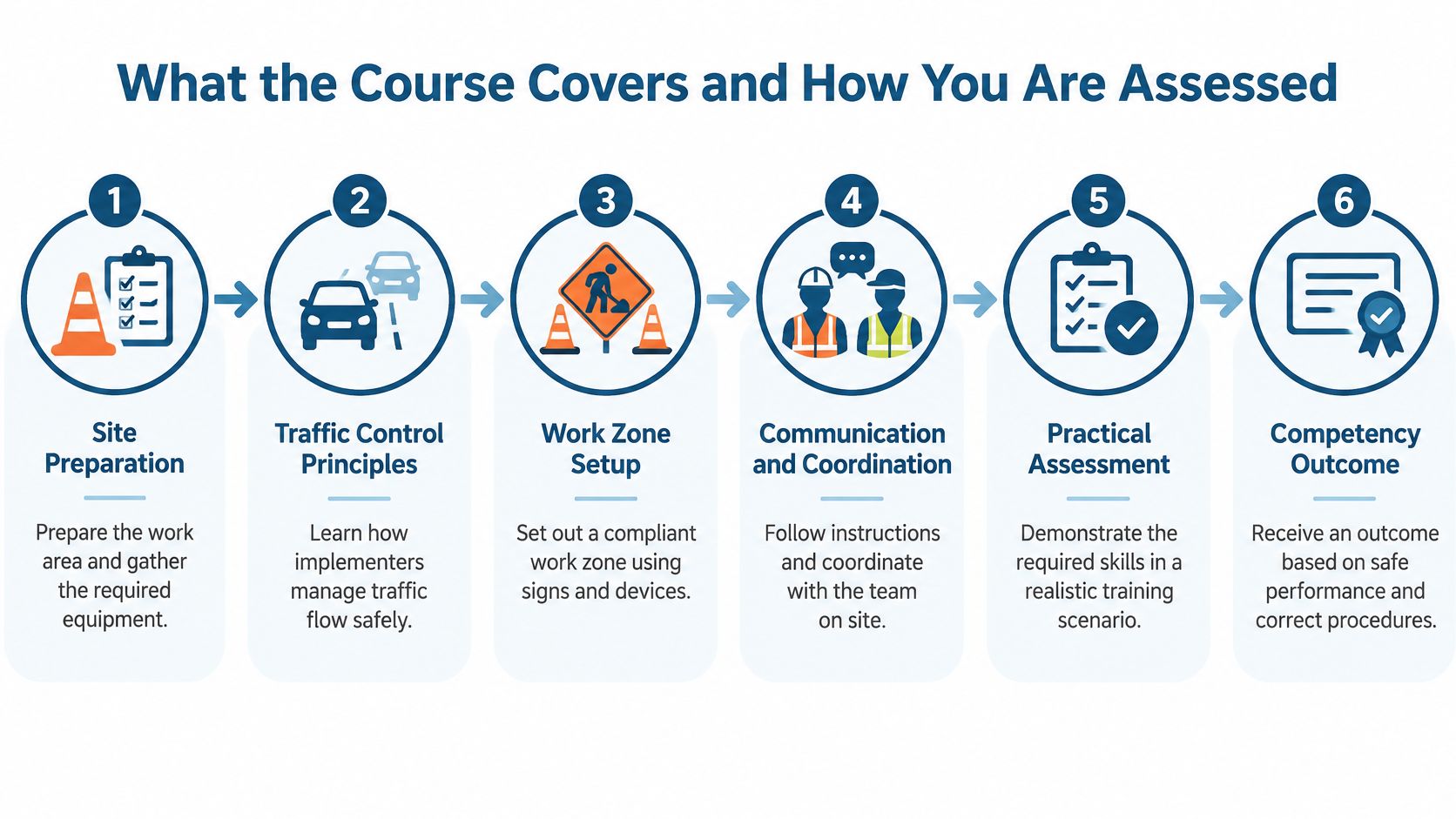
The Traffic Management Implementer Course Yellow Card covers how to prepare for, install and check a traffic management arrangement. In practical sessions, students set out a lane closure from a scheme, check it against the drawing and record deviations. These tasks show whether they can follow the approved arrangement and identify when site conditions need attention.
From the drawing to the work zone
Start by confirming you have the current approved plan and traffic guidance scheme. An old revision can lead to the wrong setup before anyone places a sign.
Compare the plan with the actual location. Check access points, pedestrian movement, traffic direction, loading areas and the work activity. If a crossing, driveway or delivery route conflicts with the drawing, don't improvise a new arrangement. Stop and raise the mismatch through the site process so the approved plan can be clarified or changed.
Install the controls in the specified sequence. Workers need protection while the setup is underway, not only once the final device is in place. Check:
- Visibility: Can approaching road users see and understand the signs?
- Position and spacing: Do the devices match the approved scheme?
- Pedestrian access: Is the intended route open and free of conflict?
- Worker separation: Are workers separated from moving traffic as planned?
- Conflict points: Do driveways, deliveries or plant movements need escalation?
Demonstrating judgement, not just moving equipment
Practical sessions let students practise reading a scheme, setting out controls, communicating and checking the result. Classroom knowledge matters, but it doesn't show whether someone will notice an obstructed sign or an unsafe pedestrian interface on site.
Before enrolling, ask the provider which tasks are assessed, what evidence is required and whether supervised work is part of assessment. Request the current unit codes and titles too. A familiar course nickname may not match the wording on your training documentation.
A competent response can be to stop and ask for clarification. Guessing confidently isn't evidence of safe implementation.
After setup, check the arrangement and retain inspection evidence. Records should identify deficiencies, corrective action and whether the issue was closed out. A checklist helps with routine checks, but it cannot describe every local hazard. The implementer still needs to recognise when the site no longer matches the scheme and raise the issue rather than carry on with an unsafe setup.
Legal Duties and Compliance on NSW Sites
Verifying a worker's card means checking the function it covers, the date of the training and the work history behind it, not only the colour on the card. The business must confirm that the person's qualification and recent experience match the work assigned.
Under the NSW Work Health and Safety Regulation 2017, a person conducting a business or undertaking must ensure workers completed the relevant training within the previous two years, or performed that type of traffic-control work within that period if their training is older. A business directing uncertified work may face a penalty of up to $21,420, according to Transport for NSW's traffic-control training requirements.

Make verification part of the pre-start
A supervisor finds that a worker's training document has an expired date. The worker says they have remained active in traffic management. Before assigning the task, the supervisor checks the current card, the work function and the supporting history. Recent experience does not automatically resolve every credential requirement.
Where the evidence is unclear, confirm the worker's status with the appropriate provider or authority. Keep the check specific:
- Confirm the function: Does the credential cover the duty being assigned?
- Check currency evidence: Can the worker show relevant training or work history?
- Resolve discrepancies: Keep the worker off the task until certification questions are settled.
- Keep evidence available: Workers need their training card or accepted evidence accessible for inspection.
Workers returning after a break can use the traffic-control refresher course guide to prepare questions about their next step.
When the approved plan no longer fits
A queue now runs past the advance warning sign, and rain has cut drivers' sight lines to the pedestrian diversion. A changed work sequence can also block the route. The setup may still match the drawing, while no longer managing the risk on the road.
Don't improvise a plan change. If safety is compromised, follow the site's stop-work or suspension procedure. Tell the traffic manager or responsible supervisor exactly what has changed. Get the arrangement reviewed, with any additional controls or revised approval in place before affected work resumes.
Escalation test: If a changed condition weakens the protection the arrangement was designed to provide, treat it as a safety decision and escalate it promptly.
Verification, inspection and auditing records should reflect the arrangement's complexity and changing conditions. A client inspection covers the client's obligations. The implementer still walks the arrangement and looks at the road before work starts.
For wider workplace context, Safety Space's safety guidance for construction and manufacturing businesses is a supplementary resource. Follow traffic-specific requirements and approved site procedures for decisions about the work arrangement.
Enrolling with TP Training in Sydney and NSW
Choose the training pathway around the work you intend to do, then choose the location and timetable. Reversing that order can leave you with a convenient booking that doesn't match the employer's requirements.
TP Training has NSW training centres including Penrith, Burwood, Auburn, Parramatta and Sydney CBD. Ask which centre is delivering your intended course and assessment pathway before making travel arrangements. Don't assume every course runs at every centre.
Choose a centre around the whole training commitment
A nearby classroom is useful, but ask about the practical component too. Confirm where it happens, how it's arranged and what you need to complete after the initial training.
For someone travelling from western Sydney, Penrith or Parramatta may be worth discussing. Students closer to the inner west or city may prefer to ask about Burwood, Auburn or Sydney CBD. The right choice depends on the actual schedule and assessment arrangements, not just the suburb name.
Bring your likely work duties into that conversation. If an employer has sent you a position description or an onboarding checklist, use it to explain what you need.
Compare a single-function pathway with combined training
The implementer pathway suits work centred on putting approved arrangements into practice. The Traffic Controller Course, commonly called Blue Card training, addresses the separate traffic-direction function.
Where the intended job includes both duties, review the combined Blue and Yellow Card course information. Combined training should be a deliberate choice based on the work, not an assumption that a larger course package is automatically the right starting point.
Ask the enrolment team practical questions before committing:
- Course scope: Which current NSW work functions and units does the booking cover?
- Entry requirements: What evidence must be accepted before attendance?
- Assessment arrangements: Where will practical assessment happen, and who organises it?
- Student work conditions: What supervision applies while assessment is outstanding?
- Completion documents: What will you receive, and what card application steps remain?
- Training location: Which centre and practical venue apply to your booking?
Book with a clear understanding of the outcome
Keep a copy of the answers alongside your enrolment documents. That gives you something concrete to check if you're unsure about a requirement later.
Don't plan a work start date around an assumed completion date without understanding the assessment and card pathway. Training attendance, demonstrated competence and permission to undertake a particular site duty aren't interchangeable milestones.
Before contacting the enrolment team, confirm your age, White Card status and recent training history. Then explain the role you're aiming for and ask for the appropriate pathway at your nearest suitable NSW location.
TP Training offers practical, nationally recognised traffic-management training for people entering the industry or adding implementation skills. Visit TP Training with your existing card details and intended job duties, then ask the team to confirm the right course, assessment pathway and NSW training location before you book.

You may also like

Construction Induction Training in NSW Explained
CPR Training Face Shields: A Practical Australian Guide