Civil Construction Plant Operations Courses Explained
You're at the training gate, looking across the yard at an excavator, a roller and a skid steer. You want practical work and a way into civil construction, but you're trying to work out which course is worth booking, what employers will expect afterwards and whether a machine ticket is the same as a licence.
That's a sensible place to start. Civil construction plant operations courses can build assessed, job-relevant skills, but completing a course doesn't guarantee a job or give you authority to operate every machine or perform every site task. The right choice depends on the work you're aiming for, the machines used by local crews and the evidence you'll take from training into the workplace.
Table of Contents
- Standing at the Training Gate and Wondering What's Next
- What Plant Operations Actually Covers on a Civil Site
- How the National Training Package Structures Each Course
- The Major Plant Types You Can Train On
- Typical Course Structures and How Learners Choose
- Entry Requirements, PPE and the Booking-to-Certification Path
- Licensing Outcomes and How They Apply in NSW
- Career Paths, Employer Expectations and Where to Train
Standing at the Training Gate and Wondering What's Next
A new labourer might be drawn to the excavator because it's the machine they see digging service trenches. Someone changing careers might be considering a roller as a focused first step into roadworks. Both are asking the same practical questions: What should I train on first? Which provider and course fit my goals? What happens after assessment?
It's easy to assume there's one ticket that opens plant work. In practice, the training pathway is more like assembling a work kit. A machine-specific unit demonstrates assessed competency for particular operations. A broader qualification combines that machine training with core civil-construction skills. Neither replaces supervised experience, employer expectations or site-specific induction.
There's a real workforce behind this training. Jobs and Skills Australia reports approximately 51,400 Earthmoving Plant Operators, with 94% working full-time hours, compared with 69% across all occupations. Construction accounted for 64.8% of the occupation in the 2021 profile, and NSW had 8,200 operators, or 26.9% of the national total (Jobs and Skills Australia's occupation profile). Those figures describe the occupation, not a promise of employment for any individual learner.
A useful decision starts with your target crew. Are you interested in roadworks, drainage, utilities, subdivisions or general earthworks? Which machine does that work use, and what practical evidence will an employer ask you to show? By the end of this guide, you should be able to match a course to a realistic next step, rather than choosing a ticket because a machine looks familiar.
What Plant Operations Actually Covers on a Civil Site
On a civil site, plant means mobile machinery used to move, shape, compact or transport materials. Operations means more than steering and using controls. It covers preparing for the task, checking the machine, carrying out the work safely and leaving equipment in a suitable condition when the task is done.
Think of a civil crew's machines as specialist tradespeople. A roller compacts a prepared surface; it can't dig a drainage trench. An excavator can dig and load, but that doesn't make it interchangeable with a roller when the job is to compact a road base. Each machine has its own controls, capabilities, attachments and risks, so training is tied to specific types of equipment.
From preparation to shutdown
A competent operator first understands the work specification. That means confirming what the crew needs done, checking the work area and identifying hazards such as underground services, people moving nearby or unsuitable ground. The operator then checks the machine and selects equipment and attachments appropriate to the task.
During operation, the operator must work within the machine's capabilities and site conditions, keep track of hazards and communicate with the crew. When the task is finished, the operating cycle continues: park and shut down correctly, carry out post-operation checks, clean up and report defects. National training units set out this sequence rather than treating operation as time spent at the controls (the small-plant unit requirements).
For example, excavating near services requires the operator to consider plans, service-location controls and communication with ground workers, not just bucket movement. A roller operator has a different task, but still needs to understand the work area, use the machine appropriately and coordinate with the crew.
A practical rule: Match the machine to the task, then match your training to the machine and duties you expect to perform.
That's the difference between a course that teaches a whole operating cycle and a familiarisation session that only introduces the controls. Civil plant work relies on coordination, sound judgement and safe operation as well as machine skill.
How the National Training Package Structures Each Course
The RII30820 Certificate III in Civil Construction Plant Operations is a qualification made up of units. Think of the qualification as the folder and each unit as a documented skill inside it. Core units establish shared civil-construction capability; electives add competencies for particular machines and tasks.
Core capability includes planning and organising work, measurements and calculations, interpreting plans and job specifications, identifying and protecting underground services, risk management, communication, small-plant use, manual excavation, drainage and dewatering, and work health and safety procedures. Machine-specific electives can be chosen to reflect the employer's fleet and the learner's intended work.
| Unit Code | Focus Area | Why It Matters on Site |
|---|---|---|
| RII30820 core units | Planning, measurements, plans, services, risk, communication and WHS | Connects machine tasks to site instructions and controls |
| RIIMPO320F | Civil construction excavator operations | Assesses the operating cycle for excavator work |
| RIIMPO317F | Roller operations | Focuses on operating a roller for compaction tasks |
| RIIMPO319E | Backhoe-loader operations | Covers a machine that combines front loading and rear excavation |
| RIIMPO318F | Civil construction skid-steer-loader operations | Assesses compact-loader operation for civil work |
| RIIMPO321F | Wheeled front-end-loader operations | Focuses on moving and loading bulk material |
| RIIMPO337E | Articulated haul-truck operations | Covers transporting material across a civil site |
The unit combination matters. A single-machine course typically focuses on a machine-specific competency; a combo can bring several machine units together. The qualification is broader, combining selected plant skills with core civil-construction units. For a plain-English overview of how vocational training fits into Australian work, see TP Training's guide to vocational training in Australia.
Assessment should test observable actions, not assume competence from familiarity. For excavator operations, requirements include pre-start and start-up checks, identifying and reporting or rectifying faults within the operator's responsibility, working within machine capability and site conditions, monitoring hazards and risks, and using indicators and alarms as specified by the manufacturer. Where lifting is involved, the operator must establish load weight, stay within safe operating limits, use lifting gear within its safe working load, position the machine stably and communicate using workplace signals. Parking, shutdown and post-operation inspection are also part of the assessed cycle (RIIMPO320F unit requirements).
The Major Plant Types You Can Train On
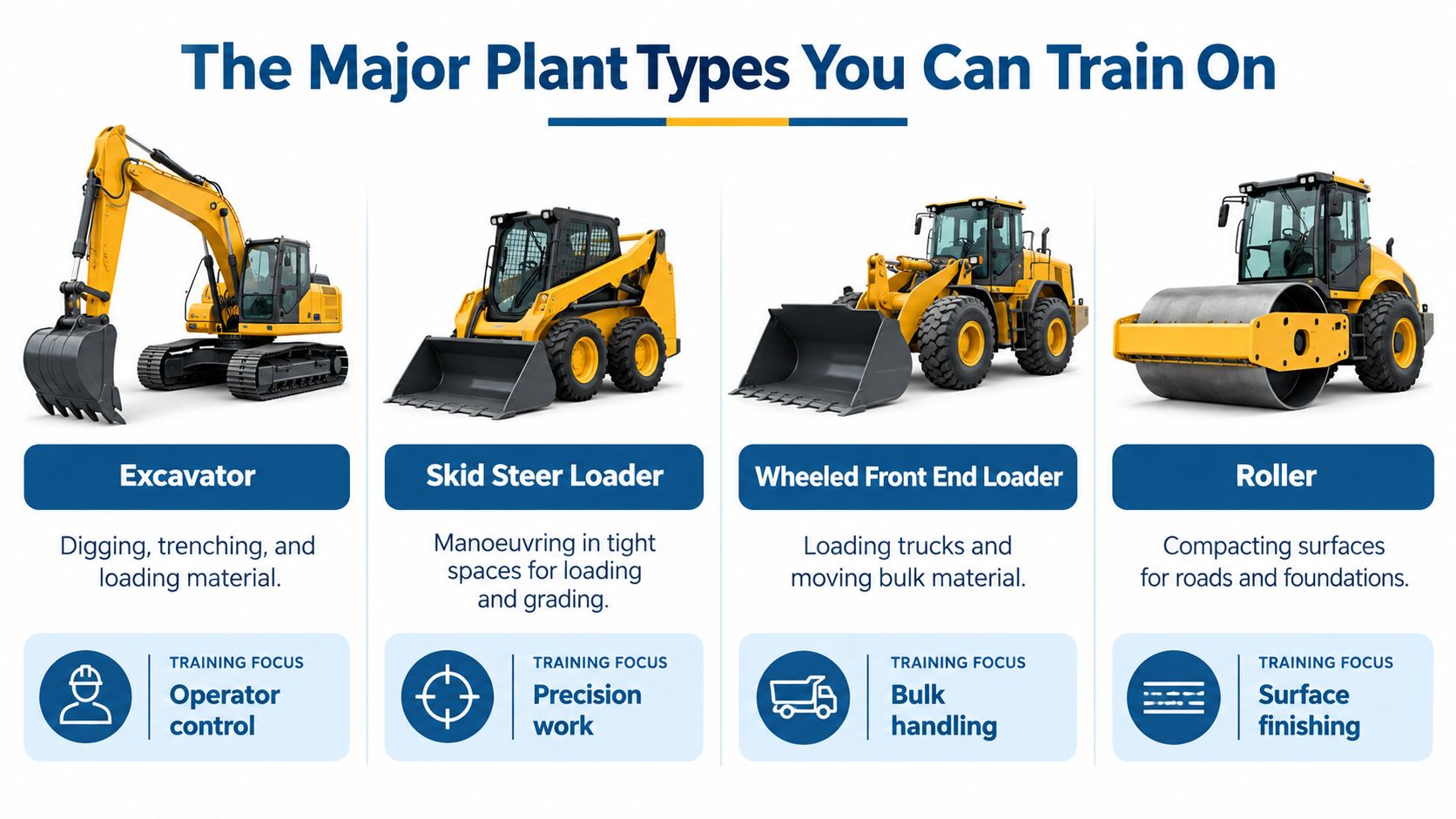
The best machine to start with depends on the work you're targeting. Roads, subdivisions, utilities, drainage and earthworks use different combinations of plant, and a ticket for one machine doesn't demonstrate competency on another.
Match the machine to the job
Roller. A roller compacts surfaces for roadworks and other civil tasks. Training focuses on controlled operation and awareness of how the machine is being used on the work area. It's a different skill from moving soil: the job is to produce a suitably compacted surface.
Excavator. Excavators dig, trench, lift and load. Operators need to position the machine carefully, select suitable attachments and work with awareness of services and people nearby. TP Training provides practical, nationally recognised RIIMPO320F Excavator Operations Course Conduct Civil Construction training with experienced trainers and hands-on learning across NSW.
Wheeled front-end loader. Loaders move bulk material, including between stockpiles and trucks. Training focuses on controlled handling and loading rather than trenching or precision excavation.
Backhoe loader. This combines a front bucket with a rear excavator-style arm. That makes it useful for work such as trenching and utility tasks, where the operator may need both loading and excavation capability.
Skid-steer loader. Often called a bobcat, a skid steer suits confined spaces and can be used for earthworks and landscaping tasks with suitable attachments. Before choosing one, consider the kind of civil work you want to join; TP Training's skid-steer ticket guide covers the machine-specific pathway.
Articulated haul truck. These trucks move material around civil sites, including uneven ground. Training focuses on the safe operating requirements of the truck and the conditions in which it works.
A course record is only one part of presenting yourself to employers. If you're preparing a job application, StoryCV's forklift-operator resume examples can help you think about how to describe equipment experience clearly without suggesting you're competent on machines you haven't been assessed on.
Typical Course Structures and How Learners Choose
There isn't one “best” course format for every learner. A focused unit can make sense if you already know which machine your target work uses. A multi-machine course may suit someone who wants a wider set of competencies, while the Certificate III offers a broader qualification built from core and elective units.
| Course Format | Typical Learner Goal | Best Fit When |
|---|---|---|
| Single-machine course | Build competency for a particular machine | You know which equipment your target crew uses |
| Combo course | Add several machine competencies in one training pathway | Employers or projects you're targeting use a mix of plant |
| Certificate III pathway | Combine plant units with broader civil-construction capability | You want a qualification covering more than machine operation |
For example, someone aiming for roadwork might compare roller training with an excavator unit, while a learner interested in drainage and utilities might look closely at excavator or backhoe competencies. Someone targeting compact-site work may consider skid-steer operation. These are starting points for investigation, not guarantees about which ticket a particular employer requires.
Before booking, ask how much practical assessment is included, which units are covered, what the completion documents show and whether the course matches the work you want to pursue. Also clarify the schedule and any entry conditions directly with the provider. A short intensive course and training delivered across scheduled sessions may suit different work and travel arrangements.
Choose for the crew you want to join, not the biggest list of tickets. A relevant, assessed competency is more useful than a collection of units that don't match your intended duties.
TP Training's article on choosing excavator training in NSW offers another point of comparison. The important question remains whether the course content and assessment suit your goal. A unit establishes assessed competency in its scope; it doesn't guarantee work or replace site experience.
Entry Requirements, PPE and the Booking-to-Certification Path
Before paying a deposit, confirm the provider's current entry requirements. Training providers may ask about minimum age, language and literacy, identification and your Unique Student Identifier (USI). A Construction Induction White Card is a common prerequisite for construction-site work and may be required for the course or its practical setting, so check before booking.
Your preparation should include suitable personal protective equipment. Ask the provider what to bring, and expect requirements such as high-visibility clothing, a hard hat, safety boots, eye protection and hearing protection where relevant. Don't assume equipment will be supplied.
What the training day involves
The course usually moves from learning and preparation to supervised practice and assessment. Depending on the provider and course, learners may complete theory or pre-study, become familiar with the machine, practise under supervision and then demonstrate the required tasks.
Assessment covers the operating cycle, not just a few minutes using the controls. Expect to show that you can prepare for the work, inspect the machine, carry out tasks safely, follow communication and hazard controls, then complete shutdown and post-operation checks. If you identify a fault, you'll need to handle it within your responsibility and report it appropriately rather than working around it.
What you'll need to confirm
Before the course, check that your identification and USI details are correct, and ask what paperwork you'll receive if you complete assessment successfully. Depending on the units completed, this may include a statement of attainment recording the nationally recognised competencies achieved. If you're unsure whether your existing experience is enough, describe it to the provider and ask how the practical assessment works.
Licensing Outcomes and How They Apply in NSW
A nationally recognised statement of attainment and a high-risk work licence are different documents with different purposes. A statement of attainment records the units you've successfully completed. A high-risk work licence is required for particular licensed classes of work under relevant rules.
Most civil plant units, such as excavator or roller operations, demonstrate competency rather than providing a general licence to operate all heavy equipment. Some activities fall under high-risk work licensing requirements, including operating certain forklifts, boom-type elevating work platforms over 11 metres, and dogging, rigging or cranes. Check the requirements for the specific equipment and work you intend to perform.
On a NSW civil site, a contractor may ask you for evidence of competency, such as a statement of attainment and a verification card, as well as a site-specific induction. Those are separate checks: a training credential doesn't automatically grant access to a site or permission to perform every task.
If you're unsure which credential applies, verify the activity and equipment before enrolling. TP Training's overview of high-risk work licences in NSW can help distinguish licence requirements from competency-based plant training. Don't assume that stacking more plant units authorises unrelated tasks. The right outcome depends on the actual unit, machine, work activity and site rules.
Career Paths, Employer Expectations and Where to Train
Plant competencies can support applications for labour-hire roles, civil crews, road and subdivision projects, utilities and infrastructure work. Employers may look beyond the course record for practical evidence: a current statement of attainment, verifiable logbook hours where available, sound pre-start habits, communication with ground workers and willingness to follow site controls.
Safety is a central part of that evidence. Safe Work Australia reported 41 construction-worker fatalities in 2025; machinery operators and drivers recorded 77 fatalities nationally, about 35% of all worker fatalities, and the highest occupational fatality rate at 8.7 deaths per 100,000 workers (Jobs and Skills Australia's Earthmoving Plant Operators profile). The figures don't mean every operator faces the same risk. They do underline why pre-start checks, hazard control and competent operation belong at the centre of training.
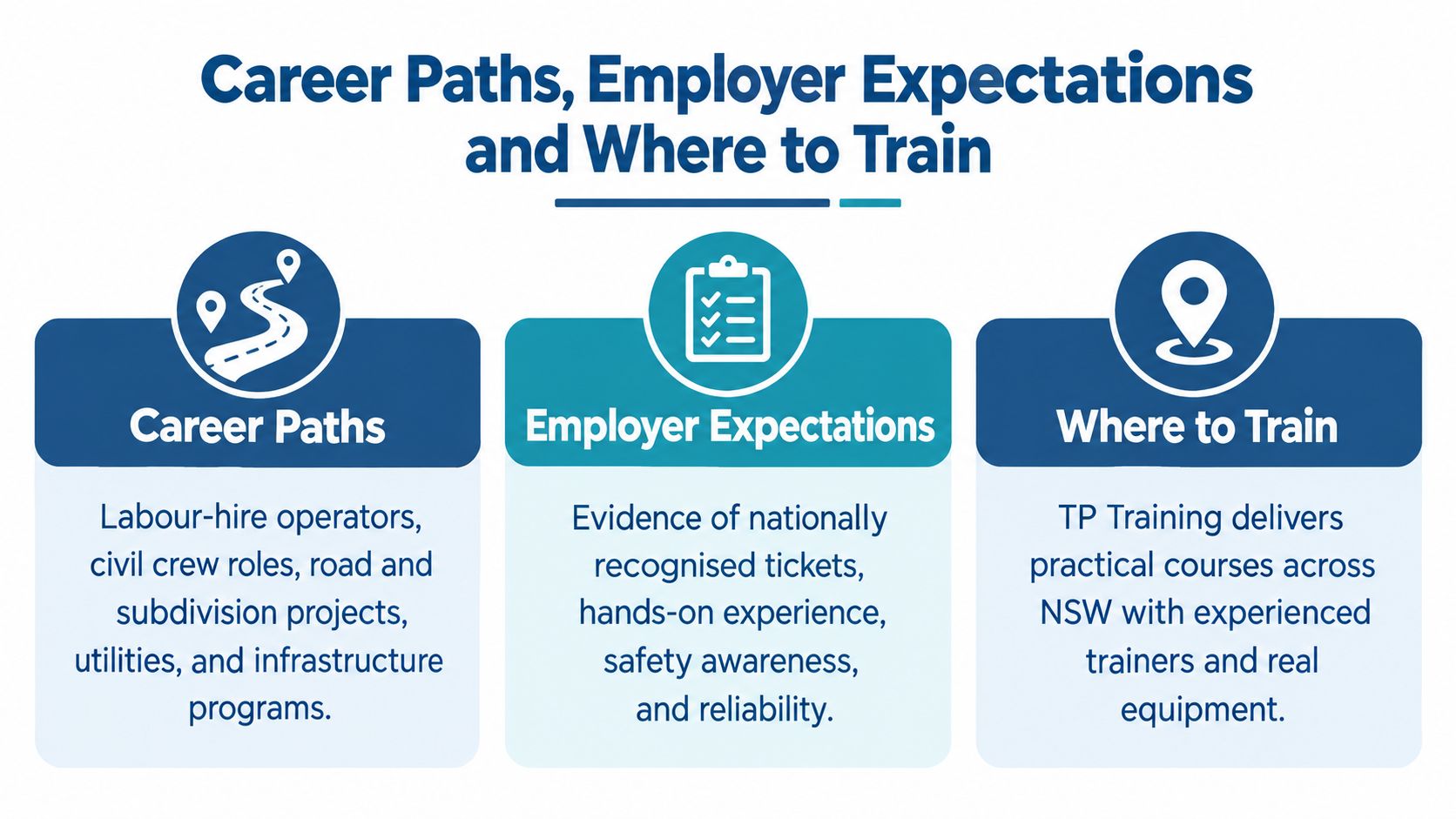
TP Training delivers practical courses across NSW, with training centres in Penrith, Burwood, Auburn, Parramatta and Sydney CBD. For a broader look at vocational options around the city, see its guide to trade courses in Sydney.
Before booking, use this checklist:
- Choose your target work: Identify the kind of crew or civil project you want to join.
- Match the machine: Check which equipment that work uses and which unit covers it.
- Confirm the outcome: Ask what assessment, documents and prerequisites apply.
- Plan for workplace evidence: Discuss how you'll build supervised experience and demonstrate safe habits after training.
You don't need to know your whole career path before starting. Choose a relevant first competency, learn the operating cycle properly and treat the ticket as a foundation for supervised work, not a shortcut around it.
TP Training offers practical, nationally recognised civil construction plant courses across NSW, including machine-specific training for learners building their skills. Visit TP Training to compare course options and take the next step towards training that fits the work you want to do.

You may also like
CPR Training Face Shields: A Practical Australian Guide
First Aid Training in the Workplace: A Complete Guide