
High Risk Work Licence NSW: Your Complete Guide for 2026
You've got the job offer, the machinery is waiting, and someone has asked, “Do you've got the right licence for that?” For a lot of first-time applicants, that's the moment the high risk work licence NSW process stops feeling abstract and starts feeling urgent. The good news is that the path is straightforward once you know what the licence covers, which class matches your work, and how the NSW paperwork fits around your training.
Table of Contents
- What a High Risk Work Licence Covers in NSW
- Eligibility, Age Rules and Documents You Need Before You Start
- Training and Assessment with a Registered Training Organisation
- Licence Classes Available in NSW and How to Choose the Right One
- Applying to SafeWork NSW Through Service NSW
- Common Mistakes That Fail Assessments or Stall Applications
- Costs Timeframes Renewal and Your Next Steps
What a High Risk Work Licence Covers in NSW
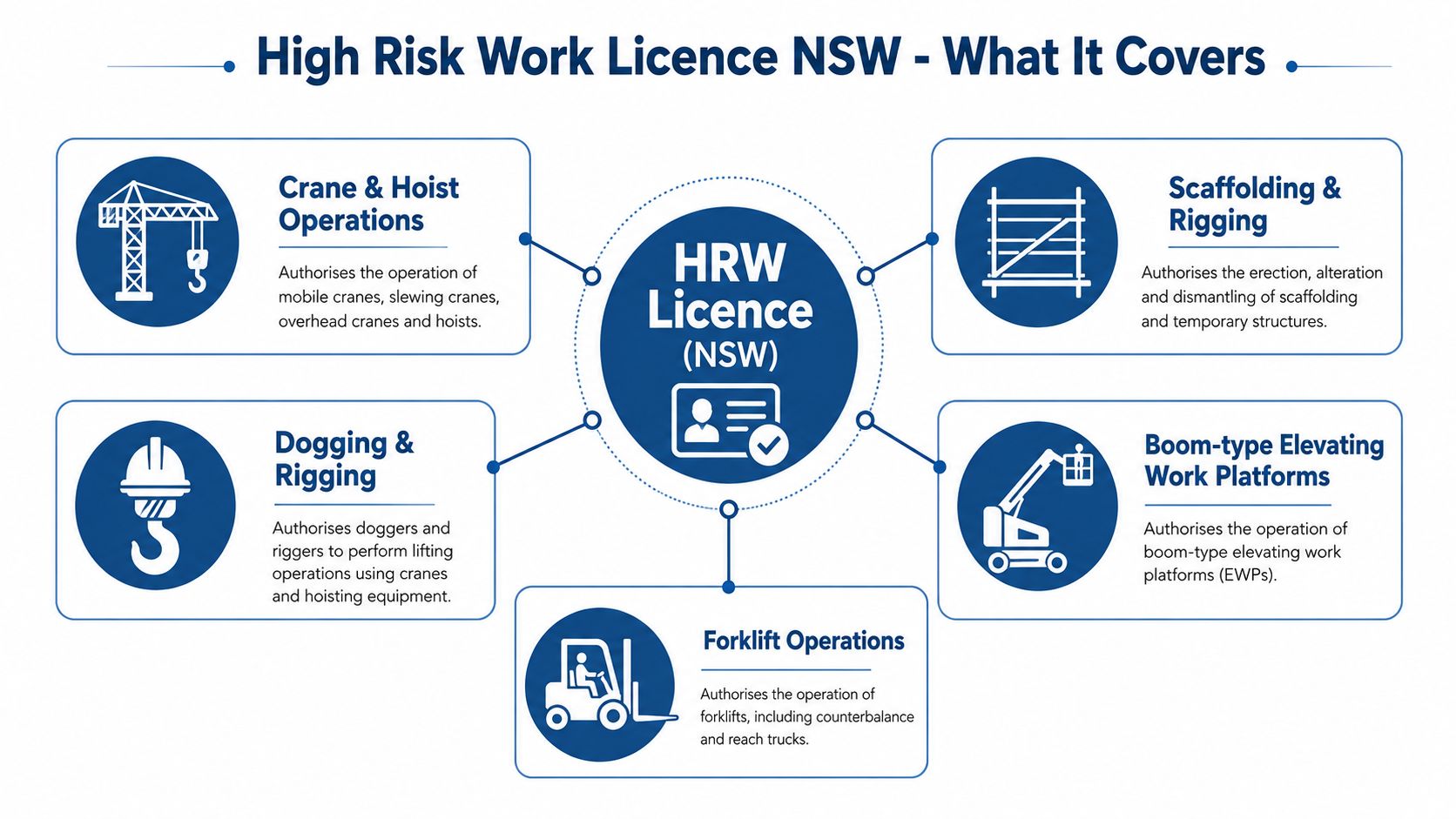
A lot of people hear “licence” and assume it works like a general safety card. It does not. In NSW, a High Risk Work Licence is a legal requirement for specific classes of work, and you cannot lawfully carry out that class unless you hold the relevant licence under the Work Health and Safety Regulation 2017. SafeWork NSW also notes these licences are generally valid for 5 years, so this is part of your ongoing work life, especially if you move through construction, warehousing, rigging, dogging, scaffolding, or crane operations. High Risk Work Licences in NSW
Why the class matters before you touch the plant
The biggest mistake new applicants make is thinking one licence covers everything. It doesn't. HRW licensing is class-based, so the class on your licence has to match the work you're doing. If you hold one class but the job calls for another, you are not covered, even if you have spent time around the equipment before.
That is why trainers keep pushing people to identify the job first, then the class. A forklift role is not the same as crane operation. A scaffolding job is not the same as dogging. The licence follows the task, not the person's confidence with the machine.
Practical rule: if you cannot name the exact class before the assessment starts, you are probably not ready to book it yet.
The same logic applies on site. SafeWork NSW expects the correct class, current status, and available licence details if they are checked. Good employers and busy site supervisors keep copies and verify them before work starts. For construction businesses trying to keep crews moving, try Eden for your construction business as a way to keep enquiries and job calls organised while supervisors focus on compliance and site work.
A simple example helps. If you are aiming for boom-type EWP work over 11 metres, you need training and assessment for that specific class, not a general “work at heights” label. TP Training's own EWP training in Sydney sits in that practical lane, where the class, the job task, and the assessment all line up.
Eligibility, Age Rules and Documents You Need Before You Start
Before anyone gets near the practical assessment, they need to check the basics. The first is age. For NSW high risk work licensing pathways, applicants need to be old enough to meet the licensing requirements set by the regulator and to handle the language, literacy, and safety obligations that come with the work. If you're unsure whether you're ready, treat that as a signal to ask the RTO before you enrol.
Get your identity documents sorted early
Service NSW asks for 2 identity documents, with at least one photo ID. You need either 2 from List 1 or 1 from List 1 and 1 from List 2. Examples in List 1 include an Australian passport, Australian birth certificate, certificate of registration by descent, ImmiCard, or Aviation and Maritime Security Identification card. List 2 includes Medicare and some Centrelink or veteran concession cards. Service NSW high risk work licence application
That sounds simple, but many first-time applicants lose time due to a name mismatch, an expired card, or a missing document holding up the paperwork after training. I tell students to gather the documents before the course starts, not after they pass.
If you're building your student admin at the same time, the USI setup guide is worth sorting alongside your ID because training enrolments often run smoother when your details are already consistent.
A useful course example is Tlilic0005 Elevate Work Platform Licence To Operate Boom Length 11M Or More Ewp, which TP Training delivers with practical, nationally recognised training and hands-on learning across NSW. If boom-type EWP is the job you're chasing, that class needs to be matched to the paperwork from the start.
Trainer's advice: bring the identity documents you plan to use to enrolment, not a different set you'll “fix later”. Later usually costs time.
Training and Assessment with a Registered Training Organisation
A high risk work licence doesn't come from work experience alone. You need structured training and a formal assessment through a Registered Training Organisation, because the system is built around consistent competency, not just time on the tools. That matters in high-risk environments where a shortcut with a load, sling, or boom can affect everyone on site.
What happens in the training room and on the practical yard
The usual flow is theory first, then supervised practical work, then the assessment. The theory covers safe operation, hazards, limits, and the specific rules around the class you're pursuing. The practical side gives you time with the plant, controls, and operating sequence before an assessor watches you demonstrate competence. That's why informal experience isn't enough. The regulator wants evidence that you can do the task safely in the class you're applying for.
A statement of attainment is the formal proof that you've completed the required training and assessment. It's the document that enables the SafeWork application step. Without it, you're not at the licence stage yet.
SafeWork Australia says you must lodge your licence application within 60 days of receiving that statement of attainment or equivalent. SafeWork Australia licence timing
For people comparing industries, the same disciplined approach shows up in other regulated training too, including Australian security officer courses, where the path also depends on structured competency and compliance rather than casual experience.
What the pace of training usually feels like
Some students move quickly because they already know the equipment. Others need more time on controls, load handling, or site communication. The exact pace depends on the class and your starting skill level, but the key is not speed. It's being ready to demonstrate the task safely and consistently on assessment day.
Short version: the RTO gets you competent, the assessor confirms it, and the statement of attainment opens the licence application window.
If you're lining up plant-based training in NSW, TP Training's excavator course guide is a good example of how practical training is framed around real work tasks, not just classroom theory.
Licence Classes Available in NSW and How to Choose the Right One
This is the point where many applicants stop and ask, “Which licence do I need?” The answer depends on the task, because HRW licensing in NSW is class-based, not a general permit that covers everything. SafeWork Australia separates the classes, and SafeWork NSW expects you to complete the training and assessment for the specific class you are applying for. High risk work licence classes
Match the job role to the class
Start with the work you will do on site, then match that task to the class, then book the right training. That order saves a lot of confusion.
| Common NSW High Risk Work Licence Classes | Job role | HRW class | TP Training course link |
|---|---|---|---|
| Boom-type EWP over 11 metres | Elevated work platform operator | Boom-type EWP | Tlilic0005 Operate Work Platform Licence To Operate Boom Length 11M Or More Ewp |
| Dogging | Dogman or dogging support role | Dogging | Cpccldg3001 Perform Dogging Licence Course And Training In Sydney |
| Telescopic handler work | Material handler operator | Telescopic handler | Telescopic handler license |
A licence class should follow the actual job, not the job title on a roster. If a supervisor says you will be slinging loads for a crane crew, dogging is the class to check first. If the job is operating a boom-type EWP on a construction site, the boom-type EWP class is the one to compare against the task. If the role is handling loads with a telescopic handler, use the telescopic handler pathway rather than assuming a generic plant ticket will cover it.
Not every site title lines up neatly with one class name, and that is where applicants get caught out. Forklift work is different from crane work. Scaffolding sits in its own class family. Rigging has separate levels as the work becomes more complex. If you are moving between plant work and support work on the same site, ask which class matches the task you will perform, not the department name or the machine brand.
Why one machine can still need the wrong class
That sounds odd until you see it on site. A worker might say they already use similar equipment, but similarity does not make the class interchangeable. The licence has to match the task, and the training has to match the class.
The same rule applies when the role shifts during the job. A telescopic handler can be used in more than one way, but the licence pathway still depends on how it is being operated. TP Training's telescopic handler licence guide is a useful example of how one machine type still needs the right class decision before assessment starts. A person who spends part of the week on load movement and part of the week on site support should still confirm the exact class before enrolling, because the assessor will test the task, not the general familiarity.
Good rule of thumb: if the supervisor names a task, ask for the class name before you enrol.
That one step keeps people from turning up to the wrong course and helps employers avoid sending a worker down the wrong assessment path. In NSW, matching the class to the job is what puts you in the right training stream from the start.
Applying to SafeWork NSW Through Service NSW
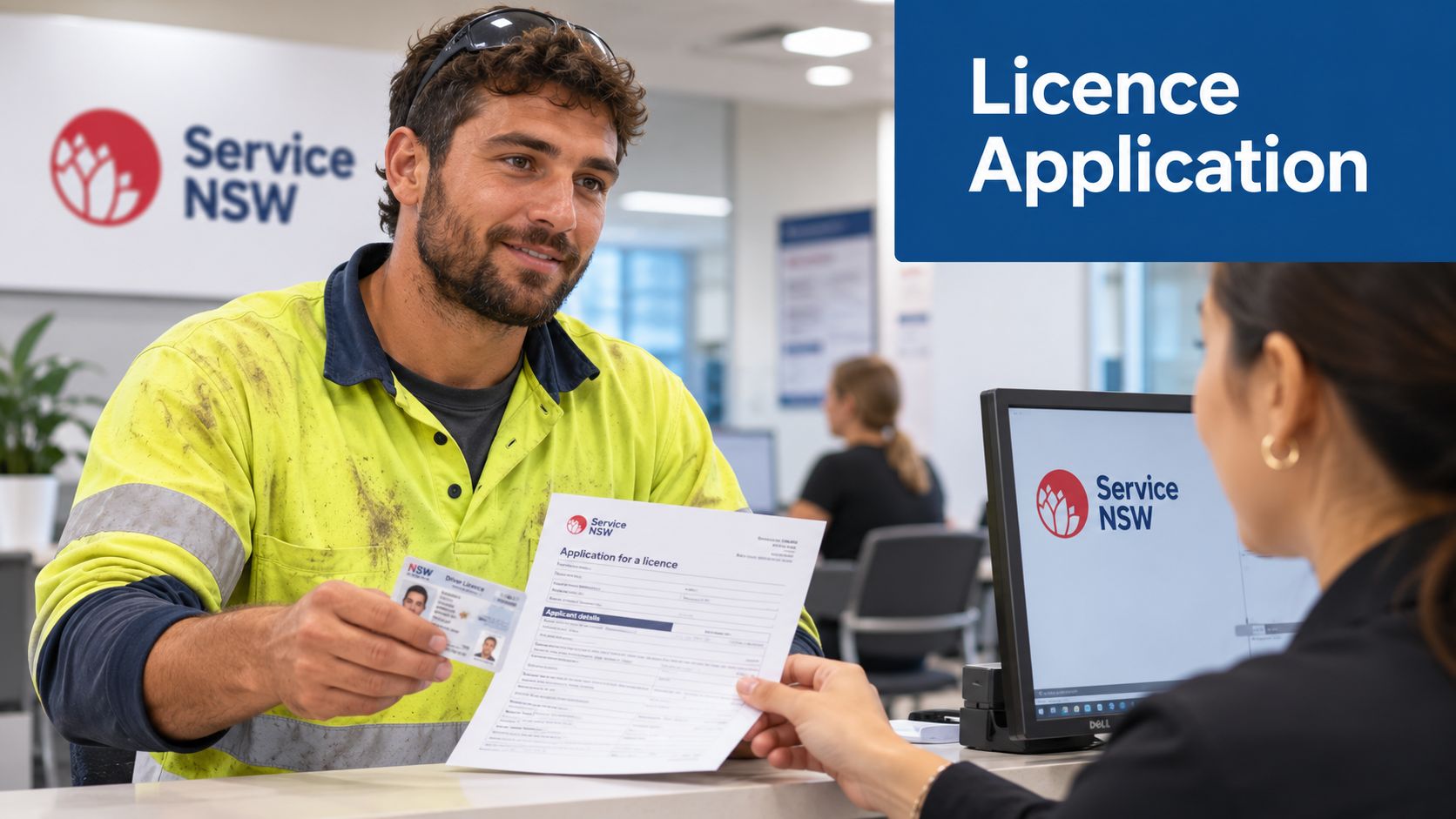
Once the training and assessment are done, the licence itself comes through the NSW licensing process, not the classroom. The application is lodged through Service NSW, and the identity check has to line up exactly with your documents. If your name, date of birth, or photo details don't match, fix them before you submit.
What to expect at the application stage
Start with the statement of attainment, then complete the application with your identity documents and personal details. Service NSW handles the identity verification step, and the final licence card includes your photo. If you're applying for multiple classes over time, keep your details consistent so the records stay aligned.
SafeWork NSW notes that if someone gets a licence in 2022 and adds another class in 2023, both classes still expire in 2027, because the new class shares the original expiry date. SafeWork NSW high risk work licences
That matters more than people realise. Adding a class later doesn't reset the whole clock. It follows the original cycle, so your renewal planning needs to track the first issue date, not just the last course you passed.
A practical way to manage this is to keep one record with the class name, issue date, and expiry date for each licence card. That helps on busy job sites where supervisors may ask to see proof before work starts. It also prevents a nasty surprise when you assume a new class bought you a fresh five years.
If you're maintaining other compliance records too, articles on compliance forms are useful background for keeping paperwork tidy across training, site access, and renewals.
Common Mistakes That Fail Assessments or Stall Applications
A lot of HRW problems start before anyone touches the equipment. An applicant turns up thinking the practical test is just a formality, then gets caught out by a missed check, a rushed setup, or an application that was left too late to lodge cleanly. The safer approach is to treat assessment day like a real work task, because that is how assessors read it.
The site mistakes assessors notice first
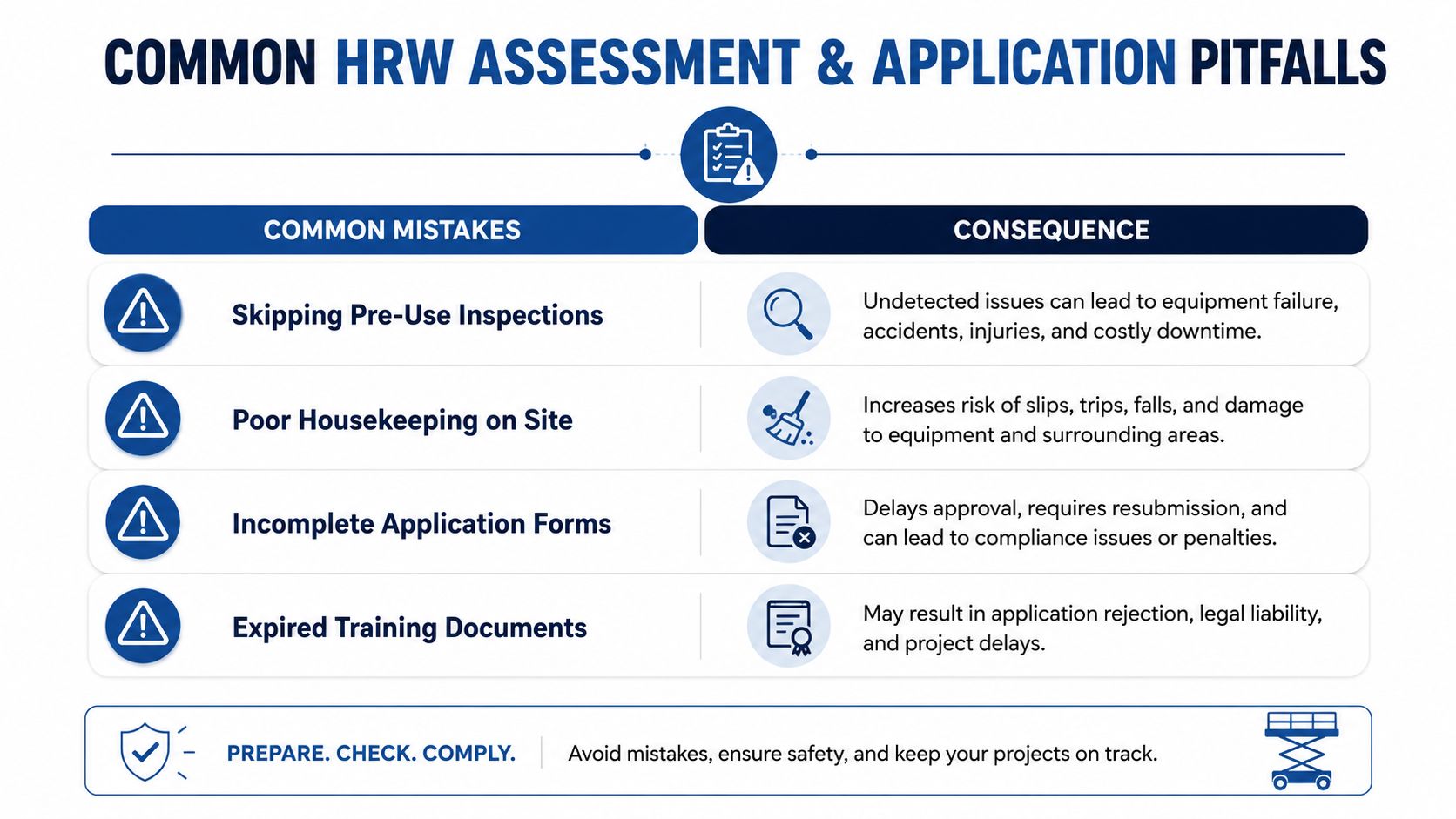
The first thing many assessors look for is whether you do a proper pre-use inspection and take time to familiarise yourself with the plant. If you skip controls, ignore limitations, or start operating before you understand the machine, you show that the safe routine has not been built yet. SafeWork Australia licence rules sit behind that approach, because safe work starts before the equipment moves.
Poor housekeeping is another early warning sign. Slings left in the wrong place, tools scattered through the work area, or obstructions that create a hazard all tell the assessor the task is not under control. Misreading load limits or using unsafe dogging and slinging methods creates the same concern. The simplest fix is repetition, practise the exact sequence with your trainer until it feels familiar, then slow down on assessment day and talk through what you are doing so the assessor can follow your decisions.
A first-time applicant can also trip over classes that sound similar but are assessed differently. A boom-type EWP class is not the same as a forklift or dogging class, and the skills the assessor wants to see are tied to the plant, the load, and the job setup. If you have moved through multiple classes during training, keep the assessment focus clear for the class in front of you instead of relying on general site experience. That is where people sometimes drift into old habits and lose marks on the wrong task.
The application mistakes that slow everything down
On the admin side, the usual problem is poor timing. If you leave the application too long after getting your statement of attainment, the paperwork can stall before it is lodged. If an HRW licence is not renewed within 12 months after expiry, the worker has to complete training and assessment again before lodging a new application.
Plain advice: don't assume the paperwork can catch up with the work. In HRW, the order matters.
Details that do not match across forms create another avoidable delay. Expired identity documents, an incomplete application, or a contact record that differs from the rest of your paperwork can slow the process after the practical side is already done. Keep your documents, contact details, and USI checked before you submit anything. If you want a broader admin mindset, the articles on compliance forms are useful for seeing how supervisors expect records to stay current and traceable.
TP Training applicants who are also comparing other pathways can use the traffic controller course price page as a simple example of how course information, admin steps, and enrolment details sit together in one place.
Costs Timeframes Renewal and Your Next Steps
The NSW high risk work licence system runs at scale. The state government has estimated 75,000 to 100,000 high risk work licence transactions occur each year, and it said digitising renewals would benefit around 425,000 current licence holders. NSW digital licences release That tells you this is a major, routine compliance system, not an occasional formality.
What the long-term rhythm looks like
Once you hold the licence, the main thing to remember is the renewal cycle. SafeWork NSW generally treats the licence as valid for 5 years, so you need a calendar habit, not a memory test. If you plan to add classes later, remember the expiry date stays tied to the original licence cycle, not the date you passed the new class.
If you're budgeting for training, compare the class you need with the training provider's practical format and the time you'll need for practice. I'm not going to guess a price here, because that changes by class and provider, but I am going to say that rushing to save time usually costs more in re-assessment or admin delays than doing it properly the first time.
If you're exploring other NSW training pathways in the same practical way, TP Training's traffic controller course price gives a good example of how many applicants compare training value, task fit, and compliance steps before booking.
Quick FAQ
Does overseas experience count? Not by itself. You still need the NSW licence pathway and the right assessment process.
Does the licence transfer between states? High risk work licensing is nationally recognised, but you still need to follow the NSW process when you're applying or renewing here.
What if I add a class later? The new class shares the original expiry date, so plan renewals around the first issue date, not the latest course.
If you're ready to get moving, book the class that matches your job, sort your identity documents early, and keep your renewal dates in one place. TP Training runs practical NSW training across multiple sites, and you can start by visiting TP Training to find the class that fits your work.

You may also like

Barista Course NSW: A Practical Guide to Getting Started