Get Your Telescopic Handler License: A 2026 Guide
You're probably here because the job's in front of you, the machine's on site, and someone has asked the obvious question: have you got the right telehandler ticket for this machine?
That's where a lot of workers get caught. They've done telehandler training, or they hold a forklift licence, or they've heard someone say a Gold Card is enough. Then they move between sites, switch attachments, or cross a state border and realise the rules aren't nearly as simple as they sound in the lunch shed.
A telescopic handler license in Australia sits in a confusing space between competency training, industry cards, and legal High Risk Work Licences. If you get that distinction wrong, you can end up turned away from site, non-compliant during an audit, or operating a machine you're not legally covered to use. For a broader look at how plant and trade rules fit together, this guide to trade licensing in Australia is also useful context.
Table of Contents
- Why You Need a Telescopic Handler Qualification
- Gold Card vs High Risk Licence Decoding the Rules
- Your Path to the Telehandler Gold Card RIIHAN309F
- What to Expect from Your Telehandler Training Course
- When You Need a High Risk Work Licence
- Book Your Course and Advance Your Career with TP Training
Why You Need a Telescopic Handler Qualification
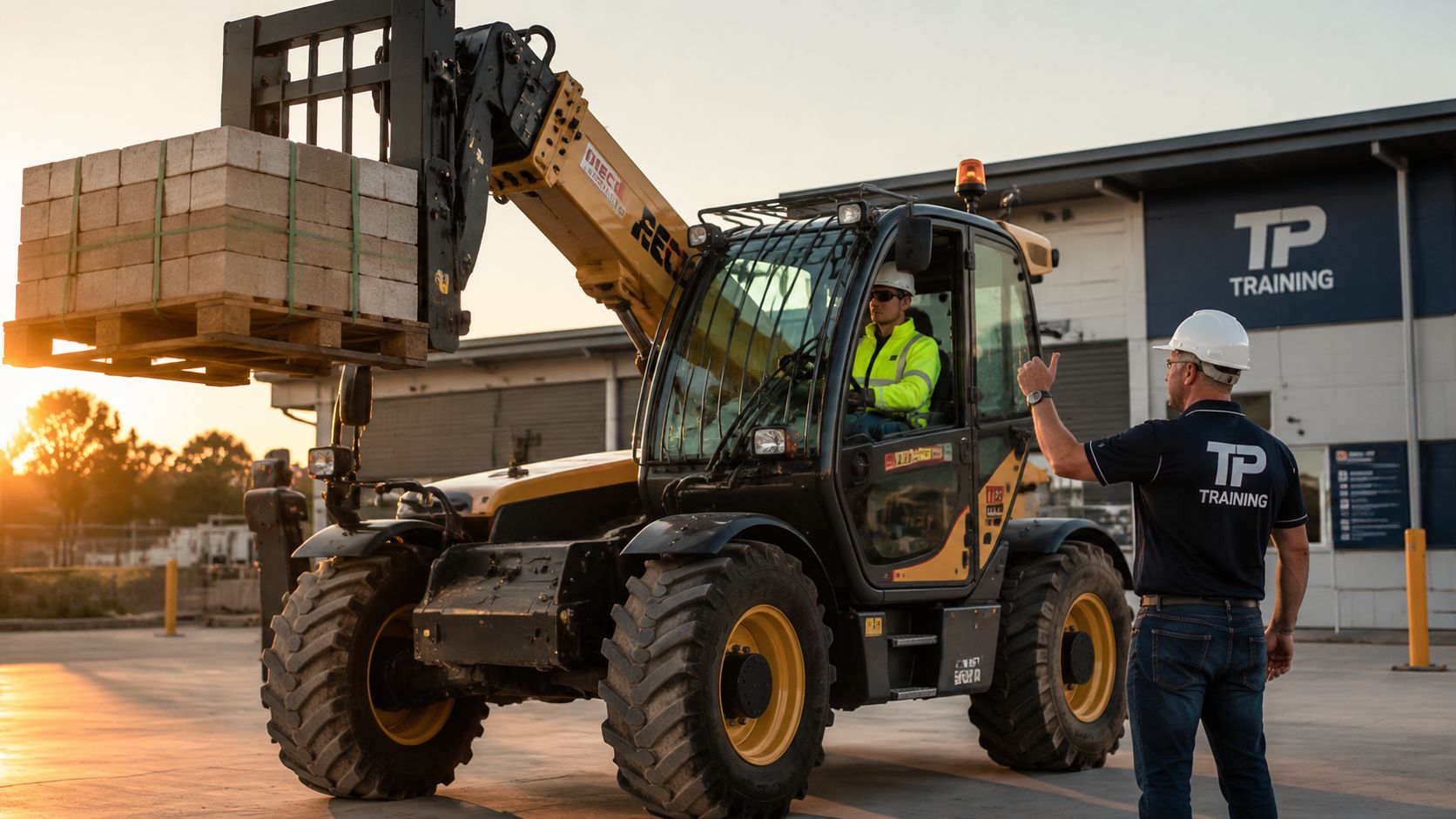
A telehandler isn't just another bit of site plant. It fills the gap between a forklift, a loader, and in some setups, crane-like lifting work. On one job it's unloading packs of materials. On another it's placing loads where a standard forklift can't reach. That flexibility is exactly why employers value competent operators.
It also explains why the qualification side gets messy. Workers often use one label for everything and say “telehandler licence” when they might mean a Gold Card, a High Risk Work Licence, or both depending on the machine and the state. That confusion causes real site problems because the paperwork that satisfies one task won't always satisfy another.
Why employers care about the right ticket
On a live construction or civil site, the telehandler operator usually works around deliveries, suspended loads, pedestrians, and changing ground conditions. Employers don't just want someone who can move the machine forward and back. They want someone who understands pre-start checks, stability limits, attachments, and where the legal boundaries sit.
That's why having the right qualification makes you more useful. You're not just another labourer who can jump in the cab. You're the person the supervisor can allocate when materials need to be moved efficiently and safely.
Practical rule: If your only plan is “I've driven one before”, you're not ready for a compliance check.
What the qualification really gives you
The value isn't only legal. Proper telehandler training builds the habits that stop common mistakes, especially around load charts, boom position, and attachment use. On busy sites, that's often the difference between a smooth lift and a near miss.
A correct qualification also gives you a clearer career path. Once you understand where the Gold Card ends and where High Risk Work licensing starts, you can choose the next ticket based on the work you want to do, not on site gossip.
Gold Card vs High Risk Licence Decoding the Rules
A common site failure starts in the office, not in the cab. An operator is booked for telehandler work, the supervisor asks for the ticket, and everyone assumes the Gold Card covers the job. Then the machine turns up with a jib, or the project is over the border in Victoria, and the operator cannot legally do the lift.
What the Gold Card actually is
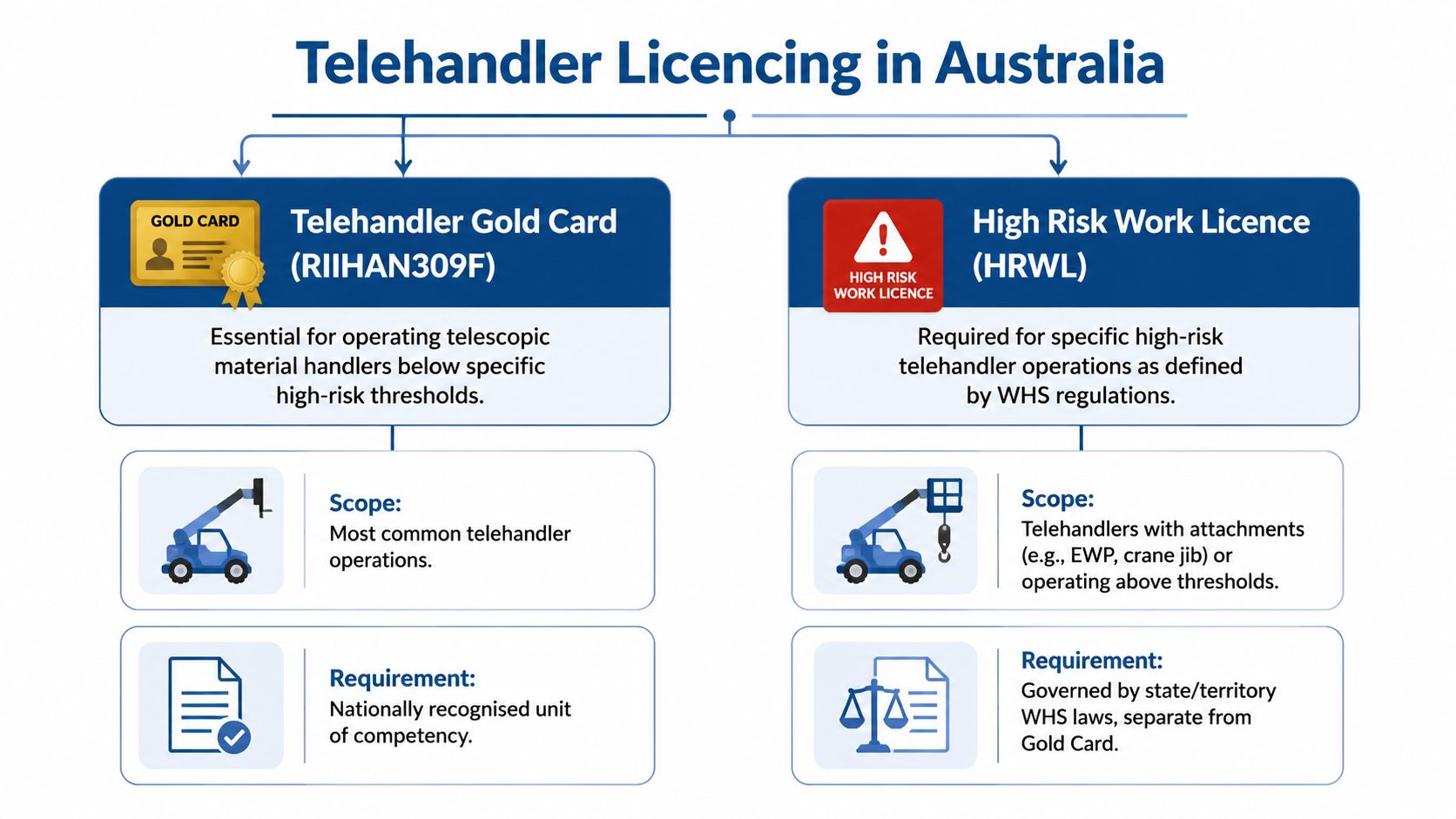
For non-slewing telehandlers, the usual starting point is RIIHAN309F Conduct telescopic materials handler operations. That unit sits behind the Telehandler Gold Card and is the industry-standard proof that an operator has been trained and assessed for non-slewing telehandler work.
The point that gets missed is simple. A Gold Card records competency. It does not automatically satisfy every legal licensing requirement that can apply to telehandler work.
If you're looking at training options in NSW, Riihan309F Operating Telescopic Material Handler Gold Card Course is one example of a practical, nationally recognised course delivered with hands-on learning. If the job also involves lifting people, not just materials, it helps to understand where EWP training in Sydney fits, because a personnel platform attachment can shift the compliance position fast.
When a legal HRWL steps in
A High Risk Work Licence (HRWL) applies when the telehandler is being used in a way that falls within high risk licensing rules. On site, that usually comes down to three things: whether the machine is non-slewing or slewing, the rated capacity, and the attachment fitted to it.
The state difference is where operators and employers get caught. As explained in the ACMT Gold Card guidance, Victoria and the ACT require a CN licence for telehandlers over 3 tonnes with any attachment, while NSW only requires the CN licence for non-slewing telehandlers over 3 tonnes when used with a jib attachment, not for standard fork work.
That is not a minor paperwork detail. It changes who you can lawfully put on the machine.
The NSW and Victoria trap
Here is the practical way to check the job before the operator arrives:
- NSW, non-slewing telehandler, standard forks. The Gold Card is commonly the competency requirement for routine operation.
- NSW, non-slewing telehandler, jib attachment on a machine over 3 tonnes. The work can move into HRWL territory and a CN class licence may be required.
- Victoria, non-slewing telehandler over 3 tonnes with attachments. The threshold is stricter, so relying on the Gold Card alone can leave the operator non-compliant.
- Slewing telehandler. Treat it as a separate licensing question. Do not assume ordinary Gold Card rules cover it.
I tell employers to check four things every time. Machine type. Capacity. Attachment. State.
That quick check prevents expensive mistakes. The course itself is rarely the cost problem. Lost time, stood-down operators, and a failed site audit are usually what hurt.
Your Path to the Telehandler Gold Card RIIHAN309F
For most non-slewing telehandler work, the starting point is the nationally recognised unit RIIHAN309F Conduct Telescopic Material Handler Operations. Under the TSHA framework, that is the course code mandated for Gold Card issuance, as stated in Why do I need a Gold Card 2025.
Start with the right paperwork
Before training starts, get your admin in order. The biggest delays are often simple ones. Missing ID, an incorrect name on enrolment records, or no USI can hold up the process before you even touch the machine.
If you need help setting that up, this guide on creating and managing your Unique Student Identifier covers the basics in a straightforward way.
A sensible enrolment check looks like this:
- Confirm the machine type you'll be trained for. Non-slewing telehandler competency is the usual base case.
- Check the provider status. For Gold Card issuance, the training needs to sit within the required RTO and TSHA-aligned framework.
- Match the training to your work. Fork work, jib work, and personnel platform work don't all sit under the same rules.
What you learn during RIIHAN309F
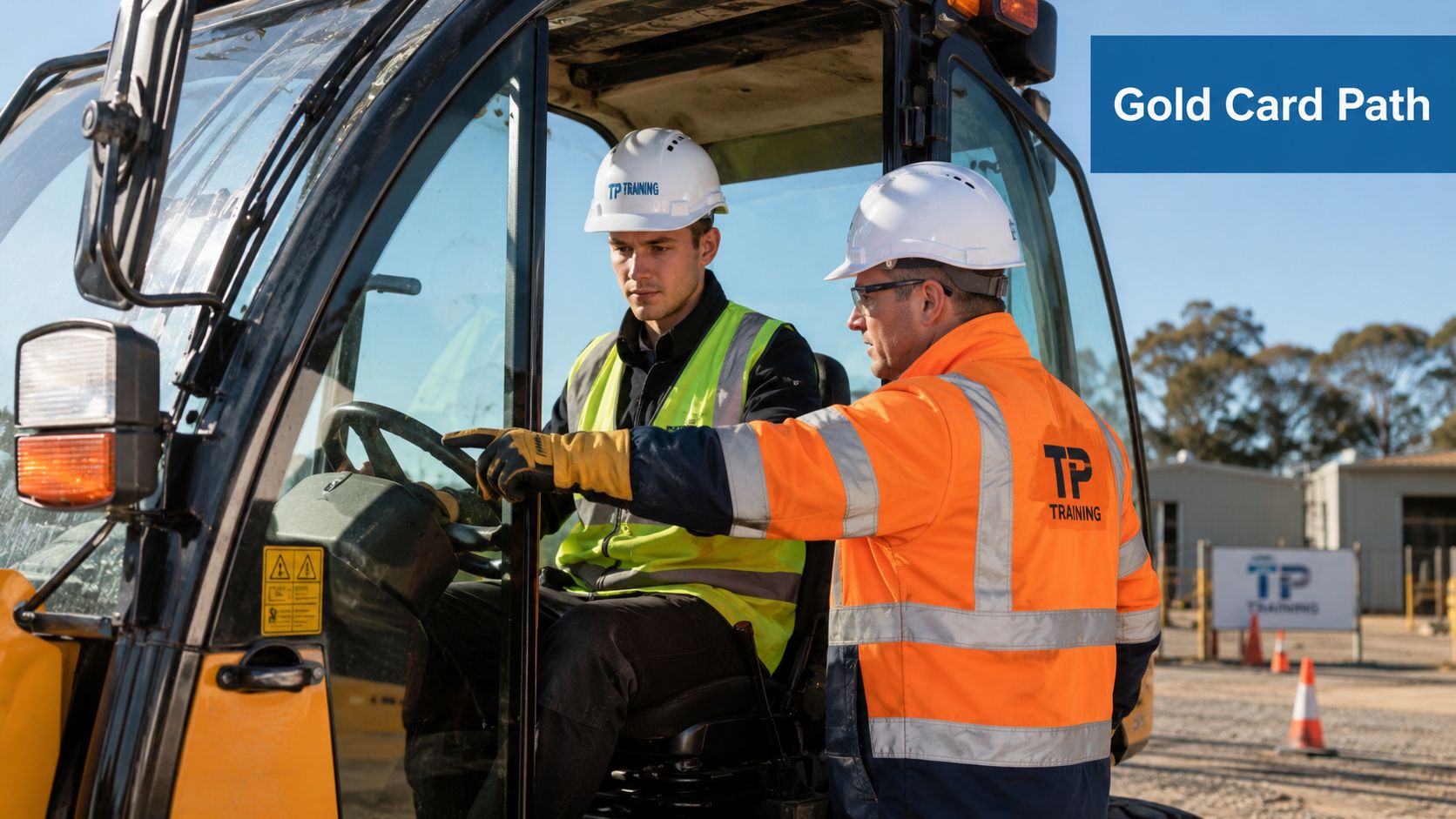
Good telehandler training isn't just cab time. It combines theory and practical skills so operators can make sound decisions under normal site pressure.
Expect the training to cover core areas such as:
- Pre-start inspections so you can identify obvious faults before operation.
- Safe operating techniques including travel, load handling, placement, and shutdown.
- Load charts and rated capacity because telehandler mistakes often start with poor interpretation of reach versus load.
- Worksite hazards such as ground conditions, overhead obstructions, exclusion zones, and interaction with other workers.
- Attachment awareness so you know when a change in setup also changes the compliance requirement.
A candidate who understands the load chart usually looks calmer in the practical assessment. They're making deliberate decisions rather than guessing what the machine will tolerate.
Assessment and related pathways
Assessment normally includes both knowledge and practical performance. The operator has to show they can inspect, plan, operate, and complete tasks safely. In real terms, assessors are looking for method, control, and judgement. Not speed.
Some workers then move into related high-risk pathways depending on the role. For example, if your work shifts toward loads, lifting support, or crane-related site coordination, Cpccldg3001 Perform Dogging Licence Course And Training In Sydney is another nationally recognised training pathway used across NSW for dogging work.
The main thing is to treat RIIHAN309F as the correct starting credential for non-slewing telehandler operation, not as a blanket licence for every telehandler job you'll ever be asked to do.
What to Expect from Your Telehandler Training Course
A labourer gets sent to operate a telehandler on Monday, then finds out on site that the employer expects a Gold Card, not just general plant experience. That mismatch is common. Good training clears it up early, shows what the unit covers, and makes it obvious where the line sits between standard non-slewing telehandler work and the jobs that trigger extra licensing in some states.
For RIIHAN309F, the course is usually delivered over 22 hours or 3 days including assessment. To receive the Gold Card, training must be completed through an RTO with TSHA affiliation. That card is the industry standard proof of competency for non-slewing telehandler operation, which is why employers across construction, civil, logistics, and rural work ask for it before they put an operator in the seat. If you have seen how other plant courses are structured, the format will feel familiar. The same practical rhythm shows up in this guide to an excavator training course in NSW.
How the course is usually structured
The first block covers the groundwork that prevents expensive mistakes later. Candidates go through operator responsibilities, site risk assessment, machine limitations, and the planning that has to happen before travel, lifting, or load placement starts. In training, people begin to understand that telehandler operation is not just driving. It is judgement under changing conditions.
Then the practical work starts.
Candidates spend time on pre-start checks, controls familiarisation, safe travel, load handling, placement, parking, and shutdown. A decent course does not rush this part because small habits show up fast in assessment. Rushed steering inputs, poor fork position, weak observation, and sloppy setup are the things assessors notice first.
The topics that usually separate a prepared candidate from an unsafe one are predictable:
- Load chart reading, because capacity changes with reach and boom position.
- Attachment use, because a different attachment can change both machine behaviour and the compliance position on site.
- Stability and terrain awareness, because side slope, soft ground, and poor load positioning cause more trouble than operators expect.
- Communication and exclusion zones, because telehandlers often work near spotters, trucks, scaffold, or pedestrian traffic.
RIIHAN309F Course Snapshot
| Attribute | Details |
|---|---|
| Course unit | RIIHAN309F Conduct telescopic materials handler operations |
| Typical duration | 22 hours or 3 days including assessment |
| Delivery requirement | Must be delivered by an RTO with TSHA affiliation for Gold Card issuance |
| Main outcome | Industry-recognised proof of competency for non-slewing telehandler operators |
What helps candidates pass
The candidates who perform well usually follow a repeatable process. They read the task, inspect the machine properly, set up with care, and keep checking the load and ground conditions instead of trying to look fast.
I tell people the same thing before assessment. Turn up ready to be coached. Previous machine time helps, but only if the habits are sound. Plenty of experienced operators struggle because they have picked up shortcuts that do not hold up under formal assessment.
Bring the right PPE, listen closely, and ask when a rule or machine function is unclear. Telehandler training rewards control, observation, and discipline far more than confidence alone.
When You Need a High Risk Work Licence
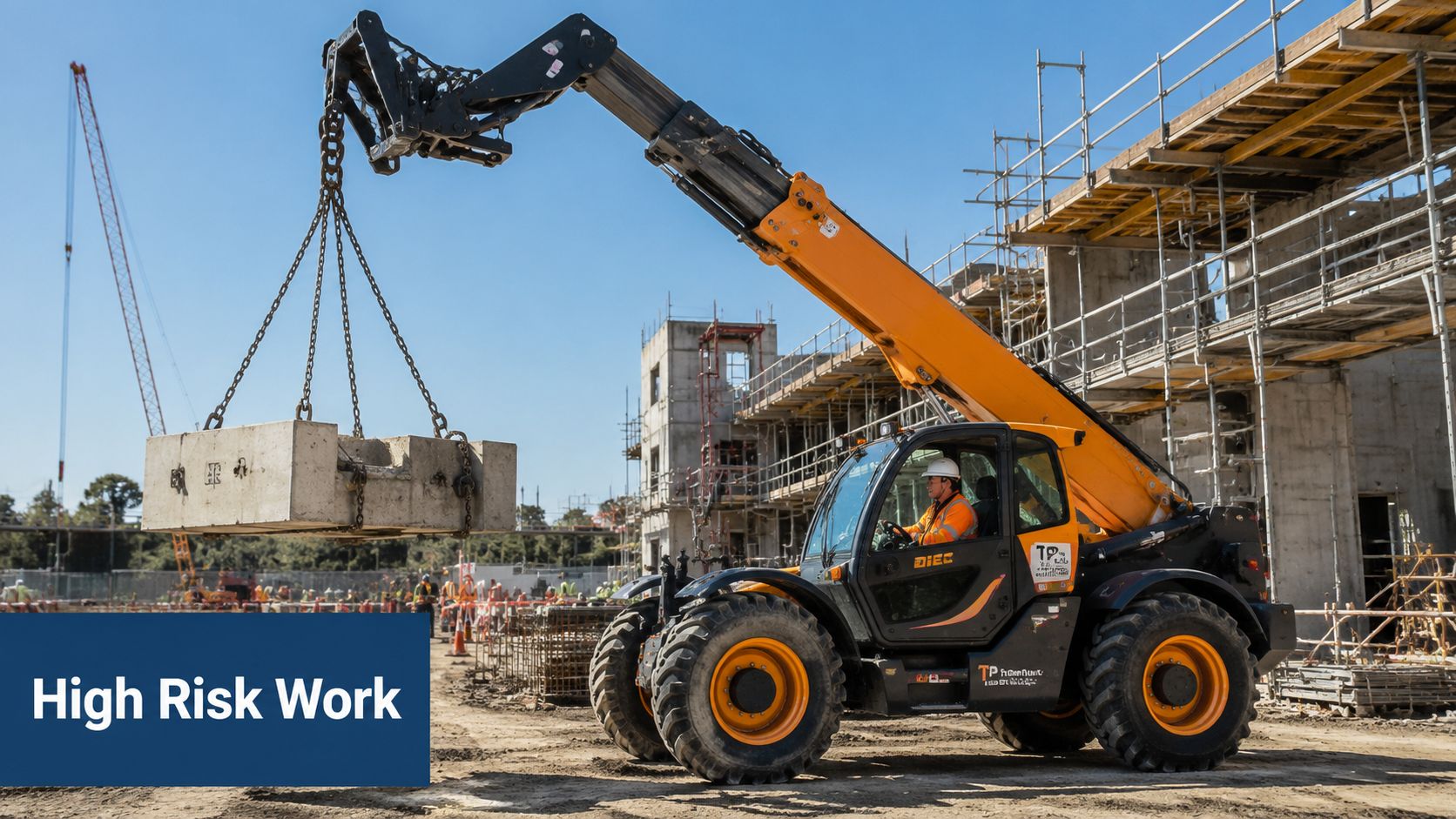
Some telehandler work sits well beyond the ordinary Gold Card level. When that happens, the legal requirement becomes a High Risk Work Licence, which means operators need to stop relying on assumptions.
Slewing telehandlers are treated differently
In Australia, a slewing telehandler requires an HRWL because it is treated as a slewing mobile crane. The required crane licence class depends on capacity: C0, C1, C2, or C6. That position is set out in the telehandler licensing and design guide.
This is one of the clearest lines in the whole licensing system. If the machine slews, you move out of ordinary non-slewing telehandler competency and into crane-class licensing.
The 11 metre work platform rule
There's another trigger that catches people. If a telehandler is fitted with a boom-type elevating work platform and the telescopic boom length is 11 metres or more, the operator must also hold a WP licence. That applies regardless of whether the telehandler is slewing or non-slewing, as outlined by WorkSafe Victoria's telehandler licensing guidance.
That threshold matters on real jobs because workers often focus on the telehandler itself and forget that the attachment changes the legal category of the work. If your role includes personnel access or work at height from a boom-type platform, the telehandler conversation quickly becomes an EWP licensing conversation as well. Related site risk issues often overlap with working at heights training, even though the licence classes are separate.
Attachment decisions matter
A practical way to think about HRWL triggers is this:
- Slew function present. Treat it as crane-class work and check the correct C-class licence.
- Personnel box or boom-type platform fitted. Check whether the 11 metre threshold triggers WP.
- State rules for non-slewing capacity and attachments. Don't assume one state's threshold applies everywhere.
- Different attachment, different legal question. Forks, jibs, and work platforms don't all sit under the same rule set.
If the attachment changes, stop and reassess the licence requirement. Don't carry yesterday's answer into today's setup.
That's the safest habit an operator can build.
Book Your Course and Advance Your Career with TP Training
Once you've sorted out whether you need a Gold Card, an HRWL, or both, the next step is choosing a training provider that delivers the course in a practical format and in a location you can get to.
TP Training delivers nationally recognised, hands-on training across NSW training centres including Penrith, Burwood, Auburn, Parramatta, and Sydney CBD. For workers who want to build telehandler competency for non-slewing operations, that local access matters because it makes it easier to book, attend, and complete the training without overcomplicating the process.

The better approach is simple. Work out the machine type you'll use. Confirm whether your work is standard non-slewing telehandler operation or whether an attachment or state rule pushes you into HRWL territory. Then enrol in the course that matches the actual job, not the label someone used on site.
That's how operators avoid wasted time and wrong-ticket problems. It's also how employers build crews that can step onto site with the right documents and the right practical skills from day one.
If you're ready to sort out the right telescopic handler license path for your role, TP Training can help you choose the correct course and book practical training at a NSW location that suits you.

You may also like
CPR Course Penrith: Book Your Training Today
Safety & Health Policy: A Guide for Australian Employers