
Yellow Card Traffic Controller Course: Your NSW Guide 2026
You've probably done the initial digging already. You've looked at traffic control work, seen the Blue Card mentioned everywhere, and then hit a wall when the Yellow Card comes up. One provider makes it sound like a simple next step. Another lists documents but says little about the job itself. Then someone on site tells you that having the card and being ready for the work are two different things.
That confusion is common in NSW because the Yellow Card traffic controller course sits right in the middle of compliance, practical site skill, and career progression. It's the point where traffic control stops being just about holding a bat and starts becoming about reading a setup, placing devices correctly, coordinating workers, and responding when site conditions shift.
You don't need more hype. You need straight answers on what the Yellow Card is, who it's for, what it costs, what catches people out, and how to avoid wasting time on a course they're not yet ready to pass.
Table of Contents
- What Is a Yellow Card in Traffic Control?
- Blue vs Yellow vs Red Card Explained
- Real Prerequisites for the Yellow Card Course
- What to Expect in Your Yellow Card Training
- Navigating the SafeWork NSW Live Assessment
- Career Benefits and Salary with a Yellow Card
- Start Your Yellow Card Journey with TP Training
What Is a Yellow Card in Traffic Control?
If you already hold a Blue Card and you're asking how to move beyond entry-level traffic control, the Yellow Card is usually the next serious step. It isn't a nickname for a general traffic ticket. It's a specific qualification tied to a specific site role.
In NSW, the Traffic Management Implementer Course, commonly called the Yellow Card, corresponds to the nationally recognised RIISS00055 Traffic Management Implementer Skill Set. Completing it is a prerequisite for obtaining the SafeWork NSW Traffic Control Work Training Card needed for legal employment in this role, as outlined by Bondi Training's RIISS00055 course information.
What the Yellow Card actually authorises
A lot of new workers think the Yellow Card is just “more traffic control”. It's more accurate to say it authorises a different kind of responsibility.
The Yellow Card sits on the implementation side of the job. That means working from an approved traffic management plan and putting that plan into operation on site. You're not only reacting to cars, pedestrians, and plant movement. You're making sure the site setup matches the approved arrangement and stays safe as conditions change.
That distinction matters on real jobs. A worker who can direct traffic is useful. A worker who can help implement and oversee the traffic setup is useful at a different level.
Practical rule: If the plan already exists and someone needs it set out correctly on the ground, that's Yellow Card territory.
Why people step up to it
The move into a Yellow Card traffic controller course usually comes from one of three situations:
- You already work in traffic control and want more responsibility on civil or construction sites.
- You want better site utility because employers often need workers who can do more than one task safely.
- You're aiming for a longer-term pathway into supervision, implementation, or eventually planning work.
For many workers, the Yellow Card is where the job starts to feel less like a single task and more like a trade pathway. You need to read the site, communicate clearly, position equipment properly, and stay disciplined when the road environment changes.
If you're still sorting out the broader NSW pathway before stepping up, this guide on how to become a traffic controller gives useful background on the entry point.
Blue vs Yellow vs Red Card Explained
A lot of course bookings go wrong at this point. Someone says they “need the yellow card” when the job they have lined up only involves stop/slow bat work, or they assume Yellow lets them change a setup on the fly when that authority sits higher up. On site, that misunderstanding creates delays, rework, and sometimes a failed assessment pathway later because the candidate never understood what the role really covers.
The three cards side by side
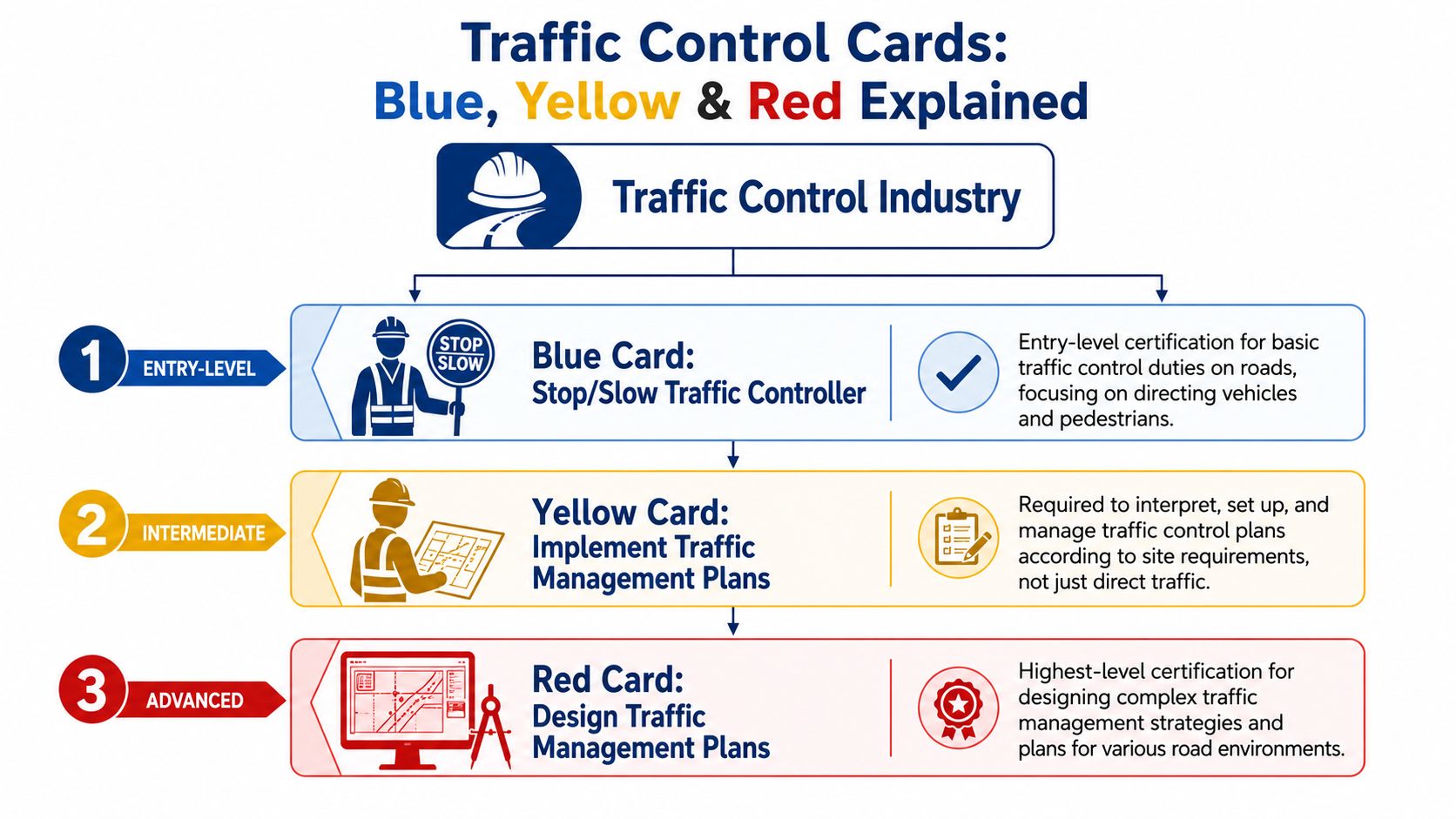
The clearest breakdown is by site responsibility, not by colour alone:
| Card | Main role | What it allows |
|---|---|---|
| Blue Card | Traffic Controller | Control traffic with a stop/slow bat and manage road users at the work area |
| Yellow Card | Implementer | Set out and implement an approved traffic guidance scheme or traffic management plan on site |
| Red Card | Planner | Prepare, select, amend, or authorise the traffic management plan |
The middle card is where many workers get caught out. Yellow is not just “Blue plus a bit more.” It is the step where you are expected to understand the approved setup, place signs and devices correctly, brief the crew, and recognise when site conditions no longer match the plan.
What this means on a live worksite
Blue Card work is front-line control. You are usually positioned where vehicles, pedestrians, plant, and workers intersect, and your job is to keep movement safe and orderly.
Yellow Card work adds implementation responsibility. On a civil job, that can mean checking the plan, confirming sign spacing, laying out tapers, placing barriers, and making sure the site matches the approved design before traffic is put through it. It also means knowing your limit. If the drawing no longer suits the conditions, a Yellow Card holder does not redesign it on the spot.
That line matters.
Red Card authority sits at the planning level. If lane widths change, access points shift, or the work method creates a setup the approved plan does not cover, the planner deals with that. Good crews respect that separation because it keeps accountability clear and reduces risky guesswork.
Where the Yellow Card fits in your career
Yellow is the practical next step for workers who already understand live traffic control and want broader site responsibility. Employers often look for people who can do more than stand on the bat. They need workers who can arrive early, read the plan properly, set the job up, and work with the supervisor and crew without constant correction.
It also links directly to the part many providers gloss over. Getting trained is one step. Being ready to perform the implementer role under assessment conditions is another. The workers who do well usually already have some exposure to real site setups, equipment placement, and the pace of live roadwork. That is why many candidates compare the entry-level and implementation pathway together before booking, using guides such as the Traffic Control Combo Course Blue & Yellow Card.
If your goal is longer-term progression, the sequence is straightforward. Blue handles control. Yellow handles implementation. Red handles planning. The mistake is treating them as interchangeable, because on site they are not.
Real Prerequisites for the Yellow Card Course
Many often get tripped up. They focus on the booking page and ignore the readiness question. The paperwork matters, but so does the practical background.
The formal entry requirements
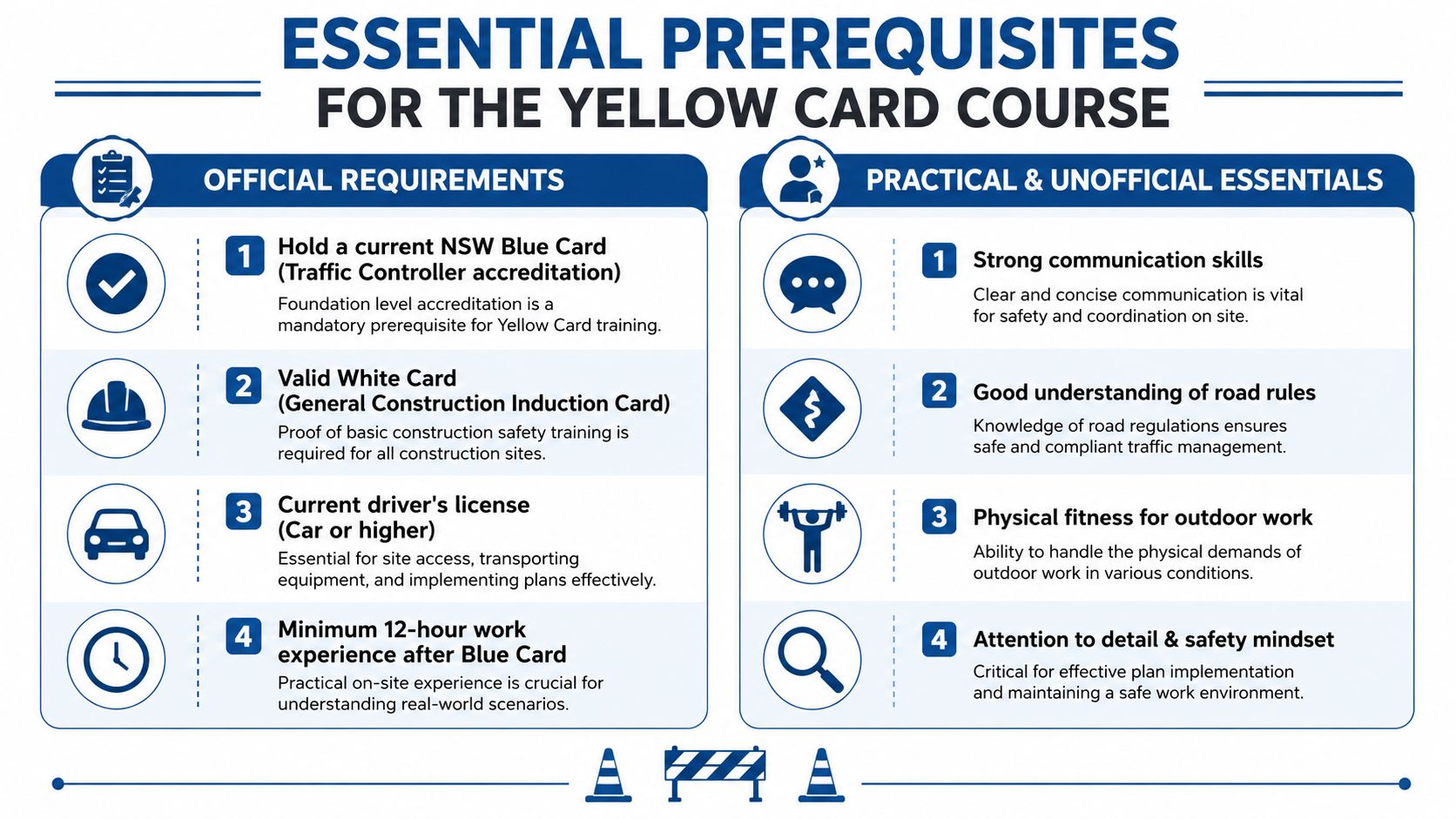
In NSW, candidates enrolling in a Yellow Card course must be at least 17 years old, hold a current SafeWork NSW White Card, and provide 100 points of verified Australian identification. No photocopies or digital pictures of ID are accepted, according to 123 Training Solutions' enrolment guidance.
That sounds straightforward, but admin issues still cause plenty of stress on course day. The main problems are usually basic:
- Incomplete ID: You need the full 100 points using accepted Australian documents.
- Wrong format: Printed copies and phone photos won't do the job if originals are required.
- Missing White Card: Traffic control sites are treated as construction sites, so this is not optional.
If you still need that construction induction requirement, the White Card Training Course provides practical, nationally recognised training with experienced trainers and hands-on learning across NSW. It also helps to review broader workplace safety certifications if you're building your site-ready documents from scratch.
The part many guides gloss over
The bigger issue isn't paperwork. It's experience.
A Yellow Card course is designed for people with traffic control experience, not complete beginners. That catches out new entrants who assume they can move straight from no site background into implementation work. In practice, that assumption usually leads to poor confidence, weak radio calls, bad setup decisions, and trouble under assessment pressure.
One source in the NSW training space highlights a commonly missed point. Many workers don't realise there is a 12-month on-site experience expectation before a Blue Card holder can legally and competitively enrol in the Yellow Card pathway, and that confusion has led to wasted enrolment fees for people who weren't ready for the demands of the course, as discussed in DLI Training's industry guidance.
What makes someone genuinely ready
Readiness usually looks less dramatic than people expect. It's not about having every answer. It's about already understanding how a site behaves once traffic, plant, weather, pedestrians, and instructions start colliding.
A candidate is usually in a stronger position when they can already do the following with some confidence:
- Read site movement quickly: You notice where vehicles hesitate, queue, or cut corners.
- Follow instruction without drifting: You don't improvise around a plan just because the site gets busy.
- Communicate cleanly: Short, accurate radio and verbal communication matters more than sounding confident.
- Work safely outdoors: You can stay alert while standing, walking, lifting, and adjusting through changing conditions.
The Yellow Card isn't hard because the paperwork is hard. It's hard because site implementation punishes hesitation and sloppy judgement.
What to Expect in Your Yellow Card Training
Your first Yellow Card day usually resets a few assumptions fast. Candidates often arrive expecting a paperwork course and leave realising the standard is much closer to supervised site decision-making.
In NSW, providers commonly run the Yellow Card as a 3-day block. That usually means two classroom-based days and a practical assessment component. The pace is quick, and the people who cope best are the ones who already understand how a live work zone behaves once vehicles, workers, plant and public traffic start interacting.
A trainer is not just checking whether you can repeat terms from the learner guide. They are checking whether you can read an approved setup, follow the sequence properly, communicate clearly, and keep the site aligned with the plan when conditions change.
If you want a broader view of how metro courses are usually delivered, this overview of traffic control training in Sydney gives a useful outline.
How the training is usually structured
The early sessions focus on plan reading and traffic guidance material. You work through what each sign, cone, barrier and control device is doing on site, where it belongs, and what cannot be adjusted without approval. That part matters because many Yellow Card mistakes start with casual changes to a setup that looked minor at the time.
The practical side builds from there. Candidates are asked to place devices in order, maintain safe spacing, communicate with the crew, and keep checking whether the installation still matches the approved arrangement. Good training feels hands-on because the job is hands-on.
LLN also matters more than some applicants expect. You need to read written instructions, interpret diagrams, complete paperwork, and follow multi-step directions without missing part of the sequence. If that foundation is weak, the course becomes hard very quickly.
What competent training should prepare you for
A solid Yellow Card traffic controller course should prepare you to do the work in the order the site demands, not the order that feels easiest in class.
That usually includes:
- Reading approved plans accurately: You need to work from the arrangement provided, not memory or guesswork.
- Placing devices correctly: Sign and cone placement affects sight lines, speed reduction, lane guidance, and worker protection.
- Working with a crew: Implementation is a team task. Poor radio calls or vague verbal instructions slow everyone down.
- Checking the setup after placement: A layout can look right from one angle and still be wrong for approaching traffic.
- Responding to site changes: Pedestrians, parked vehicles, weather, deliveries, and plant movement can all affect the control area.
What catches learners out
The difficult part is rarely the physical side alone. It is maintaining accuracy while several tasks compete for attention at once.
A candidate might be carrying equipment, watching traffic approach, listening for instructions, confirming distances, and checking the plan at the same time. That is why the earlier on-site experience requirement matters in practice, not just on paper. People with real exposure to work zones usually settle into the sequence faster because they have already seen how quickly a setup can drift if communication slips or someone takes shortcuts.
I tell applicants the same thing every week. The course is short. The judgement standard is not.
Training should leave you able to set out a site safely, explain what you are doing, and correct errors before they create a risk. That is the level the Yellow Card expects.
Navigating the SafeWork NSW Live Assessment
A lot of candidates feel confident right up until the assessor starts watching the live setup. Then the pace changes, the radio starts mattering, and small lapses become visible straight away.
The live assessment is where SafeWork NSW checks whether you can apply the role on site, under pressure, with the same discipline the job requires in real traffic conditions. That is also where the earlier on-site experience requirement stops being a paperwork issue and starts affecting results. Candidates who have spent time around active worksites usually read the flow of the task faster. Candidates who have only seen the process in training often hesitate at the wrong moment.
TP Training notes that first-attempt failures do happen in this stage, and a common pattern is poor radio communication combined with weak hazard response under pressure. That lines up with what trainers see in practice. People rarely fail because they forgot a theory term. They fail because their communication gets loose, they miss a developing risk, or they lose the sequence once the site becomes busy.
Where candidates come unstuck
Assessors are watching for controlled performance, not just basic familiarity.
The common problems are predictable:
- Radio calls that are too long or unclear: If your message takes too long to say, the crew cannot act quickly.
- Late responses to hazards: Waiting an extra few seconds can turn a manageable issue into a safety problem.
- Poor task order: If devices, checks, and communication happen out of sequence, the setup starts to drift.
- Narrow focus: Some candidates lock onto one task and stop scanning the rest of the work area.
This is why I tell applicants to treat the live assessment as a worksite simulation, not a classroom test. The assessor wants to see safe judgement, clear communication, and steady execution while several things are happening at once.
How to prepare in a way that actually helps
Candidates usually prepare better when they keep it practical and repetitive.
| Focus area | What helps | What causes trouble |
|---|---|---|
| Radio use | Brief, direct calls with clear confirmation | Overexplaining, hesitating, or speaking too softly |
| Hazard response | Identifying movement and acting early | Seeing the issue but waiting too long |
| Site awareness | Regular scanning across the whole setup | Fixating on one device, one vehicle, or one instruction |
| Following instructions | Sticking to the approved arrangement and process | Improvising because the pressure rises |
If your radio work falls apart when you are rushed, train that first.
A simple standard helps. Speak clearly. Confirm what you heard. Act in order. Recheck the area. Repeat that sequence until it feels automatic.
What assessors usually notice first
They notice whether you can stay composed and usable on site.
That means listening properly, responding without rambling, and sticking to the approved method even when conditions shift. Candidates who pass usually make the job look controlled. Their calls are short. Their movements make sense. They correct small issues before those issues spread across the site.
Candidates who struggle are often not incapable. They are underprepared for the live standard. That is an important distinction, especially for people trying to move up from basic traffic control into implementation work. If you want a realistic picture of where that step can lead, this traffic controller salary guide for Sydney roles gives useful context on the career progression tied to stronger site capability.
Career Benefits and Salary with a Yellow Card
The case for doing the Yellow Card isn't abstract. It's about moving into work that carries broader responsibility and better earning potential.
In NSW, the Yellow Card course typically costs between $180 and $400, and certified Implementers can earn between $60,000 and $90,000 annually, according to this 2025 traffic control training cost breakdown.
Why employers value the qualification
A worker with implementation capability can do more than stand in position and wait for instruction. They can help set out the job properly, support compliance on site, and work with the approved traffic arrangement instead of only responding to the live stream.
That usually matters on projects where crews need flexibility. Civil construction, utilities, roadworks, and infrastructure jobs all rely on people who can understand the setup as well as the public-facing control side.
Looking at the trade-off clearly
The cost side is manageable for most workers compared with many other construction-related tickets. The larger trade-off is responsibility.
You're stepping into a role where mistakes affect more than your own station. If the setup is wrong, the whole site can become harder to manage. If communication slips, the risk spreads quickly. That's why the higher salary range makes sense. The role asks for better judgement, better awareness, and more dependable execution.
Here's the practical comparison many workers make:
- Short-term view: It's another course fee, another assessment, and more pressure.
- Long-term view: It can open the door to broader site work and stronger annual income.
- Best fit: It suits workers who want to stay in traffic management and build responsibility rather than remain at the narrowest entry point.
For a broader discussion of pay progression in this field, this article on traffic controller salary and career opportunities in Sydney helps put the pathway into context.
What changes after certification
The biggest benefit isn't just the card itself. It's the shift in how you can be used on site.
You become more relevant to supervisors who need workers capable of implementing an approved arrangement. That can support movement into team-leading tasks, setup responsibility, and wider traffic management duties over time.
The Yellow Card won't replace reliability, site awareness, or work ethic. But it does give those qualities more room to pay off.
Start Your Yellow Card Journey with TP Training
The Yellow Card pathway makes the most sense when you treat it like a staged progression, not a shortcut. First, get the foundation right. Then build the site habits that make implementation work realistic. After that, train for the actual responsibilities, not just the paperwork.
That usually means a simple sequence. Start with entry-level traffic control capability. Get genuine on-site exposure. Build confidence with communication, awareness, and following approved setups. Then move into the Yellow Card traffic controller course when you're ready to handle implementation work under assessment conditions.
What helps candidates most
The workers who progress well usually do a few things differently:
- They don't rush the jump: They give themselves time to understand live site behaviour first.
- They practise communication: Radio discipline and short verbal instruction matter more than many expect.
- They prepare for the role, not just the class: They know implementation is operational work, not just course attendance.
- They sort their PPE early: Being organised with compliant gear removes stress on training and assessment days.
If you're reviewing PPE before practical training or live site work, it's worth looking at durable safety vest options that suit high-visibility roadside conditions.
Choosing a provider with the right delivery style
Delivery matters with this course because implementation skill doesn't come from theory alone. Candidates need trainers who can connect paperwork, site sequence, communication, and real-world judgement in a way that makes sense under pressure.
TP Training offers nationally recognised, practical, hands-on training across NSW training centres including Penrith, Burwood, Auburn, Parramatta, and Sydney CBD. For workers ready to move into implementation, choosing a provider that focuses on practical application can make the pathway clearer and the assessment standard less surprising.
The right next step depends on where you are now. If you're still missing the basics, fix those first. If you already have traffic control exposure and want to move up, the Yellow Card is often the qualification that turns site experience into broader responsibility.
If you're ready to move from entry-level traffic control into implementation work, TP Training offers practical, nationally recognised training across NSW with experienced trainers and hands-on delivery that matches the demands of live site work.

You may also like
CPR Course Penrith: Book Your Training Today
Safety & Health Policy: A Guide for Australian Employers