

How to Find Your White Card Number Fast
You've landed a job, the supervisor asks for your White Card number, and your wallet is suddenly missing the one card you need. That moment catches people out all the time. The good news is that this problem is usually fixable without much drama if you take the right path first.
The fastest results come from checking the places people usually forget, then going straight to the record-holder rather than guessing through old paperwork. If you work in construction or related site roles, it also helps to keep your safety documents organised alongside things like CPR, first aid and induction records, because they often get requested together. TP Training recently touched on that broader mix of site-ready documents in its piece on CPR, first aid, White Card and workplace safety certifications.
Table of Contents
- Introduction You Need Your White Card Number Now
- Your First Three Checks for an Instant Answer
- Contacting Your RTO The Most Reliable Method
- Using Your USI Transcript to Find the RTO
- Requesting an Official Replacement Card
- Conclusion Your Quickest Path Back to Work
Introduction You Need Your White Card Number Now
Individuals searching for how to find your White Card number aren't typically doing so out of idle curiosity. They need it for a site induction, payroll onboarding, labour hire paperwork or a same-day start. That pressure is what makes people waste time on the wrong method.
The usual mistake is jumping straight into broad internet searches, old text messages, or random state websites that don't identify your record from scratch. A better approach is simpler. Start with what you already have, then move to the organisation that issued or holds your training record.
If you still remember where and when you did the course, you're already in a strong position. If you don't remember the provider, your USI transcript is often the missing link that gets you back to the right RTO without guesswork.
Practical rule: If you're in a rush, don't start with a general web search. Start with your own records, then the training provider, then the state process for replacement.
The process usually comes down to three tiers:
- Immediate checks: wallet, email, files, phone photos
- Direct recovery: contact the RTO that delivered the course
- Official fallback: apply for a replacement through the relevant authority if needed
That order matters. It saves time, reduces back-and-forth, and gives you the best shot at getting the number you need without starting over.
Your First Three Checks for an Instant Answer
You get the call at 6:30 am. Site induction starts soon, and someone wants your White Card number before you can be cleared to start. In that situation, speed matters, but the right kind of speed matters more. A methodical five-minute check usually gets an answer faster than twenty minutes of random searching.
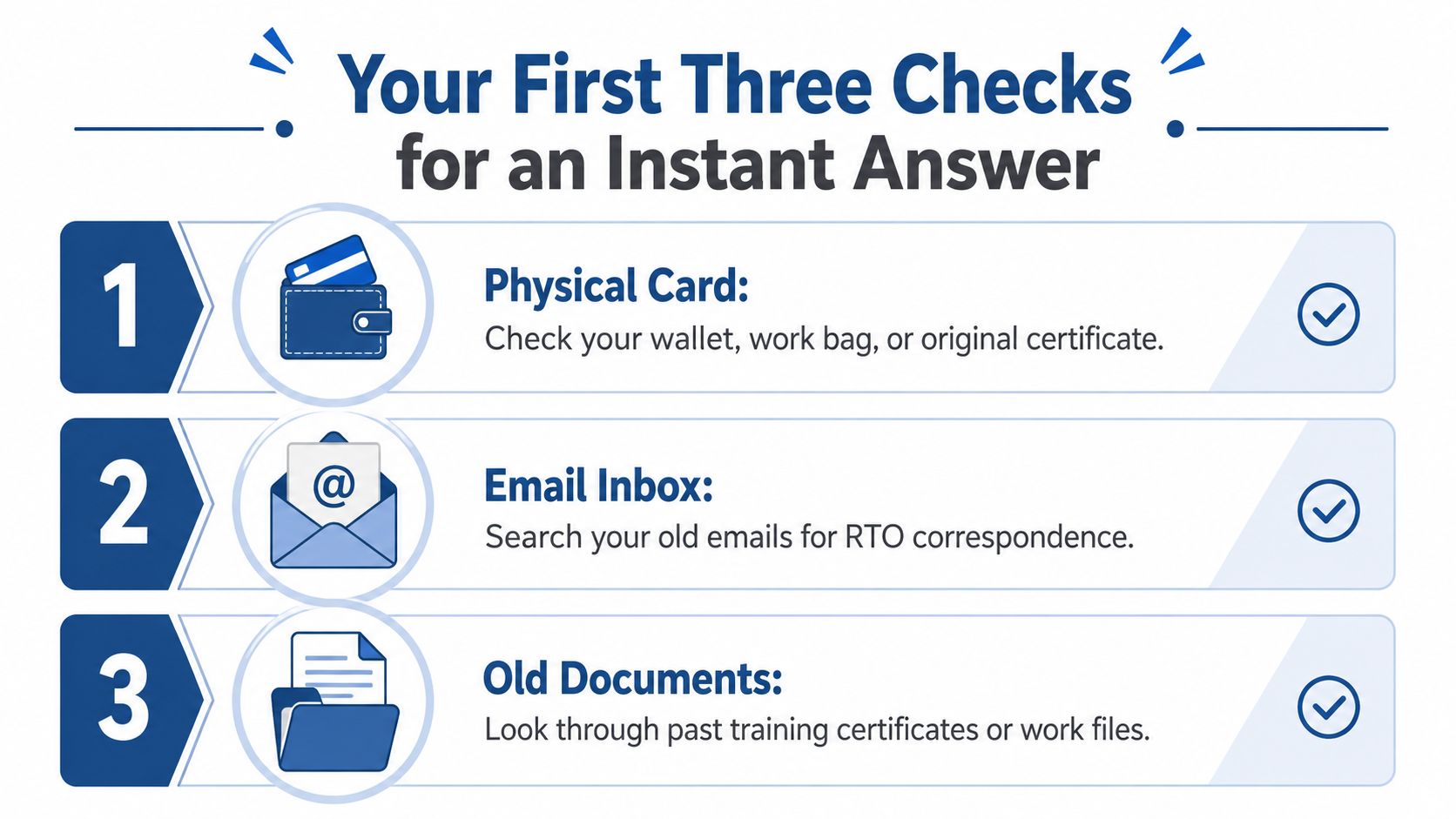
Start with the places where the number commonly survives. The card itself is the fastest result. After that, look for the training record trail you already have. I've seen plenty of students assume the card is gone for good, then find a clear photo, an enrolment email, or a PDF certificate sitting in an old download folder.
A tidy check also helps later if you need the issuing provider to step in. Good record-keeping makes recovery easier, which is the same point behind TP Training's update on its website redesign partnership with Bonna to improve access to training information.
Check the physical card first
This still solves the problem more often than people expect.
Look in the places tradies and labour hire workers use, not just where official documents are supposed to live:
- Wallet card slots: Check behind bank cards, Medicare cards, licences, and any sleeve that holds multiple cards.
- Work bags and tool bags: Cards often get moved out of a wallet before a shift and never make it back.
- Glovebox and centre console: A common spot for tickets, licences, and site paperwork.
- Home document folders: White Cards are often stored with a Statement of Attainment, tax file documents, or old onboarding papers.
Pull items out one by one. A quick glance misses more cards than people realise.
Search your email and files properly
If the physical card is gone, the next best outcome is finding the training document that points you to the right RTO. That matters because the provider name is often the missing piece, especially if you need to recover the number urgently or the original card was issued years ago.
Use specific search terms, not broad ones:
- White Card
- Statement of Attainment
- CPCWHS1001
- CPCCWHS1001A
- general construction induction
- the RTO name, if you remember any part of it
Then check the places people forget:
- Downloads folder
- Desktop
- Cloud storage
- Old phone backups
- Archived email folders
If you find a certificate but not the card number, keep the provider details. That gives you the shortest path to the correct record.
Look through your phone
This is often the fastest overlooked check.
Search your:
- Photo gallery for card photos, certificates, classroom sign-in sheets, or same-day course paperwork
- Notes app for numbers copied down after training
- Messages, WhatsApp, or email drafts for anything you sent to an employer, recruiter, or family member
A photo of the card is often enough to confirm the number for onboarding while you sort out a formal replacement.
If none of these checks work, don't start guessing providers. The next step is to identify the exact RTO that issued the training record. If you already know it, that saves time. If you don't, your USI transcript is usually the quickest way to find it, and that step becomes even more important when the original training company has closed or changed hands.
Contacting Your RTO The Most Reliable Method
When the quick checks fail, contacting the Registered Training Organisation is usually the cleanest path. In practice, most recoveries should next go to the RTO because the RTO sits closest to the original training record.

Under the National Vocational Education and Training Regulator Act 2011, RTOs across Australia must maintain training records for at least 30 years. That's why this method still works even when you completed your White Card course a long time ago.
Why the RTO should be your next call
An RTO doesn't need to guess who you are from fragments. If your details match their records, admin staff can usually find the training outcome tied to your enrolment, including the Statement of Attainment and the unit code connected to the White Card.
This is more reliable than trying to remember the card number from memory or hoping a worksite still has your old induction form on file. Employers may have copied it down once. The RTO holds the actual training record.
If you know who trained you, don't overcomplicate it. Ring the provider first.
TP Training also highlights how support can be easier when communication barriers are removed, which matters when students are confirming old enrolment details. That's part of why multilingual admin help can make a difference, as noted in its article on English, Mandarin, Korean and Vietnamese assistance.
What to have ready before you call or email
You'll get a faster result if you send complete details the first time. Have these ready:
| Detail | Why it matters |
|---|---|
| Full legal name | It needs to match the enrolment record |
| Date of birth | Helps separate you from similar names |
| Approximate course date | Narrows the search quickly |
| Old email or phone number | Useful if your current details changed |
| Any certificate copy | Even partial records help staff confirm the file |
If you changed your name after training, say that upfront. If you did multiple courses with the same provider, mention White Card specifically and use the unit code if you have it.
A short, accurate email often works better than a vague one. “I completed White Card training around 2021 under the name X, DOB Y” gives admin staff something they can use to search.
Using Your USI Transcript to Find the RTO
A lot of people hit the same wall. They know they completed the course, but they can't remember which provider delivered it. That's where the USI transcript becomes the practical fix.
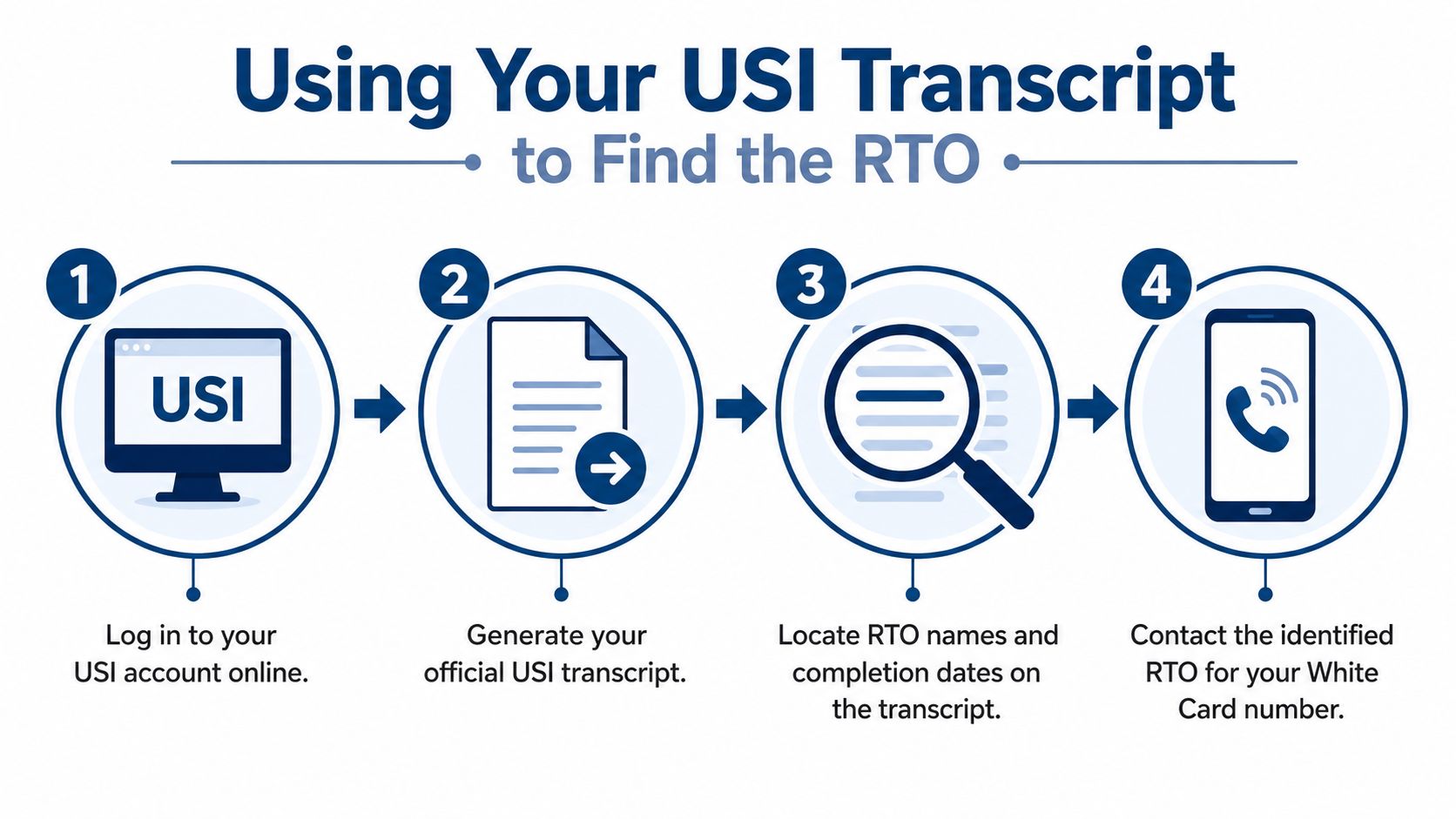
What the USI transcript does and does not show
The key point is simple. Your USI transcript doesn't display the White Card number itself. What it does show is the training record that helps you identify the right provider and qualification entry.
The useful marker is the unit code CPCWHS1001. In older records, you may see the legacy code CPCCWHS1001A. The transcript confirms the RTO name and unit completion, which gives you a targeted path instead of asking multiple providers whether they trained you.
Experts recommend using your transcript from USI when direct RTO contact fails. It confirms the RTO name and the unit code CPCWHS1001, and that targeted search can reduce retrieval failure rates by approximately 40% compared to generic name-only inquiries.
How to use the transcript the smart way
The strongest use of a USI transcript isn't as proof of the card number. It's as a map.
- Log in to your USI account
- Open your transcript
- Find CPCWHS1001 or CPCCWHS1001A
- Note the RTO name and completion date
- Contact that RTO with matching identity details
If you completed other courses over time, this matters even more because people often mix up providers. Your forklift course, traffic course and White Card may all sit under different organisations.
The transcript bridges the gap between “I know I did it” and “I know exactly who to call.”
If you haven't accessed your USI for years, it's worth getting that sorted before you need it urgently. TP Training has a practical step-by-step guide on creating and managing your USI, which is useful if your login details are buried in old emails.
Requesting an Official Replacement Card
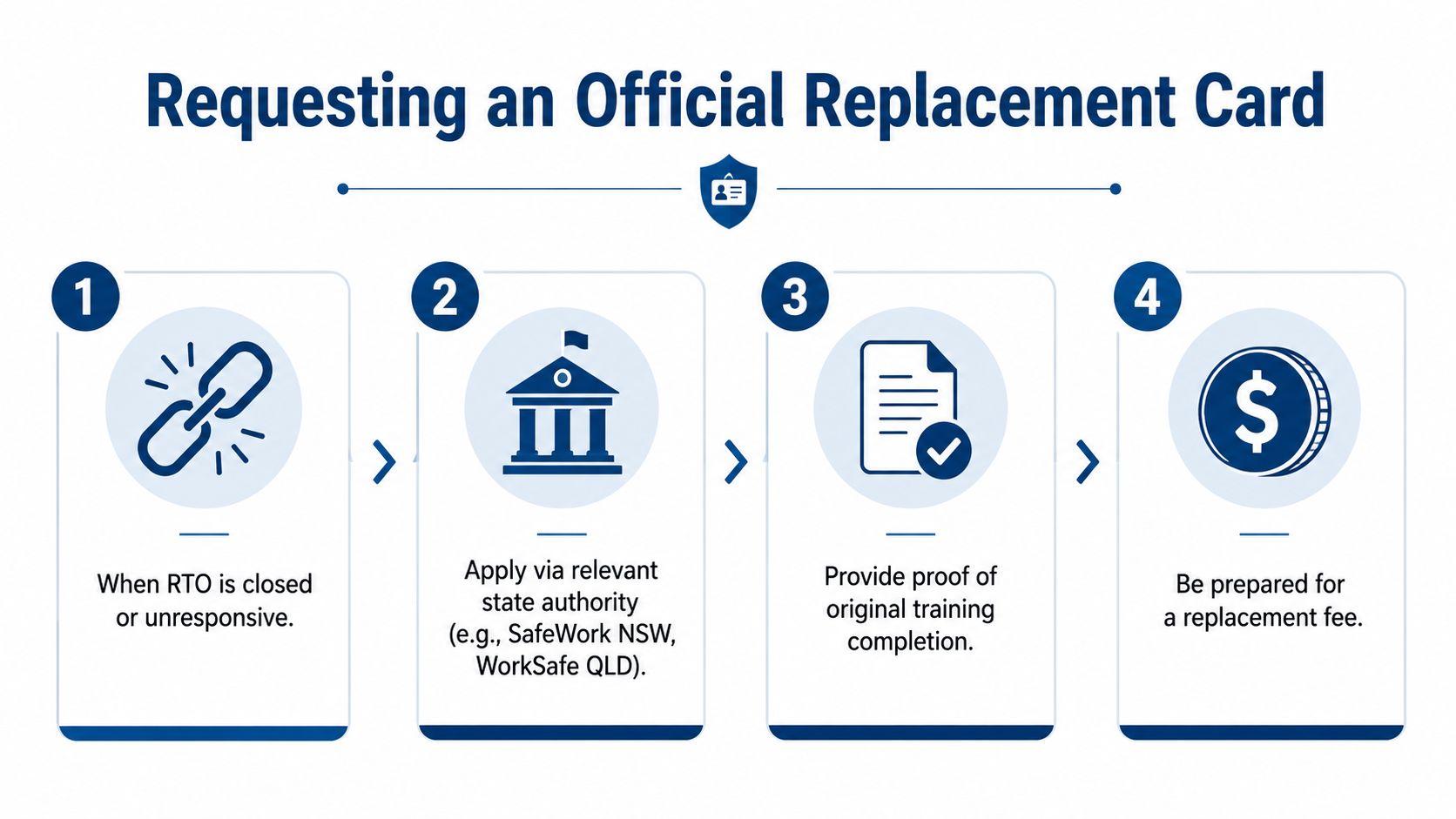
You usually reach this point after the quick recovery options have failed. The card is gone, the old emails are gone, and the provider may no longer answer the phone. At that stage, stop guessing and start the formal replacement process.
When a replacement is the right move
A replacement is the right option when you need a fresh physical card, your number cannot be confirmed from your own records, or the issuing provider cannot help. In NSW, as noted earlier, the online checking tool is only useful if you already know the card number. If you do not have it, the replacement pathway is usually the practical route because it works from identity and training records rather than the missing card itself.
That difference catches people out all the time. They try to verify a card they cannot identify, then lose a day chasing the wrong process.
A physical card still matters on site. Some employers will accept a statement or screenshot for a short period, but many site supervisors want to see the actual credential before they clear access. The same applies across other parts of construction paperwork. If you are also dealing with permits and project administration, guidance on securing building approvals in Adelaide shows how these compliance steps often stack up at the same time.
TP Training also has a practical page for people comparing locations, attendance details, and course access through its guide to the White Card course in Sydney CBD.
What changes when the original provider has closed
This is the step many workers miss. If the original RTO has closed, the job becomes a records search first and a replacement request second.
Start with your USI transcript. It will not show your White Card number, but it can show the unit, the completion date, and the RTO that reported the training. That gives you the right organisation to refer to when you speak with a regulator, successor provider, or student records contact. In practice, this is often the difference between a fast match and a dead end.
If the provider no longer operates, use this checklist:
- Confirm the unit code: Look for CPCWHS1001 or the older CPCCWHS1001A
- Pull your USI transcript: Use it to identify the reporting RTO and completion date
- Check whether records were transferred: Some closed providers have records managed by another organisation or authority
- Contact the relevant state authority: Ask for the replacement process for a lost construction induction card
- Prepare matching ID: Your name, date of birth, address history, and training suburb all help with record matching
- Ask whether a declaration is needed: Lost or stolen card requests sometimes need extra paperwork
Good applications are specific. Give the exact name you trained under at the time, including any previous surname, and the closest date range you can support. If you trained under one provider name but the transcript shows another trading name, mention both. That saves support staff from checking the wrong record set.
Fees and processing times vary by state and by how easily your record can be matched. If your details line up cleanly, the process is usually straightforward. If they do not, expect extra identity checks or requests for supporting documents.
Conclusion Your Quickest Path Back to Work
If you need your White Card number quickly, the shortest path is usually the right one. Check your wallet, your inbox, your files and your phone first. If that doesn't work, contact the training provider that issued the course record. If you can't remember who that was, use your USI transcript to identify the RTO tied to CPCWHS1001.
That sequence avoids the most common delays. People lose time when they jump straight into generic searches, call the wrong provider, or use an online checker that expects them to already know the number.
The final fallback is the official replacement route through the relevant authority. That's the practical answer when the card is gone, the provider is hard to reach, or you need a new physical credential for work. Once you recover it, take a clear photo of the card and keep your Statement of Attainment saved in two places.
If you've exhausted recovery options, or you're entering construction for the first time, White Card Training Course is one straightforward option. TP Training provides practical, nationally recognised White Card Training Course training with experienced trainers and hands-on learning across NSW.
If you need help sorting out training records, replacing lost credentials, or getting job-ready for site work, TP Training offers practical safety and vocational training across NSW with experienced trainers and support staff.

You may also like
CPR Course Penrith: Book Your Training Today

Safety & Health Policy: A Guide for Australian Employers