
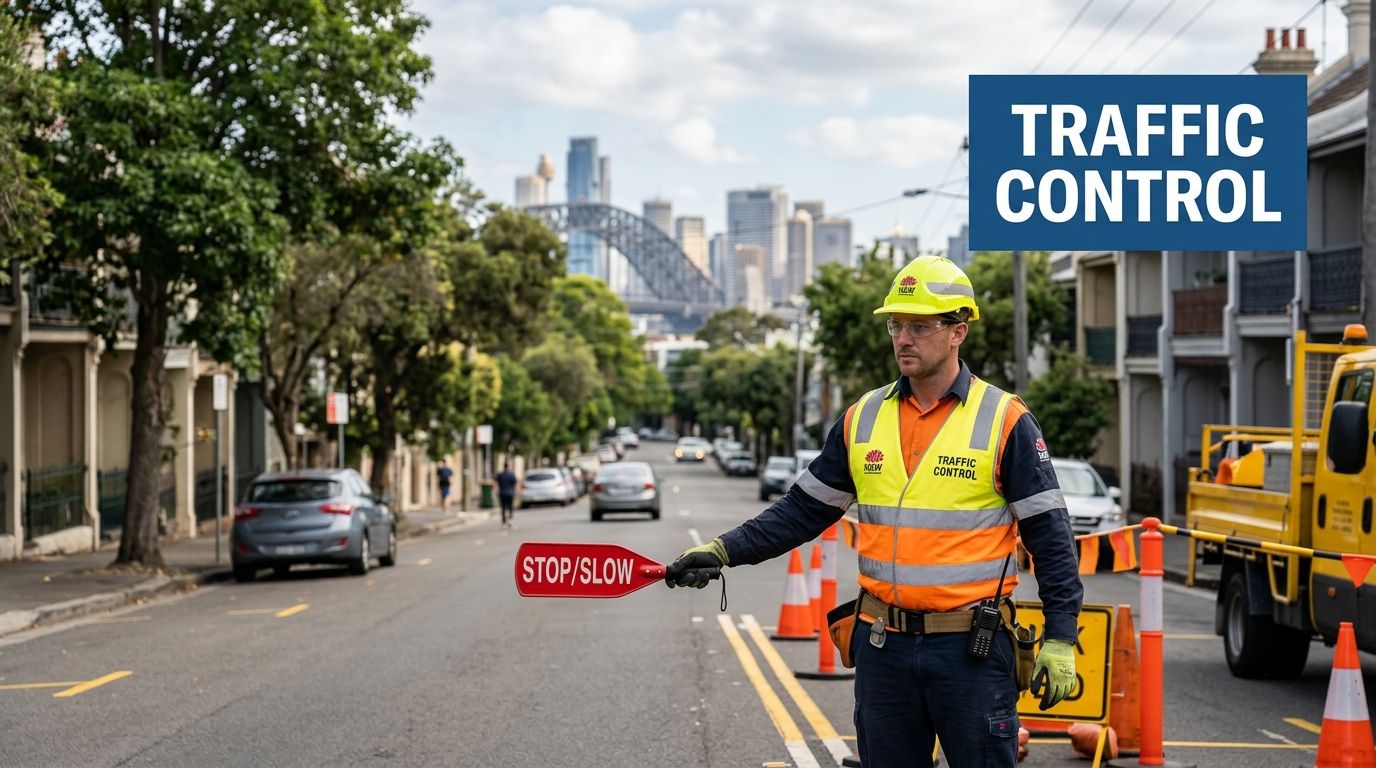
Master Traffic Control Course Sydney 2026
Seeking a traffic control course in Sydney, you're likely aiming to solve one of three problems. You want a practical pathway into construction support work. You need a ticket that gets you onto road or civil sites legally. Or you're already working around worksites and want to move beyond entry-level duties into setup, implementation, or supervision.
Sydney is a sensible place to start because the work is tied to real-world activity you can see every day. Road upgrades, utility works, rail interfaces, local civil jobs, and temporary traffic changes all need people who can follow procedure, stay switched on, and work safely around live traffic. The important part is this. In NSW, traffic control isn't a casual add-on skill. It's a regulated job, and the training you choose affects what work you can legally do.
Table of Contents
- Why Start a Career in Sydney Traffic Control
- Understanding NSW Traffic Control Qualifications
- What You Will Learn and How You Are Assessed
- Prerequisites Duration and Course Costs in Sydney
- How to Choose the Right Sydney Training Provider
- Your Career Path After Traffic Control Certification
- Frequently Asked Questions About Traffic Control Training
Why Start a Career in Sydney Traffic Control
Sydney keeps moving because crews work on roads, utilities, construction zones, and public infrastructure every day. When those works affect vehicle or pedestrian movement, someone has to manage that space safely. That's where traffic controllers fit. They aren't just holding a bat. They are part of the safety system that keeps workers, drivers, and the public separated and moving in the right way.

A lot of job seekers look at traffic control because it offers a clear entry point into site-based work. It suits people who can communicate clearly, follow procedure under pressure, and stay alert for long stretches. It also creates a pathway into broader traffic management, site coordination, and civil construction support roles once you've built experience.
The legal side matters from day one. SafeWork NSW Traffic Control Work Training Cards are mandatory for workers conducting traffic control on or adjacent to public roads in NSW, with limited exceptions for school crossing supervisors, emergency services, and defence personnel, as outlined by SafeWork NSW traffic controller training requirements. If a provider isn't approved for the relevant training, that isn't a small issue. It means you're risking time, money, and employability.
Practical rule: In traffic control, the right course isn't the cheapest one on a screen. It's the one that matches NSW rules and the work you actually want to do.
There's also a difference between liking the idea of the role and being suited to the work. Good traffic controllers are calm, visible, consistent, and safety-focused. If you want a realistic view of the day-to-day side of the job, this article on whether traffic controllers enjoy their jobs is worth reading before you book training.
Understanding NSW Traffic Control Qualifications
A lot of applicants in Sydney ask the wrong first question. They ask, "Which card do I need?" The better question is, "What work do I want to be allowed to do on site?" In NSW, the qualification should match the legal function of the job, not just the colour people use on the phone.
The Blue Card starting point
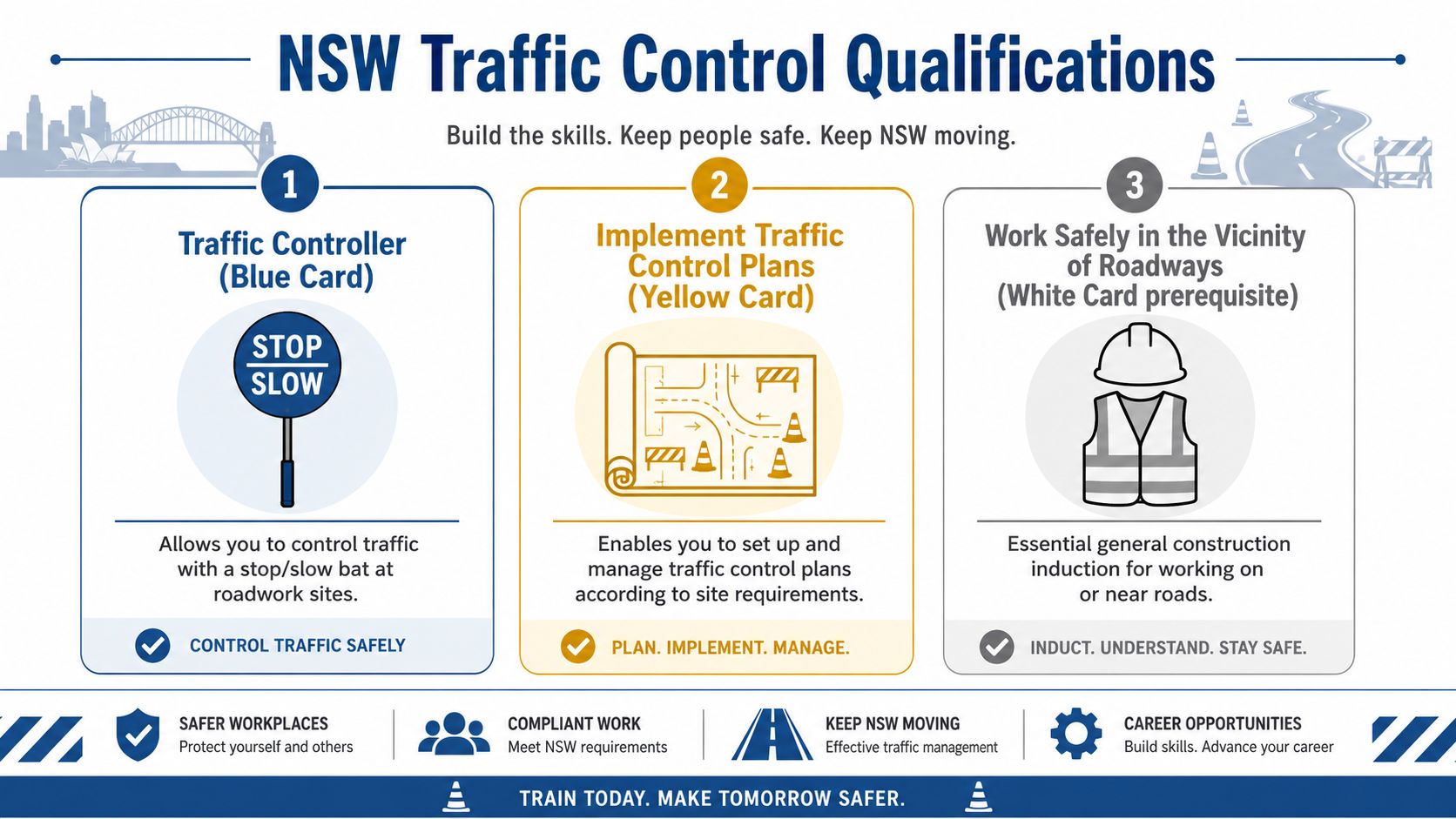
The Traffic Controller skill set, commonly called the Blue Card, is the entry point for people who will control vehicle movements in temporary traffic management areas. This is the qualification for workers using a stop/slow bat, following the site setup already in place, and managing live traffic safely under direction.
For new starters, this is usually the first course that makes sense. If the job involves standing on the road corridor, communicating clearly with drivers and other controllers, and keeping traffic moving through a work zone, Blue Card training is the starting point.
The Yellow Card step up
The Traffic Management Implementer skill set, code RIISS00055, sits above the controller role. It covers workers who implement Work Zone Traffic Management Plans and Traffic Guidance Schemes on site, rather than only operating within a setup someone else has already put in place.
That changes your responsibility in a real way. You are involved in setting up signs and devices, checking that the arrangement matches the approved plan, monitoring conditions during the shift, and packing the site down correctly at the end. On many crews, this is the point where a worker starts being trusted with more site responsibility and more varied shifts.
A factual example is TP Training's Traffic Management Implementer Course Yellow Card, which is one training option in NSW for workers moving beyond entry-level control. If you are weighing up whether to do one qualification first or train in sequence, this guide to the traffic control combo course for Blue and Yellow Card training is useful because it explains when combining pathways is practical and when it is better to stage them.
The planning-level pathway
You will also hear workers talk about a Red Card pathway. In practice, this refers to planning-level traffic management responsibilities rather than frontline control alone. It is the direction people look at after they have site experience and want to move into higher-level traffic planning, documentation, and coordination work.
That pathway matters, but it is not where most job seekers should start. In admissions, I usually tell applicants to work from the road up. Get qualified for the work you can realistically step into now, build site hours, then choose the next course based on the tasks employers are already asking you to take on.
How the pathways compare
| Qualification | Main purpose | Typical career stage | What it allows you to do |
|---|---|---|---|
| Blue Card | Entry-level traffic control | New starters | Control traffic with a stop/slow bat in temporary traffic environments |
| Yellow Card | Traffic management implementation | Experienced controllers moving up | Implement traffic guidance schemes and work from traffic management documentation |
| Red Card pathway | Planning-level traffic management work | Senior or specialist roles | Used in industry discussion for workers progressing into planning and higher-level traffic management tasks |
A common mistake is choosing by colour only. Choose by job outcome. If you know whether you want to control traffic, implement the setup, or move toward planning work, the right Sydney course becomes much easier to pick.
What You Will Learn and How You Are Assessed
People often worry that a traffic control course in Sydney will be heavy on paperwork and light on practical skill. A decent course shouldn't work that way. The point of training is to make you safer, more employable, and more predictable on site.
What the classroom part covers
The theory side gives you the rules behind the role. That includes communication, hazard awareness, signage use, worksite behaviour, and the logic behind traffic movement through temporary work zones. You need that foundation because traffic control is all about judgement inside a controlled system. If you don't understand why a setup exists, you won't respond well when site conditions change.
In NSW, the mandatory technical competency is the nationally recognised unit RIIWHS205E, which requires trainees to position signage and deploy stop/slow bats to create a controlled deceleration zone that reduces vehicle speed to 30 km/h or less before the work zone, as outlined in this guide to becoming a traffic controller in Sydney. That isn't just a theory point. It's a direct safety outcome tied to reducing impact risk.
What the practical assessment looks like
The practical side is where many students relax a bit because the work becomes tangible. You aren't being tested on abstract ideas. You're being asked to show that you can apply the rules safely.
Expect the assessment process to focus on tasks such as:
- Using the stop/slow bat correctly so your signals are visible, consistent, and timed properly.
- Positioning yourself safely in relation to approaching traffic, the work area, and other workers.
- Following communication protocols with radios, site personnel, and other controllers where required.
- Working within the setup rather than improvising your own system.
A good trainer won't try to catch you out. They'll look for competence, awareness, and safe habits.
If you're curious about where this can lead beyond frontline work, this first-hand piece on completing the traffic management designer Red Card course in NSW gives useful context on the more advanced planning side of the field.
Most assessment issues come from rushing. Students who listen carefully, follow the sequence, and treat the practical seriously usually perform far better than those who assume it's just common sense.
Prerequisites Duration and Course Costs in Sydney
Before you compare providers, check whether you're ready to enrol. Many delays occur at this preliminary stage, not because the course is difficult, but because the paperwork and prerequisites weren't sorted early.
What you need before enrolment
For the Blue Card pathway, one essential requirement is identity documentation. To enrol in the Traffic Controller Course, candidates must provide 100 points of ID, which can include a primary document such as an Australian passport or birth certificate worth 70 points, together with secondary documents such as a driver licence or proof of age card worth 40 points, according to this outline of Traffic Controller course ID requirements in Sydney.
You also need to think practically about your readiness for site work.
- Age requirement: You need to meet the NSW minimum age covered later in the FAQ section.
- Site readiness: Employers often look for people who can present properly, communicate clearly, and follow instructions without constant prompting.
- Document control: Names on your ID and enrolment records should match exactly. Small admin errors can slow things down.
Time commitment and budgeting
Course duration varies by provider and by the qualification pathway you're taking, but don't assume the entire process begins and ends in one sitting. The approved traffic control pathway in NSW involves theory, practical training, and a live practical assessment at an authorised site for the relevant skill set. That means your planning should include travel, preparation time, and the possibility that different parts of the process happen separately.
The same caution applies to cost. Prices differ across Sydney, and if a provider advertises a low fee, you need to check what is included. The right question isn't only "what's the course price?" It's "what do I still need after this to become work-ready?"
Use this simple budgeting filter:
- Check inclusions first. Make sure the fee aligns with the qualification and assessment you need.
- Allow for travel and time off. Cheap training can become inconvenient if the location or scheduling doesn't suit your week.
- Avoid rushed bookings. If your paperwork isn't ready, rebooking or delays can cost more than choosing carefully the first time.
For a practical comparison mindset, this guide to low-cost traffic control courses in Sydney is useful, especially if you're weighing price against compliance and employability.
How to Choose the Right Sydney Training Provider
A poor provider choice usually shows up after you have paid. You find out the booking was easy, but the instructions were vague, the practical assessment process was unclear, or the training felt disconnected from real traffic sites. In NSW, that costs time more than anything else.
What to check before you book
Start with fit for NSW, not just a polished course page. Course names can look similar across providers, but what matters is whether the provider clearly delivers the SafeWork NSW-aligned training pathway, explains the practical assessment requirements, and tells you exactly what you need to bring, complete, and do after training.
Then test the provider on the points that affect your experience and your job readiness:
- NSW relevance: The provider should speak plainly about NSW traffic control requirements, not rely on generic national wording.
- Trainer background: Ask who delivers the course and whether they can explain live site expectations, communication standards, and common mistakes new entrants make.
- Practical assessment process: Get clear on where the practical component happens, how it is scheduled, and what happens if you need to rebook.
- Sydney location and timetable: A training centre that is hard to reach can turn a low fee into a bad choice once travel time, parking, or time off work are factored in.
- Administration: Good student support is simple and specific. You should get a clear list of ID requirements, PPE expectations, language or literacy support options, and next steps after completion.
I usually tell applicants to judge a provider the same way they would judge any regulated training purchase. Look at outcomes, compliance, and clarity before marketing claims. The same logic appears in this article on choosing the best phlebotomy program, even though it covers a different field.
What a solid provider looks like in practice
A good provider reduces confusion. You should be able to tell, before paying, where you will train, how the course runs, what support is available, and what the qualification allows you to do in NSW.
TP Training is one example of a provider with multiple Sydney-area locations, including Penrith, Burwood, Auburn, Parramatta, and Sydney CBD. That matters for students balancing training with casual work, family commitments, or long commutes. Convenience is not a small issue in Sydney. It affects attendance, punctuality, and whether the course feels manageable from start to finish.
The better providers also explain the trade-off between price and service. A cheaper booking can still be the wrong option if the admin is poor, the schedule is inflexible, or the practical process is hard to pin down. If you are comparing options side by side, this review of the top traffic controller training centres in Sydney gives a practical starting point for shortlisting.
Your Career Path After Traffic Control Certification
You finish the course, get cleared for the next step, and the question changes fast. It is no longer "what does the course cover?" It is "how do I turn this into steady work in Sydney?"

The first work window after training
After you complete the required training and practical assessment with an approved provider, you can enter a supervised work period under NSW rules while your final authorisation is being processed, as noted earlier. For job seekers, that matters because it shortens the gap between training and earning.
This early stage is where employers form their first view of you. They are watching for simple things that matter on live sites. Do you arrive on time, wear the right PPE, listen the first time, and communicate clearly with the team?
New starters sometimes assume the qualification is the hard part. In practice, the first few shifts are often the actual filter. Traffic control work is repetitive at times, exposed to weather, and tightly tied to site discipline. Workers who stay switched on, follow the traffic guidance scheme, and keep calm around drivers usually get called back.
Where the role can lead
The entry role is traffic controller, but that is only the starting point for many people in NSW. A common progression looks like this:
- Traffic Controller: build site awareness, radio discipline, stop-slow bat use, and safe positioning habits.
- Traffic Control Implementer: take on setup, adjustment, and pack-down of signage and devices under approved plans.
- Team leader, site supervisor, or broader civil support roles: move into higher-responsibility work after you have site hours, a good safety record, and stronger knowledge of traffic management plans.
The trade-off is straightforward. Entry-level traffic control can be one of the faster ways into construction and civil work, but long-term progress usually goes to workers who add tickets, stay reliable, and learn how sites run.
I tell applicants to treat the first certification as a starting licence to prove themselves. If you keep your credentials current, accept the early starts, and build experience across roadwork, utilities, and civil projects, traffic control can lead to steadier work and better responsibility over time.
Frequently Asked Questions About Traffic Control Training
Common questions from new starters
How old do I need to be to become a traffic controller in NSW?
In NSW, the minimum age is 17 years old for SafeWork NSW Evidence of Identity sign-off, although employers often prefer applicants who are 18 and hold a valid car licence for employability, according to this guide on becoming a traffic controller and traffic implementer in Australia.
Do I need a driver's licence to do the course?
Not always for the training itself. But in real hiring situations, a licence can help because many traffic control jobs involve travel, early starts, or moving between sites. It isn't the legal starting point for enrolment in every case, but it can make you easier to place.
Is the White Card part of traffic control training?
Treat it as a separate construction-induction requirement rather than assuming it's bundled into traffic control training. Many job seekers need both pathways in place before they are work-ready for site-based roles.
Is the work only for beginners?
No. Plenty of people enter through traffic control, then progress into implementation, coordination, or broader civil support tasks. The people who move forward usually combine formal qualifications with strong site habits.
What should I ask a provider before booking?
Ask practical questions, not just fee questions.
- What qualification do I receive?
- How is the practical assessment organised?
- What ID or enrolment documents do I need?
- What can I legally do after completion in NSW?
- What still needs to happen before I can start work?
If a provider can't explain the post-course pathway clearly, keep looking. Confusion at enrolment usually turns into confusion later.
Will the course suit me if I haven't worked in construction before?
It can. Many entrants are new to the industry. What matters more is whether you can follow process, communicate clearly, and stay attentive in a safety-critical environment.
If you're ready to turn your job search into a compliant training pathway, TP Training is one option to review. Check the course details carefully, confirm the qualification matches the work you want to do in NSW, and book only when your documents and timing are in order.

You may also like
Safety & Health Policy: A Guide for Australian Employers

Asbestos Removal Requirements in NSW: The Complete Guide