
Affordable RSA, RCG, Food Safety Supervisor, and Barista Training: Your 2026
You're probably staring at a messy shortlist right now. One job ad says you need RSA. Another wants RCG. A café wants barista skills and food safety awareness. Then you start comparing providers and the prices look ridiculous. One course is cheap enough to feel suspicious. Another costs far more and doesn't clearly explain why.
That confusion is normal. Hospitality training in Australia is full of mixed signals, state rules, bundle offers, fast-track promises, and vague marketing. If you're trying to find affordable RSA, RCG, Food Safety Supervisor, and Barista training, the wrong move isn't just annoying. It can waste your money and still leave you unready for work.
The key question isn't “What's the cheapest course?” It's “What will get me compliant, employable, and moving?” That's the difference between buying a certificate and buying a path into work. If you're also thinking beyond entry-level work and want a broader view of café planning, this guide to launching a UK café is useful for understanding how training fits into hospitality operations. For a local skills comparison across other job-ready certificates, TP Training's overview of CPR, first aid, white card and workplace safety certifications is another practical reference.
Table of Contents
- Your Guide to Navigating Hospitality Training Costs
- Decoding Hospitality and Safety Training Costs
- Price Guide for RSA RCG FSS and Barista Courses 2026
- Beyond the Price Tag What Affordable Really Means
- How to Reduce Training Costs and Access Funding
- Find Your Course Your Next Steps with TP Training
Your Guide to Navigating Hospitality Training Costs
A lot of job seekers hit the same wall. You decide to take hospitality work seriously, open a few tabs, and suddenly you're comparing RSA, RCG, Food Safety Supervisor, and barista courses with no clear way to judge what's fair. One site makes everything sound urgent. Another piles on jargon. A third pushes a bundle without clearly saying whether each part is still relevant for the jobs you want.
The price shock is usually what trips people up first. You see a low figure on one page, then a much higher fee somewhere else for what sounds like the same certificate. That doesn't automatically mean the expensive one is a rip-off, and it doesn't mean the cheap one is smart.
Practical rule: If a provider spends more time selling urgency than explaining compliance, stop and verify the course before paying.
The worst mistake is treating all hospitality training as interchangeable. It isn't. RSA depends heavily on state rules. RCG and Food Safety Supervisor training can be shaped by state-specific compliance requirements. Barista training varies wildly because some courses focus on actual job skills, while others only deliver a quick introduction.
Here's the good news. Once you understand why prices move, the whole market becomes easier to read. You can spot which offers are normal, which are inflated, and which are so cheap they're probably cutting something important.
Decoding Hospitality and Safety Training Costs
The same certificate can carry very different price tags for good reasons. If you don't know those reasons, you're left guessing. That's how people overpay for basic delivery or underpay for weak training that causes trouble later.
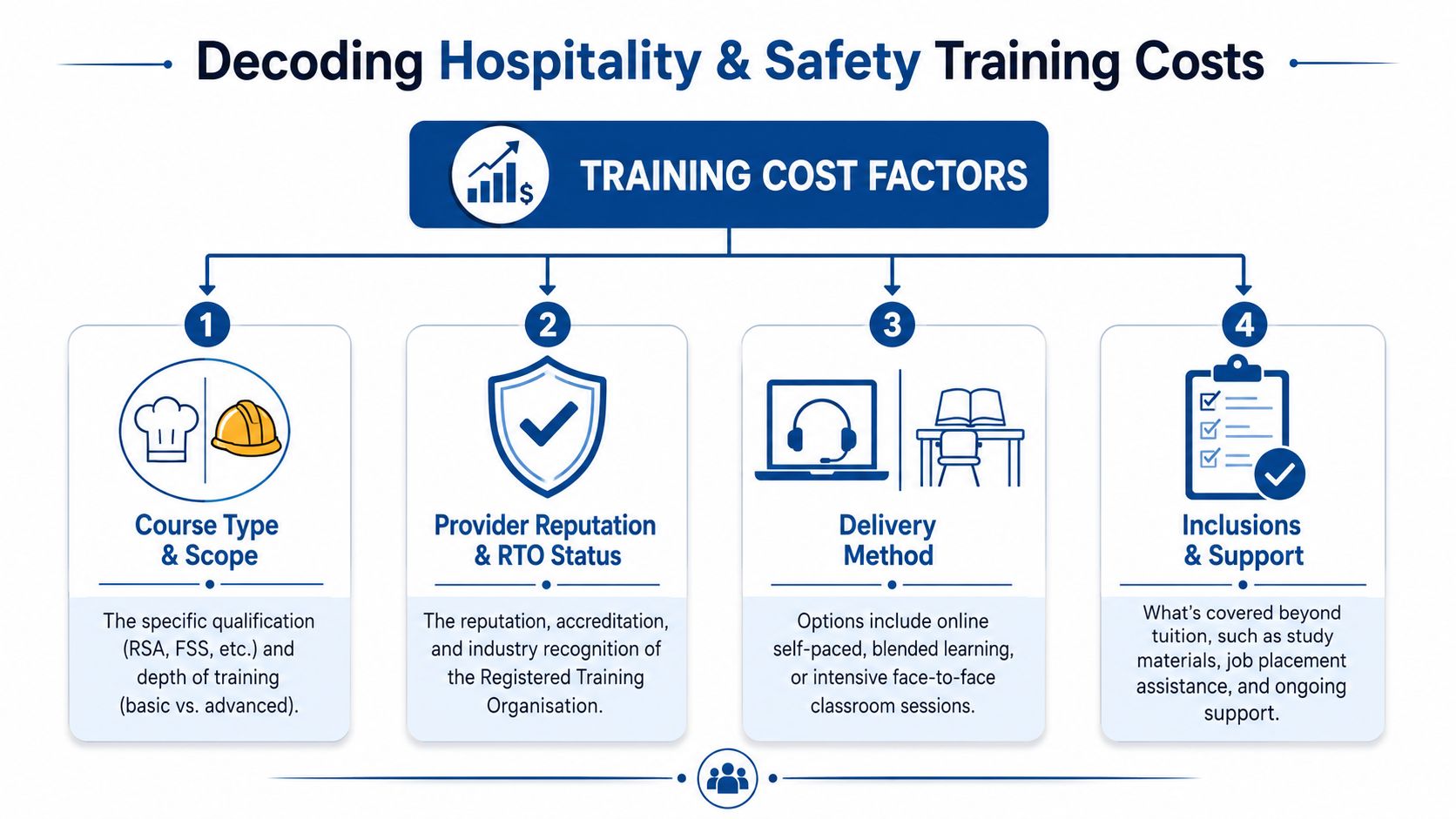
Why the same certificate can have very different prices
State law changes the equation. In NSW, RSA training is mandatory for anyone selling, serving, or supplying alcohol, the course fee must include the NSW competency card issuance, and the national unit SITHFAB021 requires a minimum of 7 hours of structured learning under the NSW rules outlined by Liquor & Gaming NSW. That requirement alone means you should be sceptical of any offer implying you can breeze through compliant NSW RSA in almost no time.
Delivery mode affects cost. Self-paced online training is usually cheaper because the provider doesn't need the same classroom overheads. Face-to-face and trainer-led formats usually cost more because you're paying for facilities, scheduling, supervision, and direct support.
Provider quality matters. A recognised course from a proper RTO isn't just a PDF at the end. You're paying for assessment, administration, compliance, and in many cases a trainer who can explain what the rules mean in a real venue, not just on paper.
For anyone comparing vocational training more broadly, TP Training's article on lowest-cost traffic control courses in Sydney shows the same principle. The lowest advertised fee doesn't tell the whole story if support, location, and compliance differ.
What you're actually paying for
Price usually reflects a mix of these factors:
- Legal compliance: State-specific content, approved provider requirements, and mandated assessment standards.
- Trainer involvement: More feedback and hands-on correction usually means a higher fee.
- Included admin: Some courses include required cards or related processing in the fee.
- Practical relevance: Better workplace examples, clearer instruction, and stronger support often cost more, but they also reduce mistakes.
That's especially relevant in food-facing jobs. If you want a broader hygiene lens alongside food safety training, this article on elevating hospitality hygiene standards is a useful operational read.
One practical example is the Provide Responsible Service Of Alcohol Course Rsa. TP Training provides practical, nationally recognised Provide Responsible Service Of Alcohol Course Rsa training with experienced trainers and hands-on learning across NSW. That doesn't automatically make it the right choice for everyone, but it fits the basic standard you should be looking for in NSW. Clear provider status, practical delivery, and compliance you can verify.
Pay for training that matches the law where you'll work, not the cheapest ad in your search results.
Price Guide for RSA RCG FSS and Barista Courses 2026
You find an RSA course for under $40, then see another for well over $100. That gap looks like a rip-off until you check the state rules. In hospitality training, price differences usually come from compliance requirements, delivery format, and how much practical support you get.
Typical training costs in Australia
| Course | Online / Blended (Typical Range) | Face-to-Face (Typical Range) | Key Considerations |
|---|---|---|---|
| RSA | In some states, online RSA is available for as little as $34 AUD in QLD, WA, SA, NT, and ACT, with some online courses across Australia starting from $17 AUD and many online options sitting at approximately $60 AUD or below, according to Jobaroo's RSA Australia guide | In NSW and Victoria, classroom RSA commonly ranges from $60 to $180 AUD | NSW has stricter requirements and higher regulatory costs. The fee can also include card processing or other state-specific admin |
| RCG | Price varies by state and funding context | Price varies by state and funding context | State-specific curriculum and funding policy affect advertised pricing, as noted by the CFT overview of hospitality training costs |
| Food Safety Supervisor | Price varies by provider, state rules, and possible funding access | Price varies by provider, state rules, and possible funding access | Check the state coverage, the current compliance content, and whether the course suits the type of venue where you want to work |
| Barista | Lower-cost options may use compressed delivery or less supervised practice | Face-to-face practical training often costs more because equipment time and trainer supervision are part of the course | Cheap barista training often cuts back on machine time, milk texturing practice, or food handling context. TP Training's guide to barista training in Australia helps you compare short intro classes with training aimed at actual café work |
How to read the table without getting fooled
RSA is the easiest course to compare badly. A low online price in one state does not make a higher NSW price unreasonable. It usually reflects different legal requirements, approved delivery conditions, and added admin. Compare like with like, or you will misread the market.
RCG and FSS need a stricter filter. There is no single national benchmark you can trust across every provider. Check the state, check the approval status, and check what the fee includes. If the ad is vague on any of those points, move on.
For NSW job seekers, one provider option is the Food Safety Supervisor (FSS). TP Training offers this course in a practical, nationally recognised format across NSW.
Barista prices are where people waste money fastest. If you only want a casual introduction, a cheap short course can be fine. If you need café-ready skills, judge the course by practice time, trainer feedback, and whether it covers the parts employers notice on a trial shift.
Cheap training is only a bargain if it gets you ready to work.
Beyond the Price Tag What Affordable Really Means
A course isn't affordable if you have to pay twice. That's the simplest way to think about it.

Cheap can become expensive fast
People get trapped by sticker price. They see a low fee, assume they've found a bargain, then discover the course doesn't line up with the state they want to work in, doesn't provide enough practical preparation, or doesn't leave them confident enough to pass a trial shift.
That's common in barista training. Existing industry commentary highlights that short classes with little machine practice and no food safety coverage may leave students ill-prepared, even when the offer looks affordable. The problem isn't just quality. It's employability.
If your course skips the practical parts employers care about, your “cheap” option starts costing more in hidden ways:
- Lost time: You finish the course and still need more training.
- Missed jobs: Employers can tell when someone has theory without usable skill.
- Repeat spending: You pay again for a course that should've done the job the first time.
A bad bargain doesn't save money. It delays work.
Job-ready beats bargain-basement
Many job seekers should raise their standards. If you're serving alcohol, handling food, or stepping behind a coffee machine in a real venue, you need training that stands up in the workplace. Not just in a checkout cart.
Use this filter before you enrol:
- Is it compliant for my state? If the answer isn't obvious, keep looking.
- Will an employer recognise the outcome? If the provider avoids specifics, that's a warning.
- Does the course build practical confidence? Especially for barista and food-related work.
- Can I get support if I get stuck? Cheap providers often disappear once you've paid.
Language support matters too. Students often struggle not because the course is impossible, but because instructions, assessment terms, or enrolment steps aren't explained clearly. TP Training's page on multilingual support in English, Mandarin, Korean, and Vietnamese is a good example of the kind of support detail worth checking before enrolment.
How to Reduce Training Costs and Access Funding
You can lower the cost of training without dropping your standards. The trick is to cut waste, not quality.
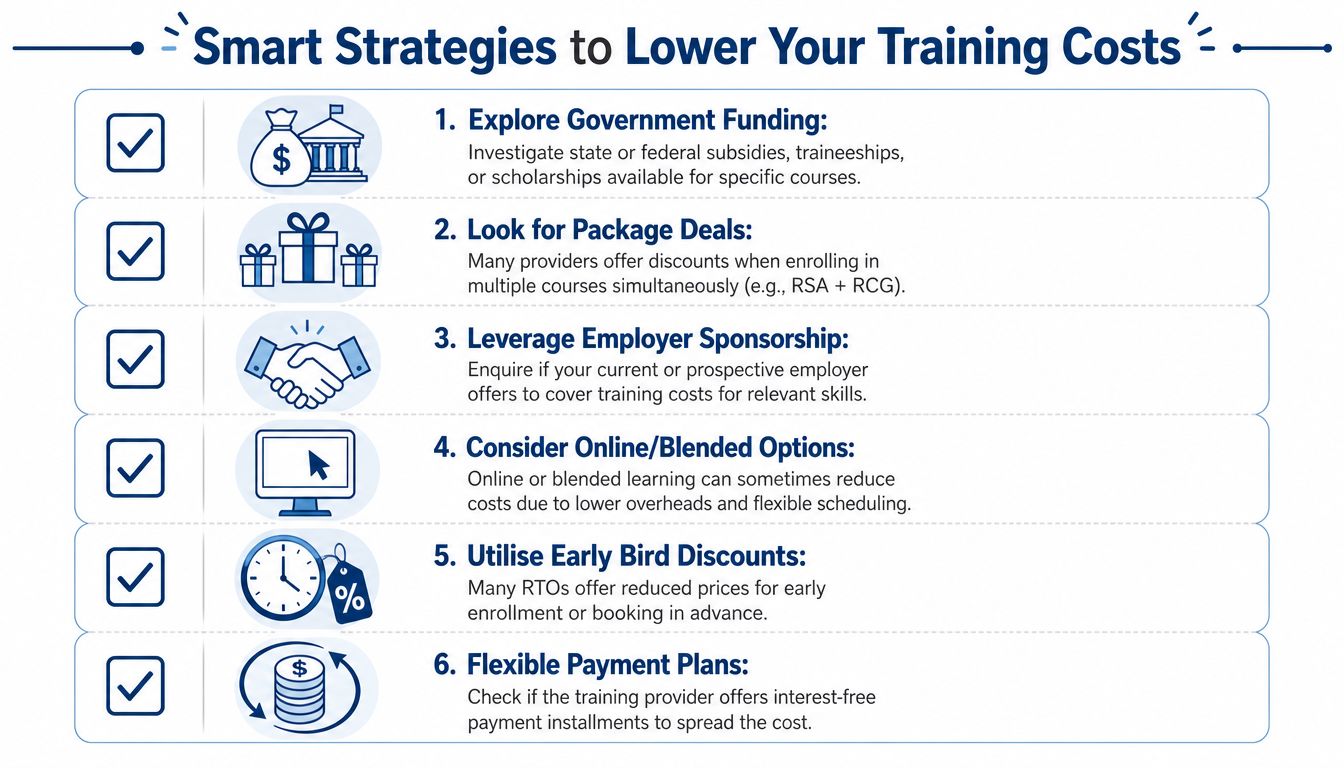
Six ways to lower what you pay
- Start with the jobs you want. Don't buy four certificates because someone online said they're useful. Read current job ads in your area and match training to what employers are asking for.
- Ask employers before paying yourself. Some venues prefer to train staff through their chosen provider or reimburse required certificates after hiring.
- Use online or blended delivery where it makes sense. For some states and some courses, flexible delivery can cut travel and scheduling costs.
- Check funding options early. Government-funded places can change the actual cost of training, especially for recognised vocational pathways.
- Compare what's included. A slightly higher fee that includes required administration or stronger learner support may save money overall.
- Spread enrolments if needed. If cash flow is tight, sequence your courses by hiring priority instead of buying everything at once.
What to check before you buy a bundle
Bundles can help. Bundles can also be lazy packaging. Treat them with suspicion until they prove their value.
The basic rule is clear. While combo deals like RSA + RCG + Barista exist, you need to verify that each part is a separate, accredited certificate that still meets current employer expectations and any state-specific refresher requirements, as noted in this combo deals overview.
Check these points before buying any package:
- Separate outcomes: Each certificate should stand on its own.
- Current relevance: Don't pay for bundled content that employers no longer care about.
- State fit: A bundle that looks cheap can be poor value if one unit isn't suitable where you'll work.
- Practical delivery: This matters most for barista training.
- Timing: If one component expires sooner or needs refreshing earlier, the bundle may be less useful than it looks.
Worth asking: “If I bought these courses separately, which parts of this bundle would I still choose?”
That question cuts through most bundle marketing fast.
Find Your Course Your Next Steps with TP Training
You don't need perfect information to make a good decision. You need a clean filter. If the course is compliant, recognised where it needs to be, relevant to the jobs you want, and delivered in a way you can realistically complete, it's worth considering. If it's only cheap, keep scrolling.
A simple decision filter
Use these four questions:
- Do I need this for legal compliance or employability? RSA and some food-related qualifications can't be treated casually.
- Is the course aligned with my state? That matters more than broad national marketing claims.
- Will this make me more usable on shift? Especially for barista training.
- Can I attend without wrecking my week? Location and scheduling affect completion more than people admit.
If you're looking at barista development outside Australia for comparison, Allied Drinks Systems has a page on barista courses that's useful for seeing how practical coffee training is framed in another market. The principle is the same. Hands-on skill matters more than polished wording.
Where TP Training fits
For NSW learners who want face-to-face access, location is a practical advantage. TP Training operates across Penrith, Burwood, Auburn, Parramatta, and Sydney CBD, which makes attendance easier if you're balancing work, childcare, or inconsistent shifts.
That matters because convenience isn't a soft factor. If a course is compliant but hard for you to reach, delays and missed sessions can turn a decent option into a bad one. Before you enrol anywhere, sort out your student admin as well. TP Training's guide to creating and managing your Unique Student Identifier is a practical checklist for getting that part done properly.
The smartest move is simple. Buy the training that gets you job-ready with the least wasted time, not the one with the loudest “sale” language.
If you want a practical next step, explore TP Training for hospitality and vocational courses across NSW. Use the decision filter above, compare the course to your state requirements, and choose training that gives you both compliance and usable skills.

You may also like

Government Fund Courses in Australia: A Practical Guide
Workplace Safety Training: A 2026 Guide for Australia