Barista Training Australia: Courses & Careers 2026
You're probably in one of two spots right now. You want café work and need the fastest path into it, or you're already applying and noticing that “barista course” can mean anything from a quick coffee class to a nationally recognised unit with food safety built in.
That confusion matters more in 2026 than it used to. Coffee skills still get you noticed, but they don't cover the whole hiring decision anymore. Employers want someone who can step onto the machine, work cleanly, and fit into a compliant food business from day one. If your training only teaches espresso, you're often left with half the picture.
Table of Contents
- Why Barista Training Is Your Gateway to Australia's Coffee Scene
- Nationally Recognised vs Short Courses Explained
- What a Quality Barista Course Must Cover
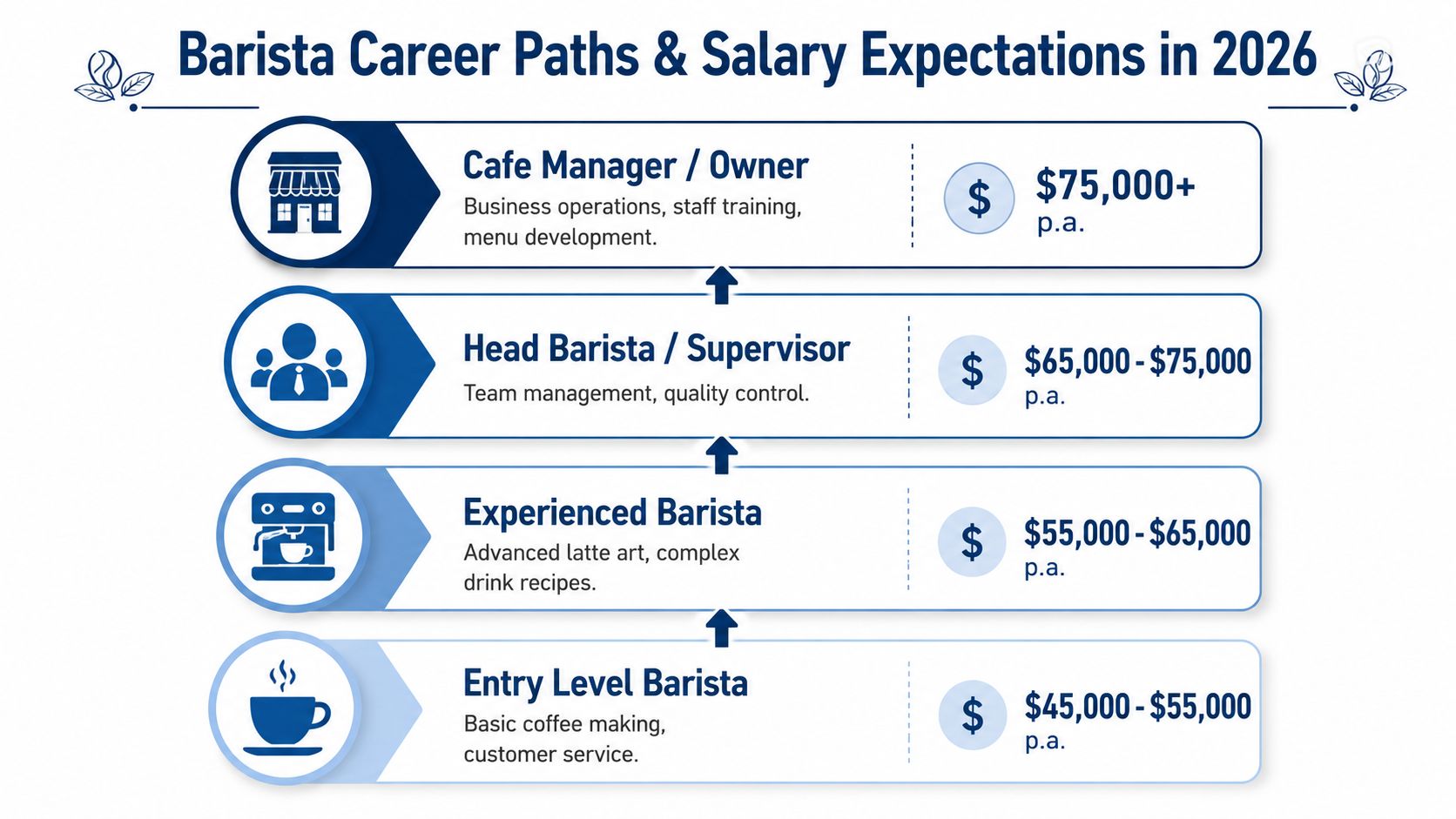
- Career Outcomes and Salary Expectations in 2026
- How to Choose the Right Barista Training Provider
- Your Next Steps to Enrolment and Getting Job-Ready
Why Barista Training Is Your Gateway to Australia's Coffee Scene
Café work attracts people for good reason. It's social, practical, fast-moving, and it gives you a clear skill that employers can test in minutes. If you can extract consistently, texture milk properly, keep your station clean, and handle service pressure, you're useful straight away.
That matters because the market is real, not hypothetical. As of 2026, there are 68,679 people employed in the Coffee Shops industry across Australia, with employment growing by an average of 2.2% annually between 2021 and 2026, according to IBISWorld's Australia Coffee Shops employment data. For job seekers, that points to a stable industry rather than a niche side path.
Why people get stuck at the start
Most beginners waste time on the wrong question. They ask, “Do I need a certificate?” when the better question is, “What will make a manager comfortable putting me on the machine?”
The answer is usually a mix of three things:
- Practical speed: You need to work on commercial equipment, not just understand coffee theory.
- Consistency: One good flat white isn't enough. Employers watch whether the second, fifth, and tenth cup look the same.
- Compliance awareness: A café hires into a food business, not just a coffee bar.
Practical rule: If your training only helps you talk about coffee, it won't help much in an interview trial.
Why Barista Training Australia matters in 2026
In earlier years, some candidates could rely on enthusiasm and learn everything on shift. That still happens. But the faster route is to arrive with enough machine confidence and food handling awareness that the café only needs to refine you, not start from zero.
That's where good barista training in Australia earns its place. It shortens the gap between “interested beginner” and “safe person to roster.” It also helps you avoid the common mistake of paying for a course that looks impressive on paper but doesn't match how cafés hire in practice.
Nationally Recognised vs Short Courses Explained
A lot of confusion comes from the word “course.” Two barista programs can look similar online and deliver very different outcomes. One gives you formal vocational training. The other gives you a short practical introduction.
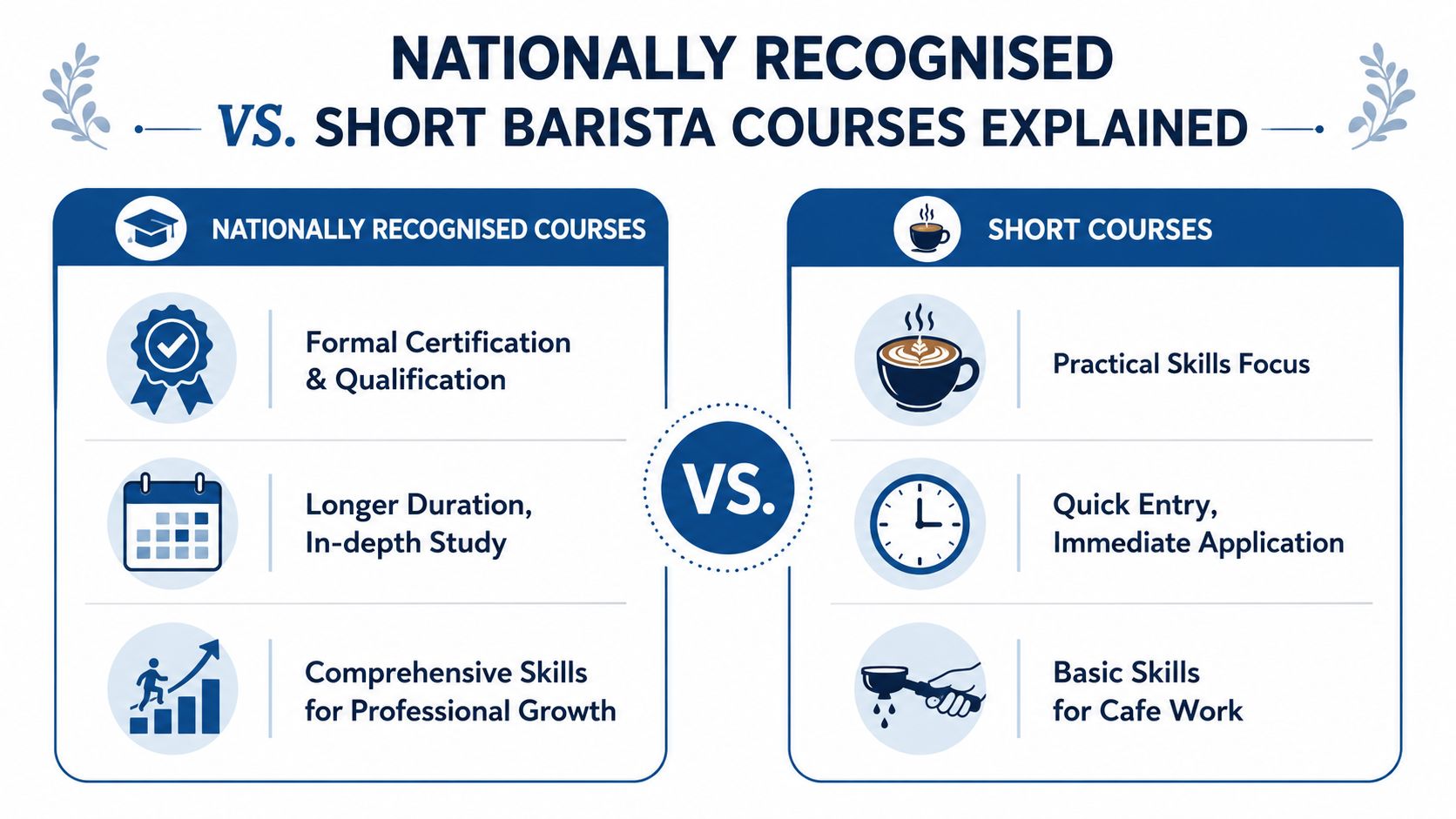
Here's the comparison graphic needed before spending money.
The real difference
A short course is usually about quick exposure. You learn the basics, spend some time on the machine, and leave with a better feel for espresso workflow. According to CHT's barista master class overview, short-course barista training in Australia typically ranges from 5 to 14 hours and costs between $100 and $295.
A nationally recognised course sits in the vocational system. It's tied to recognised units, leads to formal documentation, and is a stronger fit if you want evidence of training for employers or for broader hospitality use.
Just as important, there's no legal requirement for a barista qualification in Australia, so certification by itself won't get you hired. What it can do is remove doubt. A manager may still trial you on the machine, but formal training shows that you've invested in the fundamentals rather than just watching videos.
Barista Course Types Compared
| Feature | Nationally Recognised Course | Short 'Experience' Course |
|---|---|---|
| Outcome | Formal vocational credential, often a Statement of Attainment | Usually a certificate of completion or attendance |
| Structure | Unit-based training with clearer links to workplace requirements | Fast, practical introduction to coffee making |
| Time commitment | More involved than a quick workshop | Usually 5 to 14 hours |
| Cost | Varies by provider and subsidy access | Typically $100 to $295 |
| Employer signal | Shows formal training history | Shows initiative, but skill still needs to be proven |
| Best fit | Job seekers who want stronger documentation and broader compliance value | Beginners who want a low-commitment start |
Training categories outside hospitality make this distinction easier to understand. In fields like high risk work, providers such as Cpccldg3001 Perform Dogging Licence Course And Training In Sydney separate practical training from nationally recognised outcomes in a very clear way. Hospitality applicants should apply the same logic when comparing coffee courses.
For readers looking at how training organisations present compliance-based learning, TP Training's update on crystalline silica and asbestos awareness courses is a useful example of how nationally recognised training differs from a simple familiarisation session.
What employers usually care about first
Managers rarely lead with paperwork. They lead with risk. Can you use the machine without slowing service? Can you keep clean habits without being chased? Can you work around food safely?
A short course can help you start. A recognised course can make your application easier to trust. Neither replaces actual hands-on ability.
If you need the fastest path, the practical answer is usually this: take training that gives you commercial machine time and, where possible, combine espresso skills with food safety. That combination is more useful than chasing a fancy-looking coffee certificate that doesn't match the job.
What a Quality Barista Course Must Cover
A decent course doesn't just teach how to press a button on an espresso machine. It should prepare you for the messy, repetitive, real part of café work. That means workflow, grinder adjustment, milk texture, cleaning, and service habits under pressure.
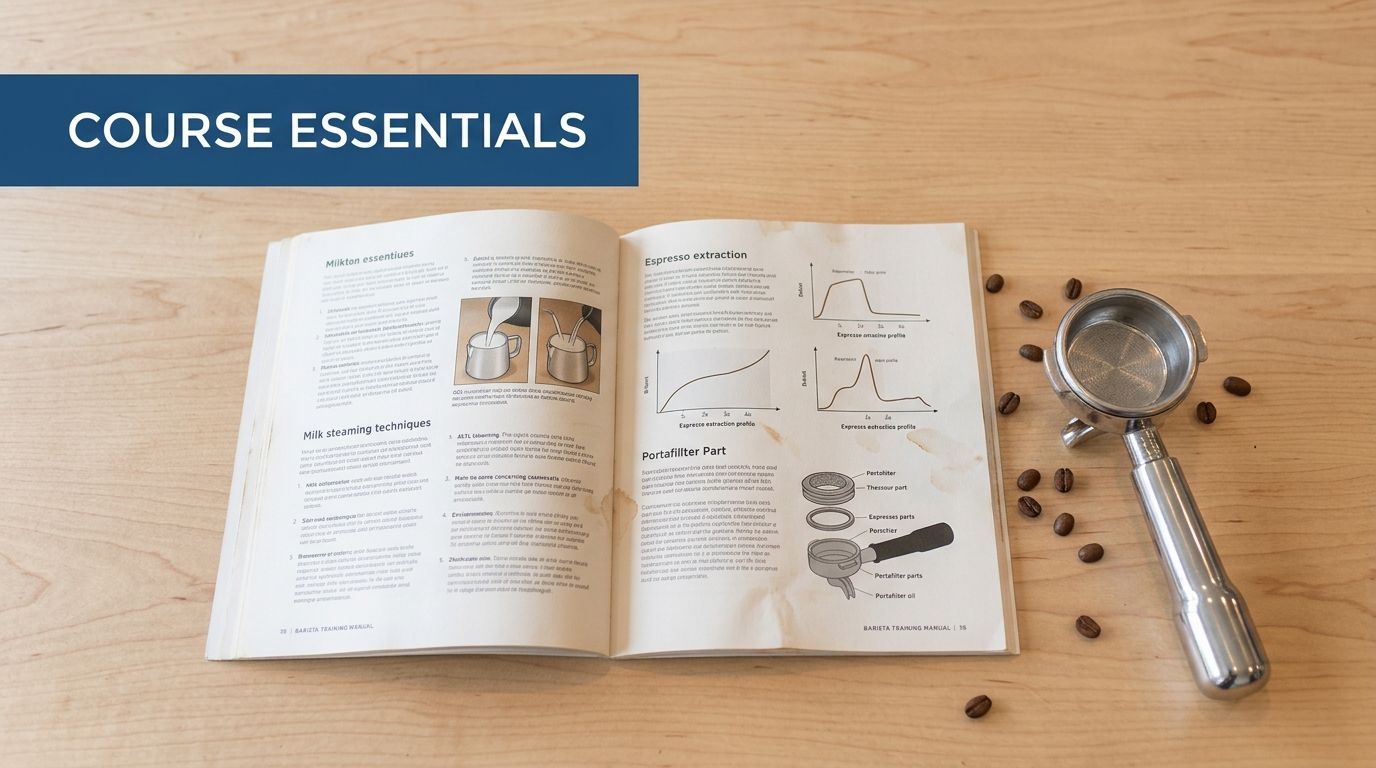
The recognised benchmark for espresso training is SITHFAB025 Prepare and serve espresso coffee, which defines the skills and knowledge needed to use commercial espresso equipment, as outlined by Black Market Training's explanation of barista certification. The same source also makes an important point. Cafés usually care more about what you can do than what your certificate says.
Coffee skills that actually matter on shift
When assessing barista training in Australia, look for a course including these workplace basics:
- Espresso extraction: You should learn dosing, tamping, shot timing, and how to recognise under-extracted or over-extracted coffee.
- Grinder adjustment: Beans change. Weather changes. A good course teaches how to respond, not just follow one setting all day.
- Milk texturing: Employers want texture suitable for flat whites, cappuccinos, and lattes, not overheated foam.
- Drink assembly: You need repetition with common menu items and a clean handoff process.
- Cleaning and maintenance: Backflushing, wiping steam wands, purging, and keeping the group heads clean are daily habits, not optional extras.
- Customer service rhythm: Even strong coffee makers struggle if they can't listen, repeat orders, and stay composed during a rush.
Why food safety can't sit outside the course
Many barista guides miss the mark. They treat coffee skills as one topic and food safety as another. Employers don't separate them that way. In a café, the same person who handles milk, cups, benches, and equipment is part of the food handling system.
The underserved issue in 2026 is that updated food safety expectations mean cafés need evidence that food-handling staff have training, yet many barista programs still don't explain how espresso training and food safety fit together in one job-ready pathway. If a course leaves out SITXFSA005 Use hygienic practices for food safety, it may still teach coffee, but it doesn't fully answer the compliance side of employability.
On the ground: A beginner with solid milk texturing but poor hygiene habits is harder to hire than a slower learner who already understands safe food handling.
If you want a broader view of how vocational courses bundle practical skill with workplace compliance, TP Training's note on CPR, first aid, white card and workplace safety certifications shows the same principle in another training context. Skills matter. So does the evidence that you can work safely around others.
Career Outcomes and Salary Expectations in 2026
Individuals don't take a barista course because they want a hobby. They take it because they want income, a roster, and a path into hospitality that can expand over time.
The pay picture is straightforward. Entry-level baristas in Australia typically earn between $24 and $28 per hour, while experienced professionals can move into head barista or café supervisor roles earning $55,000 to $65,000 annually, according to Safety Australia Training's 2024 barista course overview.
What entry level pay looks like
For beginners, hourly pay matters more than titles. A new barista usually enters on hourly rates, and the first real jump doesn't come from collecting more certificates. It comes from becoming easy to roster.
That usually means you can:
- Open or close cleanly
- Keep coffee quality steady across a busy stretch
- Work without constant correction
- Handle both machine work and basic customer interaction
Where the role can lead
Hospitality rewards useful people quickly. If you're the person who dials in well, keeps standards up, and helps less experienced staff, you move beyond “just making coffees.”
Common directions include:
- Head barista, where quality control and team support become part of the role.
- Café supervisor, where staff coordination and service flow matter as much as coffee.
- Management or ownership, for people who stay in the trade and build commercial skills around it.
Better training doesn't guarantee a higher wage. It gives you the skills that make higher responsibility possible.
A practical way to think about return on training is simple. If a course helps you start work sooner, trial better, and avoid being ruled out on food safety gaps, it has done its job.
How to Choose the Right Barista Training Provider
A common mistake is booking the first “barista course” that appears in search results, then finding out too late that it gave plenty of coffee talk and very little job-ready practice. In 2026, that gap matters more. Cafés want people who can handle the machine and work to current food safety expectations from day one.
Start by checking whether the provider trains for the actual job, not the marketing version of it. A useful course should show you how to make consistent espresso under pressure, clean correctly, handle milk safely, and follow hygienic workflow without being prompted.

Build a shortlist based on delivery, not branding
A provider deserves a closer look if it can explain exactly what happens in class, what units are delivered, and what evidence of training you leave with.
Check these points:
- Recognised training if you want formal proof: Ask whether the course includes nationally recognised hospitality units rather than only a certificate of attendance.
- Enough machine time: A good provider should be clear about how much time you spend on commercial equipment, not just sitting through demonstrations.
- Trainers with service-floor experience: The useful trainer is the one who can correct dosing, milk texture, speed, cleaning habits, and bench setup because they have done it in a working venue.
- Food safety built into the course: Employers screen for both coffee ability and safe practice, particularly as food safety standards tighten.
- Attendance practicality: Travel time, class times, and site location affect completion more than many students expect.
Ask questions that expose weak delivery
Broad questions get polished answers. Specific questions tell you whether the provider is organised and whether the training will hold up in a trial shift.
Ask:
- Which units are included, and does the course cover café-relevant food safety as well as espresso preparation?
- Will I train on commercial espresso machines, or only watch demonstrations?
- How much supervised practice do beginners get?
- What document or statement of attainment do I receive at the end?
- Is the course designed for complete beginners or for people with some café experience already?
TP Training is one example of a provider with multiple NSW training locations, including Penrith, Burwood, Auburn, Parramatta, and Sydney CBD. That matters for students balancing work, childcare, or long travel times, because convenience often decides whether training gets completed or postponed.
If language support affects your choice, TP Training also explains its multilingual support for students in English, Mandarin, Korean, and Vietnamese. For some learners, clear communication is the difference between passively attending and effectively building skill.
Price matters, but value matters more
Cheap training can cost more if it leaves obvious gaps. A short class with little machine practice and no food safety coverage may still leave you needing extra training before you are ready for café work.
Government support can also change the decision. The NSW Government fully subsidises eligible students for nationally recognised barista courses under the Adult and Community Education program, according to Zeal Futures' ACE barista course information.
For eligible students, that can make recognised training with both coffee skills and food safety coverage the faster option, not the expensive one.
Your Next Steps to Enrolment and Getting Job-Ready
Keep this simple. You don't need endless research. You need a course choice that matches the kind of job you want and the level of support you need.
Use this sequence:
- Decide on your outcome. If you only want a quick introduction, a short course can work. If you want stronger job-readiness and formal evidence of training, look for recognised delivery with food safety included.
- Check the course content. Confirm espresso skills, machine cleaning, milk work, and hygienic practice are all covered.
- Ask how practical it is. If there's barely any machine time, move on.
- Confirm the enrolment requirements. Make sure you understand any identification or student record steps before class.
- Book and attend ready to practise. Treat the session like the start of the job, not a casual workshop.
If you need help sorting your student paperwork before enrolment, TP Training's guide to creating and managing your Unique Student Identifier is a practical place to start.
The fastest path into café work is usually not the shortest class. It's the course that teaches coffee well, covers food safety properly, and leaves you ready for a trial shift without obvious gaps.
If you're comparing providers and want one practical NSW option, TP Training offers hands-on vocational training across multiple Sydney and NSW centres, including hospitality-related courses such as barista training, Food Safety Supervisor, and RSA. For job seekers who want a direct path into café work, it's worth checking whether their course structure, locations, and recognised training options fit your situation.

You may also like
Asthma and Anaphylaxis Training in NSW
First Aid Training for Construction Workers NSW