EWP Training Sydney: Book Your Course for 2026
You've got a start date, a site induction booked, and then someone asks for your EWP ticket. That's usually the moment the confusion starts. Some workers have been told they need a Yellow Card. Others hear they need a high risk work licence. Then an awareness course appears in search results and looks close enough to the necessary certification.
That's where people lose time, money, and sometimes job opportunities.
EWP training in Sydney is straightforward once you know which machine category you'll use, what the enrolment rules are, and what the assessment looks like. The practical problem isn't usually the training itself. It's choosing the right pathway, turning up prepared, and avoiding the common mistake of booking a course that doesn't legally qualify you to operate the machine you'll be using.
Table of Contents
- Your Starting Point for EWP Training in Sydney
- Choosing the Right EWP Licence for Your Job
- Meeting Your Prerequisites and Legal Requirements
- What to Expect During Your EWP Training Course
- Booking Your Course and Finding TP Training in Sydney
- After Your Course Your Licence, Renewals, and Career
- Frequently Asked Questions About EWP Training
Your Starting Point for EWP Training in Sydney
Individuals looking for EWP training in Sydney are typically in one of three situations. They've been asked for a ticket before starting work. They want to broaden their site access and employability. Or they've operated similar plant before and now need the formal qualification that matches the machine.
The first thing to understand is that “EWP ticket” isn't one single licence. It's a general jobsite term people use for different qualifications. What you need depends on the type of elevating work platform and, in practice, the boom length and machine category.
For under 11 metre units, such as scissor lifts and boom-type EWPs under 11 metres, training like RIIHAN301E is a nationally accredited one-day course that includes both training and assessment. Participants must be at least 16 years old, have a USI, complete an LLN test, and be physically fit with appropriate PPE, according to SafeZone Training's EWP ticket guide. That pathway is widely used in construction, maintenance, and warehousing.
For higher-reach boom lifts, the rules change and so does the training pathway.
Practical rule: Don't book a course based on the phrase your supervisor used. Book it based on the exact machine you'll operate on site.
If you're still sorting that out, it helps to look through the broader TP Training course list so you can match the qualification to the job rather than guessing from the course name.
Choosing the Right EWP Licence for Your Job
A wrong booking usually comes from one assumption. People think any course with “EWP” in the title will cover every platform. It won't.
The split that matters most
In Sydney, the cleanest way to think about EWP licensing is this:
- Under 11m usually points to a competency pathway for smaller boom-type machines and scissor lifts.
- Over 11m means a boom-type elevating work platform that falls into the high risk work licence category.
That distinction affects your legal authority to operate, the course duration, the enrolment age, and the kinds of sites that will accept your paperwork.
For boom-type platforms with a boom length of 11 metres or more, the relevant training is TLILIC0005, and in Sydney it is offered as a 3-day intensive course. Applicants must be at least 18 years old, demonstrate basic literacy and numeracy, and hold a valid photo ID and a USI, according to Safety Australia Training's TLILIC0005 course information.
For under 11m work, many trainees look at options such as the Riihan301E Elevate Work Platform Course Operate Boom Under 11M Yellow Card Ewp, which TP Training delivers as practical, nationally recognised training with experienced trainers and hands-on learning across NSW.
EWP licence comparison Sydney
| Feature | EWP Yellow Card (Under 11m) | HRW Licence (Over 11m) |
|---|---|---|
| Typical machine use | Scissor lifts and boom-type EWPs under 11m | Boom-type EWPs with boom length 11m or more |
| Minimum age | 16 years old | 18 years old |
| Usual course length | One full day including training and assessment | 3-day intensive course in the cited Sydney example |
| Entry requirements | USI, LLN test, physical fitness, appropriate PPE | Basic literacy and numeracy, valid photo ID, USI, suitable PPE |
| Main job context | Maintenance, warehousing, lower-height access tasks, general site work | Construction and maintenance tasks requiring higher reach and high risk licensing |
| Recognition | Nationally recognised proof of competency accepted by employers across NSW, QLD, and VIC | Nationally recognised Statement of Attainment aligned to high risk work licensing requirements |
What works on real jobsites
The best licence is the one that matches the plant register on the site you're going to. If the site uses only slab scissor lifts inside a warehouse, an over 11m licence may do nothing for you that week. If the site uses articulated booms above 11m, an awareness course or under 11m competency won't be enough.
Some workers try to save time by taking the shortest option first and “sorting the rest later”. That works only if the employer can legally put you on the gear you're qualified for. Many can't, and they won't redesign work allocation around a new starter's paperwork.
A better approach is to decide based on your likely work stream:
- Commercial construction: often demands the over 11m pathway if boom lifts are part of access planning.
- Warehousing and facilities maintenance: under 11m may be enough if the machines are smaller and the work area is controlled.
- Civil and infrastructure: broader machine exposure usually means it's worth checking whether a combined pathway makes more sense for flexibility.
If you're likely to move between employers, get qualified for the machine types you'll actually see, not the narrowest machine list that gets you onto one site.
If your target is boom-type equipment above the threshold, the relevant course information is on the TLILIC0005 EWP over 11m training page.
Meeting Your Prerequisites and Legal Requirements
A lot of enrolment problems are avoidable. Most aren't about skill. They're paperwork, ID, clothing, literacy checks, or turning up for the wrong category of course.
What you need before enrolment
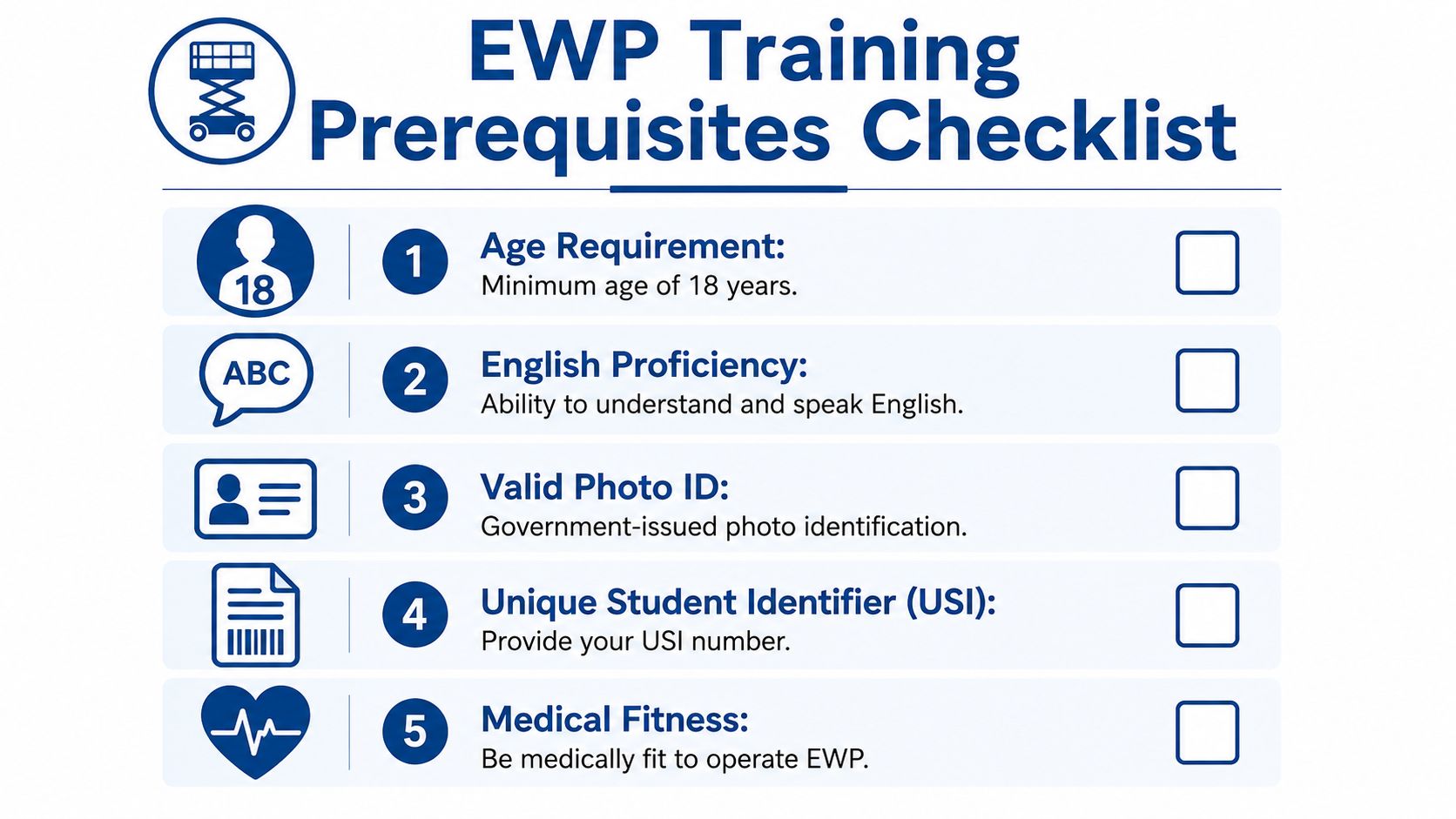
For under 11m training, the cited requirements include a minimum age of 16, a USI, an LLN test, physical fitness, and appropriate PPE. For over 11m boom-type licensing, the cited Sydney course requires you to be 18 or older, with basic literacy and numeracy, a valid photo ID, a USI, and suitable PPE.
Use this as a pre-course check:
- Confirm your age requirement: Under 11m and over 11m courses don't use the same minimum age.
- Sort your USI early: If your USI details don't match your enrolment, the paperwork slows down.
- Bring valid photo ID: Don't assume a photo on your phone will be accepted.
- Wear proper PPE: Safety boots, long pants, and hi-vis are common expectations for practical training.
- Prepare for literacy and numeracy checks: You don't need to be academic, but you do need to read instructions, complete forms, and handle basic calculations.
- Be honest about physical capacity: You'll be climbing in and out of machines, maintaining points of contact, and following emergency procedures.
Workers heading into construction often also need other site entry qualifications. If that's part of your pathway, White Card training in Sydney CBD is usually part of the same broader compliance picture.
TP Training also provides practical, nationally recognised 10830Nat 11084Nat Crystalline Silica Exposure Prevention Asbestos Awareness Combo Courses with experienced trainers and hands-on learning across NSW, which is relevant for workers moving into construction environments where multiple safety requirements sit alongside plant competencies.
Awareness is not competency
This is the mistake that causes the most grief.
Some courses teach hazard awareness only. They may help a worker understand what an EWP is, how risk should be managed, and what basic controls look like. That does not automatically mean the person is qualified to operate the machine.
According to Inscope's EWP awareness course page, SafeWork NSW treats operating an EWP without a valid High Risk Work Licence for booms over 11m or an EWPA Yellow Card for under 11m as a significant breach. The same source cites Worksafe Victoria data showing 34% of work-at-height injuries involve untrained or improperly certified operators.
Book awareness training when you need awareness. Book competency training when you need to operate the machine. They are not interchangeable.
If an employer says, “you'll be using the lift”, you need to verify the actual operating qualification, not a general induction-style course.
What to Expect During Your EWP Training Course
Good EWP training feels structured from the minute you arrive. You sign in, your documents are checked, and then the course starts with theory before anyone touches the controls. That order matters because most operating mistakes start with poor hazard recognition, not poor hand control.
How the course usually runs
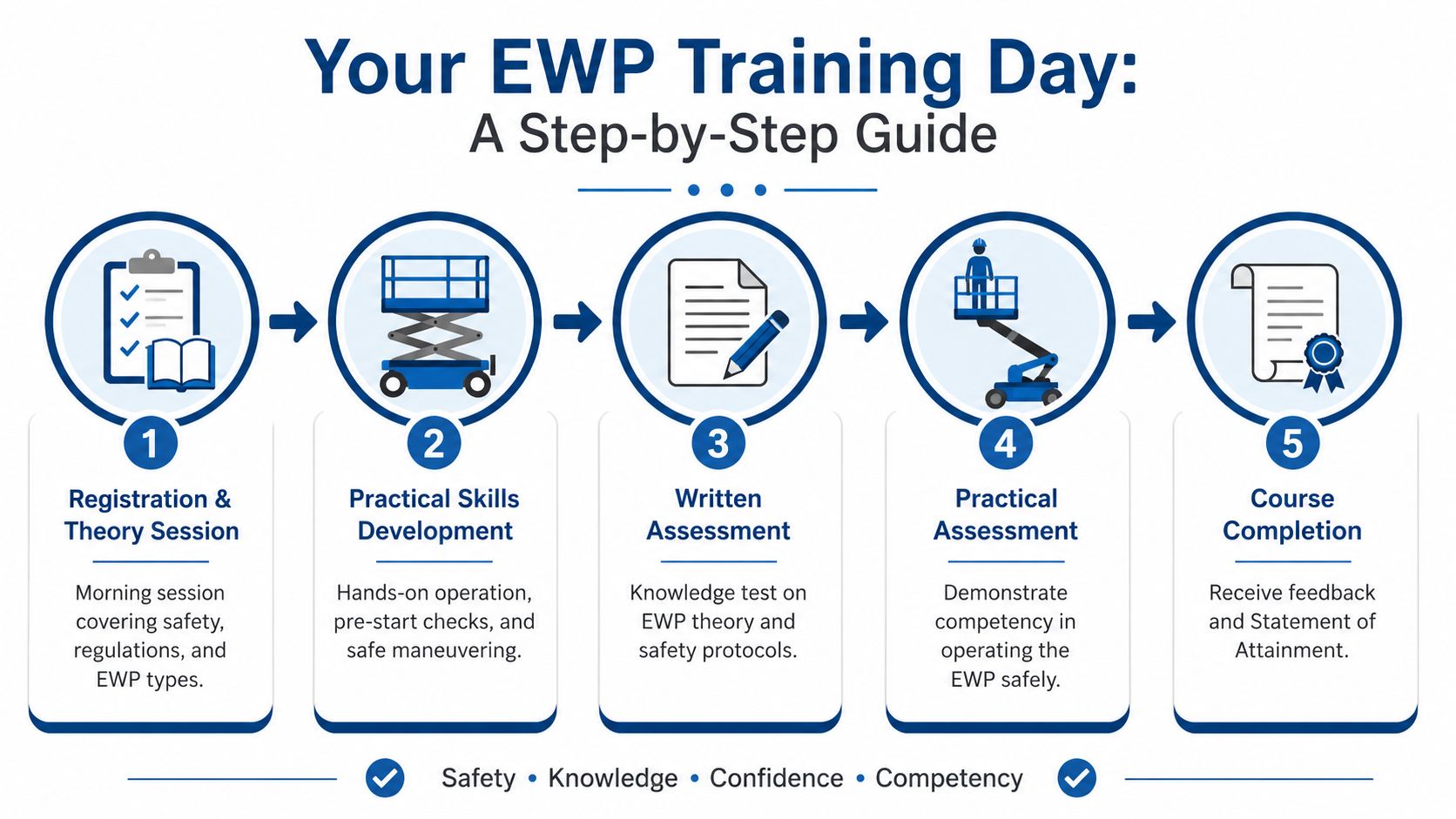
In NSW, the training structure commonly follows theory and practical instruction over one or two days, then a closed-book assessment on the final day conducted by an independent SafeWork NSW Accredited Assessor, according to Pinnacle Safety's NSW EWP training overview. Success depends on both the written knowledge and calculations test and your ability to demonstrate practical competency.
The theory side usually covers:
- Hazard identification: overhead obstructions, unstable ground, weather exposure, nearby traffic, and exclusion zones
- Risk assessment: choosing controls before the platform leaves the ground
- Machine familiarity: controls, emergency lowering systems, platform capacity, and operating limitations
- Communication: what the operator, spotter, and ground crew need to be clear on before movement starts
- Emergency procedures: what to do if the machine fails, the area changes, or a worker becomes stranded aloft
Then comes the practical component. In this stage, trainees usually settle down, because the machine makes the theory real. You'll work through pre-operational checks, setup, safe movement, positioning, and shutdown.
What trainees usually find hardest
The hardest part usually isn't driving the machine. It's staying methodical.
People rush pre-start checks because they want to get into the basket. They forget load awareness because the machine “feels stable”. They focus on where they want to go, not what's in the swing path or what the ground conditions are doing beneath them.
Common practical errors include:
Skipping pre-operational checks
If you miss a fault at ground level, it becomes a bigger problem once the platform is raised.Poor weight awareness
Platform capacity isn't a suggestion. Tools, materials, and personnel all count.Weak communication habits
The operator who doesn't confirm with the ground crew creates unnecessary risk.Tunnel vision during manoeuvring
New operators often watch the platform edge and forget the tail swing, boom path, or nearby structures.
The safest trainees aren't always the fastest. They're the ones who keep the same routine every time.
What assessors are looking for
Assessors don't expect polished production speed. They expect safe, repeatable behaviour.
That means you need to show that you can:
| Assessment area | What it looks like in practice |
|---|---|
| Pre-start inspection | You check the machine systematically and don't guess your way through it |
| Setup | You position and prepare the EWP to suit the work area and conditions |
| Operation | You use controls smoothly and maintain awareness of surroundings |
| Emergency response | You know what to do if normal operation stops or conditions change |
| Shutdown and secure | You return the machine safely and leave it in a compliant state |
If you're nervous, the best preparation is simple. Get enough sleep, review your notes, wear the right gear, and listen carefully during the briefing. Trainees who struggle most often haven't failed on skill. They've failed on attention.
Booking Your Course and Finding TP Training in Sydney
Booking the right course is mostly about timing and logistics. If you wait until the day before site mobilisation, your choices narrow quickly. You may end up travelling across Sydney, missing the course window you wanted, or settling for a date that delays your start.
How to book without wasting a week
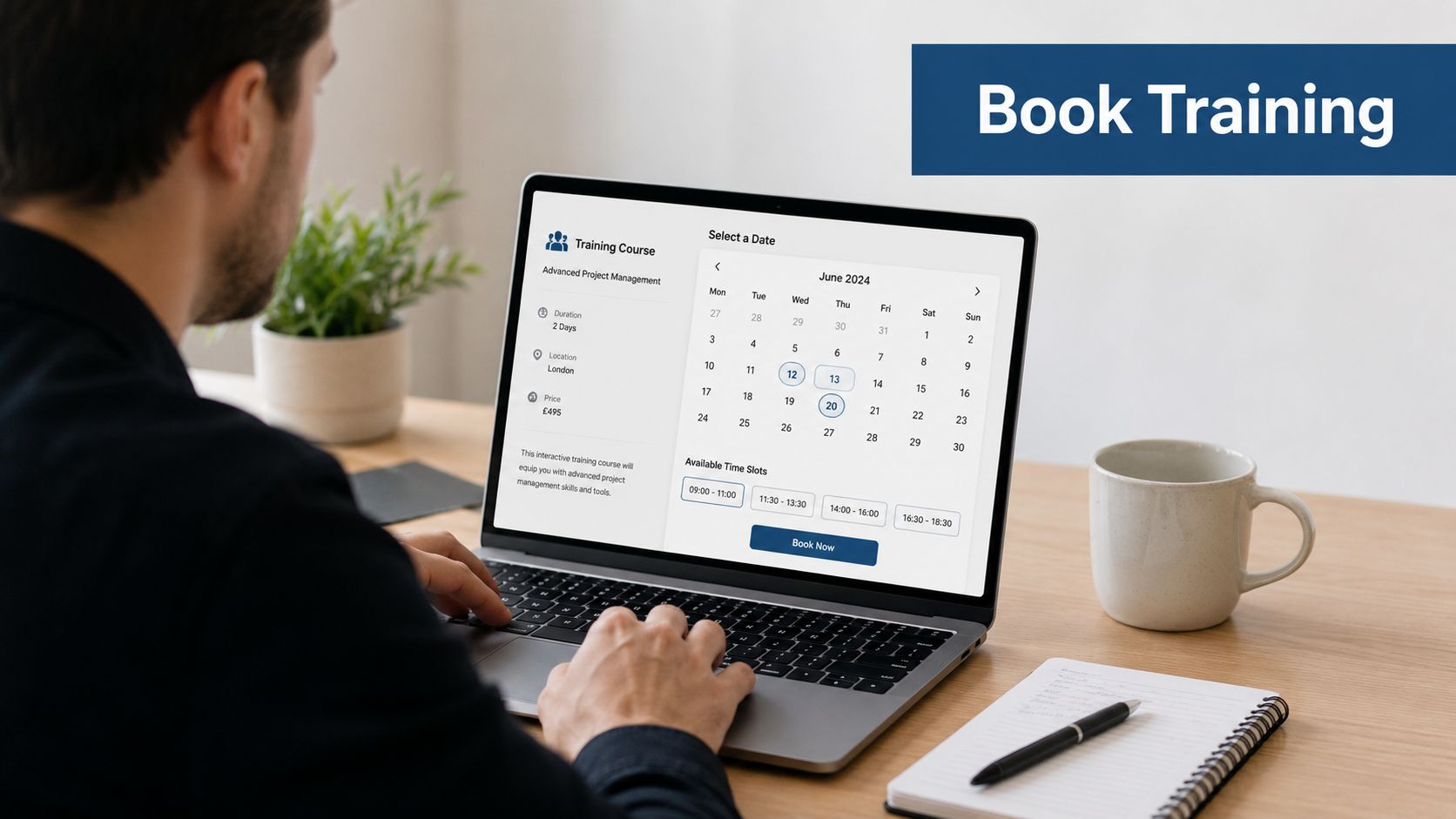
A practical booking approach looks like this:
- Check the exact machine requirement first: Don't book “EWP” as a category. Book the qualification that matches the plant.
- Line up your documents before you pay: ID, USI, and any employer paperwork should be ready.
- Ask how the assessment is scheduled: Some workers assume the whole process happens in one block, then realise the independent assessment is on the final day.
- Think about bundled compliance needs: If you also need White Card, first aid, or another plant ticket, grouping them sensibly can save travel and downtime.
- Choose a location you can reach reliably: Late arrival puts pressure on the whole day and starts the course badly.
Workers in Western Sydney often underestimate how much travel affects training performance. A long commute before a theory-heavy morning and practical assessment isn't ideal.
Why location matters more than people expect
A training provider with multiple Sydney locations gives you more control over travel, punctuality, and follow-up. That's especially useful if you're balancing work, labour hire calls, or site inductions at the same time.
For trainees who need an accessible western location, the Auburn training facility in Sydney is one of the options within TP Training's broader NSW network. That kind of location spread matters because practical training is easier to complete when the trip itself isn't the hardest part of the day.
A lot of people pick a provider based only on search results. A better filter is simpler. Can they deliver the exact course you need, at a location you can get to, with practical scheduling that fits your start date? If the answer is yes, you're already making a better decision than most first-time applicants.
After Your Course Your Licence, Renewals, and Career
A common mistake happens after the course, not during it. A worker passes, files the paperwork away, then gets asked on short notice for proof of competency, machine type experience, or recent refresher training before a site start. That is where the difference between holding a qualification and being ready for work becomes obvious.
What you receive after passing
What you get depends on the pathway you completed.
If you finished an under 11m competency course, you receive training documentation that shows you completed the relevant unit or course outcome for that class of machine. If you completed a high risk work pathway, your provider issues the assessment outcome and supporting documents needed for the licence application stage.
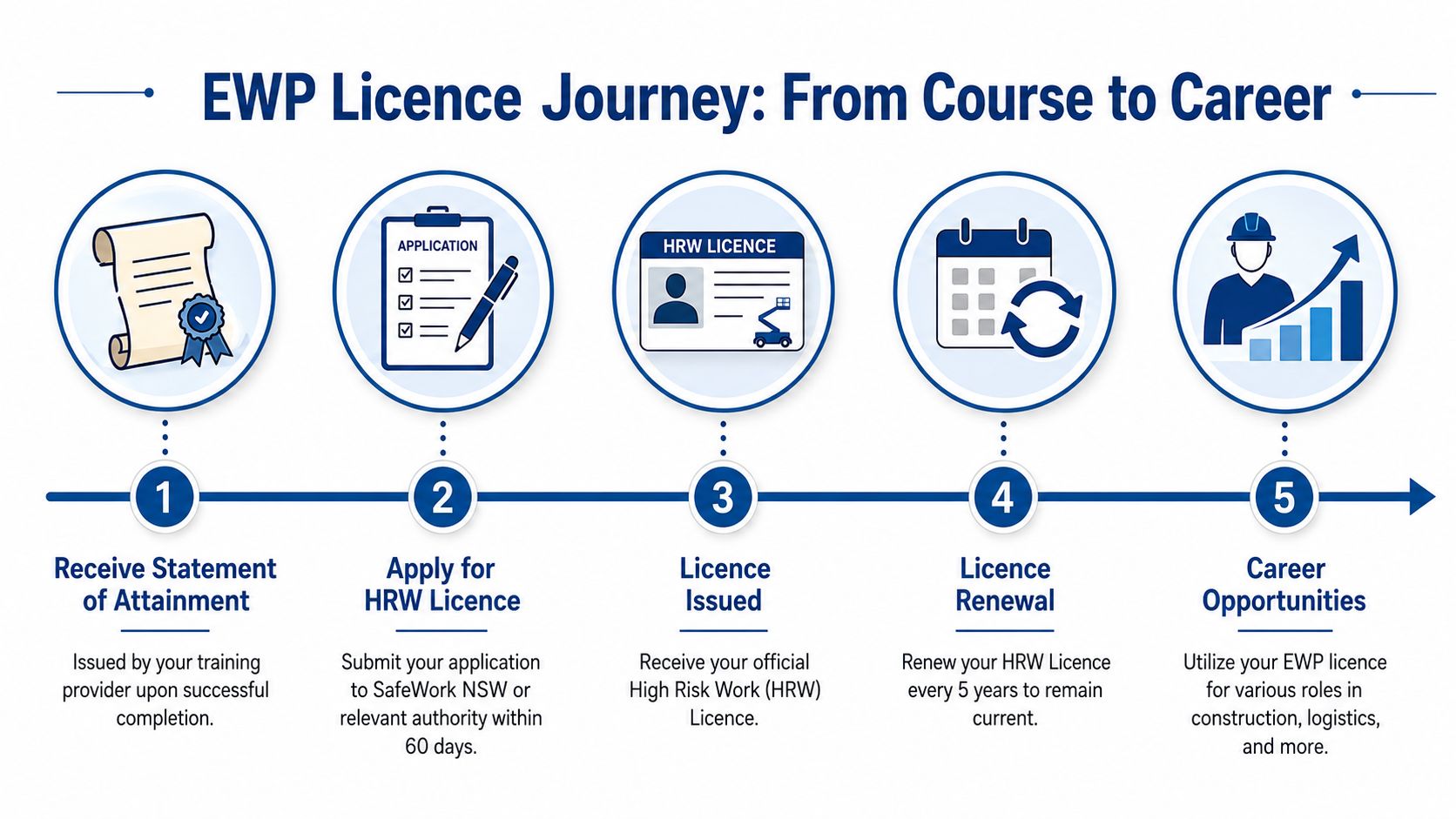
Keep those records in one place. Save digital copies, keep a clear photo of any card or statement, and store them somewhere you can access from your phone. Site supervisors and labour hire coordinators often want evidence fast.
Awareness is not the same as competency
This catches new entrants all the time.
An awareness course shows you have been introduced to hazards, controls, and safe work expectations. Competency means you were trained and assessed to operate the plant to the required standard. Employers, principal contractors, and shutdown managers usually care about that distinction because it affects who can legally operate, who needs supervision, and whether your paperwork will pass a verification check.
If a job ad asks for an EWP ticket, check what it means. Some roles only need under 11m verified competency for scissor lifts or similar equipment. Others need a high risk work licence for boom type EWPs over 11m. On site, those are not interchangeable.
The refresher issue workers often miss
A licence or statement issued years ago may still exist on paper and still cause problems at pre-start.
Across Sydney worksites, there is growing attention on recency of experience, familiarisation on specific machine types, and refresher training where a worker has had a long gap since last use. That is not just an admin issue. A person who last operated a boom several years ago may still hold the qualification, but practical skill, hazard recognition, and rescue response can slip if the work has not been current.
Good employers know the trade-off. Sending someone to refresher training costs time and money. Sending someone to site with old paperwork and rusty operating habits costs more if they fail verification, need close supervision, or make a poor decision in the basket.
How to keep your licence useful
Treat your EWP qualification as part of your work record, not a one-off course result.
Use a simple system:
- Record the machine types you operate. Scissor lift time does not prove current boom lift ability.
- Keep evidence of recent work where possible. Logbooks, VOCs, site records, and employer sign-offs can all help.
- Book refresher training before a gap becomes a problem. This matters if you have been off the tools, changed industries, or are returning to boom work after a long period.
- Check site and client rules before mobilisation. Some contractors want recent familiarisation or proof of current competency, even where the base qualification is already held.
- Match your training to the work you want next. Maintenance, shutdowns, warehousing, and civil jobs do not always use the same equipment.
Workers who stay current usually move faster between labour hire, shutdowns, commercial projects, and maintenance contracts. The course gets you through the first gate. Ongoing competency, current records, and the right machine experience are what keep you employable.
Frequently Asked Questions About EWP Training
How much does EWP training cost in Sydney
A common mistake is comparing courses by price alone. A lower fee can still cost more if it covers the wrong machine class, excludes assessment, or leaves you with awareness training instead of proven operating competency.
Check three things before you book: the type of EWP covered, whether the assessment is included, and whether the course is for under 11 m operation or the higher risk work licence required for boom-type EWPs over 11 m. Also ask whether you will train on the kind of plant you expect to use at work. A scissor lift course does not prepare you for a boom lift job.
Can you do EWP training online
Some theory can be completed online or in a blended format. The operating side cannot.
You still need practical training and assessment with the machine, because the trainer has to see that you can inspect the plant, set up correctly, use the controls safely, and respond properly if conditions change. That is the line between awareness and competency. Awareness tells you the rules. Competency shows you can apply them on real equipment under assessment conditions.
Course length varies by unit, machine type, and your experience. Under 11 m training is often shorter than the course and assessment pathway for boom-type EWPs over 11 m, which sit under high risk work licensing requirements.
What jobs can you get with EWP training
EWP training is useful across construction, maintenance, warehousing, logistics, facilities, shutdown work, and parts of civil. The better question is whether your training matches the work. Employers usually care less about the course title than whether you can operate the machine on their site safely and with minimal supervision.
That is why current experience matters. A person with an older ticket and no recent boom time may still need familiarisation, a VOC, or refresher training before starting. Newer workers often miss that point. Getting qualified is the first step. Staying work-ready is what keeps you employable.
If you need a practical next step, TP Training offers nationally recognised safety and vocational training across multiple NSW locations, including EWP courses for under 11m, over 11m, and related construction compliance pathways.

You may also like
Asthma and Anaphylaxis Training in NSW
First Aid Training for Construction Workers NSW