Elevated Work Platform Guide: Training, Licences and Safety
You've arrived on a NSW worksite and the supervisor needs someone in a work platform. There's a boom lift nearby, a scissor lift on another job, and someone asks whether you've got the right ticket. You may know how to operate the controls, yet still be unsure whether you need a Yellow Card course, a high-risk work licence, or both.
That confusion is common because the answer depends on the machine, its boom length, and the task. This guide explains how an elevated work platform works, where the 11 metre licensing threshold fits, what training pathways mean in practice, and which site controls should be in place before anyone goes up. It's written for new construction workers, civil crews, warehouse operators, maintenance workers, employers, and job seekers planning their next qualification.
Table of Contents
- Why Elevated Work Platform Training Matters in NSW
- Defining the Elevated Work Platform
- The 11 Metre Licence Threshold Explained
- High Risk Work Licences and EWP Courses
- Real Worksite Risks and How to Control Them
- Safe Operating Routines Every Operator Should Follow
- Choosing the Right EWP Course at TP Training
Why Elevated Work Platform Training Matters in NSW
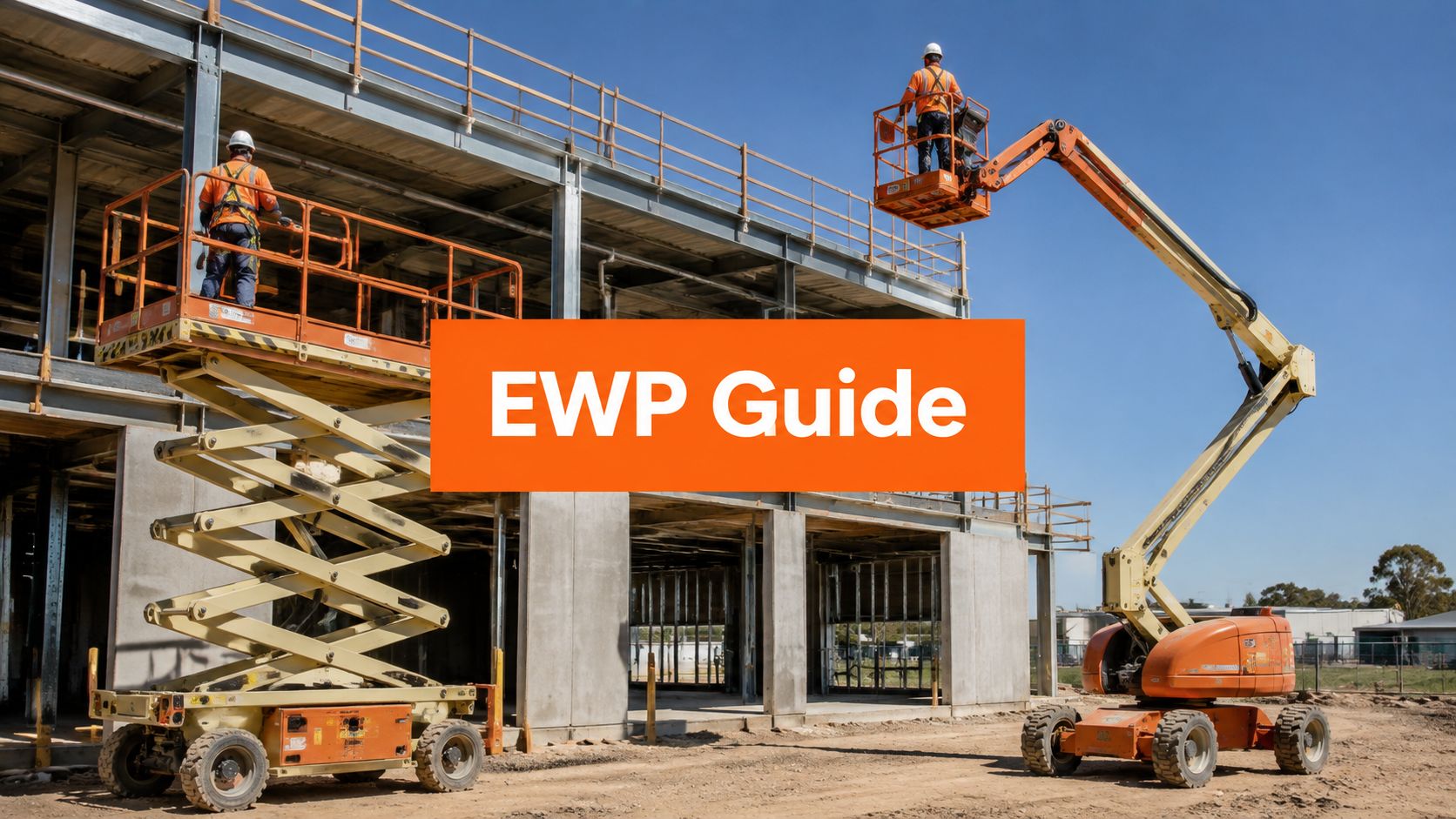
A crew might use a work platform for cladding, electrical work, building maintenance, warehouse tasks, civil construction, signage, or infrastructure work. The machine can provide controlled access where a ladder or scaffold wouldn't suit the job, but the operator still has to understand reach, stability, overhead hazards, emergency controls, and the limits of the specific equipment.
Safe Work Australia describes EWPs as plant used to lift people, equipment, and materials so work can be completed at height. Its guidance also connects EWP work with broader construction controls, including safe selection, setup, use, and maintenance of plant and, where applicable, safe work method statement requirements for high-risk construction work. You can also place EWP training alongside other workplace credentials, such as CPR, First Aid, White Card and workplace safety certifications, because employers often assess the full set of competencies needed for a role.
Why the decision matters before your first shift
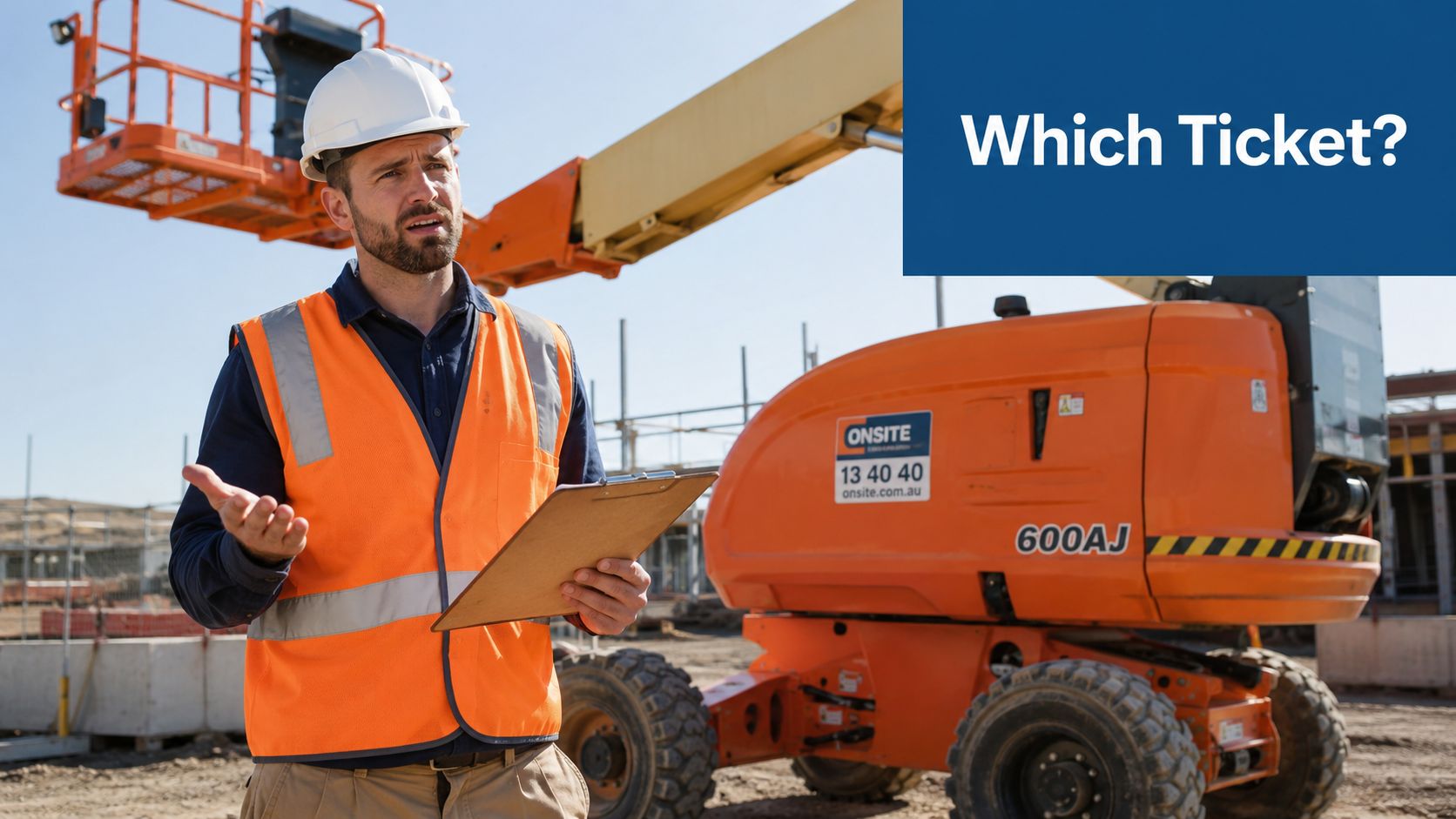
The wrong assumption can create two problems. A worker may operate equipment without the required authority, or they may complete a course that doesn't match the machine they'll use. Neither problem is solved by having experience on a different lift.
Australian regulators continue to treat EWP safety as an active issue. Safe Work Australia published a new model Code of Practice for Elevating Work Platforms on 19 December 2025, announced its release in January 2026, and still listed the guidance as current in August 2026. Victoria's industry standard was published on 23 June 2023, showing that state and national guidance continue to develop around established plant risks. These dates are documented in the Safe Work Australia model Code of Practice.
Practical rule: Don't choose an EWP course from the word “scissor” or “boom” alone. Confirm the machine's rated boom configuration and the work your employer expects you to perform.
Defining the Elevated Work Platform
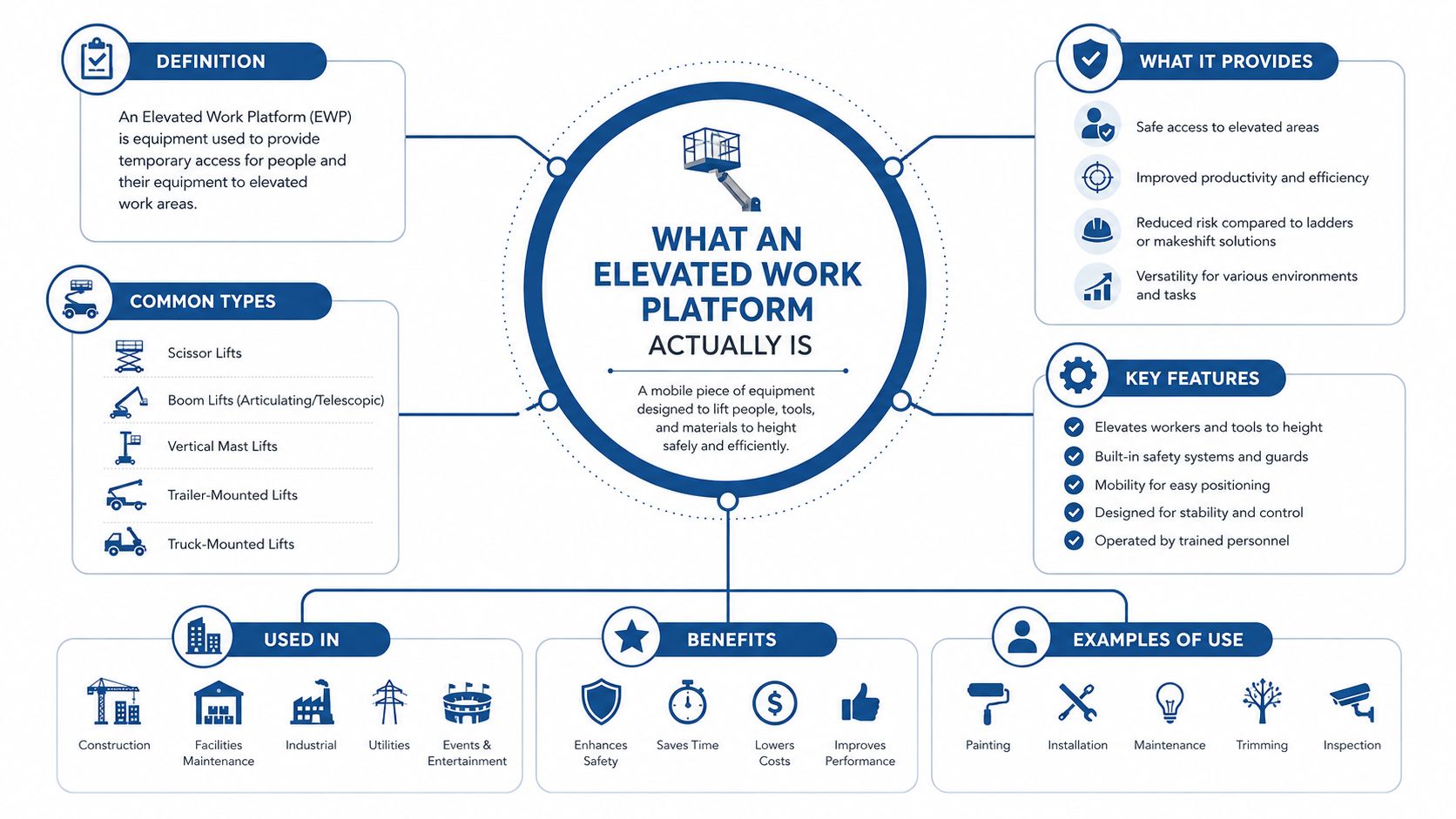
An elevated work platform is mobile plant that raises workers, tools, equipment, or materials to a higher work position. Its main parts are a mobile base, a lifting or extending structure, a guarded platform or basket, and controls for positioning the platform.
A ladder provides a fixed access point. Scaffolding creates a temporary work structure around a task. An EWP combines access with movement, so the operator can place the platform where work is required. That flexibility also brings extra checks: the travel route, ground conditions, overhead structures, nearby people, and the machine's operating limits all affect the setup.
The machine families you'll see on site
A boom lift moves a platform with an extending arm. Telescopic booms extend in a straight line, while articulating booms use hinged sections to reach over or around obstacles. Horizontal reach matters as much as working height when the platform must sit beside a façade, pipework, tree, or structural frame.
A scissor lift raises its platform through linked supports that expand vertically. It suits work requiring a broad platform and mainly vertical access, including internal fit-outs, installation, painting, and maintenance. A scissor lift is not automatically treated the same way as a boom-type EWP for licensing. Identify the machine and its rated configuration before choosing training.
A telehandler fitted with a personnel box combines a telescopic material-handling boom with a platform designed to carry people. SafeWork NSW requirements can apply when the boom reaches the regulated threshold. Trailer-mounted and compact crawler boom lifts also require attention to access, stabilisation, terrain, and machine configuration. This compact crawler boom lift guide provides further equipment context for smaller access machines.
The machine type points you toward the right training pathway, but the task determines how carefully the equipment must be assessed. For example, a compact unit on uneven ground may demand different controls from a larger machine working on a prepared slab.
Reach isn't the same as platform height
The platform can be working at a particular height while the licensing question for a boom-type EWP focuses on boom length. That length may be measured vertically from the supporting surface or horizontally from the boom's rotation point to the platform's outer edge. A task described as “working from the basket” does not identify the licensing position.
Before booking training, record the machine type, manufacturer information, rated boom length, and tasks you will perform. An EWP risk assessment approach helps connect the selected equipment with the conditions of the work area.
The 11 Metre Licence Threshold Explained
The central Australian rule is straightforward, but people often apply it incorrectly. A worker needs a high-risk work licence to operate a boom-type EWP where the boom length is 11 metres or more, as stated by Safe Work Australia and applied by SafeWork NSW through the WP licence class.
The measurement isn't limited to the platform's vertical height. Regulators recognise that boom length may be measured vertically from the supporting surface or horizontally from the boom's rotation point to the platform's outer edge. The trigger is therefore linked to the machine's boom configuration, not the height of the work face or the label used by the hire company.
The two pathways side by side
| Pathway | Typical Machines | Licence or Ticket | When It Applies |
|---|---|---|---|
| Under-11 m EWP training | Boom-type EWPs below the regulated boom length, plus relevant non-boom EWP tasks | General EWP operator training, commonly described as a Yellow Card pathway | When the machine's boom length is below 11 m and the employer's site requirements are met |
| 11 m or more boom-type EWP | Telescopic, articulating, truck-mounted, trailer-mounted, and self-propelled boom lifts that meet the threshold | WP high-risk work licence | When the boom length is 11 m or more |
| Telehandler with personnel box | Telehandler configured to carry people | WP high-risk work licence where the boom length reaches the threshold | When the equipment's rated boom length is 11 m or more |
A Yellow Card-style course and a high-risk work licence aren't interchangeable. The first may support competency for equipment below the licensing threshold, while the second is the regulated authorisation for the applicable boom-type high-risk work class. Your employer must match your evidence to the machine before you operate it.
The NSW high-risk work licence overview can help explain how the WP category fits into the wider licensing system. For the regulated pathway, TLILIC0005 Elevate Work Platform Licence To Operate Boom Length 11M Or More EWP is the relevant course name listed by TP Training for practical, nationally recognised training with experienced trainers and hands-on learning across NSW.
What the employer must check
The operator isn't the only person responsible for getting this decision right. Safe Work Australia states that the employer must sight the worker's licence or written evidence before allowing the work, as set out in Queensland's boom-type EWP licensing guidance. A site supervisor should also confirm that the evidence relates to the machine and task being assigned.
If the equipment is changed, don't assume the original ticket covers it. Ask for the machine specifications and check the pathway again before starting.
High Risk Work Licences and EWP Courses
Training should answer a practical question: what will you operate, and what risk does that equipment create? The two main EWP pathways discussed on NSW sites are the regulated TLILIC0005 licence for a boom-type EWP at or above the threshold, and RIIHAN301E training for boom-type EWPs below it.
TLILIC0005 is the high-risk work licence pathway for operating a boom-type EWP where the boom length is 11 metres or more. It deals with the responsibilities attached to a regulated high-risk task, including planning the operation, checking the plant, controlling the work area, operating the machine, and responding to an emergency.
RIIHAN301E is commonly used as the under-11 m Yellow Card pathway. It's relevant where the boom-type EWP remains below the regulated threshold and the employer requires evidence of operator competency. The course still needs to match the equipment and workplace expectations. A ticket that says “EWP” doesn't remove the need to understand the specific machine.
Why combined training can make sense
A worker who stays on one machine may only need one pathway. A civil crew, maintenance contractor, or labour hire worker may move between compact booms, larger articulated lifts, scissor lifts, and other plant. In that situation, a combined over-and-under 11 m course can create a clearer training record, provided the course scope matches the machines the worker will use.
The EWP training pathway in Sydney should be considered alongside the employer's equipment register and site rules. Training providers and employers need to distinguish between a formal WP licence, general EWP verification, refresher training, and other high-risk work tickets.
Training is one control, not the entire control system
An operator's licence demonstrates a regulated competency pathway, but it doesn't replace a site assessment. The machine still needs suitable ground, adequate clearance, functioning safety devices, an exclusion zone, communication with ground workers, and a rescue plan.
That's why the course decision should start with risk. A boom lift reaching over a roof edge creates different positioning and entrapment concerns from a scissor lift used indoors. A mobile machine travelling through a warehouse creates interaction risks with pedestrians and forklifts. The operator needs training that reflects those conditions, while the employer must control the workplace around the machine.
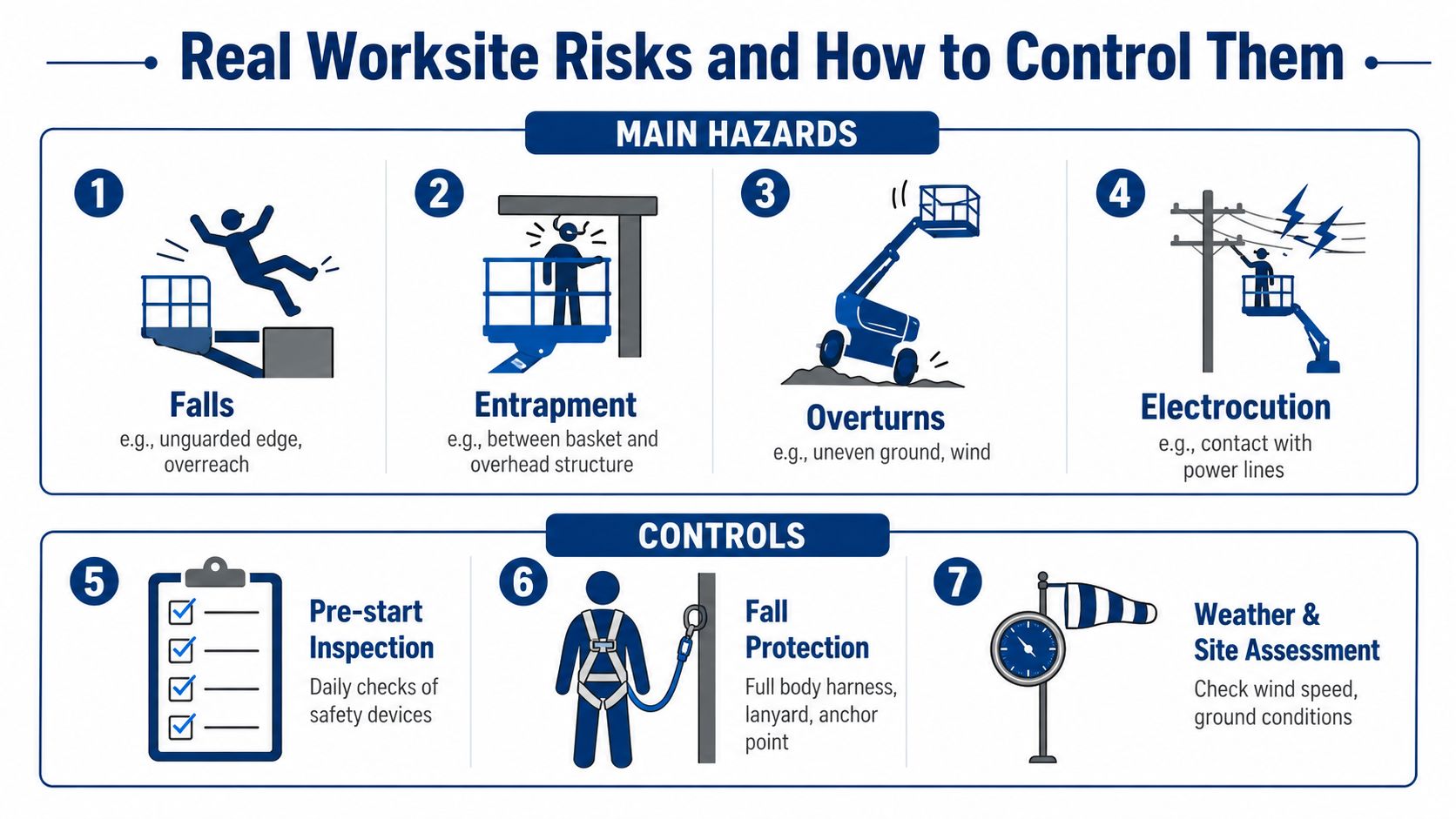
Real Worksite Risks and How to Control Them
A raised platform can turn a small site error into a serious incident. The operator, supervisor, and ground crew must control hazards created by the machine, the task, and nearby activities. WorkSafe Victoria's elevating work platforms industry standard applies to operators and people managing EWP hazards, reflecting their shared responsibility.
Start with the task rather than the licence card. A compact under-11 m machine may still expose a worker to falls, crushing, traffic, or powerline hazards. A larger boom or a machine used near structures may require a high-risk work licence as well as controls specific to its movement and reach.
Common hazards include:
- Falls: Climbing on rails, overreaching, misusing access gates, or leaving the platform's protected area can result in a fall.
- Entrapment: The basket can crush an occupant against a beam, roof edge, pipe, or other structure.
- Overturns: Soft, sloped, uneven, or unsuitable ground can reduce stability, especially during movement or poor positioning.
- Struck-by incidents: Vehicles, plant, materials, people, or falling objects can enter the work area.
- Electrical contact: A raised platform can reach overhead power infrastructure if the area is not assessed and controlled.
Build controls before the platform rises
Follow the manufacturer's pre-start requirements. Check the controls, tyres or wheels, hydraulics, guardrails, alarms, emergency systems, platform, structural components, and other safety devices fitted to that machine. Report defects that could affect operation and keep the equipment out of service until it has been assessed and rectified.
Assess the actual work area, including holes, trenches, slopes, soft ground, debris, overhead structures, electrical hazards, vehicle routes, and pedestrian access. Site owners may need workplace hazard concrete solutions for damaged or uneven concrete, but repairs do not replace the operator's surface assessment. Where the task involves fall exposure, working at heights training can support the broader control plan.
Make rescue a planned action
WorkSafe Victoria describes a safety observer as someone who can see the platform and has training in that specific EWP's emergency rescue procedures. The observer must be able to warn the operator about hazards or assist occupants during an emergency.
The rescue plan should name the people responsible, explain the emergency controls, set out communication methods, and show how occupants will be reached. First aid forms part of the wider site response. TP Training provides practical, nationally recognised Provide First Aid Course training with experienced trainers and hands-on learning across NSW.
Safe Operating Routines Every Operator Should Follow
Good operation follows a repeatable sequence. It begins before the key is turned and continues until the machine is parked, isolated, and handed back in a safe condition.
Start with the machine and the ground
Read the machine instructions and confirm the operating limits. Complete the pre-start inspection, test the controls and emergency functions as required, and report defects instead of working around them. Check that the platform, gates, guardrails, tyres, wheels, alarms, and structural parts are in suitable condition.
Walk the route and work area. Confirm that the ground can support the machine, that the machine won't cross an unprotected edge or excavation, and that overhead structures and electrical hazards have been identified. A machine that is suitable on one part of a project may be unsuitable after the crew moves to another surface.
Set up the work zone
Position the EWP so the operator doesn't need to overreach or use an unstable posture. Establish an exclusion zone with barriers, signs, a spotter, or other controls suited to the traffic around the task. Keep pedestrians, vehicles, and other plant away from the movement area, and agree on clear signals or radio communication with ground workers.
Fall protection decisions must follow the machine instructions, site risk assessment, and applicable workplace requirements. Don't climb on rails, carry loads that exceed the rated limits, or use the platform to push against structures. Keep tools and materials controlled so they don't create falling-object risks for people below.
Before you elevate: Check the machine, the ground, the overhead space, the people nearby, and the rescue method. If one of those answers is unclear, stop and ask the supervisor.
Keep reassessing while the task changes
Weather, traffic, lighting, nearby trades, and access routes can change during a shift. Wind can affect stability and make materials difficult to control. Rain can reduce visibility and make surfaces slippery. If conditions move beyond the manufacturer's operating limits or the site controls no longer work, lower the platform and suspend the task until it can be made safe.
When the job ends, lower the platform, park in the approved location, apply the shutdown procedure, remove the key or isolate the machine as required, and report faults or damage. This routine supports the model Code of Practice approach, which treats selection, safe use, maintenance, and risk management as connected duties.
The same discipline helps career development. Workers moving between construction, civil works, warehousing, and maintenance can combine EWP competency with White Card, traffic control, forklift, telehandler, first aid, and other relevant tickets. The useful qualification is the one that matches the equipment and duties an employer will assign.
Choosing the Right EWP Course at TP Training
Choose the pathway from the machine's boom length and your expected duties, not from a job advertisement's shorthand. If you'll operate a boom-type EWP at or above the regulated threshold, you need the WP high-risk work licence pathway. If you'll operate a relevant boom-type EWP below that threshold, an under-11 m Yellow Card course may be the appropriate competency pathway. If your work changes between both categories, ask about a combined option.
Workers and employers in Penrith, Burwood, Auburn, Parramatta, and Sydney CBD can also consider how EWP training fits into a broader construction or civil construction plan. A White Card may support construction entry, while traffic control, forklift, telehandler, and other high-risk work training may suit different site roles. Always confirm the exact machine and evidence required with the employer before booking.
TP Training provides practical, nationally recognised EWP training with experienced trainers and hands-on learning across NSW, including the over-11 m TLILIC0005 pathway and the under-11 m RIIHAN301E Yellow Card pathway. Prepare the machine details, your intended job duties, and any employer requirements, then enquire about the course that matches your next shift.
Visit TP Training to enquire about the work platform pathway that fits your machine and role. Their NSW training options include over-11 m high-risk work licensing, under-11 m Yellow Card EWP training, and broader construction and safety courses to support your next job.

You may also like

Government Fund Courses in Australia: A Practical Guide
Workplace Safety Training: A 2026 Guide for Australia