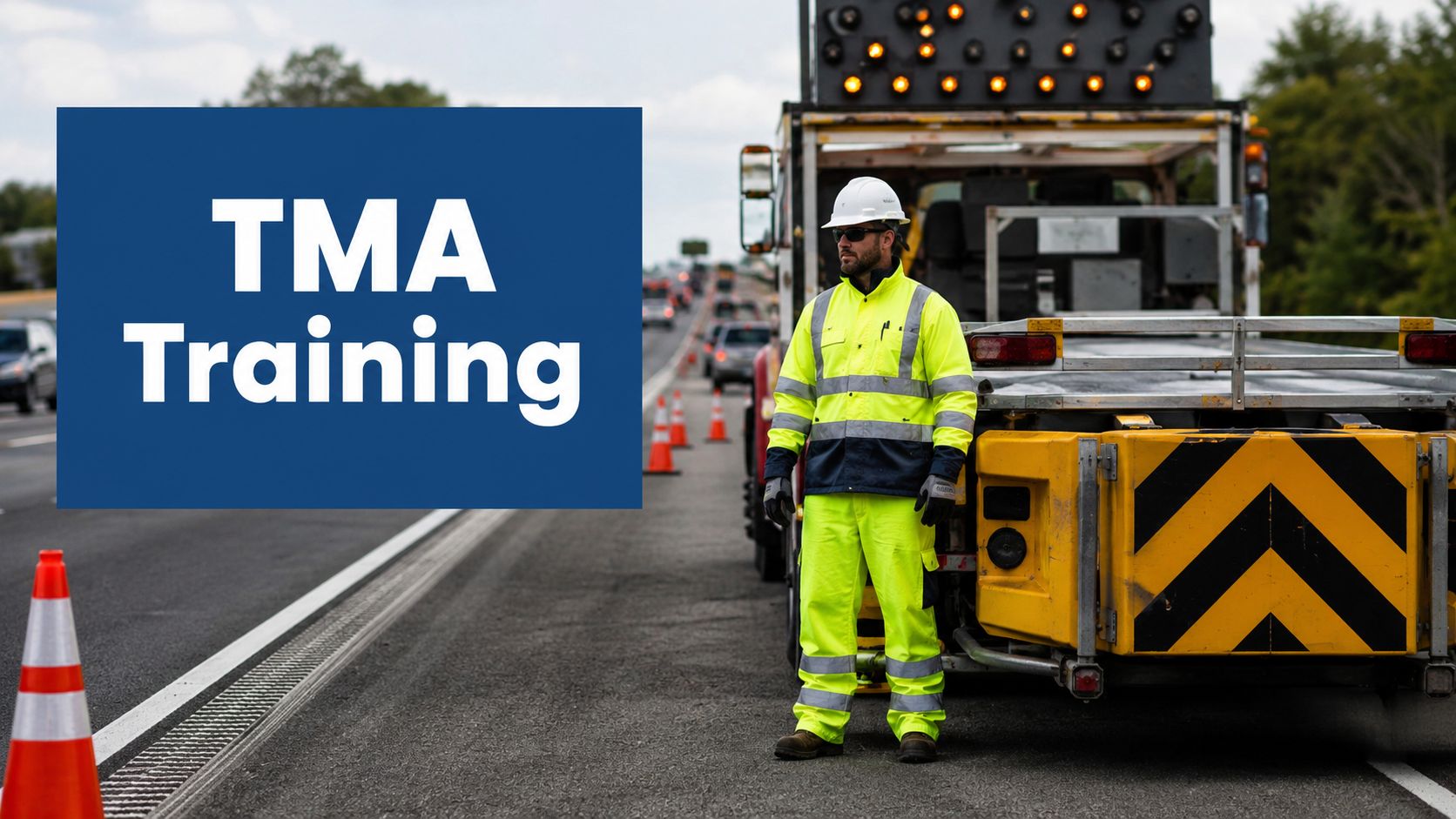
Operate Truck or Trailer Mounted Attenuators Training Course (TMA)
You're sitting in a pre-start meeting for a rolling lane closure. The truck-mounted attenuator is ready, the crew is waiting, and the traffic management plan is open on the supervisor's tablet. The question is simple but important: is the person in the driver's seat ready to protect the work zone, or have they only completed a short course without the licence, vehicle knowledge and site preparation needed to operate safely?
An Operate Truck or Trailer Mounted Attenuators Training Course (TMA) is one part of a broader Australian roadwork safety pathway. The operator needs to understand the attenuator, the host vehicle, moving traffic, radio communication and the limits of the worksite. They also need the right driving authority, construction induction, traffic-management knowledge and employer approval before deployment.
Table of Contents
- Why TMA Operators Matter in Live Roadwork
- Understanding RIIRTM301E TMA Training
- Distinguishing TMA Training from EWP Licensing
- Preparing for TMA Training and Workplace Entry
- Building the Core Skills and Assessments
- Managing the TMA Host Vehicle Safely
- Enrolling with TP Training in NSW
- TMA Safety, Renewal Checks and Next Steps
Why TMA Operators Matter in Live Roadwork
A mobile lane closure is moving along a busy New South Wales road. The crew works inside the protected area while the TMA host vehicle maintains its shadow position behind the work activity. Approaching drivers see the warning devices, but the operator sees much more. They're watching the lane, checking spacing, listening to radio instructions and preparing to respond if a vehicle enters the closed path.
A correctly trained operator doesn't treat the TMA as an ordinary trailer or truck attachment. They understand that the unit forms part of a positive-protection system. Australian guidance identifies truck and trailer mounted attenuators as temporary road safety devices under AS/NZS 3845.2:2017, while Austroads guidance addresses their use in incident response and aims to improve consistency between jurisdictions (Austroads AP-G106-23 guidance).
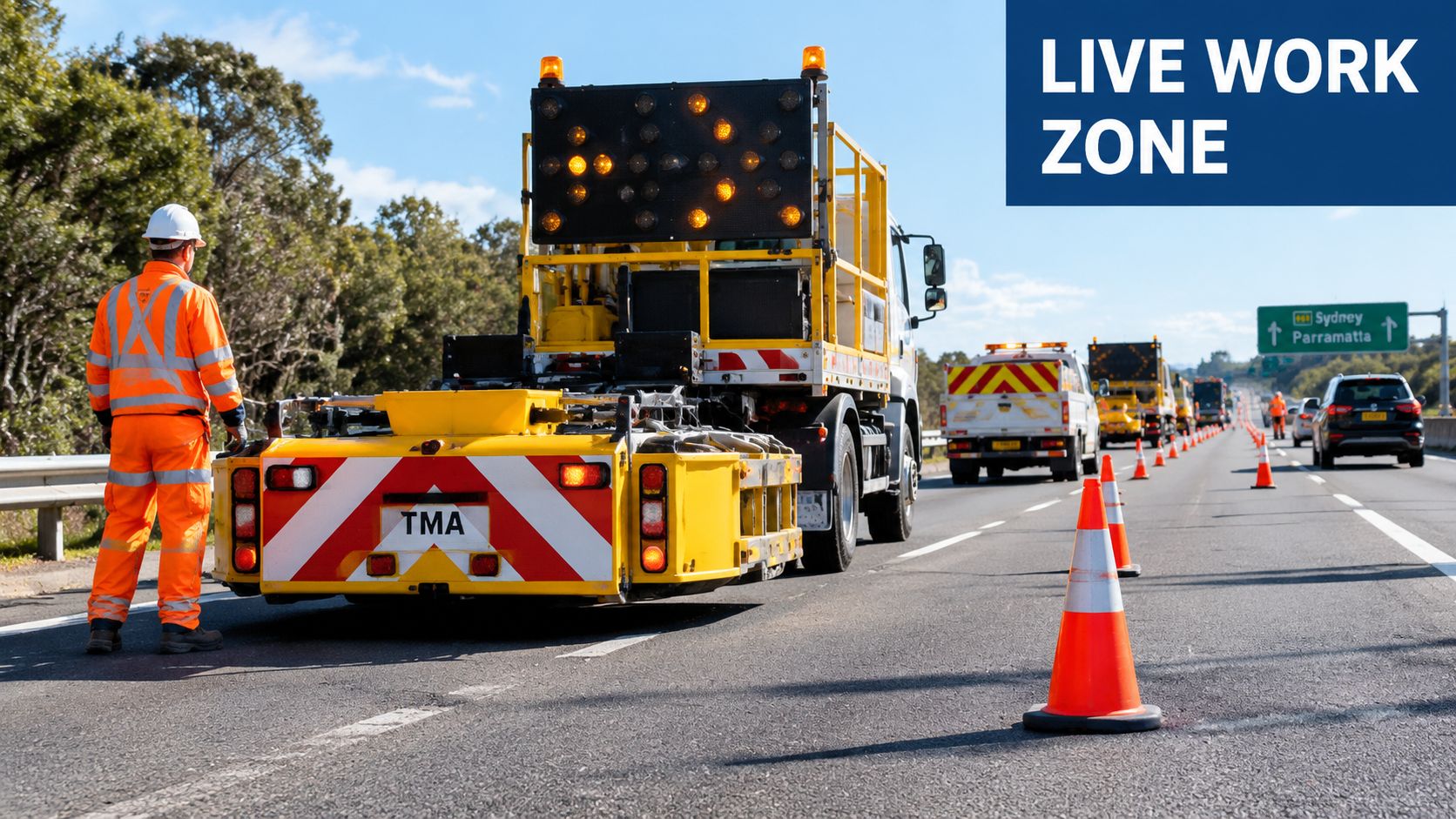
The operator's decisions affect the whole work zone
The operator must maintain the planned position, respond to instructions from the traffic management team and recognise when conditions have changed. Poor spacing, late repositioning, unclear radio calls or an unsuitable host vehicle can expose workers and road users to unnecessary risk.
Queensland guidance illustrates how precise these decisions can be. During dynamic work, the attenuator must be positioned between 100 m and 200 m from the work area, and weekly temporary traffic management inspections must be completed by a suitably qualified person from within the traffic stream at normal traffic speed. These requirements are outlined in the verified Australian TMA training information (Western Training Australia TMA course information).
Practical rule: A TMA course doesn't turn an unlicensed driver into a compliant operator. It adds specialist competence to an existing driving, construction and work-zone pathway.
The Queensland guideline requires a current and valid heavy vehicle licence of a suitable class and evidence of successful completion of an approved competency-based TMA course when requested. In NSW, the host vehicle must have at least one qualified operator, and TMAs used on Transport roads must be assessed and accepted through the Austroads Safety Barrier Assessment Panel in accordance with AS/NZS 3845.2:2017.
Before enrolling, review the broader work zone traffic management planning course information and use a practical road-user safety resource such as the comprehensive move over laws from My Safety. The TMA operator's competence is the final layer, not the entire system.
Understanding RIIRTM301E TMA Training
RIIRTM301E Operate truck or trailer mounted attenuators is the nationally recognised unit of competency for TMA operation in Australian civil construction and temporary traffic management. It was first released and listed as current on training.gov.au on 25 January 2021, establishing the national competency reference used by Australian training providers and road agencies (RIIRTM301E on training.gov.au).
The unit gives employers a formal benchmark for checking capability. A provider may give its course a particular name, but the competency outcome should be mapped to RIIRTM301E. The unit's scope includes planning and preparing, radio communication, operating and positioning the attenuator, using traffic controls and cleaning up (RIIRTM301E unit document).
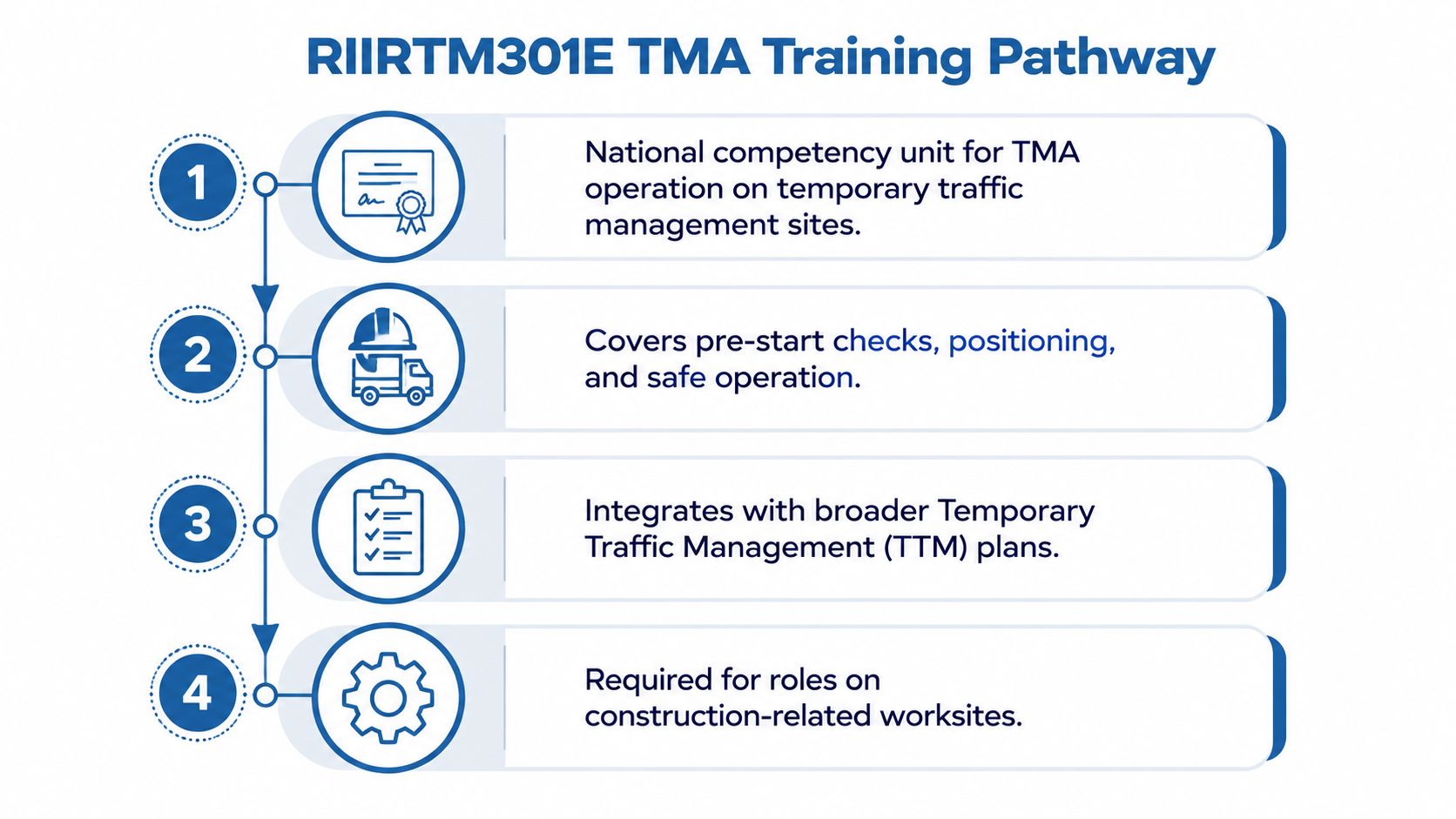
What the learning process usually covers
Training commonly combines knowledge development with supervised practical activity. Depending on the provider and jurisdiction, students may work through:
- Equipment purpose: Learn how the attenuator helps provide positive protection and how its deployment affects the work zone.
- Planning and preparation: Review the traffic arrangement, worksite hazards, vehicle compatibility and required controls before moving.
- Positioning: Practise maintaining the planned shadow position, understanding roll-ahead clearance and adjusting to the road geometry.
- Communication: Use two-way radio procedures, agreed call signs and clear instructions with traffic controllers and supervisors.
- Inspection: Complete pre-start checks and identify defects that could affect safe operation.
- Completion: Stow, clean and report the unit according to the site's procedures.
Course duration varies. Some Australian providers list delivery as one day or eight hours, while a Western Australian provider advertises two days. The duration alone doesn't prove competence, so students should confirm the assessment approach, practical requirements and entry conditions before booking.
RIIRTM301E doesn't replace a heavy vehicle licence, a construction induction card, traffic-controller accreditation or a site induction. Those requirements sit alongside the unit and must be checked with the relevant employer, road authority and principal contractor. Students comparing specialist pathways can also review information about a traffic controller ticket for traffic control work.
For an NSW option, Riirtm301E Operate Truck Or Trailer Mounted Attenuators Training Course Tma is described by TP Training as practical, nationally recognised training delivered with experienced trainers and hands-on learning across NSW.
Distinguishing TMA Training from EWP Licensing
TMA operation and work platform operation can both appear on a civil construction job description, but they address different machines and hazards. A TMA operator works at road level, managing a host vehicle and attenuator around live traffic. An EWP operator controls a raised platform or boom and manages hazards associated with height, stability, access and fall prevention.
Units such as RIIHAN301E Operate elevating work platform and TLILIC0005 Licence to operate a boom-type elevating work platform over 11 m don't authorise someone to operate a TMA. Likewise, RIIRTM301E doesn't provide an EWP high-risk work licence. The correct credential depends on the equipment and the task, not the worker's job title.
| Aspect | RIIRTM301E TMA | RIIHAN301E / TLILIC0005 EWP |
|---|---|---|
| Primary equipment | Truck or trailer mounted attenuator | Elevating work platform or boom-type EWP |
| Main work environment | Temporary traffic management and live roadwork | Elevated access and work at height |
| Core hazards | Errant vehicles, positioning, communication and host-vehicle movement | Falls, platform stability, overhead hazards and machine controls |
| Driving authority | Requires the suitable licence for the host vehicle | Doesn't replace the relevant road-driving licence |
| Height category | Not an EWP height qualification | RIIHAN301E and TLILIC0005 address different EWP requirements, including under and over 11 metre categories |
| Licence outcome | TMA competency, not a high-risk work licence | TLILIC0005 relates to the high-risk work licence category for the relevant boom-type EWP |
An operator might hold both types of training, but one doesn't substitute for the other. Before enrolling, check the equipment named in the job task, the state or territory rules and the employer's evidence requirements. TP Training describes its EWP training in Sydney as a separate training pathway from TMA operation.
For students who specifically need boom-type EWP training over the relevant height category, Tlilic0005 Elevate Work Platform Licence To Operate Boom Length 11M Or More Ewp is described by TP Training as practical, nationally recognised training with experienced trainers and hands-on learning across NSW. That course should be considered for EWP work, not as preparation for operating a TMA host vehicle.
Preparing for TMA Training and Workplace Entry
A new operator usually reaches TMA training after several practical checks. The first is the driving authority. The host vehicle may be a heavy truck or a trailer combination, so the licence class must match the vehicle being driven. The Queensland guideline specifically requires a current and valid heavy vehicle licence of a suitable class, while Victorian road authority guidance also requires a current suitable heavy vehicle licence before TMA operation (Victorian TMA operator guidance).
The next layer is construction entry. Victorian guidance identifies the General Construction Induction Card, commonly called a White Card, as a requirement alongside TMA operator training. NSW employers may also request traffic-controller or traffic-management training, documented site experience and evidence that the worker understands the traffic management plan.
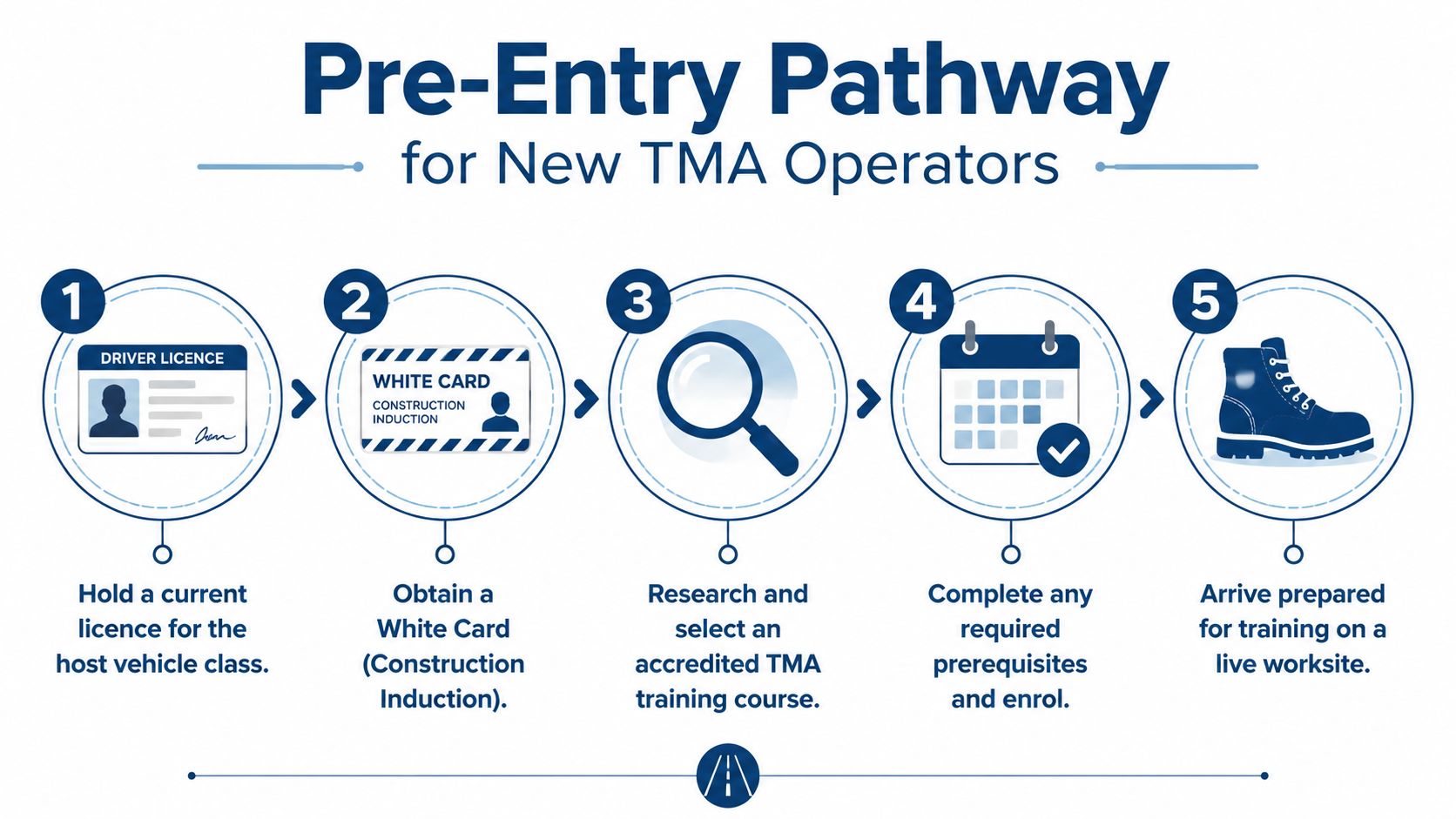
A practical entry sequence
- Confirm the host vehicle licence. Ask the employer what truck or trailer will be used, then check that your current licence class is suitable.
- Hold construction induction. A White Card or equivalent general construction induction is commonly expected for construction-related worksites.
- Build traffic-management knowledge. Depending on the role, this may include traffic-controller, implementer or work-zone planning training.
- Check course prerequisites. Providers may need to confirm identity, language and literacy capability, driving experience or access to a suitable practical vehicle.
- Prepare for the actual site. Review the traffic management plan, risk assessment, signage layout, communication process, isolation controls and supervisor briefing.
The host vehicle familiarisation step is easy to underestimate. RIIRTM301E covers the competency, but the operator still needs to understand the specific truck or trailer, its controls, mirrors, warning systems, attachment points and operating limits. A person trained on one arrangement shouldn't assume every TMA combination handles the same way.
For general construction entry guidance, review how to get a White Card. Employers planning work-zone activities may also consider Prepare Work Zone Traffic Management Plan Course Pwz Red Card, which TP Training describes as practical, nationally recognised training with experienced trainers and hands-on learning across NSW. Always confirm the final requirements with the controlling road authority and principal contractor.
Building the Core Skills and Assessments
A TMA assessment tests how the operator combines several tasks during live roadwork. On a lane closure, for example, the vehicle must form a predictable protective buffer while the operator follows the traffic plan, communicates with the crew and responds to changing conditions. Driving skill or control-panel knowledge alone does not show complete competence.
Start with the equipment
Begin with a pre-start inspection of the attenuator, mounting hardware, wheels, lighting, arrow boards, restraints and visible damage. Defects should be identified, recorded through the workplace process and reported before deployment if they could affect the unit's operation or impact performance.
The operator must also understand the equipment's operating sequence. That includes changing between stowed and deployed positions, checking locks and restraints, confirming warning devices operate and following the manufacturer's instructions. If the task includes lifting or handling trailer components, the ANTS Trailers lifting guide offers general equipment-handling context. Site procedures and the manufacturer's instructions remain the controlling references.
Position with the traffic plan
The approved traffic plan sets the starting point, movement limits and relationship between the TMA, workers and live traffic. Road geometry, traffic speed, lane width and directions from the traffic management team can change the safest position. During a practical assessment, the trainee may need to demonstrate:
- Shadow position: Keep the host vehicle where the plan places it, rather than moving closer to the crew for convenience.
- Roll-ahead clearance: Understand how far the vehicle could travel after impact and how that movement affects the protected area.
- Lane and taper alignment: Confirm changes with traffic controllers before entering a taper, repositioning or passing other plant.
- Radio discipline: Use agreed call signs, concise messages and read-back or confirmation. Workers developing wider communication and work-zone knowledge may also review a traffic control course in Sydney.
- Handover control: Tell the replacement operator about vehicle condition, current position, traffic behaviour and unresolved defects.
Assessment activities may include scenario questions, practical deployment and retrieval, inspection records and observed communication. Providers can use different assessment tools. The result should show that the trainee can apply RIIRTM301E outcomes to workplace procedures, rather than repeat isolated terminology.
An operator who can use the controls but overlooks an unsafe position has not demonstrated complete TMA competence. The same applies when a known defect is ignored or a change in position is not communicated. TMA competence is therefore the final practical part of a pathway that also depends on suitable licensing, traffic-management knowledge, a suitable host vehicle and documented site readiness.
Managing the TMA Host Vehicle Safely
The host vehicle determines how the TMA behaves. Adding the attenuator changes the vehicle's mass, weight distribution, braking response, ride height and cornering characteristics. The operator needs to understand the vehicle's gross mass and axle-loading limits, then confirm that the attachment is approved for that arrangement.
NHVR guidance treats fitting an attenuator as a vehicle modification under the Heavy Vehicle National Law. The modification requires approval by a suitably qualified Approved Vehicle Examiner. When deployed, the vehicle may have a rear overhang of up to 7.6 m and an overall length of up to 15 m, which directly affects turning, reversing, lane changes and clearance around roadside objects (NHVR TMA vehicle guidance).
Read the vehicle as a changed machine
The swept path can extend across a narrow lane, shoulder, roundabout or intersection. Kerbs, drainage structures, barriers, road furniture and gradients can all affect whether the TMA can be positioned without encroaching on the crew's space or the live traffic lane.
Visibility also changes. Arrow boards, the attenuator profile and mounting structures can create blind spots or obstruct the view of signs and approaching vehicles. Mirror coverage, camera systems, warning lights and clear sight lines should be checked before the vehicle enters the work zone.
Mounting security deserves the same attention as driving technique. The operator should verify the manufacturer's compatibility requirements, mounting points, restraints, pre-torque checks and warning-device connections. Victorian guidance recommends that TMA units be rated to a 100 km/h design speed and fitted with an Automatic Impact Brake System, showing that the host arrangement must support verified impact performance and braking control, not merely carry an attenuator.
Stop-work decision: If the host vehicle is unsuitable, poorly maintained, incorrectly mounted or missing required warning devices, the operator should not deploy it. Escalate the concern to site supervision.
Operators and fleet managers can also use a resource such as compare box truck insurance quotes when reviewing broader commercial vehicle arrangements. Insurance discussions don't replace engineering approval, manufacturer compatibility checks or site controls, but they can form part of responsible fleet planning.
Enrolling with TP Training in NSW
Students and employers usually approach enrolment from different directions. A student wants to know whether they can enter training and what documents to bring. An employer needs confidence that the training fits the worker, the vehicle and the worksite.
Student checks
Before booking, confirm:
- USI: Make sure your Unique Student Identifier details are correct and available for enrolment.
- Construction induction: Check whether you already hold the required White Card or equivalent.
- Licence class: Match your current driver licence to the host vehicle you expect to operate.
- Communication readiness: Ask the provider about language, literacy and communication expectations.
- Practical arrangements: Confirm what vehicle, PPE, identification and other materials are needed.
- Course date: Decide whether a public course date suits your work commitments or whether an employer group booking is more practical.
A student shouldn't assume that a TMA course alone provides permission to operate on every road project. The employer may require traffic-management accreditation, documented experience, site induction or additional evidence before assigning the role.
Employer checks
Employers should separately verify:
- Worker eligibility: Confirm the licence class, construction induction, relevant traffic-management training and any state-based requirements.
- Vehicle suitability: Arrange a compatible host vehicle for the practical component and confirm its condition, approval and documentation.
- Supervisor involvement: Nominate the person who will brief, observe and sign off the worker for the specific site.
- Scheduling: Allow training to fit around shifts, mobilisation and planned road closures.
- Records: Retain evidence of competency, vehicle checks, inductions, briefings and workplace authorisations.
TP Training delivers nationally recognised safety and vocational training across NSW locations including Penrith, Burwood, Auburn, Parramatta and Sydney CBD. The available TP Training NSW enrolment checklist infographic reflects the separate questions students and employers need to answer.
Confirm RIIRTM301E delivery details, venue availability, entry prerequisites and practical vehicle arrangements directly with the provider before booking. Employers should also check evidence-retention expectations with the relevant workplace regulator and principal contractor.
TMA Safety, Renewal Checks and Next Steps
TMA competence should remain visible in everyday work, not disappear into a training folder. Before each shift, the operator and supervisor should confirm the work-zone arrangement, inspect the vehicle and attenuator, test communication, review the planned position and discuss what would trigger a stop or repositioning decision.
A repeatable shift routine
Use a simple sequence:
- Inspect: Check the attenuator, attachment points, restraints, wheels, lighting, arrow board, warning systems and visible defects.
- Brief: Confirm the traffic management plan, radio channel or call signs, crew locations, emergency response and supervisor instructions.
- Position: Establish the approved shadow location and verify spacing before work begins.
- Monitor: Watch traffic behaviour, road conditions, changing geometry and communication from the traffic management team.
- Report: Record defects, incidents, changes, handovers and post-shift issues before the vehicle is released.
A refresher or reassessment may be appropriate when the operator hasn't used the equipment for an extended period, when the host vehicle or attenuator arrangement changes, after an incident, or when the employer's procedure calls for renewed verification. A competency unit may not operate like a vehicle licence with a universal expiry date, so the employer should define how ongoing competence is checked.
Common questions
Does every TMA operator need the same supporting credentials? No. The national unit is consistent, but licence classes, traffic-management accreditation, construction induction, site experience and employer controls can vary by state, authority and project.
Can a trained operator use any TMA truck or trailer? No. The operator must receive familiarisation for the specific host vehicle and attachment, and the combination must meet manufacturer, engineering and road-authority requirements.
What evidence might an employer retain? Training evidence, licence details, inductions, site briefings, inspection records, supervisor sign-off and records of any refresher or reassessment may all be relevant.
What should you do first? Confirm entry requirements with TP Training, check the required licence and host-vehicle arrangement with the employer, then book a suitable course date or request a group session if public dates don't fit.
TP Training provides practical, nationally recognised RIIRTM301E TMA training with experienced trainers and hands-on learning across NSW. Visit TP Training to confirm current course details, entry requirements and enrolment options before you prepare for TMA work.

You may also like

Government Fund Courses in Australia: A Practical Guide
Workplace Safety Training: A 2026 Guide for Australia