Prepare Work Zone Traffic Management Plan Course (PWZ) (Red Card) Guide
You've been asked to prepare a traffic management plan for a civil works project, but there's a problem. You understand the site, the plant and the work sequence, yet the client or principal contractor wants evidence that you're qualified to design the work zone arrangement. That's where the Prepare Work Zone Traffic Management Plan Course (PWZ) (Red Card) fits. It's designed for people who need to develop, vary or inspect work zone traffic management plans in live road environments, not only stand at the roadside with a stop/slow sign.
Table of Contents
- Why the PWZ Red Card Matters for NSW Traffic Management
- What the PWZ Red Card Course Covers
- NSW Compliance and the Traffic Management Plan Framework
- Evidence-Based Design and Work Zone Safety Risks
- How to Enrol in the TP Training PWZ Red Card Course
- Common Misconceptions About the Red Card and Plan Approval
- Career Pathways and Next Steps for Traffic Management Professionals
Why the PWZ Red Card Matters for NSW Traffic Management
A construction supervisor is reviewing drawings beside an active road. The work crew needs a safe entry point, traffic must pass the site, and heavy vehicles will cross the footpath or shoulder during the shift. A generic traffic control layout won't answer the key questions. Where will queues form? How will workers enter the site? What happens if the work zone moves? Which controls are suitable for the road function and surrounding hazards?
In New South Wales, the Prepare Work Zone Traffic Management Plan (PWZ) pathway is recognised by SafeWork NSW for workers who need to design, vary or inspect a work zone traffic management plan. Service NSW also states that anyone carrying out traffic control work on or adjacent to a public road must hold a SafeWork NSW traffic control work training card. The credential therefore sits inside a broader compliance framework covering plan preparation, traffic control implementation and public-road safety duties. SafeWork NSW traffic controller training guidance sets out that regulatory context.
Design work is different from roadside control
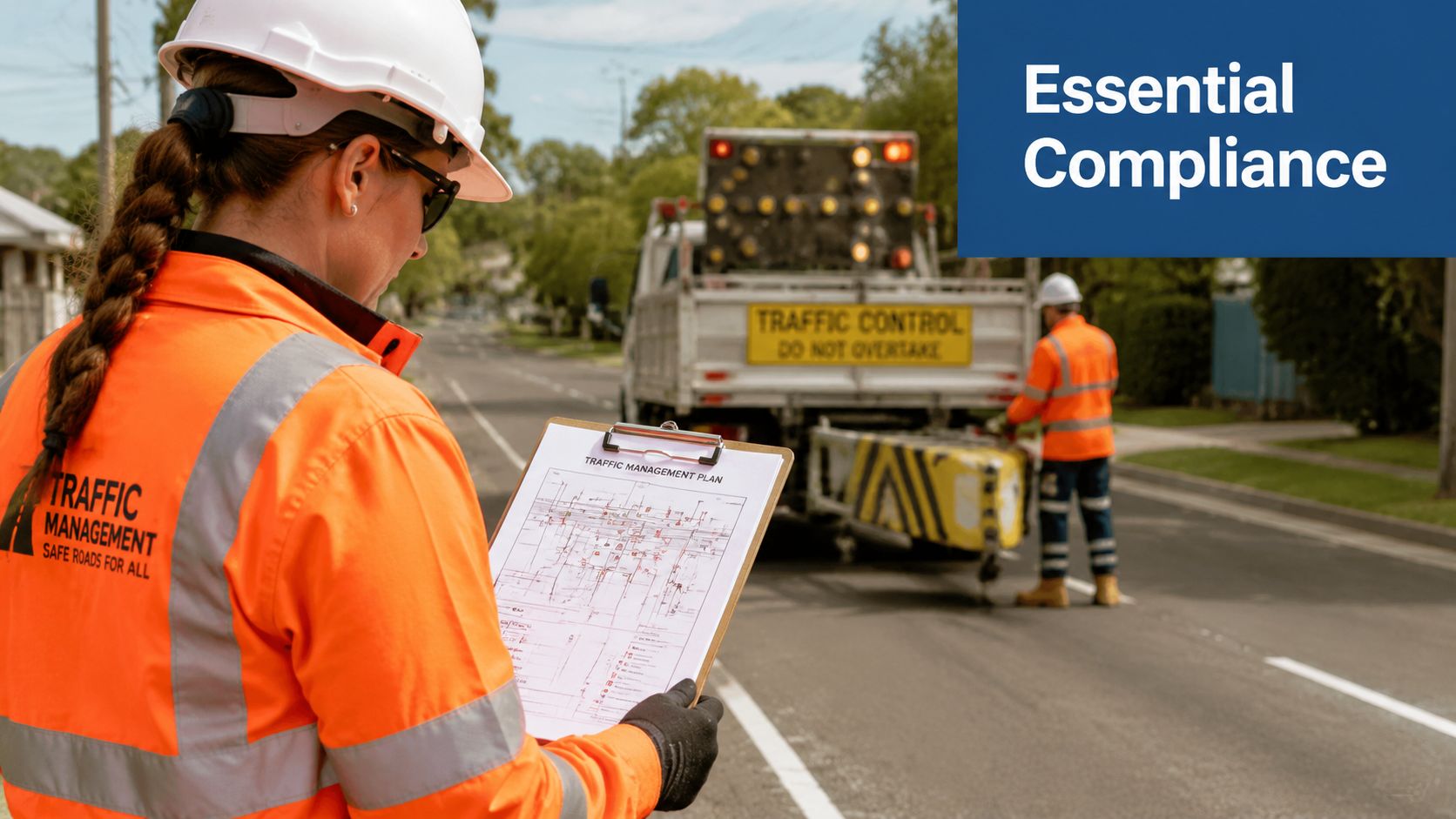
A Red Card holder works on the planning and design side of temporary traffic management. That may include assessing the road environment, selecting controls, preparing a compliant plan and checking whether the arrangement remains suitable when site conditions change.
That role is different from basic traffic controller duties. A worker performing stop/slow operations or other direct traffic control tasks needs the relevant traffic control training card. If you're deciding which pathway applies to your current role, TP Training's guide to becoming a traffic controller helps separate roadside control work from design responsibilities.
The practical value of the Red Card is that it connects formal competency with decisions that affect road users, workers, pedestrians, plant operators and site supervisors. It isn't another classroom ticket to add to a file. It's the recognised pathway for people expected to turn project information and hazards into a workable traffic management design.
What the PWZ Red Card Course Covers
A road project can change from excavation to deliveries within the same shift. The RIISS00056 Traffic Management Designer Skill Set prepares Red Card students to plan for those changes, rather than copy a standard diagram. The course focuses on preparing work zone traffic management plans and traffic guidance schemes that reflect the project's conditions, staging and hazards.
A competent designer first examines how the work will be carried out, how road users will interact with the site and which risks require controls. Device selection and drawing come after that assessment.
The planning process behind a compliant design
Austroads' Guide to Temporary Traffic Management Part 2 sets out a structured approach to temporary traffic management planning:
- Identify project parameters. Establish the work type, road function, site constraints, traffic conditions and construction requirements.
- Break the project into stages. A layout suitable for excavation may fail during deliveries, resurfacing or reinstatement.
- Conduct a traffic assessment. Review the movement of vehicles, pedestrians, cyclists, public transport and construction plant through and around the site.
- Complete a risk assessment. Identify hazards, consider their likely consequences and choose controls that match the exposure.
- Select treatments. Choose suitable signs, devices, separation methods, speed management measures and access arrangements.
- Document the traffic guidance scheme. Record the design within the traffic management plan so workers and approving authorities can understand and assess it.
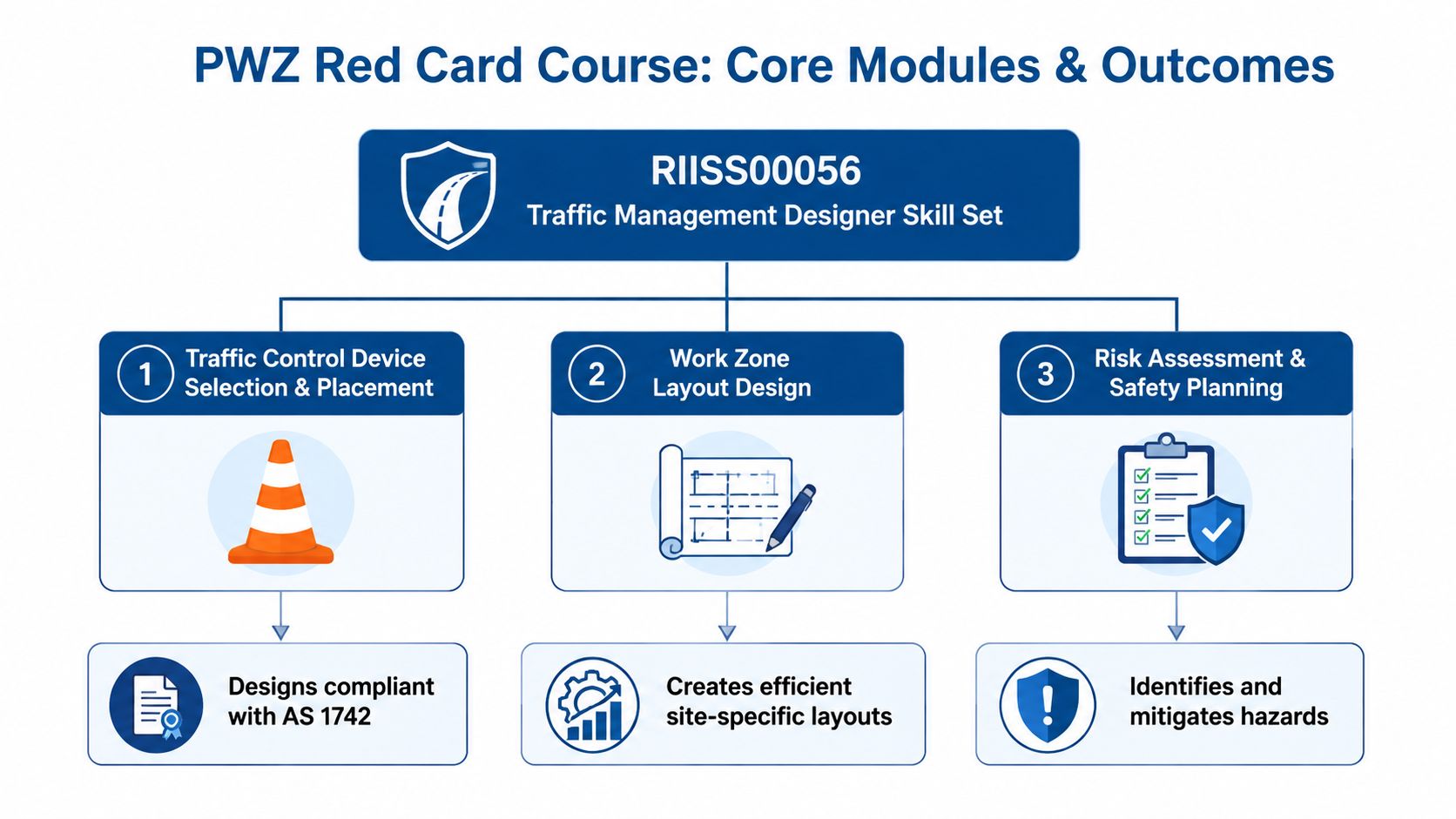
The course outcome is the ability to connect site-specific risk with documented controls. TP Training describes its Prepare Work Zone Traffic Management Plan Course Pwz Red Card as nationally recognised training covering practical learning with experienced trainers across NSW.
What the qualification doesn't permit
The Red Card does not qualify a holder to control traffic, operate boom gates or set up traffic control plans on site. Those duties require other roles and training pathways. TP Training's information on traffic control courses in Sydney distinguishes designing an arrangement from implementing it in the field.
Holding the card supports preparation of a design. It does not automatically authorise the holder to deploy every device or direct traffic, and it does not replace the separate NSW workflow for review and approval of a submitted plan. Match the course to the duties your employer expects you to perform.
NSW Compliance and the Traffic Management Plan Framework
Transport for NSW requires a Traffic Management Plan for all temporary traffic management works. That requirement changes the way a designer should approach the job. You aren't merely drawing cones and signs around an excavation. You're preparing the control document that explains how risks will be managed while the work takes place.
The Transport for NSW traffic control at work sites guidance separates strategy development from the detailed Traffic Management Plan. Strategy establishes the broader direction for managing transport and road-user impacts. The detailed plan then translates that direction into controls that suit the work activity, road environment and construction staging.
A TMP is a document package
A complete plan isn't just a diagram. NSW materials identify a package that can include:
- Traffic guidance scheme. The site layout, signs, devices and guidance arrangements.
- Vehicle movement plan. How construction vehicles, deliveries and plant will enter, leave and move within the work area.
- Risk assessment. The hazards, risk controls and reasoning behind the selected treatment.
- Supporting documents. Additional information needed to explain the work, staging, access arrangements or site-specific controls.
This distinction is important for students who've only seen simplified plan templates. A drawing may show where a taper begins, but the supporting documents explain why the arrangement is suitable and how it will operate during the relevant stage of work.
Practical insight: A plan should allow another competent person to understand the intended controls without relying on the designer's memory or verbal explanation.
The wider technical framework
The PWZ course sits within a broader Australian and New Zealand approach to temporary traffic management. The Austroads Guide to Temporary Traffic Management set contains 10 parts covering contemporary temporary traffic management practice. That wider framework reinforces why designers need a methodical process rather than a collection of memorised layouts.
The Red Card also shouldn't be confused with implementation training. TP Training's Blue Card traffic control explanation discusses a different operational function. For people whose duties involve putting approved controls into effect, the Traffic Management Implementer Course Yellow Card is the relevant separate training option described by TP Training as practical, nationally recognised training with experienced trainers and hands-on learning across NSW.
Evidence-Based Design and Work Zone Safety Risks
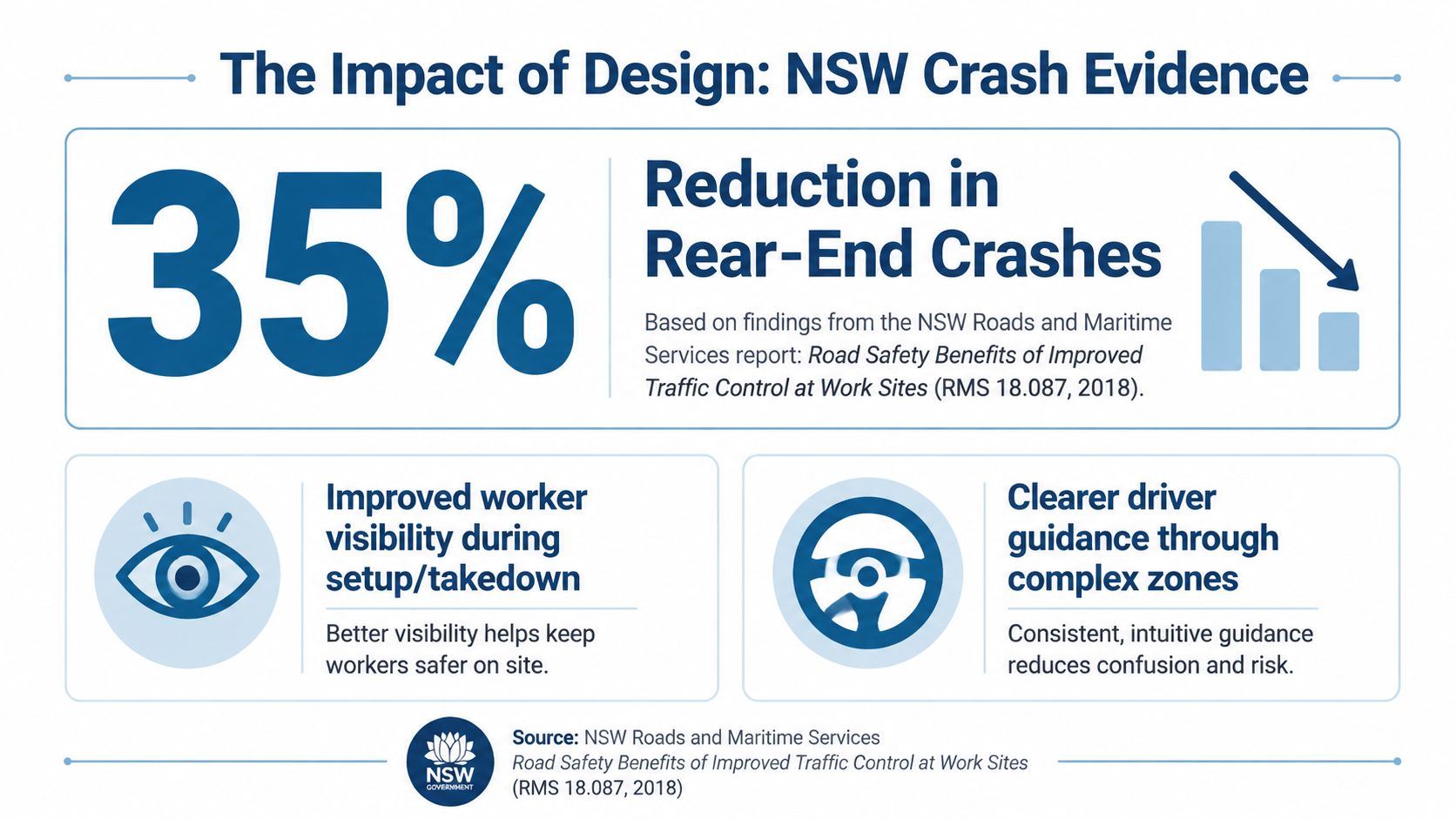
The strongest reason to learn proper design is visible in crash patterns. Analysis cited by Transport for NSW found that 14.3% of all reported crashes in a five-year NSW dataset were related to roadwork zones. Among those work-zone crashes, 40.3% were rear-end crashes, compared with 23% for non-work-zone crashes. Transport for NSW's work-zone end-of-queue study shows why the approach to a work zone deserves careful design.
The figures point to a practical problem. When traffic slows, merges or queues unexpectedly, drivers have less time to respond. A designer therefore needs to consider approach speed, queue length, taper placement and advance warning spacing as connected controls, not isolated details.
Why templates can fail
Templates are useful starting points, but they can become dangerous when designers treat them as finished answers. A layout suitable for a low-volume road may not manage a high-speed approach effectively. A plan that works during quiet periods may create unacceptable queues during deliveries, peak travel or a change in work staging.
Transport for NSW's research found that treatments using Arrowes eSERIES1 devices on high-speed, low-volume roads were among the most effective at reducing excess speed, reducing speeding probability and decreasing rear-end crash risk. That doesn't mean the device belongs in every work zone. It means the designer needs to select controls based on the road environment and justify why they fit the risk.
The current technical language matters as well. NSW updated its technical manual to issue 6.1 and replaced the term “traffic control plans” with “traffic guidance scheme” to align with recent industry and national practice. A designer who understands that terminology is better placed to interpret current documentation and communicate with clients, contractors and authorities.
Design decisions need a reason
A good plan answers questions such as:
- Where will drivers first understand the change? Warning must appear before the point where traffic is constrained.
- How will queues be detected and managed? The plan should account for the possibility that vehicles extend beyond the expected work area.
- How will workers remain separated from moving traffic? The design must protect setup, work and removal activities.
- What changes when the stage changes? Controls need to remain suitable as the work front, access route or vehicle movement pattern shifts.
For a broader discussion of hazard controls, TP Training's material on risk management in construction provides useful context. The Red Card applies that same practical discipline to traffic movement and work-zone design.
How to Enrol in the TP Training PWZ Red Card Course
A Red Card is useful only when it matches your proposed work. If you will prepare, revise or inspect work zone traffic management plans, confirm that the PWZ course covers that pathway. If your role is limited to directing vehicles or pedestrians at the roadside, another traffic control qualification may be the appropriate starting point.
Before booking, review your existing site experience and qualifications with the provider. Trainers may need to understand whether you can read plans, identify work activities, follow site controls and apply road safety requirements. Direct traffic management experience can help, but the key question is whether you are ready to justify design decisions, not just place signs or barriers.
TP Training delivers training across NSW, including centres in Penrith, Burwood, Auburn, Parramatta and Sydney CBD. Choose a location and timetable that allow you to attend the training and complete the practical assessment without rushing between shifts or other commitments.
Confirm the PWZ assessment pathway
Ask specific questions about how the course is delivered and assessed:
- Design tasks: Will you prepare or review realistic work zone arrangements rather than only answer theory questions?
- Evidence: What drawings, written decisions or other assessment evidence must you submit?
- Site conditions: How are lane changes, access points, staging and worker separation included in the exercises?
- Outcome: What nationally recognised outcome is issued after you meet the course requirements?
- Role limits: Does the training address plan preparation and design competency, rather than traffic control implementation?
The assessment portfolio matters because the Red Card demonstrates applied competency. Keep copies of submitted plans, feedback and completion records. They can help you explain your capability to an employer, contractor or project manager, although holding the card does not replace the separate NSW review and approval process for a project.
Complete enrolment requirements
Prepare the identification and student details required for your enrolment. If you need to create or manage a Unique Student Identifier, use TP Training's guide to managing your USI.
Arrive ready to discuss a work activity and the controls it may require. During training, ask why a particular arrangement suits the road environment, work stage and traffic conditions. After certification, keep your records current and check the requirements applying to each new project. The card supports your competency. Your submitted work still needs to meet the project and authority process.
Common Misconceptions About the Red Card and Plan Approval
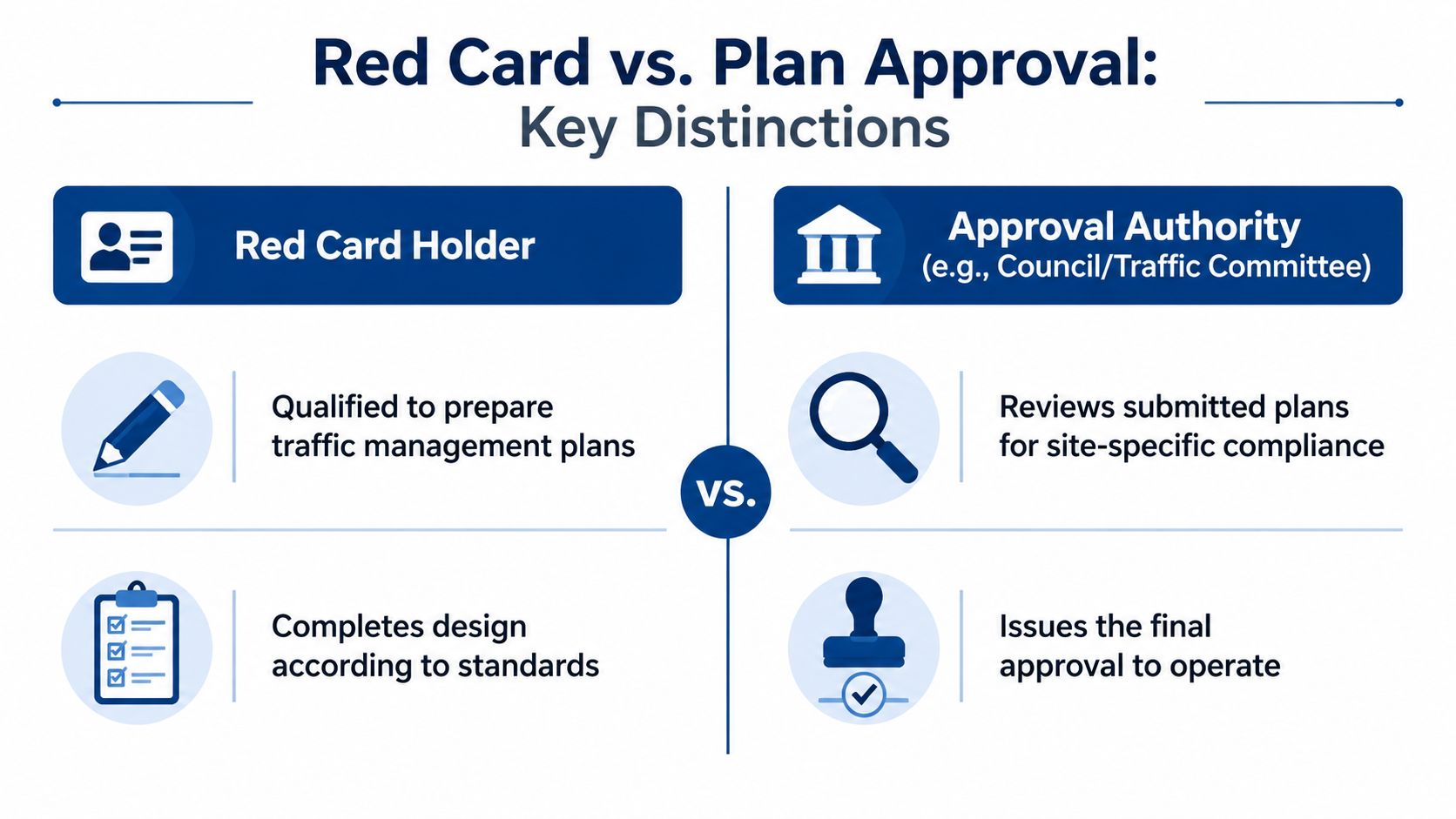
The most costly misunderstanding is simple: holding a Red Card doesn't mean every plan you prepare is automatically approved. The qualification establishes the competency pathway for preparing the design. Submission, review and approval still depend on the road class, the relevant authority and the project's operating requirements.
For local or regional roads, the relevant council may handle the application. For state roads, Transport for NSW may be the approving authority. The exact workflow can also depend on portal access and the documents required for that road and project. NSW traffic control at worksites materials distinguish the plan preparation task from the authority process that follows.
Four assumptions that cause trouble
“The Red Card lets me submit anything.” You can prepare plans within the competency, but the submission route may require the correct authority, portal access and supporting documents.
“A plan is only the traffic diagram.” A proper TMP package can include the traffic guidance scheme, vehicle movement plan, risk assessment and other supporting documents. Leaving out the reasoning or operational detail can create review delays.
“The designer also implements the setup.” Design and implementation are separate functions. A person qualified to prepare the plan isn't automatically qualified to control traffic, operate boom gates or set up site controls.
“One layout works for every stage.” Work zones change. Excavation, deliveries, plant movement and reinstatement may create different traffic and worker exposures. The plan must reflect those changes.
The Red Card gives you the design competency. The approving authority decides whether the submitted arrangement can operate for that project and road environment.
The practical lesson is to ask the client or principal contractor early who will submit the plan, which authority will review it and what supporting information is expected. That conversation can prevent a technically sound design from becoming an operational delay.
Career Pathways and Next Steps for Traffic Management Professionals
The PWZ Red Card suits workers moving from general site duties into traffic management design, supervision and project coordination. It can support progression into roles where you assess changing work zones, prepare documentation and communicate controls to contractors, implementers and approving authorities.
The qualification is most valuable when you treat it as a working competency, not a card to file away. Keep building your understanding of current NSW requirements, review plans against actual site conditions and learn from how traffic behaves around queues, tapers, access points and changing stages.
If your next role involves preparing or inspecting work zone plans, choose training that makes the design process clear and keeps the boundary between design, implementation and approval firmly understood.
TP Training provides practical, nationally recognised PWZ Red Card training with experienced trainers and hands-on learning across NSW. Visit TP Training to review the Prepare Work Zone Traffic Management Plan Course and take the next step towards compliant traffic management design work.

You may also like

Asthma and Anaphylaxis Training in NSW
First Aid Training for Construction Workers NSW