

4 Construction Jobs Sydney Workers Can Start in 2026
You reach the gate of a Western Sydney compound at 6:40am, hi-vis on, boots in reasonable condition, and the supervisor asks for your White Card before he asks your name. Then he asks what else you hold. That second question decides whether you spend the week on a shovel or in a machine, and it usually gets answered in the first two minutes.
Sydney employers verify training before they weigh experience, because a card takes seconds to check and a story takes weeks to test. The market is large enough for them to be picky. Jobs and Skills Australia records roughly 64% of the NSW construction workforce in Greater Sydney, with NSW construction employment at about 419,300 people in February 2026 (Jobs and Skills Australia). That concentration means every advertised construction job in Sydney attracts applicants whose paperwork is already in order.
Four roles give a new worker a real way in: excavator operator, dogman, skid steer operator and front end loader operator. Each is gated by one specific competency rather than by years served, and each can be booked before you have a single site contact. The signage on the gate fence tells you which tickets that site values, so it's worth knowing how to compare signage materials for construction and what the required signs mean.
Table of Contents
- 1. Riimpo320F Excavator Operations Course Conduct Civil Construction
- 2. Cpccldg3001 Perform Dogging Licence Course And Training In Sydney
- 3. Riimpo318F Skid Steer Loader Bobcat Operations Conduct Civil Construction
- 4. Riimpo321F Wheeled Front End Loader Operations Conduct Civil Construction
- Sydney construction roles at a glance
- Choosing Your Sydney Construction Pathway Starts With One Ticket
1. Riimpo320F Excavator Operations Course Conduct Civil Construction
The excavator seat is the most reliable upgrade available to a Sydney labourer. The machine sits on nearly every civil, subdivision and road project in the city, and the operator sets the pace for everyone else on the crew.
The Riimpo320F Excavator Operations Course Conduct Civil Construction is practical, nationally recognised training with experienced trainers and hands-on learning across NSW, which matters because an employer's first question is whether you can be left alone in the seat with a trench to dig.

What the job involves day to day
Nothing moves until the pre-start is done. You walk the machine, check fluids and greasing, look at track tension and bucket teeth, test the horn and the boom lock, and fill in the inspection sheet the supervisor countersigns. Skip it and you're the operator who found a hydraulic leak with a burst hose at 2pm.
The rest of the day is grade and services. Stormwater trench, bulk cut, batter trim, loading tandem trucks, stockpiling spoil where the surveyor wants it. In established suburbs, the key skill is working around live services, so you learn to read the dial-before-you-dig plans, keep a spotter with a locator beside the bucket, and hand-dig near anything marked.
The ticket that gates entry
Two things come before machine time. The White Card gets you through the gate, and no assessor will sign you off without it. Then the plant competency itself.
Excavator competency is a statement of attainment, not a photo card. There's no high risk work licence for a standard excavator, so nothing lands in your wallet to flash at a supervisor. Employers ask for the statement of attainment plus a recent VOC, because principal contractors and insurers commonly want one regardless of when you finished the course. Book the VOC through an RTO that puts you back in a machine, not one that watches a video with you.
Where the work actually sits
Sydney's construction employment is spread across the suburbs rather than clustered in the CBD. Regional labour market figures put around 33,000 construction workers in Sydney–Inner South West and around 32,800 in Sydney–South West (Australian Jobs 2026). Those corridors carry the subdivision earthworks, road upgrades and housing that keep machines booked out.
The same national report notes continuing shortages in large-employing occupations including carpenters, electricians, construction managers, plumbers and painters. Read that as funded projects running with thin crews. Plant operators open the ground those trades then work in, which is why a machine ticket travels well between contractors.
Site rule: A machine never works alone near services, pedestrian routes or an open trench. Spotter, barricade, exclusion zone, every single time.
What keeps you employable
- Log your hours by machine class: Keep a plain record of tonnage and attachments. Supervisors ask "how many hours on a 20 tonne" and a confident number beats a vague one.
- Learn grade control: 2D and 3D systems are normal on tier-one civil work. Operators who can set up, check and read them get the better seats and the night shifts that pay.
- Add a second machine: a Riimpo318F Skid Steer Loader Bobcat Operations Conduct Civil Construction ticket is nationally recognised training that puts you on a second machine, which is how you stay working between earthworks packages.
- Understand quantities: half of operating well is knowing what a bucket holds, and Exayard concrete estimating software is a useful way to learn how volumes and set-out are calculated before you quote your own small jobs.
- Keep your tickets current: an expired VOC is the fastest way to lose a start you'd already won.
The civil construction plant operations courses overview sets out how the tickets sequence from skid steer through to excavator and loader, which helps you plan the order rather than booking everything at once.
2. Cpccldg3001 Perform Dogging Licence Course And Training In Sydney
Dogging is the cheapest route from general labouring into crane work, and one that workers often misunderstand. A dogman doesn't drive the crane. The dogman decides whether the load can be lifted at all, and that authority is worth having.
The Cpccldg3001 Perform Dogging Licence Course And Training In Sydney is practical, nationally recognised training with experienced trainers and hands-on learning across NSW, built around slinging, signalling and the pre-lift checks that come before anything leaves the ground.

What a dogman actually does
You inspect the gear first. Slings, shackles, hooks, lifting points, and the load itself, checking for weight markings and anything that's shifted. Then you work out the weight and the centre of gravity, choose the sling configuration, attach, and direct the operator by hand signal or radio while keeping everyone else out of the drop zone.
On a precast panel job or a structural steel lift, the dogman is the person who stops the lift. That's the part new workers underestimate. Saying "no" to a crane operator, a leading hand or a client with a schedule is a skill, and it's the one that keeps you employed after an incident.
How the licence works
The unit is the training. The licence is the regulator's. You complete CPCCLDG3001 through an RTO, then sit a SafeWork NSW high risk work assessment, and the licence is issued in your name with an expiry date you need to diarise the week you receive it.
Entry conditions are simple. You need a White Card, you need to be at least 18, and you need enough English literacy to follow load charts and safety instructions on a live site. If reading a load chart under time pressure is hard for you, fix that before you book, because the assessment tests it.
The retention problem the industry is living with
Training supply isn't the bottleneck. Keeping people is. Infrastructure NSW anticipated a shortfall of nearly 98,000 skilled construction workers in 2025, with shortages hitting construction managers, carpenters and civil engineers, and half of surveyed NSW construction businesses named attracting and retaining appropriately skilled staff as a major business challenge (Infrastructure NSW).
The same report recorded a 51% attrition rate for apprentices and trainees in trade occupations in 2023, against 41.8% in non-trade occupations. Treat that as your own warning. A ticket gets you in the door, but people leave trades work when the first year is casual, unsupervised and badly planned.
Employers don't hire a licence. They hire the person they'll put under a load with a crane operator who has to trust them.
What separates a licensed dogman from a good one
- Know the gear: Learn sling ratings, shackle sizes and the difference between a rated and a painted lifting point. Gear knowledge is what gets you asked back.
- Show up early: Rigging and dogging crews set up before the crane arrives. Being on site 20 minutes early is a hiring criterion in practice.
- Keep the paperwork tidy: Log your lifts, your gear inspections and your licence expiry. Principal contractors audit both.
- Plan the next step: Rigging and crane operating are natural progressions. The dogging and rigging ticket guide explains how the licences build on each other.
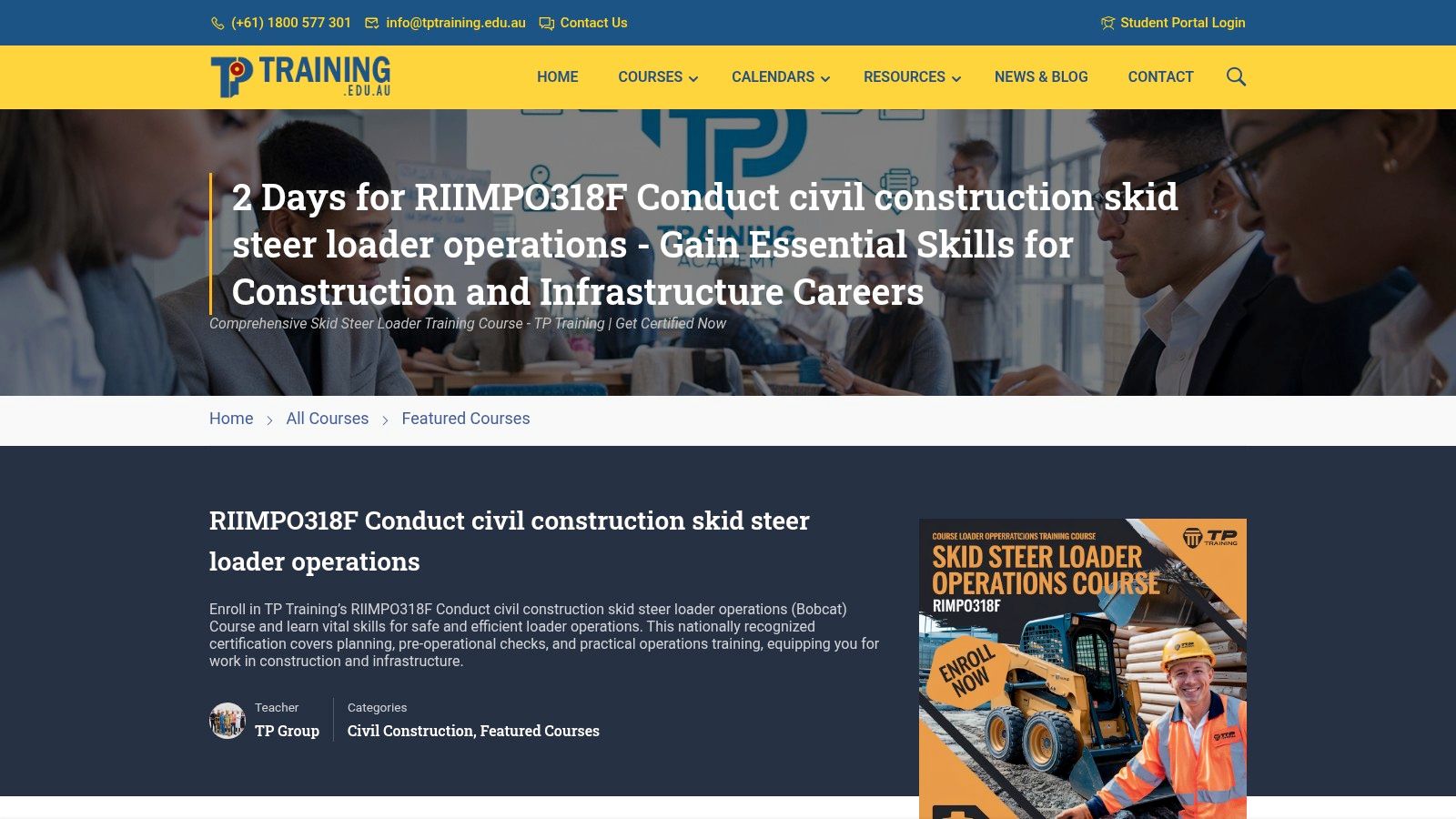
3. Riimpo318F Skid Steer Loader Bobcat Operations Conduct Civil Construction
A foreman walks past a bobcat parked beside a pile of road base, looks at you and asks whether you can take it. Your paperwork answers that question before you do.
Skid steer work is where most Sydney operators start, because the machine fits places a larger excavator can't reach and the ticket takes less time to earn than the heavy plant. It's also the role where the gap between holding a certificate and being useful is widest.
What the machine does on a Sydney site
The attachments define the job. Auger for fence posts and tree pits, trencher for conduit and drainage runs, forks for pallets and bricks, sweeper for road clean-up, bucket and levelling bar for final trim on verges and driveways.
Most skid steer work happens in tight access. Backyard subdivisions in the south-west, car park edges, service corridors between existing buildings, landscaping packages on new estates. You spend as much time watching overhead lines, fences, gas meters and people as you do watching the bucket. Judging clearance with a machine that turns on its own footprint is the skill that takes months to build.
The path most operators actually take
The pool this role draws from is large and mostly full time. Jobs and Skills Australia counted 49,400 construction and demolition labourers nationally, with 71.7% working full time, a median age of 34 against 40 across total employment, and NSW accounting for 14,700 of them, or 29.7% of the occupation (Jobs and Skills Australia).
That group is 96.0% male, which is a fact worth stating plainly rather than dressing up. If you're not a man and you're considering this route, the labourer-to-operator path is still the standard entry, and employers on civil packages are actively looking for a workforce that doesn't look like 1995.
The honest sequence is labourer, then skid steer, then excavator. People who skip the labouring stage usually struggle with site awareness, because they never learned how a crew sequences a day.
The assessment is the point
A cheap ticket with no seat time is a piece of paper you'll be asked to prove at 7am with a pile of spoil and a supervisor watching. Ask how many machine hours you get and who signs the assessment before you pay anyone.
- Pre-start competence: Daily checks, greasing, tyre or track condition, and knowing when to stop operating.
- Load, carry, place: Carrying a loaded bucket low, travelling with forks down, and placing material without tracking it everywhere.
- Attachments: Changing and securing an attachment correctly is assessed, and it's where shortcuts cause injuries.
- Shutdown: Parking on level ground, bucket down, isolation, and locking up the way the site requires.
For a full breakdown of what the assessment covers, the skid steer ticket guide walks through the machine tasks and the paperwork. Do the skid steer first if you're new, then add the excavator when you have hours behind you.
4. Riimpo321F Wheeled Front End Loader Operations Conduct Civil Construction
Loaders don't dig footings. They keep material moving, which means they're on site from the first day of a subdivision to the last day of landscaping, and that continuity is why the ticket is worth holding long term.
The Riimpo321F Wheeled Front End Loader Operations Conduct Civil Construction is practical, nationally recognised training with experienced trainers and hands-on learning across NSW, covering the machine tasks and inspection routines that a quarry, yard or civil site will test you on.

What the job involves
A wheeled loader loads trucks, feeds crushers and screens, stockpiles aggregate and soil, and handles the yard work at landscaping and waste facilities. On subdivisions it's the machine that keeps road base, sand and topsoil in the right place at the right time.
The trade-offs are real. Wheels travel faster on hardstand and handle the yard better than tracks, but tyres wear quickly on abrasive aggregate and you'll feel it in the maintenance schedule. Bucket selection matters too: too wide and you'll overload the machine and the truck, too narrow and the cycle times blow out with trucks queuing.
Why the ticket holds value over time
The national picture supports a longer view. Jobs and Skills Australia counted 1,371,500 people employed in construction in February 2026, equal to 9.3% of total Australian employment, with NSW representing about 431,900 workers, or 11.5% of the national construction workforce (Construction Industry Profile).
The same analysis projects construction manager employment rising by 19,100 people, or 14.9%, over five years and by 28,400 people, or 22.2%, over ten years. Electrician numbers are projected to grow by 13,000, or 6.7%, over five years, and carpenters and joiners by 9,600, or 6.4%. Those are projections rather than current headcounts, and they matter to an operator because supervisors and trades need material delivered and stockpiled on schedule.
What the pay benchmark actually tells you
Construction full-time earnings sit above the all-industry median, and that gap is one reason the industry keeps attracting career changers. A separate industry profile using ABS Employee Earnings and Hours data recorded median weekly full-time earnings of $2,019 for construction workers in May 2025, against $1,852 per week for total employment (Jobs and Skills Australia).
Treat it as an industry benchmark, not a rate card. Loader operators on a subdivision aren't paid the same as a quarry operator on a fixed roster, and overtime, shift loadings and site allowances move the number more than the ticket does. What the ticket does is put you in the conversation for the roles that carry those loadings.
Ask this before you book: How many hours in the seat do I get, what machine am I assessed on, and who issues the statement of attainment at the end?
Verify before you enrol
- Confirm the unit code: You want RIIMPO321F on the statement of attainment, not a generic "plant operations" certificate that employers have to interpret.
- Confirm the machinery: An assessment on a small yard loader doesn't prepare you for a production quarry machine, so check what's on the training site.
- Confirm the outcomes: Ask what the statement of attainment says, who recognises it, and what VOC arrangements the provider offers afterwards.
- Plan the sequence: The trade courses in Sydney overview shows how plant tickets sit alongside White Card and other site competencies, which helps you build a package rather than a single booking.
Sydney construction roles at a glance
| Course | Work Area | Best For | Where Offered |
|---|---|---|---|
| Riimpo320F Excavator Operations Course Conduct Civil Construction | Excavator operation | Civil construction excavator training | NSW |
| Cpccldg3001 Perform Dogging Licence Course And Training In Sydney | Dogging and load handling | Dogging licence training | Sydney, NSW |
| Riimpo318F Skid Steer Loader Bobcat Operations Conduct Civil Construction | Skid steer loader operation | Civil construction skid steer training | NSW |
| Riimpo321F Wheeled Front End Loader Operations Conduct Civil Construction | Wheeled front-end loader operation | Civil construction loader training | NSW |
Choosing Your Sydney Construction Pathway Starts With One Ticket
Four roles, one decision. Pick the work you'd enjoy doing in the rain, then find the competency that gates it and book it before you start applying. That order beats the alternative, which is months of job applications with nothing on the resume that a supervisor can verify.
The state is funding the pipeline behind that advice. The NSW Government's 2025–26 Budget allocated funding for 23,000 newly trained construction workers and upskilling for 4,800 tradies (NSW Budget 2025-26). Training places are being supported at scale, so the barrier for jobseekers is knowing which ticket to book, not whether one exists.
A practical checklist before you commit money:
- Match the role to the day: Machine work suits people who like precision and solitude; dogging suits people who like responsibility and radio coordination. Neither is easier.
- Confirm the entry gate: A White Card comes first for every pathway here, and no assessment happens without it.
- Check the local demand: Ask contractors in your own corridor, whether that's Penrith, Liverpool, Blacktown or Parramatta, which tickets they shortlist for.
- Verify before you enrol: Confirm the unit code, the machinery, the assessment conditions and the VOC arrangements directly with the training provider. Requirements vary by principal contractor and by site.
- Book a location you'll attend: A course that takes two hours to reach is a course you'll postpone twice.
Sydney's construction market rewards people who arrive with verified skills and a safety record. That's the whole game. The machine hours come later, but the ticket is the thing you control this month.
If you're ready to stop guessing which ticket opens the most doors, TP Training delivers nationally recognised construction and civil construction courses at training centres across Penrith, Burwood, Auburn, Parramatta and Sydney CBD, with hands-on machine time and trainers who've worked the industry. Start with a White Card, add a plant competency, or stack a civil construction package that gets you onto the projects you want. Visit TP Training to see the current course schedule and pick the location that fits your commute.

You may also like

Construction Labourer Jobs: Duties and Pathways Explained

10 Problem Solving Methods That Actually Work