
Dogging Rigging Ticket: Your Complete NSW Guide
Are you looking for a dogging rigging ticket, or do you need a licence for the work you'll perform on site? Those questions sound similar, but they can lead to different training choices. A worker who only slings loads and directs a crane may need dogging, while someone who erects structures or installs certain lifting systems may need a rigging class.
The safest way to choose is to start with the task, not the course name. In NSW, dogging and rigging are high risk work, and the correct licence must match the work being done. This guide walks through the difference, the licence sequence, the task boundaries, and the practical decision facing a new learner.
Table of Contents
- What a Dogging Rigging Ticket Actually Covers
- Dogging vs Basic Rigging and the Site Tasks That Need Each
- Units of Competency and the Four NSW Licence Classes
- Course Structure and Assessment for the Dogging Rigging Ticket
- When a Rigger Can Legally Perform Dogging Work
- Prerequisites, Licence Validity and Renewal Rules in NSW
- How TP Training Delivers Dogging and Rigging Courses Across NSW
- Choosing Your Pathway and Taking the Next Step
What a Dogging Rigging Ticket Actually Covers
A dogger, sometimes called a dogman, prepares a load for lifting and communicates with the crane or hoist operator. That can include selecting and inspecting lifting gear, choosing a suitable slinging method, attaching the load, and directing the operator when the load is outside the operator's view. SafeWork NSW identifies dogging as the licence class needed when judgement is required for slinging loads or crane direction. SafeWork NSW explains the high risk work licence requirements for dogging.
Rigging is broader. A rigger uses lifting equipment and related systems to assemble, position, secure, or dismantle structures, plant, and equipment. The exact work depends on the licence level, so “rigging” isn't one single permission. Basic, intermediate, and advanced rigging each cover different activities.
The reason these activities are licensed is practical. A load can be heavy, unstable, awkwardly shaped, or difficult for the operator to see. If the lifting gear is unsuitable, the attachment is wrong, or the communication fails, people and property can be exposed to a dropped or uncontrolled load. A high risk work licence shows that the worker has been assessed for the relevant class, not only that they've attended a general safety course.
What the licence proves
A dogging or rigging licence tells a supervisor that you've been assessed against the relevant nationally recognised competency and can perform the licensed work within its scope. It doesn't replace site induction, task-specific instruction, a safe work method statement, or the employer's own lifting procedures.
A construction induction card is also different. A White Card supports entry to construction work, but it doesn't authorise dogging or rigging. You still need the applicable high risk work licence before performing licensed high risk work.
Practical rule: Match the licence to the decision you'll make on the lift. If you must judge the gear, sling the load, or direct the crane, check the dogging requirement before starting.
Good risk planning helps workers identify those boundaries before the crane arrives. TP Training's guidance on risk management in construction is relevant background, but the final authority for NSW licensing remains the regulator and the conditions of the actual task.
Dogging vs Basic Rigging and the Site Tasks That Need Each
Think of dogging as controlling the connection between the load and the crane, and basic rigging as extending that work into the assembly or installation of structures and lifting systems. The two roles can work side by side, but they aren't interchangeable for every task.
Suppose a crane is lifting a steel beam. The dogger selects suitable lifting gear, checks it, attaches the beam, and communicates with the operator. If the job then involves erecting structural members, installing a relevant hoist, or setting up a more complex lifting arrangement, the work may move into rigging territory and require the appropriate rigging class.
| Aspect | Dogging (DG) | Basic Rigging (RB) |
|---|---|---|
| Main focus | Slinging loads and directing crane or hoist movements when judgement or operator guidance is required | Rigging structures, equipment, and approved lifting systems within the basic scope |
| Typical responsibility | Select and inspect lifting gear, attach loads, use signals or other agreed communication | Assemble, install, or dismantle basic rigging components under the licence scope |
| Site example | Preparing a load for a crane lift when the operator can't see the load | Supporting structural steel work or setting up specified rigging equipment |
| Entry point | Standalone dogging pathway | Builds on dogging competency |
| Key question | Does the task require judgement in slinging or directing the operator? | Does the task involve broader structural or equipment rigging? |
The legal line isn't based only on whether a crane is present. Safe Work Australia states that slinging a load where judgement isn't required, and where the load stays in the operator's view, isn't dogging work and doesn't require a dogger. That doesn't remove the need for competent work, suitable supervision, and safe procedures.
Reading the site situation
A worker may attach a straightforward load under an established procedure without performing regulated dogging, while another worker on the same project may need a dogging licence because they select the gear or direct the crane around an obstruction. The difference is the judgement and communication involved, not the size of the workplace.
For a clearer picture of crane-related site duties, TP Training's article on operating a mobile crane provides useful context. Before enrolling, ask the employer which tasks you will perform, rather than assuming a combined course is automatically necessary.
Units of Competency and the Four NSW Licence Classes
The course paperwork uses units of competency, while the regulator issues the High Risk Work licence. Those terms are connected, but they aren't the same document.
The dogging unit is CPCCLDG3001 Licence to perform dogging. Basic rigging is CPCCLRG3001 Licence to perform basic rigging. The competency demonstrates what you've been assessed to do. The SafeWork NSW high risk work licence is the legal evidence you carry for the relevant class.
| Unit of Competency | NSW HRW Class | Licence Name |
|---|---|---|
| CPCCLDG3001 Licence to perform dogging | DG | Dogging |
| CPCCLRG3001 Licence to perform basic rigging | RB | Basic Rigging |
| Further rigging competencies | RI | Intermediate Rigging |
| Further rigging competencies | RA | Advanced Rigging |
NSW guidance identifies four HRW licence levels across dogging and rigging: dogging, basic rigging, intermediate rigging, and advanced rigging. Safe Work Australia describes intermediate rigging as including dogging plus work involving hoists with jibs and self-climbing hoists, cranes, conveyors, dredges and excavators, tilt slabs, demolition of structures or plant, and dual lifts. Advanced rigging covers specialised work such as gin poles and shear legs, flying foxes and cable ways, guyed derricks and structures, and suspended or fabricated hung scaffolds. The Safe Work Australia licence-class table sets out the scope of the rigging classes.
Why the sequence matters
SafeWork NSW states that a worker must hold the dogging class before progressing to rigging classes. That sequence makes sense because a rigger needs to understand load attachment, lifting gear, and crane communication before taking on more complex work.
The statement of attainment is important evidence, but it isn't the same as carrying the regulator-issued licence. Keep the assessment paperwork organised and follow the NSW application process so the high risk work licence can be issued before you undertake licensed work. TP Training's overview of the NSW high risk work licence pathway can help learners understand the distinction.
Course Structure and Assessment for the Dogging Rigging Ticket
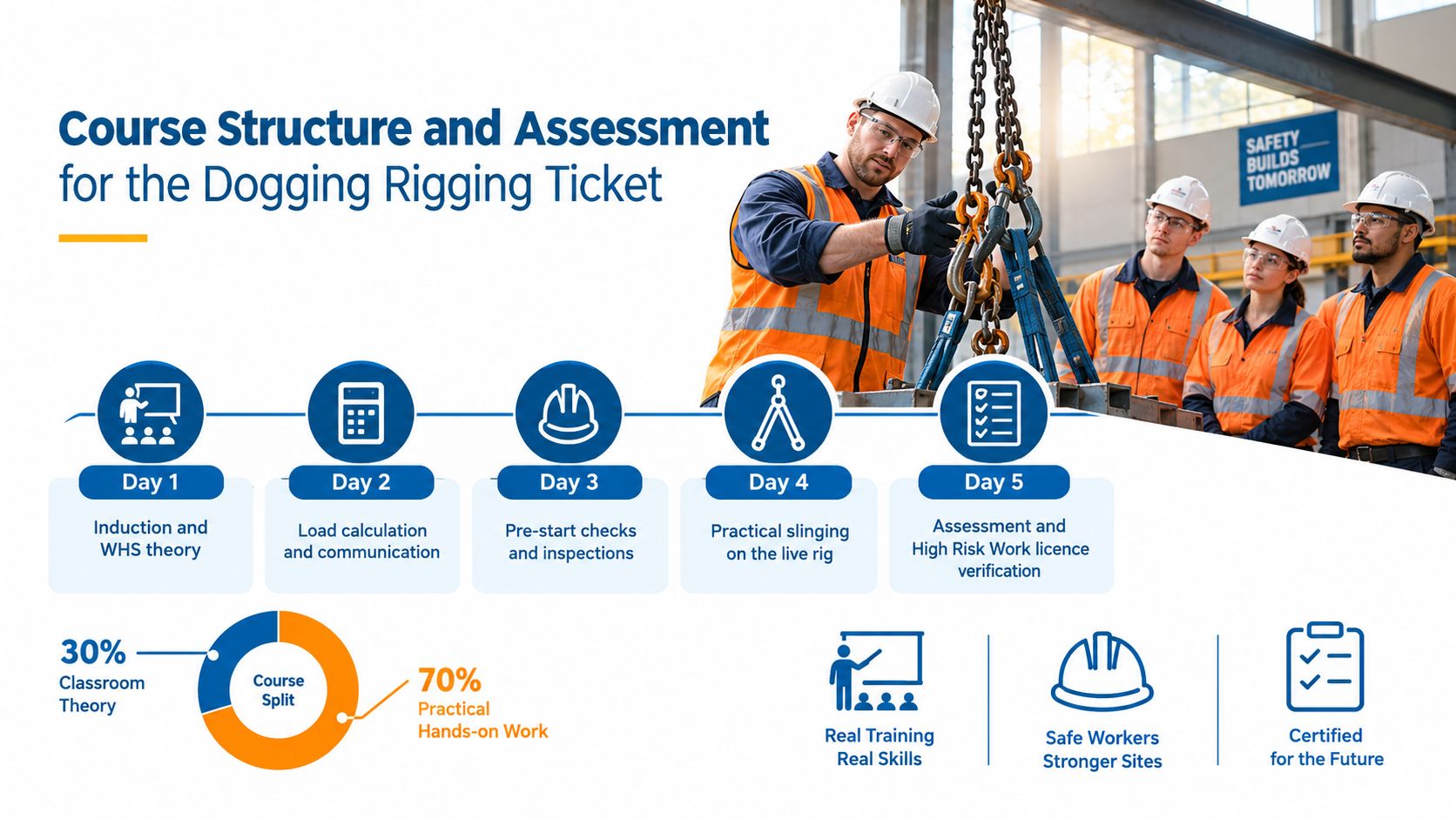
A typical combined course at TP Training is organised across five consecutive weekdays, with approximately 30% classroom theory and 70% practical learning. The split reflects the job itself. You need the theory to understand load decisions and safety duties, but you also need repeated practice attaching gear, communicating clearly, and checking the setup.
From classroom decisions to practical control
On the first day, learners work through slinging techniques, load calculations, communication calls, and WHS responsibilities. They then move onto the training rig to practise hitching loads, directing a crane operator with whistles and hand signals, and recording evidence in their logbook.
The basic rigging component adds practical work with scaffolding components, gin wheels, and cantilevered loads. Each learner builds and dismantles a small rig under trainer supervision, which gives the assessor an opportunity to observe the sequence, checks, communication, and control rather than relying only on written answers.
| Course stage | Learner focus |
|---|---|
| Early training | Slinging methods, load calculations, communication, and WHS duties |
| Practical development | Pre-start checks, lifting gear inspection, load attachment, and operator direction |
| Basic rigging work | Scaffolding components, gin wheels, cantilevered loads, and small rig assembly |
| Final assessment | Closed-book theory assessment and practical observation |
The final day includes the SafeWork NSW closed-book theory assessment followed by practical observation, delivered by an independent assessor. Successful candidates receive the statements of attainment for CPCCLDG3001 and CPCCLRG3001, which are then lodged with SafeWork NSW for the high risk work licence process.
Learners considering the basic rigging component can review Cpcclrg3001 Rigging Course Level 1 Licence To Perform Rigging Basic Level, which TP Training describes as practical, nationally recognised training with experienced trainers and hands-on learning across NSW.
When a Rigger Can Legally Perform Dogging Work
A common assumption is that a rigging licence always means a separate dogging ticket is unnecessary. The more accurate answer is that a licensed rigger can perform dogging work when the rigging licence pathway includes the dogging unit of competency.
Safe Work Australia states that licensed riggers can carry out dogging work if they've completed the dogging unit as part of their rigging high risk work licence. That matters because the rigging pathway is built on the dogging foundation. A rigger who has that competency may sling loads, select and inspect lifting gear, and direct crane or hoist movements within the dogging scope.
This doesn't mean every worker should skip standalone dogging without checking the pathway. The class and evidence must match the work, and the worker must hold the appropriate current licence. A principal contractor may also organise roles around a specific DG class, even when a rigger has broader competence.
| Task | Rigger | Dogger |
|---|---|---|
| Select lifting gear where judgement is required | Yes, where the dogging unit is included and the task is within scope | Yes |
| Sling and attach a load | Yes, where the dogging competency is included | Yes |
| Direct a crane operator when the load is out of view | Yes, where the dogging competency is included | Yes |
| Perform basic structural rigging | Yes, with the relevant basic rigging class | No, unless separately licensed for rigging |
| Perform intermediate or advanced rigging | Only with the relevant higher class | No, unless separately licensed for that class |
The value of starting with dogging
Dogging remains a useful standalone choice for a learner whose immediate role involves crane-slinging and signals, without structural rigging. It can provide a focused entry point and let the worker confirm that lifting operations suit their interests before progressing.
For someone targeting broader construction roles, going through dogging into basic rigging may offer wider compliance coverage. The right sequence depends on the employer's task list, the planned site role, and the licence class required for the work, not on the label “dogging rigging ticket” alone. Safe Work Australia's information sheet explains the relationship between dogging and rigging licences.
Prerequisites, Licence Validity and Renewal Rules in NSW
Before booking training, make sure you can meet the basic entry conditions. TP Training requires learners to be at least 18 years old, provide valid photo identification such as a driver licence or passport, and demonstrate basic English literacy and numeracy.
Those skills have a safety purpose. You need to read signs and instructions, understand lifting information, record logbook entries, and complete the closed-book theory assessment. Previous construction experience isn't mandatory, although familiarity with hand tools and site communication can make the practical learning easier.

What happens after assessment
After successful completion, the statement of attainment and assessor paperwork are lodged with SafeWork NSW. The regulator then issues the high risk work licence card, which is valid for five years from the date of assessment. The card, rather than course attendance alone, is what you need to verify your licensed status on site.
Renewal requires a new statement of attainment from an approved registered training organisation. NSW doesn't provide a refresher gap for this process, and the licence can be renewed up to 12 months before expiry. Plan early so an expired card doesn't interrupt your ability to perform licensed work.
SafeWork NSW can replace a lost or damaged card. Licence holders must also notify the regulator when their name or address changes. Keeping those details current makes it easier to receive licence correspondence and prove that your records are accurate. Learners can also review TP Training's high risk work solutions when comparing related training requirements.
How TP Training Delivers Dogging and Rigging Courses Across NSW
TP Training delivers dogging and rigging training across NSW locations including Penrith, Burwood, Auburn, Parramatta, and Sydney CBD. The practical choice is the centre that fits your commute, work roster, and ability to attend the required training and assessment activities.
Course delivery combines classroom theory with simulated slinging and dogging bays. Learners work through logbook evidence during training, rather than treating the logbook as paperwork to complete at the last minute. That approach connects each written entry to an observed task, such as an inspection, load attachment, communication sequence, or rigging activity.
What to organise before arrival
Bring the identification required for enrolment and wear or organise suitable site PPE. Learners should expect to need a hard hat, safety boots, hi-vis clothing, and gloves, while the provider can confirm which equipment is supplied for the specific intake.
Weekday and weekend intake options may be available depending on the course and location. Employers can also discuss group training requirements, particularly when several workers need aligned competencies for the same construction or civil project. The booking team can explain the timetable, training location, assessment arrangements, and what happens if a learner is assessed as not yet competent on the first attempt.
| Location | Transport & Parking | Course Availability | PPE Provided by Learner |
|---|---|---|---|
| Penrith | Confirm local access and parking when booking | Confirm weekday or weekend intake | Hard hat, safety boots, hi-vis, gloves |
| Burwood | Confirm local access and parking when booking | Confirm scheduled intake | Hard hat, safety boots, hi-vis, gloves |
| Auburn | Confirm local access and parking when booking | Confirm scheduled intake | Hard hat, safety boots, hi-vis, gloves |
| Parramatta | Confirm local access and parking when booking | Confirm scheduled intake | Hard hat, safety boots, hi-vis, gloves |
| Sydney CBD | Confirm local access and parking when booking | Confirm scheduled intake | Hard hat, safety boots, hi-vis, gloves |
The same practical planning applies to related plant tickets. TP Training's information on a telescopic handler licence illustrates why learners should confirm the exact equipment, unit, and regulator process before enrolling.
A separate White Card Training Course is also available through TP Training as practical, nationally recognised training with experienced trainers and hands-on learning across NSW. It supports construction site entry requirements, but it doesn't replace a dogging or rigging high risk work licence.
Choosing Your Pathway and Taking the Next Step
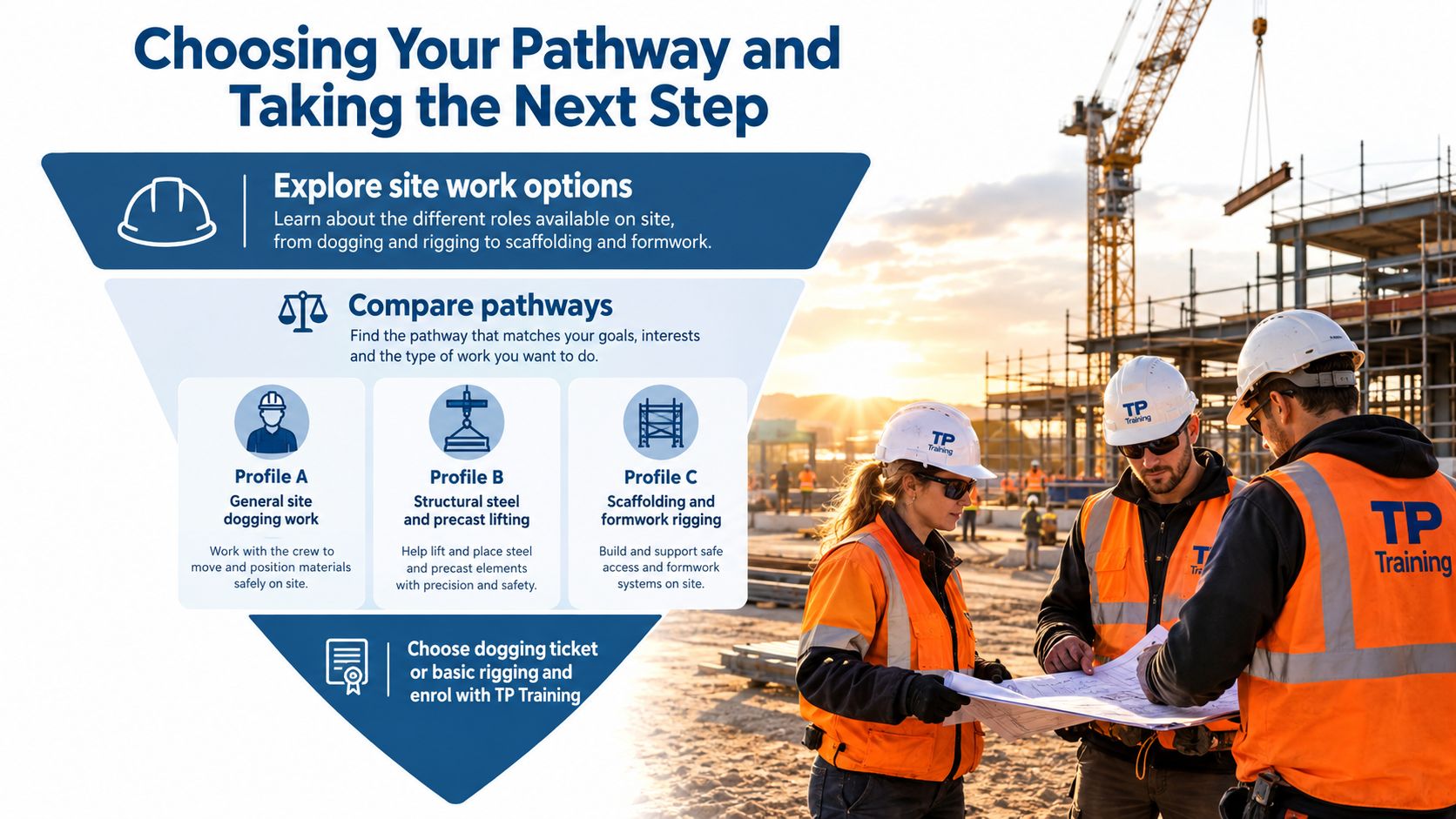
The best pathway depends on the work you want to do first. A new labourer who wants crane-area site work may start with dogging because it focuses on slinging, gear selection, inspections, and operator communication. A construction worker already involved in steel, precast, or structural installation may choose a sequence that moves from dogging into basic rigging because the broader work demands it.
Consider three common profiles:
- The new entrant: Start by asking whether the available job requires DG only or a rigging class. If the immediate work is dog-only, a standalone dogging pathway may be the most direct way to build relevant competence.
- The experienced construction worker: If your employer expects you to support structural steel, precast lifting, or basic rigging systems, compare the combined pathway with the actual position description before booking.
- The future supervisor: If you expect to coordinate more complex lifting work, discuss how basic, intermediate, and advanced rigging classes could fit your long-term role. Don't enrol in a higher class unless the work and prerequisites support it.
Decide by task, not by title
A job advertisement may use “dogging and rigging” as a broad phrase, even though the daily duties are concentrated in one licence class. Ask the employer four direct questions:
- Will I select and inspect lifting gear?
- Will I direct the crane when the load is outside the operator's view?
- Will I erect or dismantle structures, hoists, or rigging systems?
- Which HRW class must appear on the licence before I start?
Those answers reveal whether you need dogging first, basic rigging next, or a conversation with a trainer about the correct sequence. A rigger can perform dogging when the dogging unit is included, but the licence still needs to be current and appropriate for the work.
Choose the ticket that matches the task you can realistically perform after training. Confirm the employer's requirements, check your identification and literacy needs, select a suitable NSW location, and ask the training provider how the assessment and licence application will work.
TP Training provides practical dogging and basic rigging training with experienced trainers and hands-on learning across NSW locations, including Penrith, Burwood, Auburn, Parramatta, and Sydney CBD. Review the available pathway and contact TP Training to confirm the course sequence, PPE requirements, location, and next intake for the high risk work licence you need.

You may also like
How Often Should CPR Be Refreshed in Australia

Owner Builder Online Course: Your Complete NSW Guide