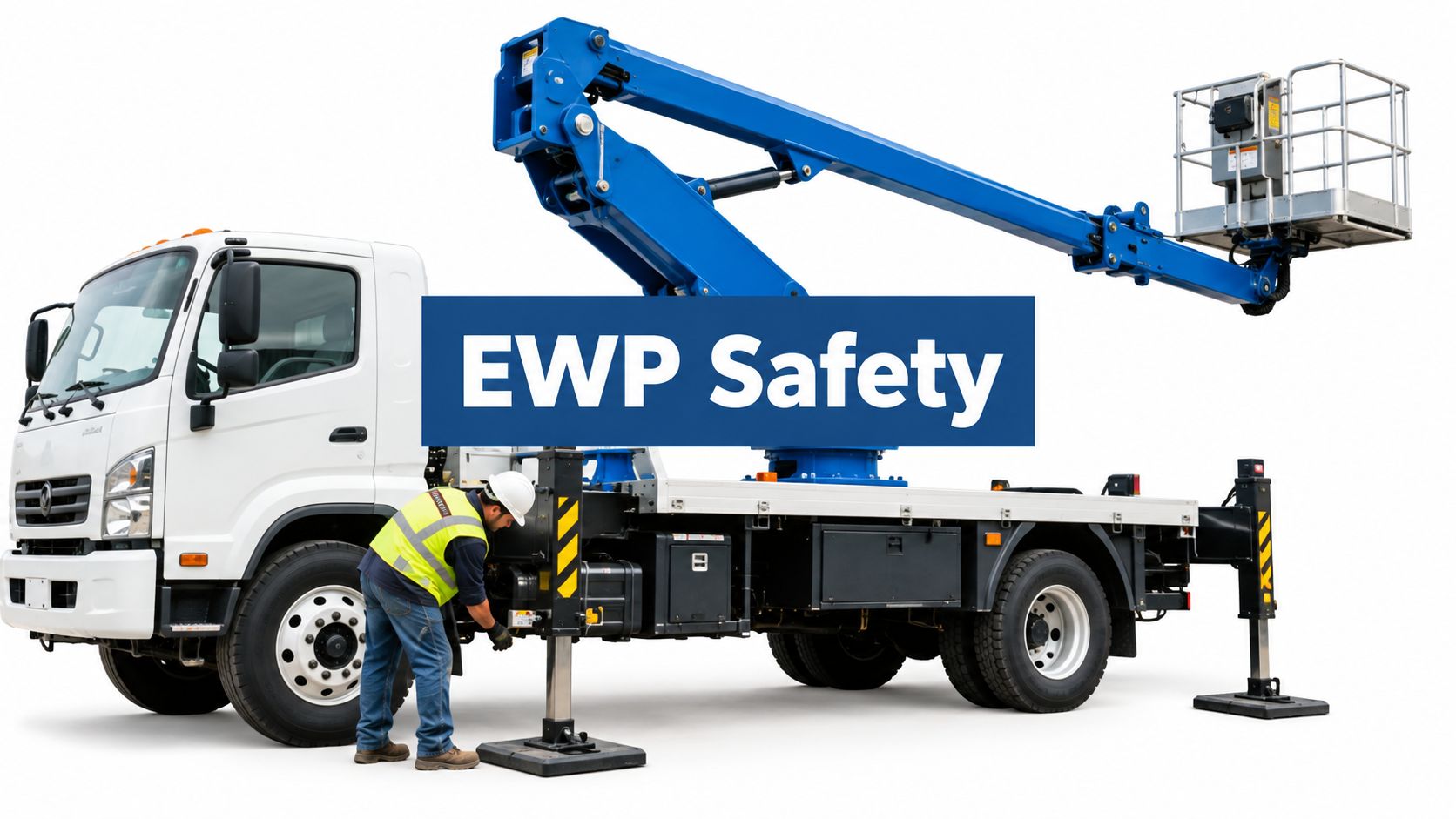
Operate Truck or Trailer Mounted EWPs Safely
You're standing at the gate with a truck-mounted boom ready to move between work areas. The crew knows how to operate an EWP, the pre-start sheet is on the clipboard, and the next job looks routine. Then someone asks whether the machine needs a WP high risk work licence, whether the loading area is level enough, and whether the boom length is measured by the platform height or the reach.
Those questions matter before the machine leaves the transport vehicle. To operate truck or trailer mounted equipment safely in Australia, you need more than driving or towing skills. You need to understand the licence threshold, the original boom design, the loading and unloading controls, the stability limits, and the site records that prove the work was planned properly.
Table of Contents
- The Reality of Mobile Boom Operations on Site
- Licensing Thresholds and the 11 Metre Rule
- Managing Transport and Loading Zone Hazards
- Comparing Truck Mounted and Trailer Mounted Units
- Critical Setup Checks and Stability Margins
- Training Pathways and Workplace Compliance
The Reality of Mobile Boom Operations on Site
A crew may use a standard under-11-metre boom EWP one day, then bring in a truck-mounted unit for lighting, utilities, signage, or civil work the next. Both machines have a platform, controls, outriggers or stabilisers, and familiar fall and crush hazards. Their behaviour on site isn't the same.
A self-propelled EWP is designed to travel as part of its normal work cycle. A truck-mounted or trailer-mounted boom adds a vehicle chassis, towing or transport arrangements, changing ground conditions, traffic exposure, and a separate loading process. The operator must manage the relationship between the boom, the supporting vehicle, the setup surface, and people moving around the plant.
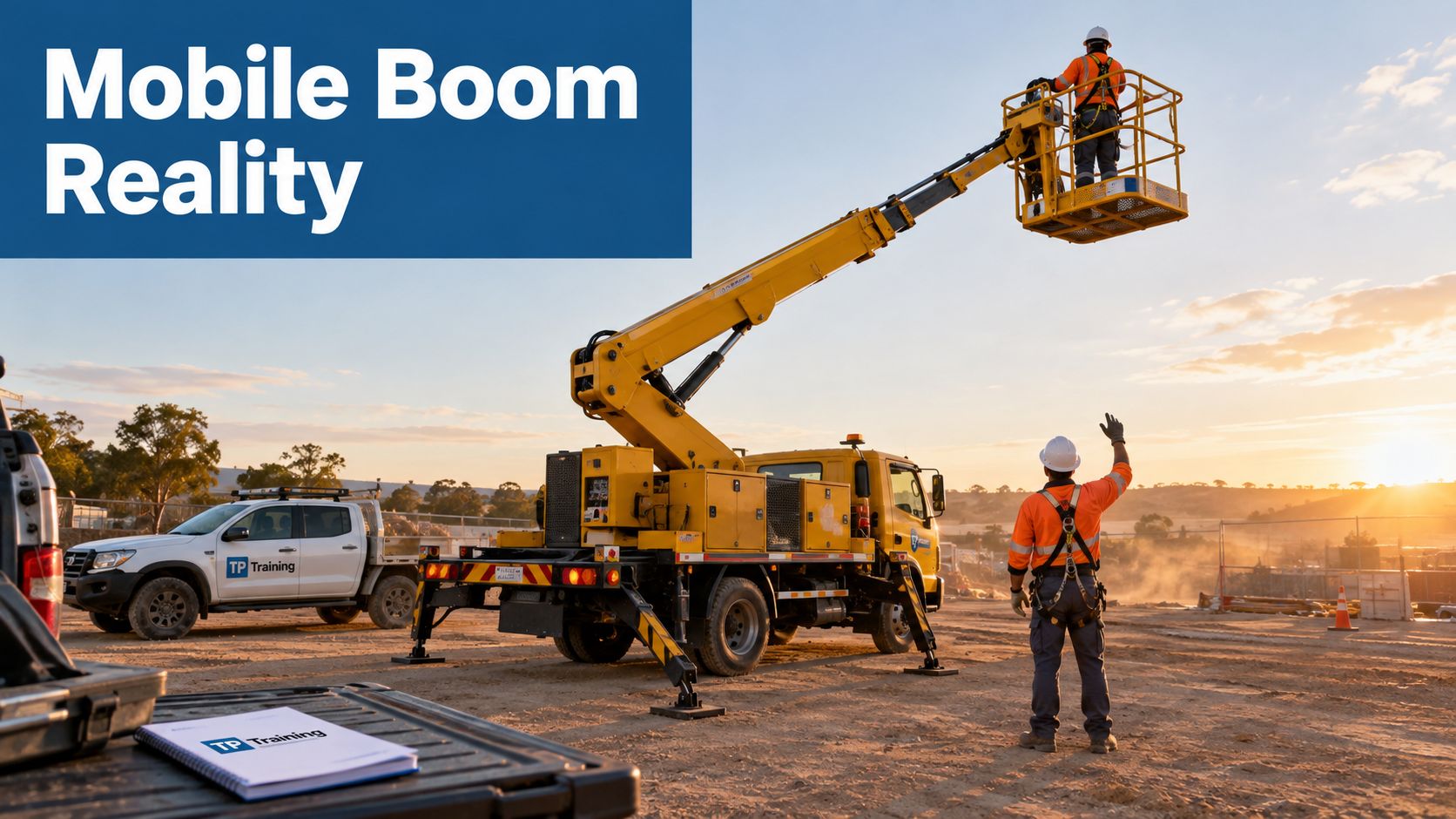
A typical shift exposes the difference quickly. The truck arrives, reverses into a work zone, waits for traffic control, and positions on ground that may be compacted fill rather than a prepared pad. The operator then checks clearances, deploys stabilisers, confirms the machine is within its rated limits, and coordinates with a spotter before raising the boom. A short walk-around inspection doesn't replace those decisions.
Site supervisor's rule: Treat the transport vehicle, the boom, and the work zone as one system. A sound machine can still become unstable if the ground, load path, traffic arrangement, or setup doesn't suit it.
A yellow-card style EWP competency can support safe operation of relevant lower-risk plant, but it doesn't answer every question for a truck- or trailer-mounted boom. The operator still needs machine-specific instruction, workplace information, and a clear understanding of the state or territory requirements. A useful EWP risk assessment guide should be applied to the actual plant and task, not copied from a different machine.
The main mistake is treating the truck as the easy part. Driving it to site may be familiar, but positioning, loading, unloading, stabilising, and operating the boom are high-consequence activities. Regulators focus on these machines because the consequences of a vehicle movement, overturn, crush point, or struck-by event can be severe.
Licensing Thresholds and the 11 Metre Rule
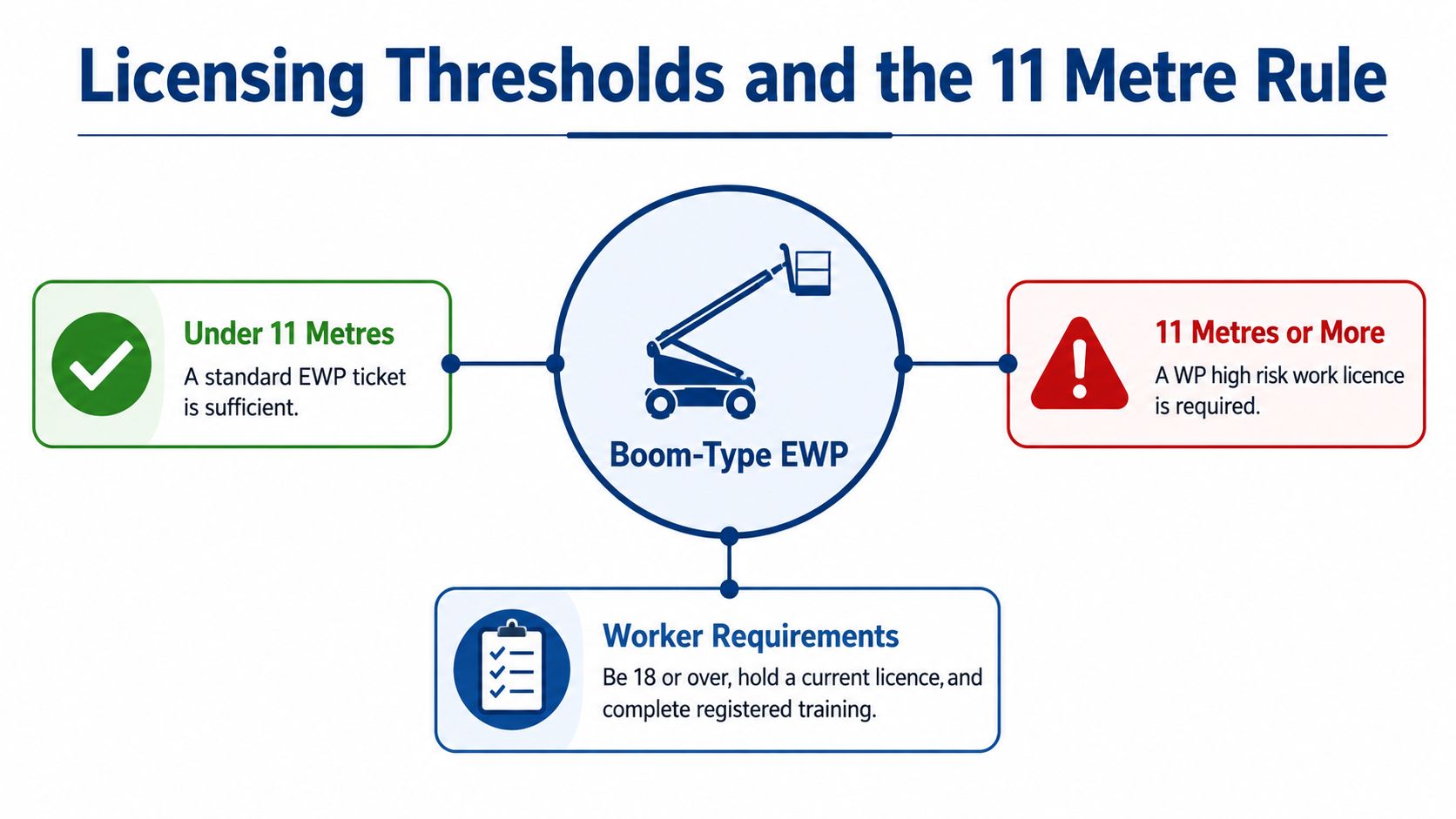
The licensing decision starts with the boom length, not with how high the operator plans to work on a particular day. In Australia, a boom-type EWP with a boom length of 11 metres or more requires the WP high risk work licence class, with formal assessment by a SafeWork-accredited assessor before the worker applies for the licence. Safe Work Australia identifies self-propelled, trailer-mounted, and vehicle-mounted boom EWPs over that threshold as high risk work licence matters. Safe Work Australia's EWP overview provides the national foundation for that distinction.
The measurement itself creates a common trap. Safe Work Australia defines boom length using the greater of two measurements:
- the vertical distance from the supporting surface to the platform floor at maximum height
- the horizontal distance from the boom rotation centre to the outer edge of the platform at maximum reach
That means an operator or supervisor shouldn't rely on a casual estimate of the machine's working height. Check the original design information and manufacturer documentation. The boom length is taken from the machine as originally designed, and a post-manufacture alteration that reduces the effective length doesn't remove the licensing requirement.
Why modifications don't solve the classification problem
A machine may have a restricted operating envelope, a shortened attachment, or a site instruction limiting reach. Those controls can affect how the task is performed, but they don't automatically change the original boom classification. Trying to use a modification as a shortcut creates a paperwork problem as well as a safety problem, because the plant register, training record, and licence decision may no longer match the equipment's design history.
SafeWork NSW states that Australia has 29 classes of high risk work licences, and these licences generally need renewal every 5 years. The same guidance identifies vehicle loading cranes with a capacity of 10 metre tonnes or more as a separate licensed class. That distinction matters where a vehicle carries more than one type of lifting plant, because a crane classification isn't interchangeable with a boom-type EWP licence.
For workers whose equipment meets the threshold, Tlilic0005 Elevate Work Platform Licence To Operate Boom Length 11M Or More Ewp is a practical, nationally recognised training pathway delivered by TP Training with experienced trainers and hands-on learning across NSW. Employers should still verify the specific machine, state requirements, current licence status, and workplace authorisation before assigning the task.
If the licensing question is still unclear, use a documented decision rather than verbal reassurance. Record the plant type, original boom specification, mounting arrangement, state or territory, operator competency, and the supervisor's approval. The EWP licence guidance for equipment over 11 metres is a useful reference when checking whether the machine and worker are aligned.
Managing Transport and Loading Zone Hazards
The most exposed moment may occur while the boom is still folded. Loading and unloading place people beside ramps, winches, wheels, tie-down points, truck beds, and moving plant. A mistake here can cause a roll-off, a crush injury, damaged brakes, or an unstable transport vehicle before the machine reaches its work position.
SafeWork NSW reports that the transport, postal and warehousing industry recorded 41 workers injured or made ill per 1,000 workers on average, compared with 28 per 1,000 across all NSW industries. It also reports that about 15% of road freight injuries resulted from people being hit by trucks, forklifts, or other moving objects. These figures are set out in SafeWork NSW transport safety information.
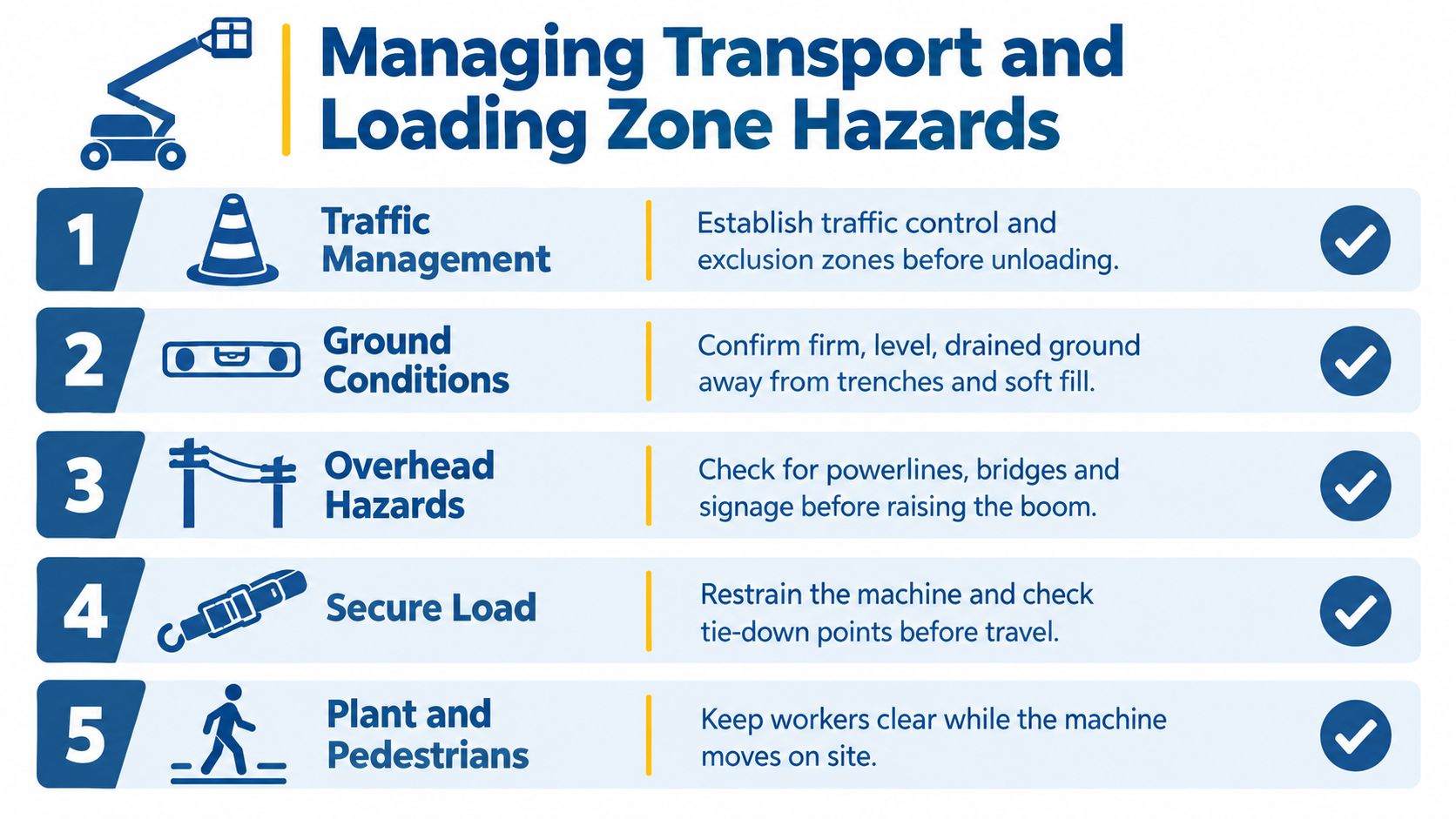
Five controls before the boom is raised
Plan the traffic arrangement first. Establish an exclusion zone around the transport vehicle before the machine moves. If unloading affects a live lane, use the required traffic management controls and keep pedestrians out of the plant's movement path.
Select firm, level ground. The truck or trailer should be positioned on firm, level, drained ground, away from trenches, edges, soft fill, and concealed voids. A surface that looks acceptable under an empty vehicle may respond differently once the machine, ramps, and loading forces act on it.
Follow the manufacturer's loading method. Check ramp angle, tray length, winch requirements, wheel contact, braking arrangements, and the machine's designated travel position. Don't improvise with a ramp that is too short or a winch point that isn't approved for the task.
Keep people clear during movement. One person should direct the operation, with agreed signals and a position that remains visible and outside the crush zone. Nobody should stand between the machine and the truck, beside an uncontrolled wheel path, or beneath a raised component.
Secure the load before travel. Use the manufacturer's tie-down points and suitable restraints. Check that loose tools, attachments, hoses, and platform items are secured, then recheck the arrangement after the vehicle has moved from the loading area.
Loading work also benefits from clear role allocation. The driver, operator, spotter, and traffic controller shouldn't assume someone else has checked the brakes, exclusion zone, or overhead clearance. A short pre-task briefing should identify who controls the movement and when the operation stops.
For teams reviewing equipment movement more broadly, this material handling equipment resource can help frame the interaction between lifting, transport, and handling systems. It shouldn't replace the EWP manufacturer's instructions or Australian workplace controls.
Traffic planning is a separate competency from boom operation. Where the work involves preparing controls for a road or work zone, the Prepare Work Zone Traffic Management Plan Course Pwz Red Card is one relevant training option provided by TP Training, with practical, nationally recognised learning across NSW. The operational detail for truck-mounted attenuators and similar vehicle-based plant also deserves attention in this TMA safety guide.
Comparing Truck Mounted and Trailer Mounted Units
Truck-mounted and trailer-mounted EWPs can both deliver a boom to a work area, but their risks are distributed differently. The truck-mounted unit arrives as one integrated vehicle, while the trailer-mounted unit introduces a towing connection, a separate tow vehicle, and an additional coupling and positioning process.
A trailer can suit crews that need to move one machine with different tow vehicles or stage the plant away from the vehicle used for other site tasks. A truck-mounted unit can suit multi-site civil work where rapid arrival and departure matter. Neither arrangement removes the need to verify the machine's classification, competency requirements, setup instructions, and site controls.
| Feature | Truck Mounted EWP | Trailer Mounted EWP |
|---|---|---|
| Arrival at site | Integrated vehicle, no separate coupling at the work location | Towed unit requiring coupling, uncoupling, and towing controls |
| Deployment | Can be efficient for repeated moves between sites | Flexible where a suitable tow vehicle and loading area are available |
| Main setup concern | Vehicle position, chassis inclination, tyre pressure, and stabiliser deployment | Trailer stability, coupling, brakes, ramps, restraints, and tow vehicle compatibility |
| Access decision | Suits locations that can accept the full truck footprint | May suit work where the trailer can be positioned independently, subject to access and ground conditions |
| Records to verify | Vehicle and plant inspections, operator competency, setup information | Trailer and tow vehicle checks, coupling records, restraints, operator competency |
| Compliance question | Confirm the boom design and WP requirement where the threshold applies | Don't assume towing changes the boom classification or licence decision |
Choose the configuration around the work
Start with access, not convenience. A narrow entry may prevent a truck from positioning safely, while a trailer may create a separate problem at the gate, during reversing, or at the unloading point. Ground conditions also matter because the final setup needs enough suitable area for stabilisers, exclusion zones, and safe worker movement.
Crew arrangements influence the decision too. A trailer-mounted unit can be useful when the business has the right tow vehicle and trained personnel, but the towing task adds another layer of responsibility. A truck-mounted unit reduces that coupling interface, yet it still requires a disciplined vehicle setup and plant inspection.
Don't transfer records from one machine to another. The operator should know which unit is being used, where its instructions are stored, what its original boom specification is, and what site authorisation applies. Civil crews using several kinds of mobile plant may also consider Riimpo320F Excavator Operations Course Conduct Civil Construction as a separate competency pathway, but excavator training doesn't substitute for EWP training.
Critical Setup Checks and Stability Margins
Stability is controlled by engineering limits, not by how flat the ground appears from the driver's seat. Australian truck-mounted and trailer-mounted EWPs are governed by AS/NZS 1418.10 and the related safe-use standard AS 2550.10. The manufacturer must stamp the maximum allowable chassis inclination and gradeability on the unit, so those figures should be treated as operating limits rather than suggestions.
Before setup, inspect the travel route and final work position. Look for soft shoulders, uncompacted fill, drainage paths, trenches, edges, overhead hazards, and any side slope that could place the chassis outside its rated condition. If the ground doesn't support the planned setup, stop and change the location or arrange a suitable control.
A pre-start sequence that works
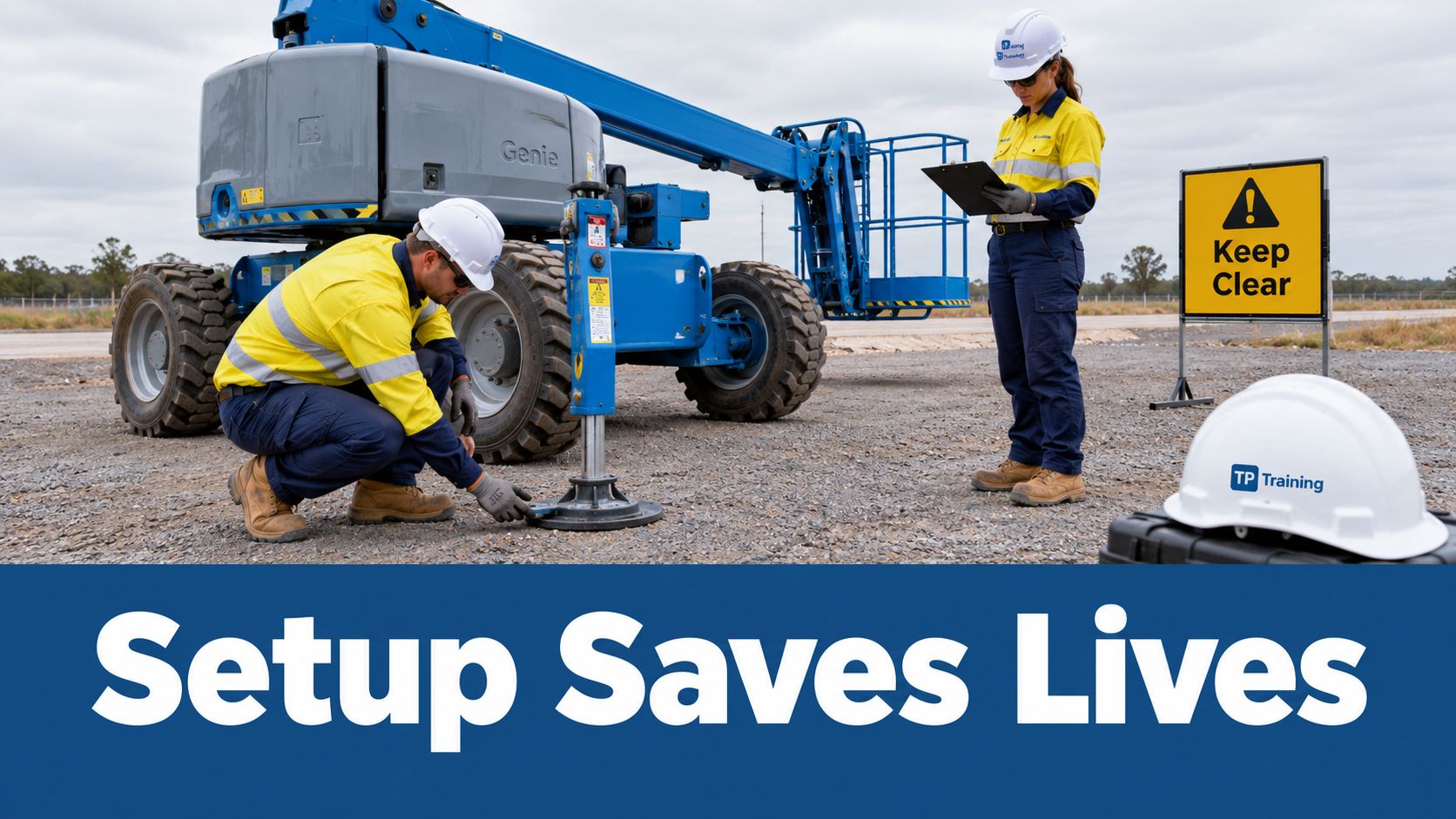
- Read the machine limits. Find the stamped chassis inclination and gradeability information, then confirm the planned position is within those limits.
- Check tyre pressure. Correct tyre pressure is necessary on truck-mounted setups because it helps preserve the stability margin the machine was designed to provide.
- Confirm the surface. The truck or trailer needs firm, level ground with no side slope. Don't rely on outriggers to correct an unsuitable foundation.
- Deploy stabilisers correctly. Follow the manufacturer's sequence, use the specified pads or spreaders, and confirm each stabiliser has seated securely.
- Inspect the work envelope. Check overhead services, structures, traffic, pedestrians, and nearby plant before the boom leaves its rest position.
- Test the controls cautiously. Confirm emergency stops, communication arrangements, and the machine's response from a safe position before committing to the lift.
Exceeding the rated tilt increases overturning risk because it reduces the stability margin available to the machine. Incorrect tyre pressure can also affect that margin. The right approach is to stop when the numbers or ground conditions don't support the setup, not to compensate by moving slowly or keeping the boom low.
For fleets that transport several types of mobile plant, practical securement safety fleet tips can support broader load-restraint checks. Site inspection records should then capture the actual conditions and decisions, not just a tick beside “ground checked”. A structured workplace inspection checklist can help supervisors organise those observations.
Training Pathways and Workplace Compliance
Formal licensing answers only part of the compliance question. A worker may hold a current WP high risk work licence, but the employer still needs to confirm that the person has been instructed on the specific truck- or trailer-mounted machine, understands the manufacturer's limits, and can manage loading, unloading, setup, traffic, and emergency arrangements.
For a boom-type EWP with a boom length of 11 metres or more, the pathway requires the WP high risk work licence and formal assessment by a SafeWork-accredited assessor before applying for the licence. SafeWork NSW sets out that pathway in its high risk work licence requirements. A standard yellow-card competency shouldn't be treated as a substitute where the plant meets the WP threshold.
What competent preparation should include
Good preparation combines theory with observed practical work. The operator should be able to identify the plant classification, interpret the original boom information, assess ground and overhead hazards, establish an exclusion zone, follow the loading method, use restraints correctly, deploy stabilisers, and respond to an abnormal condition.
Employers should keep the licence evidence, training records, machine familiarisation, pre-start checks, maintenance information, and site-specific authorisations together. Short digital refreshers can reinforce procedures, and teams developing internal learning content may find these training video templates for L&D teams useful for structuring demonstrations. Videos still need to reflect the actual equipment and mustn't replace supervised competency assessment.
Workers should check their licence before accepting the job, then ask which machine will be used and what the site requires. Supervisors should verify the boom length from original design information, not from an informal reach estimate, and should stop the task if the transport or setup controls aren't in place. The EWP licence requirements guide is a useful reference when reviewing the difference between general EWP instruction and the WP pathway.
TP Training provides practical, nationally recognised training for workers who need to build competency in elevated work platforms and related civil and workplace safety tasks across NSW. Visit TP Training to review the appropriate course pathway, confirm the training scope, and book preparation that matches the truck- or trailer-mounted equipment your workplace uses.

You may also like
CPR Course Parramatta: What to Expect and How to Book
Dogging Rigging Ticket: Your Complete NSW Guide