
How to Operate Mobile Crane
You're on a NSW worksite before the first truck has cleared the gate. The crane is parked nearby, the dogman is checking the lift area, and someone asks whether the portable building can come off the trailer before the weather changes. The controls may look familiar, but the primary question is whether the lift should start at all.
Knowing how to operate a mobile crane means managing a sequence of decisions. You need to understand the machine, read the load chart, assess the ground, establish communication, control the load and stop when conditions change. Mobile crane operation is treated as high-risk work in Australia because a rushed setup or a small misjudgement can put workers, structures and the crane itself in danger.
Table of Contents
- What a Mobile Crane Operator Actually Does
- Pre-Start Checks and Site Setup
- Controls, Slewing and Smooth Manoeuvres
- Reading the Load Chart and Planning the Lift
- Rigging Basics, Signalling and Communication
- Spotting Trouble Before the Crane Moves
- Shutdown, Maintenance and Operator Licensing in Australia
What a Mobile Crane Operator Actually Does
Before the engine starts, an experienced operator is already working. On a typical NSW site, that means arriving early, checking the lift plan, walking the pick and landing zones, looking at access routes and confirming who has authority to direct the load. The dogman might be organising slings while the operator studies the crane's planned radius, boom configuration and outrigger position.
That routine matters because the operator isn't just moving levers. The operator decides whether the machine, the site and the planned load are compatible. Safe Work Australia identifies mobile crane operation as high-risk work and generally requires the relevant high-risk work licence, with limited exceptions for supervised trainees or restricted activities such as maintenance, testing or moving the crane without a load. Mobile cranes with a capacity greater than 3 tonnes require a licence under the national crane guidance, making the 3-tonne threshold a foundational compliance point for Australian operators. Safe Work Australia's crane guidance sets out the licensing framework and exceptions.
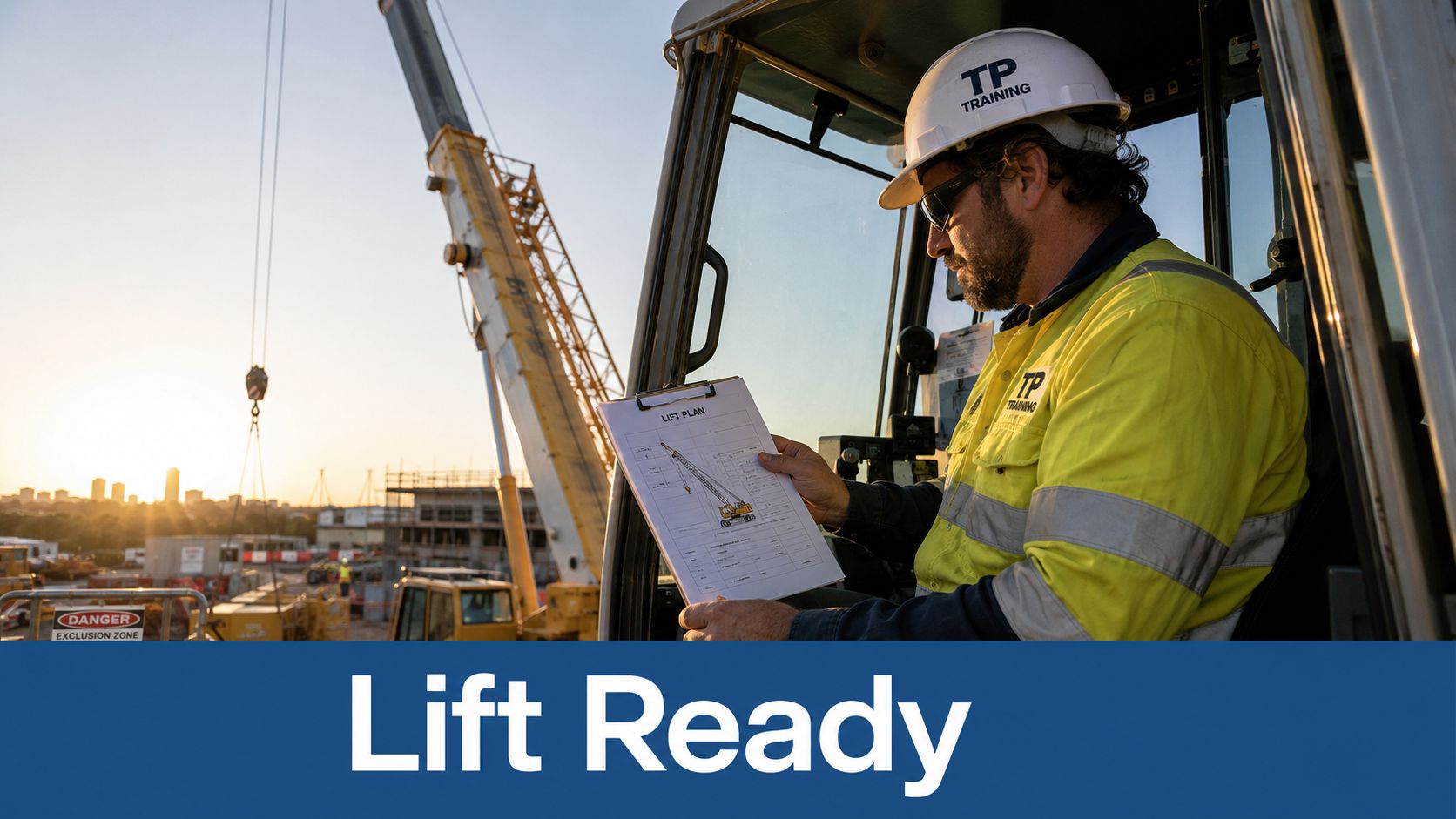
The lift starts on the ground
A sound operator checks more than the hook. The work includes:
- Ground assessment: Confirming whether the crane can be supported safely at the planned position, including the area beneath outriggers and pads.
- Load control: Knowing the load weight, lifting radius, boom arrangement and total suspended weight.
- People management: Maintaining the exclusion zone and keeping workers away from the load path and boom envelope.
- Communication: Agreeing who gives signals, what radio channel is used and what command means stop.
- Judgement: Pausing when the load behaves differently from the plan, even if the lift appears almost complete.
SafeWork NSW records 47 worker deaths in crane-related incidents between 2003 and 2015, while Safe Work Australia reported an average of around 240 serious injury claims from crane safety incidents each year. These figures are reported in the SafeWork NSW crane safety technical report. They help explain why employers and regulators expect documented competency rather than informal experience.
Operator's responsibility: If you can't explain why the crane is stable, within chart capacity and clear of people, the lift isn't ready.
The safest operators aren't the ones who make the fastest movements. They're the ones who recognise that a lift can be stopped, reset or redesigned before a problem becomes an incident.
Pre-Start Checks and Site Setup
The pre-start happens before the first load is attached. Walk around the crane with the manufacturer's manual and the site procedure available, not from memory alone. Safe Work Australia's general crane guidance requires operators to use manufacturer instructions and documented work procedures, and its controls focus on preventing falling loads, roll or tip-over and unintended contact with people or structures. The Safe Work Australia general crane guide provides the national control sequence.
Inspect the machine before setting up
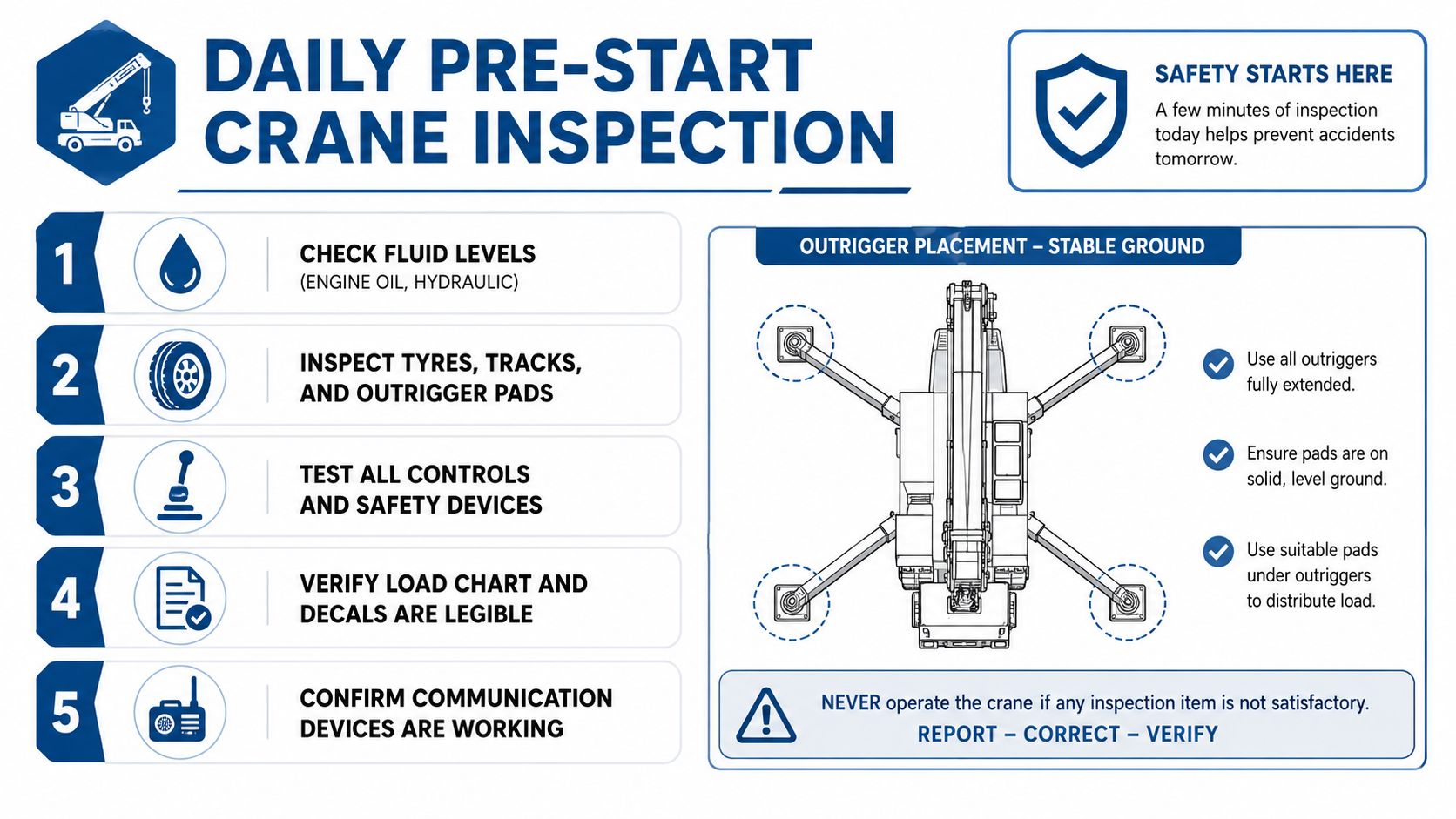
Look for leaks, damaged hydraulic lines, loose fittings, tyre or track damage, problems around the slew ring, brake issues, boom damage and missing or illegible decals. Test the controls and safety devices in accordance with the manufacturer's procedure. Check that the load chart, manuals, communications equipment and required records are available.
A visual check isn't a licence to ignore a defect. If you find a problem that could affect safe operation, isolate the crane according to site procedure, report it and keep it out of service until the responsible person confirms it's safe. Don't turn a minor hydraulic leak into a failed lift because the schedule is tight.
Set up for stability, not convenience
Position the crane on firm, level ground where the planned slew area is clear. Engage the park brake, follow the machine's setup sequence and deploy outriggers or stabilisers onto suitable pads. Pads must be placed so the outrigger load is transferred into ground capable of supporting it. A pad sitting over a void, trench edge, service route or soft fill can fail even when the surface looks flat.
Check the entire boom envelope, not just the space directly below the hook. Establish an exclusion zone around the boom and slew path, keep people out of the load route and identify nearby structures, trees, overhead services and traffic movements. If the planned position doesn't provide adequate clearance or support, reposition the crane or revise the lift plan.
For related risk-control principles, the TP Training guide to elevated work platform risk assessment offers a useful reminder that equipment selection and ground conditions must be assessed together.
Run the same mental sequence before every shift:
- Machine: Is the crane free of defects and ready for service?
- Position: Is the ground firm, level and suitable for the outrigger loads?
- Configuration: Do the chart, counterweight and outrigger arrangement match the plan?
- People: Is the exclusion zone established and understood?
- Procedure: Are the manual, lift plan and communication method available?
Controls, Slewing and Smooth Manoeuvres
A mobile crane's controls vary by manufacturer, but the operator must understand the relationship between each input and the load. Typical functions include engine controls, hoist up and down, boom elevation or luffing, boom telescoping, slew left and right, and travel. Those functions create four primary crane motions: lifting, lowering, slewing and booming in or out.
The lever isn't the job. The load's response is the job.
Match each control to the load
For a concrete panel coming off a truck, the hook should be positioned over the load's centre of gravity before taking tension. Take up the hoist slowly, watch the slings settle and stop if the panel catches, tilts unexpectedly or remains attached to the truck. Once the load is clear, slew at a controlled speed while the dogman confirms the travel path and landing area.
Avoid combining fast hoist, fast slew and boom movement without a clear reason. A sudden input can create load swing, and the swing can increase as the operator tries to correct it. Smooth acceleration and deceleration give the dogman time to manage tag lines and keep the load aligned.
Good control is predictable control. The dogman should be able to anticipate where the hook and load will be at the next moment.
The operator must also keep watching the surroundings during every movement. A load can clear the truck but move towards a wall, tree, vehicle or worker as the slew path changes. If the signaller disappears from view or radio communication becomes unclear, stop the movement and re-establish control.
Protect the hoist and boom
Test two-block protection and anti-two-block devices as required by the manufacturer and site procedure. These systems help prevent the hook block or load attachment from contacting the boom head, but they don't replace a deliberate operating technique. Never freewheel the hoist under load, and don't rely on a warning device to correct poor boom or hook positioning.
Operators who want to broaden their plant knowledge can also review practical excavator training in NSW. The same principle applies across machines: know what the control does, then watch what the equipment and load do.
Reading the Load Chart and Planning the Lift
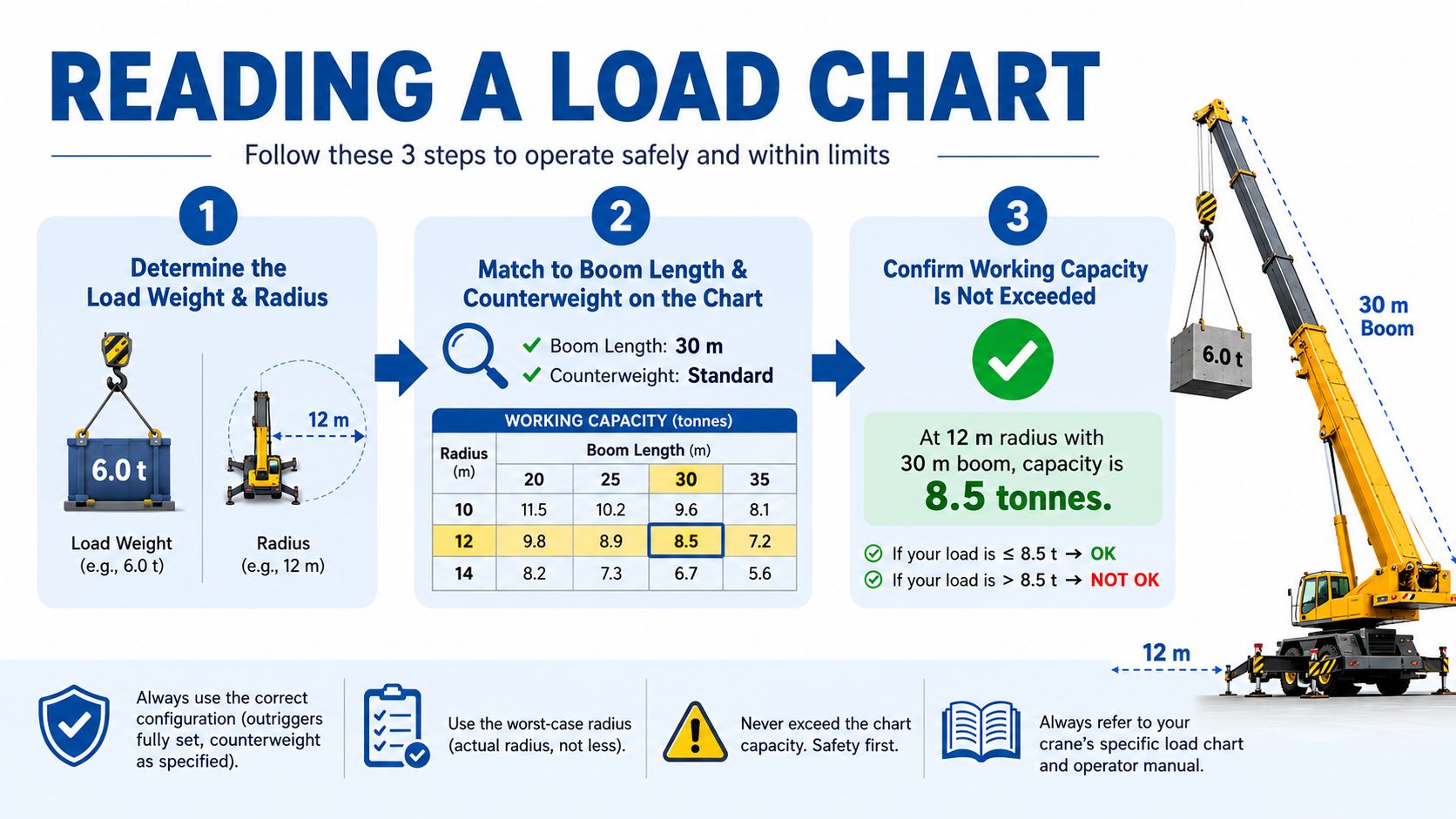
The load chart is the crane's operating boundary for a particular configuration. It shows the maximum permissible load at a stated radius, boom length, counterweight arrangement and outrigger spread. It doesn't give you a universal lifting number, and a brochure capacity is not a substitute for the chart figure that matches the crane's setup on the day.
First identify the load weight and the maximum working radius. Then identify the boom length, counterweight, outrigger configuration and the relevant duty chart. Finally, account for the hook block, hook, slings, shackles and other suspended rigging equipment. The crane must carry the complete suspended weight, not only the object being lifted.
Understand the Australian capacity classes
Australian slewing mobile crane high-risk work licences are divided into four capacity classes:
| Licence Class | Maximum Capacity | Typical Use |
|---|---|---|
| C2 | Up to 20 tonnes | Smaller slewing mobile crane lifts |
| C6 | Up to 60 tonnes | General mobile crane work within the class |
| C1 | Up to 100 tonnes | Higher-capacity mobile crane operations |
| C0 | Over 100 tonnes, open class | Large-capacity slewing mobile crane work |
The classes build cumulatively, so higher classes incorporate the lower classes. The Victorian high-risk work licence information provides the stated class capacities and cumulative structure.
Consider a planned C6 lift of a 4-tonne pack at a 14-metre radius. You can't approve that lift from the C6 label alone. You must locate the chart for the actual boom length, counterweight and outrigger setup, then deduct the weight of the block, hook and rigging gear from the chart capacity. If the chart shows insufficient remaining capacity at 14 metres, the choices are to reduce the radius, change the configuration, select another crane or revise the lift plan.
Treat radius as a critical variable
Capacity generally reduces as the load moves farther from the crane. That's why the pick position and set position both matter. A lift that begins within capacity can move outside the permitted range as the boom slews or the radius increases.
Safe Work Australia's crane guidance says to select the right crane from the load chart and never overload it. A construction risk management resource from TP Training can support broader planning discussions, while Riimpo318F Skid Steer Loader Bobcat Operations Conduct Civil Construction is a separate practical, nationally recognised civil construction training option with hands-on learning across NSW.
Rigging Basics, Signalling and Communication
The operator controls the crane, but the dogger or rigger controls critical information about the load connection and behaviour. The lifting gear must be suitable for the load, inspected for damage and used within its rated capacity. Slings, shackles and chains need clear identification and must be rejected when they show damage, excessive wear, distortion or other conditions that make their serviceability uncertain.
Sling angle changes the forces in the legs. The operator doesn't guess those forces from the cabin. The dogger or rigger selects and connects the gear, confirms the arrangement and communicates any limits or concerns before the lift begins.
Establish one clear voice
Agree on the signaller before moving. Where several workers could be exposed, use one designated person to direct the crane, with everyone understanding that stop can be called immediately when a dangerous condition appears. Radio calls should use an agreed channel and clear identification. Hand signals must be visible, deliberate and understood by both operator and dogman.
Common commands include hoist, lower, boom up, boom down, slew, travel and emergency stop. “Dog everything” means stop all crane motion, not merely pause the last command. If you're unsure whether a signal means hoist or lower, stop and clarify. Never move because a worker is waving generally in the exclusion zone.
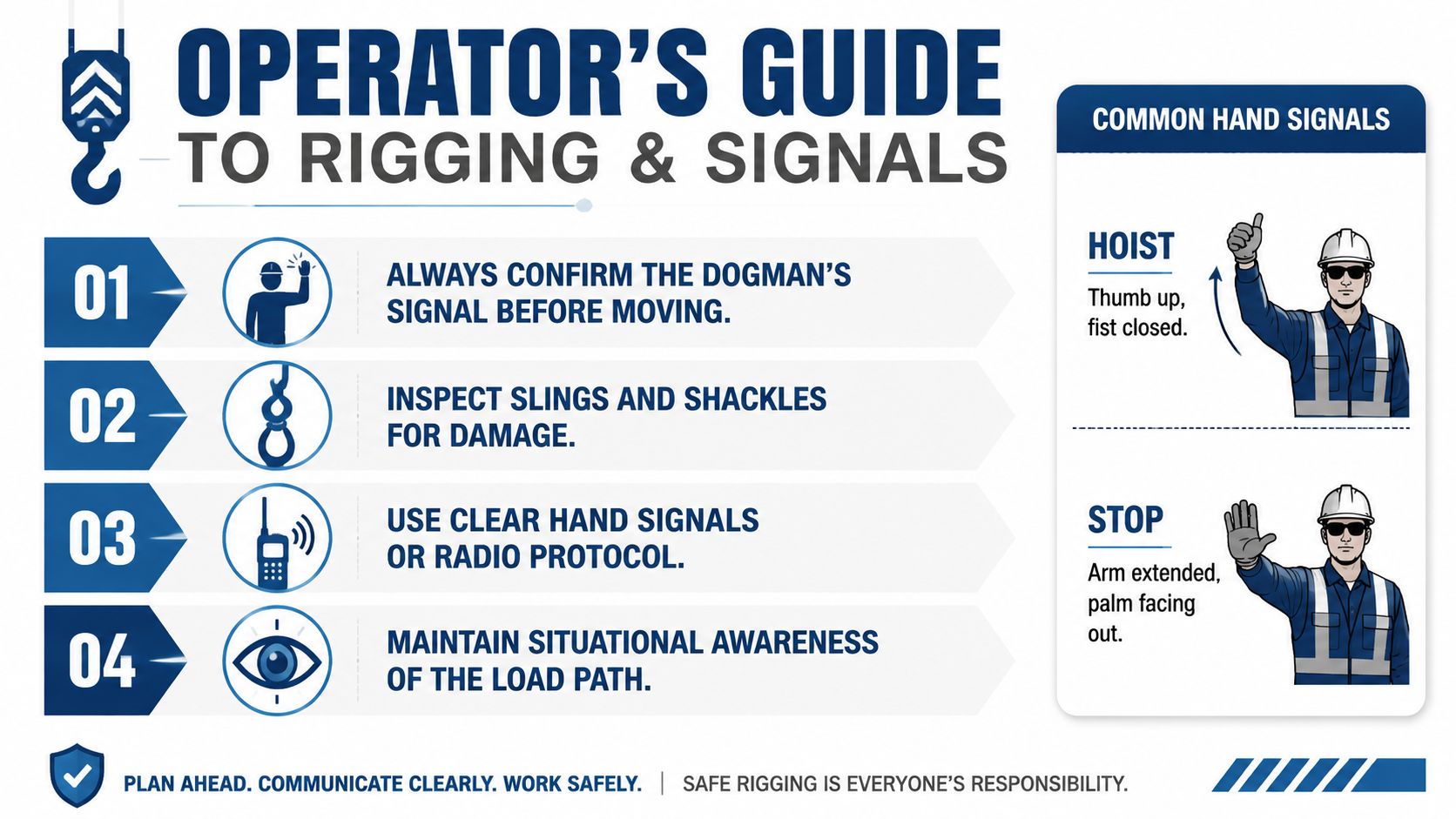
A useful practical distinction is this:
- Dogman: Directs the load and provides agreed signals.
- Rigger: Selects, connects and manages lifting gear within the relevant competency.
- Operator: Controls the crane and stops movement when the instruction, visibility or conditions become unsafe.
- Everyone nearby: Stays out of the exclusion zone and reports changing hazards.
For unusual moves, site relocations or machinery transport where the lifting team isn't available, arrange professional heavy machinery movers rather than improvising a crane plan. A separate telescopic handler licence guide also reinforces that changing the machine or attachment changes the competency and operating requirements.
Spotting Trouble Before the Crane Moves
The first metre of a lift often tells you more than the paperwork. A crane can pass its pre-start and still become unstable because the ground, load or support arrangement behaves differently under working force. The operator's job is to recognise that change before the crane commits to the movement.
SafeWork NSW reported a 2025 incident in which a mobile crane overturned while lifting portable buildings, with the boom striking a dogman and causing traumatic foot injuries. The SafeWork NSW incident release describes the event and shows why a lift can become dangerous while the load is still close to the ground.
Watch the supports during the test lift
Take the weight gradually and observe the outrigger pads. Stop if a pad sinks, tilts, shifts or shows ground deflection. A surface can look hard while the material beneath it is weak, disturbed or affected by a void. If the support changes, lower the load and reassess the ground, pad arrangement and crane position.
Look at the load as well. A load drifting sideways, rotating unexpectedly or pulling against the slings can indicate an off-centre connection, obstruction, side force or poor alignment. Slewing resistance is another warning. The crane should not need to fight a suspended object that is snagged, still attached or being dragged.
Treat side loading as a stop signal
SafeWork Queensland's 2025 alerts describe two separate mobile-crane and tree-removal incidents involving side loading and unstable trees, with cranes overturning or falling onto their sides. The lesson isn't limited to tree work. Any suspended object that's pulled sideways, caught on a structure or released from an unstable position can impose forces the crane configuration wasn't designed to absorb.
If the load wants to travel sideways, the crane isn't performing a normal vertical lift. Lower it and find out why.
Wind can also change the lift, particularly when the load or boom presents a large surface area. Watch for increasing swing, boom deflection, changing tag-line tension or difficulty keeping the load above the planned path. Don't hope the movement settles while the crane is slewing.
Use a simple response whenever something feels wrong:
- Lower: Put the load down or reduce the suspended height if it can be done safely.
- Hold: Stop crane movement and keep people clear.
- Reassess: Check the ground, rigging, radius, obstructions, wind and communication.
- Change the plan: Reposition, re-rig, select another crane or abandon the lift.
Calm judgement is a control function. The strongest operators stop early, before an unstable lift becomes a recovery operation.
Shutdown, Maintenance and Operator Licensing in Australia
A safe shutdown protects the next crew as much as it closes the current shift. Lower and stow the boom according to the manufacturer's instructions, retract or secure outriggers, engage slew and travel locks where required, isolate the machine as specified and park on suitable level ground. Leave the crane stable, secured and protected from unauthorised use.
Record defects while they're fresh. A leaking hose, faulty limit device, damaged pad or unusual slew noise shouldn't be passed to the next operator as a casual verbal comment. Operators handle routine inspections, cleaning, lubrication and reporting within their workplace procedure, while qualified maintenance personnel deal with repairs and technical faults. For fleet operators, a dedicated resource on trailer maintenance can also help separate regular transport-equipment checks from crane-specific servicing.
Know the licence pathway
The national high-risk work framework uses the following slewing mobile crane classes:
| Licence Class | Maximum Capacity | Typical Use |
|---|---|---|
| C2 | Up to 20 tonnes | Slewing mobile crane work within the lower capacity range |
| C6 | Up to 60 tonnes | Mobile crane work for cranes within the C6 scope |
| C1 | Up to 100 tonnes | Higher-capacity lifting operations |
| C0 | Over 100 tonnes, open class | Open-class, large-capacity crane operations |
The licence requirement is tied to capacity and crane type. Safe Work Australia states that a vehicle loading crane with a capacity of 10 metre tonnes or more requires either the relevant Vehicle Loading Crane HRW licence or one of the four slewing mobile crane HRW licences. A telehandler fitted with a jib or used as a crane also requires a slewing mobile crane HRW licence, according to SafeWork Tasmania's licensing information and the associated training guidance.
In Queensland, public-road travel adds heavy-vehicle licensing requirements. The relevant classes range from LR and MR through HR and HC, while MC covers all mobile cranes with or without trailers, as stated in the national crane safety research referenced earlier.
Complete training and assessment correctly
SafeWork NSW says licensing applies to residential, commercial and industrial work regardless of the cost or size of the job. The pathway includes applying for an assessment enrolment number, completing the assessment with a SafeWork Accredited Assessor and then applying online for the HRW licence. The NSW high-risk work licence process outlines these stages.
For a C6 pathway, TLILIC0023 aligns with operating a slewing mobile crane up to 60 tonnes. TP Training provides practical, nationally recognised Tlilic0023 C6 Crane Licence Course To Operate A Slewing Mobile Crane Up To 60 Tonnes training with experienced trainers and hands-on learning across NSW. Dogging knowledge is also relevant where workers direct or attach loads, and TP Training provides practical, nationally recognised Cpccldg3001 Perform Dogging Licence Course And Training In Sydney training with experienced trainers and hands-on learning across NSW.
If you're preparing for mobile crane work, visit TP Training to review practical NSW training options for the C6 pathway and related high-risk work skills. Bring your questions about load charts, outrigger setup, signalling and the HRW assessment process so you can train around the decisions that matter on a real lift day.

You may also like
Responsibilities of Employers: A Complete NSW Safety Guide

First Aid Training Cost: A Complete Guide for Sydney Workers