
Basic Scaffolding Course NSW Sydney: Your Complete 2026
SafeWork NSW found that 37% of inspected sites had incomplete scaffold decks, 39% had missing handrails or mid-rails, 27% had no written confirmation of a compliant scaffold from a competent person, and 27% had gaps between the working deck and building edges greater than 225 mm SafeWork NSW 2024 Scaff Safe findings. Those numbers explain why a Basic Scaffolding Course NSW Sydney is more than a ticket chase. In NSW, the SB licence is the legal entry point for scaffold work that must be done under a high risk work framework, and employers can’t treat it like a casual site induction.
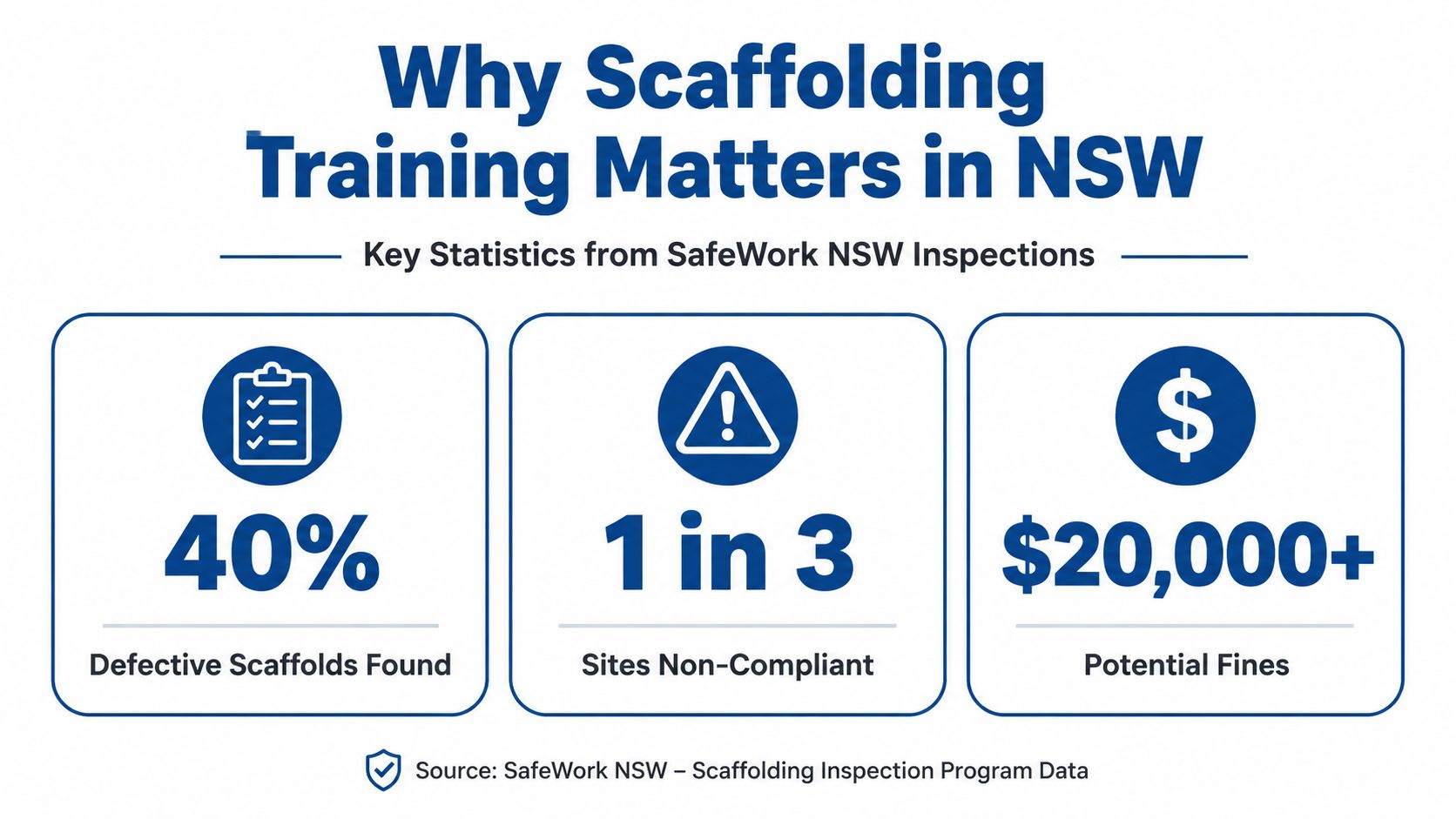
Table of Contents
- Why Scaffolding Training Matters in NSW
- What the Basic Scaffolding Licence Covers
- What a Basic Scaffolder Can and Cannot Do on Site
- Common Scaffolding Defects and How Training Prevents Them
- How to Enrol and Get Your Scaffolding Licence
- Career Pathways After Your Basic Scaffolding Licence
- Choosing the Right Training Provider in Sydney
Why Scaffolding Training Matters in NSW
Scaffold defects are not abstract compliance issues, they are the kind of faults that put workers and bystanders at risk on real sites. SafeWork NSW’s 2024 Scaff Safe findings show persistent problems across inspected worksites, including incomplete decks, missing rails, unverified compliance, and dangerous gaps at the edge of platforms SafeWork NSW 2024 Scaff Safe findings. Earlier NSW findings pointed in the same direction, with missing scaffold components, gaps beyond Australian Standards, missing mid-rails and handrails, and principal contractors allowing access to unsafe or incomplete scaffolds.
That pattern matters because scaffold work sits inside a tightly controlled licensing system. In NSW, the Basic Scaffolding (SB) class is the entry-level high risk work licence for regulated scaffold tasks, and it is not just a training certificate, it is the legal authorisation that allows a worker to perform the covered work. SafeWork NSW says applicants must complete training, obtain an assessment enrolment number, finish the assessment with a SafeWork Accredited Assessor, and then apply for the high risk work licence SafeWork NSW licence pathway.
Practical rule: if a scaffold job falls under regulated high risk work in NSW, the licence comes first, not after the crew is already on the platform.
The enforcement side is real too. SafeWork NSW lists a $900 penalty for carrying out work without a scaffolding high risk work licence, with a maximum court penalty of $4,500 training.gov.au licence penalty reference. That makes licensing a site compliance issue, not a paperwork extra.
For workers and employers in Sydney, the lesson is simple. Training is there to stop people learning the hard way on an unstable platform. Good scaffold training is part law, part hazard control, and part proof that someone understands how NSW expects scaffolding work to be done safely. The safety procedures behind that approach are also reflected in TP Training’s guidance on scaffolding safety procedures.
What the Basic Scaffolding Licence Covers
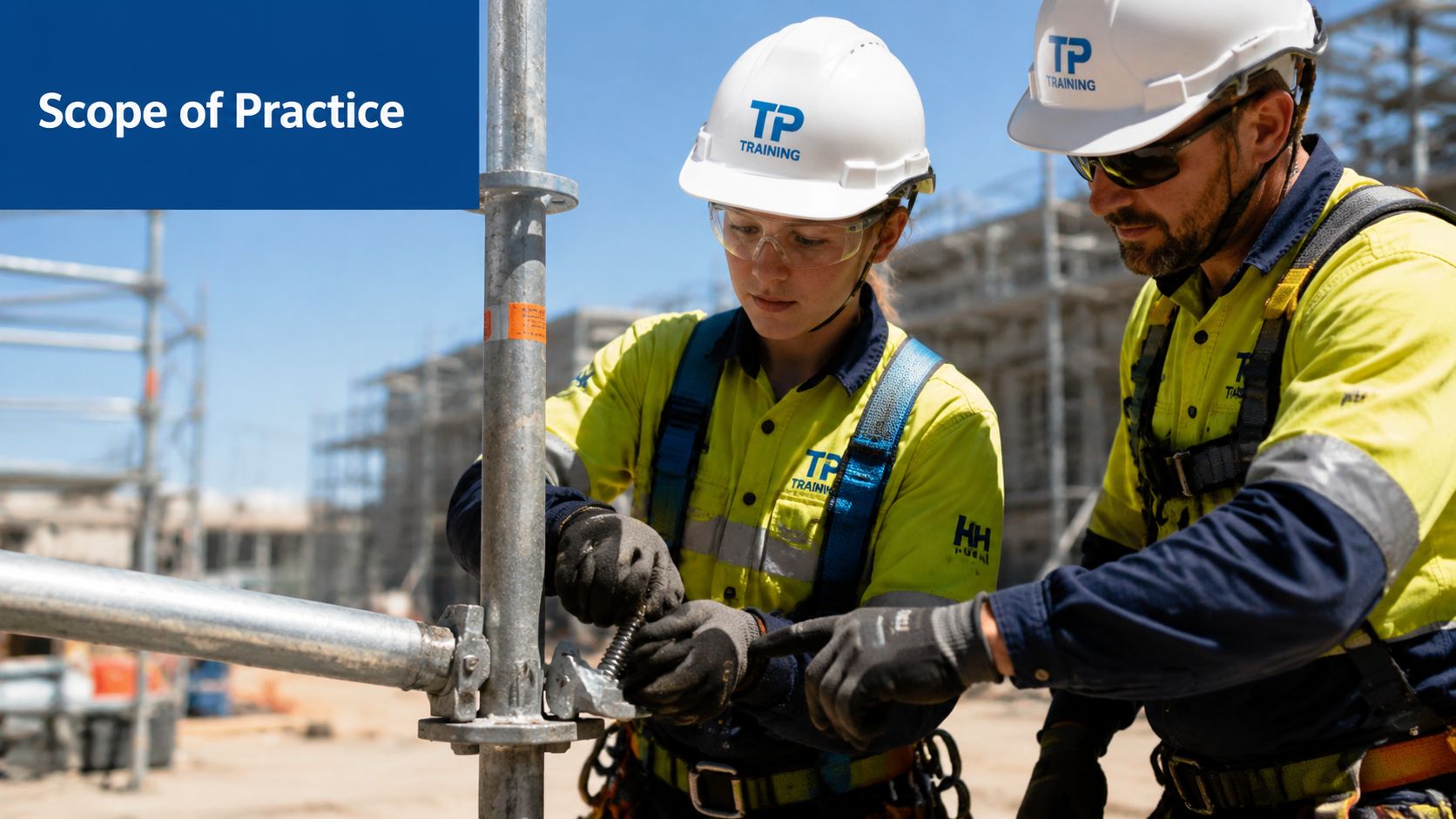
The Basic Scaffolding (SB) licence sits at the entry point of the NSW scaffolding hierarchy, below Intermediate (SI) and Advanced (SA) scaffolding. SafeWork NSW defines it as a high-risk work licence category for modular or prefabricated scaffolds, cantilevered materials hoists up to a maximum working load of 500 kg, ropes and gin wheels, safety nets and static lines, and bracket scaffolds such as tank and formwork scaffolds SafeWork NSW licence category. That scope matters because new entrants often hear “basic” and assume “minor”. In practice, it means legally defined work with real controls on site.
The SB licence goes beyond a training certificate. It is the legal authorisation that permits a worker to perform scaffold tasks under NSW’s high risk work framework.
Licence classes at a glance
| Licence Class | Scope of Work | Typical Applications |
|---|---|---|
| SB, Basic Scaffolding | Modular or prefabricated scaffolds, cantilevered materials hoists up to 500 kg, ropes and gin wheels, safety nets and static lines, bracket scaffolds for tank and formwork | Entry-level regulated scaffold work |
| SI, Intermediate Scaffolding | Broader scaffolding work than SB | More complex scaffold arrangements and progression work |
| SA, Advanced Scaffolding | Highest scaffolding class in the NSW hierarchy | Complex and higher-risk scaffold applications |
The practical boundary is just as important as the scope. SB gives a worker access to common regulated scaffold work, but it does not cover every scaffold configuration on every site. SI and SA exist because more complex structures call for extra competency and judgement.
A simple way to read the SB licence is this. It covers common scaffold systems, but it is not a blanket approval to build whatever is needed on a construction site. Training therefore focuses on stability, access, load handling, and component identification, not only on putting tubes together.
If you are comparing scaffold-related training, you may also see Cpcclrg3001 Rigging Course Level 1 Licence To Perform Rigging Basic Level presented alongside scaffold pathways. TP Training's course snapshot says it provides practical, nationally recognised training with experienced trainers and hands-on learning across NSW, which helps explain why many workers look at rigging and scaffolding together as part of a broader high-risk work pathway.
The SB licence is a legal foundation. It opens the door to regulated scaffold work, but the task still has to match the worker's competency and the site conditions.
What a Basic Scaffolder Can and Cannot Do on Site
SafeWork NSW's licence page makes the boundary clear, a Basic Scaffolding, or SB, licence gives access to defined scaffold work, but it does not open the door to every task on every site. That matters because scaffold work is judged by both the task and the conditions around it. A worker can hold the ticket and still be out of scope if the scaffold type, height, or site controls do not match the licence training.gov.au fall-risk guidance.
NSW Education's height guidance shows how that plays out in practice. It says student use of scaffolding must be on flat, stable surfaces, limited to a maximum height of 2 metres, and restricted to prefabricated or modular scaffolds that meet Australian Standards, while the host employer must ensure scaffold erection is done by a licensed scaffolder NSW Education height guidance.
A new entrant often sees the licence as a green light for independent work. On site, the picture is narrower. The SB holder may assist with prefabricated components, basic assembly under supervision, inspections, and minor adjustments within their scope. They are not being sent out to guess at structural requirements, work on unstable ground, or step into a scaffold build that needs a higher class of licence.
The fall-risk guidance used in training adds another clear line. Where a person or object could fall more than 4 metres, the work must be done by a licensed scaffolder, or by someone enrolled in a licence course and under direct supervision training.gov.au fall-risk guidance. That clarifies the difference between theory and on-site authority.
Site reality: if the base is unstable, the scaffold does not suit the task, or the work moves beyond SB scope, stop and escalate.
Employers can still add their own site rules. A commercial builder may require inductions, access controls, or written checks before anyone works near the scaffold. Those controls sit alongside the licence, they do not replace it.
The best day-one mindset is simple. Use the SB licence for the work it covers, accept supervision where the site calls for it, and build judgement as you go. A working at heights course is a practical companion because height risk and scaffold work often come together on NSW sites.
Common Scaffolding Defects and How Training Prevents Them
SafeWork NSW inspections keep finding the same failures, which is why basic training has to deal with them early. In the 2024 Scaff Safe findings, inspectors still saw incomplete decks, missing handrails or mid-rails, missing written confirmation that scaffolds were compliant, and gaps wider than 225 mm between the working deck and the building edge SafeWork NSW 2024 Scaff Safe findings. Those faults are not paperwork issues. They create fall exposure and falling-object risk on live sites.
A crew can look at a partly finished deck and assume it is “close enough” for a short job. That is where mistakes start. If the deck is incomplete, it is not a normal work surface. If the rails are missing, the fall protection is incomplete. Training breaks that habit by teaching workers to check each component, assemble in a controlled order, and stop treating an unfinished scaffold as ready for use.
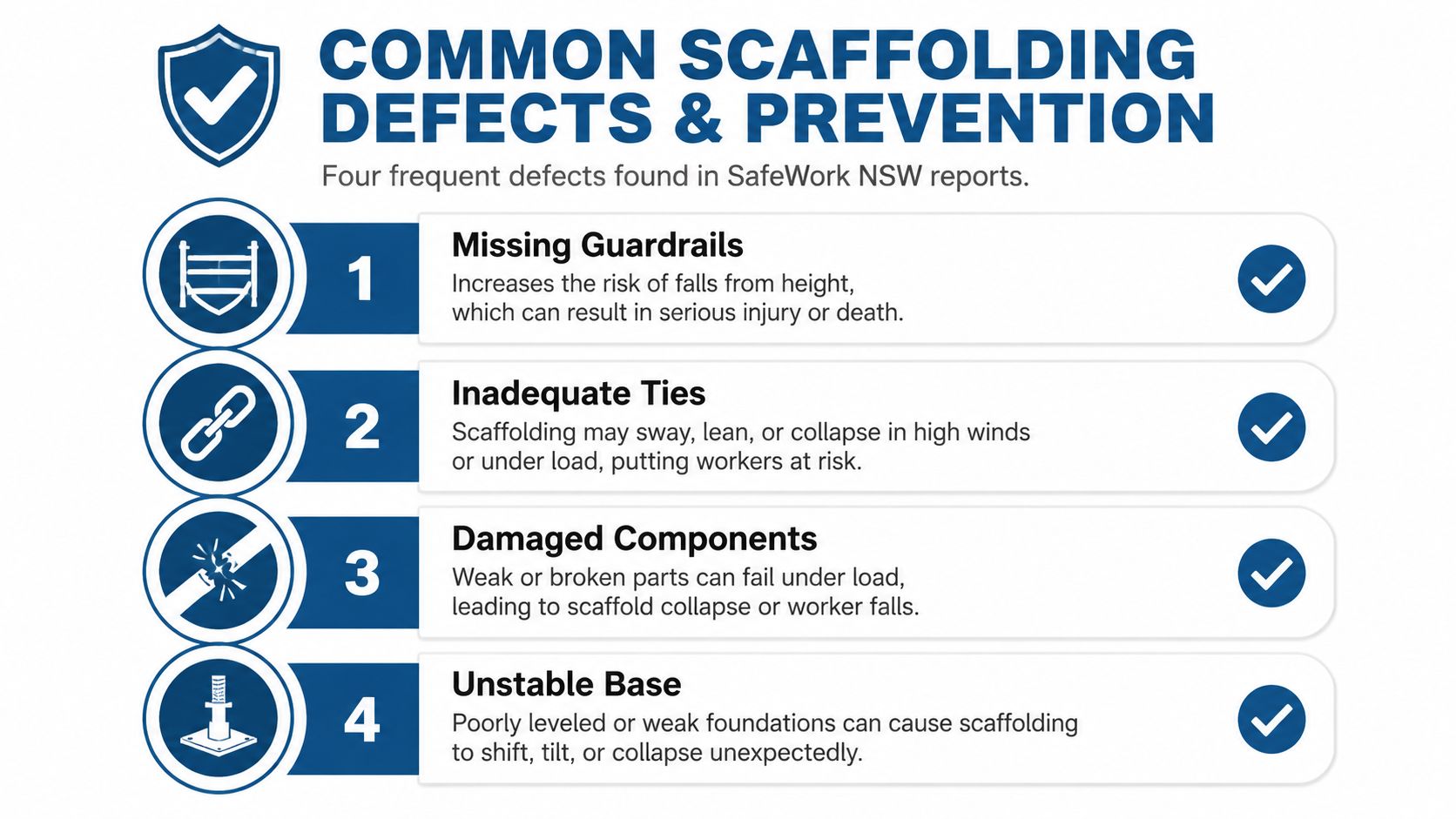
Four defects that show up again and again
- Missing Guardrails: leaves workers exposed at the edge of the platform, especially during access and material handling.
- Inadequate Ties: weakens the scaffold's connection to the structure and can compromise stability.
- Damaged Components: bent, cracked, or worn parts can fail under load or during adjustment.
- Unstable Base: uneven or unsuitable foundations can shift the scaffold before the work even starts.
The earlier NSW findings showed the same pattern, with missing components, gaps beyond Australian Standards, missing mid-rails and handrails, and unsafe or incomplete access still turning up on sites. That repetition matters because it shows the issue is not a one-off mistake, it is a recurring site control failure.
This is why the SB pathway is about more than passing an assessment. Good training teaches workers to measure gaps, check the structure, inspect component condition, and recognise when a competent person needs to sign off before use. It also builds the habit of linking scaffold checks to wider risk management in construction, because scaffold work is hazard recognition in motion.
How to Enrol and Get Your Scaffolding Licence
The path to an SB licence in NSW is clear, but each step has a role. SafeWork NSW expects you to complete the training, get an assessment enrolment number, finish the assessment with a SafeWork Accredited Assessor, and then apply for the high-risk work licence SafeWork NSW licence pathway. Leave one step out, and you are not cleared to do the work.
The usual sequence
- Enrol in training. The course should cover theory and practical skills for basic scaffold work, including the parts, hazards, and checks you will meet on site.
- Complete the learning and practice. You should work through knowledge and hands-on tasks, because scaffold work is more than remembering rules.
- Get assessed. The formal assessment is done with a SafeWork Accredited Assessor, not just anyone at the training venue.
- Apply for the licence. After you pass, you apply for the high risk work licence so you can lawfully do the covered tasks.
The Basic Scaffolding Course NSW Sydney should explain that path before you pay or attend. If a provider cannot outline the enrolment and assessment process in plain language, that is a warning sign.
For identity and enrolment admin, the USI process matters too. TP Training's 5 simple steps to create and manage your unique student identifier (USI) is a practical example of how training admin connects to course participation in Australia.
Good training does not stop at assessment. It should leave you clear on what the licence covers, what the assessor is checking, and what you still cannot do until the licence is in hand.
That last point matters because unlicensed work carries real penalties. SafeWork NSW lists $900 for carrying out work without a scaffolding high risk work licence, with a maximum court penalty of $4,500 (see penalty details above). If you plan to work in Sydney or elsewhere in NSW, the full pathway is required.
Career Pathways After Your Basic Scaffolding Licence
An SB licence is a starting point, not a finish line. It sits at the beginning of the NSW high-risk work hierarchy and can lead to Intermediate (SI) and then Advanced (SA) scaffolding, where more complex work becomes available. That step-up matters because each licence level changes what you can legally and practically do on site.
On day one, the licence gives you access to basic scaffold work, not every task people assume comes with “scaffolding” as a job title. That misunderstanding is common, which is why training has to explain the limits as clearly as the permissions.
Good scaffolders usually build more than one skill set. Basic scaffold work helps when you later move into rigging, dogging, crane-related coordination, or work at height operations, because the same habits keep showing up: load awareness, fall control, access planning, and clear communication with the crew. Those skills also fit a strategic workforce development approach, where each ticket adds real value instead of sitting alone on a résumé.
How the SB licence fits into a bigger trade plan
- Start with access and safety. Learn the scaffold environment before you chase complexity.
- Add related tickets. White Card, Working at Heights, and other high-risk work units make you more useful on site.
- Build site credibility. Reliable scaffolders get trusted with more responsibility because they handle the basics properly.
- Move up with experience. SI and SA make sense after real site work, not as a shortcut around it.
Sydney's construction work keeps needing people who can work safely and communicate clearly on active sites. Infrastructure jobs, commercial builds, and residential projects all rely on workers who understand scaffold systems without creating new hazards.
TP Training's vocational training Australia material fits that idea well, because vocational pathways work best when each ticket adds to practical site value.
SafeWork NSW inspection activity shows why this matters. A ticket is not just about passing assessment, it is about matching training to what happens on a real worksite. Basic scaffolding becomes employable when it is part of a planned, steady pathway, not a one-off credential.
Choosing the Right Training Provider in Sydney
A provider should be able to explain the SB course, the assessment process, and the licence pathway without hiding behind jargon. Ask whether the course includes hands-on practice, whether the equipment reflects current site conditions, and whether the trainer has real industry experience. If the answers stay vague, keep looking.
You should also check that the provider can support the administrative side of training, because enrolment, assessment booking, and licence application details often trip up new entrants. Ask whether they will walk you through the process from start to finish, not just sell the course seat. If you want a useful reference point for planning course content, TP Training's safety training video planning guide is a clear reminder that instruction and structure matter in any safety course.
Questions worth asking before you book
- Who delivers the training? Ask about the trainer's industry background and assessment experience.
- How much practical work is included? Basic scaffolding should never be theory only.
- What equipment is used? You want modern scaffold gear that reflects real NSW worksites.
- What happens after the course? The provider should map out the licence steps, not leave you guessing.
- Is the course timing realistic? Be cautious if certification sounds suspiciously fast.
Red flags are easy to spot once you know them. A course that promises a licence without serious practical training, a venue with poor equipment, or a provider that cannot explain SafeWork NSW's assessment requirements should make you pause. SafeWork NSW inspection findings show why shortcuts matter, because defects on real sites are the result when training does not match site practice.
If you are comparing options in Sydney, look for a provider that treats the SB licence as a safety credential and a legal pathway, not just a product. That tells you more about the training quality than any marketing claim ever will.

You may also like

Trade Courses Sydney: 3 Career Pathways Worth Exploring

Mock Interview Online Preparation Guide