Government Fund Courses in Australia: A Practical Guide
You're in a training centre in Sydney with two course quotes open on your phone. One provider says the course is “government funded”. The other offers a discount but gives you a different final price. Both sound convincing, yet neither label tells you what you'll pay in the end.
That confusion is understandable. Government-funded training isn't automatically free training. In New South Wales, the final price depends on your eligibility, the qualification, whether it appears on the relevant course list, the provider's approved scope, and any applicable concession or exemption.
This guide cuts through the marketing language. It uses the NSW Smart and Skilled system as the practical reference point, separates subsidies from provider discounts, and shows how to check the outcome before you enrol.
Table of Contents
- Two Course Quotes and a Confusing Word
- How Australia Funds Vocational Courses in 2026
- Smart and Skilled Eligibility Explained Simply
- The Three Real Cost Outcomes for NSW Learners
- Matching Popular NSW Courses to Their Funding Status
- Provider Discounts Are Not the Same as Government Funding
- Where TP Training Fits in the NSW Funded Training Map
- Your Three Decisions Before You Book a Course
Two Course Quotes and a Confusing Word

A learner might search for “government fund courses” after losing a job, changing industries, or being told by an employer to obtain a licence or safety credential. The search usually starts with a simple question: Can the government pay for this course? The honest answer is more specific: the government may subsidise an approved qualification for an eligible learner under a particular programme.
That distinction matters because a subsidy and a zero-dollar invoice aren't the same thing. A government contribution can reduce the course price while leaving a regulated student fee. A fee-free scholarship or exemption can remove the student fee for an eligible person, but only when the course and personal circumstances meet the relevant rules. A short course may be nationally recognised and still sit outside the funded pathway.
Practical rule: Never accept “government funded” as the final price. Ask for the qualification code, funding status, student fee and eligibility conditions in writing.
Why two quotes can both be legitimate
Two providers can quote different amounts without either one misleading you. One may be approved to deliver a funded qualification under the relevant NSW arrangement, while another may offer the same or a similar course commercially. Delivery mode can also affect the quote. Online, on-site and face-to-face delivery may be available, but the funding decision still depends on the approved course and the funding rules, rather than only on where the class takes place.
The wording can also hide important differences. “Course” might mean a complete certificate, a single unit, a licence assessment, a refresher, or a workplace compliance class. Those products don't necessarily attract the same subsidy treatment.
Before comparing prices, compare like with like:
- Qualification identity: Is it a complete nationally recognised qualification, a unit, a licence course or a short non-funded class?
- Funding basis: Is the price calculated under Smart and Skilled, another approved arrangement, a scholarship, or the provider's own discount?
- Learner contribution: What student fee remains after the government contribution?
- Extra charges: Are assessment, licensing, replacement card or other charges separate?
- Eligibility: Have age, residency, visa status, school status, USI and qualification history been checked?
What this guide will and won't promise
This guide won't tell every learner that a White Card, First Aid class, traffic-control ticket or civil plant course is free. That promise would be inaccurate. It will show you how to identify the funding mechanism and calculate the likely out-of-pocket result before booking.
Australia has a substantial public VET system, but national investment doesn't turn every private training product into a fee-free course. The most reliable approach is local and specific: start with your NSW eligibility, identify the exact qualification, check its Skills List and approved-provider status, then request the written student fee.
The phrase government-funded course describes who contributes to the training cost. It doesn't guarantee that the learner pays nothing.
How Australia Funds Vocational Courses in 2026
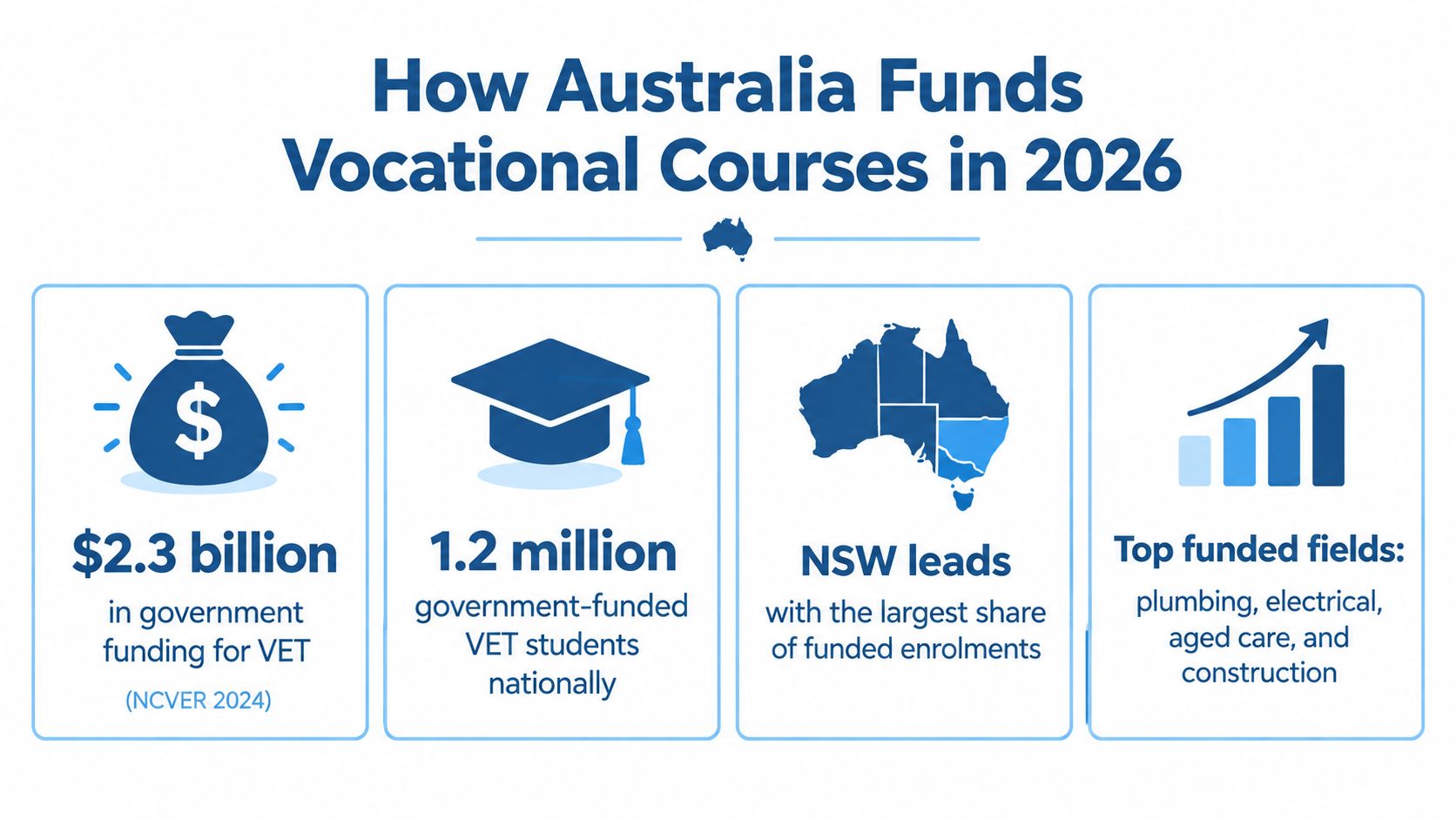
Australia's VET system is large enough that funding decisions affect employers, job seekers and training organisations across multiple industries. Government-funded VET supported approximately 1.2 million students in 2024, according to NCVER's government-funded vocational training data. That was a 2.6% decline from 2023, but participation remained above the pre-pandemic level recorded in 2019.
The dominant component was formal qualifications. About 1.07 million learners enrolled in qualifications in 2024, compared with 968,095 in 2019, an increase of roughly 101,900 qualification students, or about 10.5%, across that period. Completions also strengthened, with training-package completions increasing by 19,620, or 6.2%, between 2023 and 2024. These figures show that publicly supported training is a major workforce pathway, not a niche arrangement.
The money comes through a shared system
Public investment in VET reached approximately $10.0 billion in 2024, as reported in NCVER's government funding of VET report. That was $892.2 million, or 8.2%, lower than 2023, while still 55.8% higher than 2019.
The headline total includes different forms of public support:
- Delivery and capital expenditure: This represented $7.2 billion in 2024, an increase of 9.2% from 2023.
- Student assistance: Support rose by $213.2 million, or 122.3%, to $387.5 million.
- Equity-related investment: Funding increased by $63.1 million, or 5.4%, in regional areas, $41.2 million, or 12.8%, for students with disability, and $73.5 million, or 24.4%, for Indigenous students.
The Commonwealth supports national priorities and contributes through intergovernmental arrangements. State and territory governments fund delivery according to local and national skills needs. That shared structure explains why a course can receive public support in one jurisdiction while the same course, provider or delivery model has a different price elsewhere.
Why NSW learners need a local answer
State results differed substantially in 2024. Western Australia grew by 5.2%, Queensland by 2.6%, and Victoria by 0.9%, while New South Wales declined by 9.5%, according to the NCVER data linked above. That doesn't make NSW a small market. It means NSW providers and learners need to monitor local funding settings rather than rely on national headlines.
The national Fee-Free TAFE Skills Agreement committed more than $1.5 billion to deliver over 500,000 fee-free TAFE and VET places across Australia from 2023 to 2026, according to the Australian Government Fee-Free TAFE programme snapshot. Course lists, places, eligibility and delivery arrangements can vary by jurisdiction, so that commitment doesn't make every private course free.
NSW learners most often encounter Smart and Skilled. It operates alongside national initiatives, but it has its own rules about eligibility, qualification level, course availability and provider approval. For a broader explanation of Australia's training system, TP Training's overview of vocational training in Australia provides useful context.
The practical mental model is straightforward. National funding creates the broad opportunity, while NSW rules determine the learner's actual course price.
Smart and Skilled Eligibility Explained Simply
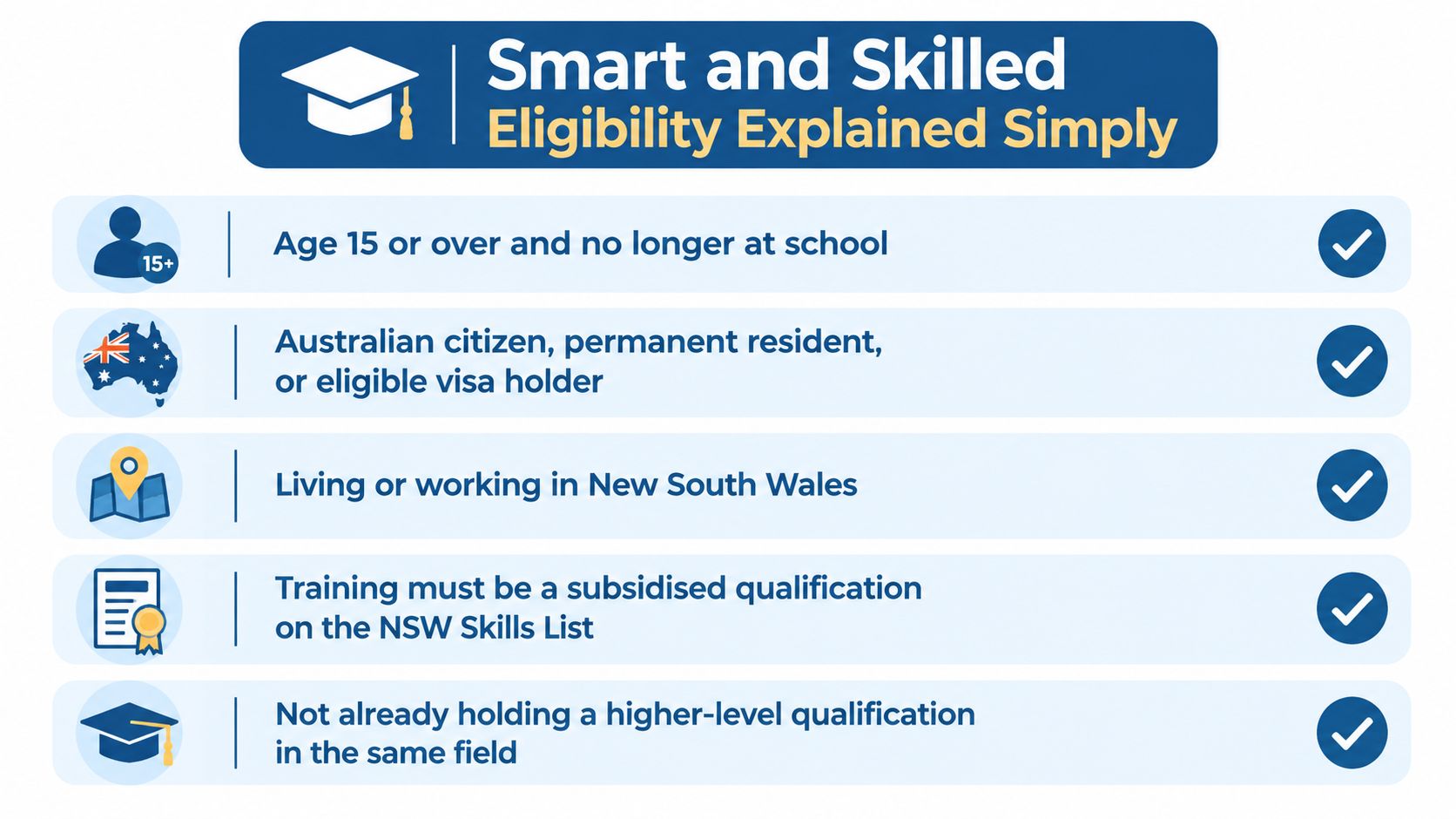
Smart and Skilled is the main NSW mechanism for government-subsidised vocational education. It isn't a blanket voucher that follows every learner into every course. Treat eligibility as a checklist, then check the qualification separately.
Start with your personal circumstances
You'll generally need to satisfy the core NSW requirements:
- Age: You must be at least 15 years old and no longer enrolled in secondary school.
- NSW connection: You must live or work in New South Wales.
- Status: You must be an Australian citizen, permanent resident, humanitarian visa holder or New Zealand citizen.
- USI: You need a valid Unique Student Identifier, or you must apply for one.
- Course availability: The qualification must be available under the relevant Smart and Skilled rules, which can include its Skills List status and provider approval.
The age and school requirements stop the standard pathway from being treated as a general school alternative. The residency and status checks establish whether NSW can subsidise your training. The USI connects your vocational education record to you, so it isn't a formality to leave until the classroom starts.
Then check the qualification level
Smart and Skilled provides an entitlement to subsidised training up to and including Certificate III. NSW apprentices are fully subsidised and don't pay a student fee under the apprenticeship arrangement. A standalone learner considering a civil-construction qualification, safety pathway or another practical course can have a different fee outcome from an apprentice in the same broad industry.
Diploma and Advanced Diploma study doesn't sit inside the standard subsidised pathway described above. That doesn't mean every higher-level course is impossible to fund through every arrangement, but you shouldn't assume the ordinary Smart and Skilled entitlement applies.
The qualification level is only one filter. A Certificate III can still be unavailable if it isn't listed, the provider isn't approved for it, or places aren't available.
Don't confuse recognition with subsidy
A nationally recognised unit or qualification has an important training and assessment status. That status alone doesn't guarantee a NSW subsidy. Short courses are where learners most often make this mistake because they see a formal unit code and assume public funding follows automatically.
Before enrolling, ask the provider to confirm:
- The exact qualification or unit code.
- Whether it appears on the relevant NSW Skills List.
- Whether the provider is approved to deliver it under Smart and Skilled.
- Whether your specific delivery mode is included.
- The student fee after applying the subsidy.
- Any additional licensing, assessment or administration charge.
The useful question isn't “Is this nationally recognised?” It's “Is this exact training product subsidised for me under the current NSW arrangement?”
If you can't answer those questions, you don't yet know the price. Create or confirm your USI early, gather your identity and residency evidence, and ask the provider to complete the eligibility check before you pay a deposit.
The Three Real Cost Outcomes for NSW Learners
“Government funded” becomes useful only when it produces a clear cost outcome. In NSW, most learners fall into one of three practical categories: fully fee-free, subsidised with a regulated student fee, or full price because the course isn't available through the relevant funded arrangement.
The first outcome applies to targeted pathways, not everyone. Eligible Aboriginal and Torres Strait Islander students can receive fee-free Smart and Skilled training in priority skill areas with approved providers. Eligible Aboriginal students may pay no fee for any Smart and Skilled qualification they undertake, subject to the programme rules. NSW also identifies fee exemptions and fee-free scholarship pathways for specified cohorts, including some students with disability and learners meeting defined social or welfare-related criteria.
The second outcome is the ordinary subsidised experience for many eligible learners. The NSW Government pays a subsidy to the approved provider, while the learner normally pays a regulated student contribution. That contribution is the amount you need to budget for, even though the government is paying part of the training cost.
The third outcome is full price. It can apply when the preferred course isn't on the NSW Skills List, no approved Smart and Skilled provider offers it, funding places aren't available, or the learner doesn't satisfy the programme rules. A private provider's discount may still reduce the commercial price, but that discount isn't the same as a government subsidy.
Compare the outcomes before you enrol
| Cost outcome | Who it applies to | Student fee | Typical qualifications |
|---|---|---|---|
| Fully fee-free | Eligible targeted cohorts, including specified Aboriginal and Torres Strait Islander pathways, apprentices, and approved scholarship or exemption recipients | No student fee under the applicable pathway, subject to evidence and eligibility | Approved priority qualifications, apprenticeships and eligible full qualifications |
| Subsidised with a regulated fee | Eligible NSW learners in an approved Smart and Skilled course | A regulated student contribution normally remains | Subsidised training up to and including Certificate III |
| Full price | Learners or courses outside the relevant funded rules, Skills List or approved provider scope | Commercial course price, potentially reduced by a provider discount | Excluded short courses, unavailable qualifications and commercial training |
For a practical example, an eligible apprentice may receive fully subsidised training, while a worker booking a standalone safety refresher pays a commercial fee. An eligible Aboriginal learner in a priority skill area may receive a fee-free outcome, while another eligible learner in the same class pays the regulated contribution. The qualification and the person both matter.
Fee-free scholarships generally cover full qualifications only up to Certificate IV for specified groups, including eligible young people receiving certain benefits, people with out-of-home-care experience and people affected by domestic or family violence. The pathway is limited to one scholarship per financial year and normally two over four years, while Diploma and Advanced Diploma courses are excluded.
For a related example of why practical safety training costs vary, TP Training's guide to silica and asbestos course costs is useful. The point is simple: a course being vocational, practical or safety-related doesn't settle the funding question.
Matching Popular NSW Courses to Their Funding Status
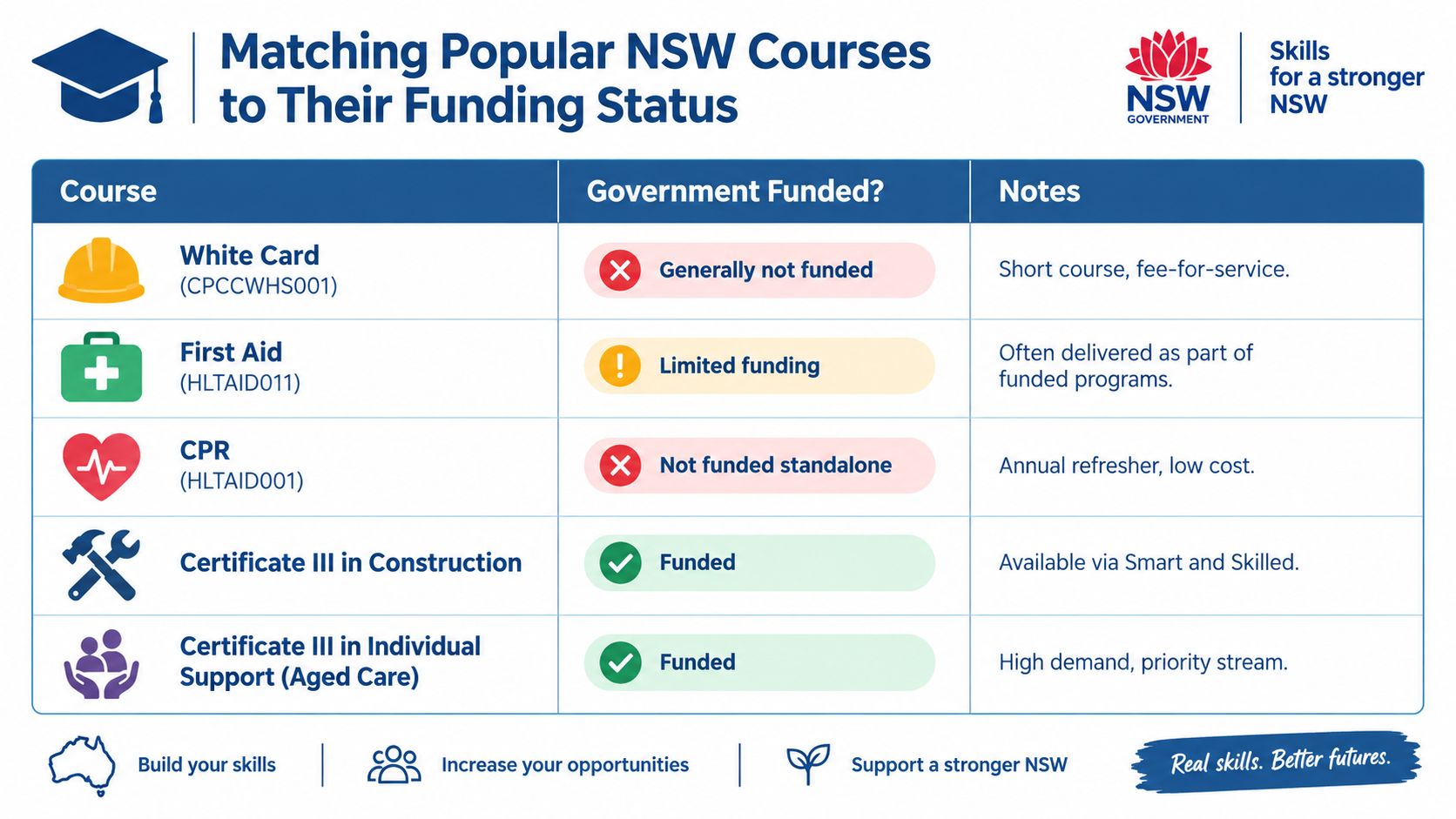
Sydney learners often search for a specific ticket, card or licence rather than a full qualification. That search behaviour creates the biggest funding trap. A White Card, CPR refresher, traffic-control card or forklift licence may be valuable for employment, but it doesn't automatically become free because it relates to an in-demand industry.
Safety and construction entry courses
White Card, CPCCWHS001: Treat this as a short construction-induction course rather than assuming it forms part of a subsidised certificate. It is generally handled on a fee-for-service basis. A learner should ask whether the quote covers the approved training, assessment and card-related requirements.
First Aid and CPR: HLTAID011 First Aid may have limited funding when delivered as part of a broader funded programme, but that doesn't mean every standalone booking is subsidised. HLTAID001 CPR is commonly an annual workplace refresher and should be priced as a standalone service unless the provider confirms an approved funded pathway.
Child Care First Aid: The workplace requirement can be clear while the funding position remains separate. Check whether the course is being delivered as an individual unit, a refresher or part of a qualification, then ask for the precise fee outcome.
The distinction is important for employers too. An organisation purchasing compliance training for staff may prefer a fast commercial booking, while a job seeker entering a qualification pathway may need to ask whether the unit is embedded in subsidised study.
Hospitality and service credentials
Barista training, Food Safety Supervisor training, RSA and RCG are popular because they help learners meet immediate workplace requirements. Their popularity doesn't guarantee a Smart and Skilled subsidy. Each quote should identify whether you're buying a short course, a nationally recognised unit, a complete qualification or an assessment pathway.
For RSA and RCG, licensing or regulatory requirements can sit alongside the training price. Food Safety Supervisor training can also have a workplace compliance purpose that differs from a full hospitality qualification. A provider discount may make any of these courses more affordable, but it shouldn't be described as government funding unless the funding conditions have been verified.
Traffic control and high-risk work
Traffic Controller training, including the Blue Card, Traffic Management Implementer training, including the Yellow Card, and the Red Card pathway for preparing work zone traffic management plans are specialised credentials. Their funding position depends on the exact training product, the NSW rules and the provider's approved delivery scope.
The same care applies to EWP, forklift, dogging, basic rigging and slewing mobile crane training. A licence outcome, high-risk work assessment and nationally recognised unit can involve different obligations. Ask whether the quote includes the full assessment and what regulator or licensing charges remain separate.
Civil construction plant tickets
Civil plant operations are often marketed together, but each machine pathway has its own training product and assessment requirements. Examples include:
- Roller: RIIMPO317F Conduct Roller Operations.
- Backhoe: RIIMPO319E Conduct Backhoe Loader Operations.
- Forklift: TLILIC0003 Licence to Operate a Forklift Truck.
- Excavator: RIIMPO320F Conduct Civil Construction Excavator Operations.
- Skid steer: RIIMPO318F Conduct Civil Construction Skid Steer Loader Operations.
- Front-end loader: RIIMPO321F Conduct Civil Construction Wheeled Front End Loader Operations.
- Articulated haul truck: RIIMPO337E Conduct Articulated Haul Truck Operations.
- Telescopic handler: RIIHAN309F Operate Telescopic Material Handler.
These tickets may be offered individually or as a civil-construction machinery combination. Don't assume that bundling several tickets makes the package government funded. The funding test still applies to the exact qualification, unit, course list and approved delivery arrangement.
A practical course-status test
For every popular course, use this sequence:
- Identify the product: Write down the full code and title.
- Classify the training: Decide whether it is a short course, licence assessment, unit or complete qualification.
- Check NSW availability: Confirm whether it appears on the relevant Skills List and whether an approved provider can deliver it.
- Ask about delivery: Confirm whether online, on-site and face-to-face options receive the same funding treatment.
- Request the final fee: Separate subsidy, student contribution, provider discount and extra charges.
TP Training delivers the listed safety, hospitality, traffic-control and civil-construction categories across its NSW training centres, including Penrith, Burwood, Auburn, Parramatta and Sydney CBD. Its all-course discount is a provider offer and should be compared separately from any confirmed Smart and Skilled outcome.
Provider Discounts Are Not the Same as Government Funding
A discount is a price reduction from the provider. A government subsidy is a public contribution governed by eligibility, course availability and contract rules. They can appear on the same quote, but they aren't interchangeable.
That distinction protects you from two opposite mistakes. You might reject a suitable course because you assume the advertised government price is the only option, or you might assume a discounted short course is subsidised when it is being sold commercially.
NSW explicitly states that fee-free training isn't universal. A preferred course may be excluded because it isn't listed on the NSW Skills List or because there is no approved Smart and Skilled provider for it, as explained in the NSW guidance on ineligible fee-free training. Places and individual eligibility also matter.
Read the quote as four separate lines
A clear quote should let you distinguish:
- Government subsidy: The public contribution paid to an approved provider under the applicable arrangement.
- Regulated student fee: The amount an eligible learner normally contributes under Smart and Skilled.
- Provider discount: TP Training's own all-course discount or another commercial reduction.
- Additional charges: Licensing, card, assessment, materials or other charges not included in the headline price.
If the quote only says “government funded” and gives one unexplained amount, ask for a revised breakdown. You need to know whether the number is the student contribution, a commercial price, a discounted commercial price or a combined outcome.
My advice to Sydney learners: Choose the course that meets your employment goal, then verify the funding. Don't choose a course solely because its advertisement uses the word “free”.
The same principle applies when comparing online, on-site and face-to-face delivery. The learning environment may change, but it doesn't override the NSW course-list and approval rules. A provider can offer a discount for a course that remains outside Smart and Skilled, while another provider may have an approved funded place for a different training product.
For a practical comparison of hospitality pricing, TP Training's guide to affordable RSA, RCG, Food Safety Supervisor and barista training shows why commercial affordability and government funding should be discussed separately.
The cheapest quote isn't necessarily the most funded quote. It may be the clearest commercial offer.
Where TP Training Fits in the NSW Funded Training Map
You see this a lot in Sydney. A learner finds a TP Training course near home, sees a familiar category like traffic control, first aid or hospitality, and assumes the funding outcome will be straightforward. It usually is not. In NSW, “government funded” is a funding mechanism tied to the exact training product and your personal status, not a blanket promise attached to a course category.
TP Training's NSW locations include Penrith, Burwood, Auburn, Parramatta and Sydney CBD. That spread matters because it puts training within reach of major Western Sydney and inner-city catchments where learners often compare travel time, shift work and parking as closely as they compare fees. If you are weighing up a short course against time off work, location is part of the true cost.
Its course range also matters. TP Training covers construction, civil construction, traffic control, high-risk work, first aid, hospitality and workplace safety. Those are common entry points for job seekers and career changers, but they do not all sit inside NSW funding in the same way. Some funded outcomes are more likely when the training forms part of an approved program or qualification. A standalone ticket, refresher, card or licence outcome can land in a different fee position altogether.
That is where TP Training is useful. It gives NSW learners a visible catalogue of practical, job-linked training options, then the funding question becomes narrower and easier to answer. Use the checklist from section 3 to test your own position first, especially your residency or citizenship status, qualification level and concession status. Then look at the TP Training course you want, not the broad label.
For ticket-style credentials, ask specifically whether the funded place covers the assessment day or only the theory component, because that difference changes your total travel and time cost. It also affects whether a cheap-looking quote is the cheaper choice once you add attendance, reassessment or site-based practical requirements.
Delivery mode deserves the same treatment. A Sydney CBD class may suit someone commuting by train. Penrith or Parramatta may make more sense for a Western Sydney learner trying to keep lost work hours down. Online theory can help, but it does not automatically reduce the full cost if the practical assessment still requires you to attend in person.
TP Training can also matter at pathway level, not just course level. Learners who are unsure whether to book a short ticket now or step into a larger training pathway should read about DLI Training and TP Training's career partnership. That context helps if your next move is employment first, then a broader qualification later.
For training organisations, operations still shape the learner experience. Tools such as software for multi-tutor businesses can support scheduling, records and tutor coordination. They do not change Smart and Skilled eligibility, but they can affect how clearly a provider handles enrolment and delivery.
Use TP Training as a practical starting point for NSW course selection, location planning and pathway comparison. Then get the fee outcome tied to your exact circumstances. That is the point where the funding map becomes real.
Your Three Decisions Before You Book a Course
You call two providers for the same forklift-related training in NSW. One says “government funded”. The other gives a fee that looks higher but lists what you will pay. That is the moment to stop treating funding like a price label and start treating it like a rule set tied to you.
First, run the eligibility checklist and qualification-level check from earlier. Do not re-do it loosely over the phone. Have your ID and residency evidence ready, and sort your USI before you ask for a final fee. TP Training's guide to creating and managing a USI is the quickest way to get that step done properly.
Second, run the exact course check from earlier. You need the qualification or unit code, the NSW funding status for that code, and confirmation that the provider can enrol you under that arrangement now. If any part of that chain is missing, treat the quote as commercial until the provider puts the funded outcome in writing.
Third, ask for the quote in a format that exposes the actual cost. That is where many learners overpay. A useful quote shows the course code, delivery mode, student fee, any provider discount, and every extra charge that sits outside the funded line.
Here is the practical version. If you are booking forklift training, do not ask “is it funded?” Ask: what is the exact course or unit, what fee applies to my status, what part is subsidised, and what part do I still pay? If you hold a concession, ask to see that fee category on the quote. If you do not meet the funded rules, ask for the full commercial price in the same email so you can compare cleanly.
TP Training fits best when you already know your likely lane: funded, concession-reduced, or full-fee. Then you can compare its NSW course options against your actual out-of-pocket position, not a headline promise. Even provider systems matter here. Good admin tools, including software for multi-tutor businesses, can improve scheduling and records, but they do not change your eligibility or fee category. In NSW, the learner who walks in with a course code, a USI and a written fee request is the one who does not overpay.

You may also like
Workplace Safety Training: A 2026 Guide for Australia
First Aid Certificate for Childcare in NSW: Complete Guide