Silica & Asbestos Courses Cost Guide for NSW Workers
An accredited 10830NAT plus 11084NAT combination costs about A$510 at TP Training, while online awareness can total about A$280, based on A$105 for silica awareness and A$175 for asbestos awareness. Subsidised face-to-face options can be roughly 20% to 40% lower, so the right choice depends on your compliance purpose, not just the cheapest advertised fee.
For NSW construction, civil and renovation workers, the price question matters because the work can involve two serious airborne hazards. Australia's respirable crystalline silica workplace exposure standard is 0.05 mg/m³ averaged over an eight-hour workday, and government figures estimate that up to 600,000 workers may be exposed each year. A national plan also states that approximately 1.45 million Australians work in industries where silica exposure may occur. These figures make silica prevention training a practical workplace requirement, not an optional add-on. (Australian silica facts and figures)
Asbestos carries a different legacy risk. It was first used in Australia in the 1880s, mining stopped in 1983, and the national ban on asbestos took effect on 31 December 2003. Government guidance says asbestos is still found in about one in three Australian homes, and estimates that 4,000 Australians die each year from asbestos-related diseases. (Australian asbestos facts and figures)
Table of Contents
- Introduction to Silica and Asbestos Training Costs in Australia
- Understanding Course Types and Categories
- How Much Silica and Asbestos Courses Cost Across NSW
- What Influences Course Pricing and Fees
- Online Awareness Versus Accredited Face to Face Training
- How to Save Money with the Silica and Asbestos Combo Course
- NSW and ACT Compliance Requirements You Should Know
- Quick Checklist Before You Book and Pay
- Quick Reference and Related Resources
Introduction to Silica and Asbestos Training Costs in Australia
The NSW Silica & Asbestos Courses Cost market has no single national price. A short online awareness module, a nationally recognised assessed course, and a bundled classroom program may all cover related hazards while serving completely different compliance purposes.
For a worker who only needs low-risk induction awareness, online training may be the economical route. For someone cutting, drilling, grinding or polishing silica-containing materials, or entering a site controlled by a principal contractor, a recognised prevention course with assessment and clear records is usually the safer buying decision. Safe Work Australia identifies nationally recognised crystalline silica exposure prevention training as an available pathway, while state requirements determine what employers must accept. (Safe Work Australia silica training guidance)
Practical rule: Never compare prices until you know whether the course is accredited, assessed, accepted by the site and suitable for the task.
This guide separates the market into three useful price bands: online awareness, subsidised or institutional training, and accredited face-to-face delivery. The cost table gives a fast benchmark, while the later sections explain funding, evidence of competency, state requirements and the economics of booking a combo.
For broader context on workplace safety education in Australia, the Safety Space courses guide is useful when you're comparing related construction and safety training categories. Employers can also review practical information about crystalline silica exposure prevention before deciding which level of training their crews need.
Understanding Course Types and Categories
Course category determines whether the training is suitable for the job. Silica awareness, crystalline silica exposure prevention and asbestos awareness address different hazards and produce different evidence. Choose by task and site requirement, not by the lowest advertised price.
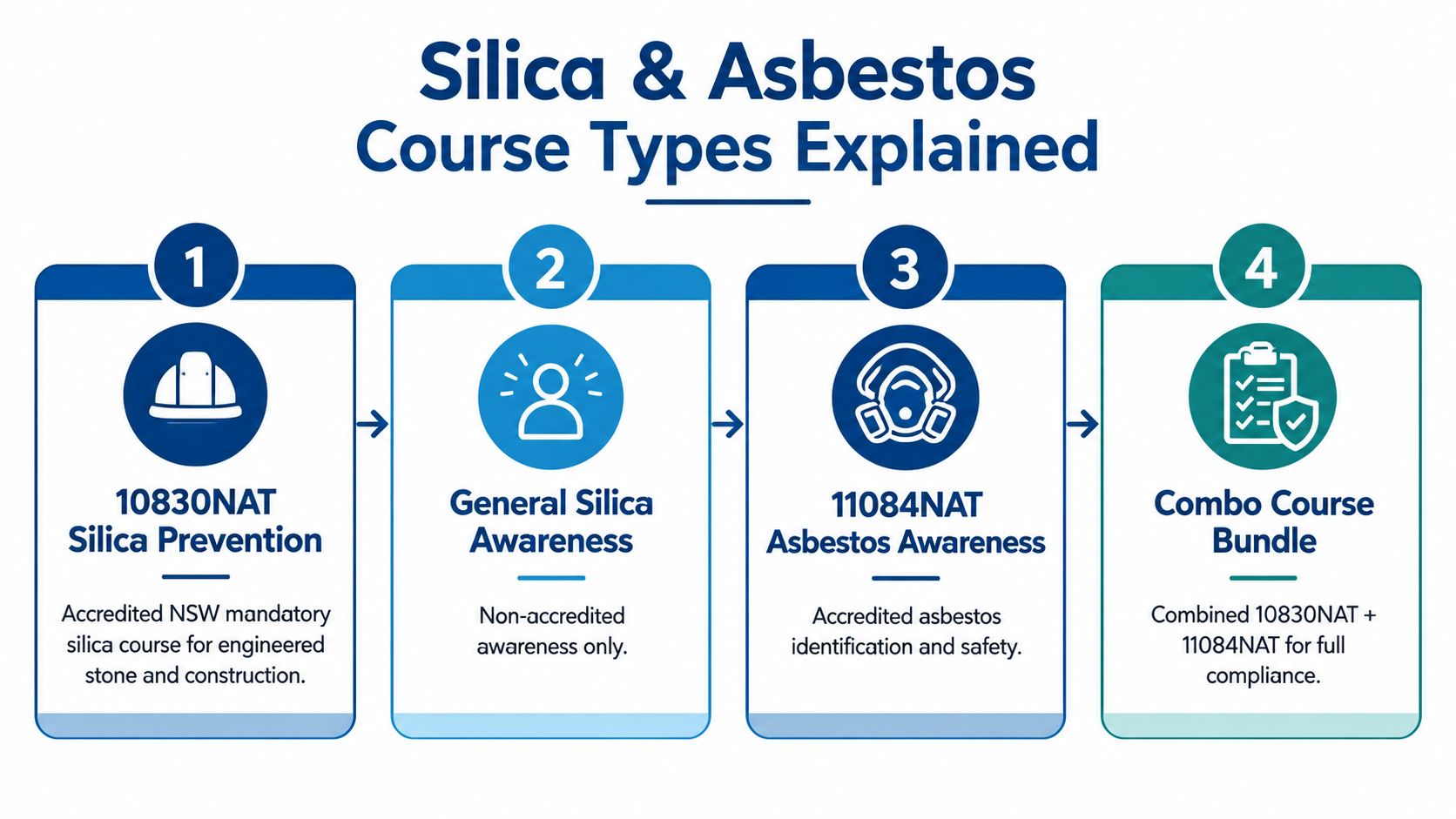
10830NAT crystalline silica exposure prevention
10830NAT is the nationally recognised prevention course for workers whose duties can generate respirable crystalline silica. It covers risk controls for cutting, drilling, grinding and polishing silica-containing materials. Select it when the work involves exposure potential, or when the employer or principal contractor requires documented training, assessment and an understanding of practical controls.
A general silica awareness module can explain the hazard and basic precautions, but it may not provide equivalent competency evidence or meet a worksite requirement. Confirm the course code, assessment method and site rules before booking.
11084NAT asbestos awareness
11084NAT is the nationally recognised awareness pathway for workers who may encounter asbestos-containing materials. It covers where asbestos may be found, how to avoid disturbing it, and when work must stop so the material can be assessed or managed.
The course does not provide an asbestos removal licence or authorise asbestos removal. Its purpose is identification, prevention and safe response for workers in construction, maintenance, demolition, renovation and related occupations.
General awareness and combination training
Non-accredited online awareness can suit a low-risk induction, subcontractor screening process or refresher when the principal contractor accepts that format. Use accredited training instead when the task, contract or applicable rule requires a recognised outcome.
For workers moving between construction, civil works and renovation, booking both course areas can reduce repeat enrolment and keep records aligned. TP Training offers 10830Nat 11084Nat Crystalline Silica Exposure Prevention Asbestos Awareness Combo Courses with nationally recognised training, trainer instruction and practical learning across NSW. Check that the delivery format and assessment meet the relevant employer or site requirement before paying.
For background on how the two nationally recognised courses fit together, read TP Training's course overview.
How Much Silica and Asbestos Courses Cost Across NSW
There is no single NSW price for silica and asbestos training. Delivery mode, accreditation and funding can shift the fee substantially, so compare the outcome you need rather than choosing the lowest advertised amount.
| Course Option | Delivery Mode | Indicative Cost AUD | Best For |
|---|---|---|---|
| 10830NAT plus 11084NAT combo | Accredited face-to-face | About A$510 | Workers needing both recognised outcomes in one booking |
| 10830NAT silica prevention | Face-to-face, standard fee | A$370 to A$400 | Workers whose silica duties require recognised training |
| 11084NAT asbestos awareness | Face-to-face, standard fee | A$210 to A$270 | Workers needing accredited asbestos awareness |
| 10830NAT silica prevention | Subsidised or rebate-supported | A$290 to A$320 | Eligible workers using TFA or institutional funding |
| 11084NAT asbestos awareness | Subsidised or rebate-supported | A$130 to A$190 | Eligible workers accessing funded delivery |
| Silica awareness | Online, non-accredited | A$105 | Induction or low-risk awareness where accepted |
| Asbestos awareness | Online, non-accredited | A$175 | Online awareness where the employer accepts it |
| Combined online awareness pathway | Online, non-accredited | About A$280 | Low-risk screening, induction or refresher use |
The accredited benchmarks come from published NSW and ACT provider information. MBA Training lists 10830NAT at A$400 standard or A$320 with a TFA rebate, and 11084NAT at A$270 standard or A$190 with a TFA rebate. CIT lists silica prevention at A$370 full fee or A$290 subsidised, and asbestos awareness at A$210 full fee or A$130 subsidised. See the CIT 10830NAT course information for its published course details.
Online prices are recorded in an Avetta workforce registration guide that references TAFE NSW and SafeWork NSW resources. Use those figures as a comparison point, then confirm whether the principal contractor accepts online, non-accredited awareness for the intended site or task. The Avetta subcontractor workforce registration guide provides the cited reference.
An ACT listing shows silica prevention options from about A$307 to A$497, depending on delivery, while an online asbestos and silica bundle has been advertised from A$75. Treat unusually low offers carefully. They may cover awareness only, without the recognised outcome and assessment required for the work.
What Influences Course Pricing and Fees
Two providers can quote different amounts for the same course code because the services may differ. The advertised fee can include trainer time, assessment, venue hire, administration, learning resources and funding adjustments. Compare what is included before comparing prices.
Accreditation changes the value of the fee
A recognised course normally requires formal enrolment, assessment and compliant documentation. Those requirements cost more to deliver than a short awareness module. Face-to-face delivery also adds trainer, classroom and practical assessment costs.
Check whether the certificate names the nationally recognised unit or course and confirms assessment. A completion certificate alone may not satisfy the employer or principal contractor. Ask which outcome the site requires before booking.
Funding can change the effective price
MBA Training's published examples show how rebates affect the payable amount. The TFA rebate changes 10830NAT from A$400 to A$320, while 11084NAT changes from A$270 to A$190. CIT lists subsidised silica prevention at A$290, compared with A$370 at the full fee, and subsidised asbestos awareness at A$130, compared with A$210. These figures are provider examples, not universal prices.
Eligibility, provider status and delivery location determine whether a subsidy applies. Queensland's government provider list for 10830NAT identifies providers, delivery locations and whether Queensland Government funding is available. Check the Queensland 10830NAT provider list before assuming a discounted fee applies.
Location and inclusions matter
Ask these questions before paying:
- GST: Is GST included?
- Assessment: Are all assessments and practical activities covered?
- Materials: Are learner resources included?
- Rebooking: What happens after a missed session or failed attempt?
- Funding: Do you qualify for TFA, school or government support?
- Travel: Will a cheaper venue create transport or accommodation costs?
A subsidy can change the final amount by more than A$100 per unit. Compare the payable total, including materials, assessment, travel and rebooking, rather than the promotional starting price. Use the TP Training combo course pricing benchmark as a separate check on whether combining silica prevention and asbestos awareness offers better value than booking each course separately.
Online Awareness Versus Accredited Face to Face Training
Online awareness courses generally cost less because they omit classroom delivery, trainer-led practice and practical assessment. The market benchmark is roughly A$50 to A$175 per topic, while accredited prevention training more often sits around A$290 to A$400 per unit before bundle discounts or subsidies. (Avetta online awareness pricing guide)
The cheaper option is not automatically the right option. It suits a limited compliance purpose, while accredited training is designed for workers who need recognised competency for higher-risk duties.
Choose online awareness when
Use online training for basic hazard recognition before site entry, a low-risk induction or an employer-approved refresher. It can also help employers screen subcontractors before requiring formal training.
Check acceptance before booking. The employer, principal contractor and relevant state authority must accept the course format for the work being performed. An online certificate does not close a compliance gap where the site requires 10830NAT or another approved pathway.
Choose accredited delivery when
Choose accredited training for workers performing silica-generating tasks or entering sites with formal competency requirements. NSW recognises 10830NAT, TAFE NSW silica awareness and safety training, and the CPCSIL3001 and CPCSIL4001 units as approved silica training options. (SafeWork NSW crystalline silica training requirements)
Asbestos training follows the same practical rule. The course must reflect the worker's exposure risk and the documentation required by the workplace. Online awareness can prepare a worker, but it should not replace a recognised course where the job demands one.
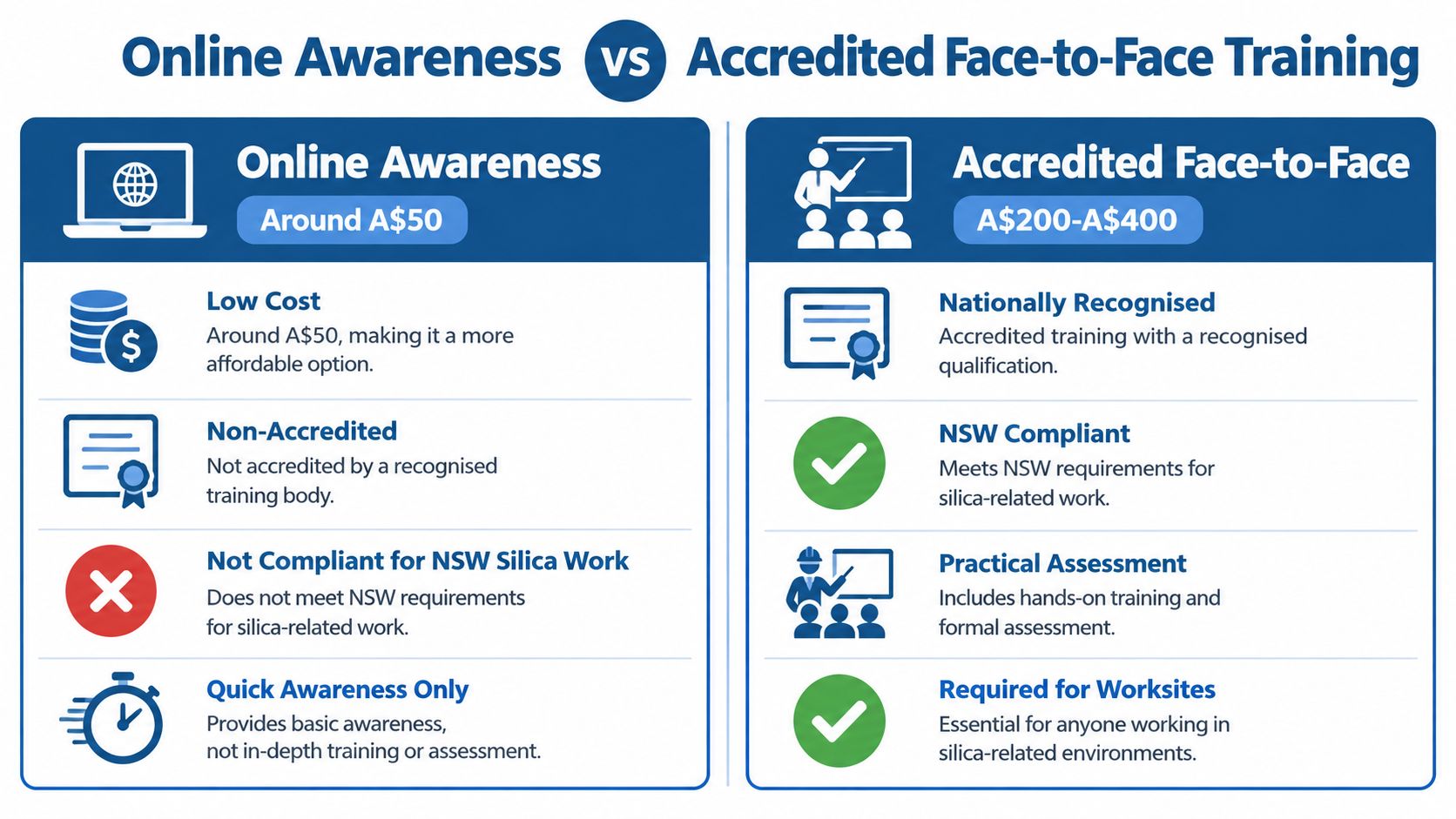
For course duration and online asbestos pricing, read this asbestos awareness course guide. Book online awareness when it matches the documented purpose. Choose accredited face-to-face training when the work, site or regulator requires recognised competency.
How to Save Money with the Silica and Asbestos Combo Course
Combining both topics can reduce the total booking cost when the worker needs silica prevention training and asbestos awareness. Compare the separate course fees with the provider's current combined quote, then check exactly what the bundle includes.
MBA Training lists 10830NAT at A$400 and 11084NAT at A$270, producing a separate standard total of A$670. A TP Training combo benchmark of about A$510 is lower than that total. Treat the figure as a comparison point only. Confirm the current price, inclusions and eligibility before paying.
A bundle does not automatically mean a discount. Some providers reduce the combined fee, while others place two courses under one booking with little or no price reduction. Review funding as well. A subsidised separate course may cost less than an unsubsidised package.
Use this buying process
- Confirm both course codes. Check that the package includes 10830NAT and 11084NAT, rather than two general awareness modules.
- Request the all-in price. Ask whether GST, assessment, learning materials and certificates are included.
- Check funding first. Compare any subsidised individual booking with the full combo price.
- Add travel costs. A nearby NSW training centre may cost less overall than a cheaper course requiring extensive travel.
- Match the schedule to the job. Missing a practical session can create rebooking fees and lost work time.
- Get site acceptance in writing. Ask the principal contractor whether the provider and delivery format meet the project requirement.
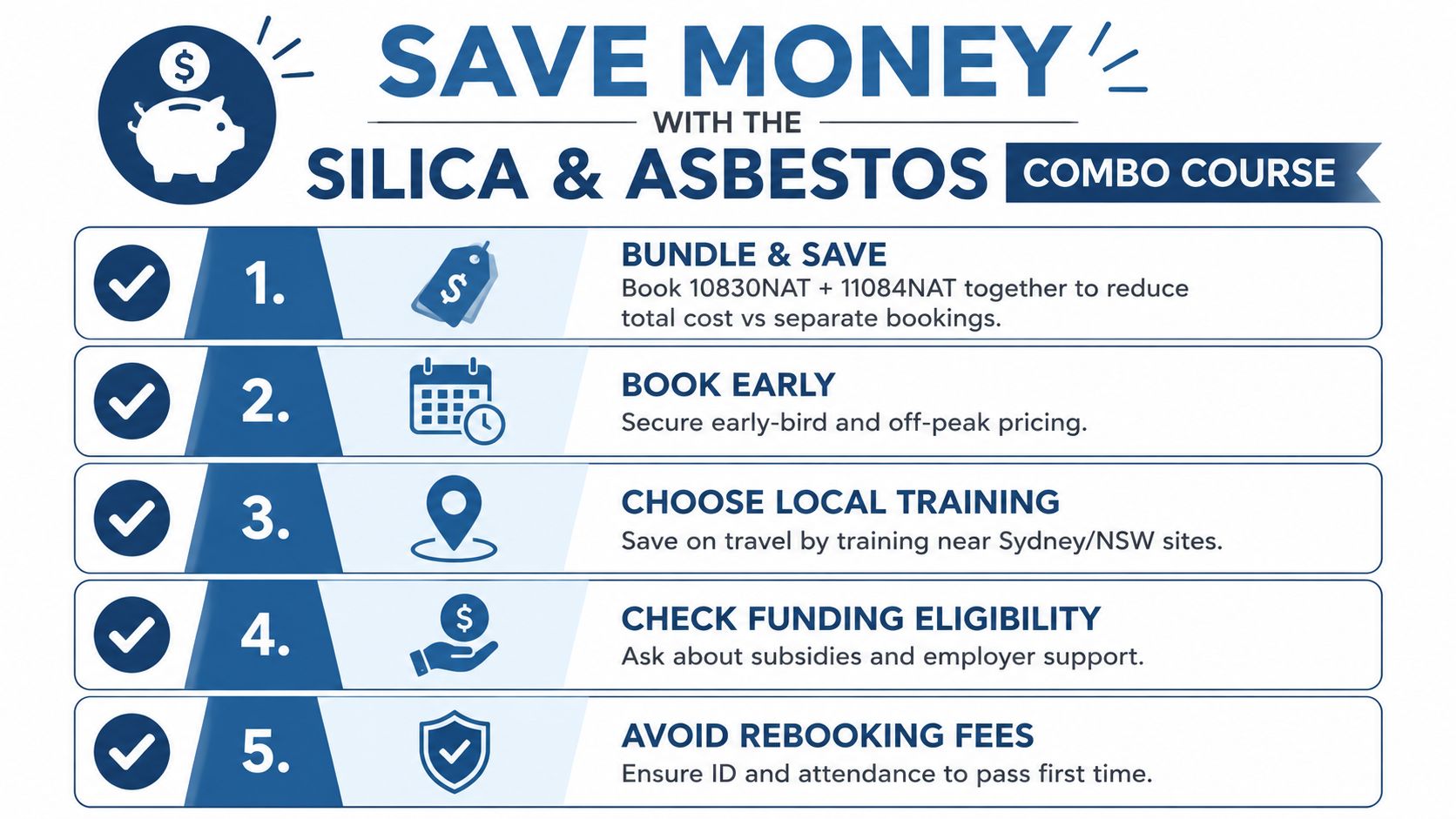
Workers moving between construction, civil works and renovation should price the combo before booking separate topics. Review TP Training's online silica and asbestos training information to distinguish awareness delivery from recognised prevention training, then choose the option the job and site will accept.
NSW and ACT Compliance Requirements You Should Know
Course selection must match the task, the state rule and the project's site conditions. In the ACT, silica awareness became mandatory in October 2023. NSW introduced the requirement in September 2024 for workers cutting, drilling, grinding or polishing silica-containing materials. Workers performing these tasks should confirm that their certificate follows an approved pathway, rather than assuming any online awareness course will be accepted.
The silica exposure standard is 0.05 mg/m³ over an eight-hour workday. Training supports dust controls, safe work methods and exposure management, but it does not replace them. Employers still need appropriate engineering controls, wet methods, extraction, respiratory protection and supervision. Workers need to understand how those controls apply to the task and site.
Asbestos has a separate exposure standard of 0.1 fibre per millilitre of air over eight hours. The national ban on manufacture and use has not removed asbestos from older homes, commercial buildings or infrastructure. Awareness remains relevant for renovation, maintenance and demolition work. The national facts and figures guidance cited earlier sets out that continuing risk.
ACT retraining requirements
WorkSafe ACT does not accept asbestos training completed before 1 January 2008. Affected workers must retrain with a registered training organisation accredited to deliver 11084NAT. Workers in declared occupations must complete the training regardless of seniority, existing qualifications or apprentice status. See the WorkSafe ACT asbestos awareness requirements before booking an ACT asbestos course.
NSW employers should keep the certificate, course code, provider details and completion record together. Check that each worker's training matches the work they will perform and the principal contractor's site rules. A low course fee becomes wasted money when the certificate is rejected and the worker must retrain before starting.
Quick Checklist Before You Book and Pay
Use this list before enrolling. It takes less time than arranging retraining after a principal contractor rejects the certificate.
- Confirm the course code: Check whether you need 10830NAT, 11084NAT, an approved alternative or general awareness.
- Confirm the task: Cutting, drilling, grinding and polishing silica-containing materials require closer scrutiny than a low-risk office induction.
- Check accreditation: Ask whether the outcome is nationally recognised and assessment-based.
- Verify acceptance: Get confirmation from the employer or principal contractor.
- Compare the final fee: Include GST, materials, assessment, certificates, travel and rebooking conditions.
- Ask about funding: Check TFA, school, institutional or government subsidy eligibility.
- Check delivery mode: Confirm whether training is online, classroom-based or blended.
- Keep evidence: Save the certificate and enrolment records where supervisors can access them.
A very low online price deserves questions, not automatic approval. Review the benchmark table above, then use this guide to online crystalline silica exposure prevention to assess whether the advertised format fits your work.
Quick Reference and Related Resources
Key terms: 10830NAT refers to crystalline silica exposure prevention. 11084NAT refers to asbestos awareness. General awareness is a lower-cost education format and may not provide the recognised competency required for higher-risk site work.
Best value rule: Choose the combo when you need both recognised outcomes and the combined quote is lower than separate bookings. Choose online awareness only when the employer accepts it for induction, screening or refresher use.
Compliance checks: Use SafeWork NSW for approved silica pathways, WorkSafe ACT for asbestos training requirements, and the Australian government silica and asbestos resources for exposure standards and national context. For broader professional development planning, Pipeline On continuing education offers a useful perspective on maintaining workplace skills.
Recheck the provider's current fee, funding eligibility, location, assessment requirements and site acceptance before you pay. Prices and delivery options can change, but the decision method remains the same: match the evidence to the work.
TP Training provides practical, nationally recognised 10830NAT silica exposure prevention and 11084NAT asbestos awareness training, including a combined course option with experienced trainers and hands-on learning across NSW. Review the course details and contact TP Training to confirm the current fee, delivery format and the right compliance pathway for your crew.

You may also like
Asbestos Awareness Online Course Cost and Time

Telescopic Materials Handler Training Guide for NSW