
Asbestos Awareness Online Course Cost and Time
The question of asbestos awareness online course cost and time often reflects a deeper concern. Is asbestos awareness the right next step for my job, or am I about to book the wrong course because it looks fast and convenient?
That matters in Sydney because a short awareness module can be the right fit for one worker and the wrong fit for another. If you need site entry, a White Card may come first. If your employer needs asbestos and silica risk covered together, a combined pathway may make more sense. If your work centres on lifting gear or plant, a high-risk or equipment course is solving a different problem altogether.
Before booking, confirm the current delivery method, prerequisites, assessment arrangements, certification outcome, location, and booking terms directly with the provider. TP Training delivers safety and vocational training across NSW, with centres in Penrith, Burwood, Auburn, Parramatta, and Sydney CBD, so Sydney learners can compare options by work task rather than by course title alone.
The simplest way to compare is this: what workplace problem does the course solve, who is it for, what proof should you check before booking, and what won't it cover?
The fastest course isn't automatically the most suitable one. A short online option can help with awareness, but it won't replace a qualification that matches a different work duty.
Table of Contents
- 1. 10830Nat 11084Nat Crystalline Silica Exposure Prevention Asbestos Awareness Combo Courses
- 2. Enroll In The 11084Nat Asbestos Awareness Training Course
- 3. Cpccldg3001 Perform Dogging Licence Course And Training In Sydney
- 4. Riihan309F Operating Telescopic Material Handler Gold Card Course
- Asbestos Awareness Courses: Cost & Time Comparison
- Book the Course That Matches Your Work
1. 10830Nat 11084Nat Crystalline Silica Exposure Prevention Asbestos Awareness Combo Courses
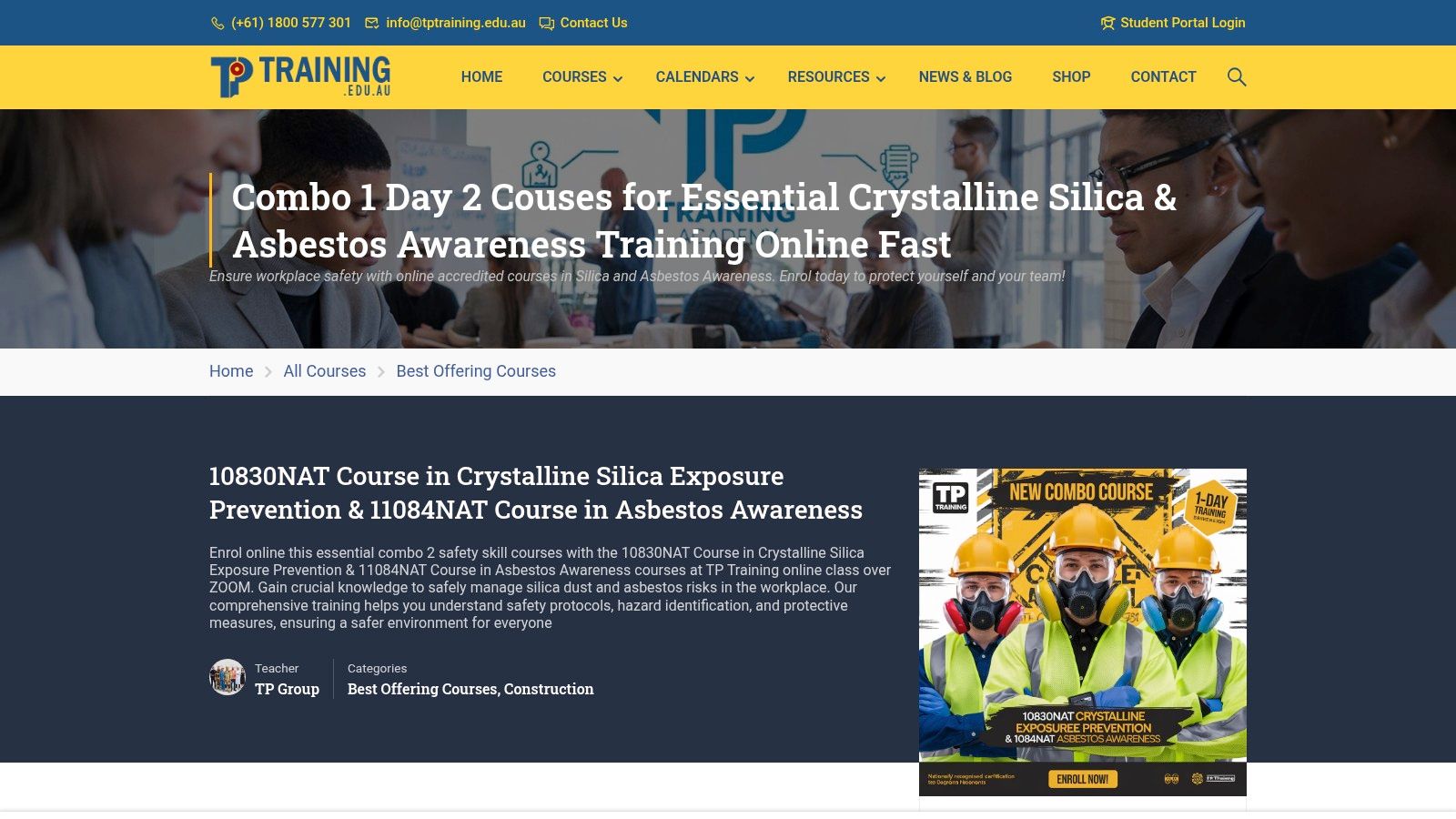
If your day involves cutting, drilling, grinding, chasing walls, demolition prep, or renovation work in older buildings, a combo pathway often solves the site problem better than asbestos awareness alone. Many workers don't face one airborne hazard in isolation. They move between asbestos risk, silica dust, and stop-work decisions in the same shift.
That's where 10830Nat 11084Nat Crystalline Silica Exposure Prevention Asbestos Awareness Combo Courses stands out as a practical training path. TP Training provides practical, nationally recognised 10830Nat 11084Nat Crystalline Silica Exposure Prevention Asbestos Awareness Combo Courses training with experienced trainers and hands-on learning across NSW.
Best fit for mixed exposure jobs
This pathway suits learners who need broader hazard recognition, not just a single-topic induction. In practice, that often includes labourers, renovators, maintenance crews, civil workers, and supervisors who need workers to understand when to stop work and escalate.
The big advantage is decision-making context. A standalone awareness module can tell a worker asbestos exists. A combined pathway is often more useful when the work itself creates multiple dust and material exposure questions across one site.
Practical rule: If your tasks can disturb old linings and also generate respirable dust from cutting or drilling, treat asbestos and silica as a combined booking decision, not two separate admin tasks.
What to compare on cost and time
Australian online asbestos awareness options sit in a low-cost range, with multiple providers advertising around $33 to $55 including GST, and a broader benchmark of $49 for 1 to 2 hours of online study, according to DLI Training's asbestos awareness online benchmark. That's useful for context, but it doesn't answer whether a combined nationally recognised option is the better workplace fit.
For Sydney employers, the useful comparison isn't only price. It's whether the course outcome matches the hazards your people face. A cheap standalone booking can still create rework if the worker then needs separate silica training or if the employer wanted nationally recognised outcomes from the start.
When reviewing a combo course page, confirm these points before you book:
- Work task match: Check whether your tasks involve renovation, demolition, cutting, chasing, drilling, or material disturbance.
- Recognition outcome: Confirm whether the training is nationally recognised and what statement or certificate applies.
- Delivery method: Ask whether any parts are online, in person, or blended.
- Assessment format: Confirm how competency is assessed and whether practical elements are included.
A useful prep step is reading TP Training's guidance on successfully completing an online crystalline silica exposure prevention course. It helps set expectations for learners who are trying to line up compliance with job-readiness rather than just chasing the shortest booking.
What doesn't work
Booking a combo course just because it sounds more thorough can be the wrong move if your employer only needs straightforward asbestos awareness for a specific role. It can also be the wrong move if the actual issue is site entry or an unrelated licence.
Workers sometimes over-correct and assume “more content” always means “better choice”. It doesn't. It means better fit only when the hazards overlap with the work you do.
2. Enroll In The 11084Nat Asbestos Awareness Training Course
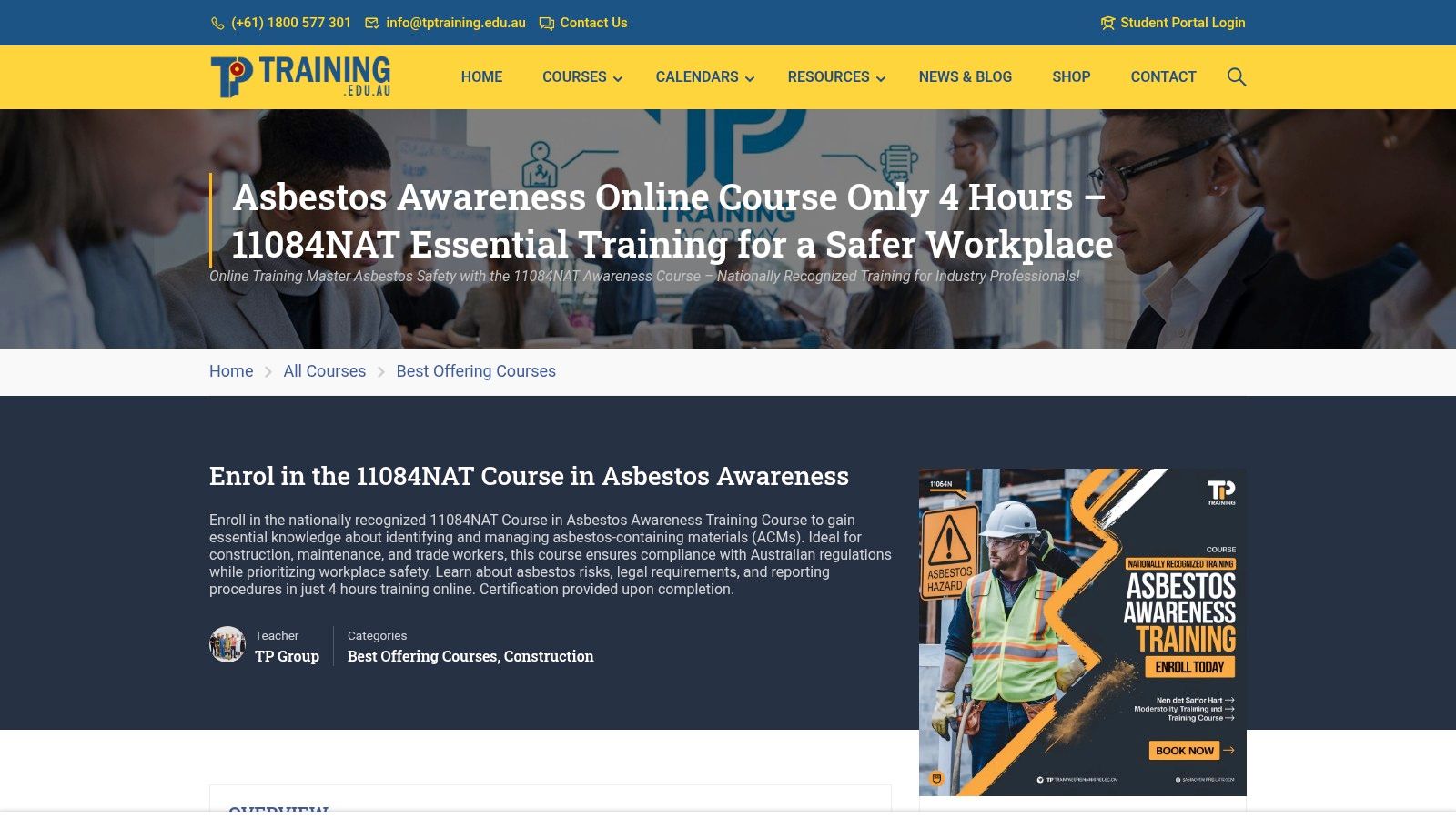
Sometimes the right answer is the direct one. If the issue is asbestos awareness itself, not a broader exposure bundle and not a plant or lifting duty, a dedicated asbestos pathway is usually easier to justify, easier to assign, and easier to explain to both workers and supervisors.
Enroll In The 11084Nat Asbestos Awareness Training Course is the clearest fit when the workplace problem is simple: your team may encounter asbestos, needs awareness and identification capability, and needs training that aligns with that risk. TP Training provides practical, nationally recognised Enroll In The 11084Nat Asbestos Awareness Training Course training with experienced trainers and hands-on learning across NSW.
Where a dedicated asbestos course makes sense
This path suits tradespeople, renovators, demolition workers, handypersons, and others who may encounter asbestos-containing materials in the course of work. SafeWork NSW states that employers have a legal obligation to provide asbestos awareness training to workers likely to encounter asbestos on the job, and that completion of its online Asbestos Awareness and Safety Course satisfies that obligation for those workers, as outlined during National Asbestos Awareness Week guidance from SafeWork NSW.
That legal point is why asbestos awareness shouldn't be treated as an optional add-on. It exists to help workers recognise risk and respond appropriately, not to authorise asbestos removal work.
A lot of confusion starts here. Workers search asbestos awareness online course cost and time as if they're shopping for a generic certificate. In reality, they should first ask whether awareness training is enough for their role, or whether they're looking for a different qualification entirely.
What to check before you book
Australian course pricing and duration vary sharply by delivery mode and accreditation level. One provider lists a fully online asbestos awareness course at $35 plus GST with a self-paced duration of about 2 hours, another lists an online course at $55 with up to 1.5 hours and access for 90 days after enrolment, while a Canberra-based RTO lists the nationally recognised 11084NAT Course in Asbestos Awareness at a full fee of $210, or a TFA-subsidised fee of $130, over a 4-hour face-to-face session, according to Nexa's asbestos awareness course overview.
That comparison is useful because it shows why “awareness course” can mean different things in practice. Some learners want the quickest online compliance option. Others need a nationally recognised training outcome and are better served by a more formal session.
Before booking, confirm:
- Assessment style: Ask whether the course includes practical discussion, observation, written assessment, or online-only components.
- Certificate outcome: Check exactly what document you receive on completion.
- Location fit: Make sure the delivery site works for your suburb and travel time.
- Employer acceptance: If an employer asked for a specific course outcome, confirm it matches before paying.
For learners who want more context first, TP Training's article on asbestos awareness training is a useful starting point.
A dedicated asbestos course works well when the hazard is specific. It's less useful when the learner actually needs site induction, first aid, or a plant-related qualification.
What many workers underestimate
General awareness in Australia is high, but practical confidence is weaker. The latest national survey found that 91% of Australians knew at least “a bit” about asbestos, yet knowledge dropped on identification and action, with about 15% saying they knew nothing about what asbestos-containing materials look like and only 30% saying they could afford professional removal, according to the National Asbestos Awareness Survey.
That gap matters. Many learners don't need more general warnings. They need clearer role-based guidance on what to look for, when to stop, and when licensed removal is required.
3. Cpccldg3001 Perform Dogging Licence Course And Training In Sydney
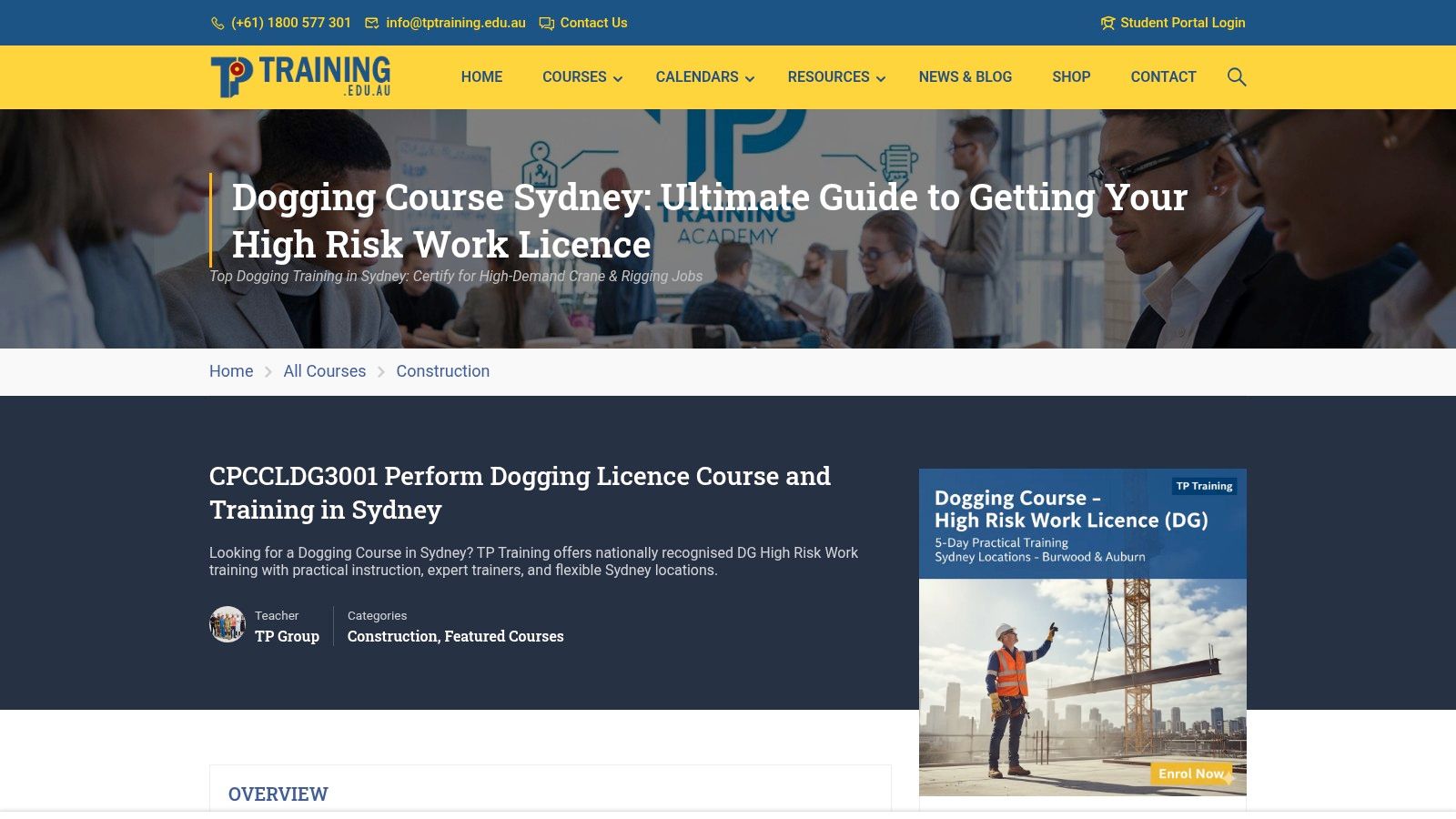
This is the comparison many workers don't make early enough. They search for a short safety course because they know they need “something for compliance”, but the job they're moving into involves slinging loads, directing crane operations, or handling lifting gear. In that case, asbestos awareness isn't the wrong topic because it lacks value. It's wrong because it solves a different workplace duty.
Cpccldg3001 Perform Dogging Licence Course And Training In Sydney belongs in this comparison because it shows how misleading “cost and time” shopping can be. TP Training provides practical, nationally recognised Cpccldg3001 Perform Dogging Licence Course And Training In Sydney training with experienced trainers and hands-on learning across NSW.
Different risk, different training logic
Dogging training is about lifting operations and load movement responsibilities. Asbestos awareness is about hazard recognition and safe response when asbestos may be present. A worker can need both across a career, but they are not substitutes for each other.
This matters on mixed sites. A rigger's assistant, for example, may still need asbestos awareness if working around refurbishment or demolition zones. But if the immediate employment requirement is dogging, asbestos awareness won't qualify for that role.
How to avoid booking the wrong course
A quick timing benchmark helps show the difference in training purpose. SafeWork NSW's online Asbestos Awareness and Safety course was described in a 2024 media release as taking 2.5 hours to complete, and the agency says it can satisfy an employer's legal obligation to provide asbestos awareness training for workers likely to encounter asbestos on the job. It was also free to the public in Australia for three months until 13 June 2024, as described on SafeWork NSW asbestos information.
That kind of short, self-directed timeframe tells you what awareness training is built for. It's an induction-style safety outcome. Dogging training serves a separate, more operational responsibility.
Use this filter before booking:
- Job offer wording: If the role mentions dogging, lifting operations, crane support, or load directing, check the licence pathway first.
- Site duties: If your duty changes the movement of suspended loads, asbestos awareness won't cover it.
- Supervisor request: If a supervisor said “get your safety ticket”, ask them to name the actual task or licence requirement.
The same practical approach applies to progression. If you're moving toward lifting and plant work, TP Training's article on how to operate a mobile crane helps frame the wider skills pathway around dogging.
“Fast” only helps if the course leads to the work you'll actually be doing next week.
Where dogging and asbestos can overlap
The overlap is site context, not training equivalence. On redevelopment, demolition-adjacent, or older industrial sites, a dogging worker may still benefit from asbestos awareness because material disturbance risks can sit alongside lifting tasks.
What doesn't work is using one course to stand in for the other. If your next job depends on lifting responsibilities, book the lifting qualification. If your work also puts you near asbestos risk, add the awareness course on its own merits.
4. Riihan309F Operating Telescopic Material Handler Gold Card Course
Equipment pathways create a different kind of confusion. A worker knows they're heading onto a busy construction or civil site, sees a short asbestos module available online, and books it because it seems like a sensible safety start. It may be sensible, but it still might not be the qualification the employer asked for.
Riihan309F Operating Telescopic Material Handler Gold Card Course sits firmly in the equipment operation lane. TP Training provides practical, nationally recognised Riihan309F Operating Telescopic Material Handler Gold Card Course training with experienced trainers and hands-on learning across NSW.
When plant training is the real requirement
If the work involves operating a telescopic material handler, the booking question is no longer just asbestos awareness online course cost and time. It becomes licence or competency relevance, machine access, site acceptance, and practical operating ability.
That's the key trade-off. Awareness training is often shorter and easier to schedule. Plant training addresses a different responsibility and can't be replaced by a hazard-awareness module.
A lot of job seekers lose time here. They collect general safety tickets but still can't step into the role because the employer needed machine-specific capability.
A better way to compare fit
Online asbestos awareness training in Australia is commonly short. Providers report typical durations of about 25 to 45 minutes, 50 minutes, 1 to 2 hours, or around 2 hours, according to JB Hunter's asbestos awareness duration benchmarks. That's useful context for awareness training, but it also explains why it should not be confused with equipment competency.
If a telehandler role is the target, ask these questions before booking anything:
- Machine access: Does the role require a telehandler outcome before site start?
- Practical training: Will you be assessed on equipment use rather than only theory?
- Work sequence: Do you need asbestos awareness as a separate site safety layer after the plant course, not instead of it?
- Employer paperwork: What exact card, statement, or evidence has the employer asked to see?
For learners looking at that pathway, TP Training's piece on telescopic materials handler training gives practical context.
One compliance detail that affects the market
Provider-side regulation also shapes what you see in course pricing and availability. WorkSafe ACT publishes approval fees for delivering the nationally recognised 11084NAT Course in Asbestos Awareness, including a one-off fee of $10,000 for RTOs delivering in the ACT only and $15,000 for delivery in the ACT plus other states and territories, along with annual audit fees of $1,000 for ACT-only providers and $2,000 for providers outside the ACT, as set out by WorkSafe ACT asbestos awareness training approvals.
That doesn't tell you what your booking will cost in Sydney. It does explain why formal, nationally recognised training sits in a different category from a simple online awareness module.
Asbestos Awareness Courses: Cost & Time Comparison
| Course | Complexity 🔄 | Resource requirements ⚡ | Expected outcomes ⭐📊 | Ideal use cases 💡 | Key advantages ⭐ |
|---|---|---|---|---|---|
| 10830Nat + 11084Nat Crystalline Silica Exposure Prevention & Asbestos Awareness Combo Courses | Moderate 🔄, combined theory + practical | Moderate ⚡, classroom time, PPE, demo setups | ⭐⭐⭐ 📊, national units; practical competency in silica prevention and asbestos awareness | Construction, demolition, renovation; supervisors and workers in silica/asbestos risk areas | Dual qualification; hands-on learning; nationally recognised |
| Enroll In The 11084Nat Asbestos Awareness Training Course | Low 🔄, awareness-focused | Low ⚡, short duration, minimal equipment | ⭐⭐ 📊, national unit; ability to identify asbestos and apply safe work practices | General workers, site inductions, refresher training | Quick completion; accessible; nationally recognised |
| CPCCLDG3001 Perform Dogging Licence Course and Training in Sydney | Moderate–High 🔄, licence-oriented practical training | High ⚡, rigging gear, crane access, trainer-to-student practical assessment | ⭐⭐⭐ 📊, statement of attainment/licence competency for dogging tasks | Crane dogging roles, rigging assistants, construction lifting operations | Licence preparation; hands-on assessments; national recognition |
| RIIHAN309F Operating Telescopic Material Handler (Gold Card) Course | High 🔄, heavy-equipment operation training | Very High ⚡, telescopic handler access, training area, experienced assessors | ⭐⭐⭐⭐ 📊, gold card; certified operator competency for telehandlers | Telehandler operators in construction, yards, warehousing needing site authorisation | Gold card certification; intensive practical training; nationally recognised |
Book the Course That Matches Your Work
The best booking decision starts with the work, not the course name. If your role involves possible contact with asbestos-containing materials, asbestos awareness may be the right fit. If your tasks also involve dust-generating activities such as cutting, drilling, or demolition prep, a combined asbestos and silica pathway may be the more useful choice.
Then confirm the current course cost and delivery time directly with TP Training. Public benchmarks show that online asbestos awareness in Australia is often short and relatively low-cost, while nationally recognised face-to-face training can sit in a different pricing and delivery bracket. That's helpful for comparison, but it's still not a substitute for checking the live course page, the booking terms, and the actual outcome you'll receive.
Location matters too. If you're based in Sydney, check which TP Training centre is the most practical for you, whether that's Penrith, Burwood, Auburn, Parramatta, or Sydney CBD. Also confirm the assessment method, any prerequisites, and whether the result is an awareness certificate, a nationally recognised statement, or a different licence-linked outcome.
Keep the course purpose clear. Dogging training and telescopic material-handler training address lifting and equipment responsibilities. They shouldn't be used in place of asbestos awareness, just as asbestos awareness shouldn't be used in place of a plant or high-risk work qualification.
The safest move is simple. Match the training to the actual task, confirm the current details before paying, and use the provider's official course information to avoid doubling up or booking the wrong pathway. If you want a broader service-business view on turning clear information into better bookings, Expressify AI's playbook for service businesses is a useful companion read.
TP Training offers practical safety and vocational courses across NSW, including asbestos awareness, silica prevention, dogging, and telehandler training through its Sydney-area centres. If you want to compare the right pathway for your role and confirm current delivery details before booking, visit TP Training.

You may also like

Telescopic Materials Handler Training Guide for NSW

First Aid Training Penrith: Courses, Costs and Booking