
CPR Certificate Online Australia: What Counts in 2026
An in-date first-aid qualification does not automatically mean your CPR is current. CPR currency runs on a shorter renewal cycle, so check the CPR requirement separately rather than relying on the date of your broader first-aid credential.
Choose training around the outcome your job requires. Where the requirement calls for nationally recognised practical assessment, select blended or face-to-face training that includes it.
The quickest certificate is not necessarily the right one. Before comparing prices, confirm whether you need standalone CPR, a broader first-aid qualification or an industry-specific outcome.
Table of Contents
- Can You Get a Valid CPR Certificate Entirely Online?
- What Employers and Regulators Actually Accept
- What a Compliant Online or Blended CPR Course Includes
- Matching the Format to Your Job and Situation
- CPR Currency and When Your Certificate Expires
- Verify the Provider and Book the Right Course
Can You Get a Valid CPR Certificate Entirely Online?
Not through e-learning alone. A knowledge-only course can provide useful education, but its completion certificate isn't equivalent to a nationally recognised CPR outcome.
The CPR unit requires performance consistent with Australian Resuscitation Council guidance. You must demonstrate that performance on resuscitation manikins under assessment, rather than only identify the correct answers in a quiz.
CPR course formats compared against the nationally recognised standard
| Format | Theory delivery | Practical CPR and AED assessment | Nationally recognised HLTAID009 outcome |
|---|---|---|---|
| Fully online (e-learning only) | Online | Not assessed in person | No |
| Blended (online theory plus in-person practical) | Online | Face-to-face, assessed by a trainer | Yes, when the RTO issues a Statement of Attainment |
| Face-to-face classroom | In person | Face-to-face, assessed by a trainer | Yes, when the RTO issues a Statement of Attainment |
The distinction is delivery versus assessment. A course can deliver its knowledge component online without removing the practical requirement. Equally, attending a classroom doesn't automatically earn the outcome: you still need to complete the assessment successfully.
Blended delivery works well when you're comfortable learning independently. You can pause the theory, revisit unfamiliar terms and prepare around shifts, then attend the practical session ready to apply what you've learned.
Face-to-face delivery suits learners who want immediate explanations or need more support connecting the emergency sequence to physical actions. It also avoids leaving all your questions until the assessment appointment.
Allow time for learning, not just attendance
Queensland's published face-to-face CPR course provides a useful planning reference, but its duration isn't a universal timetable for every provider. Pre-learning, assessment arrangements and learner support can change the time you need to set aside.
Don't compare a practical-session booking with a complete classroom course as though they contain identical amounts of learning. A shorter attendance window may assume that you've already completed online work.
Before paying: Find both the practical assessment arrangements and the promised Statement of Attainment in the course listing.
If a listing prominently advertises an instant certificate but makes the assessment difficult to find, stop and clarify the outcome. Ask whether the document confirms completion of online learning or successful assessment against the nationally recognised unit.
For most workers comfortable with independent study, blended delivery offers the best balance. It keeps the theory flexible without treating hands-on competence as optional.
What Employers and Regulators Actually Accept
Acceptance comes from the applicable sector rules and the employer's risk assessment, not from whether a provider uses the word online. A polished certificate won't resolve a mismatch between the course outcome and the worker's responsibilities.
Commonwealth Home Support Program guidance expects providers to ensure direct care and support workers receive and maintain accredited first-aid training and certification. It allows online courses to be considered when face-to-face attendance is difficult, but that flexibility shouldn't be read as permission to omit required practical assessment.
WorkSafe Western Australia takes a workplace-risk approach. First aiders should be selected and trained for the hazards they may face, hold a nationally recognised Statement of Attainment from a registered training organisation, and refresh their skills regularly.
Who sets the requirement?
The employer determines which trained people it needs, where they work and whether additional skills are necessary. A construction site with mobile plant and difficult emergency access needs a different first-aid arrangement from a small office, even where workers hold the same basic credential.
Regulated education and care services also need to follow ACECQA's approved qualification and currency requirements. A general workplace assurance that a certificate is acceptable doesn't replace the relevant care-sector checks.
The national training register entry for HLTAID009 requires practical compression and ventilation skills on adult and infant manikins, AED training-device use and appropriate protective equipment, including at least 2 minutes of uninterrupted adult CPR, equivalent to 5 cycles, and a comparable 2-minute infant demonstration.
What an employer should check
- The unit code and title: Look for HLTAID009 Provide cardiopulmonary resuscitation, rather than a generic course name.
- The issuing organisation: Check the registered training organisation's name and number, not just the booking business's branding.
- The assessment evidence: Confirm that practical assessment formed part of the completed training.
The practical assessment table below identifies the assessed elements worth matching against a course outline. For employers organising coverage, our guide to first-aid training in the workplace helps frame the wider staffing and safety questions.
For TP Training's online or blended delivery, the meaningful benchmark is a documented face-to-face practical assessment, not a certificate generated solely from e-learning. If the regulator's requirements and the employer's policy both call for hands-on competence, an online-only completion document won't satisfy them.
What a Compliant Online or Blended CPR Course Includes
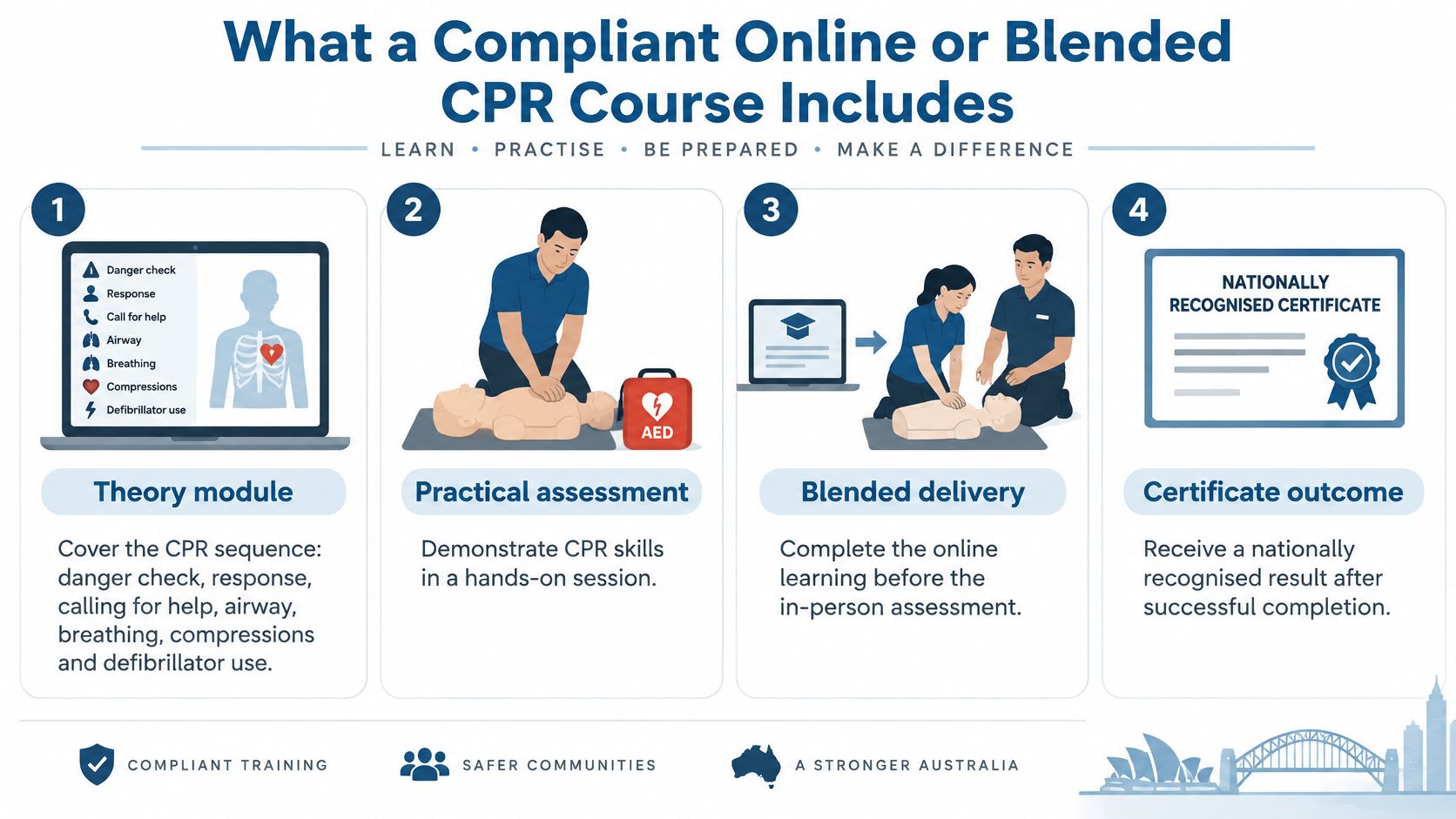
A suitable course should connect preparation, physical practice, assessment and certification. The learner should understand what happens at each stage before enrolling, especially where online work must be completed before attending.
The theory should explain the response sequence: checking danger, assessing response, calling for help, checking airway and breathing, performing compressions and ventilation, and using an automated external defibrillator. It should also address the recovery position, choking response and personal protective equipment.
Practical assessment requirements and what each one proves
These are the practical benchmarks specified in the national unit, not optional extras added to make a course appear more detailed.
| Assessment component | Benchmark in the unit | What it demonstrates |
|---|---|---|
| Adult CPR on floor manikin | At least 2 minutes uninterrupted, about 5 compression-ventilation cycles | Correct depth, rate and ventilation |
| Infant CPR on firm surface | Comparable 2-minute demonstration | Infant technique on an infant manikin |
| AED use | Shock response on an AED training device | Safe and correct device operation |
| Operator rotation | Minimal compression interruption during change-over | Team handover without losing rhythm |
| Vomiting or regurgitation response | Demonstrated response during CPR | Airway management under pressure |
| Emergency services handover and incident reporting | Handover and written or verbal report, with post-incident review | Communication with paramedics, documentation and reflection |
Adult and infant CPR are separate practical skills. An outline that mentions only an adult manikin leaves an important question unanswered, so don't assume that infant assessment is included.
Operator rotation also matters beyond the classroom. Changing rescuers while keeping interruptions minimal tests whether people can coordinate under pressure, rather than each performing well in isolation.
Handover tests a different skill: explaining what happened and what treatment was provided. Incident reporting and post-incident review then support workplace documentation and consideration of the response.
Check the outline before committing
Use the course outline as a checklist, not a marketing summary.
- Preparation: Are the online modules, completion requirements and assessment instructions clear?
- Equipment: Are adult and infant manikins, an AED training device and suitable PPE included?
- Practical access: Is the location and format of the hands-on session stated?
- Outcome: Does successful assessment lead to a nationally recognised Statement of Attainment?
Protective equipment should be something you learn to handle, not just a picture in the module. Our explanation of CPR training face shields provides context for that part of preparation.
Match every practical element against the course outline. Treat a missing element as a gap to resolve before enrolment, not a minor detail to investigate after receiving the certificate.
Matching the Format to Your Job and Situation
Choose the format around your responsibilities and learning needs. The following scenarios are examples, not assumptions about what every employer in an industry accepts.
Workers with an employment requirement
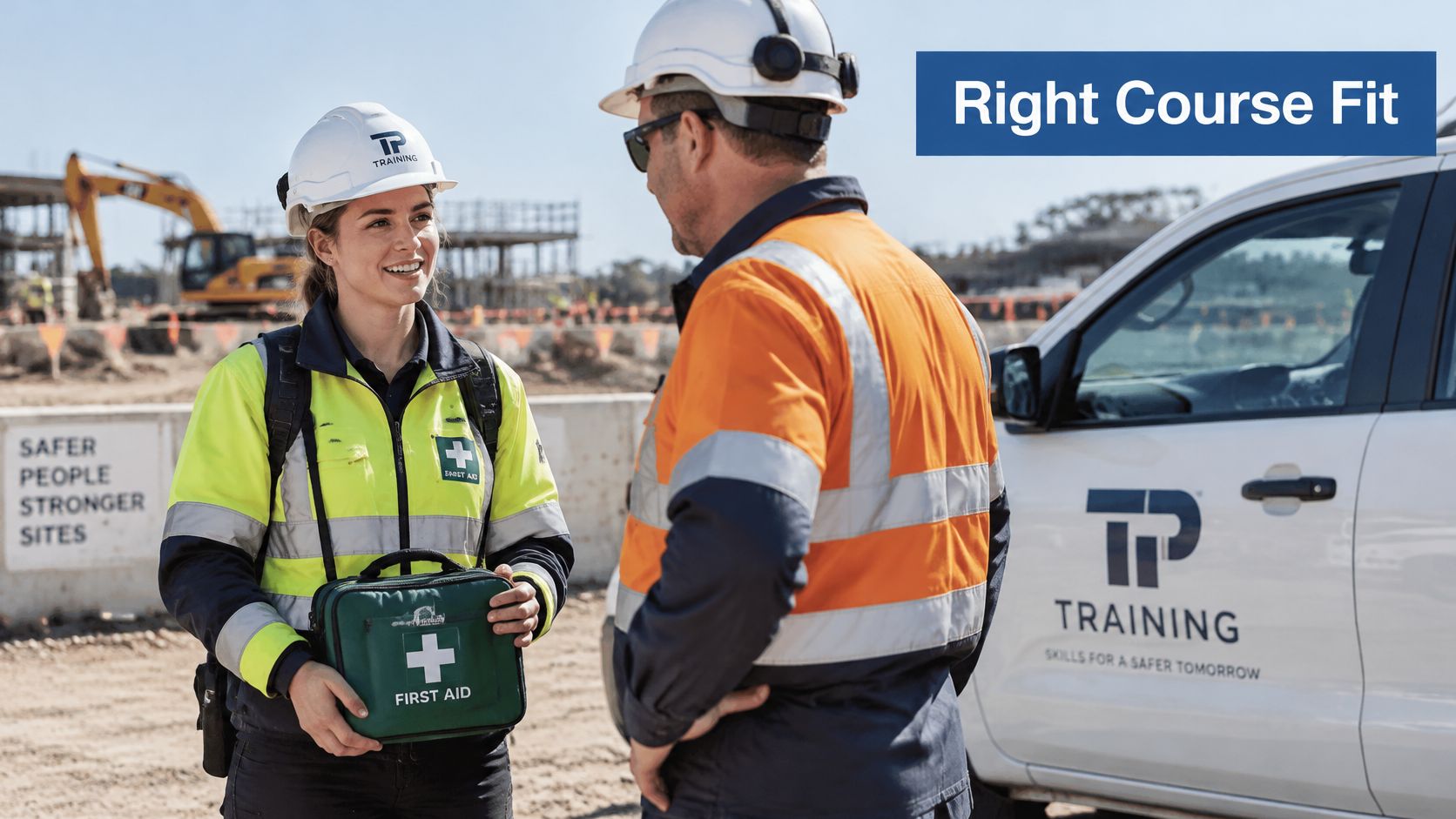
Liam, a civil construction worker, has been nominated as a site first aider. He needs to confirm whether the employer requires broader first aid as well as CPR, then choose blended or classroom training that meets that requirement. His time commitment includes the assessment, any pre-learning and travel, so booking only the attendance window into his roster isn't enough.
Aisha, a home support worker, needs accredited training appropriate to direct care. Blended learning can reduce classroom theory time, but she should secure a workable practical appointment before starting. If her duties extend into regulated education and care, she also needs to check the relevant qualification requirements; our guide to childcare first-aid training addresses that separate setting.
Ben, a warehouse worker, has an employer that accepts the relevant Statement of Attainment. Blended delivery is a sensible fit if he can complete the theory without rushing and attend a local session between shifts. A classroom course may be easier if he prefers to reserve a single block for supported learning rather than organise study at home.
Personal learning and regional access
Megan, a parent and community volunteer, wants emergency knowledge but hasn't been asked for a workplace credential. An online awareness course can introduce the sequence and terminology, with study spread around family commitments. She should describe the result as knowledge training, not nationally recognised practical CPR certification.
Noah, a regional job seeker, faces a different constraint: travel. Before enrolling, he needs the practical venue, available dates and attendance requirements confirmed, so he can allow for the whole journey rather than just the advertised session.
Choose the course you can fully complete, including preparation and practical assessment, not merely the course you can start today.
Course duration alone doesn't establish compliance. A short practical session may sit behind substantial pre-learning, while a longer classroom session may include theory and supported practice together.
The decision rule is straightforward: if a workplace, regulator or licence requires nationally recognised CPR, choose blended or face-to-face training with the required assessment. If personal knowledge is the only goal, online learning may be enough for that narrower purpose.
CPR Currency and When Your Certificate Expires
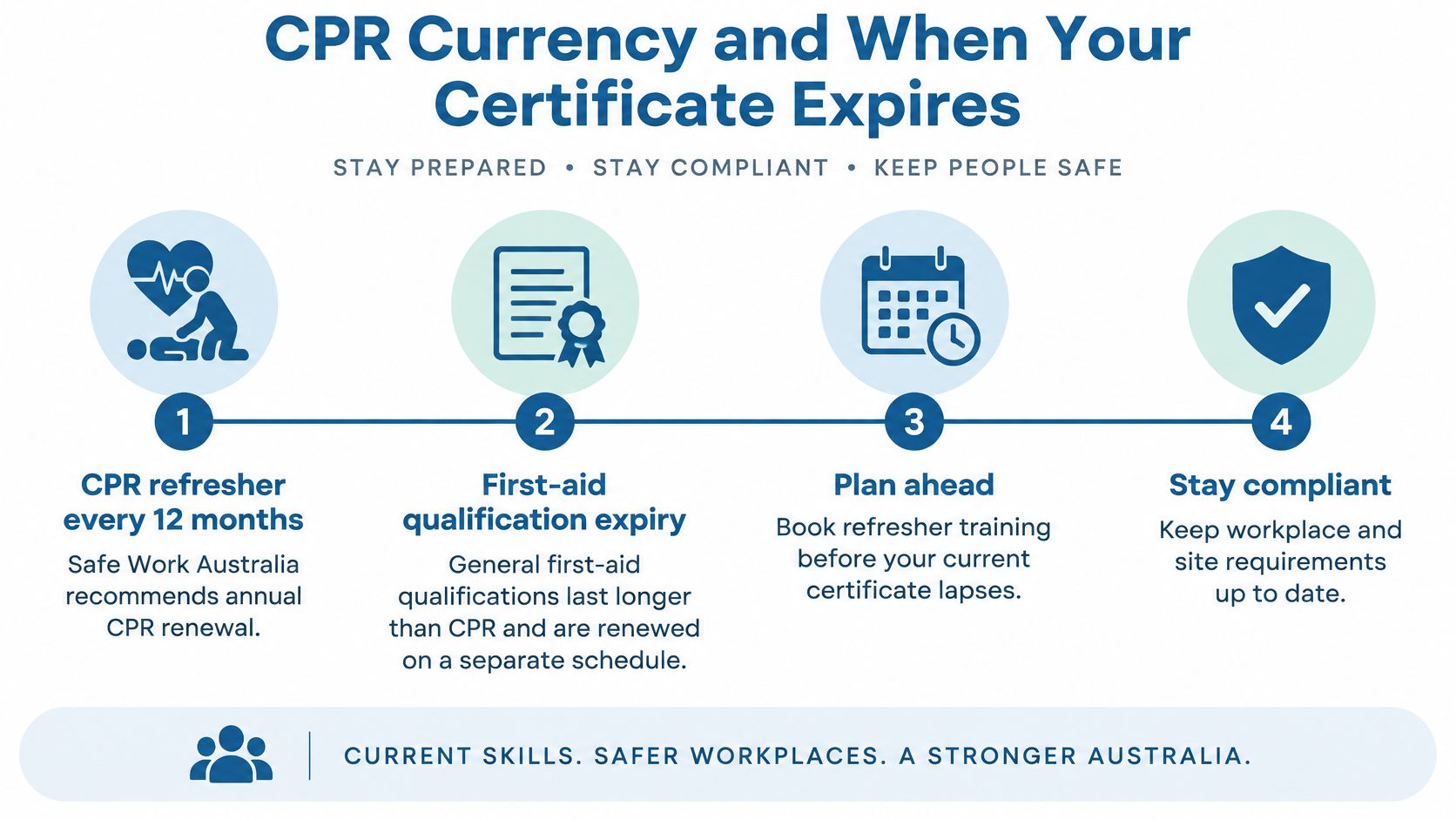
CPR currency and broader first-aid currency run on different schedules. The Safe Work Australia first-aid code of practice recommends CPR refresher training every 12 months, while general first-aid qualifications are generally renewed every 3 years.
That distinction matters more than a general assurance that your first-aid certificate is still valid. You can hold an otherwise current first-aid credential while no longer meeting your employer's current-CPR requirement.
Renewal and currency periods by credential
| Credential or requirement | Currency or renewal period | Where the rule comes from |
|---|---|---|
| CPR refresher (HLTAID009) | 12 months | Safe Work Australia first aid code of practice |
| General first-aid qualification (HLTAID011) | 3 years | Safe Work Australia first aid code of practice |
| CPR in education and care services | Completed within the previous 12 months | ACECQA |
| First-aid qualification in education and care services | Completed within the previous 3 years | ACECQA |
| Employer site policy | Shorter internal period may apply | Employer's documented first-aid policy and workplace risk assessment |
HLTAID009 is the standalone CPR unit. HLTAID011 is broader first aid. Renewing the former helps maintain CPR currency, but it doesn't replace renewal of the broader training when that becomes due.
ACECQA applies its own currency requirements to approved training in education and care. Workers in that setting should check both the approved qualification and its completion date rather than relying on a general workplace renewal reminder.
A worked renewal calendar
As a hypothetical example, a worker completes blended CPR training on 10 March 2026. Applying the annual refresher schedule, they would plan to refresh by 10 March 2027, subject to any earlier employer deadline.
That worker might also hold a broader first-aid credential completed in 2024 that remains within its usual renewal window. The earlier first-aid date doesn't extend the later CPR deadline, and the CPR refresher doesn't restart the broader first-aid schedule.
Calendar rule: Track the latest CPR completion date separately from the broader first-aid renewal date.
The document records an assessment outcome; workplace currency asks whether the training is recent enough for the role. Treating those as the same question creates an avoidable compliance gap.
Book ahead rather than waiting until the due date, retain your Statement of Attainment and any assessment record supplied, and check for shorter site requirements. Our guidance on how often CPR should be refreshed can help you organise that ongoing routine.
Verify the Provider and Book the Right Course
A suitable CPR course can still be the wrong booking if the practical session is inconvenient or the venue is unclear. Once you have confirmed the course requirements described above, check the provider's details and make sure you can attend the scheduled training.
TP Training is an ASQA-recognised provider. Its RTO number is 21488 and its ABN is 28 095 686 034. You can compare provider registration details with the national training register.
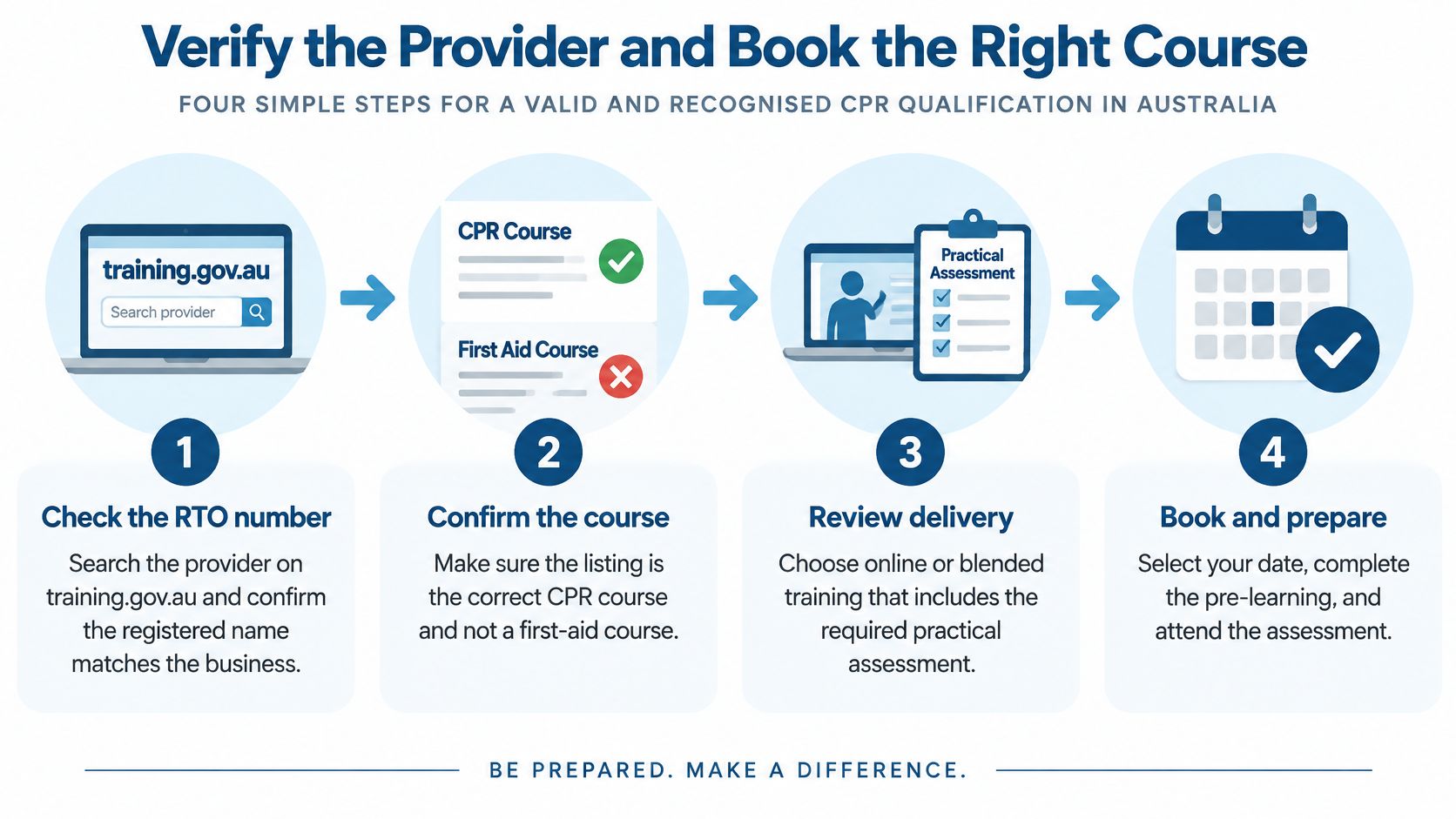
Check the booking logistics
Before paying, confirm the venue and session time attached to your chosen booking. Training locations can vary by course, so don't assume a provider runs every course at every site. Allow for travel and any time away from work.
TP Training delivers courses at locations including Penrith, Burwood, Parramatta and Sydney CBD. Its Provide Cardio Pulmonary Resuscitation Course (CPR) runs 4 hours and costs $75. Check that the listed session and venue suit your schedule.
The guide to finding CPR courses near you can help you compare nearby options. Confirm the specific appointment before arranging travel or leave.
Compare the whole booking
Compare the course duration and price alongside the practical arrangements. If you have concerns about floor-based CPR or another physical part of the assessment, ask the provider about the requirements before enrolling. An online study component does not remove practical assessment demands.
For a booking that includes online preparation, check when and how that preparation must be completed before attending the practical session. Keep the booking confirmation and any course information together so you can refer to the venue and appointment details.
Choose the format and session you can complete as scheduled. Visit TP Training to review its CPR course and check the available training arrangements.

You may also like

White Card Ballarat: Face-to-Face Course Steps for 2026
Different Classes of Fire Extinguishers: A Workplace Guide