Telescopic Materials Handler Training Guide for NSW
You're probably here because the job ad says telehandler ticket required, your supervisor has asked you to get trained, or you've turned up on site and realised this machine does a lot more than just move pallets.
On a typical NSW worksite, a telescopic materials handler might unload pallets in the morning, shift pipe or formwork after smoko, and help position materials where a standard forklift can't reach by the afternoon. That flexibility is exactly why the machine is so useful. It's also why people get confused about training and licensing. The same base machine can sit in very different legal categories depending on how it's set up and what attachment is fitted.
That's where good telescopic materials handler training matters. It helps you operate the machine safely, gives employers evidence of competency, and stops you booking the wrong course for the work you need to do.
Table of Contents
- Introduction to Telescopic Materials Handler Training in Australia
- What a Telescopic Materials Handler Is and How It Works
- Gold Card Competency and When a High Risk Work Licence Is Required
- Inside the Course Units Prerequisites and Assessment Methods
- Duration Career Outcomes and Where This Ticket Takes You
- How to Enrol for Telescopic Materials Handler Training in NSW
- Next Steps After Completing Your Telescopic Materials Handler Training
Introduction to Telescopic Materials Handler Training in Australia
It is 6:30 on a cold NSW site. A new worker is booked to unload pallets with a telehandler in the morning, then help with a different lifting task after lunch. The machine looks like one machine, one ticket, one simple course choice. In practice, that is where many people book the wrong training and lose time fixing it later.
Telescopic materials handler training in Australia is designed to stop that mistake. It teaches safe operation, but it also helps you choose the right authorisation pathway before you spend money on a course. The key point for new entrants is simple. With telehandlers, the legal pathway can change with the machine setup and the attachment fitted to the boom.
For the base operating side of the role, training is commonly built around RIIHAN309F Conduct telescopic materials handler operations, which appears on the national register at training.gov.au. That matters because employers usually want more than informal instruction from another worker on a busy shift. They want evidence that the operator has been trained and assessed against a recognised unit.
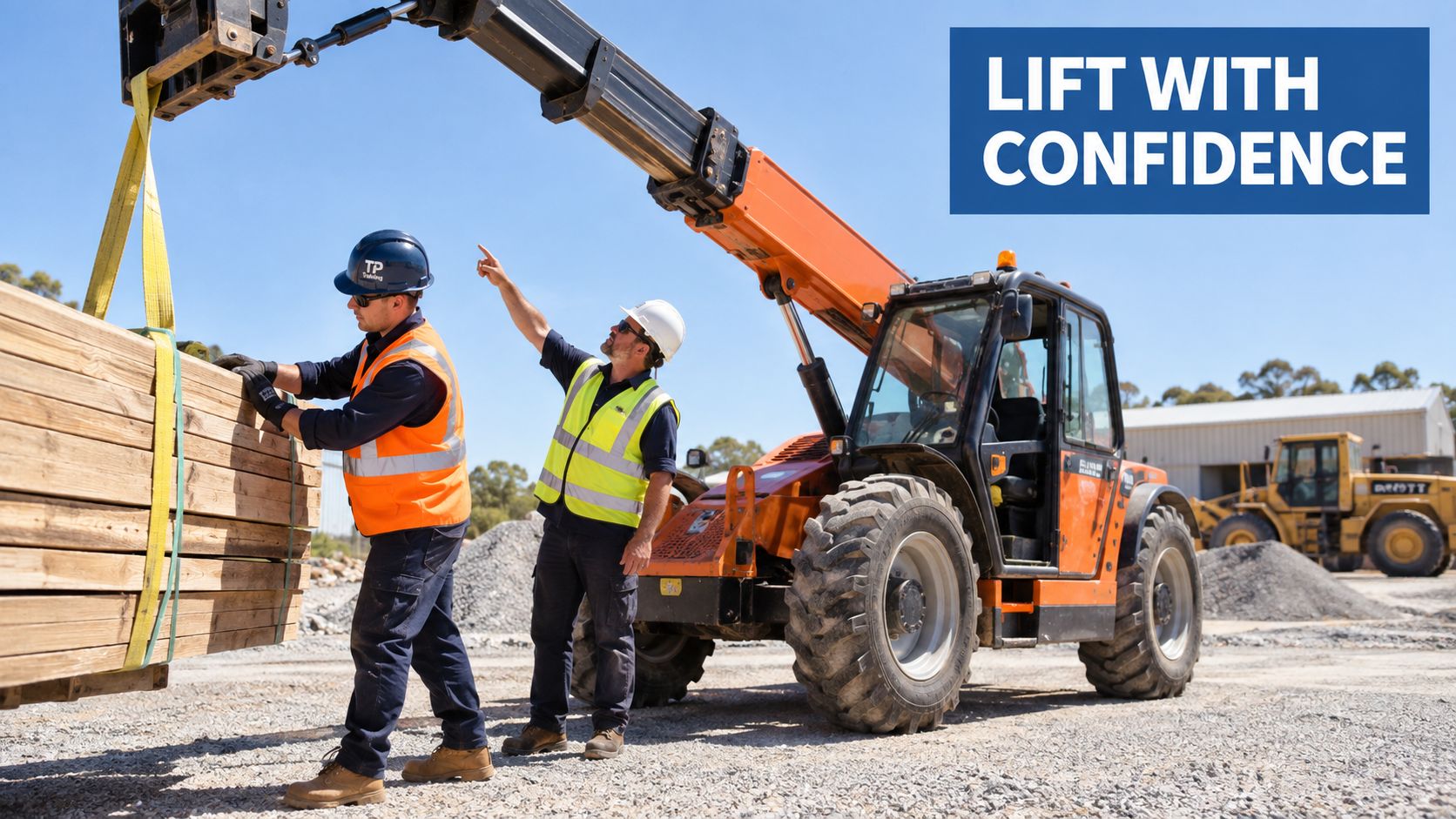
Why people seek this training
Some learners are brand new to site work. Others already work in construction, civil, warehousing, labouring, or plant support and want another competency that makes them more useful on site.
A telehandler course often suits people who want to:
- Start site-based work: It can open the door to construction, logistics, and industrial roles.
- Add a practical machine skill: Many operators build their tickets step by step across different plant types.
- Meet employer and site requirements: Businesses need proof that operators have been trained properly and can use the machine within its limits.
A good way to view telehandler training is as learning both the machine and the rules around the machine. One without the other causes problems.
What usually confuses new entrants
The first question is usually, “Do I need a Gold Card or a High Risk Work Licence?”
The short answer is that the pathway depends on the work you will do. New entrants often get stuck because they ask about the machine name only. A better question is, “How will this telehandler be configured on site, and what tasks will I be doing with it?”
That small shift in thinking saves a lot of trouble. It is the difference between buying boots for a warehouse and turning up to a muddy civil site. The machine may be the same brand and model, but the authorisation path can change with the job it is set up to perform.
What a Telescopic Materials Handler Is and How It Works
A telescopic materials handler, often called a telehandler, is a lifting machine with a boom that extends outward. The easiest way to understand it is to think of it as a machine that borrows ideas from both a forklift and a crane. It can pick up, move, raise, and place loads, but it does so with a telescoping boom rather than a fixed upright mast.
That boom is what changes the job. A standard forklift mostly works close in. A telehandler can reach forward and upward, which helps on uneven sites, around obstacles, and into places where a normal forklift can't position a load cleanly.
The basic idea in plain language
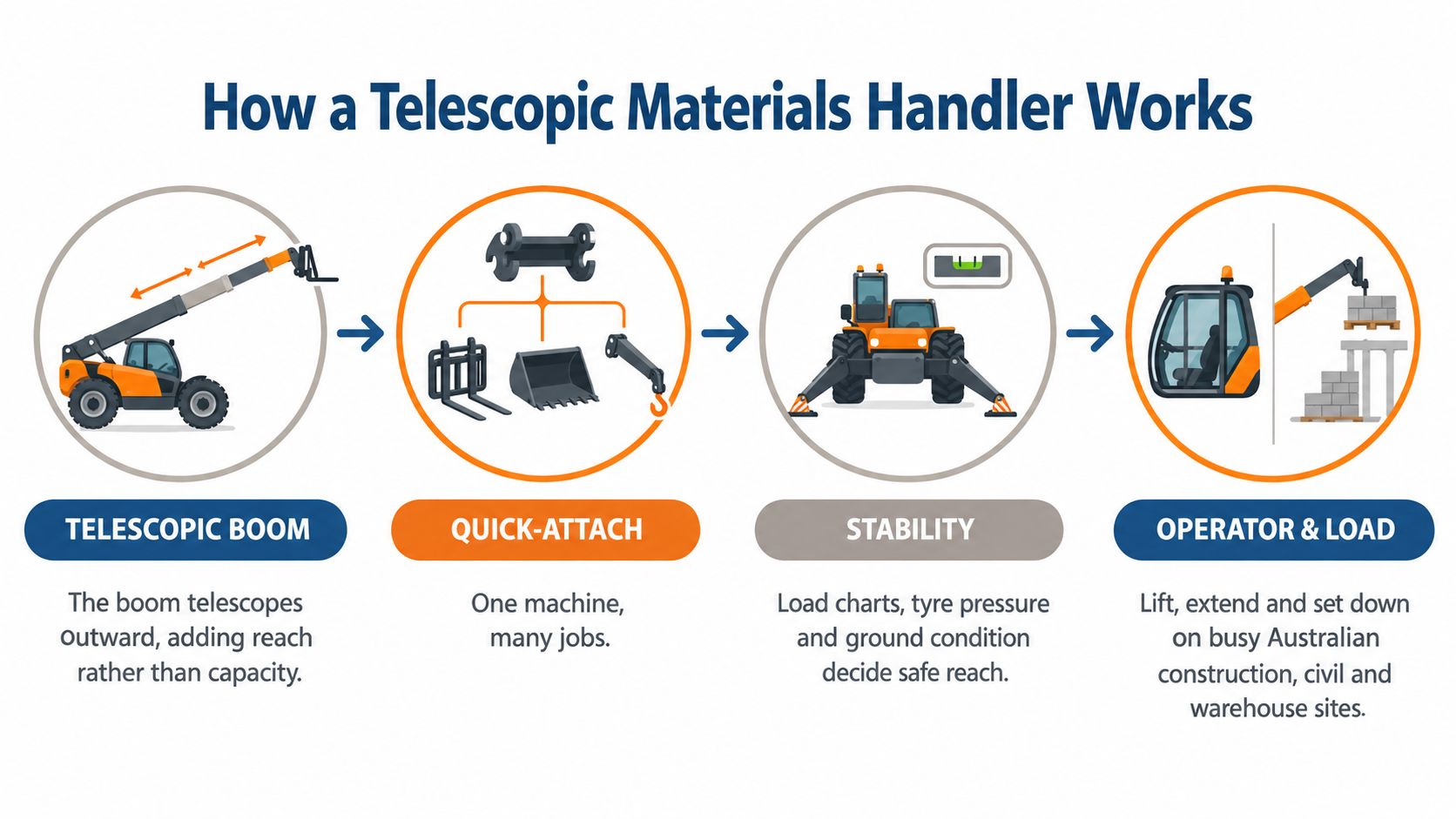
The machine does four simple things:
- Lifts a load
- Extends the boom to create reach
- Uses an attachment suited to the task
- Relies on stability and load limits to stay safe
What catches people out is the second point. When the boom extends, the machine's safe operating envelope changes. Reach doesn't mean unlimited lifting power. It means the operator has to understand load charts, machine limits, ground conditions, and the effect of attachments.
Practical rule: More reach can mean less lifting capacity. Operators need to treat extension and placement as part of the lift, not as an afterthought.
Common attachments and common jobs
On Australian worksites, telehandlers are commonly used with attachments such as forks and buckets. With forks, the machine might unload pallets of bricks, blocks, or packaged materials. With a bucket, it may move loose materials or assist with site handling tasks.
That's one reason many learners also compare telehandler work with other plant roles. Someone building broader site capability may also look at courses such as Riimpo320F Excavator Operations Course Conduct Civil Construction, which TP Training provides as practical, nationally recognised training with experienced trainers and hands-on learning across NSW.
For a simpler overview of the local licence question many people ask first, TP Training's article on telehandler licence pathways is a useful starting point.
Non-slewing and slewing explained simply
The next concept matters because it affects your legal pathway.
A non-slewing telehandler generally works without a rotating upper structure. A slewing telehandler can rotate in a way that moves it into a different risk category. To a beginner, they can look similar enough to cause confusion, but in training and licensing terms they aren't treated the same.
That's why telescopic materials handler training needs to start with machine identification, intended task, and attachment choice. If those aren't clear from day one, people often book training that doesn't match the work they'll perform.
Gold Card Competency and When a High Risk Work Licence Is Required
You book telehandler training for a job starting next month. On paper, it sounds simple. Then the site supervisor asks one question. Will you be using forks, a hook, or a work platform? That question changes the legal pathway, and it is where many new entrants take the wrong turn.
In Australia, telehandler training does not sit under one single licence outcome. The pathway depends on how the machine is configured and what attachment is fitted at the time of use. A good way to read it is this. The machine body matters, but the job it is set up to do matters just as much.
For non-slewing telehandlers doing standard materials handling work, the usual pathway is competency-based training. That may be a TSHA Gold Card or a Statement of Attainment for RIIHAN309F. For slewing telehandlers, the legal category changes because the rotating upper structure places the machine into mobile slewing crane classes. Industry guidance points to the relevant High Risk Work Licence classes such as C2, C6, C1, or C0, depending on capacity, as outlined in the TSHA telehandler licensing and training requirements guide.
Why attachments change the answer
A telehandler works a bit like a ute with different tool bodies. The base machine may be the same, but the legal expectations change when the task changes.
With forks, you are usually in the standard telehandler competency pathway. Fit a boom or jib with hook, and the machine may be treated as a crane for licensing purposes. Use a boom-type work platform, and the rules can shift again because you are no longer just moving materials.
The same Australian guidance states that if a telehandler is used as a crane with a boom or jib and hook and exceeds 3 tonnes, a CN class non-slewing mobile crane licence is required. It also states that if the machine is fitted with a boom-type work platform extending 11 metres or more, a WP High Risk Work Licence is required. For a broader explanation of how these licence classes work, TP Training's guide to the High Risk Work Licence in NSW helps place telehandler decisions in the wider compliance picture.
Telehandler configuration and required authorisation in Australia
| Machine Configuration | Example Attachment or Condition | Required Authorisation |
|---|---|---|
| Non-slewing telehandler | Forks or general materials handling setup | Competency-based pathway such as TSHA Gold Card or Statement of Attainment for RIIHAN309F |
| Slewing telehandler | Rotating telehandler used within slewing crane classes | Relevant High Risk Work Licence for the mobile slewing crane class |
| Telehandler used as a crane | Boom or jib with hook, over 3 tonnes | CN class non-slewing mobile crane licence |
| Telehandler with boom-type work platform | Platform extending 11 metres or more | WP High Risk Work Licence |
| Mixed site use | Different attachments across different tasks | Assessment depends on machine configuration, task, and state rules |
The NSW and state compliance point
The unit itself makes this clear. The descriptor for RIIHAN309F Conduct telescopic materials handler operations states that licensing, legislative, regulatory, and certification requirements vary by state and must be sourced from state jurisdictions before delivery or assessment, as shown in the official RIIHAN309F unit document.
On site, this matters in a very practical way. A worker may be competent and authorised to use a non-slewing telehandler with forks, yet still need a different licence before using the same machine with a hook or for work platform operation.
Before you enrol, confirm three things first. The machine type, the attachment, and the actual task. “Telehandler work” is too broad on its own.
Inside the Course Units Prerequisites and Assessment Methods
You arrive on a NSW site and the supervisor points to a telehandler near the laydown area. Before you even turn the key, the question is not just, "Can you drive it?" The fundamental question is whether your training matches the machine setup, the attachment fitted, and the job you are about to do.
That is why this part of the pathway matters. A telehandler course is not just about steering, lifting, and parking. It checks whether you can work through the full job safely, follow site procedures, and recognise when a different attachment changes what you are allowed to do.
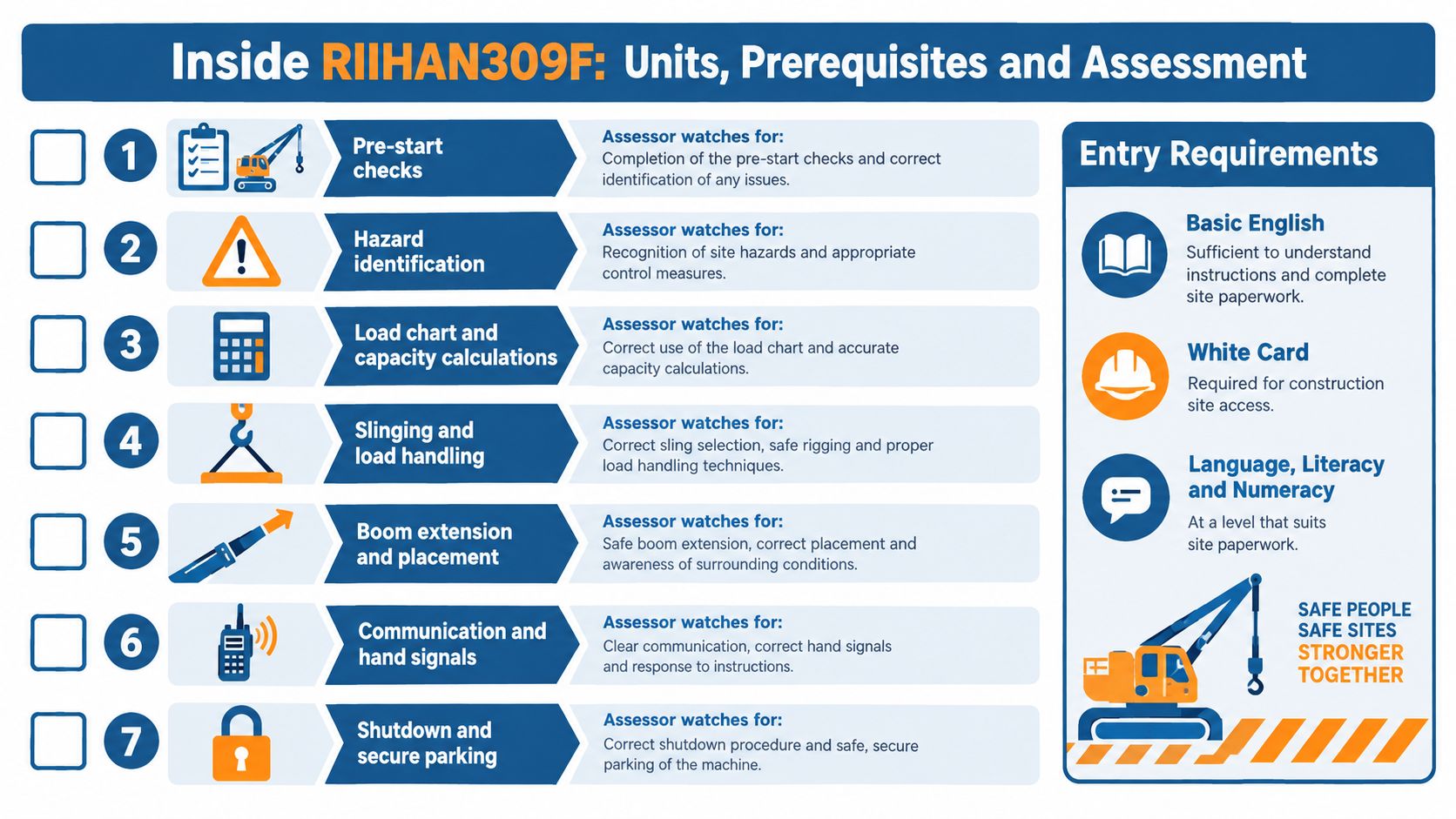
For the common non-slewing telehandler pathway with forks, the nationally recognised unit is RIIHAN309F Conduct telescopic materials handler operations. The official unit document shows that assessment must reflect state and territory requirements, workplace procedures, and practical performance across the required tasks in the unit, as set out in the RIIHAN309F unit document on training.gov.au.
What the course usually covers
A good provider teaches the operating sequence from start to finish, much like teaching someone to drive safely in traffic rather than only showing them how to start the engine.
You will usually be assessed on your ability to:
- Plan the task: read the job instructions, identify the load, confirm the travel path, and check the work area
- Inspect the machine: carry out pre-start checks, spot faults, and report anything unsafe
- Control hazards: identify problems such as soft ground, overhead obstructions, poor visibility, pedestrians, or unstable loads
- Operate the telehandler correctly: move, position, lift, place, and travel in line with site procedure and manufacturer limits
- Use the right attachment awareness: understand that forks, a hook, or a work platform can change both handling and legal requirements
- Shut down safely: park, isolate, secure, and leave the machine ready for the next step in site procedure
That attachment point often causes confusion for new entrants. The machine may look the same from the cab, but the job changes with the setup. Fork work usually follows the competency pathway for non-slewing telehandlers. Hook work or boom-type platform work can shift you into High Risk Work Licence territory, depending on the configuration and task. Good training helps you spot that difference before you accept the job.
What you may need before training day
Entry requirements are usually practical rather than academic. Providers want to know that you can follow instructions, communicate clearly, and work around mobile plant without creating extra risk.
Bring the basics your trainer asks for, including:
- Photo ID: to confirm your identity
- USI details: for nationally recognised training records
- PPE: usually boots, high-vis clothing, and other required protective gear
- Basic language, literacy and numeracy: enough to read instructions, complete forms, and understand safety information
Some sites also expect workers to hold construction induction first. If you have not done that yet, this guide on how to get a White Card is a useful starting point.
How assessment usually works
Assessment is meant to reflect real site behaviour. The assessor is not looking for speed or showmanship. They are checking whether you follow a safe sequence, make sound decisions, and stay within the machine's limits.
In practice, that often means two parts. First, a knowledge check to confirm you understand hazards, controls, load handling, and procedures. Second, a practical assessment where you inspect the telehandler, prepare for the task, operate it correctly, and complete the job without skipping steps.
A simple way to think about it is this. Anyone can move a machine a short distance. A competent operator can prepare it properly, handle the load with control, and stop the job when conditions are wrong.
Strong telehandler operators build the habit of checking the ground, the load, the attachment, and the lift path before they move.
Some learners like to review operating steps visually before practical training or toolbox talks. If that helps you, these tips for engaging training videos are useful for presenting steps in a clear order and keeping attention on the safety-critical parts of the task.
Duration Career Outcomes and Where This Ticket Takes You
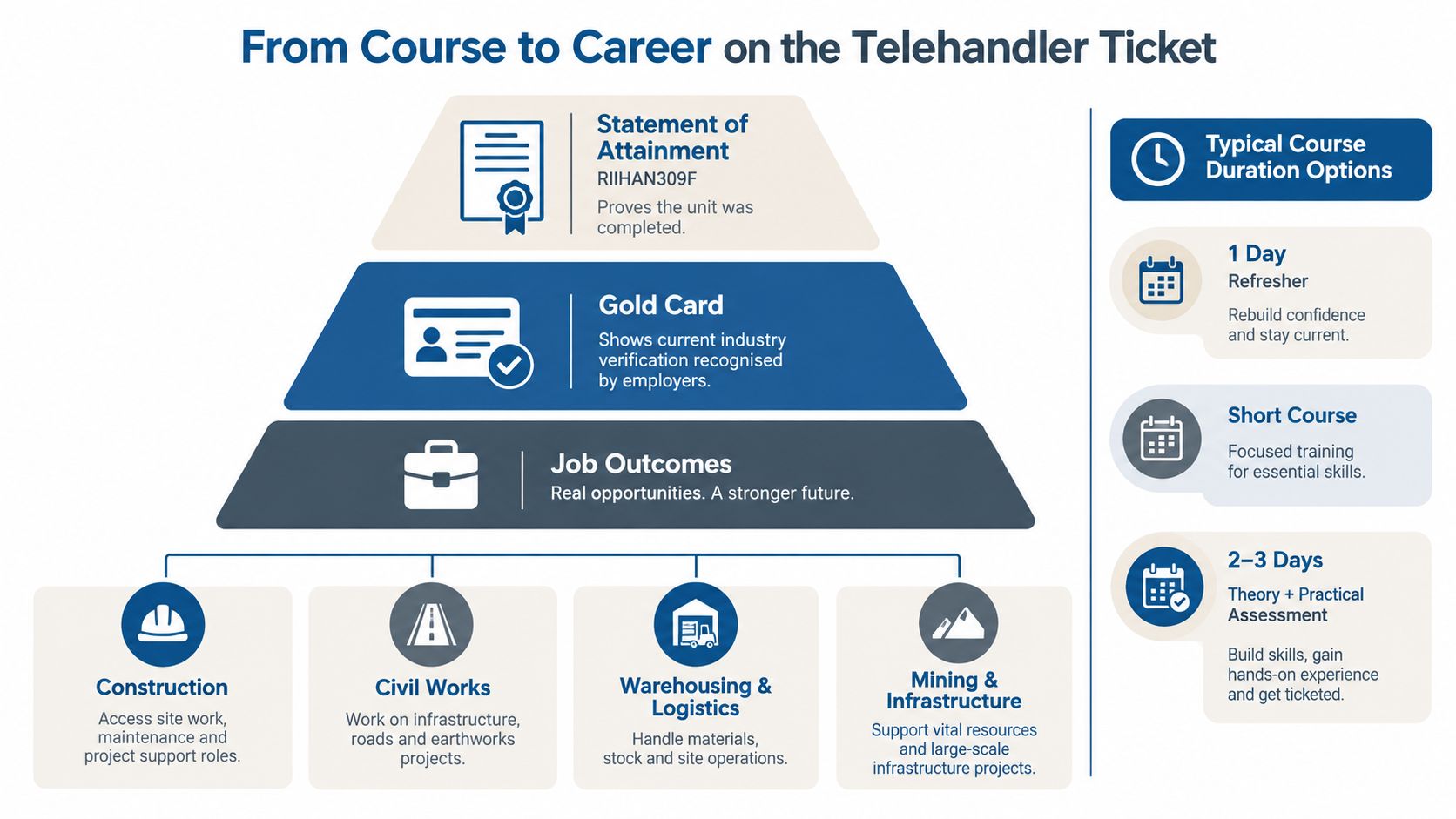
Training duration can vary by provider, learner experience, and whether the course is being delivered as a refresher or as a fuller practical and assessment program. What matters most isn't finding the shortest session. It's making sure the training matches the machine type, the work task, and the evidence required for competency.
For employers, the value of formal telehandler training is straightforward. A Statement of Attainment for RIIHAN309F shows the learner has completed the nationally recognised unit. In industry settings, the Gold Card is commonly used as the competency-based recognition pathway for non-slewing telehandler work. Those aren't interchangeable with every high risk licence class, but they are highly relevant for many common telehandler tasks.
Where telehandler skills are used
A telehandler ticket can support work across several environments:
- Construction sites: moving palletised materials, assisting with staging and placement tasks
- Civil works: supporting materials handling where rough ground or reach is involved
- Warehousing and logistics yards: handling loads where standard forklift reach may not suit the job
- Industrial workplaces: moving bulky materials in controlled site environments
Why formal training still matters when no HRWL is triggered
This is one of the most important practical points for NSW workers. SafeWork NSW says a high risk work licence is not required when a telehandler is fitted with forks or a bucket, but employers still have a duty of care to ensure workers are appropriately trained to operate it, as stated on the SafeWork NSW high risk work licence page.
That means “no licence required” never means “no training required”.
A worker using forks to unload materials might not need the extra licence pathway triggered by other attachments, but they still need proper instruction, assessment, and site authorisation. For job seekers, that formal training can make the difference between being considered site-ready and being told to come back once competency is documented.
How to Enrol for Telescopic Materials Handler Training in NSW
Enrolling is easier when you sort out the pathway before you book. Most mistakes happen when someone chooses a course name based on what they've heard on site, instead of checking the actual machine setup and task they'll perform.
Start with the job itself. Are you operating a non-slewing telehandler for materials handling, or are you moving into a configuration that changes the authorisation required? That single question usually saves the most time.
A simple enrolment checklist
Use this sequence before you lock in a date:
Check the machine type
Confirm whether the telehandler is non-slewing or slewing.Confirm the attachment and task
Forks, bucket, hook, jib, or work platform can change the training pathway.Ask the employer or site contact
Find out what evidence they expect to see before you start.Prepare your student details
You'll usually need ID, your USI, and the ability to meet the provider's entry requirements.Bring the right PPE
Wear the gear required for practical plant training.
NSW locations and practical planning
For many learners, convenience matters almost as much as course content. Training location affects travel time, punctuality, and whether you arrive ready to learn or already stressed. TP Training operates across NSW training centres including Penrith, Burwood, Auburn, Parramatta, and Sydney CBD, which helps learners choose a location that suits work and travel commitments.
If you still need to organise your student identifier, TP Training's guide to creating and managing your USI is a practical reference before booking nationally recognised training.
What to expect once you book
Training day is usually a mix of site-style instruction, safety discussion, machine familiarisation, and practical assessment activity. Arrive early, bring what the provider has requested, and don't guess if you're unsure about your pathway. Ask first.
The best enrolment decision is the one that matches your real site duties, not the one with the quickest name recognition.
Next Steps After Completing Your Telescopic Materials Handler Training
Your first day on a new site is not the time to find out your telehandler ticket does not match the machine in front of you. A telehandler with forks, a telehandler lifting with a hook, and a telehandler set up for people to work from a platform can lead to different evidence and licensing requirements. That is why your next step after training is to match your ticket to the actual job.
Start by keeping your proof of training easy to produce. Employers and principal contractors often want to see the card, statement of attainment, or licence that fits the machine setup and attachment you will use. If your work changes, check the setup again before you assume your current pathway covers it.
Telehandler training in Australia is split by configuration and task, not just by the machine name. Fork work may sit under a Gold Card style competency pathway, while lifting with a hook or carrying out access work may push you into a High Risk Work Licence pathway instead. It works like having the right key for the right lock. Similar machine, different function, different requirement.
If your role is starting to include people-working-from-platform tasks, learn how that telehandler use connects with broader work platform training pathways.
The practical rule is simple. Check the machine. Check the attachment. Check the task. Doing that first helps you avoid turning up with the wrong evidence, losing a start date, or booking training you do not need.
TP Training offers nationally recognised, practical training across NSW for people building site-ready skills, including telehandler pathways linked to real workplace use. If you want to choose the right course before you book, check your machine setup and task, then visit TP Training to find the training option and location that fit your next step.

You may also like
First Aid Training Penrith: Courses, Costs and Booking
Yellow Card Requirements in NSW: A Practical Guide