
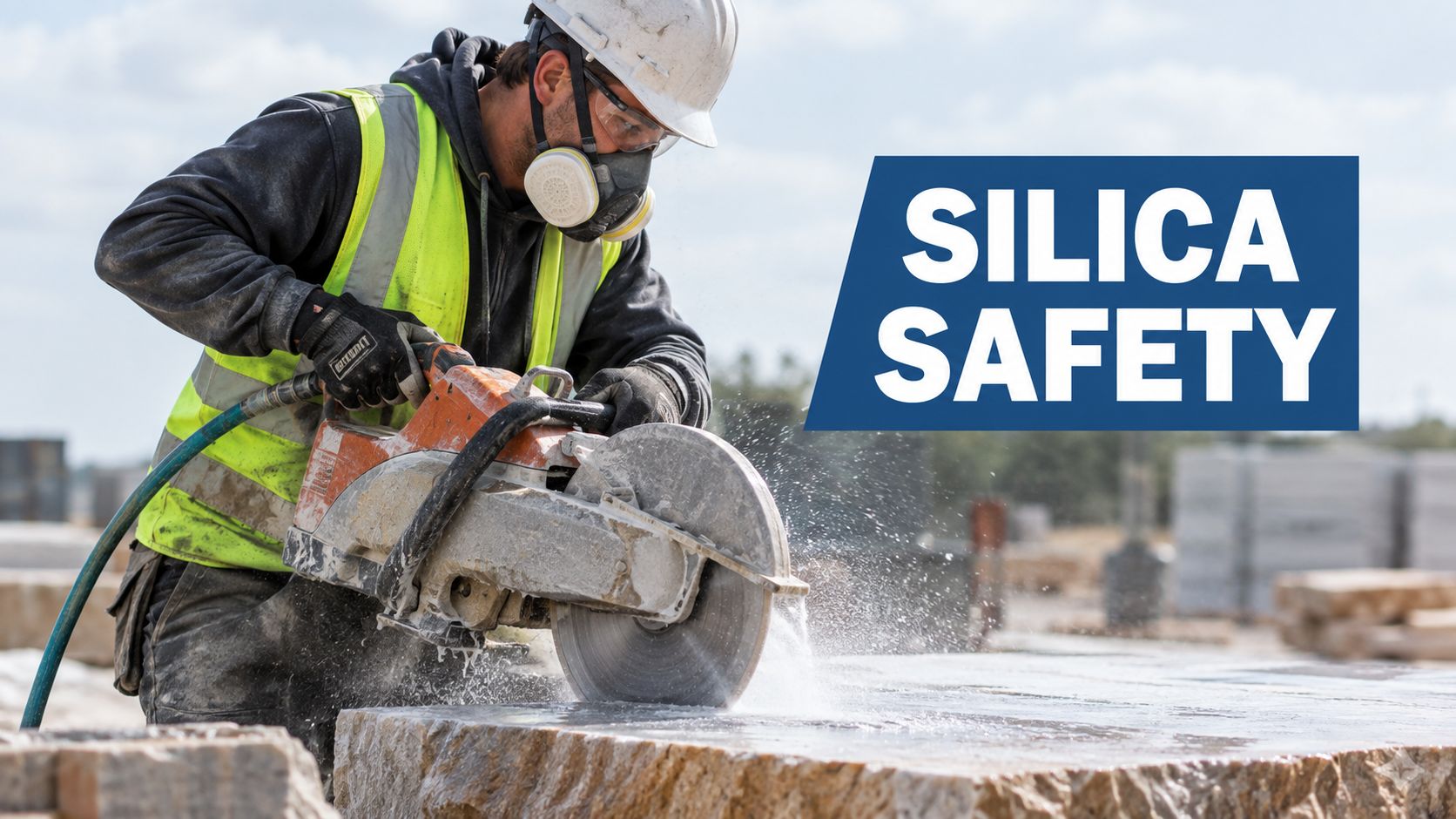
Crystalline Silica Exposure Prevention at Work: A 2026 Guide
Thursday afternoon on a Sydney civil site, the bobcat is trimming a sandstone pad and the worker behind it is dry-sweeping the spoil into a cloud that hangs in the air. That's the jobsite smell of trouble, and it's exactly where Crystalline Silica Exposure Prevention stops being theory and starts being a PCBU problem.
Silica dust doesn't need a dramatic accident to hurt people. It comes from ordinary work, especially cutting, grinding, drilling, sweeping, and moving dust around after the tool stops. In Australian construction and manufacturing, the job is to stop treating it like “just dust” and start controlling it like the serious airborne hazard it is.
Table of Contents
- Why Crystalline Silica Exposure Prevention Matters on NSW Worksites
- Applying the Hierarchy of Controls to Silica Dust
- Task-Specific Controls Beyond the Generic Checklist
- Air Monitoring, Health Monitoring and Documentation
- Training That Changes Behaviour on Site
- Preparing Your Business for the December 2026 WEL Transition
Why Crystalline Silica Exposure Prevention Matters on NSW Worksites
Silica shows up in the materials crews touch every day, including sandstone, concrete, brick, mortar, and engineered stone. The problem is the respirable fraction, the fine dust small enough to get deep into the lungs, where it can cause silicosis, lung cancer, and other long-term scarring diseases. That's why a worker standing beside a cutter or sweeper can be in the danger zone even when the dust looks light in the air.
NSW sites are not all the same
A bench-fabrication workshop, a trench through sandstone, and a closed cab on a dozer are three different exposure problems. Yet too many PCBUs still reach for the same lazy answer, a mask and a toolbox talk, then hope the dust behaves itself. It won't.
In NSW, the exposure conversation is now tied to enforcement, planning, and documented control. Safe Work Australia sets the current respirable crystalline silica exposure standard at 0.05 mg/m³ as an 8-hour time-weighted average, and says it must not be exceeded. That limit sits inside a broader duty of care structure, where the PCBU owns the hazard, not the apprentice, not the subcontractor, and not the bloke who says he's “used to dust.” The practical line is blunt, if silica work is happening on your site, your controls, paperwork, training, and supervision all have to line up.
Practical rule: if the work is dusty enough to make you pause, it's already dusty enough to require a control decision.
The other reason this matters is accountability across the chain. When subcontractors, plant operators, and labour hire crews are on the same job, the dust risk doesn't stop at a contract boundary. It travels with the task. That's why the prevention mindset has to be a hierarchy of decisions, not a single purchase of respiratory protection.
Risk management in construction is where a lot of businesses first get serious about that decision-making structure, but silica demands more than a general risk-process refresher. You need a site plan that names the task, the dust source, the control, and the person responsible for checking it works.
Applying the Hierarchy of Controls to Silica Dust
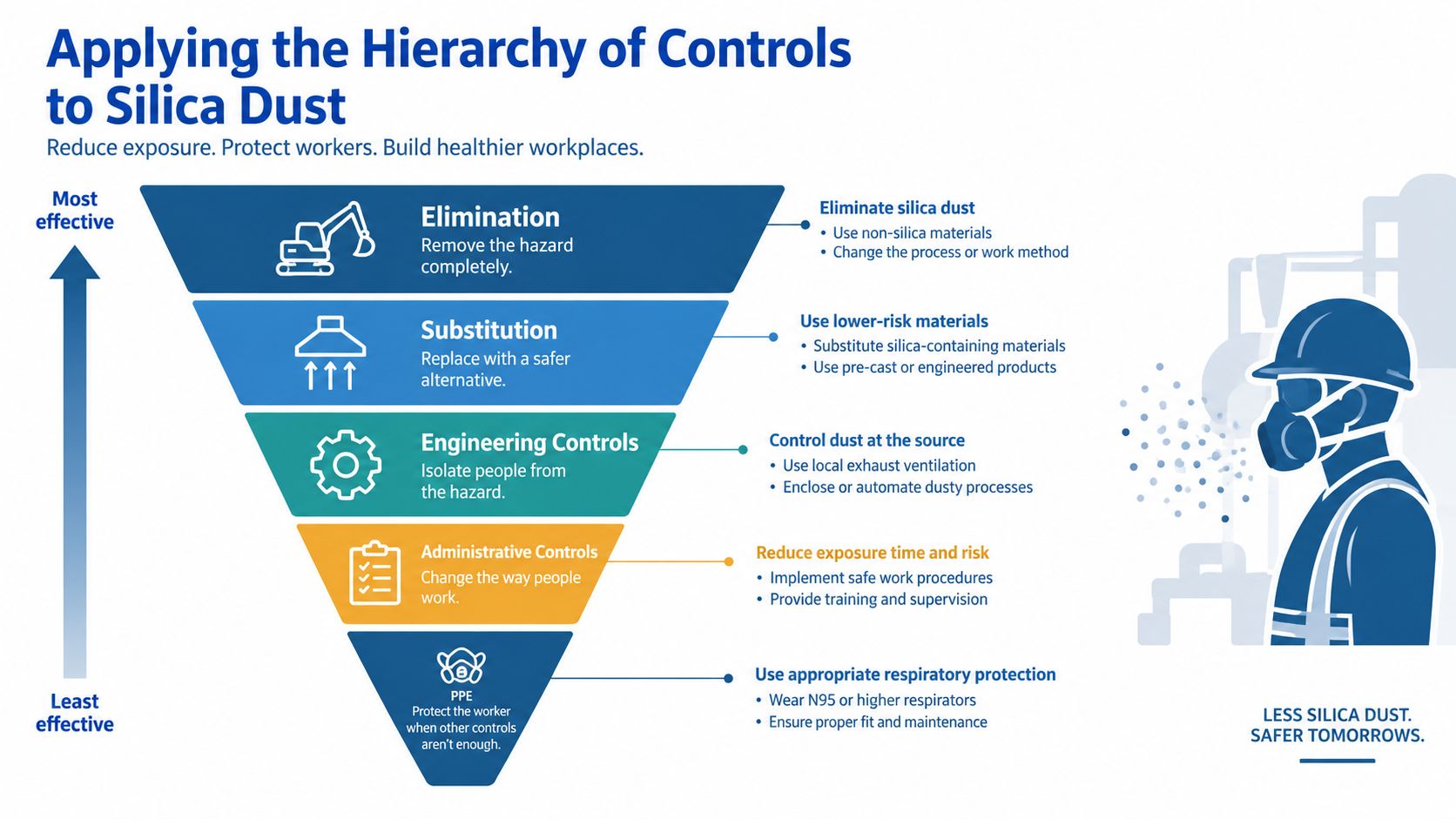
The hierarchy matters because silica control fails fast when people start at the bottom. PPE has its place, but it's the last layer, not the first. If the task can be redesigned, isolated, or captured at source, do that before you start talking about respirators.
Start with the task, not the mask
The strongest move is elimination or substitution. Use pre-cast components where that removes cutting altogether. Choose lower-silica materials where the design allows it. Swap dry cutting for wet cutting, or swap a high-dust abrasive for a less risky method. That isn't softness, it's engineering.
Isolation comes next. Put cutting in a segregated bay. Use enclosed plant cabs with filtered air, and keep the cab sealed and maintained so the operator isn't breathing what the bucket kicks up. A cab that's “usually closed” is not a control, it's wishful thinking.
Engineering controls have to do real work. Water suppression has to hit the point of contact, not just mist the area. On-tool extraction shrouds need compatible vacuums and maintained filters. Local exhaust ventilation only works if it captures dust, so measured airflow matters more than the logo on the machine.
Field reality: if the dust plume keeps outrunning the extraction, the system isn't controlling anything.
Administrative controls sit below that. Sequence dusty work away from other trades. Put up exclusion zones. Keep the area clean without re-entraining dust. Rotate only when rotation doesn't just spread exposure around like a bad joke. Then, and only then, use PPE.
The usual minimum benchmark when respirators are required is a P2 half-face respirator, and it needs proper fit-testing, correct wear, and a clean-shaven seal area. If exposures warrant it, powered air can be the better call. But no respirator rescues a broken process.
One practical note for mixed crews, the same hierarchy applies whether the task is cutting, dogging, lifting, or plant support. TP Training's Cpccldg3001 Perform Dogging Licence Course And Training In Sydney is one example of the kind of hands-on, nationally recognised training that helps crews understand how high-risk work has to be planned around the hazard, not around convenience.
Task-Specific Controls Beyond the Generic Checklist
Generic silica advice falls apart the moment the task changes. A stonemason, an excavator operator, a driller, and a tunnel crew are all dealing with silica, but they're not dealing with it in the same way. That's why controls need to be task-specific instead of recycled from a poster.
The control has to match the plume
Engineered-stone fabrication is the clearest example. Wet cutting, on-tool water feeds, H-class extraction, and the right respiratory protection tier belong in the same workflow. Dry cutting in a small shop creates a dense plume, and the worker leaning into the cut to “see the line” only makes it worse. The control fails the moment the operator shortcuts the method.
Civil earthworks and trenching through sandstone need a different answer. That means enclosed cabs with good filtration, water carts used properly, no dry sweeping, and active control of dust deposition. The operator in the cab is not safe if the filters are overdue or the door is left open all shift. The spotter on the ground is not safe if the wind keeps moving the dust across the work zone.
Rotary and percussive drilling need shrouded bits, integrated vacuum ports, and sealed operator stations where the design allows it. The dust source is small and aggressive, so capture has to happen at the tool. If the worker has to keep clearing the hole by hand or blowing it out, the control has already failed.
Tunnel and confined-space work is different again. Forced ventilation with filtration, continuous monitoring, and supplied-air respiratory protection may be needed depending on the conditions. In confined work, dust doesn't get to wander off-site, it hangs around and keeps cycling through the space.
Watch the failure mode, not just the control name. A cab, a vacuum, or a respirator means nothing if the operator keeps working in the plume, the filter never gets changed, or housekeeping slips back to dry sweeping after rain.
| Task | Primary control | Secondary control | PPE minimum | Common failure |
|---|---|---|---|---|
| Engineered-stone benchtop fabrication | Wet cutting or substitution | H-class extraction and segregated cutting area | P2 respirator at minimum where required | Dry cutting and leaning into the cut |
| Civil earthworks and trenching through sandstone | Enclosed cab with filtered air | Water carts and exclusion zones | P2 respirator when exposure can't be otherwise controlled | Cab filters not maintained |
| Rotary and percussive drilling | Shrouded bits with vacuum capture | Work sequencing and housekeeping | P2 respirator at minimum where required | Dust blown out by hand or compressed air |
| Tunnel or confined-space work | Forced ventilation with filtration | Continuous monitoring and access control | Supplied-air RPE where warranted | Ventilation running but not reaching the workface |
A useful comparison point outside construction is the idea behind a powder containment hood for labs, which exists for the same reason silica controls do, to stop the source from escaping into the breathing zone. The setting is different, but the logic is identical, contain the dust where it's created.
Air Monitoring, Health Monitoring and Documentation
If you cannot show what you measured, when you measured it, and what changed after the result, you do not have a silica program. You have a hope-based system. That is the wrong approach, especially with the 1 December 2026 workplace exposure limit transition coming up in NSW.
Monitor first, then prove the control works
Start air monitoring when the task is high risk, the exposure is unclear, or you need to verify the controls. That includes engineered-stone cutting, tunnelling, abrasive blasting, and other jobs where dust levels can climb and drop across the shift. Personal sampling shows what the worker breathed, which is what matters for compliance. Static sampling can show what is happening in the area, but it does not replace personal exposure data.
Queensland's code is useful because it states the practical trigger clearly. If the PCBU is not certain on reasonable grounds that the exposure standard has been exceeded, air monitoring must be carried out. Safe Work Australia's guidance also makes it clear that 0.05 mg/m³ is the current limit. Treat an unclear result as a control problem, not a paperwork problem.
Health monitoring sits beside exposure monitoring for workers at risk. The registered medical practitioner is part of the process, not a box to tick at the end. Respiratory questionnaires and imaging such as low-dose high-resolution CT scans may be used in the health-monitoring process for exposed workers, depending on the risk profile and medical oversight.
Documentation has to stay live. Keep SWMS, exposure registers, fit-test records, respirator issue logs, plant maintenance records, and incident reports together in one system the supervisor can use. If a site inspector asks for evidence, “I think someone filed that last month” is not an answer.
Keep the records close to the work. If the foreman cannot see the monitoring history, the maintenance status, and the current SWMS in one sitting, the system is too clumsy to rely on.
| Record Type | Trigger / Frequency | Owner | Retention |
|---|---|---|---|
| SWMS | Before high-risk silica work starts, and when the task changes | Site supervisor | Keep current version on site |
| Air monitoring report | When exposure is uncertain or verification is needed | PCBU / hygienist | Retain with exposure records |
| Health monitoring file | For workers exposed to RCS at risk of harm | PCBU with medical practitioner | Retain as part of health-monitoring record |
| Fit-test record | Before respirator use and then at scheduled review points | Supervisor / safety lead | Keep current and auditable |
| PPE issue log | On issue, replacement, or change of respirator type | Stores or site admin | Keep with PPE records |
| Plant maintenance log | According to service schedule and after defects | Plant manager | Keep in plant file |
| Incident and exceedance report | After failure, exceedance, or near miss | Supervisor and PCBU | Retain for trend review |
Asbestos awareness training is a useful reminder that dust hazards are not only about the material. They are about the discipline of record-keeping, monitoring, and follow-up that stops the same mistake repeating. Silica deserves that same administrative seriousness.
Training That Changes Behaviour on Site
Induction-style silica briefings fail because they teach the hazard, not the task. A worker can leave a meeting knowing silica is harmful and still walk straight into a dust plume, because nobody showed them what good control looks like at the grinder, the saw, the cab, or the cleanup point.
Teach the task, not just the disease name
An effective silica session names the diseases plainly, silicosis, COPD, and lung cancer, then moves straight to what the crew does differently on Monday. Choose the control for the task, check the respirator seal every time, and use wet sweeping or H-class vacuums instead of dry brushing or compressed air. If the trainer skips the cleanup method, half the exposure picture is missing.
Supervisors need a harder version of the same content. Leading hands and foremen are often where silica control succeeds or falls apart, because they decide whether the method stays wet, whether the exclusion zone stays closed, and whether a shortcut gets challenged. A supervisor who cannot correct bad dust habits is part of the failure.
Training also has to fit the crew. Short toolbox talks work when they are under five minutes and tied to the actual job in front of the team. Demonstrations with the tool beat generic slides every time. If the crew is culturally diverse, deliver in the language that lands, because confusion on respirator use is not a language-neutral risk.
Crew action matters as well. Workers need to know they can stop and escalate unsafe silica work. If the cab filter is blown out, the water feed has failed, or the cleanup method has slipped back to dry sweeping, the job is wrong. It does not become acceptable because the pressure is on.
TP Training's crystalline silica course is one practical option for NSW PCBUs who want a structured approach rather than another poster on a lunchroom wall. Pair that with an online animated video maker only if it supports real-world demonstration, not if it replaces it.
Preparing Your Business for the December 2026 WEL Transition
The 1 December 2026 transition matters because the current 0.05 mg/m³ exposure standard will become the legally binding workplace exposure limit, and businesses that leave preparation until late will get crushed by the admin and the site changes at the same time. Small and medium NSW employers need a 90-day plan, not a vague intention.
Days 1 to 30, find every dusty task
Start with a complete silica task inventory across all sites. Name the activities that create the problem, engineered-stone fabrication, concrete cutting, drilling, abrasive blasting, excavation in silica-bearing rock, trenching, and plant work in dusty ground. Then benchmark your current controls against the exposure limit and write down where the gaps are.
Assign one owner per site to the list. The site supervisor should know which task is high risk, the plant manager should know which cab or vacuum needs attention, and the PCBU should know which subcontractors are bringing their own exposure problems onto the job.
Days 31 to 60, verify the controls
Commission baseline air monitoring for the priority tasks. Revise the SWMS so the controls are task-specific, not generic. Upgrade dust extraction, replace worn respiratory gear, and book health monitoring for exposed workers who need it.
This is also where the common failures get fixed. Plant cabins without filtered air need maintenance or replacement. Uncontrolled jackhammer work needs source capture or a different method. Dry sweeping has to stop, even when the site is under pressure and someone thinks it's “just for a minute.”
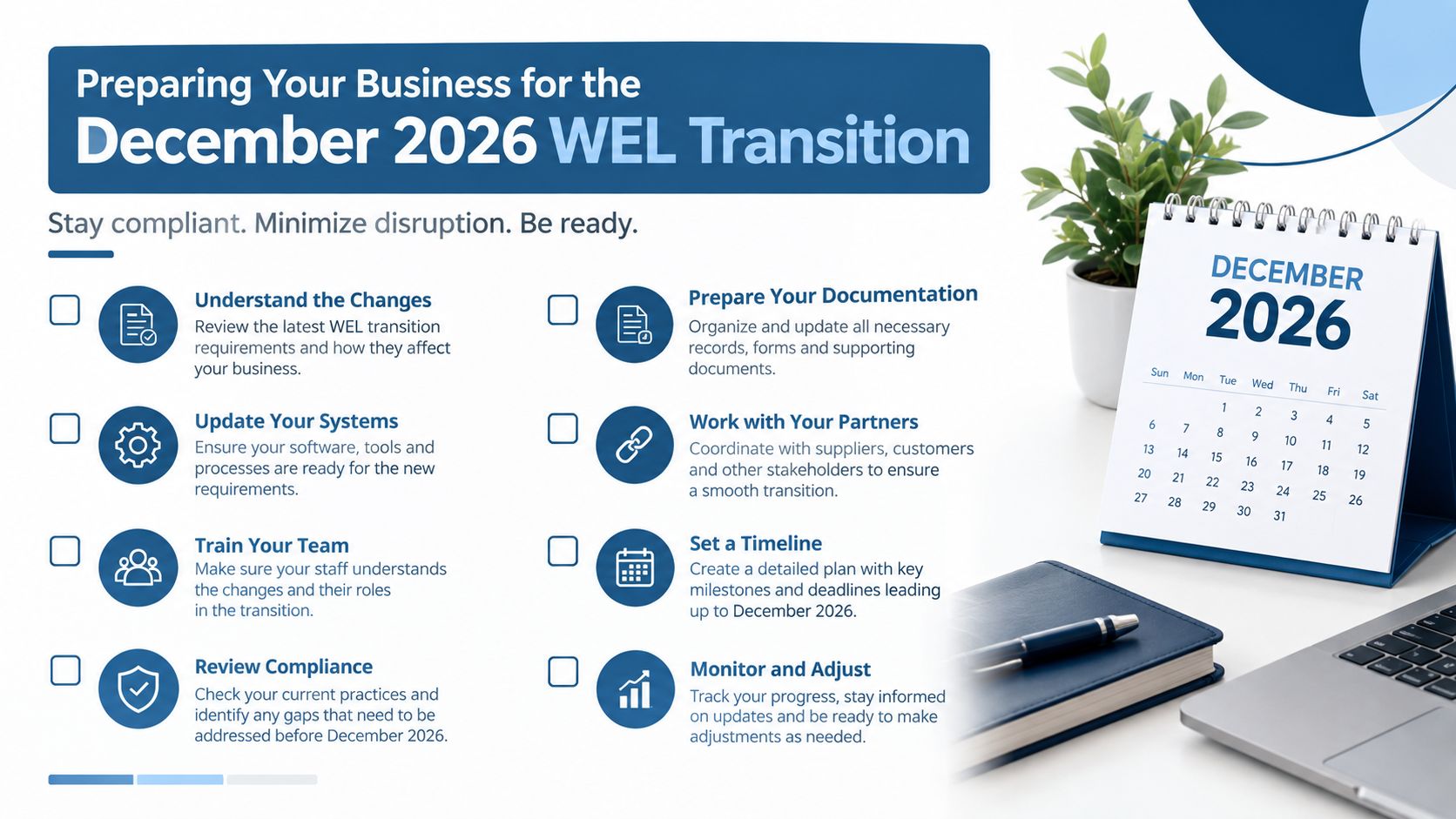
Days 61 to 90, lock in the behaviour
Deliver task-specific silica training and document the attendance. Run a fit-test program and keep the records where supervisors can see them. Build supervisor coaching into weekly site routines so bad habits are corrected before they become normal.
Contractor compliance has to be written into procurement, not negotiated on the gate. If the subcontractor can't show the control method, the monitoring evidence, or the respirator arrangement, they're not ready for the job. That's the standard.
Introducing the 10830NAT crystalline silica and 11084NAT asbestos awareness courses at TP Training is relevant because businesses need training that supports the control program, not training that sits apart from it. Keep an eye on 2027 updates too, because the policy environment is still moving and any fresh guidance will likely sharpen the same message, measure properly, control at source, and document everything you do.
If your site is still relying on “wear a mask” as the main silica control, fix that now. Book practical silica awareness training, review your SWMS and monitoring records, and get your supervisors on the same page before the December 2026 change tightens the screws. Visit TP Training to line up training that connects the hazard to the actual work your crews do every day.